
Today’s Cinema Adventure was originally published in
Eliza Hittman’s “Beach Rats” is unquestionably a potent piece of filmmaking.
After a glowing debut at Sundance early this year, it has claimed awards at numerous film festivals, including the prize for Outstanding Screenwriting in a U.S. Feature at Los Angeles’ own Outfest. Now receiving wider release in movie theaters across the country, it continues to garner impressive reviews as it cements its status as the latest darling of indie LGBT cinema.
It’s also at the center of a blooming controversy which threatens to undermine that status.
A gritty, slice-of life drama, the movie documents a fateful summer in the life of Frankie, a closeted South Brooklyn teen who finds escape from his joyless life through anonymous online hookups with older guys he meets online. As the narrative follows his efforts to mask his secret by posturing with hooligan friends and pursuing a romance with a neighborhood girl, it creates an astute portrait of internalized homophobia and the cultural pressure that breeds it.
The critical acclaim is not unwarranted.
Anchored by a breathtaking performance from the beautiful Harris Dickinson (an English actor, though you would never know it from his flawless depiction of a young Brooklyn “bro”), Hittman’s movie is sexy, haunting, and impressionistic. It flows through a series of incidents and encounters with dreamlike detachment; its 16mm cinematography (by Hélène Louvart) creates a sense of disjointed aimlessness with hand-held camerawork, and oppresses our senses with the frequent use of extreme close-ups. The overall effect is to keep us as completely “in the moment” as the film’s protagonist as he floats blithely along towards the inevitable collision of his two worlds.
It doesn’t all work as well as Hittman wants it to. There are stretches when the movie’s meandering pace feels like a test of patience; its narrative is occasionally obscured by its impressionistic visual style; and one has to wonder why, in a film about a young man coming to terms with his homosexuality, so much more screen time is devoted to his relationship with a would-be girlfriend than it is to his encounters with other males (no offense to the lovely Madeline Weinstein, who gives a luminous performance as the girl in question).
Ultimately, though, “Beach Rats” wields a cumulative power that grows out of its scattered moments of truth, leaving us with a clear picture of a young man disconnected from his sense of self by his own determination to be what he thinks the world expects him to be. Frankie’s compartmentalization of his sexual identity is less about shame than it is about living up to a role in which he sees himself cast by his community. It’s okay for him to have sex with men, as long as he keeps it separate from his “real life.” Thanks to Ellis’ subtly illuminating performance, it’s clear that his most truthful and authentic self comes to the surface when he is with his clandestine “tricks” – which makes it all the more devastating to watch him betray that self through the actions he takes to hide it.
The film’s insightful observations about such homophobic rationalization- made all the more impressive by the fact that “Beach Rats” is written and directed by a straight woman – are well worth the sometimes slow and rocky journey it takes to reach them, and would normally be reason enough to give it a hearty endorsement.
Unfortunately, ethical questions about the source of its content make such an endorsement problematic.
Though Hittman has stated in numerous interviews that her screenplay for “Beach Rats” was influenced solely by her own memories of growing up in the Brooklyn neighborhood depicted in the film, the circumstances leading up to the story’s climax are suspiciously close to those of a real-life incident.
In 2006, a black gay man named Michael Sandy arranged a meeting online with a teen named John Fox. When he arrived, he saw four young men instead of only one and decided to leave; soon afterward, however, he contacted Fox again and arranged to meet him alone for sex. Lured to Plumb Beach, a remote location off the Belt Parkway near Brooklyn, he was ambushed by Fox and three of his friends – Anthony Fortunato, Ilya Shurov, and Gary Timmins – who planned to steal the marijuana he had promised to bring along. Sandy fled onto the Parkway, pursued by Fox and Shurov. The latter shoved him into the path of a moving vehicle, which struck and killed him. All four teens were later convicted of manslaughter as a hate crime.
The events which transpire in Hittman’s movie do not play out exactly the same way; there is no overt depiction of a killing, although the outcome is deliberately ambiguous. Nevertheless, the specifics leading up to them – along with numerous other factual parallels that are woven into the film’s entire structure – are so similar to the highly publicized case as to raise the eyebrows of New Yorkers who remember it.
The climactic scene was even filmed, in part, at the same location where the real-life incident took place.
One detail which is glaringly different, however, is the fact that Michael Sandy’s equivalent character in “Beach Rat” is a white man. It is this factor that has drawn the most objection, particularly in light of a cultural climate in which acute awareness has developed to the “whitewashing” of the stories told in our popular entertainment and the subject of race in general.
For her part, Eliza Hittman has repeatedly insisted that her film was drawn from her own experience and observations; when pressed by a reporter from New York’s Gay City News at an August 27 Lincoln Center screening of “Beach Rats,” she refused to answer questions about the issue – though she clarified in a written statement two days later that she was familiar with the Sandy case (while still maintaining she had not intended to depict it in her film).
It’s not uncommon for a filmmaker to draw inspiration from factual events, of course, nor is it unusual for them to change the details to suit the needs of their story.
To do so invites ethical debate about the responsibility of an artist to truth, and opens the door to controversies which may deflect attention from the work itself; but such conversation in itself can often be a pathway to wider awareness, and allows for the airing of grievances from affected parties.
To deny having done so shuts down that discourse; it casts a shadow over the film in question, tainting its integrity no matter the quality of the work or the nobility of the intentions behind it. It also begs the question of “why?”
For the moment, at least, Hittman is steadfast in her denial. Whether or not we can take her at her word is a matter of personal choice.


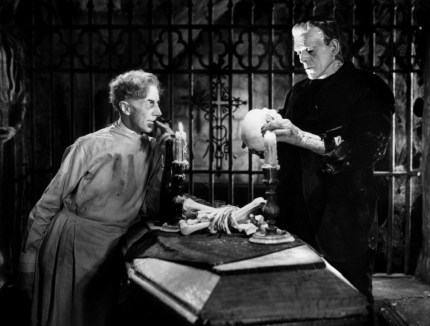
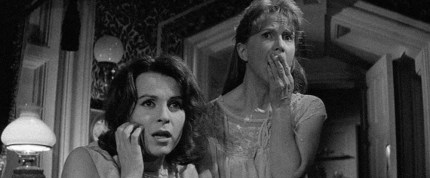 “The Haunting” (1963) – Even if seems tame by today’s standards, director Robert Wise’s adaptation of a short novel by Shirley Jackson is still renowned for the way it uses mood, atmosphere, and suggestion to generate chills. More to the point for LGBTQ audiences is the presence of Claire Bloom as an openly lesbian character (Claire Bloom), whose sympathetic portrayal is devoid of the dark, predatory overtones that go hand-in-hand with such characters in other pre-Stonewall films. For those with a taste for brainy, psychological horror movies, this one is essential viewing.
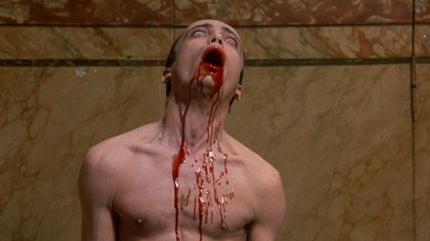 “Blood for Dracula” AKA “Andy Warhol’s Dracula” (1974) – Although there is nothing explicitly queer about the plot of this cheaply-produced French-Italian opus, the influence of director Paul Morrissey and the presence of quintessential “trade” pin-up boy Joe Dallesandro – not to mention Warhol as producer, though as usual he had little involvement in the actual making of the movie – make it intrinsically gay. The ridiculous plot, in which the famous Count (Udo Kier) is dying due to a shortage of virgins from whom to suck the blood he needs to survive, is a flimsy excuse for loads of gore and nudity. Sure, it’s trash – but with Warhol’s name above the title, you can convince yourself that it’s art.
 “Phantom of the Paradise” (1974) – Again, the plot isn’t gay, and in this case neither was the director (Brian DePalma). Even so, the level of over-the-top glitz and orgiastic glam makes this bizarre horror-rock-musical a camp-fest of the highest order. Starring unlikely 70s sensation Paul Williams as a Satanic music producer who ensnares a disfigured composer and a beautiful singer (Jessica Harper) into creating a rock-and-roll opera based on the story of Faust, it also features Gerrit Graham as a flamboyant glam-rocker named Beef and a whole bevy of beautiful young bodies as it re-imagines “The Phantom of the Opera” with a few touches of “Dorian Gray” thrown in for good measure. Sure, the pre-disco song score (also by Williams) may not have as much modern gay-appeal as some viewers might like, but it’s worth getting over that for the overwrought silliness of the whole thing.
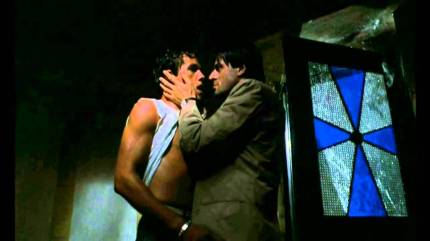 “The Fourth Man (De vierde man)” (1983) – This one isn’t exactly horror, but it’s unsettling vibe is far more likely to make you squirm than most of the so-called fright flicks that try to scare you with ghouls and gore. Crafted by Dutch director Paul Verhoeven (years before he gave us a different kind of horror with “Showgirls”), it’s the sexy tale of an alcoholic writer who becomes involved with an icy blonde, despite visions of the Virgin Mary warning him that she might be a killer. Things get more complicated when he finds himself attracted to her other boyfriend – and the visions get a lot hotter. More suspenseful than scary, but you’ll still be wary of scissors for awhile afterwards.
 “Stranger by the Lake (L’Inconnu du lac)” (2013) – This brooding French thriller plays out under bright sunlight, but it’s still probably the scariest movie on the list. A young man spends his summer at a lakeside beach where gay men come to cruise, witnesses a murder, and finds himself drawn into a romance with the killer. It’s all very Hitchcockian, and director Alain Guiraudie manipulates our sympathies just like the Master himself. Yes, it features full-frontal nudity and some fairly explicit sex scenes – but it also delivers a slow-building thrill ride which leaves you with a lingering sense of unease.
 When Ridley Scott’s dystopian neo-noir sci-fi opus opened in 1982, it was overshadowed at the box office – along with a number of other worthy films – by the juggernaut that was Steven Spielberg’s “E.T.: The Extra-Terrestrial.” Consequently, it was deemed by the then-reigning Hollywood pundits to be a misfire, and critics seemed to echo that sentiment; though praised for its imaginative visual design – now regarded as influential and iconic – and its provocative thematic explorations, it was greeted with middling reviews that, taken together, marked it as an “interesting failure.”


 Today’s Cinema Adventure was originally published in






 Today’s Cinema Adventure was originally published in




 JPK's Adventures in Cinema