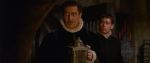
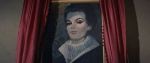
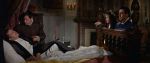
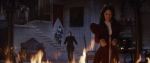
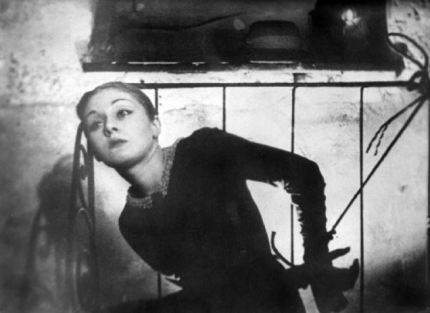
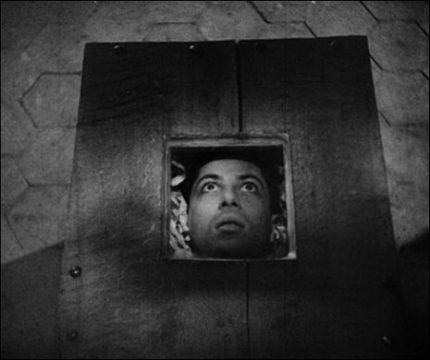
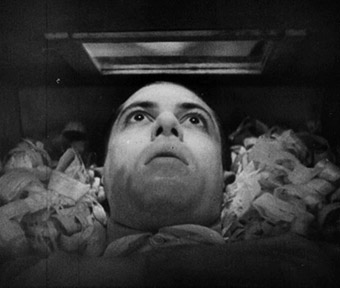
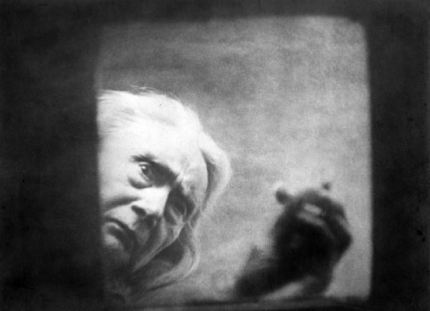
Daybreakers (2009)


Today’s cinema adventure: Daybreakers, a 2009 sci-fi/horror/action mash-up about a dystopian near-future in which an epidemic has turned most of the world’s population into vampires, and the remaining humans are farmed for their blood.  Written and directed by Michael and Peter Spierig, it is elevated above the usual standard of B-grade schlock by the presence of an unusually distinguished cast, and features a slick and well-executed visual style enhanced by special creature effects from New Zealand’s Weta Workshop.  It was met with fairly positive critical response upon its initial release, but despite the presumably heightened appeal of its combined fantasy genres, its box office performance was somewhat disappointing, owing largely to its competition with the blockbusters Avatar and Sherlock Holmes.

Set in 2019, Daybreakers depicts a world not unlike our own, a place where high-tech convenience and corporate domination rule the day; the fact that most of its inhabitants are vampires makes little difference- modern technology ensures the uninterrupted flow of culture by providing protection from sunlight, and industrial farming procedures provide the required supply of human blood, while the military takes care of hunting down and capturing the few remaining mortal survivors.  The rewards of embracing vampirism- immortality, superhuman strength, enhanced senses- seemingly outweigh any troubling moral concerns, at least for most, and the only real problem is the dwindling supply of blood- an ongoing issue which has reached the level of an international crisis as the non-vampiric representatives of the human race have reached near-extinction.  While corporate experts race to find a synthetic substitution, rationing and poverty have begun to take their toll by causing the malnourished to “subside,” morphing them into primal, instinct-driven monsters who terrorize and feed on their own kind.  In the midst of this dire state of affairs, Edward- a blood expert whose ethical beliefs lead him to sympathize with humans- becomes involved with a group of mortal fugitives that have found a cure for vampirism, and he joins them in their quest to save humanity.  The powers that be, however, have no interest in a cure, so Edward and his new companions must fight to stay alive until they can find a way to spread their miraculous discovery and reclaim the future of the human race.

The premise is undeniably intriguing, though it clearly requires some serious suspension of disbelief for viewers beyond the age of, say, 14.  The metaphorical possibilities are provocative; Daybreakers could be viewed as an allegory for corporate greed and its ruthless bleeding of the underclasses, or as an indictment of humanity for its merciless over-exploitation of natural resources, or simply as a parable about the conflict between the dark and light sides of human nature.  Implicit as these ideas may be in the scenario, however, the Brothers Spierig have included little, if any, subtextual emphasis on anything beyond the necessary psychological conflicts of the story, such as the desire of a corporate chief executive to bring his resistant daughter into the vampiric fold or the struggle for reconciliation between Edward and his military brother, who converted him unwillingly to his undead state.  There are unavoidable parallels, too, between the vampiric “subsiders” and the homeless population of our own world- viewed as undesirables, they are feared and persecuted, a reminder of the larger social problem of which they are a symptom and of the potential fate which threatens the entire civilization.  Here too, the film’s creators have chosen to leave the obvious comparisons in the background, instead treating this element as just another complication in their plot.

With all this possible social commentary inherent in the material, one might expect the filmmakers to find creative ways to explore it within the framework of the narrative, particularly since their screenplay was an original work, unencumbered by the need to adhere to an existing storyline; but throughout their movie, opportunities for such resonance are ignored, and the script contents itself with a reliance on melodramatic confrontation and goofy one-liners, setting up its conflicts sufficiently to allow for dramatic tension and to provide the justification for its climactic bloodbath, but leaving larger and more significant questions unasked and unanswered.  In essence, the Spierigs have made an extended chase movie, spiced up with the trappings of a sci-fi/horror fantasy, and everything else within it exists merely to serve its crowd-pleasing purpose.

This is not to say that Daybreakers is without redeeming quality; indeed, its lack of pretension might be its saving grace, keeping it from becoming one of those preachy, self-important epics that gives lip service to a politically-correct stance while asking us to believe in a patently absurd premise (such as the movie that buried this one at the box office, the obscenely successful Avatar).  The Spierigs keep it simple, confining their socio-political observation to the world of the film, and incorporating only as much of it as is needed to set the stage for their story.  Unfortunately, that story is not a particularly compelling one- the protagonist is something of a wimp, and the developments which lead to the film’s resolution are even more far-fetched than its premise- but it manages to be entertaining enough; and because Daybreakers does not take itself too seriously, we can allow ourselves to enjoy the gratuitous violence and gore that we ultimately expect from any vampire movie.  There is quite a lot of it, actually, increasing in frequency and intensity as the plot progresses, until it culminates in a climax dripping with cathartic carnage.  On this level, at least, Daybreakers does not disappoint.

Besides the guilty pleasure of bodies being exploded, incinerated, beheaded and otherwise torn to bits- justifiable because they are, mostly, vampires, after all- there are some other features worth attention in Daybreakers.  Most noticeable, perhaps, is its cool, slick visualization of a not-too-distant future marked by a sterile, streamlined elegance in architecture and interior design, and rendered in a muted palette of steely grays and icy blues by cinematographer Ben Nott.  The vampiric mutants, debased by their malnutrition into anthropomorphic creatures (which look decidedly similar to the notorious “Bat Boy” of tabloid fame), are effectively creepy and pathetic at the same time, and well-executed by their aforementioned creators at Weta.  As for the acting, well, clearly nobody expects Oscar-caliber performances from a movie like Daybreakers, but that said, the presence of a particularly high-grade trio of actors in the key roles- Ethan Hawke, Willem Dafoe and Sam Neill- helps to elevate it from the level of a run-of-the-mill formula thriller to something at least a little more engaging.  Dafoe in particular deserves credit, in his role as a former-vampire-turned-human savior, for being able to utter some truly ridiculous dialogue with enough conviction to make it seem believable; and there is a nicely subdued and grounded performance from the less-familiar Claudia Karvan as the mortal female refugee who brings Hawke (as Edward) into the cause and becomes a possible love interest.  It’s also notable that she takes an active and heroic role in the proceedings instead of being presented as the typical passive woman usually seen in such male-centric adventures- though she does, ultimately, have to be rescued, it’s also true that Hawke’s character does too, and more than once, at that.

Daybreakers makes an attractive package, with its skillful technical and visual elements providing considerable distraction, and the work of its competent players ensuring that we can stay involved in its plot; but that plot is all-too-familiar despite the painfully clever conceits in which it is framed, and though it manages to grow on you as it goes, in the end it offers nothing more than a mildly interesting 90-minutes-plus of entertaining fluff.  The rich potential of its scenario seems to beg for further development, but goes unexplored, creating half-formed thoughts and ideas about its implications that are quickly left in the wake of its action agenda; the result, though not exactly a bad movie, is not exactly a good one, either.  Rather, it’s just another gimmicky thriller that capitalizes on the surging craze for vampires, and though it’s a well-made and fairly likable one, the sense of missed opportunity makes it very disappointing, indeed.


http://www.imdb.com/title/tt0433362/


From Hell (2001)


Today’s cinema adventure: From Hell, the 2001 screen adaptation of Alan Moore and Eddie Campbell’s award-winning serialized graphic novel exploring the real-life Jack the Ripper case through a fictionalized story about its investigation, starring Johnny Depp as the Scotland Yard Inspector in charge of the case.  As directed by Allen and Albert Hughes, it condenses the 500-plus page original to fit a running time of less than two hours, omitting much of the book’s rich, immersive material in the process, effectively transforming the piece from an informed- if dark- historical fantasia into a pop-art horror movie with pseudo-sociopolitical overtones.  Nevertheless, taken on its own merits, it’s a stylish and intelligent thriller, offering a fairly accurate (though highly speculative and sensationalistic) depiction of perhaps the most infamous true crime story of all time, as well as an excursion into the dark underbelly of Victorian London.

Adapted into screenplay form by Terry Hayes and Rafael Yglesias, From Hell blends fact and fiction as it unfolds its narrative, set mostly in London’s seedy Whitechapel District in the fall of 1888.  It’s a miserable, economically depressed slum, populated by rough laborers, criminals, and prostitutes- the latter of who are being savagely killed in a series of increasingly macabre and horrific murders.  In charge of the investigation is Frederick Abberline, an opium-addicted police inspector with a gift for psychic visions; his prescient insights into the case bring him to suspect an even darker and more insidious motive to the crimes than is suggested by their brutality, as well as leading to his personal involvement with one of the Ripper’s potential victims.  As he gets closer to the truth, he finds himself enmeshed in a dangerous web of secret intrigue, racing against time and facing powerful opposition in a desperate effort to prevent the monstrous killer from claiming more lives- including his own.  The plot unfolds against a backdrop of late 19th-Century English society, offering a bleak and politically-charged vision of a world in which disrupting the illusion of propriety is a greater crime than murder; the privileged elite exist outside and above the law, orchestrating and manipulating events from behind closed doors while the impoverished masses endure an unthinkably cruel and desperate existence with little hope of escape or betterment, and even those sympathetic to their plight are powerless to help them.

Moore and Campbell engaged in painstaking research in the creation of their graphic novel, meticulously incorporating the facts of the Jack the Ripper case into their multi-layered fictional retelling.  That effort is reflected in the film, though in a somewhat diluted form; on the page, the historical facts are presented side by side with the story, making for an immersive experience in which the reader can participate in the process of speculative myth-making, whereas for obvious reasons this cannot be duplicated onscreen without disrupting the visual (and emotional) flow.  In addition, the panoramic view of Victorian society offered by the original has been necessarily stripped down; though the filmmakers have clearly made an effort to provide as much of this background as possible, their running time dictates the removal of all but the most cogent information.  An unfortunate side effect of this streamlining is that key plot points, which might have been better masked in a more comprehensive script, become painfully obvious, making the film highly predictable to savvy viewers, particularly those familiar to the true events of the Ripper case.  It can be argued, however, that the film’s purpose is not to puzzle us with its mystery- which is well-known as an unsolved and probably unsolvable case- but to offer a social commentary by using its plot and its setting to parallel our modern world.

To this end, the Hughes Brothers sculpt their film to highlight the disparity between the upper strata of the Victorian population and the impoverished lower classes amongst whom the Ripper’s crimes take place.  The wealthy are isolated, arrogant, and dismissive of the concerns of the less fortunate, while the poor, in their struggle to survive, are greedy, opportunistic, and cruel.  It’s not a pretty picture of mankind, and there are few examples of middle class decency on display- only Abberline and his Shakespeare-quoting sergeant represent a compassionate view towards humanity, and even they are characterized by a mistrustful cynicism which reflects their exposure to the harsh realities of the age.  The nobility and their bureaucratic allies are portrayed as smug, self-appointed guardians of a status quo that favors their continuing prosperity, and many of them seem possessed of a sadistic streak, exhibiting an unmistakable delight in their infliction of suffering and the exercise of their power over the weak.  Each and every member of the ruling class is portrayed as contemptuous of the poor, even those who seem, on the surface, to be more enlightened, and the underprivileged commoners beneath them are shown to have suppressed any noble sentiments in favor of self-preservational hostility and practical amorality.  Providing illumination on this ugly portrait of mankind at its worst, the directors give us an unvarnished look at the wretched conditions of existence to which these masses are subject- the filth, the corruption, the continual struggle for inadequate food and shelter- and the opposing luxury with which their economic superiors surround themselves.

From a visual standpoint, the Hughes Brothers make their objective clear from their opening shot, which pans down slowly from an austere London skyline at dusk, offering glimpses of the various strata of society through their lighted windows until it reaches the dark and squalid streets of Whitechapel, where an assortment of dehumanizing activities are plainly on view.  The pair also take pains to recreate the dramatic visual atmosphere of the comic book format, reconstructing the composition of panels from the original and utilizing a color palette which conjures memories of the lurid English horror classics from the fifties and sixties- many of which share a similar setting and were clearly inspired by the lingering cultural memory of the Ripper’s reign of terror.  However, although these iconic forbears were noted for reveling in an almost gleeful depiction of blood and gore, From Hell is relatively short on explicit violence, though there are certainly enough glimpses of horrific acts and their aftermath to create the impression of having witnessed a bloodbath.  Similarly, despite its title (a reference to a letter sent by the real-life Ripper to taunt the police), the film is not a supernatural fright fest, though there is a not-so-subtle implication of a dark, possibly otherworldly force at work behind the killings; this is no tale of demons at large, wreaking havoc on a weak but innocent humanity, but an indictment of mankind at its basest and the depths to which it will sink in order to preserve its own selfish desires.  Ultimately, From Hell aims to derive its real horror from the implications of its clearly-stated premise- that the gruesome career of Jack the Ripper is but a prelude to the larger scale horrors that await in the coming century, the tip of an iceberg formed by the clandestine machinations of the world’s tightly-knit power elite.

This darkly cynical sociopolitical viewpoint is familiar to anyone familiar with Alan Moore, whose somewhat radical sensibilities are plainly displayed in such other of his works as Watchmen and V for Vendetta, as well as his contributions to the Batman series.  While his leanings certainly come across in this screen adaptation, however, their effectiveness is certainly limited by its narrower focus.  Where the published work is overwhelmingly centered on his postulated notion of the killings as a symptom of a far-reaching social imbalance, supported by an interwoven tapestry of peripheral events which underline and reinforce his theme, the screen version fails to bring home the significance of this element, treating it more as a necessary conceit of the plot than as the main purpose towards which that plot is geared.  Though the writers and directors have clearly understood their task, and made considerable effort to stress the relevance of Moore’s allegorical subtext in their realization of his piece, they are ultimately defeated by the need to provide a Hollywood-style, story-driven thriller; the cold-hearted patrician gentry and the need-driven proletarian rabble are present, but the broad strokes with which they are painted render them clichéd, stock figures of the Grand-Guignol horror genre from which the film takes its cue, and the numerous scenes of social injustice and economic inequality come off as obligatory, the kind of standard fare usually found in dramas set in this period- and often presented with more conviction than we see here.  Coupled with the aforementioned predictability of the plot, the familiarity of these elements help to make From Hell feel like something we’ve seen before.

Though the film doesn’t quite live up to its potential, the actors acquit themselves admirably.  Johnny Depp is shrewdly cast as Abberline, who in real life was described by his colleagues as a highly capable officer with the demeanor of a mild-mannered bank clerk, though here he is portrayed as a decidedly more unorthodox figure, somewhat dissolute and highly unorthodox in his methods; Depp provides a perfect access point for a modern viewer, bringing a highly contemporary persona into the proceedings and providing his customary intelligence and commitment to the role, and if he sometimes seems to be sleepwalking through the film, this adds an appropriate layer of detachment to a character who is, after all, a drug addict and a visionary.  Heather Graham also brings a modern feel to her performance, though in this case it feels a bit less appropriate- she plays a prostitute who lives on the streets, and her level of intelligence and sensitivity seems a bit anachronistic; this is true of the portrayal of all the streetwalkers in the film, but in Graham’s case, given the conceit of her highly fictionalized role, it’s an acceptable disparity, and she succeeds in being likable and sympathetic in the midst of a cast of unpleasant characters.  The two stars, however, are ultimately less memorable than the host of fine British character actors who fill the supporting roles.  Particularly noteworthy are veteran character actor Ian Holm as gentleman doctor who assists Abberline in the case by providing his medical knowledge, and who may in fact possess more information than he is willing to share; and the always delightful Robbie Coltrane as the gruff but good-natured sergeant who serves as Abberline’s loyal assistant and friend.  The remainder of the cast get little chance to flesh out their characters, most of which come off as little more than ciphers in service of the story, but for the most part, they perform their tasks with a relish which goes a long way towards making the world of the movie seem believable, if not particularly compelling.

Despite the fact that it falls short of its considerable potential, From Hell is not a bad movie; it succeeds on a number of levels, not the least of which is providing a fairly gripping two hours of suspenseful- if unsurprising- entertainment.  It takes an oft-seen scenario and presents it in a form that both pays homage to the style of its former, more traditional incarnations and refreshes it with a modern and distinctive flavor of its own.  If it fails to capture the full power and ambitious scope of its source material, that is perhaps no surprise; Moore and Campbell’s creation is a complex work of art that is inherently best served by the medium in which it was first presented, and it is doubtful that any film could capture it faithfully without falling short on some level.  Nevertheless, it is a brave attempt, and if nothing else, it certainly provides inspiration for viewers to seek out the graphic novel and experience its brilliance for themselves.  Beyond that, it is a well-made, if ultimately ordinary, thriller, blessed with a talented cast and an impressive visual style; and for those who have an interest in Jack the Ripper and the world in which he existed, it’s a must-see, and as long as you don’t expect to learn anything new about the case (and you don’t mind seeing a long-disproved theory being put forward once again), you’ll probably find it a worthy rendering of this legendary chapter in the annals of human brutality.

http://www.imdb.com/title/tt0120681/

The Phantom of the Opera (1925)

Today’s cinema adventure: The Phantom of the Opera, the 1925 silent horror film featuring the legendary Lon Chaney in his most famous and recognizable role; it was a troubled production, but it ultimately proved so successful that it sparked a two-decade reign by its studio, Universal, as the premiere source of horror on the big screen. Critics at the time were lukewarm in their overall response to the film, though most were impressed by its production values and visual style, but they bestowed unanimous acclaim upon the element which was- and remains- its greatest appeal: the electrifying performance of Chaney as the title character, and the still-terrifying makeup he designed to transform himself into a ghoulish human monster.

Based on the 1909 novel by French author Gaston Leroux, the film’s plot differs somewhat in its details from the one familiar to fans of the now-better-known stage musical based on the same source, but the general premise remains the same. The prestigious Paris Opera is haunted by a mysterious shadowy figure known only as “The Phantom,” who is, in reality, a grotesquely disfigured musical genius that dwells in a secret lair deep within the catacombs beneath the opera house. Becoming enamored of Christine, the understudy to the Opera’s temperamental prima donna, he coaches her singing from behind the walls of her dressing room, and begins to send threatening letters to the Opera’s owners demanding they allow her to replace their star onstage; when they refuse to cooperate, he sabotages a performance, crashing the grand chandelier into the audience, and then kidnaps his protégé, prompting a desperate rescue attempt by her lover, Raoul, and sparking a manhunt to capture the fiend and put an end to his reign of terror, once and for all.

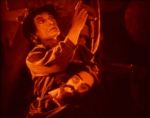
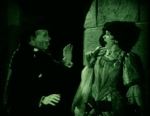
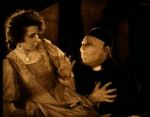
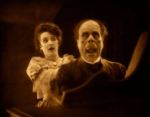
This highly melodramatic plot has since been fleshed out by a numerous variety of interpretations, from the gothic horror approach of Hammer Studios to the campy glam-fantasy of Brian DePalma’s seventies cult classic, The Phantom of the Paradise; but this original screen version remains, nearly 90 years later, the most iconic. Though many in today’s world have never seen the film, it would be hard to find someone unfamiliar with the horrific countenance of Lon Chaney’s Phantom; his pale, grinning, skull-like features are still among the most recognizable in horror cinema, turning up in various forms of media throughout our popular culture- even on a postage stamp- and continuing to inspire artists and actors today in their efforts to terrify. Without question, unless you are a serious film scholar- or a hardcore completionist- Chaney is the only real reason for a modern viewer to see The Phantom of the Opera; his makeup alone is worth the time investment, an impressive creation of face paint and wire which caused him excruciating pain during filming. His appearance- the most faithful depiction of the character to date, as described in the novel- is so gruesome that audiences of the day reportedly leaped from their seats in terror, and some weaker spirits even fainted from the shock- though doubtless some of these incidents were embellished by the studio for publicity purposes. However, Chaney’s magnificently deformed visage is only part of his draw here; the reason he was one of Hollywood’s biggest stars was that he had an uncanny gift for making such monstrous characters profoundly human, finding their hearts and rendering them with a rare poignancy that ultimately made them far more sympathetic than the stiffly artificial performers that surrounded them. His work is a revelation for anyone whose conception of silent film acting is limited to the stilted, melodramatic style represented by most of his contemporaries; his gift shines through the antiquated techniques of the form, reminding us of the effectiveness of pantomime as practiced by a true master. He communicates volumes of complex emotion with his body language and tells whole stories with the subtlest of gestures. He presents such a clear portrait of the pain and sadness lurking beneath the phantom’s furious persona that we cannot help but be on his side, for all the mayhem he causes; he conveys the depth of this man’s tragic experience- the isolation, the ridicule, the self-loathing- that has led him to hide himself away from the eyes of the world, and he makes us hope alongside him that the beauty of his musical gift will be enough to make Christine see past his physical ugliness and fall in love with the tender soul it conceals. We know that it won’t work, of course, which only serves to heighten our pity for this miserable outcast, dangerously mad though he may be.

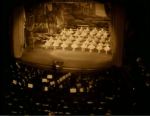
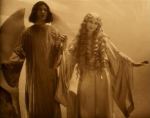
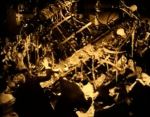
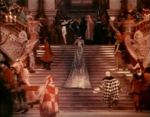
Thanks to the success of Chaney’s previous blockbuster for Universal, The Hunchback of Notre Dame, the studio knew they had a major asset; consequently they spared no expense in the preparation of this follow-up, building lavish sets of enormous scale upon which to play out the drama. The production design (headed by the uncredited Ben Carré) centers on a complete vision of the Paris Opera House, giving us its opulent interiors, its magnificent façade and spectacular rooftop, and the elaborate sets and costumes for its onstage production of Faust (which, appropriately enough, figures prominently in the plot), including a backstage view full of looming and ominous props and set pieces. As for its dark underbelly, the Phantom’s sinister hideaway is a splendidly imaginative mix of gothic gloom and regal refinement, with dark labyrinthine passageways that include such improbable elements as a horse and an underground lake, leading to residential chambers resplendent with elegant décor and devilish mechanisms. Adding to the visual bedazzlement, the film utilizes a the technique of monochromatic tinting to create moods and to differentiate settings- a fairly common method of the era, and a far cry from the drab look most modern viewers associate with the silent cinema, due to the decades in which only faded black-and-white prints of these films were available. Thanks to modern restoration, we are treated not only to the recreation of this effect, which greatly enhances the visual experience of the film, but also to the full glory of the two-tone color process used for the film’s centerpiece, a grand masked ball sequence in which the Phantom appears amongst the revelers costumed as the Red Death.

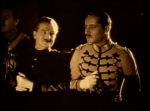
Apart from the scenery, though, when Chaney is absent from the screen we are left, for the most part, with little to hold our interest. Though it’s important to remember that the overwrought posing practiced by most of the other actors was the accepted technique of the day, and that the performers here were well-known, popular, and respected stars at the time, modern audiences are still likely to feel alienated rather than endeared by the likes of such primitive thespians as Mary Philbin and Norman Kerry, who portray Christine and Raoul, particularly when contrasted with the raw, timeless power of the film’s star. It’s not that they give bad performances- by the standard of the day, they were more than competent- but that they seem vaguely silly to us now, holdovers from the pulpy melodrama theatre which dominated American entertainment before the movies took over our collective imagination. Still, if one can get past the stylistic gap created by the intervening decades of changing fashion, it’s possible to see the talent on display here. There are some nice moments from Philbin, who was a lovely young woman, to be sure, exuding a sweetness and sincerity that seems particularly noticeable when she shares the screen with Chaney; and some of the supporting players provide memorable contributions, such as early Broadway star Snitz Edwards as a decidedly fey and cowardly stagehand who provides comic relief, and the uncredited Bernard Siegel as the Opera company’s resident “expert” on the Phantom. Kerry’s Raoul gets the worst deal, despite his then-much-heralded matinee-idol looks; his character is a stock, one-dimensional bore, and though he does give every effort to make some real feeling come through, his performance comes off as wooden and unimaginative, and the character seems almost dull-witted at times, making us root all the more for the Phantom in his efforts to win Christine away from him. Far more interesting is Arthur Edmund Carewe, who portrays Ledoux, a police detective secretly investigating the case of the mysterious opera ghost, who emerges just in time to become an ally in the quest to save Christine; despite the fact that the character was completely rewritten during the process of creating the intertitles- having originally been a Persian former associate of the Phantom now on his trail- and his scenes were filmed with a completely different backstory in mind, he still comes off better than Raoul, decisive, determined and brave. Barring her acceptance of the Phantom’s love, it would be better for Christine to fall for this hero, instead of the boring, moon-eyed stiff with whom she ends up.

The subject of Ledoux and his rewritten backstory brings up a major point in the discussion of The Phantom of the Opera- its tumultuous production history. Universal originally hired Rupert Julian, a prestigious director of stylish romances, to helm the project, but the shooting process was marred by his difficult relations with the cast and crew. Nevertheless, he succeeded in providing a final cut, more faithful to the novel’s plotline, including the mysterious Persian and keeping the original ending, in which the Phantom allows Christine and Raoul to leave together and remains in his underground hideout to die of a broken heart; unfortunately, the unfavorable reaction of preview audiences prompted the studio to embark on major rewriting and reshooting, without Julian (though his name was- and still is- retained as the credited director), which involved the creation of several subplots, new characters, more comic relief, and a different ending in which the Phantom is chased down by an angry mob and savagely murdered. Unfortunately, this version also bombed in previews, so the desperate studio scrapped most of it (though they retained the new, more “exciting” finale) and attempted to salvage the project by re-editing and rewriting the original cut (this is when the Persian became a Parisian police inspector). This time, it clicked, and the film was a huge hit- though, as mentioned, the critics found it somewhat mediocre, save for Chaney- and became a cash cow for Universal; in fact, it was so popular that upon the advent of sound a few years later, the studio shot new sequences (including more extensive scenes of the opera) and added a dubbed soundtrack featuring members of the original cast, except for Chaney (who was by then under contract with MGM). This version was also a success, but it has proven problematic for the film’s subsequent history; over the years, thanks to the negligence of the studio in preserving its original negatives, the only remaining prints of The Phantom of the Opera are a widely varying mish-mash of combinations from its different incarnations, making it virtually impossible to reconstruct its original form. As a result, the version now widely available contains material from both the final release cut of 1925 and the 1930 pseudo-talkie edition; sadly, there are sections which only survived in badly deteriorated form, making the contemporary version frustratingly patchy in its overall visual coherence. There are other inconsistencies, too, such as the use of a different actress as Carlotta (the opera’s prima donna) in the later version, a problem explained by changing the character’s former incarnation into “Carlotta’s Mother” for her retained scenes in the Opera managers’ office and billing the second actress (who appears only in the Faust performance scenes) as the actual “Carlotta.”

Despite all this, however, the current restored edition of The Phantom of the Opera preserves a valuable piece of cinematic history, and provides the interested viewer with a chance to experience the original screen version of this oft-filmed tale in a condition as close as possible to its initial, pristine form. Some of it is eye-opening, such as the important role of color in telling its story, a factor that was lost for many years; some of it, of course, comes up short of the expectation created by the film’s reputation, revealing the shortcomings observed by critics of the day, such as a somewhat shallow focus on spectacle and sensationalism at the expense of the deeper subtext inherent in its ultimately tragic tale, and the inclusion of certain bizarre, melodramatic elements designed merely to elicit audience response without consideration for their logic within the larger scope of the narrative. That said, it would be foolish not to take advantage of the opportunity to see this venerable classic, a film which has generated so much influence and so many imitators over the years that it has entered the realm of legend. Though the film itself may not live up to its legendary status, the performance at its center certainly does; in fact, seeing it today, Lon Chaney’s Phantom seems perhaps even greater than it did in 1925, as fresh and immediate as if it were filmed yesterday, despite the elevated style. This is a testament to his powerful gift, with which he was able to reach across the decades, even 80 years after his death, to touch our world with his understanding of the human soul.

http://www.imdb.com/title/tt0016220/

The Pit and the Pendulum (1961)

Today’s cinema adventure: The Pit and the Pendulum, the 1961 thriller which was the follow-up to Roger Corman’s surprisingly successful House of Usher, and the second of what would ultimately be eight of Corman’s Poe-based independent features. Once again starring horror film stalwart Vincent Price, and shot on an elaborate set built from cannibalized pieces rented from other studios, it was an even bigger hit than its predecessor and achieved a substantial amount of critical acclaim, despite its low budget, becoming a classic staple of later TV “creature feature” programs and providing considerable influence over the future of horror films, particularly those produced in Italy through the late ’60s and ’70s.

The original short story by Edgar Allan Poe is a brief, moody affair, more or less the description of a prisoner’s experience as he is tortured by the Spanish Inquisition with the swinging, bladed contraption of its title. This being clearly insufficient as the basis for a feature-length film, Corman re-hired Usher screenwriter, Richard Matheson- a respected wordsmith responsible for, among other things, numerous well-known stories and several classic episodes of The Twilight Zone– to fashion a suitable narrative that could feature Poe’s horrific scenario as part of a longer tale. Matheson’s solution is the 16th-Century tale of a young Englishman who travels to the remote Spanish castle of Don Nicholas, son of an infamous Inquisitor, seeking an explanation for the unexpected death of his sister, who had been the Don’s bride. Though his host is cordial and consumed with sorrow over the loss of his love, the young man’s suspicions begin to deepen as dark secrets are revealed surrounding the castle and its lord- including the presence of a horrific torture chamber which lies beneath it. The common threads of Poe’s work- madness-inducing grief, untimely death, premature burial- are intricately woven into Matheson’s script, giving it a strong feeling of authenticity, though there is little resemblance to anything in the author’s actual story; even the original setting within the Spanish Inquisition has been distanced, if not quite removed, by an intervening generation- though the connection has been maintained enough to provide the means of replicating Poe’s vision for film’s climactic sequence. Matheson was (and is) a highly renowned writer, and it is probably not an exaggeration to say that it was ultimately his contribution, more than any other, that raised The Pit and the Pendulum, as well as many of the other Poe features, above the level of the usual cheap exploitative fodder for which Corman was known; his fabricated storyline includes compelling situations and characters, clever and intricate plotting with a heavy sense of irony, and rich thematic layering which touches on our most universal fears and subconscious concerns.

It’s not prestige-picture material, though, make no mistake. Many of the conceits Matheson puts into place to facilitate the developments of his melodramatic plot do not hold up to even the most cursory logic. It’s also worth mentioning that some of the dialogue has a jarringly modern, banal sound to it, especially against the gothic backdrop and in comparison with some of the more florid passages in his script; coupled with the contemporary bearing and mannerisms of most of the performers, who seem vaguely uncomfortable and out of place in their period costumes, it makes for a certain low-brow quality that reminds us just how far-fetched the whole thing is. But that, of course, is part of the fun; The Pit and the Pendulum is a no-brainer, designed to keep its audience on edge not because of some vague intellectual idea of horror, but in anticipation of the inevitable gruesome shocks promised by its premise. Corman’s filmmaking agenda as a producer was always about knowing what his audience wanted and giving it to them, and he knew that what they would want was no different with these Poe films than from any of his other shockers, despite their literary pedigree. His goal was to provide a good hour and twenty minutes of chills and thrills, and that is what he delivered, with little concern for stylistic considerations that would make for a more erudite filmgoing experience.

This is not to say, however, that Corman the director eschews all artistic concerns; on the contrary, his work here is remarkably polished and coherent, with a highly effective visual style that goes a long way towards creating the film’s luridly baroque air. He adheres to a conceptual notion in which the events of the film, like Poe’s fiction, represent the contents of the subconscious, welling up to manifest in his woeful tale; consequently, he takes pains to establish his setting as isolated from the real world, surrounding the seaside castle with endlessly crashing waves and stormy skies. Further underlining the psychological nature of the drama, he depicts various memories and perceptual experiences in heightened style, shooting some sequences in deep monochromatic hues, using extreme distortion and camera angles, and steeping everything in a garish, dramatic palette- starting with a psychedelically surreal opening sequence featuring swirling pools of liquid color. Beyond his deliberate visual touches, he also delivers a well-paced, savvy piece of cinematic narrative, keeping the aura of tension and impending menace quite tangible despite the fact that much of the film contains no overtly horrific content. To be sure, when it’s there, he lays it on as thick as the cobwebs which cover the walls of the castle’s secret dungeon, which of course, as has been noted, is precisely what we want; and when we reach the payoff, the final sequence in which our young hero is subjected by his now-demented brother-in-law to the titular torture device, Corman’s efforts come to their fruition. It’s a genuinely hair-raising scene, enhanced by weird and stylized filmmaking, which truly captures the core of what makes this concept horrific- the psychological terror of awaiting the inevitable, grisly doom that methodically descends like clockwork, an imagined outcome that is ultimately far more disturbing than any blood-soaked act of dismemberment that might actually be shown onscreen.

Corman’s success at cashing in on popular trends with his cheaply-made quickies (he famously shot one of his most lucrative earlier films, The Little Shop of Horrors, in two days and one night) had by this point in his career afforded him the opportunity of securing bigger-name talent to help hedge his bets at the box office. Vincent Price, well established as a popular horror star, had taken on the lead role in Usher, and here returns once more, as he would continue to do throughout Corman’s “Poe cycle.” This time around he plays Don Nicholas, a sensitive soul living in the shadow of his father’s cruel public image and even crueler private deeds, and driven to the point of madness by the tragic death of his beautiful wife. It’s a foregone conclusion that he will eventually lose his sanity, of course; and Price plays with that boundary like the pro that he is, giving us a doe-eyed, fragile gentility that contrasts- and yet nevertheless offers frequent glimpses of- the roaring monster he will become by the end, with lots of overwrought moments of soul-shaking despair and horror thrown in throughout. It’s a flamboyantly campy performance, really- almost, but not quite, over-the-top; but after all, this kind of vaguely hokey melodrama requires a bit of hamminess in order to keep the emotional pitch high, and Price certainly provides it. Upon the film’s release, his work was roasted by several critics as laughable; in retrospect, however, it’s precisely the right blend of the serious and the ridiculous to keep us engaged and entertained, and the sense of gentle self-parody it suggests has come to be seen as one of the familiar hallmarks of this particular style and era.

It’s a good thing, actually, that Price’s work here is so gleefully theatrical, for his co-stars are considerably blander. The ostensible leading man, John Kerr, was a Tony-winning actor who started his Hollywood career as one of the most promising young actors of the late ‘50s; by the time he made this film, his star was almost faded. He is handsome and capable, but there is a lack of passion here that makes him far less interesting or sympathetic than his supposed antagonist, and he has a certain frat boy quality that hampers his believability as an early Renaissance nobleman. I’m not saying his performance is weak- indeed, he is more than adequate and far more convincing than many of the actors who filled this type of role in other Corman films, and by the time he gets strapped down under that swinging blade in the finale we definitely care about his fate- but he is far less compelling or memorable than Price. More interesting is Barbara Steele, fierce and beautiful as the doomed, not-quite-innocent young bride- though Corman dubbed her lines with another actress, fearing that Steele’s coarse English accent would not jibe with the sound of the other players. Luana Anders exudes kindness and refreshing normalcy as Price’s younger sister and Kerr’s obligatory love interest; and Anthony Carbone is fine as the family friend and doctor, though he would be likely be more convincing as a Vegas mobster in a slick suit. On the whole, unquestionably, it’s Price’s show- but that, perhaps, is as it should be.

No doubt due to the fact that, by the time of The Pit and the Pendulum, Corman and his crew were well-schooled in the art of movie-making on the fly, the film overall has fine production values. Considering it was filmed in three weeks with a reported budget of $300,000- a third of which was Price’s salary- it has a surprisingly polished and professional look. The sets are truly impressive, executed by Daniel Haller and Harry Reif on a large soundstage and using, as mentioned above, rented set pieces from other studios to patch together the interiors of the Don’s foreboding castle. For the exterior shots, process shots featuring matte paintings create a decidedly artificial look (it should be remembered that these kind of effects looked considerably more convincing, somehow, on a big screen) which nevertheless contributes to the film’s dreamlike- or should I say nightmarish- effect. The cinematography by Floyd Crosby is rich and weighty, and the score by Les Baxter (who was a well-known singer and arranger of jazz and popular music) is serviceably eerie, if not exactly memorable.

The Pit and the Pendulum is one of those movies that has become a classic despite itself, a monument to a particular era of filmmaking that contains numerous influential elements; these elements were not intended, necessarily, to be groundbreaking, just to be scary- such as the shots of a desiccated corpse frozen in the agony of trying to claw free of a premature grave, an iconic moment which has been echoed countless times over the subsequent decades. The movie’s status is partly to do with its exposure on television, where a whole generation of impressionable young people was acquainted with its fruity frights. Just because it’s a classic, however, doesn’t mean it’s a masterpiece; it’s still an example of hack-work elevated by the contributions of a few ringers, and boosted by the self-assured confidence that comes from being on a roll, as Corman and his team certainly were. Still, even if it’s not a great movie, it’s a damn good one, with a respectable commitment to quality and a strong dedication to good story-telling. If that story is ultimately more than a little cheesy, it is nevertheless engaging and- more to the point- undeniably spooky and disturbing, even as it generates laughs (which may not be as unintentional as one might think. This is no small feat, and it doesn’t happen accidentally; The Pit and the Pendulum succeeds thanks to the skill of the artists behind it, whose sole purpose was to stir up the uncomfortable corners of the psyche, and in the end, that’s about as close to the spirit of Edgar Allan Poe as any filmmaker could hope to get.

http://www.imdb.com/title/tt0055304/

Carnival of Souls (1962)

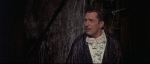
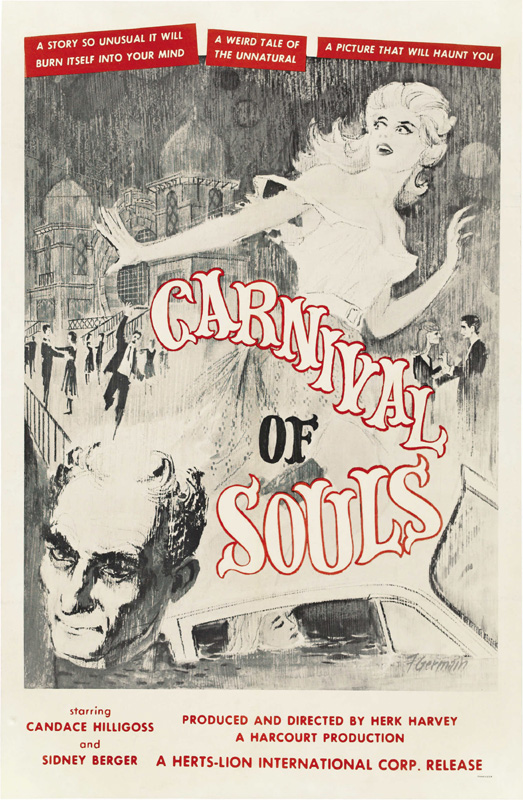
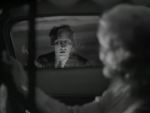
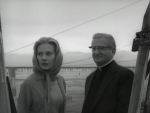
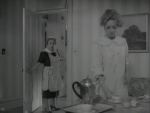
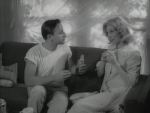
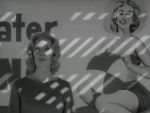
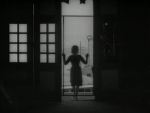
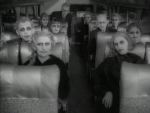
Today’s cinema adventure: Carnival of Souls, a 1962 low-budget horror film that was more or less ignored on its release, but which has gone on to become a highly influential cult classic.  Directed by Herk Harvey, a prolific lifelong creator of educational and industrial films who never made another theatrical feature, it was shot on location in Lawrence, Kansas and Salt Lake City, Utah, using a 16mm camera and reportedly with a budget of around $30,000- a cost which today would probably not even cover the price of the car that goes off a bridge in the first reel.  Needless to say, it’s a film that relies solely on atmosphere and cinematic storytelling to provide its scares, and the fact that it does so very well is no doubt responsible for its importance in the history of the modern horror genre.

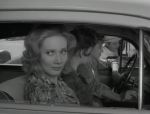
Despite its humble origins, the film’s screenplay, written by John Clifford from Harvey’s original story, is surprisingly sophisticated in its layering of thematic elements and even in the believability of its dialogue- considering the nature of its subject matter, that is.  The plot concerns Mary Henry, a young woman who works as church organist though she has no particular interest in religious sentiment.  A week before she is to begin employment in a new town, she becomes the only survivor of a car accident in which two of her friends are drowned.  Determined to go on with her life, she makes the trip to start her job as planned, but she soon finds herself being stalked by a mysterious specter- who cannot be seen by anyone else- and inexplicably drawn to an abandoned carnival pavilion on the shores of a local lake.  Her strangely cold and detached behavior, coupled with her increasing hysteria and delusional episodes, begin to alienate her new friends and associates, and she finds she must confront the mysteries that haunt her in order to escape them.  The story contains little action, per se; it mainly follows Mary as she attempts to start her new life.  Nevertheless, the tension builds steadily throughout, shrouded in a dreamlike surreality and accompanied by a tangible sense of foreboding.

Much of the film’s unsettling mood has to do with the locations.  Director Harvey supposedly got the idea for his movie while driving past the abandoned Saltair Pavilion on the Great Salt Lake in Utah.  Though most of the rest of the movie was shot in Lawrence, where he was based, he paid the Salt Lake City Chamber of Commerce $50 for one week of filming at the ruined location; it was a good investment, because the scenes in this eerie, decrepit monument to cheap thrills long past can stand with some of the creepiest images ever put on film.  It’s a marvelous symbolic element- a giant, decaying fun palace in the middle of a desolate wasteland, a haunted shell evoking the futility of the good times it once housed in the face of the eternal emptiness that surrounds it.  To put it another way, it’s an apt reminder that, in the midst of life, we are in death, making it a perfect metaphor for the uneasy thematic core of the film.

The majority of Carnival of Souls, however, takes place in the kind of quiet, small town setting that can so easily serve to conjure thoughts of malicious forces lurking beneath the mundane familiarity of its surface- particularly when captured in the stark black-and-white palette of Maurice Prather’s cheap-but-effective cinematography.  Sunlit parks or dark nighttime highways, a crowded nightclub or an empty church, a bus depot or a department store- no place feels quite right or completely safe.  Even before the car accident in the opening scene, the lonely country roads seem threatening, and from the moment Mary emerges, dripping, from the watery scene of the crash, we spend the rest of the film waiting for the drop of another proverbial shoe.

It would not be fair, though, to place all the credit for this oppressive creepiness on the happenstance of starkly-photographed scenery.  The film’s humble director was clearly a man with a vision, evidenced by the fact that he worked, without salary and with money he raised himself, to make Carnival of Souls in three weeks with a crew of five- including himself.  Though there is definitely a clunkiness in his cinematic style, this has more to do with the limitations of his budget than with his understanding of the craft or his talent; the abrupt edits and the sloppy continuity are at least partly the consequence of a tight shooting schedule and insufficient funds.  There is ample proof, throughout the film, of Harvey’s ability as a director; he frames his shots with an eye for arresting composition, and his instinct for pacing belies his lack of experience with narrative fiction.  There are numerous moments when his use of clever camera trickery parallels that of directors like Hitchcock- whose work he no doubt studied- and the overall sense of inexorable menace, though enhanced by the settings and the visual style, is ultimately achieved by his cinematic rhythm- leisurely takes punctuated by short, sharp shocks at just the right moment- and his choices of what to show us and when to show it.  To top it all off is his choice of musical accompaniment- an otherworldly organ score composed by Gene Moore, a natural extension of the heroine’s occupational duties which provides the perfect aura of fruity gothic gloom to the proceedings.

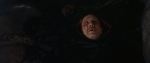
As for the actors, most of the roles are handled by local Lawrence “talent,” unprofessional actors acquainted with Harvey through his industrial work; admittedly, there are some embarrassing performances on display throughout the film, though Sidney Berger deserves a mention for his unexpectedly complex work as a loutish boarding-house neighbor who tries to woo the oddly disaffected heroine.  A nod must also go to director Harvey himself, who makes a personal appearance onscreen as the ghoulish figure who plagues Mary, sporting pale makeup and leering malevolently- which may sound easy, but requires a certain finesse to pull off effectively, which he certainly does.  Obviously, though, his movie hinges on the leading actress, and he shrewdly spent his casting budget there, hiring an unknown but highly-trained and experienced performer named Candace Hilligoss; strikingly beautiful and fully committed to her role, she carries the weight of the picture on her capable shoulders, convincingly playing a variety of far-fetched conceits and walking a thin line between ethereal detachment and frightened vulnerability.  It would be overstating the case to say that she gives a great performance, but it’s a good one- certainly much better than the vast majority of would-be starlet turns in this sort of sub-B-grade horror movie.

That, of course, is exactly what Carnival of Souls is, despite the considerable praise it may have garnered over the 50 years since its inauspicious debut.  It’s unquestionably the kind of lowbrow drive-in fodder that was churned out ad infinitum during its era- it’s just that Harvey’s enthusiasm and dedication make it several cuts above most of the others.  To be sure, there is a level of artistry here that is hard to define; it’s not quite accurate to call the director a talented amateur, and the film’s stylistic strength is not accidental- he definitely knew what he was doing.  Even so, the power of this strange little film may lie beyond the full scope of his intentions or abilities, and is perhaps rooted in the notion that lies at its heart, the one which ultimately provides its twist ending- predictable as it may be, in this day and age.  Beneath its bogey-man thrills, it conjures a profound despair, perhaps the result of touching on some deep, unnamable dread, leaving a disturbing feeling that lingers long past its final frames.  It is this quality, more than the diamond-in-the-rough technical prowess of its director, which has placed Carnival of Souls so highly in the esteem of modern horror enthusiasts and provided dark inspiration for later, greater filmmakers like George Romero, David Lynch, and Quentin Tarantino.

It probably goes without saying that by today’s standards, the fright factor of this film is very low; and by any standards, its production quality is ridiculously shoddy.  The average modern viewer will probably find it laughable, the kind of movie that has gained its popularity from falling into the so-bad-it’s-good category.  Certainly, a screening with a bunch of quick-witted friends would probably yield some pretty snarky zingers, and that’s a good enough reason to recommend it; but while you’re laughing, make sure you take a close enough look to admire the weird beauty that emanates from Carnival of Souls.  However jaded you may be, there is something there that demands attention and commands respect.

 http://www.imdb.com/title/tt0055830/

Abraham Lincoln: Vampire Hunter (2012)

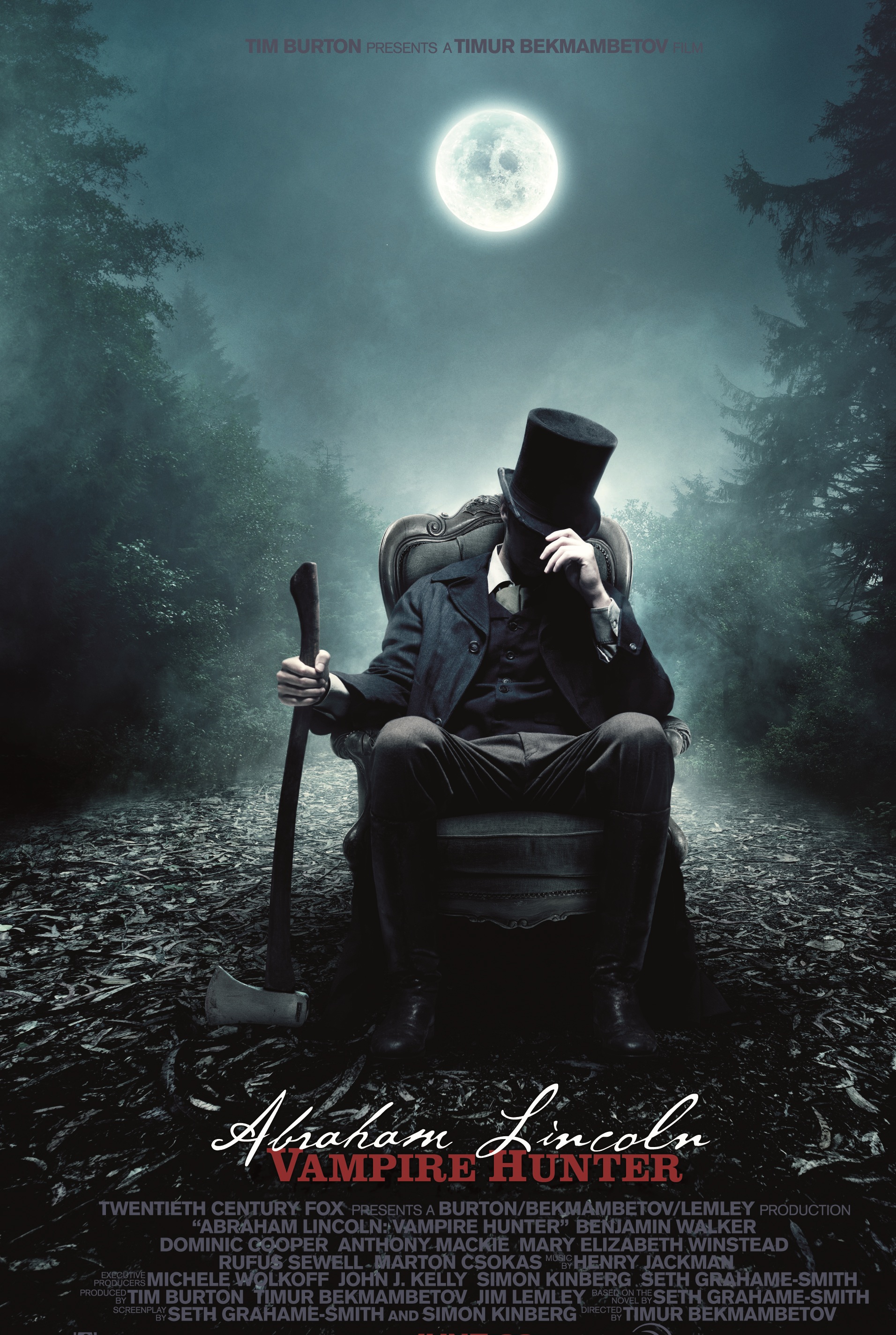
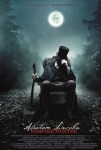
Today’s cinema adventure: Abraham Lincoln: Vampire Hunter, the 2012 feature based on the bestselling historical fantasy/horror novel by Seth Grahame-Smith, casting the already-heroic 16th American president in the even more heroic role of a secret slayer of the undead.  Directed by Timur Bekmambetov and adapted by the novelist himself, it’s a movie that hinges on a bold juxtaposition of historical fact and supernatural adventure, with a flashy visual style and an emphasis on bloodshed and action.  The plot follows Lincoln from his childhood, when his mother is ostensibly poisoned by his father’s former employer; upon reaching manhood, he seeks to avenge her murder, only to discover that her killer is in fact an undead monster.  Narrowly escaping death himself, he is rescued by a mysterious stranger, who reveals to him the secret existence of vampires living in the midst of human society and offers to teach him the skills he needs to become a warrior in the ongoing battle against them.  He becomes a master hunter, and his discovery of an insidious connection between vampires and slavery fuels his parallel political career, culminating in his presidency and providing underlying motivation for the Civil War.

With such a blatantly ridiculous premise, one might expect a substantial amount of tongue-in-cheek self-mockery, coupled with a sense of goofy fun for its own sake.  These elements are definitely present, but Abraham Lincoln: Vampire Hunter takes a decidedly serious tone in its approach to this genre-mashing mixture of history and hokum; Lincoln’s secret calling is no parenthetical side job, but is integrally woven into the events that shape both his private and public lives, as well as into the fabric of some of our nation’s still-most-painful memories.  It would be unforgivably glib of the film’s creators to make these connections without investing an appropriate amount of weight in the proceedings; accordingly, Lincoln’s dedication to vampire-killing stems from deeply personal motivation, rooted in the monsters’ victimization of his family, and their thirst for blood is linked directly to the most contentious and shameful issue ever to face the United States.  Of course, tying these various personal and national tragedies to a narrative about inhuman, bloodsucking parasites may have rich metaphoric possibilities- which, unfortunately, remain largely unexplored beyond the obvious implications of the situation- but it doesn’t do much for fueling the kind of escapist melodrama promised by the audaciously wacky concept.

Most of the critical unkindness towards this film has revolved around its insistence on anchoring its bloodlust-fulfillment fantasy in a sense of earnest importance, as if its purpose were to present a legitimate portrait of Honest Abe and his far-sighted principles.  Indeed, the world of Abraham Lincoln: Vampire Hunter is a place where lofty ethical considerations seem moot, a given condition of the larger political order, perhaps, but out of place with the more immediate conflicts of our hero’s secret occupation.  The situation cries out for the kind of unapologetic amorality found in a down-and-dirty exploitation film, contrasting Lincoln’s public face as a wise and compassionate leader with his role as a one-man boundary between the forces of darkness and the unknowing society he is sworn to protect.  The very title of this movie suggests a no-nonsense, merciless killing machine, and that is not only what we expect to see, it’s what we want.  Instead, we are given an idealized version of the real man, and a slice of his personal drama thrown in to boot- for which, presumably, we could easily wait until next year’s highly anticipated Spielberg biopic.

All of these problematic reservations can be attributed to the screenplay, written by Grahame-Smith with an eye towards keeping the emotional stakes high enough to keep viewers connected to the characters in the midst of all the slaughter.  By giving the plot a sense of purposeful noblilty and including a substantial dose of Lincoln’s private life as a lover, friend, husband, and father, the author hoped, presumably, to avoid turning the whole affair into a garish cartoon.  The effort is commendable, as is the attempt to maintain at least a tenuous connection to historical accuracy (with a few notable exceptions), in the use of names and relationships, actual events and chronology, etc., even if the details are rearranged considerably.  However well-intentioned he may have been, and however well these factors may have worked in his novel, the writer may have miscalculated; though normally I am adamantly in favor of the thoughtful, character-driven approach to storytelling for the screen, in this case I believe the film as a whole would have benefited from a lighter, less self-consciously sincere touch- and more scenes of Mr. President wielding his silver-edged axe.  The very notion which drives the plot demands a film which doesn’t take itself too seriously, and thanks to its script, this one often does.

I have always, however, been an advocate of taking a movie on its own terms, and with that in mind, Abraham Lincoln: Vampire Hunter is by no means a failure.  Though the weighty trappings of pseudo-biographical drama make for some slow going from time to time, when the movie does release the giddy adolescent joyride at its core, it takes off like a silver cannonball.  Director Bekmambetov delivers the same kind of flashy, multi-speed, computer-assisted action that helped to make his previous film, Wanted, a hit, transporting us decisively into the realm of superhuman feats, where we can at last get a taste of the thrills inherent in the idea of our chief executive moonlighting as a bad-ass monster-killer.  There are a number of these electrifying set pieces scattered throughout the film- a chase across the backs of a stampeding herd of horses, a gruesome monsters’ ball in a decrepit plantation, a climactic fight on the rooftop of a moving train- all saturated with grisly, blood-spattered, and deliciously satisfying violence.  It is in these segments that the movie really comes to life, and, like a true showman, Bekmambetov always leaves us wanting more; though everything in between often feels like filler, the payoff we receive from this kind of exciting screen action is almost worth the patience it takes to get there.

Bekmambetov ‘s slick modern style brings a contemporary edge to the movie that contrasts sharply with its period setting- which is firmly established with authenticity in the clothes and the physical surroundings, and further complemented by the effect of using muted, faux-sepia tones in the cinematography (possibly the film’s finest asset, accomplished by the legendary Caleb Deschanel).  This color palette has the odd benefit of seeming both old-fashioned and yet somehow very high-tech, a double-edged description that could be used to sum up the overall production design (by François Auduoy); the look and feel of the film, heavily reliant on computer graphics, creates a heightened reality, reminiscent of the dramatic visual style of a comic book.  Though this stylized environment adds a layer of artificiality to the proceedings, it also reinforces the supernatural atmosphere necessary to sustain the film’s absurd conceit.

The actors are more than adequate for the task at hand, with Dominic Cooper and Rufus Sewell standing out in the showiest of the supporting roles- Lincoln’s mentor and the vampires’ supreme leader, respectively.  Obviously, though, it’s the title character who must shoulder the heaviest burden here, and young Benjamin Walker’s shoulders are broad enough to do it.  He does a fine job of walking the thin line between Lincoln the man, Lincoln the statesman and Lincoln the terminator, and, on top of that, is convincing playing the great man from youth to weathered middle age.  He even bears a resemblance to Lincoln, though he is considerably more handsome- a requisite Hollywood touch.

There is something about Abraham Lincoln: Vampire Hunter that draws me in.  Maybe I’m just a sucker for this kind of preposterous “what if?” speculation, or maybe I’m just a big kid at heart, but from the very moment I heard about this movie, I was excited to see it.  Though in the end it was not quite the kind of adrenaline-pumping silliness I was hoping for, I can’t say I was disappointed, either.  Sure, I would have liked a little more of the gory action that worked and a little less of the pedestrian costume drama that didn’t; but there is plenty in this movie to tickle my juvenile fancy and keep me interested throughout its running time.  Even if that weren’t the case, the final scene contains an amusing twist that left me fairly delighted as the end credits rolled- and if I can walk out of the theater with a smile on my face, I think that’s a good enough reason to recommend a film.  So consider it recommended, but with the following qualification: it’s a stupid movie, but perhaps not stupid enough.  If you can get past that, you’ll have a great time.

http://www.imdb.com/title/tt1611224/

Crash (1996)


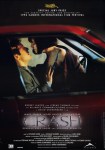
Today’s cinema adventure: Crash, David Cronenberg’s highly controversial and disturbing feature about a group of car crash survivors and the obsessive sexual fetishism they develop around their experience. Based on the equally controversial novel by J.G. Ballard, it was banned from public screening in its country of origin (Canada) as well as in many other countries, and released in both an R- and NC-17-rated form in the U.S. Despite widespread protest and outrage over its combination of graphic sexual and violent content, it was widely acclaimed by critics for its bold depiction of an uncomfortable and unorthodox subject matter, as well as for the cinematic prowess of its director in bringing his twisted vision to the screen.

The plot, such as it is, focuses on James, a sexually adventurous film producer whose marriage to the beautiful Catherine is spiced up by the reports they bring back to each other of their mutual infidelities. After a traumatic automobile accident requiring a lengthy hospital rehabilitation, he becomes involved with a community of other survivors that has gathered around Vaughan, a charismatic and hyper-sexual figure who encourages- and participates in- the merging of their sexual impulses with their fixation on the crash experience; James draws Catherine into the circle to join him, and with the others they explore ever-riskier fantasies in the pursuit of their dark passions. Though there is a structural arc to the story, which involves Vaughan’s role as sexual mentor and the gradual transference of his obsessions to James and Catherine, the narrative takes a back seat, if you’ll pardon the expression, to Cronenberg’s perverse fantasia of sexual deviancy.

From the very first scene, in which we see Catherine pressing her exposed breasts against the fuselage of an airplane during a clandestine encounter in an airport hangar, Cronenberg sets up his motif, a juxtaposition of soft flesh and hard metal which strives to make the viewer’s experience as close as possible to a tactile one; as the film progresses, it moves through its brief interstitial scenes- ostensibly necessary for the advancement of the plot, but in actuality merely required for establishing the next sexual scenario- into one graphic encounter after another, each one pushing us further past our comfortable boundaries and deeper into an unfamiliar realm of extreme sexual fetishism. Taboos fall away one by one as we witness erotic acts between various combinations of genders, performed in private and in public, involving sexual and non-sexual body parts, and almost always in connection with cars. This saturation of sexual imagery is not gratuitous: Cronenberg’s aim is to turn us on, certainly; but by mingling blatant eroticism with the adrenaline rush of recklessly driven vehicles, the carnage of roadside disasters, and a heavy dose of the body horror he so frequently returns to in his films, he triggers our sexual response alongside our conflicting reactions of fear and repulsion- alerting us to the possible dark corners in our own libidos and making us paraphiles by association. It’s an effect that makes Crash a highly unique cinematic experience, a sexual horror film which completely removes the distancing elements between our shock and our arousal- the subject he shows us is the object of both.

Of course, this experiment in dysfunctional autoeroticism is not for the squeamish; even those comfortable with explicit sexual content may find themselves turning away from the accompanying depictions of twisted metal and disfigured body parts, and most especially the frequent merging of the two. Those who are able to brave it out, however, might find themselves in awe of the way Cronenberg uses his skill to manipulate their wiring, like some sort of mad psychosexual scientist, to elicit responses ordinarily deemed inappropriate in the face of such stimuli. At the very least, the film begets a grudging admiration for its director’s ability to exploit the basic similarity between the primal reactions to sex and horror, and to use it in a visceral exploration of themes usually handled in the realm of intellect- the role of social conditioning in defining “normal” sexuality, the aphrodisiac effects of dangerous or forbidden behavior, and the age-old psychological connection between sex and death.

In bringing Ballard’s novel to the screen, Cronenberg (who also wrote the screenplay) updates it from its original 1970s setting and transposes the action from London to Toronto, but the underlying feeling of participating in something you shouldn’t remains the same, as does the tantalizing use of the author’s last name for the leading character, though Ballard denied any autobiographical connections (which didn’t stop eyebrows being raised when he was seriously injured in a car accident shortly after the book’s publication). To add another coincidental wrinkle, the character shares his first name with the actor portraying him, James Spader. Cronenberg’s shrewd casting adds another layer to the motif of contrasting textures, with outwardly cool, aloof performers- Spader and Deborah Kara Unger (as his wife)- colliding with the hot, rough, seething energy of Elias Koteas as Vaughan. The sparks are palpable; Koteas exudes raw, musky sensuality in every scene, making it clear how this underground sexual prophet attracts his furtive, broken followers. As a fellow survivor of the same crash, whose affair with James is the first step on his journey into dangerous obsession, Holly Hunter gives us a straight-laced, almost asexual surface that belies the ravenous carnal appetite underneath; and Rosanna Arquette, as another of Vaughan’s acolytes, is the ultimate embodiment of the film’s grotesque fantasy, a mangled sexpot encased in a set of rigid metal braces, beautiful and terrifying as some sort of steampunk sex robot- the perfect object of paraphiliac desire.

Rounding out the total package is the moody cinematography by Peter Suschitzky, which somehow gives a glossy, candy-shell shine to the dark and shadowy atmosphere of the film’s environment; and the background score, by longtime Cronenberg colleague Howard Shore, which underlines the director’s dominant concerns with a piercing, metallic guitar sound that manages to be both dissonant and harmonious.

Crash is one of those films that falls definitively into the category of cinema as art; there are doubtless many viewers who would disagree, citing its subject matter as unworthy or its deliberately titillating sexual content as exploitative. It’s a film that challenges us, that makes us uncomfortable by forcing us to cross boundaries we accept as sacred, and the first response to such material is often to dismiss it as trash. However, just like controversial works in other media- such as “Piss Christ” or “The Human Printing Press,” or the writings of the Marquis de Sade- there is a powerful voice behind this movie, one with a purpose and a need to express something about the human experience that can enlighten us despite our defensive reaction to its form. That said, it should be duly noted that Crash is not meant as entertainment, at least not for the casual movie-goer; though it is loaded with sex scenes and car chases, they are not in the nature of the ones which normally make for box office appeal. I can’t say that I enjoyed this movie- I’ve had a much better time watching other Cronenberg films, disturbing though they usually are- and I’m not even sure I can say it enriched me, in any way. I can, however, say that it forced itself into my consciousness and made itself a permanent part of my psyche, for better or for worse, and that in itself is enough for me to recommend it highly, at least to those adventurous cinemaphiles who are willing to be disturbed, or even outraged. It’s not safe cinema, but then, as the denizens of the secret world portrayed in Crash would tell you, there are sometimes more important things than being safe.

http://www.imdb.com/title/tt0115964/

Crash (1996)

;

Today’s cinema adventure: Crash, David Cronenberg’s highly controversial and disturbing feature about a group of car crash survivors and the obsessive sexual fetishism they develop around their experience. Based on the equally controversial novel by J.G. Ballard, it was banned from public screening in its country of origin (Canada) as well as in many other countries, and released in both an R- and NC-17-rated form in the U.S. Despite widespread protest and outrage over its combination of graphic sexual and violent content, it was widely acclaimed by critics for its bold depiction of an uncomfortable and unorthodox subject matter, as well as for the cinematic prowess of its director in bringing his twisted vision to the screen.

The plot, such as it is, focuses on James, a sexually adventurous film producer whose marriage to the beautiful Catherine is spiced up by the reports they bring back to each other of their mutual infidelities. After a traumatic automobile accident requiring a lengthy hospital rehabilitation, he becomes involved with a community of other survivors that has gathered around Vaughan, a charismatic and hyper-sexual figure who encourages- and participates in- the merging of their sexual impulses with their fixation on the crash experience; James draws Catherine into the circle to join him, and with the others they explore ever-riskier fantasies in the pursuit of their dark passions. Though there is a structural arc to the story, which involves Vaughan’s role as sexual mentor and the gradual transference of his obsessions to James and Catherine, the narrative takes a back seat, if you’ll pardon the expression, to Cronenberg’s perverse fantasia of sexual deviancy.

From the very first scene, in which we see Catherine pressing her exposed breasts against the fuselage of an airplane during a clandestine encounter in an airport hangar, Cronenberg sets up his motif, a juxtaposition of soft flesh and hard metal which strives to make the viewer’s experience as close as possible to a tactile one; as the film progresses, it moves through its brief interstitial scenes- ostensibly necessary for the advancement of the plot, but in actuality merely required for establishing the next sexual scenario- into one graphic encounter after another, each one pushing us further past our comfortable boundaries and deeper into an unfamiliar realm of extreme sexual fetishism. Taboos fall away one by one as we witness erotic acts between various combinations of genders, performed in private and in public, involving sexual and non-sexual body parts, and almost always in connection with cars. This saturation of sexual imagery is not gratuitous: Cronenberg’s aim is to turn us on, certainly; but by mingling blatant eroticism with the adrenaline rush of recklessly driven vehicles, the carnage of roadside disasters, and a heavy dose of the body horror he so frequently returns to in his films, he triggers our sexual response alongside our conflicting reactions of fear and repulsion- alerting us to the possible dark corners in our own libidos and making us paraphiles by association. It’s an effect that makes Crash a highly unique cinematic experience, a sexual horror film which completely removes the distancing elements between our shock and our arousal- the subject he shows us is the object of both.

Of course, this experiment in dysfunctional autoeroticism is not for the squeamish; even those comfortable with explicit sexual content may find themselves turning away from the accompanying depictions of twisted metal and disfigured body parts, and most especially the frequent merging of the two. Those who are able to brave it out, however, might find themselves in awe of the way Cronenberg uses his skill to manipulate their wiring, like some sort of mad psychosexual scientist, to elicit responses ordinarily deemed inappropriate in the face of such stimuli. At the very least, the film begets a grudging admiration for its director’s ability to exploit the basic similarity between the primal reactions to sex and horror, and to use it in a visceral exploration of themes usually handled in the realm of intellect- the role of social conditioning in defining “normal” sexuality, the aphrodisiac effects of dangerous or forbidden behavior, and the age-old psychological connection between sex and death.

In bringing Ballard’s novel to the screen, Cronenberg (who also wrote the screenplay) updates it from its original 1970s setting and transposes the action from London to Toronto, but the underlying feeling of participating in something you shouldn’t remains the same, as does the tantalizing use of the author’s last name for the leading character, though Ballard denied any autobiographical connections (which didn’t stop eyebrows being raised when he was seriously injured in a car accident shortly after the book’s publication). To add another coincidental wrinkle, the character shares his first name with the actor portraying him, James Spader. Cronenberg’s shrewd casting adds another layer to the motif of contrasting textures, with outwardly cool, aloof performers- Spader and Deborah Kara Unger (as his wife)- colliding with the hot, rough, seething energy of Elias Koteas as Vaughan. The sparks are palpable; Koteas exudes raw, musky sensuality in every scene, making it clear how this underground sexual prophet attracts his furtive, broken followers. As a fellow survivor of the same crash, whose affair with James is the first step on his journey into dangerous obsession, Holly Hunter gives us a straight-laced, almost asexual surface that belies the ravenous carnal appetite underneath; and Rosanna Arquette, as another of Vaughan’s acolytes, is the ultimate embodiment of the film’s grotesque fantasy, a mangled sexpot encased in a set of rigid metal braces, beautiful and terrifying as some sort of steampunk sex robot- the perfect object of paraphiliac desire.

Rounding out the total package is the moody cinematography by Peter Suschitzky, which somehow gives a glossy, candy-shell shine to the dark and shadowy atmosphere of the film’s environment; and the background score, by longtime Cronenberg colleague Howard Shore, which underlines the director’s dominant concerns with a piercing, metallic guitar sound that manages to be both dissonant and harmonious.

Crash is one of those films that falls definitively into the category of cinema as art; there are doubtless many viewers who would disagree, citing its subject matter as unworthy or its deliberately titillating sexual content as exploitative. It’s a film that challenges us, that makes us uncomfortable by forcing us to cross boundaries we accept as sacred, and the first response to such material is often to dismiss it as trash. However, just like controversial works in other media- such as “Piss Christ” or “The Human Printing Press,” or the writings of the Marquis de Sade- there is a powerful voice behind this movie, one with a purpose and a need to express something about the human experience that can enlighten us despite our defensive reaction to its form. That said, it should be duly noted that Crash is not meant as entertainment, at least not for the casual movie-goer; though it is loaded with sex scenes and car chases, they are not in the nature of the ones which normally make for box office appeal. I can’t say that I enjoyed this movie- I’ve had a much better time watching other Cronenberg films, disturbing though they usually are- and I’m not even sure I can say it enriched me, in any way. I can, however, say that it forced itself into my consciousness and made itself a permanent part of my psyche, for better or for worse, and that in itself is enough for me to recommend it highly, at least to those adventurous cinemaphiles who are willing to be disturbed, or even outraged. It’s not safe cinema, but then, as the denizens of the secret world portrayed in Crash would tell you, there are sometimes more important things than being safe.

http://www.imdb.com/title/tt0115964/


&nbsp

Vampyr (1932)

Today’s cinema adventure: Vampyr, a 1932 French/German horror film directed by Carl Theodor Dreyer, about a young man, obsessed with the occult, whose wanderings lead him into the dark troubles of a remote countryside manor, where the owner’s mysteriously ill daughter may be in the grip of horrifying powers from beyond the grave. Dreyer’s first film using sound, it was also his first effort following The Passion of Joan of Arc, a feature which, despite enthusiastic acclaim from critics, had been a box office disaster. With no studio willing to take a chance on the basis of his artistic promise alone, Dreyer found private financing from Nicolas de Brunholz, a young Baron who was a fixture of the Parisian social scene, known for his extravagant parties and his patronage of the arts, who would later become a prominent fashion editor for such magazines as Harper’s Bazaar and Vogue (and a mentor for designers Bill Blass and Calvin Klein, among others). De Brunholz’s condition for backing Dreyer’s film was that he would be its star; under the pseudonym of “Julian West,” assumed to assuage his prominent family’s disapproval of his acting ambitions, he portrays the wispy focal character of Allan Grey, and though his acting abilities were decidedly limited (and wisely un-stretched by Dreyer’s demands), his tall, slender frame and his handsome, elegant appearance set a distinctive tone at the center of the movie, aptly suggesting a strong spirit that has perhaps found himself over his head in a situation beyond his grasp.

Nevertheless, despite the support and participation of one of Europe’s most prominent society figures and the attendant buzz which surrounded it, Vampyr proved to be a worse flop than Joan of Arc, booed at its debut screening and, this time, even derided by the critics, who found it slow-moving, incoherent, and/or laughable; for many years it was widely considered Dreyer’s worst film, falling into such neglect that all but a few damaged original prints were lost. Indeed, produced to capitalize on the popularity of such American horror films as Dracula and Frankenstein (though it was initially conceived before these films had been released), it had such a marked difference in tone and style that it is easy to see why it perplexed and disappointed movie-goers of the time. The film’s failure contributed to Dreyer’s declining financial and emotional stability, which led to a nervous breakdown and kept him from making another film for another 11 years. It was only after his subsequent career and the retrospective appreciation of a later generation that reassessment granted it a status more deserved by its innovative and unique contribution to the horror genre and to cinema in general.

Ironically, many of the elements which made Vampyr such a flop are the reasons it is considered such so significant today. On a superficial level, it is one of the first horror films to feature a female vampire (and an elderly one at that) as its main antagonist, having been partly based on the short story Carmilla, by L. Sheridan La Fanu, a popular 19th-century fiction known for its decidedly lesbian overtones- some of which carry over into the film. It was also one of the first times the obvious sexual implications of the vampire myth were explored more overtly; though there is no explicit reference or depiction of sex, the metaphoric connection is clear, particularly in the decidedly romantic manner in which the young heroine is seen being victimized by her attacker. The film is also notable for its re-imagination of the standard, Dracula-based formula seen in most vampire movies; although it features most of the key archetypes inherent to the story, many of the familiar stock characters are absent or significantly changed, and the locations, though suitably grim and antiquated, are not the gothic staples of our expectation- the village is an idyllic, sun-scaped riverside town, devoid of torch-waving mobs, and in place of a foreboding castle for the vampire’s lair, we are given a decrepit flour mill.

More important, however, is Vampyr‘s visual and thematic style, and the underpinnings of its influences from dominant artistic movements of the time. Dreyer’s artistic sensibilities, while distinctly his own, were clearly influenced by his involvement with the French art scene, resulting here in a movie reminiscent of works by his more directly avant-garde contemporaries such as Luis Buñuel and Jean Cocteau. His stated intention with Vampyr was to take the art of cinema in a new direction, using a vehicle which lent itself to imaginative treatment by nature of its supernatural content; in realizing this goal, he blended his own passion for realism (enhanced by his use of natural lighting and authentic location photography) with the heightened theatricality and Freudian overtones of Expressionism, the seemingly nonsensical and dreamlike imagery of Surrealism, and the piecemeal construction of Impressionism. The resultant film glows with an ethereal beauty, combining a variety of cinematographic techniques (exquisitely executed by Rudolph Maté) that range from the sharply defined to the gauzy and murky; the narrative is deliberately cloudy and illogical, filled with non-sequiturs and credibility gaps, creating the feeling of a dream or even a delusion, an effect bolstered by camera trickery that gives us such jarring elements as shadows moving independently (or in compete absence) of their owners, and otherwise commonplace actions occurring in reverse; deeply symbolic or arcane iconography is everywhere, and the screen is filled with a rich and varied texture of design- mostly the result of decor and objects inherent to the actual shooting locations; and finally, the overall effect of Vampyr is created by a cumulative process in which the broad and vivid strokes of its seemingly disjointed progression combine to form a complete picture that is unified and harmonious- if somewhat unsettling.

Adding to the hallucinatory feel of Vampyr is its primitive use of sound. The European film community was behind the curve with the new technology of talking pictures, and the location shooting of Dreyer’s movie only exacerbated the difficulties, as did his plan to shoot the film in three separate languages- French, German, and English, though the existing print was restored from surviving copies of the former two versions and there is no evidence that the latter was ever completed. The problems were surmounted by a screenplay (co-written with Dreyer by Christen Jul) containing a minimum of dialogue, mostly cryptic exchanges that were overdubbed in a studio after the fact by actors other than the ones onscreen; however, the inclusion of aural elements was an integral part of Dreyer’s technique here, and he utilizes a wide variety of eerie effects, not only to underscore the action (along with an elaborate and effective score by Wolfgang Zeller- a pioneering inclusion for early sound films, which were mostly devoid of musical accompaniment), but also to aid in telling the story, with several key scenes relying heavily on soundscapes to convey important events that are taking place off-camera.

However, even with full appreciation for the skill and artistry with which it was made, watching Vampyr is hardly a thrilling experience; with its emphasis on atmosphere and its artistic conceits, it fails to concern itself with such usual priorities as pacing or continuity, and in spite of the macabre crisis it depicts it is largely lacking in suspense or action, contenting itself instead to create a series of elegiac encapsulations of mood and concept. As it approaches its ending, however, Vampyr suddenly shifts gear and delivers a pair of sequences that transform it from an intellectual exercise into a genuine horror movie. First is an extended set piece in which its protagonist has a premonition of himself lying wide-eyed in a windowed coffin, being prepared for and carried off to burial. Through the use of first-person perspective, Dreyer creates a highly uncomfortable, claustrophobic identification of the audience with the corpse, forcing us to imagine our own death and experience the ominous finality of these moments, as well as conjuring the universal fear of being buried alive. Continuing to capitalize on the latter, we are shortly afterward given a scene in which one of the characters, trapped at the bottom of a storage shaft and surrounded by the cold sterility and inhumanity of ominous industrial machinery, is slowly submerged in a cascade of sifted flour until his desperate cries for help are silenced by death. These sections of the film distill its underlying theme into a direct and palpable form; for Vampyr, at its core, is ultimately a meditation on the inescapable reality of death, the fear of which, as Dreyer rightly understood, is at the base of all our obsessive fascination with the dark mythology of our folklore and fiction. When we cringe at the imagined threat of the undead monsters or unspeakable diseases that haunt our shared nightmares, we are really responding to the shadow of our own mortality; and though an iron spike through the heart may end the vampire’s reign of terror, and an emergence from fog into a sunlit clearing may temporarily provide the comfortable reassurance that all will now be well, we know that staving off these supernatural horrors can only delay the inevitable fate which awaits us all. The power of Vampyr derives from its recognition of that fact; and though much of the film expresses the concept of death through motifs and moods that impress us without involving or exciting us, it blindsides us in its penultimate scenes with these visceral evocations of our most primal fear, rendering hollow its obligatory happy ending and leaving us with an indelible sense of the bleak hopelessness summed up in the familiar words inscribed on the lid of our hero’s hallucinatory coffin: “From dust are you made and to dust you shall return.” It’s an uncomfortable reminder, and one which Vampyr provides more vividly than the vast majority of gruesome splatter-fests that represent the horror film genre of today.

http://www.imdb.com/9/title/tt002364

The Cabinet of Dr. Caligari/Das Cabinet des Dr. Caligari (1920)

Today’s cinema adventure: The Cabinet of Dr. Caligari, the 1920 cinema cornerstone that established enduring conventions for the horror genre- indeed for cinema itself- and for the general public at least, has become one of the most recognizable representations of the German Expressionist movement.  A bizarre tale about a mysterious carnival magician whose hypnotized slave commits a series of murders at his bidding, this landmark film was first conceived by its writers, Hans Janowitz and Carl Mayer, as a way to demonstrate the effectiveness of film as a medium for Expressionist art, and also to establish a definitive look for German cinema that would distinguish it from the growing influx of American movies to their country. The resulting work is one of the most distinctive visual experiences ever produced, featuring wildly distorted scenery (abstract, asymmetrical sets with sharp, jagged lines, obvious and elaborately theatrical backdrops with painted-on shadows) highly dramatic lighting, and a heightened acting style that seems exaggerated even compared with other silent films of the time; it was an experiment which only took place because the writers persuaded producer Erich Pommer that making the film in this style would save considerable amounts of money.  These creative pioneers- including director Robert Weine, who was brought on board when rising wunderkind Fritz Lang was unavailable- believed that their bold new approach would change the art form forever; however, though Dr. Caligari met with enthusiastic response from audiences and critics alike, and stirred much excitement in the world’s blossoming film community, it failed to lead the industry away from the more mundanely representational style in which it remains more-or-less grounded to this day.

This is not to say that the film had no bearing on the future of cinema.  Its visual conceits and thematic elements have provided immeasurable inspiration for filmmakers from F.W. Murnau to Tim Burton and beyond. Its macabre tone and gruesome content influenced not only the future of the horror genre but the entire film noir movement as well.  It set the precedent for using cinematic embellishment to suggest altered states of consciousness: virtually every film depicting dreams, delusions, or drug-induced hallucinations can trace its heritage back here.  Most important of all, perhaps, was its establishment of numerous structural conventions that have been in continuous use ever since: by constructing its grim story as the remembrance of a young man who is ultimately revealed to be a delusional patient in a mental hospital, Dr. Caligari became the first film to feature a framing device bookending its main narrative, to rely on an unreliable narrator, and to surprise its audience with a twist ending.  None of this is to say that later filmmakers could not have made these innovations on their own- but Caligari went there first.

All this film class trivia is well and good, but how does The Cabinet of Dr. Caligari  hold up today for the casual viewer simply seeking entertainment?  Probably not well: the world is a much different place than it was in 1920, and we have been inundated with stories and images much more shocking and terrifying than those in this film- which, ironically, opened the door for all of them.  The conventions of fiction observed within it seem quaint and unsophisticated by our jaded modern standards, and the performances, with their jerky, unnatural physicality and their often-seemingly-inappropriate facial expressions (to say nothing of their histrionic, over-the-top style) seem unconvincing and inaccessible to us.  To top it off, its outrageously artificial visual style is so alien and disconcerting that it only serves to distance us further from the events onscreen, ensuring that we will never become viscerally engaged in the proceedings.  Of course, it’s true that these qualities were present even when Dr. Caligari was made- deliberately included as part of the Expressionist form intended and carefully crafted by its creators- but historical context has no bearing on our contemporary requirements for suspension of disbelief.

Before concluding, however, that Caligari has no value for any modern viewer who is not a film buff or an art enthusiast, it might be wise to look past the obvious sensibility gaps created by its distance from us in time.  It was never meant to be a purely escapist experience, even when it was conceived nearly a century ago; rather, it was- and is- a vivid and fully realized vehicle for Expressionist themes such as paranoia and the unreliability of perception, and an impressive presentation of the movement’s distinct visual style, comprised of crude, primal imagery that works on the subconscious to elicit a strong emotional response.  Its effectiveness is even keener in its restored form, which not only returns sharpness and luster to the once-faded print but also recreates the original hand-tinted colors, helping to clarify the story by differentiating day from night, and polishing up the intertitles with a font and style coordinated with the bizarre content of the story they tell.  A viewing of Dr. Caligari is hallucinogenic enough on a small screen, and though I’ve never had the opportunity to do so, I suspect that seeing it projected larger than life in a darkened theatre would be akin to experiencing a full dream state.

It’s also worth mentioning that although the stylized acting is hard to assess fairly from a standard modern perspective, Werner Kraus and Lil Dagover, as the mad magician and tragic damsel, respectively, have become iconic as personified archetypes of the collective consciousness; and as Cesare, the tormented somnambulist, Conrad Veidt is electrifying, using his remarkable physical skills and his expressive face to transcend both genre and style, and delivering perhaps the first truly great film performance- one which continues to inspire and influence actors to this day.

So although The Cabinet of Dr. Caligari may not offer the kinds of thrills and chills sought by the average viewer looking for a lively horror film, it certainly offers many other rewards.  There are good reasons why it has been celebrated, emulated, re-invented, re-adapted, saluted and parodied so many times over the decades; it is part of our cultural makeup, and if that is enough to get you to watch it, you may find yourself enjoying its twisted pleasures in ways you never expected.

 http://www.imdb.com/title/tt0010323/