Eating Raoul (1982)

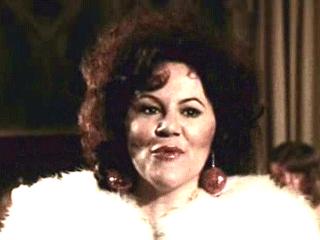
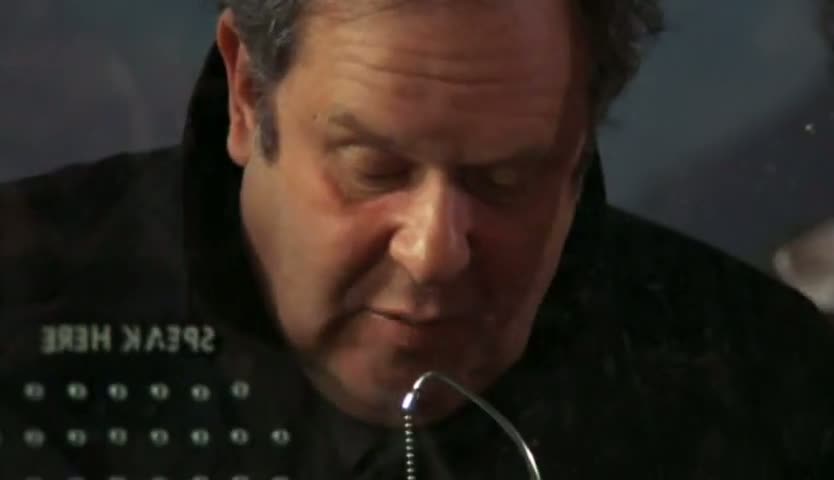
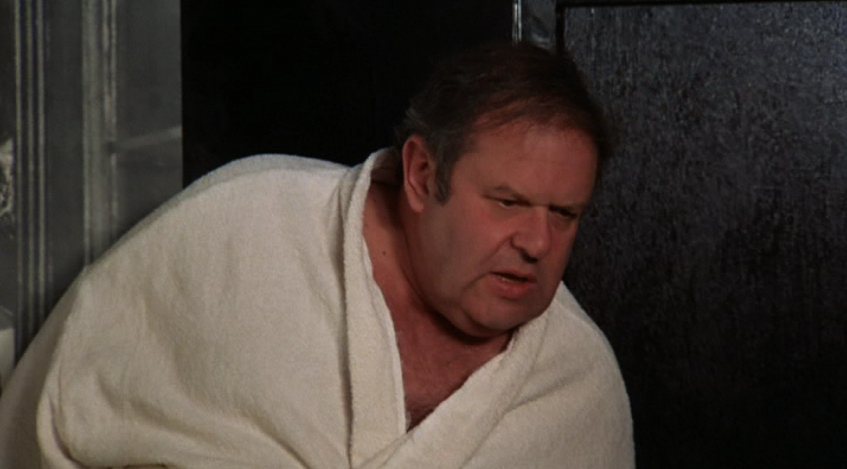
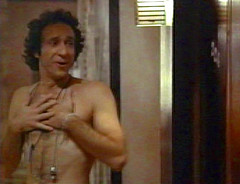
Today’s cinema adventure: Eating Raoul, the dark 1982 low-budget satire which became a surprise hit and helped to start a wave of goofy “camp” comedies that pervaded the rest of the decade.  Director/co-writer Paul Bartel, an exploitation cinema veteran, also stars with longtime friend and frequent co-star Mary Woronov as a married pair of sexual squares who lure “swingers” to their Hollywood apartment and kill them with a frying pan in order to finance their dream of opening a restaurant.  Macabre as the premise seems- and in spite of a plot which features such elements as rape, serial murder and cannibalism- the film is kept light and fun by a healthy dose of good-natured kitsch and by its ridiculously over-the-top portrayal of the lurid “swinger” culture and its sexually liberated denizens.  Bartel and Richard Blackburn’s screenplay is loaded with pseudo-shocking dialogue which exploits the ridiculousness of both prudish repression and extreme sexuality, peppered with great deadpan one-liners, and thematically unified by an exploration of the depravity hiding just under even the most respectable-seeming surfaces.  Clever writing aside, the primary factor in the film’s success is the charm of its leading players: Bartel is somehow likeable and endearing despite his pompously indignant and über-nerdy persona; former Warhol “superstar” Woronov is a complex confection, undercutting her character’s uptight austerity with smoldering sensuality and a girlish vulnerability; and the chemistry between these oddball stars is palpable- they are clearly driven by the same skewed vision.  Rounding out the main cast is Robert Beltran, equally charming and sympathetic as Raoul, the hot-blooded Latino hoodlum who attempts to blackmail and come between the couple- and whose ultimate fate is foreshadowed by the tongue-in-cheek title of the film.  In addition, there are some delightful cameos by comedic masters such as Buck Henry, Ed Begley, Jr., and the incomparable Edie McClurg.  The sordid proceedings play out against a now-nostalgic backdrop of seedy Los Angeles locations, accompanied by a quirky and eclectic soundtrack and driven at a brisk pace by Bartel’s quietly masterful direction.  Don’t get me wrong here- Eating Raoul is by no means a masterpiece, even in the world of underground cinema- it lacks the anarchic, subversive edginess of a John Waters film, and its “shocks” are pretty tame, even by 1982 standards- but it is nevertheless a delight to watch, perhaps because for all its satirical snarkiness and its unsavory subject matter, there is an unmistakable sweetness at the center of its black little heart.

http://www.imdb.com/title/tt0083869/

Fritz the Cat (1972)

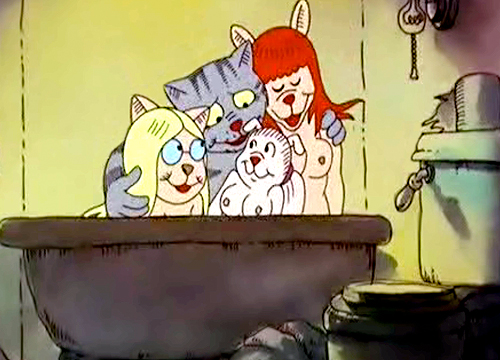
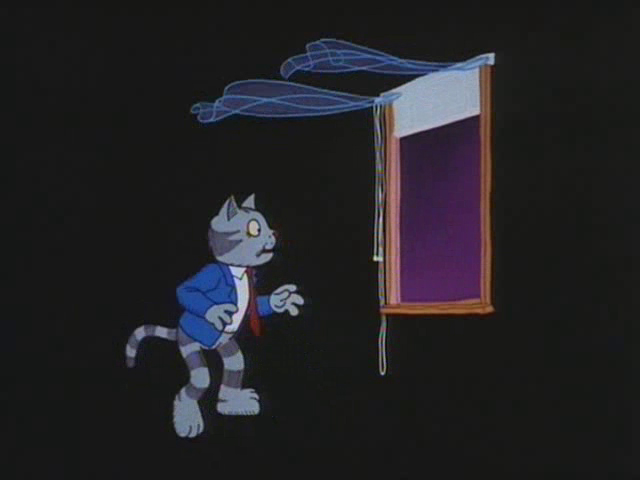
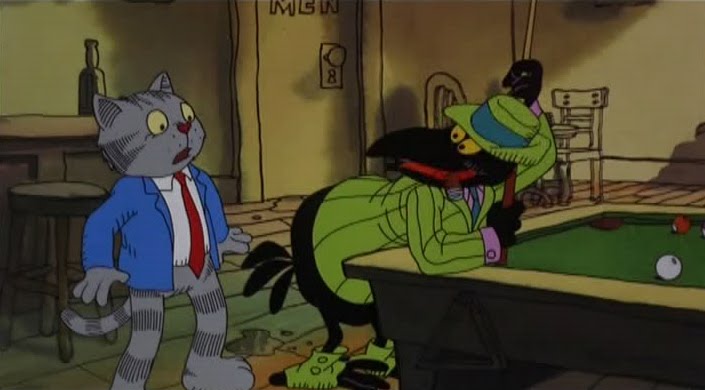
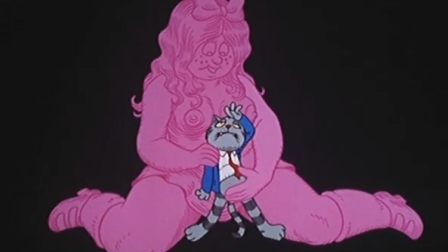
Today’s cinema adventure- Ralph Bakshi’s 1972 feature debut, his adaptation of R. Crumb’s underground comic, Fritz the Cat.  The first animated film to earn an “X” rating, it met with a lot of resistance and outrage from the mainstream, and Crumb hated it, disowned it, and tried to get his name taken off the credits- but it ended up being the most financially successful independent animated feature of all time.  Written and directed by Bakshi, the film follows Fritz as he takes a personal odyssey from a life of “hanging out” and looking for a good time through a drug-inspired pursuit of revolution- with plenty of shockingly permissive bad behavior along the way.  Voiced by Skip Hinnant (known for his work as part of the ensemble on the classic educational show, The Electric Company), Fritz is hardly a typical cartoon hero: far from cute, barely likeable, and nobody’s idea of a role model, he indulges in one ill-advised misadventure after another, motivated by selfish hedonism even when he is ostensibly acting for what he views as the greater good.  He serves as a sort of counter-cultural Candide, a naïve fool who fancies himself a sophisticate, and as such is at the mercy of a world more corrupt and complex than he imagines; in short, he is the kind of phony that the truly hip despise, and his journey of self-discovery in this worst-of-all-possible-worlds is a vehicle to expose social and political hypocrisy from every source, including (and especially) from our hero himself.  This ambitious agenda may have been beyond the scope of Crumb’s original work (he certainly thought is was), but for Bakshi, it was important for the film to make a statement, which it most certainly does- in between scenes of anthropomorphic animals having sex and taking drugs, that is.  Not that his intention was to shock: geared towards a drug-friendly youth culture, loaded with tons of juvenile sexual, political and racial humor, and mercilessly critical of both the radical left and the extremist right, the film is clearly aimed at an audience who shares his uncensored sensibilities.  At the time of its release, it was one of those films that generated protest and controversy from people who more than likely never saw it, and was cheerfully received by a target audience hungry for the kind of frank, turned-on content it offered.  Forty years later, most of its shock value and its topicality are long gone (one can see comparable content on any given episode of Family Guy today) and across the gap in time much of the film’s anarchic zeitgeist seems more than a little tiresome- as I suspect, to the more mature viewer, it did even then.  Still, as a piece of history, it is fascinating to watch: the animation, though primitive and almost quaint to modern eyes, was innovative and ground-breaking at the time; it presented adult subject matter and content never before seen in animation and completely changed the industry, breaking the stereotype of cartoons being only for children; and it vividly captures a particular social strata of 1960’s culture that is often ignored by popular memory.  I won’t say that you’ll enjoy it, but if you’re intrigued by looking through a window to a bygone era- and you’re open-minded and adventurous- you’ll be glad you watched it.

http://www.imdb.com/title/tt0068612/

The Ritz (1976)

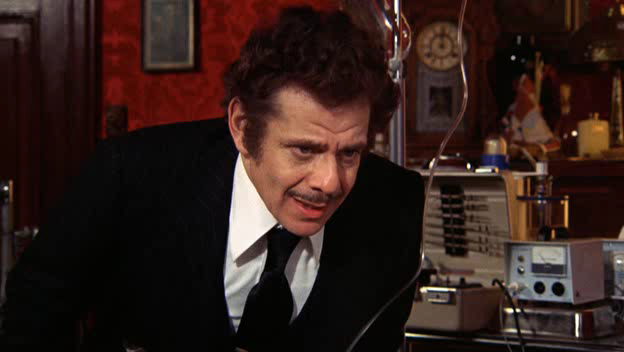
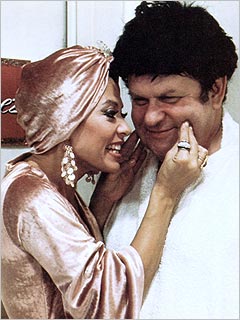
Today’s cinema adventure: The Ritz, the 1976 screen version of Terence McNally’s daring-for-its-day stage farce about a straight Midwestern businessman who hides out from his homicidal brother-in-law by checking into a gay Manhattan bathhouse. Directed by the legendary Richard Lester (known for a fast-paced, edgy style that made The Beatles A Hard Day’s Night into an instant classic) with a screenplay by the playwright himself, the film has aged into something of a curiosity of its time- a glimpse at bathhouse culture during the heady pre-AIDS era of the sexual revolution. McNally (who has become something of a gay poet laureate) made the brilliant move of taking the formula of a classic farce and placing it into what was at the time (and, sadly, to an extent, still is) a socially taboo setting; the result was a risqué piece of popular entertainment which brought underground gay culture into the spotlight and ostensibly took a small step towards making homosexual subject matter more acceptable for mainstream audiences. Unfortunately, by virtue of the requirements of the farcical genre, the characters (both gay and straight) are one-dimensional stereotypes which seem tired and offensive today, and the comedy has been rendered considerably less amusing by years of over-exposure to TV sit-coms in constant rotation. The highlight of the film is undoubtedly Rita Moreno, reprising her Tony-winning Broadway performance as Googie Gomez, a fiery Bathhouse Betty who gets caught up in the intrigue and (fortunately for the audience) performs a deliciously over-the-top lounge act for the boys; also of note are her Broadway co-stars, Jack Weston (as the hapless refugee), Jerry Stiller and future Oscar-winner F. Murray Abraham (as a flaming, self-appointed tour guide who manages to be likeable despite the heaping load of gay clichés he is required to carry), and an amusing turn by a young Treat Williams as a naïve (and squeaky-voiced) private detective. The rest of the cast fill their roles sufficiently well, Lester’s direction is sure-handed, and the look and feel of the seedy setting are captured quite authentically- but in 2012, the edge which once made it all so delightful has become painfully dull. The bottom line: as a piece of social and theatrical history, The Ritz is definitely important enough to warrant a viewing; but if you are just looking for some laughs and entertainment, you might want to skip it- or, better yet, fast forward to Rita’s scenes and just watch those.

http://www.imdb.com/title/tt0075144/

Young Adult (2011)

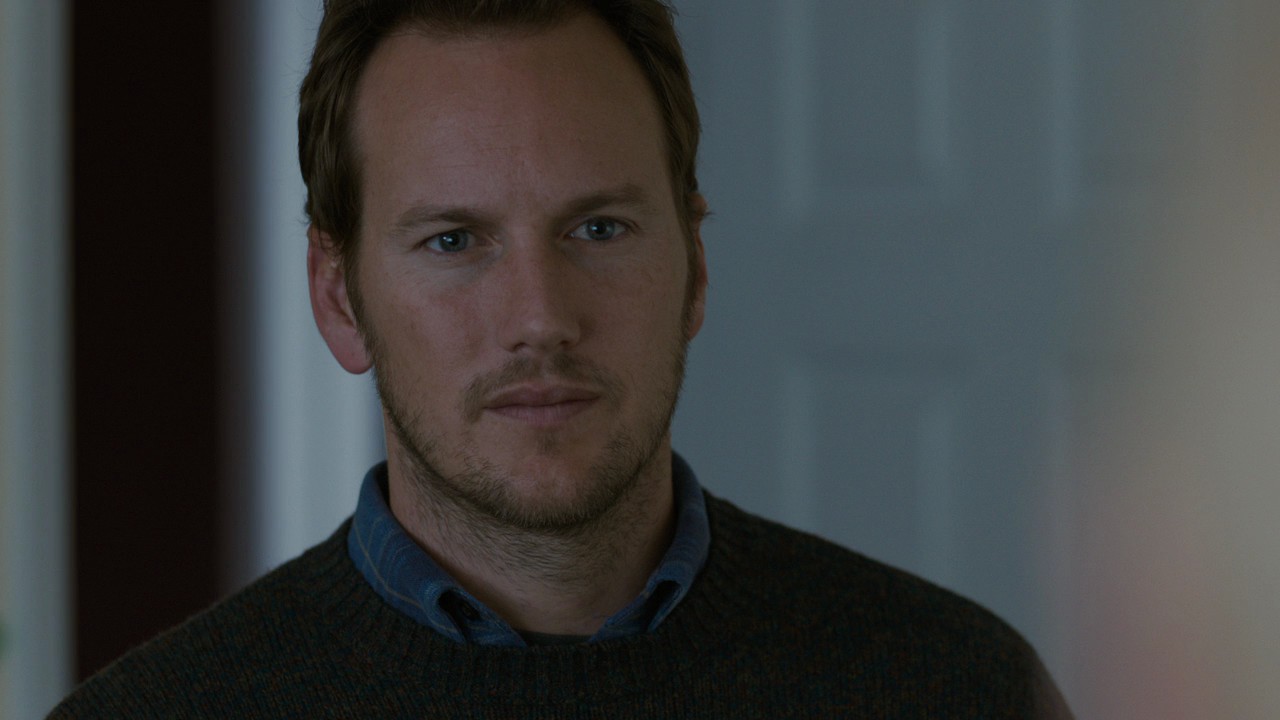
Today’s cinema adventure: Young Adult, the 2011 feature by writer Diablo Cody (Juno) and director Jason Reitman (Up in the Air).  Charlize Theron stars as Mavis, a hard-drinking thirty-something writer of teen romance novels, who attempts to resolve her fractured emotional life by returning to her small hometown and stealing her former high school sweetheart away from his wife and infant daughter.  Ostensibly a dark comedy, this piece is in fact a character study- and a bleak one- which hinges on the performance of Theron as its central character, and she rises brilliantly to the occasion.  The actress won an Oscar for playing a serial killer in Monster, and she equals that work here with her portrait of another kind of “monster,” an alcoholic whose arrested emotional development has her teetering on the brink of self-destruction, trying to use prom queen tactics in a grown-up world and unconcerned with the havoc she wreaks on the lives of those around her; but, even as Mavis’ downward spiral becomes increasingly embarrassing and her behavior grows more and more hateful, Theron succeeds in capturing the spark of humanity that allows us to see through the affectation and attitude to which she so desperately clings, and makes it possible, if not to sympathize with her, at least to understand her- and, a little unsettlingly, even to relate to her.  Providing a counterpoint to Mavis’ delusional shenanigans is Patton Oswalt, as an old schoolmate (disabled by a savage beating which may have been at least partly her fault) whose ability to see through her façade makes him both an antagonist and an unlikely ally; he delivers an unsentimental performance that keeps the character likeable while still underlining the dysfunctions that affect his own broken life.  Patrick Wilson, as the object of Mavis’ obsessions, is cast once more as the stolid-but-faded golden boy, a part which he fills to a tee- though it would have been nice to see his character laced with a little more of the darkness he has so brilliantly essayed in similar roles (Angels in America, Little Children, Watchmen).  The remainder of the cast is largely relegated to the background, where they serve as foils for the one-woman-show they surround; indeed, one of the film’s most significant characters is the scenery itself, an authentically realized small-town suburbia full of the bland and familiar icons of Middle American life, which provides a constant reminder of the comforting-and-maddening mediocrity from which- or to which- so many of us wish to escape.  As for the work of the film’s masterminds, Cody’s screenplay is full of the kind of edgy hipster irony we have come to expect from her, infusing the dialogue with a double-edged wit that makes us cringe even as we chuckle; and Reitman’s direction displays his easy skill with visual storytelling, effortlessly blending revelatory character detail and thematic reinforcement within the straight-and-steady unfolding of the narrative.  It should be said, however, that Young Adult, though strong on observation, comes up a bit short when it comes to insight; in the end, despite the exposure of numerous key moments in Mavis’ life, we are really no closer to understanding what makes her tick.  Still, perhaps it is wrong to expect easy answers in a story about an alcoholic’s decline; and even though Young Adult  lacks the disarming freshness of Juno or the unexpected emotional resonance of Up in the Air, both its creators deserve considerable praise for making a film brave enough to favor realism over sentiment by refusing to redeem or resolve.  Though there are plenty of genuine laughs here (albeit somewhat morbid ones), this film is not for the squeamish; the rest of us, however, will be refreshed by the rare honesty behind it- and rewarded by the magnificent performance of its leading player, who continues to prove that, as beautiful as she is, it is her talent that makes her a star.

http://www.imdb.com/title/tt1625346/