Kubo and the Two Strings (2016)

kubo-and-the-two-strings-poster-the-ice-fields


Today’s Cinema Adventure was originally published in

The Pride L.A.

There is a popular perception that animated movies are pure kid-stuff, designed to lure families to the box office and to generate lucrative marketing tie-ins.  After all, animation pioneer Walt Disney used this formula as the foundation for a financial empire that continues to dominate the entertainment industry today.  Of course, Disney’s films (at least the early ones) were also artistic triumphs, and there have since been numerous others that rival them in stature.  Nevertheless, even the most open-minded critics often tend to join the general public in considering “cartoons” as belonging to a separate-and-unequal category from live-action filmmaking, and often overlook them in any discussion of serious cinema.

This intellectual bias may often be warranted; but occasionally, a film like “Kubo and the Two Strings” comes along to challenge it.  Set in Ancient Japan, it’s the story of a boy who lives with his strangely afflicted mother in a cave by the sea.  Every night, she tells him half-remembered tales of his long-lost Samurai father; every day he spins them into adventurous yarns to entertain the nearby villagers- aided by magic which allows him to manipulate pieces of paper with the music from his shamisen. He is careful, though, to heed his mother’s warning and return home before nightfall, in order to avoid the watchful eye of his grandfather, the Moon King, who wishes to steal him away to his kingdom in the sky.  One day, however, Kubo lingers too long at a village festival, and suddenly finds himself caught up in an adventure of his own- aided by a monkey and a man-sized beetle, with his two terrifying aunts, the Daughters of the Moon, pursuing him every step of the way.

This deceptively simple setup provides the basis for a magnificent visual journey, full of magic, which blurs the lines of reality and challenges us to jump seamlessly between different levels of existence.  This is no small feat, and the fact that we never question it is a testament to the brilliance of its technical execution- the bulk of which was performed using the same basic techniques that took King Kong to the top of the Empire State Building over 80 years ago.  Though some assistance was provided by modern CG technology, most of what we see on the screen was achieved by posing models, one frame at a time, in front of a camera.  This painstaking effort certainly pays off; Kubo’s story comes to life with such palpable reality that the viewer might almost forget to be dazzled by it.

What’s impressive about “Kubo and the Two Strings,” though, is that its story more than lives up to the technical wizardry surrounding it.  Though it evokes the traditional folk tales of Japan, “Kubo” is entirely original, its screenplay written by Marc Haimes and Chris Butler from a story by Shannon Tindle.  Even so, as guided by director Travis Knight, it maintains a strong sense of mythological authenticity as it delivers its own version of the classic hero’s journey; the mystical elements which comprise much of the story’s framework are presented as factual conditions of the plot, yet the deeply resonant symbolism they possess- a quality downplayed by most such films aimed at contemporary American audiences- is given equal weight.  Similarly, while the film doesn’t avoid sentimentality, it never manufactures it to generate an unearned emotional response; rather, it allows the story and its characters to provide it, in appropriate doses, when it arises naturally.  As a result, “Kubo” manages to amuse, frighten, touch, and surprise its viewers- whatever age they might be- all the way through to its lovely, delicate, and bravely bittersweet ending.

Of course, there are many other factors contributing to the film’s success.  Its visual design is a marvelous blend of stylization and historical detail, effectively transporting us to the story’s time and place from the very first frames- with the aid of a majestic and immersive score by Dario Marianelli.   As for the voice cast (led by Art Parkinson as the title character and including the likes of Charlize Theron, Matthew McConaughey, Rooney Mara, and Ralph Fiennes), it must be mentioned that “Kubo” has drawn some heat for using mostly white actors.  Conroversy aside, those actors deserve credit for their fine work, which plays a big part in making “Kubo” into the special experience it is.

It’s a bit early to start making lists of the year’s best films, but when the time comes, I think it’s a safe bet that “Kubo and the Two Strings” will be on a few of them- anti-animation prejudices notwithstanding.  It fully deserves that honor.  It’s a multi-layered, visually stunning work which tells a powerful story without pandering to its viewers- and a film like that, animated or not, is very rare indeed.

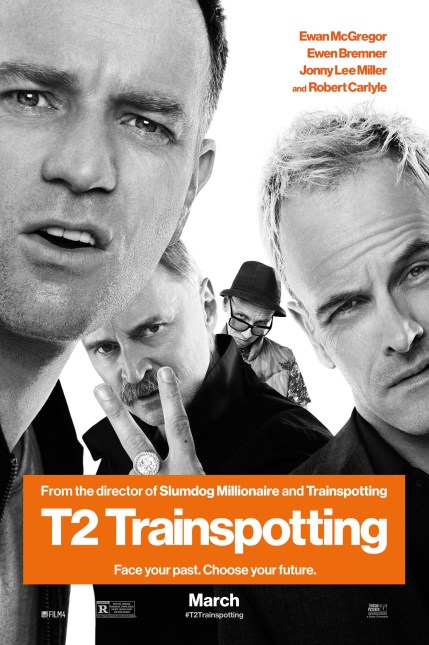
T2: Trainspotting (2017)

t_two_trainspotting_ver6_xxlgToday’s Cinema Adventure was originally published in

The Los Angeles Blade.

A little over two decades ago, though English director Danny Boyle had built a reputation in his native country with his work in theatre and his first movie had just won a BAFTA award, he was still an unknown quantity to the rest of the world.  That changed when his second feature roared onto screens in 1996; immediately embraced by audiences and heralded by critics as a rebirth of Great British Cinema, it became an instant pop culture phenomenon, and suddenly his name was no longer as obscure as the quaint English pastime from which it drew its title.

That movie was, of course, “Trainspotting,” and twenty years later, thanks to its enduring popularity, it has gained iconic status.  Now, at least partly for the same reason, it has also gained a sequel.  Still, “T2: Trainspotting” is no mere effort at pandering to fans; Boyle, now an Oscar-winner and power player, has long spoken of a desire to revisit his breakthrough film because he felt there was still a story to be told.  With the help of original screenwriter John Hodge, he has mined the source novel (by Irvine Welsh) and its follow-up, “Porno,” to flesh out that story, and re-enlisted the now-considerably-craggier original cast to bring it to life.

For those who need a refresher, “Trainspotting” followed the wild-and-wooly exploits of a cadre of young mates – Renton (“Rent Boy”), Daniel (“Spud”), Simon (“Sick Boy”), and Franco (“Begbie”) – as they tried to navigate life (and heroin addiction) in the economically depressed slums of Edinburgh.  It ends with Renton leaving his friends behind in the squalor of their dead-end lives, as he escapes with the hope of building a better one for himself.  “T2” rejoins them 20 years later, as he returns to make amends.  Things aren’t much different, despite the intervening years.  It’s as if time has stood still for these men, or rather they have stood still while time passed them by.  Their world is still defined by the blight of poverty, and the oft-repeated catchphrase, “Choose Life,” seems as much a gilded lie as it was in their youth.  And of course there are still the drugs, with their insidious allure, and the abdication of responsibility which comes with them.  This time around, though, percolating under it all, are a host of long-buried conflicts- with each other and with themselves- which their reunion inevitably brings to the surface.

Boyle directed “Trainspotting” with the exuberant, visually engaging style which has marked his entire output.  Driven by irreverent energy, it was in turn dizzyingly joyous and harrowingly dark, laced with absurdity and irony, and marked by a refusal to rely on the tropes of social realism.  That same vision propels “T2”: it shares the same essential elements (arresting camerawork, bright colors, free-associative imagery, an edgy pop-music soundtrack), and adds a touch of self-referential humor to the mix (clever acknowledgment of the notoriously thick Scottish dialects, for instance, and several nods to the original’s iconic toilet scene).  The new film unquestionably feels like a natural extension of the old- perhaps a bit more sophisticated, and maybe a bit mellower, but no less audacious.

The cast clearly relishes its chance to revisit these characters.  Leading it, of course, is Ewan McGregor as Renton, bringing the same intelligence and good nature which allows us to like this character even when his choices strike us as questionable.  The formidable Jonny Lee Miller is every bit his equal, managing to be somehow lovable as Sick Boy, the inept con artist on the other side of their precarious bromance.  Ewen Bremner is again both comical and heartbreaking as Spud, and Robert Carlyle gives us a Begbie whose ferocity and haplessness have only been magnified by the passage of time.  Finally, new addition Anjela Nedyalkova brings a complex blend of warm and cold- along with a fresh perspective- into the mix as Simon’s Bulgarian girlfriend, Veronika.

When a sequel appears to such a revered original, there is always a question of worthiness.  The intervening years have added layers of resonance which help to make “T2: Trainspotting” a compelling two hours, and Boyle and company have certainly brought the same level of energy and expertise to the table.  Its quality is undeniable.  Is it a masterpiece of the caliber of its predecessor?  Not quite.  Does it add something essential to the story?  Perhaps not.  Nevertheless, any film as intelligent, superbly executed, and downright entertaining as this one will always be welcome- and that not only makes it necessary, but very worthy indeed.

Florence Foster Jenkins (2016)

ffj_1sht_characters_meryl

Today’s Cinema Adventure originally appeared in

The Pride L.A.

Walking into the theater to see “Florence Foster Jenkins,” it’s a given that you are about to watch another tour-de-force by Meryl Streep.  I’ll waste no time in saying that she delivers on that expectation.  The story of a real-life society matron who realized her life-long dream of singing at Carnegie Hall despite a complete inability to carry a tune, this bio-pic is tailor-made for her talents; it can be no surprise that she gives arguably her most delightful performance in years.

What’s surprising is that nobody sharing the screen with her disappears behind her shadow.  On the contrary, her co-stars contribute just as much as she does to the movie’s overall charm, helping it to become much more than just a showcase for the talents of a beloved silver-screen diva.

To give full credit, it is necessary to recognize that this is not just a Meryl Streep vehicle, but the latest entry on the resumé of British filmmaker Stephen Frears, who first gained international recognition with his iconic 1985 gay romance, “My Beautiful Laundrette,” and who has helmed a number of prominent movies over the decades since- “Dangerous Liaisons,” “The Grifters,” “The Queen,” and “Philomena,” to name only a few.

No stranger to working with legendary talent, one of Frears’ great strengths as a director is his ability to enlist them in the service of his own sure-and-steady storytelling skills, allowing them to be actors instead of stars, and to enhance his work instead of dominating it.  It’s an approach geared towards the character-driven projects he prefers; his movies, though they often involve unorthodox situations or famous figures, are always ultimately about universally-shared human experience, and they benefit from the workmanlike performances though which he guides his players.
In this case, of course, the incomparable Meryl is front-and-center, as she should be.  Her Florence has all the hallmarks of a great Streep role.  She is a larger-than-life personality, almost cartoonish, but in Streep’s hands she is never anything less than completely, believably human.  She displays impeccable comedic abilities in one moment and slips seamlessly into heartbreaking pathos the next, without ever relying on clownish mugging or heavy-handed sentiment- and on top of it all, she does her own bad singing without sounding like she’s trying to sing badly.  In short, she gives the kind of performance that has put her in the echelon of such stars as Hepburn and Davis.

Even so, she is not the whole show.  The movie’s real surprise is certainly Hugh Grant.  Usually regarded more as a personality with a pretty face than as a high-caliber actor, he more than rises to the occasion here as Florence’s devoted (if not-quite-faithful) husband, who uses his connections in both the high and low strata of New York society to help her accomplish her improbable dream.  Carrying himself with the slightly-obsequious swagger of a ne’er-do-well cad, he undercuts that demeanor with a layered performance which never leaves you in doubt of his sincerity.  His aging-but-still-handsome features convey a depth of feeling which reveals “Florence Foster Jenkins” to be, at its core, a love story.

In the third key role, Simon Helberg (of “The Big Bang Theory”) portrays Florence’s reluctant accompanist, Cosmé McMoon, in a style which (in keeping with the film’s period setting) suggests the codified “sissy” characters of old Hollywood.  His homosexuality is never explicitly addressed, but the film derives some good-natured humor from his obvious orientation- which, rather than demeaning or marginalizing him, serves to place him, along with all such characters, in his rightful role as an integral part of society.  Queerness aside, Helberg gives us a marvelous serio-comic turn as a timid outsider who finds the strength of his own spirit through his dedication to his unlikely employer; he fully earns the right to share the screen with his two co-stars.

The rest of the cast, though their names and faces are less recognizable, are equally effective in portraying their roles.  In addition, the film benefits from breathtaking production design (by Alan MacDonald) and sumptuous costuming (by Consolata Boyle).  Finally, as is always the case for a strong film, the screenplay (by Nicholas Martin) is well-crafted, literate, and thoughtful, providing a strong foundation upon which the other artists can build their own great work.

“Florence Foster Jenkins” is not a deep or ground-breaking piece of cinema.  It’s a refined crowd-pleaser, a serio-comic slice of life designed to touch and delight its audiences.  That’s not a bad thing.  In a summer filled with noisy blockbusters, it’s refreshing to be treated to a movie with such quiet class- particularly when it has as much talent on display as this one.  After all, when a Meryl Streep performance is just the icing on top, you know that has to be one delicious cake.

Weiner-Dog (2016)

wiener-dog-poster01

Today’s Cinema Adventure originally appeared in

The Pride L.A.

Todd Solondz doesn’t make movies to offer you an escape from your problems; he makes movies to confront you with them.  Ever since his 1995 breakthrough, “Welcome to the Dollhouse,” he has repeatedly offered up grim, uncomfortable stories of the dysfunction lurking just beneath the banal surface of suburban American life.  His films are variations on the interconnected themes of failure, depression, and emotional isolation.  Not exactly the stuff blockbusters are made of.

Yet the quirky writer/director has developed a loyal cult following who continue to be mesmerized by his sardonic vision of the world and the broken, faltering lives of the people who live in it.  Indeed, there is an almost masochistic fascination to these sad little fables of modern life, not unlike that can’t-look-away feeling you get when passing a gruesome accident scene on the highway.  Coupled with this morbid appeal is his tendency to feature recurring characters in his films (usually portrayed by different actors) alongside the new ones.  The desire to see what has happened to some of these familiar figures (and the hope that they have somehow managed to improve their dismal lives) is undoubtedly key in keeping his fans coming back for more, and it provides a major hook for the filmmaker’s latest effort, “Weiner-Dog.”

Those familiar with “Dollhouse,” which remains Solondz’ most popular and successful work, will immediately recognize this title as the nickname bestowed on that film’s pathetic anti-heroine, middle-schooler Dawn Wiener.  Though clearly intended to invoke that connection, and though that much-beloved character does indeed make her long-anticipated return here, in this case the name refers to a new central figure- a dachshund who becomes the pet of four different, unconnected people through the course of her life.

First, she is gifted to a young cancer survivor, Remi (Keaton Nigel Cooke), providing the boy with a brief respite from the stark home environment created by the antagonistic and seemingly loveless marriage of his affluent parents (Julie Delpy and Tracy Letts).  Then, she is adopted by the now-adult Dawn Wiener (the gifted Greta Gerwig)- still awkward and desperate for affection- who takes her along for the ride as she accompanies an old schoolmate on a road trip.  Changing hands again, she becomes the pet of Dave Schmerz (Danny DeVito), a has-been screenwriter barely clinging to his job as an unappreciated teacher at a film academy.  Finally, she ends up as a companion animal for Nana (the always-stellar Ellen Burstyn), an elderly and misanthropic invalid who receives a surprise visit from her long-absent granddaughter, Zoe (Zosia Mamet).

That’s it.  The dog connects the segments by her presence, but otherwise these are stand-alone vignettes, composed around Solondz’ usual themes and exploring the various ways in which human beings treat each other- and themselves- very badly.  As anyone familiar with the director’s work would anticipate, there’s not much hope to be found in these stories, and where there are glimmers of it they are subverted by the surrounding circumstances; and yet, the film has a strange and terrible beauty.

This is the hallmark of Solondz’ work; he shows us life at its cruelest and most demeaning- almost always with the explicit qualifier that it is we ourselves who are responsible- and yet he makes it somehow lovely.  He also makes it darkly funny; he is, above all, a social satirist whose stunted, minimalist dialogue conveys both depth of insight and an arch sense of ironic humor that revels in making us laugh at the things which most disturb us.  It might be argued that the laughter is a defensive reflex, a release of uncomfortable tension; this may be true, but it’s an authentic response, nonetheless.

Cut from the same cloth as his earlier films, this is perhaps Solondz’ most elegantly-made work to date.  Cinematographer Ed Lachman delivers a low-key study in composition that subtly elevates the aesthetic and allows us just enough of a cool perspective to distance ourselves without being able to completely detach.  That’s important, because Solondz wants us to reconnect with the primal emotions- fear, shame, guilt, loneliness, resentment- within us all.  He warns us that if they are left in the darkness to be stoked by our failures and losses, they can make our lives like those he shows us on the screen; those lives might seem absurd, exaggerated, and extreme, but he never lets us believe they are anything other than truthful.  Brutally truthful.

For non-Solondz-fans, it should be noted that “Weiner-Dog” (like all of his work) is likely to put off many viewers.  It’s bleak and unrelenting, with a pall of despair that hangs over it from beginning to end.  Animal lovers, especially, should be warned to consider carefully before seeing it; for the sake of avoiding spoilers, I’ll just leave it at that.

1473523071_skrin3


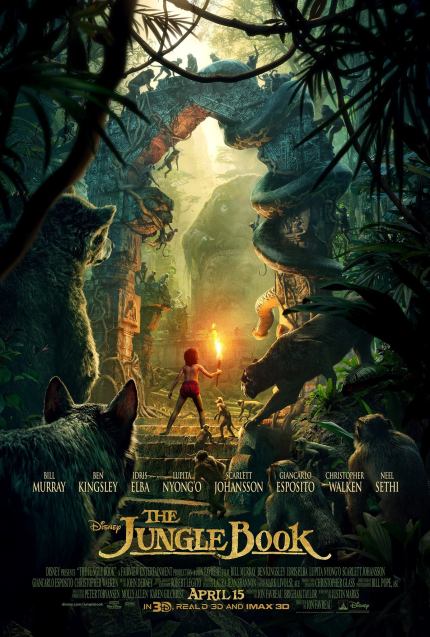
The Jungle Book (2016)

affiche-internationale-le-livre-de-la-jungle-film-04

Today’s Cinema Adventure originally appeared in
The Pride L.A.

Rudyard Kipling was a product of his era.  An Englishman born in Colonial India, he grew into a prolific author and poet whose canon was informed by his childhood experiences there.  Though his literary gifts were undeniable, and much of his work is still widely read more than a century later, he has come to be seen as a champion of British Imperialism.  The world view of white-privileged conquerors, with their assumption of racial superiority over the indigenous populations they subjugated, is deeply embedded in the fabric of all his stories- including the much-beloved children’s tales for which he is most remembered today.

Needless to say, in a modern world keenly aware of the issues surrounding race, this makes him a controversial figure.  He is regarded by many as an unapologetic racist whose writing, even at its finest, was little more than propaganda for the cause of white supremacy.  Others vehemently insist that he was a humanist working from within the system to illuminate both the noble and ignoble traits of all people and thus promote a more egalitarian mindset.  Arguments and evidence are plentiful in support of either side, as well as of the myriad viewpoints which lie somewhere between those two poles.

Of course, the majority of modern moviegoers are unaware of this literary debate, which is undoubtedly why two major studios have both developed family-friendly blockbusters based on the most well-known of Kipling’s stories: “The Jungle Book.”  The first of these, directed by Jon Favreau from a screenplay by Justin Marks, is the Disney studio’s latest effort to remount one of their animated classics as a live-action film for the 21st Century generation.

Their previous version- the final film personally overseen by Walt Disney himself- was released in 1967, and though it has become a cherished favorite to those who grew up with it, at the time it was heavily criticized for taking Kipling’s rather solemn original and turning it into a rollicking, jazz-infused comedic showcase for a star-studded cast of voice talent.

This time around, Marks and Favreau have doubled down on that same approach, while also expanding the basic story framework to include elements from the Kipling tale (or rather, tales- what we have come to know as “The Jungle Book” is actually derived from several short stories concerning the man-cub, Mowgli, and his adventures in the jungle with his animal mentors).  The result feels like a satisfactory blend, a best-of-both-worlds crowd-pleaser which captures the serious tone and allegorical flavor of Kipling while still delivering the good-natured hi-jinks expected from a studio known for its fun-for-all-ages romps.

It’s also a technical masterpiece.  The use of CGI and performance-capture technology has yielded a breathtaking visual experience, giving us a lush and majestic experience of the Indian wilderness as well as remarkably believable depictions of the animals which comprise most of the cast of characters.  This latter element also benefits from superb vocal portrayals by the likes of Ben Kingsley, Scarlett Johansson, Idris Elba, Christopher Walken, Lupita Nyong’o, and the always-welcome Bill Murray.  Perhaps most importantly, newcomer Neel Sethi gives an on-point performance as Mowgli, a remarkable accomplishment for a young actor whose work took place on a soundstage far removed from the world on display in the finished product.

Yet for all its excellence, this new “Jungle Book” feels somehow overdone.  There’s a “bigger-is-better” philosophy at play which detracts from its meticulously-constructed authenticity; a larger-than-life quality may be appropriate to the material, but is it really necessary, for instance, for King Louie to be the size of King Kong?  Although Marks’ screenplay does a good job of underlining the humanistic parallels with the animal kingdom, the sincerity of his intentions is steamrolled by heavy-handed execution, perhaps most tangibly in the manipulative orchestral swellings of John Debney’s score.  And on the subject of music, the inclusion of the best-known songs from the 1967 film not only seems perfunctory, but also jarringly incongruous within the realistic environment created to evoke the period and setting of the story.   .

These observations are, of course, likely to be immaterial to most of Disney’s target audience- perhaps rightly so.  After all, whatever his socio-political philosophies may have been, Kipling wrote his Mowgli stories to entertain, and “The Jungle Book” certainly succeeds in doing justice to that purpose.  Still, one can’t help but wonder how much richer it could have been made by a subtler hand, one that might have allowed for a bit of reflection on how to reconcile our modern sensibility with the more troubling issues contained in an iconic tale that, like it or not, is deeply ingrained into our cultural consciousness.  Perhaps we will find out in two years, when Warner Brothers releases their take on it.

Until then, this one will do well enough.

junglebook1

Viva (2015)

210827

Today’s Cinema Adventure originally appeared in

The Pride L.A.

There’s a comparatively high level of visibility for drag performers on the entertainment scene today.  Not long ago, they were known only to the LGBT community and a few savvy “straights;” now, thanks to widening acceptance, you would be hard-pressed to find anyone not at least marginally aware of “RuPaul’s Drag Race,” or of movies like “Kinky Boots.”  While still not exactly mainstream, drag has emerged from the gay bar and planted its cha-cha heels firmly on the stage of popular culture.

Most of the time, we are treated largely to the finished product of an artist’s long struggle towards triumphant self-expression.  This is as it should be; drag deserves to be celebrated for its own merit.  Still, it’s been decades since “Torch Song Trilogy,” and the time seems ripe for a new story about the offstage life of a queen.  Thanks to film director Paddy Breathnach and screenwriter Mark O’Halloran, we need wait no longer.

Set in the slums of Havana, “Viva” follows Jesus, a gay eighteen-year-old who supports himself by styling hair for his female relatives- and the wigs of the queens at a local drag club.  Given a chance to perform himself, he is just beginning to blossom when his father Angel- a “local hero” boxer who abandoned him at the age of three- suddenly returns to his life.  Angel- a homophobic macho man- insists on moving in with his son and refuses to allow him to continue working at the club.  Torn between his longing for a father he never knew and his new-found self-expression, Jesus must forge a relationship with this stranger and attempt to build a bridge between their seemingly incompatible worlds.

From its very first scenes, “Viva” promises to be the story of an awkward gay boy’s evolution into a fabulous queen.  It delivers on that promise, but not by taking the expected route.  Though it starts us through familiar territory- the trying on of wigs and outfits, the catty dressing-room banter, the obligatory jokes about tucking- it suddenly (and literally) stops us in our tracks with a punch to the face.  From that point forward, Jesus’ story is less about the outer trappings of drag and more about the inner journey that will eventually bring power and passion to his stage persona- and give him the strength and integrity necessary to live truly as himself.

We’ve seen the hard-knock, emotionally dysfunctional background of such a character before, of course, but in the past it has usually been portrayed as something to rise above, with drag as both protective armor and triumphal raiment.  Here, though, Breathnach and O’Halloran give us a new take, in which their protagonist embraces his hardships instead of enduring them.  It’s a subtle change of focus, underscoring a shift into a new era in which there’s a chance for those who don’t conform to societal “norms” to be true to themselves without having to live a life apart.

The key reason that “Viva” has resonance at a societal level is that O’Halloran’s script avoids politicizing or pontificating and instead focuses on an intimate relationship between father and son.  In their negotiations, Jesus and Angel serve as stand-ins for their respective generations- and if these two men can gain acceptance from each other, there is hope for us all to do the same.  Director Breathnach understands where the strength of his movie lies; other than making sure that the Havana location (described by Angel as “the most beautiful slum in the world”) is magnificently captured, he wisely keeps his cinematic styling simple and direct, allowing his cast to dominate the screen.

It helps that the actors- especially the movie’s two handsome co-stars- are up to the challenge.  The movie naturally belongs to Héctor Medina; the young actor combines sensitivity and strength, his expressive face allowing us to experience Jesus’ journey with him, and caps it with a climactic performance in which he brings the film’s title character into a full, electric life of her own.  As Angel, Jorge Perugorría embodies the hubris of culturally-bestowed entitlement, yet infuses his character with the humanity necessary to invite love and compassion.  Providing an important third perspective to their dynamic is Luis Alberto García, who elegantly avoids stereotype as “Mama,” the drag club owner who takes Jesus under his wing.

Though it’s an Irish-made movie, “Viva” is spoken in the Spanish appropriate to its Cuban setting.  This might be a challenge if you are subtitle-averse, but to skip seeing it would be a mistake for anyone who longs for world-class LGBT-themed cinema.  By eschewing heavy-handed tactics, it takes a story which, in the not-too-distant past, might have been a tale of despair and tells it instead as parable of hope.

29viva-facebookjumbo


Midnight Special (2016)

Today’s Cinema Adventure originally appeared in

The Pride L.A.

MIDNIGHT SPECIALadamdriverAndjaedenlieberher

Movie “mash-ups” are a hallmark of our Postmodern era.  It is as if everything that has come before in cinema has been collectively smashed into pieces, and filmmakers freely pick up whatever shards they like and combine them to make something new.  It doesn’t matter if the pieces are recognizable, nor is it necessary to justify the appropriation by calling it an “homage.” This is, arguably, how it should be.  Each generation redefines the culture on their own terms, and it has always been standard practice for artists to “borrow” from those who have exerted a strong influence over their own work.  However, when they are not driven by a cohesive vision that makes the whole greater than the sum of its parts, far too many films fall short, no matter how sincere their creator’s intentions may be.  Unfortunately, “Midnight Special,” the newest feature from writer/director Jeff Nichols, is one of them.

Drawing heavily on the work of Steven Spielberg in his heyday, it combines several genres- chiefly science fiction and family drama- to tell the story of Alton (Jaeden Lieberher), a boy with mysterious powers who has been kidnapped by his father, Roy (Michael Shannon), from the compound of a religious cult that believes he is their only hope to survive the imminent apocalypse.  With the help of an accomplice, Lucas (Joel Edgerton), the fugitives flee across the country in an attempt to reunite with the boy’s mother (Kirsten Dunst) and journey towards a mysterious destination to which Alton’s visions seem to be leading them- all the while trying to stay ahead of the cult’s operatives as well as a government task force, spearheaded by Paul Sevier (Adam Driver), that wants to find Alton for reasons of their own.

There are a lot of threads to follow in “Midnight Special.”  Nichols takes his time unraveling them for us, and doles out information sparingly as he goes.  In the first few minutes, he effectively introduces us to the main elements of his premise; from this point on, however, his film develops into a continuing series of complications, each one serving only to lead to the next, while offering only the merest scraps of information about the deeper mystery at the heart of the proceedings.  By the time we get to the big revelation- which is simply announced to us, somewhat anti-climactically- we have already been led through so many confusing turns that it’s difficult to still be invested in the outcome.

Of course, anyone familiar with Spielberg’s “Close Encounters of the Third Kind” will sense from early on where the story is going.  “Midnight Special” has so many echoes of that classic (among others) that it is hard not to compare the two works.  To go into detail about the connections would spoil the current film, but it is worth noting that the things that make Spielberg’s movie so memorable are painfully absent here.  The sense of adventure is replaced by a feeling of impending doom; and although both movies center on families threatened and pulled apart by momentous events, “Close Encounters” nevertheless manages to be joyous and fun while “Midnight Special” struggles to stay just this side of despair.  It’s fair to say that they are different movies from different eras, but one still cannot help but think that Nichols movie takes itself far more seriously than needed.

It’s not the fault of the cast, who mostly deliver heartfelt performances.  Young Lieberher is engaging and likable while still managing to be suitably grave.  As his adult protectors, Shannon, Dunst, and Edgerton all play admirably against sentimentality, and if they come off as unrelentingly dour it seems more a function of the script and direction than the integrity of their work.  As the cult leader, the venerable Sam Shepard (whose presence underscores strong parallels with another vintage film, Daniel Petrie’s “Resurrection”) provides understated sorrow instead of predictable menace.  The standout performance, though, comes from Driver, whose turn as the government expert trying to unlock Alton’s secrets evokes the wonder and excitement so sorely missing from the rest of the film.  His screen time is all too brief.

“Midnight Special” is not a complete failure; it offers an intriguing exploration of the way that belief- whether in religion, science, or worldly concerns- can keep us blinded to truths that lay outside our understanding, and it avoids pandering to its audience with easy answers or familiar clichés.  In the end, though, there is little payoff for these ruminations, and the movie leaves us wondering far more about the details of its plot than the implications of its ideas.  It disappoints us more than it challenges us- and considering the sources from which it draws its inspiration, it is a strong disappointment, indeed.

Anomalisa (2015)

ANOMALISA

Today’s Cinema Adventure originally appeared in

The Pride L.A.

Screenwriter Charlie Kaufman has completed only a small handful of features since his 1999 debut (“Being John Malkovich”), yet despite his relatively sparse output, his name and reputation loom large, particularly among those cinephiles whose tastes run toward the edgy and intellectual.  His narratives, which seem to flow from dream logic rather than dramatic structure, are more like psychological case studies disguised as heavily symbolic brain-teasers, inhabited by figures that feel less like individual characters and more like shattered fragments of a single personality.  His latest effort takes the form of an animated film, but though “Anomalisa” is markedly different in its execution, it is cut from the same unmistakable cloth.

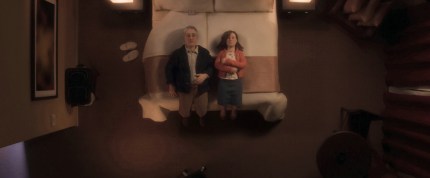
Kaufman’s screenplay is adapted from his own “sound play” of the same title, and, for the second time (the first was for 2008’s “Synecdoche, New York”), he steps into the director’s chair, as well- though he shares it with co-producer Duke Johnson.  It focuses on Michael Stone, a successful self-help author who travels to a Cincinnati hotel in order to speak at a conference.  Though he is an expert on interpersonal relations, Michael is unable to distinguish people as individuals.  Everyone with whom he interacts possesses the same male face and voice- even the women- until he encounters Lisa, a young woman attending his seminar.  She is distinctively herself within the sea of homogeneous banality that surrounds him, and he begins to hope she can at last release him from the boredom and isolation he has felt for so long.

The above description may not read like the synopsis to an animated film, but “Anomalisa” is no ordinary animated film.  Shot in stop motion style, it utilizes puppets partly manufactured by 3-D printing, resulting in a somewhat unsettling effect that is simultaneously stylized and naturalistic.  It’s an effective style for the story being told; the world of the movie seems concrete enough to anchor it in reality, allowing us to forget the animated format as we are gradually drawn into the premise.  Much of the credit for this aspect of “Anomalisa” belongs to co-director Johnson, who supervised the creation of its technically stunning, intricately detailed animation.

The content of “Anomalisa,” while equally as creative as its visuals, is perhaps less innovative- at least to those familiar with Kaufman.  As with most of his work, it’s an observational fable that takes place within a Kafkaesque landscape of psychological dysfunction.  It challenges our ideas about the nature of identity and explores the effects of perception on our experience of the world around us.  It presents characters unable to make the emotional connections they desperately desire, who live in private bubbles of perspective and fumble blindly in their interactions with others.  And then there are the puppets; puppets have always figured prominently in Kaufman’s imagination, and here, they even take the place of live actors.  To say the film revisits Kaufman’s recurring themes is by no means a negative criticism, however.  On the contrary, those themes strike deep and resonant chords; they always yield new insights into our shared human experience, and the writer’s quirky imagination ensures that his work is always full of surprises.

Though the provocative ideas and visuals are the real stars here, credit also goes to the fine work of the voice cast.  David Thewlis (as Michael), Jennifer Jason Leigh (as Lisa), and Tom Noonan (as everyone else) eschew the usual exaggerated vocal styling of animation in favor of a nuanced, naturalistic approach.  Their effectiveness is likely due in large part to the fact that all three performed their roles in the original play, as well.  Composer Carter Burwell also carries over from the stage version (he actually produced it), contributing a delicate, moody score which perfectly serves the melancholy tone of the overall piece.

“Anomalisa” is certainly melancholy, even dark.  In addition to its complex and mature themes, it features profanity, full-frontal nudity, and even a somewhat explicit sex scene.  Needless to say, it is not for children, despite being an animated film.  Many adults might also have a hard time with it; its intellectualism, coupled with its stylistic conceit, creates an emotional distance that may leave some viewers cold.  This is a frequent issue with Kaufman’s introspective creations, but as always, those willing to stick with it will find that it has a lot of heart hiding under all its conceptual constructs.  There’s also a lot of humor in the mix.  Despite the philosophical weightiness of his material, Kaufman never takes himself too seriously; he somehow always manages to be both thought-provoking and entertaining, and it is this that makes him one of the most original voices in American film.  “Anomalisa” is a worthy entry to his canon, and like most of his work, it fully deserves to be called essential viewing.

Youth [La giovinezza] (2015)

YOUTH (2)

Today’s Cinema Adventure originally appeared in

The Pride L.A.

At this time of year, movie houses are suddenly filled with films clearly intended as “award bait,” each one marketed as the next big winner in an effort to attract your attention and your box office dollars.  Discriminating movie-goers, of course, know that most of these are often just the usual mainstream studio fare masquerading as art films- but usually, in their midst, one can find the genuine article.  This year, one such contender is “Youth,” an English language film by Italian writer/director Paolo Sorrentino.

With an impressive cast of veteran heavy-hitters, “Youth” belies its title by centering on two elderly characters- Fred and Mick (played, respectively, by Michael Caine and Harvey Keitel), who are vacationing at a luxurious resort in the Swiss Alps.  Fred, a renowned conductor and composer, is faced with a hard-to-decline invitation to come out of retirement for a very special command performance, which brings up long-suppressed feelings over his absent wife; Mick, a respected film director, clings to his self-acknowledged illusions while crafting the script for his next movie, which he envisions as a definitive “testament” about the nature of life and art.  Personal struggles notwithstanding, these two old friends spend their time together talking only of “good things,” and mingling with the other guests, who include (among others) a hot-shot movie star, a now-obese former soccer legend, and the newly-crowned Miss Universe.  Clearly, this hotel boasts an exclusive clientele.

If the above description doesn’t read like much of a synopsis, that’s because “Youth” is not really a plot-driven film.  Sure, things happen- Fred’s daughter (Rachel Weisz) has some romantic complications, and a number of background characters have their own dramatic arcs throughout- but these serve more to illuminate the ongoing meditation that is the true focus here.  Instead of rising and falling action, we are given ebbing and swelling emotion, conveyed less by what we see and hear than by what we feel- or, perhaps more accurately, what we sense.  In this way, Sorrentino allows us to experience his characters at an empathic level, and turns what seems to be a story about the existential struggles of privileged people into a contemplation of the human need to connect.

This is no simple accomplishment, but Sorrentino makes it seem effortless.  His movie is a study of the contrast between surfaces and what is beneath them; from beginning to end we are treated to atmospheric, richly-detailed visuals, photographed (by Luca Bigazzi) with an eye towards capturing both the idyllic settings and the subtle activity within them.  Breezes billow through canopies, steam rises from still water, sunlight pierces shadows; and populating the scene are the placid figures of the hotel’s guests, evoking speculation about the interplay of forces taking place behind their own inscrutable exteriors.  The cumulative effect of this visual counterpoint is a growing awareness of the inner lives of the characters which gets its ultimate payoff in a moving finale involving a performance of one of Fred’s songs- actually a piece written by the film’s composer, David Lang, which would get my vote for the Best Song Oscar, if I had one.

Of course, it’s not all accomplished with subtle cinematic style; a great deal also depends upon the characters themselves- and, therefore, upon the players who portray them.  The perfect front man for all this under-the-surface exploration is Caine, who gives us yet another sublime performance; his Fred is a masterpiece of understatement, conveying monumental passions with the slightest quaver of his voice or nuance of his expression.  Keitel, as Mick, provides a fitting contrast with his earthy, passionate persona, and there are equally effective contributions by Weisz and Paul Dano (as the movie star).  However, it’s Jane Fonda, in a brief-but-show-stealing turn as Mick’s muse and favorite actress, who makes the most spectacular impression; she explodes into the proceedings like a thunderstorm, and the effect of her performance lingers for the remainder of the film.

“Youth” is one of those movies that are hard to recommend with certainty.  Despite its familiar, English-speaking cast, it’s as European as can be; Sorrentino invokes his idol, Fellini, with situational references (there are clear parallels to “8 1/2”), stylistic homage, circus imagery, unabashed symbolism, and infusions of surrealism.  In addition, with its languid pace and heavy reliance on subtext, it often runs the risk of alienating viewers who prefer more actively engaging fare.  For myself, I found it intellectually challenging, emotionally complex, and deeply resonant; if that description appeals to you, I encourage you to see it for yourself.  At the least, you will be treated to a display of artistry by all of its participants; odds are good, though, that you will also walk out of the theater with a deeper connection to your own humanity- and in today’s world, that can only be good thing.

45 Years (2015)

45_YEARS

Today’s Cinema Adventure originally appeared in

The Pride LA

Roughly midway through “45 Years,” there is a discussion about the buildup of melted glacial ice due to climate change, and how it will eventually break through the geography that contains it to come cascading down the mountainside and obliterate everything in its path.  It’s an ominous scenario which provides a vivid metaphor for the process of emotional devastation charted by out British writer/director Andrew Haigh in this, his latest slice-of-life drama about the complexities of a relationship.

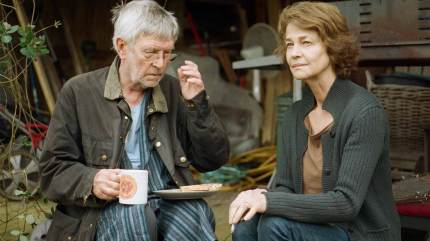
Adapted from the short story “In Another Country,” by David Constantine, “45 Years” follows an aging couple, Kate and Geoff (screen legends Charlotte Rampling and Tom Courtenay), through the week before a party celebrating their 45th wedding anniversary.  As they go about the business of planning the event, Geoff receives a letter notifying him that a body has been found- that of his former girlfriend, who perished in a fall while they were hiking through the Alps together, 50 years ago.  Though Kate has known of this occurrence, the news triggers a resurgence of long-withheld memories in Geoff, and as they gradually come to light she begins to question everything she has assumed about her relationship with her husband, and to suspect that their long and seemingly happy marriage has been built upon a lie.

In a way, Haigh’s latest film serves as a companion piece to his previous feature, “Weekend,” Both are, at their core, about a relationship threatened by the emotional baggage of past experiences; in one, the ability of the couple to open up to each other allows them a hope of breaking through the boundaries between them, while in the other a lack of openness results in a gulf which may ultimately be impassable.  Though the former film features two young gay men at the possible beginning of their relationship, and the latter is about a mature heterosexual couple at the possible ending of theirs, they could essentially be bookends of the same story, each serving as a mirror in which we can find food for thought about the way we deal with our own baggage.

Once again,” Haigh’s screenplay relies heavily on naturalistic dialogue, allowing him to direct his actors towards emotional honesty and coax from them the nuanced performances required to reveal the layers between the lines.  It was this meticulously-crafted realism that brought acclaim to “Weekend,” and in “45 Years” it is perhaps even more tangible.  One reason for this, of course, is that here he is blessed with two of the most gifted film performers of their generation, both clearly still at the top of their form.

Courtenay, evoking memories of the young, passionate intellectuals he portrayed in the British social realism cinema of the early sixties, is superbly opaque as Geoff.  The qualities of those youthful characters are here transposed into an older iteration, so that the “angry young man” has evolved into a grumpy old one, and the aloof emotional distance now disguises itself behind the distracted dottiness of the aged; we never doubt the honesty of the feelings he expresses, but we are never sure how many others he obscures behind that benevolent mask, nor can we tell if he is hiding them even from himself.

As much as Courtenay is guarded, Rampling wears her heart on her sleeve.  With the likable but inscrutable Geoff as her husband, it is Kate’s perspective we must share, and the actress uses all her long-renowned intelligence and bravery to show it to us with absolute clarity.  Taking us on a downward progression, from the easy confidence of a woman in complete control to the insecurity of one uncertain of everything upon which she has built her life, it is up to her to provide the movie’s emotional center.  She is more than up to the task; her luminous performance is no less clear for its sublime subtlety than her beauty is diminished by the lines which grace her iconic face.

As great as both stars are individually, “45 Years” works because together they are incandescent.  The relationship they portray feels so heartbreakingly real that at times one almost forgets the film is not a documentary- and it is here that credit must come back around to Andrew Haigh, who has not only provided the collaborative freedom to cultivate the brilliance of his stars, but used a sure hand behind the camera to merge subdued realism with visual poetry in a way that asserts itself as pure cinema without ever being flagrant.  It is a rare movie that allows its major revelations to take place without a single line of dialogue to underscore the moment; “45 Years” is self-assured enough to do so, and Haigh is a strong enough director to pull it off.