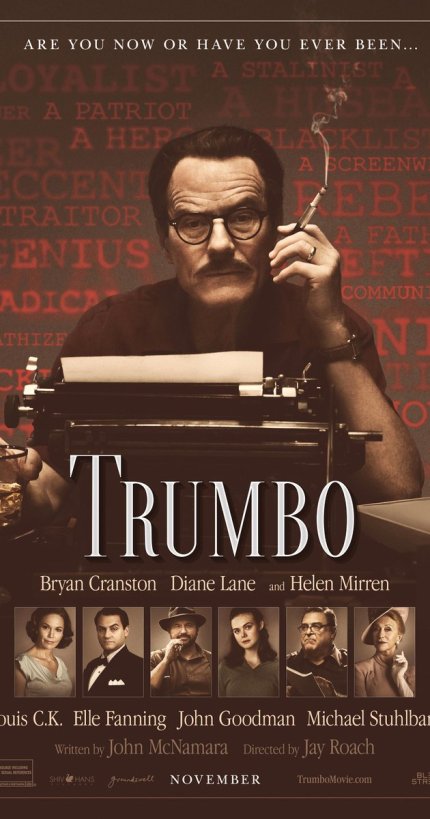
Trumbo (2015)

mv5bmjm1mdc2otq3nv5bml5banbnxkftztgwnzq0njq1nje-_v1_uy1200_cr9006301200_al_Today’s Cinema Adventure was originally published in

The Pride L.A.

When most younger Americans hear the phrase “Cold War,” it likely conjures vague impressions of backyard bomb shelters and spy vs. spy intrigue in far-flung corners of the world; but when confronted with the acronym “HUAC,” odds are good that many of them will be able to come up with nothing more than a blank stare.  That’s a pity, because in today’s political climate, the history of the House Un-American Activity Committee should be an essential cornerstone of our cultural knowledge.  For that reason alone, “Trumbo,” director Jay Roach’s new biopic about the most prominent member of the so-called “Hollywood Ten,” is a must-see.

I won’t go into detail about the anti-Communist hysteria in post-WWII America- after all, this is a film review, not a history lesson.  Suffice to say that Dalton Trumbo was a prominent Hollywood screenwriter, called before congress to answer questions about his affiliations to the American Communist Party.  Standing on his constitutional rights, he refused to cooperate; not only was he convicted of contempt, political pressure on the Hollywood establishment resulted in a blacklist which prevented the hiring of film artists who would not testify before the congressional committee, and he was left with no means to make a living despite being one of the most lauded scribes in the industry.  “Trumbo,” recounts this history, and goes on from there to detail the story of the writer’s determined climb out of the ashes.

John McNamara’s screenplay focuses its attention on the man himself, giving us a whirlwind tour of his 13-year struggle, and intertwining the political with the personal through an emphasis on private scenes- as well as some healthy dashes of humor along the way.  Through the periphery of Trumbo’s story, we are given glimpses of careers destroyed, lives ruined, and good people forced to betray their friends and their ideals.  The result is a film that delivers a timely socio-political warning about governmental overreach, disguised as a safe, middle-of-the-road narrative.

Some might argue that the story of this dark chapter in Hollywood history might be better told by a less “Hollywood” movie.  Even through its darkest moments, we know that the hero will triumph and the powers that oppress him will be vanquished.  Most were not so lucky; their careers were permanently derailed, and the few survivors still had to wait years after the blacklist fell before getting work.  In addition, though it strives to convey the complex ethics of the situation, it paints at least one character (notorious gossip columnist Hedda Hopper) as a clear target for the audience’s moral outrage without offering any satisfactory insight into the motivations which may have driven her.  It should also be said that “Trumbo” “re-arranges” facts for smoother story-telling- standard movie-making procedure, perhaps, but regrettable, nonetheless.

Such quibbling aside, the film delivers a solid, honorable account of a determined man’s journey through darkness.  Contributing to that is a meticulous recreation of the mid-century period, achieved through set and costume designs that convey the passage of time by reflecting subtle changes in the prevailing styles.  More important, though, are the strong performances, provided by an ensemble ranging from familiar Oscar-winners to relative unknowns.  A few standouts: Michael Stuhlberg, portraying actor Edward G. Robinson through suggestion rather than impersonation; John Goodman, hilarious as the no-nonsense producer who employed Trumbo during the blacklist; and Helen Mirren as Hopper, who reveals the tough-as-nails power-player masquerading as a blowsy busybody while still managing to give us glimmers of her humanity- despite the script’s failure to do so.

The impressive cast, however, rightly takes a back seat to Bryan Cranston, who displays his astonishing range with every subtle shift of expression.  He completely inhabits the larger-than-life Trumbo with an authenticity that never makes him seem affected.  He’s a delight to watch- the image of him doggedly typing away in the bathtub is bound to become iconic- but never afraid to show us Trumbo’s ugly side; and despite his exceptional work throughout, he saves the best for his final, moving recreation of a late-in-life speech that and leaves us with a powerful impression of Trumbo’s integrity.

That integrity, of course, is a given from the beginning of the film; but “Trumbo” is not meant to surprise.  It is meant, rather, to retell of a story that should always be retold.  As its postscript reminds us, the Communist witch hunt affected people in all segments of the population, not just members of the Hollywood elite.  Though set in a time gone by, the film is chillingly contemporary; and if paranoia and political opportunism can combine to persecute a wealthy white man, then who is really safe?  It’s easy to point out that none of us are Trumbo- but his story serves as a reminder that he could be any one of us.

Guys Reading Poems (2016)

c8mxwwiuwaa1zok

Today’s Cinema Adventure was originally published in

The Los Angeles Blade

“WHEN you have tidied all things for the night,
And while your thoughts are fading to their sleep,
You’ll pause a moment in the late firelight,
Too sorrowful to weep.”

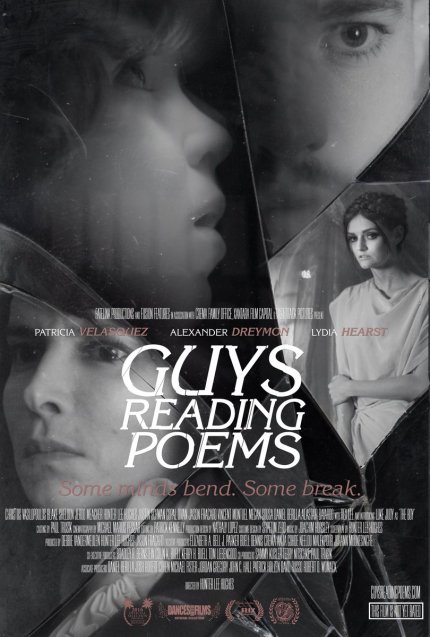
So begins “Solitude,” by Harold Monro, one of 32 works that comprise most of the spoken words in Harold Lee Hughes’ new feature, “Guys Reading Poems.”  The mood it captures is tangible, and suggests the ideal state of wistful melancholy from which to appreciate this delicate cinematic creation.

The film tells the story of a boy whose unstable mother imprisons him in a puppet box and builds an art installation around him; to cope, the boy imagines a group of young men who read poetry to him, and these recitations echo through scenes of his past, his future, and his fantasies.  This ostensible premise serves as the centerpiece in a complex jigsaw puzzle charting the reverberations of a traumatic childhood, through which the resulting psychological fallout- fear and grief, anger and sorrow- is evoked both by the masterful language of the poems and by Hughes’ haunting black-and-white visuals.

It’s an ambitious undertaking to pack so much heavy emotional content into an average-length movie; many filmmakers have tried to channel these kinds of demons into some kind of celluloid catharsis, only to fall short of the mark.  Such efforts are often constructed either as overwrought psychodramas which offer trite resolutions for the sake of closure, or else as fantasies which obscure the issues behind mythological tropes and pseudo-symbolic whimsy.

Hughes has taken a middle path; “Guys Reading Poems” is both drama and fantasy- which means that it is also neither.  Instead, it walks a line between realism and artistic conceit; multiple layers emerge from each other as a progression of imagery takes us from past to present to future, through reality and fantasy and places in between.

The storytelling is elegantly simple, and almost entirely visual; a prologue depicting the courtship of father and mother plays like a lovely pantomime of archetypes, and the rift which develops between them later- as well as the conflict it creates in their child- is eloquently communicated by body language and artful cinematography.  As for the reciting interlopers, they may be somewhat disorienting, at first, but soon become a comfortable presence; like a Greek Chorus, they give voice to the soul of the story.  It’s largely due to them that the film’s elevated stylization can yield an authentic emotional connection, allowing both plot and purpose to be revealed like a lotus flower blossoming in a dream.

The array of poems incorporated includes works by Blake, Whitman, Wordsworth, Dickinson, Yeats, and WeHo poet laureate Steven Reigns, among many others; no less crucial, however, is the visual poetry achieved by Hughes and cinematographer Michael Marius Pessah.  Lushly lit and richly photographed, “Guys Reading Poems” is a movie that revels in its black-and-whiteness, evoking a noir sensibility that pays homage to its cinematic heritage and makes every frame feel like a deeply imbedded memory.  Combined with a flair for artistic design and a deft use of symbolism (which avoids heavy-handedness without sacrificing clarity), this results in a movie of distinctive style and beauty which lingers in the mind’s eye long after viewing.

As for the onscreen talent, they face the task communicating complex relationships mostly without the aid of dialogue, and they succeed admirably.  At the center is young Luke Judy as the boy, moving and endearing in a performance as refreshingly natural as any of his adult co-stars; but it is Patricia Velasquez as the mother- brooding and cold, yet vulnerable and tragic- who, appropriately, dominates the screen.  Rounding out the principal cast is Alexander Dreymon as the father; charismatic, and impossibly handsome, he balances tenderness with a hint of swagger as he provides an embodiment of the elusive masculine ideal.

Of course, the movie is called “Guys Reading Poems,” so the true stars of the show are the ensemble of young men who fill those title roles.  Their soulful delivery provides the movie’s beating heart, and gives weight to what might otherwise be nothing but a succession of pretty vignettes.  Each of them provides a differing perspective, standing in for various aspects of the young protagonist’s psyche as he makes sense of his experience- and each of them, like Dreymon, are stunning examples of the male aesthetic.

In fact, the preponderance of maleness, along with an underlying current of unrequited yearning for masculine affection (piercingly established with the departure of the boy’s beloved father), inevitably suggest a gay subtext.  This tale of a boy locked away in childhood provides an unmistakable allegory for a life shaped in the closet; the isolation from family and society, the entwined longing and resentment, the combination of loneliness and self-sufficiency- all these themes have deep resonance within the LGBTQ community, and all are intricately woven into every fiber of “Guys Reading Poems.”  Never overt, but vivid nonetheless, it’s a layer of meaning that makes this a full-fledged addition to the queer cinema canon.

Even so, Hughes’ film has a universal appeal.  By channeling the pain of damaged youth into a unique filmic meditation, he has created a touchstone for anyone who struggles to reconcile these psychic scars within their own life.  It’s an interior landscape that can be recognized by almost anyone, of course; and by treating it with candor, acknowledging its dark beauty, and honoring its inseparability from identity, Hughes has given us a movie which illuminates the path to transcendence.

“Guys Reading Poems” is unequivocally an art film, and as such unlikely to achieve widespread success at the box office; but for those of us who appreciate the bravery required not only to confront these difficult issues, but to explore them in such a public and honest manner, it is a much-appreciated effort and worthy of being sought out.  It deserves to be called essential viewing.

Goodnight Mommy [Ich seh, Ich seh] (2014)

509614

Today’s Cinema Adventure was originally published in

The Pride L.A.

With Halloween right around the corner, most of the cool kids will want to include an outing to a nice, creepy horror flick amongst all the other seasonal festivities.  If that includes you, but you are bored to death by variations on the “Found Footage” formula (and their perfunctory cheap scares), you might want to seek out a showing of Goodnight Mommy.  Written and directed by Veronika Franz and Severin Fiala, it was Austria’s 2014 submission for the Best Foreign Language Film category at the Academy Awards.  It didn’t get the nomination- but don’t let that dissuade you from seeing it.

Set at an isolated house in a deceptively tranquil woodland, Goodnight Mommy evokes a modern-day Grimm’s Fairy Tale as it introduces us to Lukas and Elias, a deeply-bonded pair of twin pre-teen brothers whose mother has just returned home from having extensive facial surgery.  Almost immediately it becomes apparent to them that more has changed about her than just the features still concealed beneath those intimidating bandages.  Her personality is different: she is colder, harsher, and, worst of all, inexplicably intent on driving a wedge between her two sons.  Gradually they become convinced that she is an imposter, and they begin an effort to expose her- but soon it becomes clear that the biggest question may be how far they are willing to go to discover the truth.

There are a lot of things that grab you right away about this movie.  The opening sequence, in which we first see the twins roaming together through a cornfield, immediately sets the tone.  They (and we) are inside a vast bubble of isolation, one which seems serene and peaceful but is in fact alive with unseen and vaguely unsettling activity- revealed by the carefully orchestrated soundscape of buzzing insects and rustling winds, just the beginning of a soundtrack which favors natural ambience over the use of music.  There is a score, but it only emerges for brief and infrequent intervals, and is all the more effective for it.  Then there is the cinematography, the opposite of what you see in the Paranormal Activity movies and their ilk.  Instead of a herky-jerky handheld camera, we get the stately elegance of widescreen, 35mm photography with the kind of artful framing and clean lines that make the film as good-looking and stylish as the country house of its setting.

All this technical excellence makes it clear that Goodnight Mommy is not a film made by hacks, but it would count for far less if the content were not on the same par.  The directors make sure that it is: their script is complex and tantalizing, doling out clues and hinting at secrets even as it provokes us with new mysteries and confronts us with surprises.  We know from early on that we are being manipulated; Franz and Fiala show us the world only through the eyes of the two young protagonists, carefully filtering our perceptions through them and making us both dread and anticipate the shift in perspective which we sense must be coming.  This sense of impending menace is compounded by the performers: real-life twins Lukas and Elias Schwarz are perfectly cast, exuding both sweet sadness and a kind of otherworldly distance which makes them the perfect blank slate upon which to hang the audience’s expectations; and Susanne Wuest, as Mother, walks the thin line between being menacing and sympathetic with dexterity, keeping us unsure, almost until the very end, whether we should fear her or feel for her.

Of course, it wouldn’t be much of a horror film if there were not also some outright creepy, maybe even gruesome imagery along with all the psychological unease, and although I don’t want to give anything away, I can promise that it delivers (and that if you are squeamish about bugs, you might want to be prepared to look away a few times).

Goodnight Mommy does have its flaws.  The cost of keeping its characters ambiguous enough to preserve our uncertainty is that sometimes it’s hard to connect with- and therefore care about- any of them; and like many horror films, the story hinges on a gimmick, one which will probably be fairly obvious to most savvy moviegoers pretty early on.  Nevertheless, the film works superbly because it doesn’t rely on standard elements of genre formula to have its unsettling effect.  Again, I don’t want to give anything away, but Goodnight Mommy disturbs because it reveals real-life horror, the kind that makes us lie awake at night and worry about those we love.  In the end, it seems more tragedy than thriller.

That said, it’s still pretty thrilling.

Absolutely Fabulous: The Movie (2016)

absolutely-fabulous_1468883174

Today’s Cinema Adventure was originally published in

The Pride L.A.

When reviewing the latest entry in a popular movie franchise, such as the “Star Wars” saga or the various offerings from the Marvel “Universe,” a critic is faced with a serious dilemma.  Should the usual tools of film criticism- principles of cinematic theory, analysis of script and direction, interpretation of thematic elements, and so on- even be applied?  Or are we to accept that these movies are instead designed to satisfy the specific criteria of their legions of fans?  Although it’s not exactly “Star Wars: The Force Awakens” or “Captain America: Civil War,” “Absolutely Fabulous: The Movie” presents the same challenge.

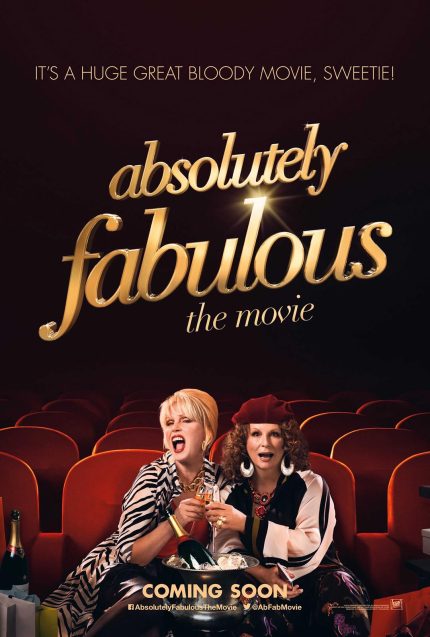
As anyone reading this is likely to know, “AbFab” (as it has been lovingly abbreviated by its fans) is a BBC cult comedy series following the misadventures of P.R. guru (and wannabe fashionista) Edina “Eddy” Monsoon (Jennifer Saunders) and her best chum, fashion editor and perennial party monster Patsy Stone (Joanna Lumley).  These two self-absorbed, socially inept, politically incorrect survivors- or more accurately, relics- of “swinging” sixties London have spent more than two decades pursuing one ludicrous scheme after another- and delighting their (mostly gay) audiences by simultaneously skewering and celebrating the absurd whirlwind of popular culture.

Now this whole crazy circus has finally made its long-anticipated leap to the big screen, with a story that owes as much to the farcical cinema of Eddy and Patsy’s sixties heyday as it does to the “new/now/next” world of the show itself.  Having hit rock bottom (yet again) in her career, Eddy is feeling irrelevant.  When Patsy lucks onto an insider tip that supermodel Kate Moss is seeking a new P.R. rep, it looks like a chance to help her friend regain her mojo.  The two women hatch a plan- but, as usual, things don’t go smoothly, and Moss ends up in the Thames, presumably drowned.  The pair is soon on the run from the law, fleeing to the South of France with one last-ditch strategy to achieve the glamorous life of leisure for which they have always thirsted.

As penned by Saunders, the series’ star (and co-creator, with former comedy partner Dawn French), the “AbFab” movie follows the same formula as most of the small-screen episodes- which means the plot is little more than a wispy premise upon which to drape a wickedly irreverent blend of satire and slapstick.  Essentially, it’s an extra-long installment of more-of-the-same, with Eddy and Patsy stumbling through an over-inflated crisis of their own creation and lampooning the world of fame, fortune and fashion.  They are accompanied, of course, by such long-suffering bystanders as Eddy’s uptight daughter Saffron (Julia Sawalha), dotty assistant Bubble (Jane Horrocks), coyly subversive mother (June Whitfield), and a host of other returning faces from the show’s long run.  To spice things up, there are also some new characters- like Eddy’s uber-gay stylist Christopher (Chris Colfer, from “Glee”) and Saffy’s daughter Lola (the gorgeous Indeyarna Donaldson-Holness)- as well as a sea of celebrities doing good-natured cameos in which they spoof their own personas.

Yes, it’s all constructed around a now-familiar formula, and no, none of the characters seem to have changed or grown throughout their twenty-plus years of madness-on-a-loop.  That is, of course, entirely appropriate.  Nobody needs a softer, wiser version of these two champagne-guzzling anti-heroines, nor a mellower Saffy, nor a smarter Bubble.  So Saunders and director Mandie Fletcher have shrewdly delivered the movie that any “AbFab” follower might expect, and their only concession to the new format is that they spend a lot more screen time taking advantage of gorgeous location scenery in London and on the timelessly elegant French Riviera.

This means that “AbFab: The Movie” is not exactly a stand-alone experience.  Anyone unfamiliar with its endearingly awful characters and their terrible behavior will probably find much of it going over their head.  The dialogue is characteristically rapid-fire, many of the cultural and celebrity references are specifically British, and there are some regional dialects which will be an obstacle for the uninitiated.  On the other hand, Saunders and Lumley- whose interplay is always a sheer delight- lead a cast which is clearly having a blast; their sheer enjoyment is infectious, and even those who have never seen an episode of the TV show might find it hard to resist.

.Ultimately, though, this movie is blatantly, unapologetically, for the fans.  Fortunately, I count myself among their number, so I enjoyed every second of it.  I also appreciated its many subtle references to the comic cinema of the past; any movie that caps itself with a nod to one of the greatest film comedies of all time is okay in my book.  So yes, I highly recommend “AbFab: The Movie.”

To borrow a phrase from Patsy, “don’t question me!”  After all, I’m a film critic, sweetie.

Kubo and the Two Strings (2016)

kubo-and-the-two-strings-poster-the-ice-fields


Today’s Cinema Adventure was originally published in

The Pride L.A.

There is a popular perception that animated movies are pure kid-stuff, designed to lure families to the box office and to generate lucrative marketing tie-ins.  After all, animation pioneer Walt Disney used this formula as the foundation for a financial empire that continues to dominate the entertainment industry today.  Of course, Disney’s films (at least the early ones) were also artistic triumphs, and there have since been numerous others that rival them in stature.  Nevertheless, even the most open-minded critics often tend to join the general public in considering “cartoons” as belonging to a separate-and-unequal category from live-action filmmaking, and often overlook them in any discussion of serious cinema.

This intellectual bias may often be warranted; but occasionally, a film like “Kubo and the Two Strings” comes along to challenge it.  Set in Ancient Japan, it’s the story of a boy who lives with his strangely afflicted mother in a cave by the sea.  Every night, she tells him half-remembered tales of his long-lost Samurai father; every day he spins them into adventurous yarns to entertain the nearby villagers- aided by magic which allows him to manipulate pieces of paper with the music from his shamisen. He is careful, though, to heed his mother’s warning and return home before nightfall, in order to avoid the watchful eye of his grandfather, the Moon King, who wishes to steal him away to his kingdom in the sky.  One day, however, Kubo lingers too long at a village festival, and suddenly finds himself caught up in an adventure of his own- aided by a monkey and a man-sized beetle, with his two terrifying aunts, the Daughters of the Moon, pursuing him every step of the way.

This deceptively simple setup provides the basis for a magnificent visual journey, full of magic, which blurs the lines of reality and challenges us to jump seamlessly between different levels of existence.  This is no small feat, and the fact that we never question it is a testament to the brilliance of its technical execution- the bulk of which was performed using the same basic techniques that took King Kong to the top of the Empire State Building over 80 years ago.  Though some assistance was provided by modern CG technology, most of what we see on the screen was achieved by posing models, one frame at a time, in front of a camera.  This painstaking effort certainly pays off; Kubo’s story comes to life with such palpable reality that the viewer might almost forget to be dazzled by it.

What’s impressive about “Kubo and the Two Strings,” though, is that its story more than lives up to the technical wizardry surrounding it.  Though it evokes the traditional folk tales of Japan, “Kubo” is entirely original, its screenplay written by Marc Haimes and Chris Butler from a story by Shannon Tindle.  Even so, as guided by director Travis Knight, it maintains a strong sense of mythological authenticity as it delivers its own version of the classic hero’s journey; the mystical elements which comprise much of the story’s framework are presented as factual conditions of the plot, yet the deeply resonant symbolism they possess- a quality downplayed by most such films aimed at contemporary American audiences- is given equal weight.  Similarly, while the film doesn’t avoid sentimentality, it never manufactures it to generate an unearned emotional response; rather, it allows the story and its characters to provide it, in appropriate doses, when it arises naturally.  As a result, “Kubo” manages to amuse, frighten, touch, and surprise its viewers- whatever age they might be- all the way through to its lovely, delicate, and bravely bittersweet ending.

Of course, there are many other factors contributing to the film’s success.  Its visual design is a marvelous blend of stylization and historical detail, effectively transporting us to the story’s time and place from the very first frames- with the aid of a majestic and immersive score by Dario Marianelli.   As for the voice cast (led by Art Parkinson as the title character and including the likes of Charlize Theron, Matthew McConaughey, Rooney Mara, and Ralph Fiennes), it must be mentioned that “Kubo” has drawn some heat for using mostly white actors.  Conroversy aside, those actors deserve credit for their fine work, which plays a big part in making “Kubo” into the special experience it is.

It’s a bit early to start making lists of the year’s best films, but when the time comes, I think it’s a safe bet that “Kubo and the Two Strings” will be on a few of them- anti-animation prejudices notwithstanding.  It fully deserves that honor.  It’s a multi-layered, visually stunning work which tells a powerful story without pandering to its viewers- and a film like that, animated or not, is very rare indeed.

Weiner-Dog (2016)

wiener-dog-poster01

Today’s Cinema Adventure originally appeared in

The Pride L.A.

Todd Solondz doesn’t make movies to offer you an escape from your problems; he makes movies to confront you with them.  Ever since his 1995 breakthrough, “Welcome to the Dollhouse,” he has repeatedly offered up grim, uncomfortable stories of the dysfunction lurking just beneath the banal surface of suburban American life.  His films are variations on the interconnected themes of failure, depression, and emotional isolation.  Not exactly the stuff blockbusters are made of.

Yet the quirky writer/director has developed a loyal cult following who continue to be mesmerized by his sardonic vision of the world and the broken, faltering lives of the people who live in it.  Indeed, there is an almost masochistic fascination to these sad little fables of modern life, not unlike that can’t-look-away feeling you get when passing a gruesome accident scene on the highway.  Coupled with this morbid appeal is his tendency to feature recurring characters in his films (usually portrayed by different actors) alongside the new ones.  The desire to see what has happened to some of these familiar figures (and the hope that they have somehow managed to improve their dismal lives) is undoubtedly key in keeping his fans coming back for more, and it provides a major hook for the filmmaker’s latest effort, “Weiner-Dog.”

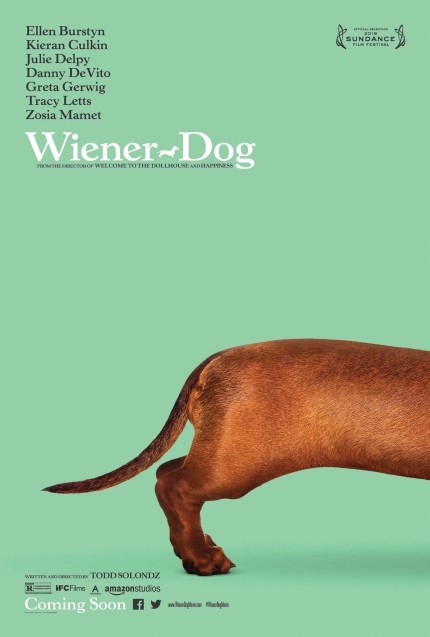
Those familiar with “Dollhouse,” which remains Solondz’ most popular and successful work, will immediately recognize this title as the nickname bestowed on that film’s pathetic anti-heroine, middle-schooler Dawn Wiener.  Though clearly intended to invoke that connection, and though that much-beloved character does indeed make her long-anticipated return here, in this case the name refers to a new central figure- a dachshund who becomes the pet of four different, unconnected people through the course of her life.

First, she is gifted to a young cancer survivor, Remi (Keaton Nigel Cooke), providing the boy with a brief respite from the stark home environment created by the antagonistic and seemingly loveless marriage of his affluent parents (Julie Delpy and Tracy Letts).  Then, she is adopted by the now-adult Dawn Wiener (the gifted Greta Gerwig)- still awkward and desperate for affection- who takes her along for the ride as she accompanies an old schoolmate on a road trip.  Changing hands again, she becomes the pet of Dave Schmerz (Danny DeVito), a has-been screenwriter barely clinging to his job as an unappreciated teacher at a film academy.  Finally, she ends up as a companion animal for Nana (the always-stellar Ellen Burstyn), an elderly and misanthropic invalid who receives a surprise visit from her long-absent granddaughter, Zoe (Zosia Mamet).

That’s it.  The dog connects the segments by her presence, but otherwise these are stand-alone vignettes, composed around Solondz’ usual themes and exploring the various ways in which human beings treat each other- and themselves- very badly.  As anyone familiar with the director’s work would anticipate, there’s not much hope to be found in these stories, and where there are glimmers of it they are subverted by the surrounding circumstances; and yet, the film has a strange and terrible beauty.

This is the hallmark of Solondz’ work; he shows us life at its cruelest and most demeaning- almost always with the explicit qualifier that it is we ourselves who are responsible- and yet he makes it somehow lovely.  He also makes it darkly funny; he is, above all, a social satirist whose stunted, minimalist dialogue conveys both depth of insight and an arch sense of ironic humor that revels in making us laugh at the things which most disturb us.  It might be argued that the laughter is a defensive reflex, a release of uncomfortable tension; this may be true, but it’s an authentic response, nonetheless.

Cut from the same cloth as his earlier films, this is perhaps Solondz’ most elegantly-made work to date.  Cinematographer Ed Lachman delivers a low-key study in composition that subtly elevates the aesthetic and allows us just enough of a cool perspective to distance ourselves without being able to completely detach.  That’s important, because Solondz wants us to reconnect with the primal emotions- fear, shame, guilt, loneliness, resentment- within us all.  He warns us that if they are left in the darkness to be stoked by our failures and losses, they can make our lives like those he shows us on the screen; those lives might seem absurd, exaggerated, and extreme, but he never lets us believe they are anything other than truthful.  Brutally truthful.

For non-Solondz-fans, it should be noted that “Weiner-Dog” (like all of his work) is likely to put off many viewers.  It’s bleak and unrelenting, with a pall of despair that hangs over it from beginning to end.  Animal lovers, especially, should be warned to consider carefully before seeing it; for the sake of avoiding spoilers, I’ll just leave it at that.

1473523071_skrin3


The Jungle Book (2016)

affiche-internationale-le-livre-de-la-jungle-film-04

Today’s Cinema Adventure originally appeared in
The Pride L.A.

Rudyard Kipling was a product of his era.  An Englishman born in Colonial India, he grew into a prolific author and poet whose canon was informed by his childhood experiences there.  Though his literary gifts were undeniable, and much of his work is still widely read more than a century later, he has come to be seen as a champion of British Imperialism.  The world view of white-privileged conquerors, with their assumption of racial superiority over the indigenous populations they subjugated, is deeply embedded in the fabric of all his stories- including the much-beloved children’s tales for which he is most remembered today.

Needless to say, in a modern world keenly aware of the issues surrounding race, this makes him a controversial figure.  He is regarded by many as an unapologetic racist whose writing, even at its finest, was little more than propaganda for the cause of white supremacy.  Others vehemently insist that he was a humanist working from within the system to illuminate both the noble and ignoble traits of all people and thus promote a more egalitarian mindset.  Arguments and evidence are plentiful in support of either side, as well as of the myriad viewpoints which lie somewhere between those two poles.

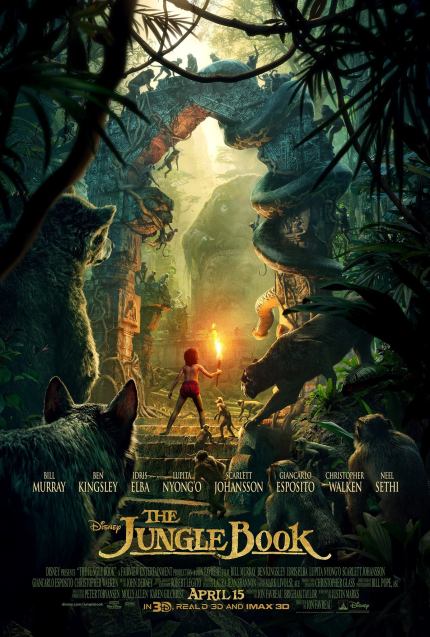
Of course, the majority of modern moviegoers are unaware of this literary debate, which is undoubtedly why two major studios have both developed family-friendly blockbusters based on the most well-known of Kipling’s stories: “The Jungle Book.”  The first of these, directed by Jon Favreau from a screenplay by Justin Marks, is the Disney studio’s latest effort to remount one of their animated classics as a live-action film for the 21st Century generation.

Their previous version- the final film personally overseen by Walt Disney himself- was released in 1967, and though it has become a cherished favorite to those who grew up with it, at the time it was heavily criticized for taking Kipling’s rather solemn original and turning it into a rollicking, jazz-infused comedic showcase for a star-studded cast of voice talent.

This time around, Marks and Favreau have doubled down on that same approach, while also expanding the basic story framework to include elements from the Kipling tale (or rather, tales- what we have come to know as “The Jungle Book” is actually derived from several short stories concerning the man-cub, Mowgli, and his adventures in the jungle with his animal mentors).  The result feels like a satisfactory blend, a best-of-both-worlds crowd-pleaser which captures the serious tone and allegorical flavor of Kipling while still delivering the good-natured hi-jinks expected from a studio known for its fun-for-all-ages romps.

It’s also a technical masterpiece.  The use of CGI and performance-capture technology has yielded a breathtaking visual experience, giving us a lush and majestic experience of the Indian wilderness as well as remarkably believable depictions of the animals which comprise most of the cast of characters.  This latter element also benefits from superb vocal portrayals by the likes of Ben Kingsley, Scarlett Johansson, Idris Elba, Christopher Walken, Lupita Nyong’o, and the always-welcome Bill Murray.  Perhaps most importantly, newcomer Neel Sethi gives an on-point performance as Mowgli, a remarkable accomplishment for a young actor whose work took place on a soundstage far removed from the world on display in the finished product.

Yet for all its excellence, this new “Jungle Book” feels somehow overdone.  There’s a “bigger-is-better” philosophy at play which detracts from its meticulously-constructed authenticity; a larger-than-life quality may be appropriate to the material, but is it really necessary, for instance, for King Louie to be the size of King Kong?  Although Marks’ screenplay does a good job of underlining the humanistic parallels with the animal kingdom, the sincerity of his intentions is steamrolled by heavy-handed execution, perhaps most tangibly in the manipulative orchestral swellings of John Debney’s score.  And on the subject of music, the inclusion of the best-known songs from the 1967 film not only seems perfunctory, but also jarringly incongruous within the realistic environment created to evoke the period and setting of the story.   .

These observations are, of course, likely to be immaterial to most of Disney’s target audience- perhaps rightly so.  After all, whatever his socio-political philosophies may have been, Kipling wrote his Mowgli stories to entertain, and “The Jungle Book” certainly succeeds in doing justice to that purpose.  Still, one can’t help but wonder how much richer it could have been made by a subtler hand, one that might have allowed for a bit of reflection on how to reconcile our modern sensibility with the more troubling issues contained in an iconic tale that, like it or not, is deeply ingrained into our cultural consciousness.  Perhaps we will find out in two years, when Warner Brothers releases their take on it.

Until then, this one will do well enough.

junglebook1

The Mummy (1932)

The Mummy 1932 (poster)

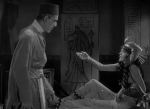
Today’s cinema adventure: The Mummy, Karl Freund’s 1932 horror classic about an ancient Egyptian priest, returned to life by the power of a sacred spell after his tomb is discovered by archaeologists, and his efforts to reunite with the reincarnated soul of the woman he loved thousands of years before. One of the three iconic monster movies- with Dracula and Frankenstein– made by genre-champion Universal Studios during its golden age of the early thirties- it was the only one not derived from a pre-existing literary source, instead being developed in a deliberate effort to capitalize on the then-current craze for Egyptology and the sensationalistic popularity of the “Curse of King Tut,” of which rumors had been circulating since the discovery of the young Pharaoh’s tomb, ten years before, and the seemingly mysterious deaths of several of those who participated in its excavation. It was also intended to capitalize on the newfound stardom of Boris Karloff, who had been a virtual unknown barely a year before, but thanks to his success as the monster in Frankenstein was now so popular that he could be billed in the movie’s ads by his surname alone (“KARLOFF is THE MUMMY“) and still guarantee the film’s status as a box office hit.

Charged by Universal studio chief Carl Laemmle, Jr. with the task of finding a suitable story for an Egypt-themed thriller, story editor Richard Shayer came up empty-handed; drawing inspiration from the real-life history of Alessandro di Cagliostro, an 18th-Century occultist and charlatan who claimed- among other things- to have used arcane mystical practices to prolong his life for centuries, he teamed with writer Nina Wilcox Putnam to write a story treatment entitled Cagliostro. Laemmle was pleased with the essence of their narrative, but still determined to make his Egyptian picture, he brought in Dracula and Frankenstein screenwriter John L. Balderston to transform the idea into a script that suited his needs. The Italian magician became an Ancient Egyptian priest, and the rest of the details fell into place. The movie begins in 1921, at the base camp for the British Museum’s archaeological expedition in Egypt. Renowned Egyptologist Sir Joseph Whemple and his young assistant, Ralph Norton, have discovered the 3000-year-old Mummy of a High Priest named Imhotep, buried in an unmarked tomb with a mysterious box inscribed with a curse which promises destruction to any who open it. Whemple has called in his old friend, psychiatrist and occult expert Dr. Muller, as a consultant; the doctor recommends that both mummy and box be returned to the earth and forgotten, but while the older men debate the issue outside, the younger Norton cannot contain his curiosity, and he opens the box. There, he finds an ancient scroll, and as he begins to read out the hieroglyphs it contains, the mummy of Imhotep awakens. The sight of the ancient corpse come to life drives the young archaeologist instantly mad, and the mummy leaves him crumpled on the floor, hysterical, as it takes the scroll and wanders slowly out into the desert night. Ten years later, the disappearance of these artifacts is still a mystery, and a new British expedition, in which Whemple’s son Frank (who has followed in his father’s footsteps) is involved, is having scant luck finding anything of note in their digging- until Ardath Bey, an Egyptian scholar with an odd, aloof manner, arrives unexpectedly and leads them to the undiscovered tomb of Princess Anck-es-en-Amon. The British soon have the Princess and her relics on display at the Cairo Museum, reaping the scientific rewards of their find- but the mysterious Bey has his own purposes. He is, in fact, Imhotep himself, and he has spent the decade since his resurrection planning to use the stolen scroll to restore life to the Princess- his former love- so that they may at last be reunited. Using spells and incantations in the museum after hours, he summons the reincarnated soul of Anck-es-en-Amon- now inhabiting the body of young, beautiful Helen Grosvenor (coincidentally, a patient of Dr. Muller’s)- to come to his side. Muller, however, immediately surmises the truth behind the girl’s strange attraction to Bey, and with the help of young Frank Whemple, attempts to thwart the ancient priest’s dark purpose by taking her under his protection. Imhotep’s mastery of the scroll, however, makes him a powerful adversary, and with it he exerts his will to break down the mortals’ defenses, despite Muller’s vast knowledge and understanding of these archaic forces- and despite the love that is blossoming between Frank Whemple and the object of his millennia-old obsession.

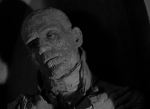
I’ve said it before in relation to other horror films from this classic era, and perhaps it seems an obvious point hardly worth mentioning at all, but for today’s audiences- conditioned as we are to the oceans of gore and unspeakable violence that permeates the genre and so familiar with its standard conventions of plot and character that they have achieved for us the level of cliché- The Mummy offers little in the way of genuine thrills or chills. The script is laden with clunky exposition, the necessary conditions of the plot are unconvincingly established and accepted by rote, and the most directly terrifying moments are portrayed either by sound effects or reaction shots as they take place offscreen. Its plot is formulaic, borrowing more than a little from Dracula– unsurprisingly, perhaps, considering that this film is a product of the same studio, written by the same screenwriter, and directed by the previous movie’s cinematographer- with its scenario of an ancient horror using arcane powers to lure a young and vital female to the doom of an unholy union. Even so, The Mummy can scarcely be dismissed as an irrelevant or inferior work; indeed, dated though it may seem to the casual viewer today, it was and continues to be a vastly influential film, helping to define the genre at least as much as the others in the Universal canon and casting its dusty shadow over every archaeological fantasy film to follow, right on down to Spielberg’s Indiana Jones movies and beyond. It is every bit the equal of Frankenstein and Dracula in terms of artistry and surpasses them in technical prowess, setting new standards in makeup and special effects. More importantly, in terms of lasting effect, its then-novel conceit of a resuscitated mummy has become an iconic pop culture trope, joining the ranks of such legendary monsters- with lengthier pedigrees- as vampires and werewolves as inspiration for imaginative tales and Halloween costumes the world over.This last item will no doubt be the source of most interest for the casual modern movie viewer, a chance to see the original incarnation of a much-loved and imitated celluloid spook that has terrorized everyone from Abbot and Costello to Scooby-Doo and his gang. Painstakingly executed by make-up pioneer Jack Pierce (who also crafted Karloff’s frightening countenance for his star-making role in Frankenstein), the mummified Imhotep was created in an excruciating 8-hour process involving clay, cotton, spirit gum, and linen. Karloff went before the cameras for another 5 hours, and then spent 2 hours having the make-up removed; the actor- who famously complained to Pierce that in all his attention to intricate detail, he had nevertheless forgotten to include a fly- later called it the most “trying ordeal” of his life. He had only to endure it once, however; Imhotep is seen in his fully-wrapped mummy regalia for only few minutes, during the opening sequence in which he is studied and inadvertently revived, and the character spends the rest of the film in the simpler- but no less effective- make-up required to give him the desiccated, shriveled look one might expect from a man who has spent three millennia beneath the desert sands. This brief appearance may disappoint those hoping for a whole movie’s worth of moaning, shambling, bandage-wrapped menace- a device not introduced until several years later, when the studio re-introduced the character for a series of inferior, unrelated pseudo-sequels- but it offers a classic look for this particular ghoul that has never been supplanted or surpassed, and it was enough to electrify audiences in 1932; indeed, the chilling moment when Karloff slowly opens his eyes for the first time remains one of the most singularly ominous few seconds in the history of the horror genre.

It is Karloff’s performance, too, that gives The Mummy its classic stature, for without his elegant presence in the title role the film would be little more than a stylish-but-hollow melodrama; though his character is less directly menacing than Dracula and less brutal than the creature of Frankenstein, Karloff nevertheless infuses him with a palpably terrifying power, exuding the absolute confidence of invincibility with every underplayed line. Always a master of physical performance, his brittle, slow and deliberate movement gives us not only a sense of Imhotep’s antiquity, but emphasizes a soft and careful gentility that contrasts the destructive intent that hides beneath his staid persona. It’s a difficult task to convincingly portray the ability to enslave and destroy with the power of a mere thought, but Karloff does so. More crucial than that, however, is his gift for revealing the tender soul that dwells inside the monster; though he makes clear the treacherous nature of Imhotep, and leaves no doubt of his callous disregard for the suffering of mere mortals, so too does he show, with utmost sincerity and simplicity, the deep and desperate pangs of love that have driven him across centuries and motivated him to defy the gods themselves in order to recapture the woman he has lost. Karloff gives us a villain who is, at his most private core, an almost touchingly naive romantic- something to which we can all relate, at some level- and therefore one we can feel sorry for, particularly in light of the vaguely smug sense of anglo-centricism, a product of the less-culturally-sensitive era in which the film was produced, projected by the protagonists. It’s a masterful performance, and one that takes its place alongside the other classic characterizations that made this gifted actor into a screen legend well-known and respected even today, when so many of his fellows from the early days of cinema have long faded into obscurity.

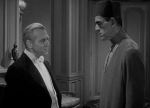
Sharing the screen with Karloff are a handful of other capable performers of the time, an A-list selection of actors who help, in their own ways, to make The Mummy stand the test of time. Most notable, of course, is Edward Van Sloan, the horror stalwart who here completes his triumvirate of monster-fighters (having previously portrayed the title character’s mentor in Frankenstein and the intrepid vampire-hunter, Van Helsing, in Dracula) as Dr. Muller; wise, intense, and steely at the core, he cements his own legend with a solid and believable performance that may not be as showy or compelling as those offered by some who have followed his footsteps in similar roles, but nonetheless sets the standard for this indispensable archetype of the genre. The most memorable supporting player, however, is perhaps Bramwell Fletcher, as the unfortunate and overly-enthusiastic archaeologists’ assistant who unwittingly speaks the words which return Imhotep to the world of the living; as the central figure in the film’s most famous sequence, he is burned into popular consciousness by virtue of the chilling, hysterical laughter into which he descends as the sight of the reanimated relic turns his mind to permanent jelly.

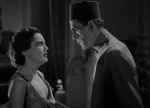
Much of the authenticity of the film’s conceit, though, hinges on the performance of Zita Johann, the exotic and beautiful actress with the difficult task of portraying Helen, a young woman rooted simultaneously in both the modern and the ancient world; she exudes warmth and intelligence even as she is convincingly mesmerized by her ancient lover’s mystical powers. and she successfully conveys both the sophisticated candor of a contemporary woman and the haughty formality of an Ancient Egyptian princess. She was no doubt aided with the latter by a deeply-held personal belief in reincarnation; indeed, she protested vehemently when a lengthy flashback sequence, portraying her character’s journey through the centuries in a series of lives during different historical periods, was cut from the film in an effort to reduce its running time- though sadly, her efforts to have the scenes reinstated were unsuccessful and the footage has been long-since lost. Even so, her contribution to The Mummy is a performance worthy of being matched with the great Karloff, from an actress whose screen career- abandoned after only five films for a life in the theater, working with then-husband John Houseman and his cohort Orson Welles- was all too brief.

The third corner of the movie’s bizarre love triangle is David Manners, a popular and respected stage-actor-turned-movie-star who had played essentially the same role in Dracula, a year earlier; while the character is not particularly compelling and is mostly required to perform the obligatory acts of passionate (if ineffectual) heroism inherent to the film’s formula, this handsome, likable actor gives him much more personality than many of the others who have played his equivalent in countless creature features. Manners, though primarily known for his twin roles in these iconic horror films, also appeared with Katharine Hepburn in her screen debut (A Bill of Divorcement) as well as several other important leading ladies of the time; he was a star in the making, well-liked by colleagues who spoke very highly of his professionalism and supportive attitude- but, like his female co-star in The Mummy, he retired young from Hollywood, saying it was “a false place.” He moved to a ranch in Victorville, California with his life partner, writer Bill Mercer, and returned to a successful stage career; at one point in the 1940s, he worked in Maxwell Anderson’s play Truckline Cafe with fledgling actor Marlon Brando, who later said he owed Manners his “entire career.”

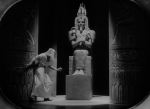
The fine cast and artful production values of The Mummy were supervised by director Karl Freund; a legendary cinematographer from Germany, where he had photographed such visually stunning masterworks as The Last Laugh and Fritz Lang’s Metropolis, he had emigrated to Hollywood a few years earlier. Hired to lens Dracula, he had been left in charge of many of the scenes in that film due to director Tod Browning’s frequent absences from the set; consequently, Universal officially gave him the job of directing this follow-up. It proved a wise choice, for Freund approaches the story with a photographer’s eye; wisely recognizing the weakness of the narrative, he relies on mood and atmosphere to carry his film, using an elegant visual style- replete with exotic locales, majestic sets, sumptuous costumes, and gorgeous black-and-white cinematography (executed by Charles Stumar, no doubt under close supervision from Freund himself)- to give us imagery that transcends the plot and transports and unsettles our imagination almost independently of the script. Freund would go on to direct a handful of other films, and photograph many others, but his greatest success would come much later in his career, when he was hired by Desi Arnaz to supervise the photography on the series I Love Lucy; he developed a use of lighting that would allow multiple cameras to shoot the same scene simultaneously, eliminating the need for cutting the action to change angles and thereby allowing for an uninterrupted performance to be filmed in front of a live audience. It was a ground-breaking technique that changed the future of television sitcoms forever, and Freund received much well-deserved acclaim and respect for it, giving him a sizable feather in the cap of an already-illustrious career.

It would be overstating the case to say that The Mummy is a great film, in the sense of other early talkies such as The Public Enemy or All Quiet on the Western Front; it was, and remains, a piece of glossy pulp cinema, a sensationalistic crowd-pleaser aimed primarily at providing scares and making money. It did both in 1932, making it a successful film, whether or not it was a great one. Just because it is, essentially, schlock entertainment, however, doesn’t mean it is not also a fine example of the filmmaking art as it was at the time; indeed, the primal, timeless nature of its subject matter- and even its relatively lowbrow intent- means that it is more easily accessible to modern audiences, playing better today than many of the more prestigious “art” pictures of its day. If nothing else, it’s a treat to look at, but more than that, there is something intangibly resonant about it; perhaps it is its theme of undying love opposed by the inexorable march of time and the irresistible winds of fate, or its evocation of ancient memories buried deep within our psyches through its exploration of reincarnation and arcane magic, but The Mummy, creaky and corny as it may be to our modern sensibilities, still has the power to move us. There are lots of good reasons why this golden-age potboiler remains a classic, worthy of watching for those who have never seen it and of repeated returns for those who have; but the best of these reasons, and the one which makes The Mummy a truly essential piece of cinema, is Boris Karloff. The man had a rare ability to find the monster within us all, and show it to us with the dignity, honesty, and pathos it deserves; he did so many times- and did it well- throughout his long career, even in films far inferior to this and his other early classics. To see him here is to understand why, so many generations later, and despite his association with depraved, monstrous characters, he is still one of those rare actors who can genuinely be called “beloved.”

http://www.imdb.com/title/tt0023245/?ref_=fn_al_tt_2

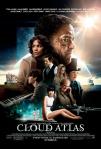
Cloud Atlas (2012)

Cloud Atlas (poster)

Today’s cinema adventure: Cloud Atlas, the epic 2012 adaptation of David Mitchell’s multi-narrative novel exploring the connections between individuals and their actions across time and space, written and directed by Lana and Andy Wachowski in collaboration with longtime associate Tom Tykwer, and featuring an ensemble cast of stars in multiple roles.  Produced in Germany with funding from an assortment of production companies and government agencies, it was one of the most expensive independent films ever made (with a budget of $100 million); the difficulty in securing the necessary finances led to stalls in development and production, with the project being declared “dead” at several points, but the enthusiasm and determination of the cast and crew- particularly the dedication of its biggest star, Tom Hanks- helped provide the impetus to drive the project to fruition.  After a premiere at the Toronto Film Festival met with a ten-minute standing ovation, it was released to widely mixed reviews and disappointing box office receipts, ending up in the unusual position of being placed on lists of both the ten-best and ten-worst movies of the year; nevertheless, its creators have maintained their pride and belief in the work as a labor of love and a true expression of cinematic art.

The screenplay, written in close consultation with original novelist Mitchell, follows six interwoven stories, each set in different eras, in which common elements bind seemingly unrelated characters and developments together through the course of an overall narrative.  In 1849, Adam Ewing, a young lawyer on an ocean voyage to conduct a transaction for his father-in-law’s slave-trading business, keeps a journal of his experiences on the ship, detailing his battle against a mysterious disease which worsens despite the efforts of the ship’s doctor, as well as his unexpected friendship with a runaway slave who has stowed away in his cabin; in 1936, Robert Frobisher, a gifted young musician, writes letters to his lover Rufus Sixsmith from the estate of an aging composer, where he works as an amanuensis, transcribing his employer’s musical creations as he strives to compose his own masterpiece; in 1973, Luisa Rey, a young reporter, has a chance encounter with the now-elderly Sixsmith, leading to her dangerous pursuit of a story exposing corruption and fraud in the development of a new nuclear power plant; in 2012, Timothy Cavenaugh, an aging, down-on-his-luck London publisher, has a surprise bestseller on his hands when its author becomes front page news by murdering a disapproving critic- but when the writer’s thuggish family comes after a cut of the profits, he is duped by his own resentful brother into hiding out in a rest home, where a draconian staff holds him against his will until he joins with a band of other disgruntled residents to plan a daring escape; in 2144, Sonmi-451, a genetically-engineered “fabricant” created for life as a server in a Seoul restaurant, is freed from her slavish existence by a handsome and mysterious young stranger who wishes to recruit her into a rebellion against the oppressive, consumer-driven government, and after he reveals to her the dark secrets of the regime and its treatment of her kind, she agrees to speak out in an underground broadcast which will expose the truth and spread a message of love and equality for all people; and finally, in 2321, a century after a catastrophic event in which most of Earth’s population either perished or fled to colonies in outer space, a primitive tribesman named Zachry lives with intrusive visions of a ghoulish figure he refers to as “Old Georgie,” and when his village is visited by a “prescient” (a group of culturally-and-technically advanced remnants from the old society) who seeks their aid in reaching a deserted outpost from before “the fall,” he must decide whether to offer her his assistance or to abide by the prompting of his otherworldly counselor, who advises him to mistrust and betray her.  As these six different tales unfold, it becomes clear that the events of the past send ripples through time to shape the events of the future, and that each person is intertwined with every other who ever lived or will live in an ongoing destiny shaped by individual choices and actions, no matter how small or insignificant they may seem.

If all that seems confusing when encapsulated into a bare-bones one-paragraph synopsis, it is no less perplexing as it plays out in leisurely detail during a nearly-three-hour running time on the screen.  This is, however one of the strengths of Cloud Atlas; as the various plotlines slowly move around each other in a carefully orchestrated progression of intercut scenes, they offer a challenge that intrigues the viewer despite the seeming incoherence of the juxtaposed scenarios, rather like the experience of piecing together a puzzle without being able to see the picture it will eventually form.  It is difficult to become emotionally engaged in the characters or their adventures, at least at first, simply because for a good third of the film it is virtually impossible to tell what is going on or where it is all leading; but the intellectual challenge of piecing it all together from the plethora of tantalizing clues with which it baits us is sufficiently irresistible to hold our attention until, as the parallels and common elements become apparent, we find ourselves invested in the proceedings, almost without having noticed it happening.  The rhyme and reason of these initially dissevered narratives becomes clearer as the threads that bind them into one are revealed, and by the time we see the underlying premise at work- the interconnectedness of all human life and experience as revealed through the gradual passage of time- we are ready to let go of our academic need to understand precisely how it fits together and simply sit back to watch as they resolve into their respective conclusions, simultaneously converging into an emotional climax which unites them into the single story which, of course, they have been all along.

At least, this is the design of the Wachowsi/Tykwer team behind the film; however, in order for it to work according to that plan, the viewer must be willing and able to buy into the conceits upon which their movie is built.  This is asking a lot of modern mainstream audiences, who generally expect their movies to be grounded in concrete, tangible realism and follow a logical, linear storyline; and though there is a built-in appeal for fantasy and sci-fi fans, Cloud Atlas mixes in elements of other genres that may only serve to put off those who are hoping for a more straightforward piece of escapist adventure.  In addition, its philosophical leanings, serving not merely as underpinnings to the overall piece but as the very core of its purpose, are impossible to disregard for those whose taste runs towards more concrete matter.  In the end, though the film packs plenty of action, drama, and even comedy into its panoramic tale, these things take a backseat to its larger agenda of presenting an epic meditation on the unseen forces that drive our collective journey through history; there is a decidedly literary feel here- indeed, references and homages abound to authors from Melville to Ray Bradbury, and many of the situations and settings evoke memories of their best-known works- and though the directors have not slacked in their efforts to create a cinematic experience, Cloud Atlas achieves its ends largely through a cerebral process more akin to reading a book than to the visceral response associated with film.  This is an observation, not necessarily a criticism; nevertheless, audiences seeking thrills and excitement may find themselves less entertained than frustrated.

For those who relish the challenge of it, however, the scrambled-picture format of Cloud Atlas makes for an engaging exercise; deciphering the internal logic that transforms this mosaic of seeming non-sequiturs into a cohesive whole requires a close attention to detail and provides insurance against a flagging of interest before things become clear enough to capture our sympathies as well as our intellectual curiosity.  Tykwer and the Wachowskis have done a deft job of building their game of connect-the-dots, providing no shortage of clues- presented with varying degrees of subtlety- that keep us assured that something is going on here, even if we can’t tell what it is.  This, of course, binds us with the characters, most of whom also become gradually aware of these as-of-yet unexplained points of intersection, and by the time we have begun to see the layered pattern of connectivity within these conjoined tales, we are able to surrender to the momentum and let the movie carry us towards the emotional nexus of its finale.  Indeed, it is the structural mystery itself that gives the film its appeal; taken on their own, the various episodes would be far too weak to build an entire movie around- with the possible exception of the dystopian saga of Sonmi-451.  Tied together by the undercurrents of causality that are the filmmakers’ true focus, however, each segment assumes a higher level of integrity than is bestowed by its individual premise or plot developments, and Cloud Atlas ultimately becomes a whole that is greater than the sum of its parts.

Besides the ambitious structural conceit, there are other aspects of the movie that may prove problematic for some viewers.  Part of the thematic core is reinforced by the choice of using the same company of actors in all the stories, playing different roles; the cast was told by their directors to think of themselves as playing a “genetic strain” rather than individual characters, and the result is a suggestion of spiritual continuity and progression throughout a series of lives- though the idea of reincarnation is not directly referenced in any other way, nor is the story dependent on a belief in that concept.  This multiplicity of casting, of course, gives the film’s stars a rare opportunity to show the range of their talents and yields the fun of seeing them in a wide variety of personas throughout- some of them across lines of age, gender, and ethnicity.   This latter element has been the source of some controversy, with objections being raised to the use, specifically, of white actors in “yellowface” to portray Asian characters.  This decision was made purely to maintain a crucial thematic concept, and indeed, Asian and black actors are also cast in white roles for the same reason; nevertheless, audiences sensitive to these kind of racial issues may find this uncomfortable.

Questions of perceived racism aside, this somewhat theatrical tactic, achieved with an extensive use of make-up and prosthetic effects in order to create vastly differing appearances for each of the characters’ various incarnations, may prove somewhat distracting- even jarring- to audiences not quite able to accept seeing these familiar faces passed off as anything other than their recognizable selves.  Some of the more obviously exaggerated permutations- Hanks as a Cockney gangster, for instance, or Hugo Weaving as a sadistic female nurse- are deployed for intentional comedic effect, but the inescapable cartoonishness of the disguises, in other cases, may elicit inappropriate chuckling.  To be sure, the use of actors in multiple roles is nothing new; it is part of a grand cinematic tradition most famously represented by the likes of Alec Guinness and Peter Sellers.  Again, though, contemporary audiences are unused to seeing it, and the sight of Hanks with enormous prosthetic buck teeth or Susan Sarandon as a heavily-tattooed tribal crone might demand too great a test of the willing suspension of disbelief for a good number of viewers.

The biggest obstacle that Cloud Atlas faces, though, in winning the hearts and minds of its audience, comes not from its unorthodox structural form or its casting, but from the very essence of its premise.  In positing a continuous thread of influence that runs through the course of human history, the film presents a thought-provoking- and relatively uncontroversial- idea that most reasonable viewers will have no problem accepting; but Tykwer and the Wachovskis, along with original author Mitchell, layer in the additional suggestion of an underlying consciousness of this phenomenon that manifests itself in an awareness within the characters themselves.  While it is not a stretch to portray individuals who feel a certain sense of destiny, Cloud Atlas goes further than this, making it clear that these moments of a priori recognition are the result of a force- whether supernatural, spiritual, or scientific- which exists beyond conscious perception.  To fully accept Cloud Atlas, the viewer must be open to embracing a certain “New Age” sensibility (for want of a better term) that encompasses notions of collective consciousness, the continuity of souls, and the workings of karma; though there is no overt discussion of these things by name- characters express their own beliefs and speculations in more-or-less generic, non-denominational terms- they are directly implied and, indeed, required as a condition of the film’s entire premise.  It is this factor that may most sharply determine whether a viewer can enjoy Cloud Atlas or not, and it’s a point that is not dependent on any affect the film may adopt.  There is no persuasion to be accomplished here; you either believe in this stuff or you don’t, and if you don’t, the payoff at the end of this ambitious epic will likely leave you cold.

That said, even for skeptical or cynical cinema enthusiasts, there is much to admire in Cloud Atlas.  The directors- who split the segments between themselves, with Tykwer handling the 1936, 1973, and 2012 stories and the Wachovski siblings helming those set in 1849, 2144, and 2321- have delivered a polished and cohesive whole while not only working separately but within styles appropriate for the different tones and settings of each of the six episodes; from period drama to seventies action to contemporary comic caper to futuristic action-adventure, they hit the right chords in their approach.  They deftly cut between the various threads in such a way as to emphasize the crucial parallels and reinforce their central conceit, as well as using the cross-cutting as a technique to build suspense and quicken the pace.  Most importantly, perhaps, they infuse their movie with the kind of epic visuals that linger in the memory- not just in the sci-fi segments, where dazzling design and effects create a distinctive and original vision of the future while evoking classics like Blade Runner and 2001: A Space Odyssey, but in the less fantastical sequences as well.  Artful composition and imaginative camerawork are expertly employed throughout, allowing, after all, for that direct, visceral effect of a purely cinematic experience, and thereby creating a cumulative emotional response while the necessary intellectual constructs develop through the dialogue.  It is this mastery of filmmaking technique that gives Cloud Atlas its most universal appeal; even those with the most vehement rejection of its concept and message can appreciate the artistry that has been employed by its makers in their passion to bring it to the screen.

That same passion manifests itself in the work of the cast, an oddly-mixed yet complementary ensemble that includes no less than four Oscar-winners and an assortment of acclaimed up-and-comers.  The aforementioned Hanks heads the group, playing a “genetic strain” that makes perhaps the most profound journey- from avaricious killer to selfless hero- during the course of his six incarnations; of these roles, the most “Hanks-like” is that of a sympathetic nuclear physicist in the 1973 sequence, in which he gives voice to perhaps the most eloquent expression of the film’s central theme, but it is in his against-type turn as a visionary post-apocalyptic tribesman that he truly shines- though for some viewers, accepting the usually warm and civilized everyman actor in this gruff and primitive persona may be too much of a stretch.  Halle Berry is also prominently placed as Hanks’ feminine counterpart, of sorts, serving as muse and catalyst for the development of others as she continually works towards her own fulfillment; her best work comes in her showcase role as journalist Luisa Rey- though she has an undeniably intriguing presence as the white, Jewish-refugee wife of the aged composer in the 1936 story.  Jim Broadbent is, as always, spot-on in his multiple appearances, the quintessential character actor clearly relishing the opportunity to show off his range; though his star spot comes in arguably the weakest of the scenarios- the cutely comedic adventure of the rascally publisher and his escape from the old folks’ home- his honest and likable performance is more than enough to make it engaging and endow it with the weight necessary to make it suitable as a companion to the other, more serious tales.  Hugo Weaving is perhaps a bit wasted in his series of roles, for the most part representing the darkest side of humanity throughout the film, and therefore denied the opportunity to show the kind of variety displayed by his co-stars; but he is, nevertheless, a welcome participant, particularly in his delightfully droll drag appearance as the elder-abusing head nurse who terrorizes Broadbent.  Ben Whishaw and James D’Arcy are moving and believable as the doomed young musician and his future-nuclear-physicist lover, making their tragic love story as inspirational, resonant, and universal as it deserves to be.  The former is particularly heartbreaking, playing against sentimentality to embody the roguish dilettante and making this pivotal character all the more sympathetic for it; and the latter- the only cast member to play the same character in two separate segments- also stands out in his other featured role as the interrogator struggling to maintain his neutrality as he questions captured rebel Sonmi-451. Jim Sturgess, who plays a central role in both the 1849 shipboard drama and the tale of Sonmi, is appealingly sensitive- and handsome- as each; and Hugh Grant is virtually unrecognizable in most of his appearances here, but highly effective in all of them, reminding us that this former matinee-idol- a last-minute addition to the cast- has always been a formidable actor, as well. With less screen time than some of the others, the aforementioned Sarandon lends her venerable respectability to a handful of supporting parts, mostly representing the dignity and wisdom of the feminine aspect, and David Gyasi scores with the earnest nobility he brings to Autua, the runaway slave.  The performance that provides the heart and soul of Cloud Atlas, though, comes from Doona Bae as reluctant rebel Sonmi-451; with quiet, unassuming intelligence and a sense of wonder that mixes with a deep sadness in her core, she gives us a believable and touching transcendence from slave to saint, filling the center of the film’s most ambitious segment and making it into the most touching and memorable of the lot.

Aside from the direction and the performances, there are numerous other impressive contributions to Cloud Atlas; the costume and makeup design are outstanding, the cinematography luminous, the scenic elements- which include both magnificent natural locations and sumptuously realized interiors- rich and detailed, and the special effects stunning.  If there were a single element to be singled out, however, it would unquestionably be the remarkable score.  Composed by co-director Tykwer himself in collaboration with Reinhold Heil and Johnny Klimek (a long-standing team responsible for the music in most of Tykwer’s previous films, as well), it is a genuine masterpiece of movie music.  Emerging within the narrative itself as the “Cloud Atlas Suite” written by young Frobisher, it weaves the same dominant themes and motifs throughout the six stories in styles which complement the mood and setting of each; alternately haunting, sad, stirring, triumphant, eloquent, and simple, it registers both subliminally and overtly as the true backbone of the film’s emotional and conceptual raison d’être, and though it could easily have been pushed just a few notches up to become maudlin, manipulative, and bathetic, instead it strikes just the right balance of flourish and restraint every step of the way.  A textbook example of the proper use of scoring in the cinema, it is strong enough that it could likely tell the story without need for dialogue, and deserves to stand among the best works of other film-scoring giants from Erich Wolfgang Korngold to John Williams.

Ultimately, Cloud Atlas is one of those movies that defy criticism.  Technically superb as it may be, and whole-heartedly committed and enthusiastic as all its participants were in its making, it inevitably elicits a polarized response.  Cinema, like all art forms, is at its essence a conceptualized expression- whether of an idea, an emotion, or some mixture of both; the reaction of the observer, when all is said and done, is dependent upon how that observer feels about what has been expressed.  There are those who will simply not respond sympathetically to the message of Cloud Atlas, and there are others who will find it deeply profound and inspirational.  Much like the perennial Christmas classic, Frank Capra’s It’s A Wonderful Life, its a matter of personal taste; one could probably split the world neatly into two types of people: those who like it and those who don’t.  Of course, there will always be an overlapping group of those who can’t quite make up their mind, for whatever reason; for my own part, that’s where I found myself fitting in, at least initially.  As days went by, however, I kept thinking about this unusual, challenging film, and remembering moments that I had almost overlooked in the lengthy sweep of it; the more I thought, the more I admired it, and I am now eager for a second viewing, and perhaps more, in order to catch hold of the myriad threads of detail with which its tapestry is woven.  I suspect that multiple viewings are probably necessary to gain a full appreciation for Cloud Atlas, and I must say that I am now more than willing to test that theory.  As much as I have come to appreciate it, however, I have my doubts that this Wachowsi/Tykwer opus will ever approach the top of my list of favorites.  Though I confess my personal beliefs are very much in sync with the ones presented here, there is something about seeing them presented as a concrete truth that somehow diminishes them; perhaps it is because, by nature of the very act of creating a story to encapsulate them, a degree of necessary artifice exists which evokes a suggestion of insincerity.  To its credit, Cloud Atlas skillfully avoids being precious, preachy, or cloying, despite many moments which could easily go this way, and it is clear from beginning to end that its makers are adamant in the beliefs their film espouses; indeed, it’s hard to imagine a movie that feels more genuine in its dedication to a purpose.  Even so, there are many viewers- myself included- who simply prefer to be allowed to draw their own conclusions about such deeply personal matters, and while Cloud Atlas never makes a defining pronouncement about the nature of existence itself nor declares any principle as an ultimate truth, it certainly leaves no doubt which way you should look for these things.  Perhaps it’s less a movie than a devotional meditation, in the end; though it can be a beautiful experience for seekers and believers, everybody else is going to have a hard time seeing the point.

http://www.imdb.com/title/tt1371111/?ref_=sr_1
The Great Gatsby (2013)

The Great Gatsby 2013 (poster)

Today’s cinema adventure: The Great Gatsby, director Baz Luhrmann’s appropriately extravagant 2013 screen adaptation of F. Scott Fitzgerald’s iconic “Great American Novel” about an enigmatic millionaire at the center of New York’s Jazz Age social whirl and the intrigues and entanglements which surround him at his Long Island estate.  The fifth film to be based upon the classic book and arguably the most ambitious, it takes special pains to recreate the giddy, opulent atmosphere of the “roaring twenties,” as well as making a direct connection to the contemporary party culture through its interpolation of modern pop music, and striving to translate the story’s introspective style into a strong visual narrative.  Buoyed by the box office appeal of its star, Leonardo DiCaprio, and Luhrmann’s reputation for making wildly eccentric- and hugely successful- films that combine high art with pop culture (Romeo + Juliet, Moulin Rouge), it has met with considerable box office enthusiasm.  Reactions, however, have been dramatically mixed, from critics and the public alike, ranging from enthusiastic praise to vehement antipathy.

The screenplay, by Luhrmann and Craig Pearce, frames Fitzgerald’s plot as a flashback, told by the depressed and alcoholic Nick Carraway- the novel’s narrator- as he receives treatment in a sanitarium.  In the summer of 1922, the young war veteran moves to New York to work in the booming stock market.  He rents a small cottage in an affluent Long Island community, near his cousin, Daisy, and her wealthy husband, Tom Buchanan; a far more intriguing neighbor, however, is the mysterious Jay Gatsby, whose palatial mansion next door to Nick is the site of spectacular parties at which New York’s “glitterati” cavort each weekend, and whose origins are the subject of many wild and conflicting rumors.  As the summer progresses, Nick becomes entwined in the affairs and intrigues of the wealthy social whirl that surrounds him; he is “fixed-up” by Daisy with professional golfer Jordan Baker, he is made an unwilling confidante and accomplice in Tom’s infidelities with working-class housewife Myrtle Wilson, and he eventually receives an invitation to one of Gatsby’s parties.  There, surrounded by the free-spirited excesses of the Jazz Age- flappers, movie stars, musicians, gangsters, politicians, and businessmen, all mingling together in a seemingly endless sea of illegal liquor- he finally meets his infamous neighbor.  Gatsby- who is surprisingly young, handsome, and courteous- is a man possessed of a singular and intangible charisma, to which the idealistic Nick is immediately drawn; the millionaire courts his friendship, taking care to establish his own integrity.  In time, Gatsby reveals that five years previously, as a soldier preparing to depart for the war, he had a brief romance with Nick’s cousin Daisy, and though he promised to return and marry her, he kept himself apart while amassing his fortune; unwilling to wait indefinitely, and presented with a proposal from the rich and handsome Tom, she married, and now her former lover hopes to win her back- with Nick’s help.  Though he has mixed feelings about the morality of the situation, Nick agrees to facilitate a reunion between the pair, and their passion is rekindled- but Gatsby’s noble optimism may not be enough to overturn the jealously guarded status quo of the privileged elite, and the surfacing secrets of his past may shatter the spectacular dream he has so carefully built upon them.

Fitzgerald’s novel, a labor of love for the struggling author whose earlier successes were behind him and who was actively striving to create a lasting and definitive work, was a commercial and critical disappointment when it was published in 1925; it was seen as a shallow and inferior book by a formerly great writer, and by the time Fitzgerald died fifteen years later, it was largely forgotten, except by those who saw it as a quaint and nostalgic period piece, and its creator went to his grave believing himself and his magnum opus to be failures.  In the disillusionment of the post WWII era, however, the book’s theme of naive optimism crushed by cynical reality began to take on a new resonance, and The Great Gatsby rose to prominence as one of the quintessential American novels, eventually being ranked by literary critics and scholars as one of the most important books of all time and becoming standard curriculum in high school English classes the world over.  In the nine decades since its publication, it has become increasingly noted for its timelessness; it possesses a quality of universal relevance, for within the highly specific time and place of its setting it tells a story that touches on experiences of human life that exist in any era.  Consequently, like most great novels, it has repeatedly found its way in front of the camera, and though it’s hard to accurately gauge the relative success of these cinematic incarnations- the original silent version from 1926 is now considered a lost film, and the 1949 remake with Alan Ladd is largely unavailable due to copyright issues- the consensus seems to be that the results have been more or less disappointing.  Anyone familiar with the book itself will find this unsurprising; much of the story’s depth and power comes not from the events of its plot but from the private observations of its narrator, Nick Carraway, through which Fitzgerald’s voice infuses Gatsby’s tragic tale with meaning and significance, as well as providing acute insights on human nature, complex ethical and philosophical ideas, and a fairly sizable portion of social and cultural commentary.  Besides the obvious and uninspired use of voice-over narration, this crucial element of The Great Gatsby has proven virtually impossible to translate to the visual medium of cinema without sacrificing most of its potency- until now.

With Baz Luhrmann behind the camera, this previously insurmountable obstacle becomes instead a means by which to transform a literary masterwork into a breathlessly cinematic experience; rather than taking the expected course of offering a dramatization of the outward events of the plot, thereby rendering extraneous the all-important narration, he has constructed his film as a visualization of Nick’s memories and impressions, thus filtering the story of Gatsby’s idealistic quest through his eyes, and making the movie- like the book- a reflection of his internal reality rather than an objective record of events.  In doing so, the director frees himself from the understated simplicity of the novel- one of its most admired strengths- and allows for a limitless influx of the over-the-top theatricality which has defined his career.  The narration has been restored to its rightful place as the key component to experiencing the story, and Luhrmann employs the tactics of modern filmmaking to bring it into sharp focus, translating literary conceits into clear, striking imagery without regard for maintaining an illusion of realism.  It’s a bold approach, and a canny one, for while the book’s sedate detachment is a springboard for the reader’s imagination into the passion and drama beneath the surface, such a technique is better suited for the page than for the silver screen; by making the kind of florid, outrageous choices for which he is famous, Luhrmann uses aural and visual stimulation to bring about a heightened emotional state in a more directly visceral way.  The end result is the same, but the style which brings it to us is, appropriately enough, purely cinematic.

To describe the world Luhrmann conjures for The Great Gatsby in detail would be an overwhelming task, but anyone familiar with his elegantly excessive sensibilities can easily imagine the result of bringing them into a recreation of the Jazz Age, an era of such noisy and self-indulgent flourish that even the most flamboyant exaggeration cannot be said to go too far.  The screen is filled with a maelstrom of period fashion and design, meticulously realized and embellished with all the high-tech magic of a 21st-Century production.  The filmmaker seeks to over-saturate us, not simply in order to magnify our emotional response but to simulate, as much as possible, the giddy energy of the period’s amplified lifestyle, making it clear that every speeding car, frantic dancer, and crowded speakeasy is a pointed and obvious metaphor for the reckless mindset of the age. The camera zooms and twirls through crowds of dancing, reveling party people, piecing together its imagery with a mosaic of rapid cuts and juxtaposed images and making the film’s first two thirds feel like an ongoing bacchanalia; even when the scene changes- to luxurious estates, sumptuous rooms, bustling offices, and (in all their CG-rendered glory) the glittering streets and skylines of New York City- there is a constant sense of urgent movement, providing an appropriate and irresistible feeling of pushing forward to whatever spectacular experience comes next.  In this way, Luhrmann manages to capture the heady, progressive character of the twenties, with all its lax morality and blasé sophistication, in a much more tangible way than most previous films about the period, which often fall prey to a tendency towards the stiff and pretentious- or worse yet, to the quaint and precious- in an attempt to tell the story through imitating the stylistic means of the time itself.  Far from undertaking a recreation of twenties-era filmmaking, he instead pulls out all the stops available in the modern age, not only with the aforementioned computer-enhanced scenery and hi-tech camera fluidity, but by using audaciously contemporary conceptual imagery to bring some of the novel’s more abstract literary conceits (the famous “green light,” the ever-watching eyes of the oculist’s billboard, the utilitarian hellscape of the “City of Ashes”) to life in ways that would be impossible- even unimaginable- in the early days of cinema.  He even goes so far as to make his movie as a 3D blockbuster- and like Martin Scorsese’s Hugo and Ang Lee’s Life of Pi, The Great Gatsby is an example of how this state-of-the-art technology can be elevated from the level of a mere gimmick to an effective artistic embellishment by a true master of the craft.

All this visual opulence has given The Great Gatsby a decidedly dream-like quality, reminding us that what we are watching are the larger-than-life memories of the tale’s narrator, romanticized and heightened by his emotional state; suitably enough, after the parties have ended and the sordid truths have begun to emerge, and the story moves towards its denouement, the golden-hued, luminescent reality of Gatsby’s world takes on the semblance of a nightmare- still the glowing dreamscape, but now tinged with dread, foreboding, and sadness, it is a world in which the shimmering lights taunt us and the fixtures of luxury seem cold and comfortless.  For some, this change in the movie’s thrust, from the fast and furious to the slow and sorrowful, seems to make for an anticlimax in which the promise of the first 90-or-so minutes diffuses into a limping, unsatisfying conclusion; this, of course, is precisely the point of The Great Gatsby– the world it depicts is full of people going nowhere fast, riding a whirlwind of careless abandon towards the assumed certainty of an ever-brighter tomorrow, but we know (as Fitzgerald may have, in some way, foreseen) that their overconfident fantasy will come abruptly crashing down with the stock market just a few short years later.  Gatsby himself is their champion, a uniquely American figure who reinvents himself in the image he wishes to present, believing that wishing can ultimately make it so, and never permits doubt to enter into his thinking or his plans; anything is possible for him, so he thinks, if he wants it badly enough.  It’s a seductive idea, and one which all of us, to some degree, would love to believe in; Gatsby’s failure, then, becomes our own, and Luhrmann’s film does not allow us to deny it within ourselves by distracting us with the continual flash of the previous scenes.  In the end, all of Luhrmann’s razzle-dazzle falls away to reveal a stark and sobering human truth, conveying the purpose of Fitzgerald’s masterpiece by providing a full sensory experience which allows it to hit us not just on an intellectual level, but right where we live.

Though my own response to Luhrmann’s vision of Fitzgerald’s novel may have been highly positive, it should be noted that others have not been quite so appreciative as I.  As mentioned above, reactions to The Great Gatsby have been wildly mixed, unsurprisingly for a film by this particular director.  Baz Luhrmann is one of those filmmakers whose personal style is not only unique and unmistakable, but also aesthetically controversial; as a rule, audiences (and critics) either love or hate his work, with very little middle ground.  With a sensibility that might best be described as low-rent Bohemian glamour, he is unapologetically operatic, deliberately provocative, and audaciously eclectic; he challenges our expectations and preconceptions by imposing contemporary attitudes onto whatever material he happens to be exploring, whether it be the Renaissance poetry of Shakespeare’s Romeo and Juliet or the Parisian post-impressionist fantasia of Moulin Rouge.  His most controversial tactic by far is his prominent use of anachronism in his artistic choices, and Gatsby is no exception.  By far the biggest sore spot for most of the film’s detractors is its use of modern-day pop music- rap, hip-hop, “indie” rock- in the film’s soundtrack, a jarring device which directly opposes the visual (if heightened) authenticity of the 1922 world he has so painstakingly orchestrated.  To be sure, it seems, on first analysis, to be a blatant ploy designed to capture the attention of the youth demographic so coveted by studio executives wishing to maximize their profits; but as the movie progresses, it becomes plain that Luhrmann, who seamlessly interweaves the contemporary material into the genuine period jazz which accompanies the action, has a more pointed artistic agenda here.  The juxtaposition of this familiar “now” sound with the equally familiar (and, for many, dated) sound of the era’s music makes an unmistakable and instantaneous connection between the fast-living partiers which surround Gatsby and the modern-day club culture of which many of the movie’s audiences are presumably a part.  With this over-the-top stroke, Luhrmann succeeds in bringing home the point that, though separated by several generations and countless shifts in cultural interest, the people on the screen are, in essence, the same as the people seated in the theater.  Though it may be difficult for many to overcome their disapproval of Luhrmann’s choice, it is undeniable that it’s an effective tool, and in truth, there is a sense that the strains of Florence + the Machine, Jay-Z, and Beyoncé are a sort of reverse echo from the future, an otherworldly intrusion that we are meant to hear but to which the characters onscreen are oblivious.  Seen this way- and given the fact that Luhrmann has remained diligently faithful to Fitzgerald in both plot and thematic substance, as well as providing a remarkably detailed and authentic recreation of the time and place of the novel’s setting, The Great Gatsby is probably the director’s least anachronistic film.

Without question, the star of this Gatsby is its Australian director; but acknowledgement must be made to his fine cast, charged with putting faces to these iconic characters, who manage to rise admirably to the task- one which is made no less difficult by Luhrmann’s sensibilities, which insist on maintaining Fitzgerald’s already-elevated language in a deliberately heightened style.  Front and center, of course, is Leonardo DiCaprio’s performance in the title role; he is well-suited to play Gatsby, handsome and confident, but with an innate sensitivity that seems almost to be deliberately- and ultimately, unsuccessfully- concealed.  He makes this archetypal American dreamer into a flesh-and-blood individual, whose shining veneer is full of cracks that allow glimpses of the flawed psyche that lies beneath; we get a real sense, from almost his first appearance, that this pretty package contains damaged goods, but his charm and his sincerity- even when he is most obviously putting on a not-very-convincing front and telling the most outrageous untruths- are so engaging that we, like Nick, are naturally drawn in, and we like him despite our ever-growing certainty that he is not what he seems to be.  The more we learn, the more we sympathize with him and long for the success of his grand, romantic undertaking, and though this is partly due to Fitzgerald’s skill in creating the character (and Luhrmann’s skill at translating it into film), DiCaprio deserves full credit for successfully bringing what is clearly a deep understanding of this complex figure to his work here.  In the difficult role of Nick, who is in many ways an outsider to the story, but upon whom so much depends, Tobey Maguire also does stellar work.  Taking clear inspiration from the notion of his character as a stand-in for Fitzgerald himself (a conceit made obvious by the film’s framing device), he gives us a young man with all the manic emotional intensity of a burgeoning alcoholic, indulging in outrageous behavior and introspective intimacy yet always seeming aloof and distant, concealing a surging ocean of depth and feeling behind a faintly bemused, stoic expression.  Thanks to Luhrmann’s stylistic window, we are allowed to see past this placid exterior to the poetic soul which fuels the narrative, and when his pent-up passions finally explode forth, Maguire’s roaring performance elevates Nick to his deserved status as the true hero of the tale, rather than the parenthetical necessity so often presented in previous attempts to dramatize The Great Gatsby.  Joel Edgerton, stuck with the difficult role of Tom Buchanan, is able to bring out the humanity of this elitist, misogynistic racist, though to make such a pointedly hateful man sympathetic is beyond his- or, perhaps, any actor’s- abilities; Elizabeth Debicki fares better as Jordan Baker, presenting the quintessentially chic, sophisticated, and disaffected flapper in a long, lean package that manages to be likable despite the character’s inherent coldness; and Isla Fisher, though her Myrtle Wilson suffers from having a bare minimum of screen time and therefore pales in (the perhaps unfair) comparison to Karen Black’s standout performance of the same role in Jack Clayton’s 1974 film version, shows us both the appealing sparkle and the desperate longing of this tragic girl who is forced, by both the men in her life, to hide her light under a squalid, ashy bushel.  The film’s best performance, though, comes from Carey Mulligan, as Daisy; vilified by so many commentators as a vapid and shallow representative of self-absorbed materialism, the focus of Gatsby’s obsession becomes, thanks to the intelligence of this gifted actress, a real woman, torn apart by the conflicting impulses of her heart and the ingrained conditioning of her social role.  Though Fitzgerald’s portrait of Daisy leaves her inner experience a mystery, Mulligan lets us in, and shows us the pain, the fear, and the heartbreak that goes on as she struggles towards making her choice, and plainly shows us that it is a difficult and heartbreaking choice for her; because of this sensitivity and humanity, we can see why Gatsby should want her so badly- the unspoken depth she reveals validates his obsession, and rescues his character from shallowness, as well- and transforms this much-maligned character from a cruel and thoughtless child into as much a tragic victim of the status quo as her would-be paramour.  It’s a truly luminous performance, yet subtle enough in detail to go unnoticed and unappreciated by many; full recognition is deserved, however, and this remarkable English performer certainly gets it from me.

Ultimately, of course, The Great Gatsby is a movie that is destined to divide; like all revered books, its source novel evokes deeply personal responses in its readers, and it is inherently impossible for an adaptation in any form to satisfy all of them.  Coupled with Luhrmann’s love-it-or-hate-it style of cinema, it is inevitable that many audiences would be left cold- or, just as likely, be actively outraged- by this film’s approach.  It is unlikely that anything I could say would sway those who dislike it, but for viewers with an open mind and a love for outside-the-box filmmaking, this is a movie that deserves a chance; as a fan of the book, I expected to be disappointed, but instead I found Luhrmann’s version not only exceptionally true to Fitzgerald’s original, but loaded with the kind of passion and insight that thrills me and reminds me why I love movies so much.  Is it eclectic and sometimes jarring to accepted sensibilities?  Absolutely, and that’s one of the reasons it worked so well for me.  Most of all, though, it is the work of a bold and consummate artist who was driven- by his own love of the material- to create a lavish and definitive representation of this resonant literary touchstone, and though I can understand why some may take exception to a few of his personal touches, for me it is beyond question that he has succeeded, far beyond reasonable expectation.  Baz Luhrmann has managed, after 87 years, to finally give us a film that conveys why The Great Gatsby is, truly, great.

http://www.imdb.com/title/tt1343092/?ref_=fn_al_tt_1