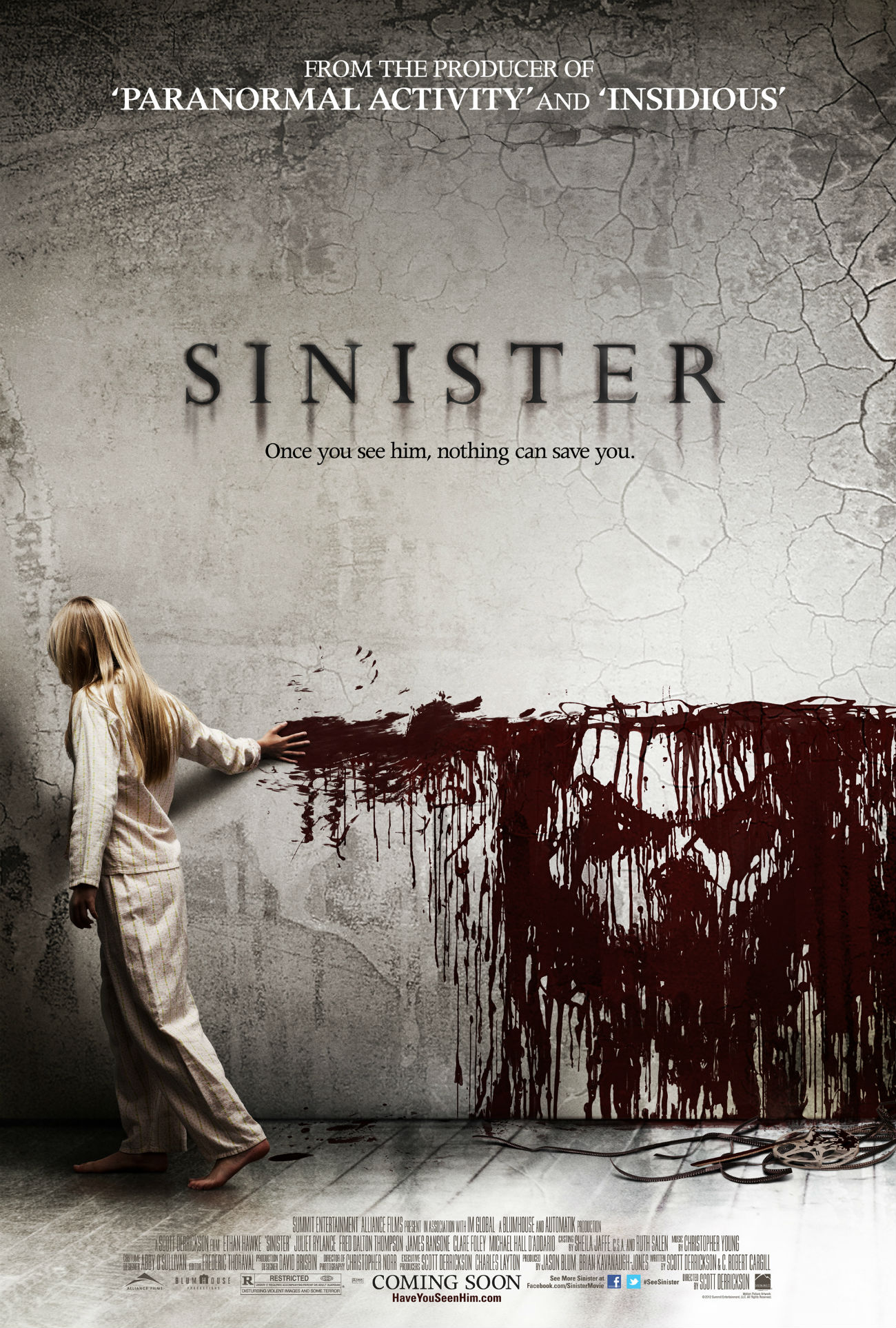
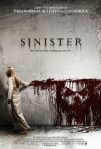
Today’s cinema adventure: Sinister, the 2012 horror feature by director Scott Derrickson, about a true-crime writer whose research into the unsolved murder of an entire family uncovers links to a decades-long series of similar killings and connections to an ancient malevolent force. Combining a standard cinematic narrative with elements of the now-prevalent “found footage” format employed by the horror genre, it relies heavily on mood and atmosphere, eschewing overt violence and gore for the terrors of a stimulated imagination and the deliberate build of suspense through tried-and-true methods of filmic storytelling. Benefitting from intelligent writing and a strong and experienced cast headed by Ethan Hawke, it received mostly positive response from critics and was even named by some as the best horror film of the year.
Inspired by a nightmare in which he discovered a home movie documenting the hanging death of an entire family, Derrickson built a screenplay, co-written with C. Robert Cargill, in which this situation serves as the premise for a tale of real-life obsession and supernatural evil. It begins as crime author Ellison Oswalt, moves with his family into a house located in a small rural town where a family has been brutally murdered the year before- except for a young daughter, who disappeared without a trace. Hoping to recapture the success of his first bestseller after a string of subsequent failures, Ellison plans to research the sensational case up close; unbeknownst to his wife and children, he has gone so far as to purchase the very house in which the killings took place. While exploring the attic, he discovers a box containing an old projector and several reels of Super 8 home movies; obviously curious, he takes them into the office he has set up in a spare bedroom and begins to watch. When he begins with the most recently-dated film, he finds- to his horror- that it shows the murder of the house’s former occupants, although any shots of the murderer have been edited out; even more disturbingly, the remaining films, dated over the course of six decades, contain a visual record of other, similar murders- each one the ritualized slaughter of an entire family by different, equally horrifying methods- and in each one, upon close inspection, can be found a glimpse of an ominous, dark-eyed figure watching the gruesome proceedings. Though at first he considers bringing the films to the police, Ellison’s ambition to regain his fame and fortune wins out; he decides to pursue the investigation by himself, hoping to solve the case on his own and use it as the basis for his triumphant return to the bestseller lists. With the help of a star-struck deputy sheriff and a local expert on the occult, he begins to piece together a pattern linking the various filmed murders, but the mystery only deepens- as does his obsession with it, leading him to heavy drinking and driving a wedge of alienation between himself and his family, who have begun to be affected by the sinister aura of the house. It soon becomes apparent that Ellison’s ego-driven quest for answers has uncovered an ancient and diabolical secret, and that he may unwittingly be placing himself and his loved ones at risk by continuing to pursue the truth.
Derrickson’s efforts to create a truly frightening film went beyond the development of the screenplay itself, and involved a heavy focus on the creation of the central villain, whose wordless presence gives Sinister the bulk of its creepy power. After abandoning his original conception of an evil “Willy Wonka” figure, luring children into his murderous trap, and transforming the character into an legendary Sumerian spirit rather than a demonic entity (to avoid rooting the film in a specific religious setting), he researched over half a million online images and drew inspiration from the visual style of “black metal” music- which is extensively used in the soundtrack- in order to achieve the look and persona of “Bughuul,” fondly known as “Mr. Boogie” by the children who fall under his spell. The filmmaker’s instinct to get it right was a wise one- many otherwise effective horror films have been sunk by the presence of an unconvincing or laughable monster, but Sinister succeeds in dispensing chills largely because of the primal fear effortlessly elicited by its elegantly simple, utterly terrifying boogeyman. Made all the more disturbing by his ephemeral presence on the fringes of consciousness and reality, he appears only fleetingly onscreen, yet he leaves haunting, indelible images in the mind and makes us search for another look at him even as we dread the prospect of it. Though the plot of the movie is driven, like so many other films in the genre, by characters making mind-numbingly stupid choices (why do horror characters never reach for a light-switch when they enter a darkened room?) and implausibilities that stretch the willing suspension of disbelief dangerously close to its limit, we forgive these clichés of the formula because of the palpable aura of inevitable doom conjured by our brief encounters with this otherworldly phantom. From the first moment we see him, we know where things are going, and we are drawn into the journey towards that horrific culmination with the same illogical, obsessive fascination as the characters onscreen.
Not that Sinister is devoid of strengths besides the portrayal of its Sumerian specter; although the perfunctory and predictable pitfalls of the genre- cheap and sudden shocks, the usual reliance on creepshow staples such as evil children and menacing animals, the aforementioned brainless behavior of the potential victims- are undeniably present here, Derrickson and Cargill have infused their screenplay with enough intelligence to bring a sort of sense to these elements. Their clever use of modern technology to facilitate the story not only allows for the visceral immediacy of the supposed “actual footage” upon which the premise hangs, but also for streamlining the narrative; the pursuit of information requires no more than a few keystrokes on a laptop, eliminating the need for lengthy expository scenes at the local library. In addition, the rooting of the story in a tech-savvy modern world helps to heighten the contrast with the antiquated force of evil within it, and- more importantly, perhaps- serves to compound the isolation of our protagonist, whose vulnerability increases the as he retreats deeper into his self-created solitary confinement. In addition, Sinister re-imagines the stock characters of the genre to a sufficient degree that they almost seem original. The town sheriff is not a pompous buffoon, but a smart and authoritative figure with refreshing candor and obvious wisdom, and our confidence in Ellison is undermined almost from the outset, simply through the hostility and lack of respect he bestows upon this man; likewise, the deputy who later assists in Ellison’s research, though he seems, at first, to be the slack-jawed yokel we’ve seen so many times before, soon proves to be a sharp and savvy investigator, who might be a valuable ally if the ostensible hero were not blinded by his own sense of intellectual superiority; finally, Ellison’s wife and children, though ultimately relegated to the position of a plot condition, are not the clichéd ciphers so often seen in these roles- the kids, though troubled (understandably and believably so), are possessed of genuine and endearing personalities, and his wife (played by the lovely and substantial Juliet Rylance) is strong, supportive- within reason- and eloquent enough to deliver the film’s keystone monologue about her husband losing sight of his life’s true purpose in the pursuit of fortune and glory.
It is this last point that underscores what truly elevates Sinister above the level of schlock horror and gives it the weight and substance that allows it to be more than just a spooky campfire story. In Ellison’s self-destructive determination to recapture his worldly success, he abandons his role as protector and companion to his family; indeed, he effectively separates himself from the rest of mankind, devaluing all outside influence and presuming to stand alone against a powerful evil which he has yet to fully comprehend. Cut off from the source of his humanity, and with his stubborn ego undermined by self-doubt and self-loathing, he can only watch, powerless, as the forces he has unleashed proceed to overwhelm him and infiltrate the world around him. It is this portrait of a man haunted from within, driven by his ambition but paralyzed by his fear of failure, that gives Derrickson’s movie its real power; the story of Bughuul and his ancient evil becomes a metaphor for the soul-consuming effect of displacing one’s humanity in favor of the blind pursuit of material success, and Ellison’s spiraling downfall is as much an indictment of the so-called “American Dream” as Willy Loman’s delusional road to suicide in Death of a Salesman over a half-century ago. Of course, this is not to say that Sinister has social commentary as its ultimate purpose; the film is aimed squarely at scaring the bejeezus out if its audience, and it succeeds wickedly. Nevertheless, while it is relatively easy to shake off the chills it brings by exploiting our fear of things that go bump in the night, this deeper level allows those chills to sink to the bone, leaving us unsettled and uncertain long after the final, gruesome images have faded from the screen. It is also the presence of this underlying theme that allows the film to seem fresh and original even as it evokes and pays homage to the genre classics which influenced its director- most obviously The Shining, a movie with which Sinister bears many similarities in story, subject, and mood.
Derrickson’s slick direction goes a long way towards making the whole thing work. He heavily utilizes his soundtrack, both musical and ambient, to create near-unbearable tension; the big visual scares come as surprises, emerging from the periphery of our gaze or rising from the shadows of the background; his use of authentic Super 8 film to recreate the ghostly snuff films which lure both protagonist and audience into the story lends a grainy realism that makes these sequences all the more disturbing, and his choice to cut away from these at their most gruesome moments, or show us the gore out-of-focus, in a reflection or in the background, forces our imagination to complete the picture with images more horrific and unthinkable than anything he could have put on film. The director’s cleverness behind the camera, however, would be for naught without a strong performance from his star, and Ethan Hawke- an oft-overlooked but genuinely fine actor, particularly adept at playing likable losers on a downward spiral- delivers just that; in Hawke’s capable hands, Ellison avoids coming off as just another cocksure golden boy paving the road to his own deserved comeuppance and instead becomes a sympathetic Everyman, flawed but inherently decent, well-intentioned despite his over-confidence, and ultimately more devoted to his family’s welfare than his own success. Though we see from the beginning that he is an unreliable figure in which to place our trust, we are drawn to identify with him nevertheless, largely due to Hawke’s honesty, which lets us inside the conflicted and desperate mind which drives him; he takes us along for the ride, bouncing between determination and fatalism, buoying himself with self-assured good cheer even as morbid self-doubt eats away at his core, and never letting us forget that Sinister, for all the arcane circumstances at its surface, is really about a man’s struggle with demons on the inside.
This review may seem like a rave, and in a way, it is. I must admit that, for the most part, contemporary horror movies do very little for me; I find them gimmicky, shallow, and unimaginative, relying on gross-out tactics and cheap scares to make an impact without challenging the intellect. They debase human behavior, fetishize violence and cruelty, and reinforce a simplistic morality even as they present a nihilistic view of a hostile and malicious universe. Of course, these criticisms of the genre are not unique to its most recent expressions- far more horror movies have been lowbrow schlock than have been cinematic gems, no matter what the era- and there are certainly exceptions. Sinister is one of those, a movie in which the shocks resonate to a deeper level and strike at fundamental issues in our collective psyche; it taunts us not just with primal fear of horrors hiding in the dark, but with the more sophisticated terrors of living in the real world- of failure, of inadequacy, of getting it all wrong, and perhaps worst of all, of playing in a rigged game where even your most determined effort only serves to ensure your ultimate defeat. Sinister is not, in the end, a film of the caliber of such cinema greats as Rosemary’s Baby or The Exorcist, which weave philosophical contemplation about the true nature of evil seamlessly into their narratives, nor does it approach the subversive genius of Golden Age classics like King Kong or Bride of Frankenstein, in which the hypocrisy, greed, and intolerance of so-called normalcy are used to cast the “monsters” as more worthy of sympathy than those they terrorize; like those and other films of the genre, it invites us to think and to feel as it thrills us, but it falls short of true brilliance by never quite breaking free of standard formula, no matter how expertly it adapts the tropes to its own ambitious needs. Nevertheless, it succeeds in chilling us to the bone without expecting us to shut off our higher functions in exchange for the thrill, and it manages to breathe new life into its clichés without being too clever for its own good (see my review of The Cabin in the Woods). Sinister may not be a great movie, but it is, in my estimation, a good horror movie- and coming from me, that is high praise indeed.
http://www.imdb.com/title/tt1922777/?ref_=fn_al_tt_1







































 JPK's Adventures in Cinema