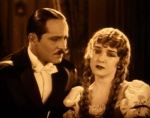
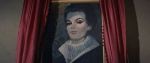
Faust (1994)

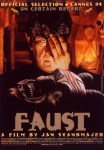
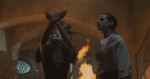
Today’s cinema adventure: Faust, the 1994 feature by celebrated Czech filmmaker Jan Švankmajer, a surrealist take on the classic German legend in which a scholar trades his soul to the Devil in exchange for worldly knowledge and experience.  Set in modern day Prague and incorporating the director’s trademark blend of live action with stop-motion animation, claymation and puppetry, as well as his disturbingly textural use of sound, it represents the culmination of Švankmajer’s long fascination with the tale and stands- along with his other highly distinctive work- as a major influence on more well-known directors such as David Lynch, Tim Burton, and Terry Gilliam.

Presenting its own loose adaptation of the familiar morality fable, Švankmajer’s film borrows elements (and, occasionally, entire scenes) from previous versions by the likes of Christopher Marlowe and Goethe, as well as from the early folk stories of its origin, more or less faithfully following the traditional structure of the narrative; but thanks to the director’s surrealist sensibilities, it recasts the tale in the form of a nightmarish hallucination centered around a nondescript middle-aged everyman who stands in for the mythic scholar.  When this hapless protagonist is handed a flyer in the street, upon which is printed only a simple map of the city with a location marked in red, his curiosity- coupled with some unusual occurrences in his apartment- leads him to a mysterious, ruined theatre; there, after donning costume and makeup, he begins to read from a charred and tattered script, setting in motion a hallucinatory cycle in which he enacts the role of Faust.  Assisted- and manipulated- by an assortment of other “actors,” human and otherwise, his own identity merges with that of the character he plays, and it becomes clear that his own fate is being determined by the scripted events of the ancient drama in which he has become enmeshed- in which he strikes a bargain with Mephistopheles, an agent of the Devil, to instruct him in the secrets of the universe and guide him through the pleasures of earthly life for a period of 24 years, after which he will surrender his soul to be damned into Hell for all eternity.

A dark and moralistic story like this one, born of the same dour Germanic heritage that yielded the Grimm fairy tales and other such cautionary parables, could easily be translated to the screen laden with the ponderously heavy trappings of deep tradition and humorless Puritanism; likewise, given the fact that this legend has provided the inspiration for countless adaptations and re-inventions (from Shakespeare’s Macbeth to Brian DePalma’s The Phantom of the Paradise), the familiarity of its basic plot and its themes make it challenging, to say the least, for any artist attempting a new version to find a fresh approach that might prevent predictability and redundancy from undermining the proceedings- and the audience’s interest in the outcome.  In Švankmajer’s hands, however, the entire well-known saga is transformed into an audaciously non-traditional package of surprises, each one as delightful as it is disturbing, appropriately dark in tone but laced throughout with macabre, tongue-in-cheek humor, and loaded with the peculiar blend of the cinematic and the theatrical that gives this director a reputation for visual magic that is unlike the work of any other.  A self-proclaimed surrealist, Švankmajer creates a movie that captures the peculiar flow of nonsensical logic one follows in a dream, making the experience of watching Faust feel thoroughly like a visit to the realm of the unconscious; he tells the story clearly and succinctly, but he does it through a deeply symbolic progression of seeming non-sequiturs, building a mass of perplexing puzzle pieces that fall seamlessly into place as the narrative resolves itself.  By transposing the story deeply into a hallucinogenic reality in which rules of plausibility and common sense no longer apply, the director not only allows himself free use of arcane and metaphoric artistic conceits, he manages to frame his oft-told tale in such a way that every development seems completely new and unexpected, giving us the opportunity to discover its hidden meanings and significant themes by discovering them from an unfamiliar perspective.

That perspective, shrewdly, moves the Faust story out of the medieval past and into a milieu more relevant to a modern audience; Švankmajer doesn’t exactly update his drama, but rather rehearses it within a contemporary framework.  Our protagonist is established from the outset as a decidedly present-day figure, emerging amidst a crowd of commuters from a subway station- just another anonymous drone.  He is drawn into the web that will seal his fate by a pair of men passing out flyers on a street corner, a sight so mundane in our modern world we scarcely take notice; this, of course, sets up a recurring theme for Švankmajer, that of the mystical contained within the ordinary, a motif that manifests itself throughout the film and tempts us, like Faust, with the promise of secret wonders hiding just beneath the bland surface of our everyday lives.  In our demystified era of utilitarian buildings and dehumanized masses, we long for the thrill of the unknown, a glimpse of something mysterious behind the mask of our predictable, well-ordered existence; such a revelation, however, is as unsettling as it is exhilarating, a source of terror as much as enlightenment, and therein lies the essence of Faust.  To obtain the key to this secret world, we must be willing to sacrifice our very selves, to give up everything that defines us- our souls, if you will; for to be privy to the secret workings of the universe is to be torn irrevocably from our humanity, confronted with an absolute power that renders our previous understanding meaningless and dissolves our identity by shattering the precepts upon which we build our relationship with the world.  In a modern age full of the smug assumptions and easy explanations derived from centuries of scientific exploration, the idea of an unseen order to things is perhaps even more terrifying than it was to our superstitious forefathers, whose imaginations conjured the tale of Faust to warn against delving too deeply into the hidden mysteries of life.  They feared the cost of knowledge and worldly experience was the loss of the soul, but we who have embraced these things may be more frightened by the possibility that they were right.  Švankmajer’s Faust, then, is about the rediscovery of the soul by modern man, and the disturbing notion that he has already sacrificed it.

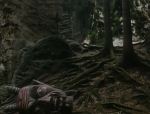
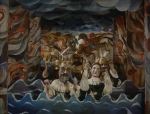
That Švankmajer conveys all this in his movie is remarkable; but convey it he does, in a manner which gives testimony to his skills as an artist and a visual storyteller.  How he does it, exactly, is beyond the power of words to describe, and at any rate is best left to be experienced firsthand. Suffice to say that, in order to bring our modern sensibility into the mystical world of his story, he takes us into the last remaining stronghold of magic, the realm of the theater.  By trapping his protagonist into a re-enactment of an ancient text, not only does he provide the obvious metaphor of man’s fate being dictated by his repetition of the patterns of the past, he opens the door for his own use of all the tricks of the trade in the service of creating his goofy nightmare.  Puppets, both life-sized and miniature, stand in for other characters- and occasionally, for Faust, too- and interchange with live actors; painted backdrops appear in naturalistic settings, and vice-versa, patently theatrical objects and occurrences manifest in the real world, and events move freely back-and-forth between the containment of the theater and the expanse of nature, underscoring Švankmajer’s dissolution of the boundary between reality and illusion; dialogue is recited, arias are sung, ballet dancers perform, and an audience observes the proceedings, though most of Faust’s key scenes take place “backstage,” at least ostensibly.  Of course, the director’s familiar techniques of stop-motion animation are directly drawn from this theatrical background, and fit in seamlessly here- particularly effective is his claymation rendition of Mephistopheles, growing from a ball of clay into a vaguely humorous demonic face that then transmutes into a mirror image of Faust’s own appearance, giving us, once again, the mystical inside the familiar.  Throughout the film, Švankmajer utilizes all these devices to draw us along on this metaphysical journey, using his surrealist tactics to provide cryptic images that simultaneously amuse and appall us- an egg baked inside a loaf of bread, a baby transforming into a skull, a severed leg wrapped in plastic, a puppet demon sexually assaulting a puppet angel, and countless other blasphemous delights- and, in the end, achieve their cumulative goal of revealing the film’s underlying mystery.  It’s worth mentioning, too, that Švankmajer also indulges his usual fascination with food, offering us numerous important scenes that revolve around eating; he also provides his trademark, hallucinatory soundscape, a collection of rustling, scratching, rattling noises that crosses the sensory boundaries to make us feel the surfaces we hear- and creeps us out, in the bargain.  The entire film, ultimately, has this effect- it’s something akin to visiting a haunted house at Halloween, in which we want to feel our skin crawl and our hair stand on end, but we want to giggle with glee over the pure silliness of it all.

Jan Švankmajer is something of a national treasure in his native Czechoslovakia, and rightly so.  His visionary work, at once quirky and powerful, represents the kind of purely artistic sensibility that is rarely found in modern cinema; with the personal spirit of a true auteur, he makes certain his films are distinctly his own, and whether or not audiences respond is not his concern.  Though much of his work has been rarely seen in the U.S., thanks to Cold War restrictions and prejudices that impaired his ability to distribute it on this side of the Iron Curtain (and, sometimes, even to produce it at all), he has gained a steady and growing following among fans of animation, surrealism, and cinema in general.  His decidedly adult adaptation of Alice in Wonderland (simply titled Alice) is partly responsible for breaking him through into Western culture, but many of his other films- including this one- have been championed by critics and other filmmakers alike, and the ready availability of the digital age has now made it possible for almost anyone to partake of the disturbing delights he offers.  Since Faust, like all of his films, is virtually impossible to describe- even stills fail to capture it, since Švankmajer’s visual sense is so connected to motion and juxtaposition of images- I strongly recommend a viewing.  I can praise it all I want, but, ultimately, it’s a movie that speaks far more eloquently for itself.

http://www.imdb.com/title/tt0109781/

Women in Revolt (1971)

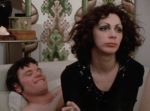
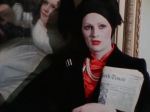
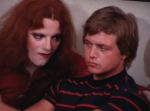
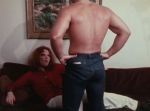
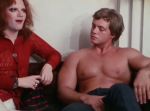
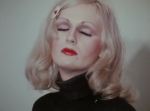
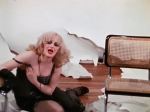
Today’s cinema adventure: Women in Revolt, the 1971 Andy Warhol-produced film satirizing the Women’s Liberation Movement and starring a trio of transgendered “superstars.” Notably, it was the last film to be produced by Warhol on which he actually stood behind the camera, though it was directed by longtime associate Paul Morrissey; it enjoyed more attention and mainstream notoriety than many of the infamous artist’s earlier films, largely on the basis of its controversial approach to the subject matter, drawing the wrath of feminists who felt it was a slap in the face to have their cause savagely lampooned and to be represented onscreen by “female impersonators” instead of biological women.

The plot, such as it is, revolves around three women who become involved in the Women’s Lib movement for their own reasons: Jackie is a militant intellectual schoolteacher who believes men are inferior to women and should be relegated to their naturally subservient place in society; her friend Holly is a model who hates being treated as a sex object, although she herself has a ravenous libido; and Candy is a society heiress who longs to break free of the stiflingly traditional role she is expected by her family to play, wishing instead to build a career for herself as a glamorous movie star. When Jackie and Holly decide to form their own protest group- called Politically Involved Girls, or “P.I.G.” for short- they hit upon the idea of enlisting Candy, hoping to capitalize on her high-profile society position to generate publicity for their cause, and more importantly, to gain access to the financial support of her family and the wealthy circle in which they move. A series of misadventures follows in which each of the three activists are revealed to be more motivated by self-interest than by real passion for their cause. Jackie, despite being a self-proclaimed lesbian, spends the organization’s money on a bodybuilding male hustler and becomes the unwed mother of his baby; Holly succumbs to her penchant for drinking and sex, becoming a derelict living in the street; and Candy abandons her friends, her family, and the movement to realize her dream of stardom.

The scenario for Women in Revolt– it would be inaccurate to call it a script- is not so much a storyline as it is an excuse for extended on-camera improvisation and trashy bad behavior. This, of course, is the real purpose here, far more than any deliberate social or political commentary. Still, it’s easy to see why genuine feminists would find Morrissey’s movie insulting and offensive; their arguments are put into the mouths of enfants terribles whose grotesquely exaggerated behavior and plainly self-absorbed motives render them meaningless and laughable. Given Morrissey’s right-wing political bent, it’s possible, if not probable, that this was at least part of his intention here; but in truth, the whole affair is so patently ridiculous that it is impossible to take seriously. The political satire is merely a vehicle in which the film’s three stars can indulge in their individual excesses, gleefully breaking taboos and acting out with histrionic abandon. Much of the dialogue is devoted to the kind of verbal bitch-slapping that has fueled drag shows for decades, and for the most part, whoever shares the screen with each of the three central characters is merely there to provide a foil- and the occasional straight line- for their onslaught of caustic camp.

Though this formula, admittedly, provides numerous amusing moments throughout the film, it is also the main downfall of Women in Revolt. The pervading atmosphere of uncontrolled, undisciplined expression hardly makes for concise, coherent filmmaking; the improvisational approach works for fleeting moments, but those are islands in a sea of self-indulgent chatter- often spoken simultaneously, in a seeming battle for dominance, rendering much of its content incomprehensible and more than a little grating. This, of course, is inherent in improv, which is why it is most effective when used as a basis for developing more polished material or edited into a cohesive form by a savvy director; it also helps when the performers have been given clear guidance and, ideally, have received some formal training. In the absence of these elements, the end result usually ends up looking and feeling like a free-for-all, reminiscent of rambunctious children play-acting in a schoolyard game of make believe- which can be effective in short doses, but is perhaps not the best way to sustain the length of an entire feature film. It creates, in fact, the sense that we are watching a movie made by amateurs, and such is the case here; the low budget production values, the clumsy lighting, the choppy editing, and the generally insipid nature of most of the dramatic conceits all contribute to this feeling. As a result, instead of being provocative or outrageous, the proceedings quickly become simply tiresome, with a juvenile sensibility that makes the archness of the film’s tone come off more like shallow snarkiness. In addition, despite a considerable amount of gratuitous nudity- mostly male- and sexual content, the handling of these scenes strips them of eroticism; indeed, sex as portrayed here is a repugnant, degrading act, devoid of charm or subtlety, and thoroughly shocking for reasons that have nothing to do with morality or social acceptability. Like everything else in the world as seen by Warhol, Morrissey and company, it’s just another boring convention to be disdained and ridiculed.

These criticisms, valid though they may be, might be immaterial if one considers that film for Warhol- originally, anyway- was just another decorative medium, a way to produce ever-changing pop art images to be projected on a wall at a party, perhaps- a means to provide atmosphere in the background of a real-life “happening.” The rules of good cinema do not apply when a film is more of a statement in itself than a legitimate exploration of the art form. However, by the time of Women in Revolt, the enigmatic Warhol had stepped away from participation in his film productions, handing over the reigns to Morrissey, who had taken things in a more (or, arguably, less) ambitious direction, focusing on a narrative-driven, mainstream approach. It would be a mistake to classify these later Warhol movies as art for art’s sake, as they clearly aspire towards providing a more medium-specific experience; therefore, it seems fair to say that by any reasonable cinematic standards, Women in Revolt is a terrible film. One might argue that the film eschews traditionally accepted style and polish as a rejection of conventional cultural values, but pretensions of artistic purpose are no excuse for sloppy movie-making, and even if one generously classifies Morrissey’s style as cinema verité, it’s hard to think of a less professional, more careless example of cinematic hack-work. What makes this film so appallingly bad is not its nasty attitude or its banality, but the fact that it is, in the end, a poorly executed, badly assembled mess- and despite the fact that Warhol himself operated the camera for several botched scenes (at the insistence of star Jackie Curtis, who refused to perform without his participation), the fault for this lies solely at the feet of its director. Morrissey’s apparent lack of skill in the creation of his product may have been intentional, a deliberate effort to make a statement about the subjectivity of artistic values or to prove the point that arbitrary notions of bad or good are irrelevant to an audience simply seeking to be distracted; but his work here smacks of fraud, the attempts of a would-be artist to discount the importance of techniques he hasn’t the patience or understanding to master. Whereas Warhol’s genius was in simply setting up the camera and letting it capture what it would, the same approach is Morrissey’s crutch. In other words, Women in Revolt seems the work of a lazy director who wants glory without having to work too hard.

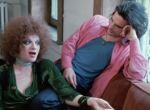
Despite this harsh assessment of Morrissey and his work, Women in Revolt is not devoid of value. For better or for worse, in fact, it is probably a more significant film today than it was when it was originally released, due largely to the window it provides into the miliieu of the Warhol factory and- more importantly- the all-too-rare opportunity it gives us to see the work of its three leading players: Jackie Curtis, Candy Darling, and Holly Woodlawn. Each of them were members of Warhol’s famous coterie at the “Factory,” known for their work in previous of his films, and as such were popular- and notorious- fixtures of New York’s avant-garde arts scene. Curtis, unlike his two co-stars, was a female impersonator, who appeared both as a man and a woman in his work, and was successful independently of his projects with Warhol; he was an actor and playwright whose edgy, campy plays were a fixture of New York’s experimental theatre scene, as well as a singer and poet whose work garnered considerable praise and attention from critics of the era. His screen persona- abrasive, outspoken, sarcastic, and sporting a frizzy red wig with glittery make-up- provides many of the best one-liners in Women in Revolt, and whenever he is on the screen he is in absolute command. This is not always to the benefit of the film; many of the shrillest and most confused scenes are the result of Curtis’ aggressive improvisation, in which other performers are drowned out and cut off at every turn in favor of his unscripted outbursts. Nevertheless, it’s a smart performance, giving a glimpse at the potential for brilliance which might have been more fully realized with a little rehearsal and direction. Likewise, Candy Darling, a true transgendered performer, who had worked extensively with Curtis in his plays as well as in previous Warhol outings, reveals the ethereal, double-edged sincerity that allows her, somehow, to rise relatively unscathed above the messy chaos of Women in Revolt; she contrasts Curtis’ brash bullying with her own form of dominance, the cool superiority of a sophisticated and intelligent woman with nothing to prove. She is elegant and truly beautiful, and Women in Revolt is at its best- and most watchable- when she is onscreen, working her magic with the curious blend of earnestness and irony that made her one of the most charismatic of the “superstars.” Rounding out the trio is Woodlawn, also a true transgender, whose fiery Puerto Rican energy bursts from the screen, representing the raw energy of the body (as opposed to that of the mind and spirit, personified by Curtis and Darling, respectively) as she gropes and gyrates her way through the film. Truly sinking her teeth into her role as a nymphomaniac who hates men, she gives a manic, conflicted performance which displays a remarkable gift for comedy and hints- as does the work of her co-stars- at a considerable talent, making us wish all the more for a surer hand behind the camera. The fact that all three of these stars are so obviously gifted is yet another indictment against Morrissey’s infuriating mediocrity as a director; their work continually gives us glimmers of what Women in Revolt might have been. Still, they provide plenty of reasons to sit through the movie- though it requires considerable patience and might be best accomplished in short installments- and even manage to create several moments which could be called classic. Besides these three heavyweights, the film offers brief appearances by other counter-cultural icons of the era, including Penny Arcade and Betty Blue, and Brigid Berlin in a wordless cameo as a decidedly butch bar owner.

The fact that Women in Revolt is an atrocious movie, oddly enough, does not alter the fact that it is a classic, of sorts. Clearly, there are many stalwart supporters of Warhol and his crew that would defend the film staunchly and embrace its many flaws proudly, claiming them as victories in a cultural war and viewing them as medals of honor. There is certainly a weird power to this curiosity of its time, and despite its lack of real ambition it manages to offer up some interesting observations about the power struggle between the sexes- particularly through its reversal of roles in which liberated women treat their men with the same disrespect and contempt they deplore when they are the recipients, and the use of sex as both a bargaining tool and a means of gaining power. It can be argued that the movie was a success in terms of what it set out to accomplish. Warhol neither knew nor cared about the aesthetics of film; he wanted only to present his branded material for the sake of building his cult-of-personality-based empire, and notions of good or bad were of little interest to him. With this in mind, Women in Revolt is exactly what he wanted it to be- a source of controversy and buzz, and another brick in the continually growing monument to his so-called genius. Indeed, given his particular, nose-thumbing stance at conventional society, it is probably preferable that it should be bad; the exaltation of the banal was a major part of what he was all about, after all. Therefore, I find myself in the curious position (which Warhol would have loved) of recommending a movie that I found to be abysmal. I would stress, however, that my endorsement is based not on any sort of respect for the artists behind the scenes, but on my admiration for the ones on the screen. It is beyond tragic that these three were given the treatment they were- exploited by Warhol for their “freak” appeal, they were given just enough cultivation to reveal the brilliance of their underlying talent, then abandoned because the impresario had lost interest. Perhaps the real reason for his fickleness can be surmised by viewing Women in Revolt; it is the talent of Curtis, Darling, and Woodlawn that redeems the experience, and without them it would truly be unwatchable.  Could it be that Warhol feared they might outshine him on their own merits, and take away some of the credit for their own success? It’s a question, sadly, that must be asked, but can never be answered. Darling would pass away of cancer within two years of the film’s release, and Curtis would die of a heroin overdose a decade later; Woodlawn returned to her native Puerto Rico and worked as a busboy until, years later, a resurgence of interest in her former persona allowed her to return to the limelight. Women in Revolt, wretched as it is, is a snapshot of a moment in time, when all three were poised on the brink of success, and maybe, just maybe, could have broken through the barriers of social prejudice to achieve mainstream success. It was not to be, but they paved the way for future generations who continue the struggle for transgender acceptance. That in itself makes this movie worthy of respect- not for the posers behind the camera, but for the real people in front of it.

http://www.imdb.com/title/tt0129631/

Santa Sangre (1989)


Today’s cinema adventure: Santa Sangre, the surreal 1989 horror fantasy by director Alejandro Jodorowsky, about a young man, raised in a circus, who is dominated by his puritanical mother and driven by her to exact revenge for the sinful impurity which led to her brutal dismemberment.  Hallucinatory, disturbing, and gruesome, it received only limited release in the U.S. despite its director’s status as a revered avant-garde legend and the enthusiastic reception of critics, but quickly became a cult classic and has since been made widely available for home viewing.  Hailed by many as a masterpiece, it’s a bizarre visual feast, pervaded by a garish carnival atmosphere and a sense of sickly wonder, which offers the guilty thrills of Grand Guignol horror alongside religious, psychosexual, and social themes, providing an unforgettably nightmarish cinematic journey through the arcane and the unspeakable.

The story centers on Fenix, whom we first see as a patient in a mental institution- naked, animalistic, and uncommunicative, but beginning to emerge from his isolated state in response to the gentle coaxing of his doctor.  Through flashbacks, the origins of his traumatized state are revealed; we see his childhood as the son of a circus impresario and his aerialist wife, performing as a juvenile magician and surrounded by the extreme environment and eccentric denizens of their show-business world.  His libidinous father is enamored of his newest act, a tattooed contortionist whose abused deaf-mute daughter, Alma, has become a new companion for Fenix; his mother is also the fanatical leader of a cult dedicated to the memory of a little girl whose arms were cut off by rapists.  When the authorities close and demolish her church, and she catches her husband with his tattooed mistress, it is too much for mother to take- she attempts to punish the philanderer for his faithlessness, resulting in a tragic turn of events that leads to his death and her dismemberment, a tragedy witnessed by their horrified child.  When the film returns to the present, we see the adult Fenix gradually reawakening to his memories, culminating in his escape from the hospital and a reunion with his now-armless mother; together, they form an act in which his arms become hers- an odd symbiosis which carries over into their strange and secretive offstage life.  It gradually becomes apparent that Fenix’ limbs have become subservient to his mother’s will, and he is forced to do her bidding despite his own wishes- even when it means committing murder.  The situation becomes even more complicated with the reappearance of Alma, now grown into a beautiful woman; his feelings for her threaten to disrupt the twisted bond between mother and son, triggering a final battle of wills in which Fenix must attempt to regain control of his destiny and put an end to his mother’s vengeful reign of blood, once and for all.

This scenario may seem convoluted and illogical, but in Jodorowsky’s screenplay, co-written with Roberto Leoni and producer Claudio Argento, it all makes its own kind of sense.  It is clear from the beginning of the film, when we are first introduced to our damaged protagonist (crouching naked in a white room adorned with only a severed tree trunk, which he uses much in the way of a monkey at the zoo) that we are visiting a universe where the rules of common sense and linear thinking do not apply.  It’s a primal place, a realm of deep unconscious impulses and associations, where every occurrence seems symbolic and yet has simultaneous real-world significance.  In short, it is a dream reality, and one marked by the kind of feverish dread and sadness from which we long to awaken.  Into this soul-sick, delirious setting, the film weaves its epic tale of good and evil, complicated by deep-rooted familial bonds, contradictory moral strictures, and the personal needs of heart, body and spirit.  Along the way it mercilessly exploits our expectations and challenges our sensibilities, forcing us to endure depictions of unthinkable cruelty, incomprehensible depravity, and devastating heartbreak, so that when we are confronted with the grisly violence of murder, it seems almost a relief.  Certainly these scenes provide a kind of cathartic release for all the accumulated emotional saturation to which Jodorowsky’s film subjects us; but this does not mean that Santa Sangre condones or glorifies killing.  On the contrary, these periodic bursts of bloodshed only serve to compound the psychic despair that drenches the movie, until it seems that true evil is everywhere and all the good intentions in the world are powerless to stop it.  This, of course, is the ultimate point of Santa Sangre:  it is not enough to bewail and bemoan the workings of evil, or to regret one’s own unwilling or unknowing participation in them; the consequences may be dire, and the effort may be great, but conquering evil means taking responsibility for one’s own actions and exercising one’s free will by refusing to perform its bidding.  In a film so outwardly monstrous, the biggest shock of all may be that it is, ultimately, about the triumph of good over evil.

In support of his overriding theme, Jodorowsky has assembled a film worthy of his legendary surrealist pedigree.  He fills the screen with a progression of remarkable images, drawing heavily on the filmmakers who have influenced him- particularly Federico Fellini- but infused with his own darkly visionary sensibility.  Over the course of Santa Sangre he gives us a dancing dwarf, an elephant funeral, a pimp who gives cocaine to mentally handicapped children, naked whitewashed corpses rising from their graves, dogs and chickens feasting on human blood, a cross-dressing wrestler, and any number of other fascinating, macabre, unsettling sights and sounds; it’s an inundation of the bizarre that is so perversely gripping that looking away is simply not an option.  Jodorowsky is not merely being outrageous for the sake of shock value, however; every element, no matter how bewildering it may seem, has a concise purpose here.  The theatricality of the early scenes reminds us of the traditional view of the circus as a metaphor for life, but its larger-than-life atmosphere carries over into the film’s “real-world” setting- particularly in the nighttime streets of Mexico City, bedecked with the morbidly cartoonish imagery of Dia de los Muertos and populated with a frightening menagerie of revelers- suggests that the absurdity of life itself requires no exaggerated artistic conceit to expose its folly and decadence; the recurrence of quasi-religious iconography underpins an examination of hypocrisy in a moralistic dogma more concerned with punishment than salvation, more fixated on death than life, and more reverent of representation than of reality; and the heavy use of deep psychological themes throughout- symbolic bird imagery, the multilayered opposition of illusion to unadorned reality, the merging of sex and violence, the conflict between paternal and maternal influences- is carefully accumulated towards the director’s ultimate purpose of peeling back such complications to reveal the truth that choice, in the end, is what defines us.

For those who are just looking for a horror movie, Santa Sangre delivers on those terms, as well.  All of Jodorowsky’s avant-garde explorations are woven around a lurid tale of psychosis, murder, and mayhem that could easily have come from a mind like Stephen King’s.  In keeping with the film’s ironic title, much blood is spilled during the course of its story, in celebrations of gleeful gore managed with the flair of a true cinematic master; the macabre humor with which these killings are played out is worthy of Hitchcock- whose work, like Fellini’s, is echoed throughout.  Indeed, despite its serious agenda, Jodorowsky’s movie is laced with comical moments; part of the director’s style is to capitalize on the absurdity of what he shows us, eliciting laughter in the face of the strange and unfamiliar.  In a similar manner, he finds beauty in the grotesque and joy in the sorrowful, giving Santa Sangre an unexpectedly transcendent quality for such a gruesome saga.

Populating Jodorowsky’s epic is an assorted collection of personalities, some professional actors and many, clearly, not so professional.  At least a half-dozen cast members are relatives of the director, including his sons Axel and Adan, who portray Fenix as a young man and child, respectively.  Both deliver performances to do their father proud; as does the fiery Bianca Guerra as Concha, the unforgiving mother.  Also worth mentioning are Guy Stockwell as Fenix’ über-masculine, contradictory father and Thelma Tixou as his gyrating, tattooed mistress; many of the film’s remaining cast fall into the “where-did-he-find-these-people” category, conjuring memories of Tod Browning’s Freaks– another seminal influence for Jodorowsky’s vision- and providing indelibly-stamped images for the memories of any viewer.  The acting, needless to say, is not always stellar amongst these motley supporting players, though many of them do acquit themselves admirably; but even the most stilted and awkward performances contribute to the overall surrealism of the piece, an effect that is further enhanced by the obvious dubbing of some of the dialogue- a factor no doubt made necessary by Jodorowsky’s inexplicable decision to shoot his film in English, despite its Mexican setting and the fact that most of his previous work was produced in Spanish.

Santa Sangre is one of those film experiences that reminds viewers of the dazzling potential of the cinematic medium.  It transports us to a world that we have never seen, or even imagined, and opens pathways to the deepest, most private places of our psyches, making us aware on a level that erases the extraneous differences in our lives and connects us to the shared consciousness that unites us with the rest of humanity.  It manifests its own, utterly unique style while drawing from a sea of visual influences that includes not only the aforementioned filmic inspirations but such diverse sources as Frida Kahlo, the psychedelic counterculture, and the garish camp of lucha libre.  It’s a pity, though hardly a surprise, that this and Jodorowsky’s other films have remained more-or-less obscure; their edgy, unorthodox visual poetry is hardly the stuff of safe, commercial filmmaking, and the director’s long history and reputation as an iconoclastic free spirit has no doubt kept him distant from the profit-driven film industry establishment.  Nevertheless, the French-Chilean auteur maintains a large and loyal cult following throughout the world, and has enjoyed a long and remarkable career of which filmmaking is only a single facet; he is renowned as an artist, a theatrical director, an author, and a creator of comic books, as well as for his extensive work and research in the field of “psychomagic,” which has included a painstaking recreation of the classic Marseilles Tarot deck and the development of several therapeutic practices drawing on ideas from various so-called “occult” fields towards the purpose of psychological healing.  At the time of this writing, he is 83 and still active, at last report working on a film version of his autobiography, with which his stated goal is “to lose money.”  Perhaps the recent re-emergence of Santa Sangre, lovingly restored on DVD and BluRay and widely available on web-based streaming video platforms everywhere, will introduce the dark wonders of his world to a wider segment of the population and help to create a larger audience for his latest project.  At the very least, it may lead viewers to seek out and discover Jodorowsky’s other works, such as El Topo and The Holy Mountain, so that he may, at last, get the recognition he richly deserves as one of the great auteur filmmakers of our time.

http://www.imdb.com/title/tt0098253/
 

The World of Henry Orient (1964)

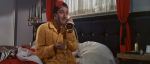
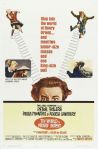
Today’s cinema adventure: The World of Henry Orient, a 1964 comedy directed by George Roy Hill, featuring Peter Sellers as the title character, a concert pianist whose libidinous exploits are complicated by the obsessive adulation of a pair of adolescent schoolgirls.  Based on a novel by Nora Johnson, daughter of Hollywood writer/director Nunnally Johnson (with whom she also co-wrote the screenplay for the film), it places greater emphasis on the coming-of-age story of Orient’s juvenile stalkers than it does on the misadventures of the loutish lothario himself.  It was successful with both audiences and critics, its popularity no doubt bolstered by the presence of its star, who was at the time entering the height of his career, and it was later turned into a Broadway musical, Henry, Sweet Henry, which enjoyed considerably less success.

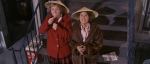
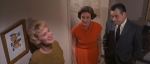
Set in Manhattan, the film follows the experiences of Val and Marian, two students at an exclusive girls’ school who develop a close friendship; both are outsiders at school, and share an imaginative flair for fantasy and make-believe, which leads to their indulgence in precocious adventures together.  On one such outing, they stumble upon a clandestine rendezvous in Central Park between Orient and his nervous, married, would-be mistress, interrupting their tentative tryst and foiling the pianist’s amorous intentions.  Later, when the girls attend his concert with Marian’s family, they recognize him from their encounter at the park, and Val develops a crush; so the pair begin to follow him, watching his apartment and making a scrapbook about their obsession- as well as a fanciful diary documenting Val’s hypothetical romance with him.  When Val’s jet-setting parents return for a holiday visit, her strict and austere mother finds the secret volume, a discovery which leads to uncomfortable complications not only for the girls, but for the unwilling object of their affections, as well.

Though The World of Henry Orient was a fairly successful film at the time of its release, it has faded somewhat from cultural memory.  Part of the reason for this may be that much of its draw in early 1964 arose from the presence of three up-and-coming names in its credits- Peter Sellers, Angela Lansbury, and director George Roy Hill- each of whose subsequent work would soon eclipse the importance of this quaint little movie.  Another factor, no doubt, was the changing social landscape of the years shortly to follow its debut, in which stories about the wholesome innocence of childhood, no matter how well-made they may have been, seemed somehow to be less relevant and important than those addressing the “larger” issues that were suddenly confronting young people as they came of age during the upheaval of the late sixties.  Ironically, one of the key factors in the film’s initial popularity was likely the fact that, in its good-natured and sweet depiction of teen-agers, it represented something of a backlash against a decade of teen dramas in which modern American youth culture was depicted as a dangerous and depraved environment full of delinquents, drugs, and rock-and-roll; the two young ladies at the center of this film were a refreshing change of pace, and their problems were, in truth, more representative of those faced by the average teen in daily life.  Sandwiched between two eras of rapid cultural evolution, The World of Henry Orient enjoyed its moment in the sun while the world took a moment to catch its breath.

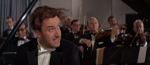
Whatever the reasons for its success or for its relative disappearance, Hill’s sweet-but-sophisticated little movie definitely holds up to contemporary viewings.  It’s worth noting that the title character’s name- a play on the name of renowned celebrity pianist Oscar Levant, whose surname means “Orient” in French and upon whom the character was loosely based- does result in some minor cultural discomfort surrounding Asian stereotypes; in deference to their idol’s unusual moniker, his two young stalkers adopt faux-Japanese code names and indulge in playful rituals which parody Eastern traditions, such as kowtowing to their collection of Henry-themed “relics” and sporting conical straw “coolie” hats as they stake out the pianist’s apartment building.  Aside from this, however, which can be written off as nothing more than playful, non-malicious fancy, the film’s gentle depiction of the transition from childhood into adolescence has a timeless feel, despite its distinctive, now-nostalgic mid-century Manhattan setting; much of this is due to Johnson and Johnson’s screenplay, which manages, through its focus on the universal concerns of young girls (and adults, for that matter) rather than on time-and-place-specific hotbed issues, to avoid any topicality that might have made the story seem dated today.  It also helps that the girls portrayed here are atypical teens, from a social standpoint; Marian comes from a “broken” home, living with her mother and another divorced woman (a situation with overtones which must have been provocative, even in 1964), while Val is the “problem” child of wealthy, distant parents who leave her in the care of hired guardians.  Coupled with the fact that neither girl is among the “in” crowd at school, and are therefore not surrounded by a gang of Hollywood-style adolescents following the latest fads and speaking in the teen-speak jargon of the day, this means that The World of Henry Orient is mercifully free of the kind of mass-media clichés that would make its appeal more ironic than sincere; this is not a picture postcard of idealized nuclear families getting mixed up in occasional kooky hi-jinks, but a story of real, not-so-average people going through genuine life experiences.  This is not to say there is a lack of goofy comedy; that is mainly provided by the over-the-top exploits of the title character, as portrayed by comic chameleon Sellers.  His Henry Orient is a ridiculously shallow, pompous charlatan: affecting the pose of a continental sophisticate as he slips back and forth between a generic, vaguely European accent and a crass Brooklyn-ese; falling over himself in his efforts to lure vulnerable, attached women to worship at the shrine of his ego; indulging in pretentious theatrical antics as he shamelessly fakes his way through an avant-garde piano concerto; and generally revealing himself to be a self-serving buffoon whose real personality is a far cry from the romanticized vision held by his two juvenile followers.  In addition to being funny, of course, this serves to illustrate the contrast between the girls’ rose-colored view of reality and the sometimes sordid truths of the adult world into which they are about to crash.  It’s a revelation that unfolds as the story progresses; as the movie’s focus expands to include the troubled relationship of Val’s parents, we are given more and more evidence of the gap between image and authenticity, and the all-too-frequent failure of adults to live up to the expectations of their roles.

In addition to the aforementioned performance by Sellers- who is, as always, a wonder to watch as he melds psychology and physicality together to completely become his character- there is the work of Angela Lansbury, whose icy turn as Val’s deceitful and hypocritical mother provides another sharp example of the gap between ideal and reality in the adult world, as well as reminding us that, before her success in Broadway’s Mame and her long tenure as television’s Jessica Fletcher re-invented her as a warm and lovable matron, this fine actress was one of the screen’s foremost bitches.  The hollowness of her worldly sophistication and her barely-concealed disinterest in her daughter’s life (until it affects her own image, of course) help to expose the character’s own desperate need for attention and validation, which, though it doesn’t exactly make her sympathetic, certainly paints a clear picture of who she really is, at the core.  Contrasting her unpleasant phoniness are Phyllis Thaxter and Bibi Osterwald, who embody good-natured warmth and unconditional love as Marian’s mother and her live-in, fellow-divorcee companion, making the point that an unorthodox family unit can be far healthier than a traditional one; as well as Tom Bosley, as Val’s father, who foreshadows his later success on Happy Days with his stolid performance as a man finally ready to assume the responsibilities of parenthood, even if it is a little late in the game.  Rounding out the adult cast is the always-delightful Paula Prentiss, as Orient’s skittish would-be lover, who manages to be likable and sympathetic despite the fact that her role is a caricature of upper-middle class shallowness and gullibility; she manages to hold her own opposite Sellers, matching his manic zaniness like a seasoned pro- no small accomplishment, to be sure.  The key performances here, however, are the children’s; Merrie Spaeth (as Marian) and Tippy Walker (as Val) fully live up to the demands placed upon them by their central roles in the proceedings.  Full of youthful giddiness, smart without being precocious, and capable of the honesty required to show us the full emotional journey of these two remarkable young women, they also provide a perfect complement to each other with their distinct and separate personalities- the more grounded Spaeth anchors the duo, while Walker gives us the edgier dynamic of Val.  Neither actress went on to an adult career in cinema- Spaeth became a noted political and public relations consultant, Walker opened an art gallery- but their work in this single film ensured them a secure hold on movie immortality.

As for the director, George Roy Hill does a superb job of juggling the perspectives of the various worlds within The World of Henry Orient.  He captures the irrepressible vivacity of youth with then-edgy techniques such as wildly tilted camera angles and montages utilizing both slow-motion and high-speed photography; he manages some grade-A comedic set pieces around his charismatic star, particularly the extended concert sequence in which the hammy Orient ad-libs his way through a performance at Carnegie Hall while frustrating his conductor and fellow musicians with his ego-maniacal shenanigans; and he uses the Manhattan scenery, lovingly photographed by Boris Kaufman and Arthur J. Ornitz, to full advantage, allowing the change of its character through the seasons to reflect the progression of his two heroines through their rite of passage.  Adding to the bittersweet, nostalgic delight is his confident reliance on the score by Elmer Bernstein, which evokes the carefree ease of childhood, the sweeping majesty of the city, and the emotional longing at the core of the story.

The World of Henry Orient is a difficult movie to criticize; though the themes it tackles are hardly momentous, there is an authentic quality to it that is impossible to dislike, which no doubt arises from the fact that Johnson’s novel was autobiographical, based on her own experiences growing up at a New York girls’ school.  Parenthetically speaking, the fact that she co-wrote the screenplay with her father is very telling, considering the turn of events which brings emotional closure to the story.  The unpretentiousness of the movie has made it one of those certifiable classics that is usually forgotten in discussions of great cinematic art, but is beloved by almost anyone who has seen it in its frequent appearances on the late-night movie broadcasts of the seventies and eighties; there is a comfort in its gentle portrayal of youthful fantasy meeting seedy reality, considerable appeal in the fact that it manages to be sweet without ever becoming cloyingly so, and an additional bonus provided by farcical tour-de-force performance of its star, surely one of the screen’s great masters of comedic acting.  When all is said and done, The World of Henry Orient is a film I can heartily recommend with more confidence than any number of “greater” cinematic achievements; it may not be a masterpiece, but it is one of the most likable little movies I can think of.

http://www.imdb.com/title/tt0058756/

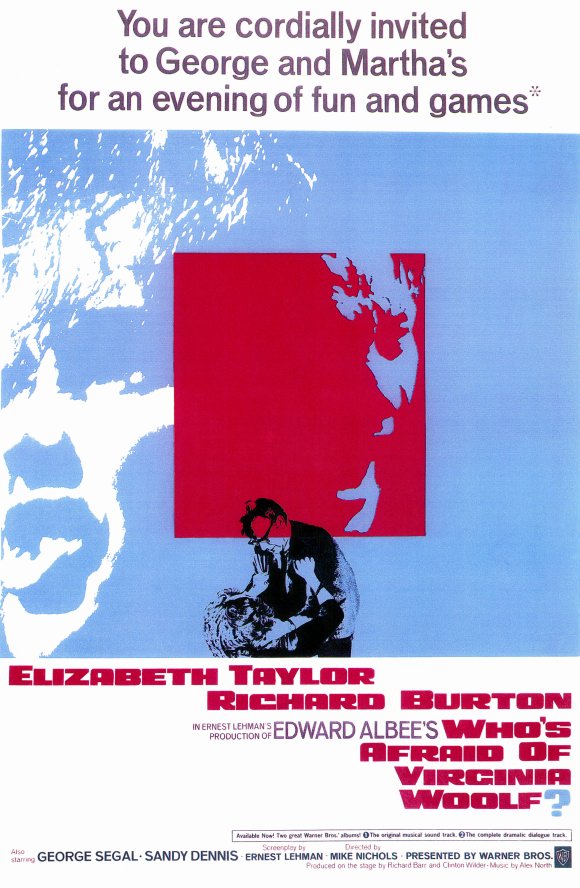
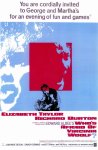
Who’s Afraid of Virginia Woolf? (1966)

Today’s cinema adventure: Who’s Afraid of Virginia Woolf?, the auspicious 1966 debut feature from director Mike Nichols, based on the much-lauded Pulitzer-winning play by Edward Albee and starring the superstar husband-and-wife team of Elizabeth Taylor and Richard Burton.  Filmed during a fiercely guarded, top-secret nocturnal shoot, it was an eagerly awaited production which became an instant classic upon its release, and the intensity of its subject matter- particularly its then-shocking language- dealt a death blow to the antiquated Hollywood “decency” standards that dated back to the Hays Code of the thirties, leading instead- along with Antonioni’s Blowup– to the development of the MPAA rating system still utilized in the U.S. today.  In essence a powerhouse four-character showcase for tour-de-force acting, it depicts a single night of alcohol-soaked socializing between an older and a younger couple which becomes a vicious, no-holds-barred battle over the pent-up secrets, frustration, shame, and resentments that plague both marriages.  It garnered several major acting awards, including a second Oscar for Taylor, whose reputation as an actress was considerably bolstered by her remarkable, career-changing performance.

Faithfully adapted from Albee’s play by screenwriter Ernest Lehman, the story focuses on George, a middle-aged history professor, and his wife Martha, the daughter of the president of the small New England college at which he teaches.  As they are returning home at 2 AM from a faculty mixer thrown by Martha’s father, George is startled to learn she has invited a new, younger professor and his mousy wife to join them for nightcaps; though he resigns himself to their visit, he admonishes Martha against broaching any taboo subjects in conversation- particularly the impending homecoming of the pair’s teenaged son from boarding school.  When the younger couple, Nick and Honey, arrive, Martha belligerently defies her husband’s stricture, goading him into an ugly game of one-upmanship in which they both exploit every possible weakness to humiliate and hurt each other, even using their hapless guests as pawns in a dysfunctional war of wits that- it becomes clear- has escalated throughout their long marriage.  As the night progresses, their own secrets are laid bare, as well as a few of Nick and Honey’s, revealing the depth of their misery, the lengths to which they have retreated into fantasy, the extent of their verbal and emotional abuse of each other, and- perhaps most surprisingly- the intensity of the love that still endures beneath all the anger, lies, and recriminations.  By the time the sun begins to rise, both of the weary couples have undergone a purging of pretense and illusion that will leave them irrevocably changed- at least, presumably, until the next drunken faculty party.

When Who’s Afraid of Virginia Woolf? opened on Broadway in 1962, its frank and explicit dialogue, coupled with its overt sexual implications and it’s harrowing emotional intensity, led many audiences and critics to believe it was an unfilmable play.  Though it was hailed as a masterpiece, and won both the Tony and Critics’ Circle awards for Best Play, such was the controversy surrounding its content that though it was chosen by the Pulitzer judges as the winner of the prize for drama, the advisory board for the awards refused to present it, instead choosing to withhold that years’ prize in the category.   Nevertheless, Warner Brothers studio pursued the rights from playwright Albee, and despite protests and warnings from the Catholic Advisory Board and the MPAA, went ahead with plans to produce a film version that preserved the majority of the play in its original, undiluted form.  In the end, a few minor concessions were made (“Screw you” was changed to “God damn you,” at least in the American edit) and the script was abridged slightly for length, but, for the most part, the film version was released with its profanity and sexual content intact- and, perhaps unsurprisingly, became a major hit.

Although the publicity over its controversial content no doubt played a role in its box office success, Who’s Afraid of Virginia Woolf? has sustained its iconic status because it was never meant to be just a sensationalistic shock piece; the brilliance of Albee’s play crackles through every frame, with his dialogue virtually intact and his over-arcing vision maintained with an emphatic zeal for faithfulness.  Director Nichols, though already known as a wunderkind for his stage work, was making his film debut here; nevertheless he was given an unprecedented amount of freedom and control over the project, and his determination to translate the cathartic experience of the original work resulted in a film which brings the full, terrible power of the play to life.  Underneath the bombastic psychological warfare of its action, the saga of George and Martha’s walpurgisnacht is about the line between truth and illusion- more specifically, the dangers of living a life based on comforting lies and fantasy instead of frankly facing an unpleasant reality.  In mid-century America, it was a theme that hit very close to home; a generation after WWII, the cracks were beginning to show in the idyllic façade of the “American Dream,” and the growing discontent and disillusionment with its hollow ideals, which had long been voiced by the counterculture and its underground artists, had begun to find its way into the mainstream.  Virginia Woolf, with its portrait of a couple trapped in their nightmare of elaborate fictions and suppressed truth, provided a perfect catalyst for a nation afraid to face its own reality; and though its characters and setting are not overtly subversive, it is nevertheless a film which heralded the rise of anti-establishment sentiment in American cinema.  It’s telling that Nichols’ next movie, The Graduate, would be Hollywood’s first bona fide “youth culture” film to express criticism of the social status quo; Virginia Woolf is unmistakably cut from the same radical cloth.

As apt as this film was in capturing the zeitgeist of its era, the significance and power of its themes are undiminished by the passage of time; Albee’s magnificent play retains its relevance today, and this remarkable transcription of it seems as fresh and vital as if it were brand new.  Though its then-shocking profanity and its sexual frankness are now milder than much of our prime-time TV fare, the emotional intensity behind them makes for a fierceness that still leaves us reeling; it is not merely the saltier dialogue of Virginia Woolf that packs a punch, but the totality of its language- Albee’s dazzling symphony of words elicits responses on every level from the esoteric and intellectual to the visceral and primal, evoking laughter, horror, sorrow, fear, and every other conceivable reaction, in rapid succession and sometimes simultaneously.  By the end of this grueling evening of “fun and games” we are as stunned and exhausted as the film’s four characters, and like them, we are left facing the cold, unfriendly dawn in a world without illusions.  Of course, it’s not all dire depression and angst; Albee’s absurdist sensibilities are evident throughout, ensuring the continual interjection of ironic, dry, and dark humor, not to mention the considerable intelligence and wit he bestows upon his antagonistic protagonists.  Part of the great power of Virginia Woolf comes from its ability to elicit our laughter even as it is pummeling us with its existential themes and its social commentary.  Like the greatest of tragedies, it’s a play (and a film) that is full of out-and-out comedy, providing a much-needed release of tension and underscoring the ridiculousness of the human situation at the center of the drama.

Needless to say, the linguistic alchemy of Albee’s script would never work without the ability of a superb cast to bring it to life.  When Nichols chose Hollywood’s hottest power couple for the demanding roles of George and Martha, there was considerable skepticism over whether they would be up to the challenge.  Burton, of course, was well-established as a consummate actor, with copious legitimate training and a host of theatrical successes under his belt in addition to his film experience; his bride, however, was a different story.  Taylor had been a major star for two decades, and had previously proven herself as a superb actress (having already won an Oscar for her work in Butterfield 8, though many felt it was a sympathy prize); but she was primarily known for her remarkable beauty rather than her acting chops, and the role of Martha- a middle-aged, overweight, alcoholic harridan whose looks were meant to be faded, at best- was thought by most of the cognoscenti to be beyond her grasp.  Undeterred by preconceived doubts, the actress committed herself whole-heartedly to the part; she gained 30 lbs. in order to present the necessary voluptuous figure, and sank her teeth into Martha’s ugliness- both physical and spiritual- in order to do justice to the character.  Her embrace of these attributes does not result in a stereotyped, surface portrayal, however; her Martha is a monster, yes, but she is also every bit a woman- vulnerable, warm, loving, spiteful, frightened, jovial, capricious, calculating, and fully realized.  Taylor’s performance here is the crowning achievement of her career; far from being merely a star turn, it is an example of an actress claiming a role and making it so much her own that it is impossible to imagine another star playing it.  It probably goes without saying that her ferocity is matched at every step by her on- and off-screen husband; Burton, also giving a career-defining performance, gives us an unforgettable portrait of George, a character that has been described as an “angel with a devil’s tongue.”  Breathtakingly intelligent, unmistakably virile despite his crushing mantle of failure and disappointment, and compassionate behind the hostile irony of his icy mask, he takes us along on every step of George’s difficult journey, helping us to understand and to sympathize with a man who could easily come off as an impotent, disaffected snob, and making it clear that his task, like that of his sainted namesake, is to slay a dragon.  Together, Burton and Taylor become a force of nature, making George and Martha appear both as titanic archetypes of marital conflict and painfully real, fragile human beings, and convincingly conveying the familiarity and intimacy of a couple who have been through so much together they seem to think as one despite their embattled dynamic.

Though their roles are less showy, George Segal and Sandy Dennis, as Nick and Honey, respectively, are equally superb; as representatives of the younger generation, they enter the scene wearing the freshness and confidence of a new wave, seeming to embody the perfect picture of up-and-coming success that stands in stark contrast to the appalling discord of their hosts’ dilapidated lives.  It doesn’t take long for the shine to wear off, however; confronted with the harsh reality of their probable future reflected back at them in the grotesque form of their elders, their practiced poise begins to disintegrate, and their true natures begin to show through.  Segal’s Nick, hiding his own fears of inadequacy behind a smug golden-boy demeanor, lashes out with defensive hostility; while Dennis, a ball of barely-concealed insecurity as Honey, rapidly descends into a drunken spiral of infantile banality.  They provide the perfect foils for Burton and Taylor, helping to reveal the repeating pattern of self-deception at the core of the drama by giving us an example of a couple at the beginning of the cycle.  Dennis, like Taylor, won an Oscar, and both the men were deservedly nominated, as well, making this one of only three films ever to have gained Academy Award nominations for its entire credited cast (the others being Sleuth– the 1972 version, of course- and Give ‘Em Hell, Harry).

There are so many reasons to love Who’s Afraid of Virginia Woolf?: Haskell Wexler’s magnificently stark black-and-white cinematography, which captures beauty and blemishes in equally loving detail; Alex North’s haunting and evocative chamber-music score; the completely authentic setting which moves you part and parcel into George and Martha’s cluttered, musty world of booze and bric-a-brac, revealing them both as members of the intelligentsia and as the world’s worst housekeepers; and of course, overseeing it all, the sure and steady direction of Mike Nichols, who appropriately drives the piece like a master conductor presiding over a fine piece of music, finding new ways to position and move his camera, alternating between long, slow takes and short, bursting flurries, building the tension unbearably and giving the impression of heart-stopping action even though most of the film consists only of four people talking.  It earned him a place as one of Hollywood’s most respected filmmakers, and deservedly so.

Who’s Afraid of Virginia Woolf? is one of those all-too-rare instances when Hollywood has managed to transfer a brilliant stage play to the screen more-or-less intact and done it full justice; though producer Ernest Lehman takes screenplay credit, his work mostly consisted of editing Albee’s original down to a shorter running time and making a few minor adjustments to compensate for the marginally-reduced ages of its lead characters- virtually every word is Albee’s, and apart from moving a few scenes outdoors and taking the characters on an excursion to an all-night roadhouse for one key sequence, the setting remains the same, as well.  Ultimately, of course, the play is one of those masterworks, like Hamlet, which can probably never be given a definitive treatment; it continues to be mounted in theaters around the world and performed brilliantly by actors who bring their own unique individual interpretations to its iconic characters.  Even so, this important and influential film remains the version which, in the collective imagination of our pop culture, is identified as the ultimate representation of the piece.  Though other actresses may give us a deeper Martha, or other directors may find a more visionary approach to the material, this group of artists have left their indelible mark on Albee’s play, and if you only see one version of it in your lifetime, you couldn’t do better than this one.  If you have never seen it, you owe it to yourself to do so, as soon as possible; apart from the fact that it is one of the most important pieces of dramatic literature written in the last hundred years, it is also still one of the most searing, surprising and thought-provoking dramas you are likely to see, a far cry from most of the sterile, whitewashed, politically correct fodder that passes for adult entertainment today.

http://www.imdb.com/title/tt0061184/

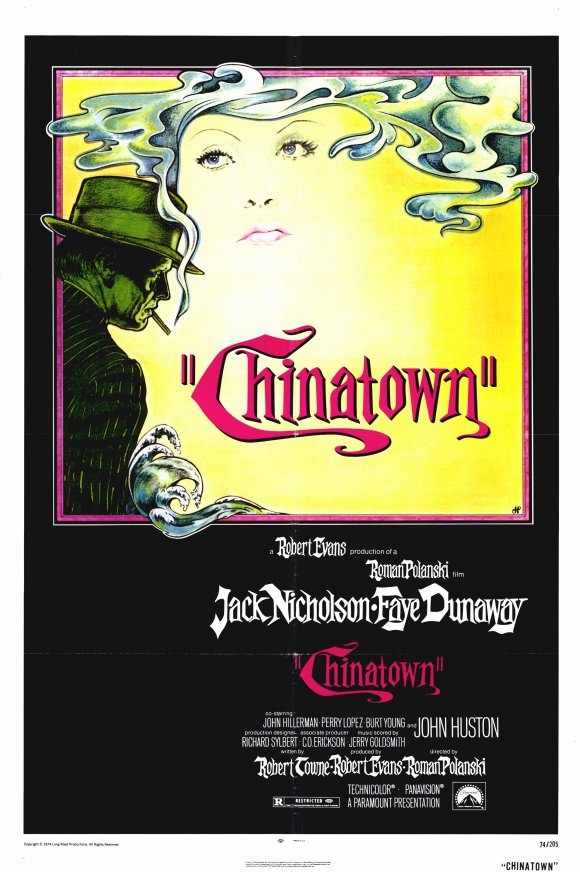
The Stunt Man (1980)

Today’s cinema adventure: The Stunt Man, the 1980 feature by director Richard Rush about a runaway fugitive who stumbles into the middle of a film shoot and finds cover working as a stunt man, only to realize that the movie’s megalomaniacal director may be planning to kill him for the sake of filming the ultimate stunt.  A difficult film to place within a genre, it was shot in 1978 and ended up shelved for two years by a studio that didn’t know how to advertise it; when it finally hit the screen it was only given a limited release, and it was largely overlooked by the public.  Nevertheless, it garnered considerable praise from critics and managed to earn several Academy Award nominations, including one for its star- and its main appeal, then and now- Peter O’Toole, whose performance represented something of a comeback in his storied career.

Adapted by Rush and Lawrence B. Marcus from a novel by Paul Brodeur, The Stunt Man follows a young Vietnam War veteran who is running from the law, having committed an unspecified crime after returning from his tour of duty.  With officers in hot pursuit, he runs into the middle of a film shoot, inadvertently disrupting a dangerous automobile stunt in which the driver is accidentally killed.  With a sudden new opening for a replacement and only a few days to finish his ambitious anti-war epic, the movie’s director, Eli Cross, takes the young outlaw under his wing, offering him a safe haven and a new identity- in exchange for completing the aborted stunt himself.  As he prepares for the big moment, learning the tricks of the trade and attempting to bond with the gregarious crew of movie-making gypsies that have taken him into their fold, he begins to suspect the flamboyant and mercurial Cross, who is obsessed with realism, of plotting to orchestrate his death in order to capture it on film.  Things are further complicated when he finds himself in a blossoming romance with the film’s leading lady, heightening his dilemma over whether to flee back into a permanent life on the run or stay and risk his own untimely demise.

If the premise seems a bit gimmicky, it is; The Stunt Man offers a highly improbable premise, riddled with plot holes and unlikely conceits.  This, however, is part of the sense of wicked fun that permeates the movie.  Rush and Marcus never take the pseudo-thriller plot too seriously; although they give an appropriate amount of weight to the psychological conflicts of its hero, they make certain that the overall tone is decidedly comic, flavored with cynical irony and self-satire, and they derive a great deal of nudging humor from the tricks they work on their audience.  Within its far-fetched scenario, The Stunt Man plays with our expectations and our preconceived assumptions in order to keep us off balance, establishing its young protagonist as our access point into its smoke-and-mirrors world and ensuring that we, like him, are constantly betrayed by appearances; this is, after all, a movie about making movies, and in keeping with its subject, nothing is what it seems.  At every turn, we are presented with illusions- many of them clearly established as such- and then find ourselves surprised when the truth behind them is revealed.  The film shrewdly manipulates our willing suspension of disbelief, understanding that we want to buy into its various cons, and exploiting our natural inclination to believe what we see.   Rush spends most of his movie exploring examples of the conflict between truth and illusion, from the oft-repeated assertion that King Kong was only 3′ 6″ to the extended sequence of WWI carnage enacted in front of a throng of horrified spectators at the beach, making for a highly amusing display of magic in which the tricks being performed mirror the tricks being played on us by the magician behind the camera.

Of course, this idea of illusion vs. reality, which fits so perfectly into the metaphoric possibilities of a self-reflexive movie about movies, is nothing new; it has been highlighted in works ranging from Fellini’s 8 1/2 to Ben Stiller’s Tropic Thunder, providing fodder for low comedy to high tragedy and everything in between.  The Stunt Man, however, ties it to another theme, perhaps more immediately relevant to the lives of everyday civilians not lucky enough to be working in the film industry- namely, the difficulty of trust in a culture full of deliberate lies and manipulation.  Our hapless hero, ironically dubbed “Lucky” by his newfound protector (or, perhaps, persecutor), is full of paranoia and mistrust, the result of buying into a much bigger and more insidious con game than any cinematic sleight-of-hand perpetrated by Eli Cross and his crew; he has been cheated by a system that sent him to war on the promise of making him a hero and now treats him as a pariah, and had his hopes for a happy future shattered by faithless friends and lovers.  When the nature of his crime is revealed, we discover it was an act of anger and frustration over the raw deal into which he has been suckered- like so many of his generation.  Is it any wonder, then, that when he is offered a new lease on life by a representative of the dream factory, a man who blatantly and unabashedly manipulates truth and illusion in order to achieve his ends, he is wary of being suckered once again?  This is the central conflict of The Stunt Man; in a world devoted to illusion and deceit, where pretty lies often disguise ugly truths and trust is only a lure by which the foolish are led like lambs to the slaughter, the only hope of self-preservation is to doubt everything and everyone around you.  As Eli Cross puts it, late in the film, “Paranoia is a social disease; it’s got by screwing your fellow man.”  Whether he offers a cure or euthanasia is the primary question of The Stunt Man, and I wouldn’t dream of answering it here.  Suffice to say that the course of treatment has a few twists and turns.

Rush guides his film with bravura flair, capitalizing on his rare opportunity to both celebrate and send up the conventions of movie-making.  Infusing it with a certain tongue-in-cheek aura of self-awareness, he nevertheless dives headlong into the numerous opportunities for old-fashioned movie spectacle, with the added layer of showing us the spectacle behind the spectacle; he gives us a delight akin to seeing a magician reveal his secrets, only to discover the revelation itself is part of the trick.  He also takes advantage of the film-within-a-film milieu to capture a sense of bygone Hollywood glamour in the midst of the nuts-and-bolts candor of the contemporary setting, aided considerably by the extensive use of the historic Coronado del Rey Hotel, which serves as a location for much of the film; and though his film is primarily focused on psychological concerns, he fills it with action, not just within the framework of the “meta-movie” but expanding it outward into the surrounding real environment of the film as well.  The result is a movie that takes its time to get to its point but maintains the feeling of a brisk pace, enhanced by all the inherent details of its film-shoot backdrop, and keeps us engaged in its game of interchanging fact and fiction right up to the final playful moment.

The Stunt Man benefits from Mario Tosi’s cinematography, with its exploration of various qualities of light, both natural and staged; and the rousing score by Dominic Frontiere conjures the circus atmosphere of the movie-making world with a bravado that matches that of its director (the one onscreen, that is), and even includes a haunting vocal tune, “Bits and Pieces,” co-written by veteran songsmith Norman Gimbel and performed by the iconic Dusty Springfield.  As for the cast, a fine ensemble of likeable faces clearly enjoys itself with the material.  The titlular hero is played by Steve Railsback (whose careeer was mostly defined by his portrayal of Charles Manson in the TV film of Helter Skelter), who lets us see the vulnerable little boy inside even as he pulls off the hard-edged toughness he uses as a protective mask, and conveys the impression of a young man walking around in a state of prolonged shell-shock- which, of course, is not far from the truth.  The beautiful Barbara Hershey is highly effective as the leading lady (of both the film and the film within it), marvelously embodying the multi-layered quality of an utterly contemporary woman; she is sensual, independent, confident and full of a zest for her life and her work, but she also reveals the insecure little girl underneath the worldly actress- and, most importantly, she manages to find the balance between candor and mystery that keeps us from really knowing the sincerity of her feelings for “Lucky.”  Alex Rocco is memorable as an exasperated local lawman, as are  Allen Goorwitz, Chuck Bail, Adam Roarke, and Sharon Farrell as various members of the film’s cast and crew; but, without question, The Stunt Man belongs to its star, Peter O’Toole.

As Eli Cross, O’Toole’s famously over-the-top persona finds its perfect match; zooming around in his helicopter, descending from the heavens on his crane, and constantly enfolding his underlings with the enormity of his personality, he gives us the ultimate egotistical film director.  He is vain, dictatorial, demanding, pretentious, manipulative, and arrogant; yet he is also generous, gregarious, compassionate, and clearly more aware than anyone else of his own ridiculousness.  Cross plays himself with gusto, and O’Toole plays Cross with just as much of it; the legendary actor has said he based his performance on David Lean, the famously godlike director who helmed, of course, Lawrence of Arabia.  This may account for the unmistakable air of authenticity that underlies his work here, for despite his fully appropriate chewing of the scenery, every moment of his performance is infused with an absolute honesty and a fully recognizable humanity.  O’Toole’s Eli Cross is exactly the kind of larger-than-life man who is both worshiped and feared by those beneath him- and considering his God-or-the-Devil role in the proceedings of The Stunt Man, it’s a quality that fits to a tee, and makes the entire film work like gangbusters.

The Stunt Man is one of those odd little films that time forgot; a staple in the early days of cable TV, many have seen it- and liked it- and yet it has slipped into relative obscurity, no doubt due to its effervescent qualities that are likely to disguise its deeper matter for audiences who aren’t paying close attention.  For myself, I have noticed that when it comes up in conversation with someone, almost invariably the other person’s eyes light up- “Oh yeah, that’s a great movie!  I haven’t thought about that one in years!”  I’m happy to say that it holds up well, perhaps seeming even better now, though clearly the behind-the-screen technology it shows us is a bit dated in some ways.  The high-spirited camaraderie it depicts among its film-making “family” is timeless, however, and so are the themes it so cagily explores.  After all, today’s world is as full of phonies and liars as ever, and it is perhaps more difficult than ever to let our defenses down, for fear of being taken in and played for a fool- or worse.  The Stunt Man, in its quaint little tale of Machiavellian plotting in an insular world, provides an apt metaphor for the difficulties of overcoming paranoia in our own.

 http://www.imdb.com/title/tt0081568/

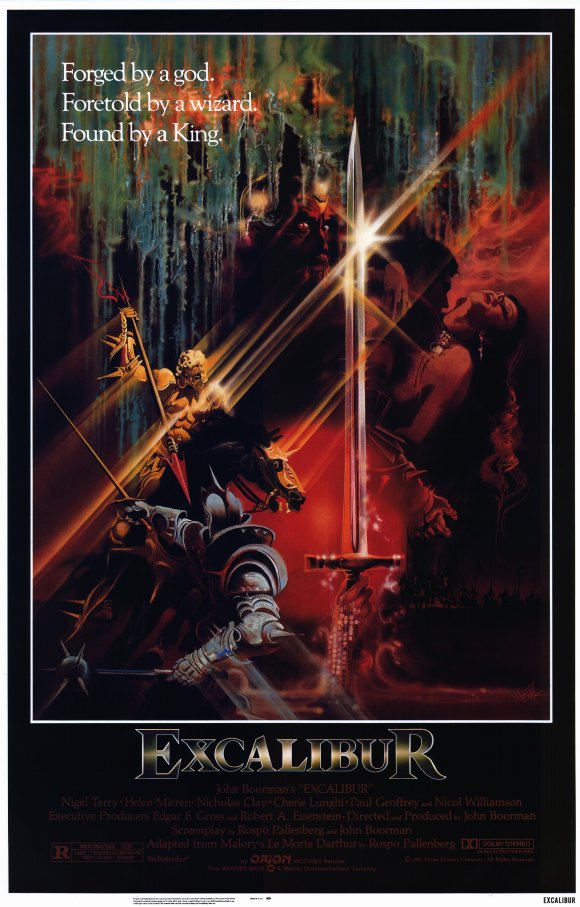
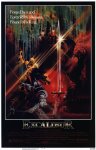
Excalibur (1981)

Today’s cinema adventure: Excalibur, John Boorman’s 1981 filmic retelling of the mythic life of King Arthur, rendered against a lush backdrop of Irish locations and featuring a host of future stars before they became familiar faces.  It was a moderate hit at the box office, despite the mixed reviews of critics who praised its visual style but expressed bewilderment over its handling of the Arthurian legends; subsequent reviewers have gained an appreciation for its unique style, however, and not only has it grown in popularity among fans of the fantasy genre (over which it has exerted considerable influence), it is considered by many literary scholars and mythological experts to be the most faithful and definitive screen representation of its subject to date.

Boorman had wanted to make an Arthurian film since before his success with the thriller Deliverance in 1972, albeit focusing more specifically on Arthur’s mentor, Merlin; he presented his ideas to United Artists, who instead offered him the job of making a film version of J.R.R. Tolkein’s The Lord of the Rings.  Agreeing to the challenge, he collaborated with Rospo Pallenberg on a screenplay for a three-hour adaptation of the classic, as well as creating extensive preliminary designs for the film.  The studio, however, passed on it, having decided the project was too costly. Boorman attempted to sell other studios on the film, but to no avail; however, he was able to secure sufficient interest from backers to revive his Merlin idea. With Pallenberg as co-writer once more, he fashioned the screenplay for Excalibur, and eventually incorporated many of the design concepts from the aborted Rings project to bring his Arthurian vision to life.  Drawing mostly from Thomas Malory’s epic 16th-Century romance, Le Morte d’Arthur, with some elements added from other early versions of the tale- as well as a few original twists of their own- their script is a stripped-down narrative of the archaic British legend, focusing on the key themes of its mythology- the transition from the brutality of the Dark Ages to a more enlightened time of justice and chivalry, the passing of old pagan beliefs with the rise of the Christian faith, the connection between the well-being of the land and its king, and the legend’s parallels with the Christ story.

The film chronicles the Arthurian tale from before its hero’s birth, depicting the rise and fall of his father, Uther, who, with the help of the mysterious necromancer, Merlin, unites the divided land and becomes its king, only to be defeated and overthrown as a result of his selfishness and lust; the sword of power, Excalibur, is driven into a stone, able to be removed only by his rightful successor, and Merlin spirits away his only child to be humbly and anonymously raised in secret.  When the boy grows to maturity, his destiny unfolds; he draws the sword from the stone, becoming the unlikely king, and is tutored in the ways of rulership by Merlin, who has reappeared to continue his shepherding of mankind into a more enlightened future.  In time, Arthur re-unites and brings peace to the land, establishing justice and a code of chivalry, and creating a fellowship of champions to represent these ideals- the Knights of the Round Table; along the way he wins the love of Guenevere, who becomes his queen, and Lancelot, who becomes his best friend and greatest knight- but therein lies the seed of doom for the utopia he has built, for their eventual betrayal of their king will tear the land apart, leaving it vulnerable to the dark ambitions of the sorceress Morgana, Arthur’s jealous half-sister.  The saga ultimately leads to the redemption of Arthur’s dream, through the quest for the Holy Grail, and his final battle with the forces of his bastard son, Mordred, and reaches its bittersweet conclusion with the heroic king’s final mystic voyage to the Isle of Avalon, where he will wait until the world is ready once more to welcome his vision of peace.

This epic tale has found expression in countless works of fiction throughout the centuries, but a comparatively small number of films have dealt with it, and even fewer have attempted to tackle the story in its entirety.  It’s easy to understand why: though it is full of possibilities for adventure, romance, and drama, it is highly esoteric at its core, rich with symbolic content that makes a literal screen depiction somewhat problematic.  To be sure, there are many possible approaches to the material which can bypass these elements; but when stripped of deeper meaning, the stories seem, well, pretty cheesy.  Boorman, however, takes the opposite approach with Excalibur– far from downplaying or obscuring the archetypal connections of the myth, he places his focus squarely on them.  The pageant of the story’s familiar events moves by quickly, depicted with indelible imagery and loaded with the kind of clanging medieval action that we expect from such a movie, but infused throughout with a deliberate awareness of its thematic essence; each episode plays like a ritual, enacted for the purpose of illuminating the spiritual and psychological experience it represents.  The “Dark Ages” in which the story takes place are clearly not based in a factual period, but are rather a manifestation of the collective unconscious, a dream-world in which the artistic imagination is unfettered by concerns of historical accuracy or temporal logic.  Boorman’s vision incorporates both the realistic and the fantastical, blending authenticity of detail with wild stylization in his depiction of costumes and armor, weaponry and technology, architecture, and even geography.  All these factors are represented by a mix of designs that spans some 500-odd years of period style, a deliberately anachronistic conceit intended to remind us that we are witness to an idealize fantasy and not a recreation of a specific era.  He further elaborates this meta-reality by enhancing it with his trademark emphasis on the primal power of nature, as well as with an extensive use of back-lighting and reflected colors to evoke a surreal, other-worldly aura; and as he moves the narrative towards its climax, he progressively blurs the line between reality and dreams, so that by the end, the two have become one and the same.

Although Boorman’s film is designed to elucidate the inner mechanics of its source material, his intention is not to provide an academic experience; his purpose goes far beyond a desire to illustrate the coded significance of a classic myth for an audience already familiar with its meaning.  Instead, Excalibur is an attempt to translate this antiquated story for modern consumption, to stimulate a kind of communion in which contemporary viewers can share the revelations within and experience them as relevant to their own lives.  To this end, the director uses all his cinematic skills to convey the universally understandable human element of the tale even as he unmasks the hidden principles underpinning it; he removes all but the most important episodes of the epic saga, distilling it into a document of the emotional arc experienced by the characters as they progress through its momentous events.  Consequently, the film creates a delicate balance between its larger-than-life atmosphere and the intimacy with which its key figures are portrayed.  It’s a disconcerting effect, to be sure- Arthur and his comrades converse in an odd combination of lofty speech and familiar banality, seeming at once to be both elevated and de-mystified versions of the archetypes they personify, and the visual interpretation of the tale evokes both the romanticized pageantry of an illuminated manuscript and the garish gore of a Hammer horror movie.  Doubtless this odd approach, which makes for a film that seems reverent and iconoclastic at the same time, accounts for the initial confusion of critics who saw Boorman’s film as a stylistic mess; but on a visceral level, it works exactly as the director intended, allowing audiences to access the story on both a metaphoric and a personal level.  In some ways, Boorman’s film is reminiscent of the work of Kurosawa and other masters of the Japanese cinema, presenting his epic of a mythic realm with a stunning visual approach that captures both the timelessness of its powerful symbolism and the immediacy of its underlying human story with equal power. For some, it may be disconcerting to see this legendary tale- perhaps the most seminal story in modern western culture- being presented in the milieu of a Samurai film, and the jarring contrasts inherent in the movie’s dual purpose may strike certain viewers as vaguely ridiculous, as if there had been a sudden invasion by members of the Monty Python troupe; but for those who can get themselves in tune with Boorman’s somewhat unorthodox vibe here, his vision yields remarkable riches.

Excalibur’s visual realization of the Arthurian world is, of course, the film’s most universally acclaimed feature. Boorman has drawn inspiration from the classic chivalric paintings of the Romantic era, as well as from his obvious passion for technical accuracy in his depiction of medieval warfare; the result is another level of contrast which infuses his movie with both ethereal beauty and barbaric cruelty. The striking and imaginative costumes merge prehistoric, pagan, courtly and even space-age styles for a highly distinctive and fantastical look, while the settings are a splendid mix of the highly theatrical and the naturalistic. Much of the film was shot on location at various real-life castles and ruins, and for the interior scenes, elaborate soundstage sets were built, using highly theatrical designs, as well as mirrors and matte paintings to create an even more expansive feel. The extensive forest scenery, most of which was located within a mile of Boorman’s home in Ireland, is all genuine; lush and verdant, it has a preternatural beauty that goes a long way towards making “the Land” into a viable character in the film. Extensive rain during production helped keep the locations vibrant, and the natural magic of the setting was enhanced by being back-lit with green to bring even more color into the scene. As captured by the Oscar-nominated cinematography by Alex Thompson, the entire package is a breathtakingly gorgeous feast for the eyes, full of unforgettable imagery.

As for Boorman’s cast, it was comprised by mostly unknown or little known actors- at least, they were at the time. Liam Neeson, Patrick Stewart, Gabriel Byrne, and Ciarán Hinds all made early appearances is supporting roles, and each of them stands out in their few minutes (or less) onscreen.  The beautiful Cherie Lunghi brings a disarming contemporary charm to Guenevere, making this complex feminine icon into a believable, understandable human being- no small feat, considering the multitude of differing feminine attributes she must represent in the story.  Nicholas Clay is stiff but sincere (and supremely handsome) as Lancelot, embodying the character’s soon-to-be-tarnished moral purity and suitably conveying the strength- if not the depth- of his passion for both his lover and his friend.  In the crucial role of Arthur is Nigel Terry, whose most prominent big screen performance prior to this was as one of the scheming princes of The Lion in Winter over a decade before; he has an Everyman simplicity that makes him an ideal stand-in for this common man’s king, bringing candor and humility to the role while also rising to the task of conveying the hero’s substantial nobility and determination, and though at times his delivery borders on being a bit awkward, the honesty of his performance shines through his expressive eyes throughout, accomplishing one of the film’s primary purposes by making this towering mythological figure touchingly and accessibly human.

The center ring in Excalibur, however, is occupied by two electrifying performers who, although they technically play supporting roles, are definitely the star attraction.  Helen Mirren, already a renowned stage actress, with a few notable roles onscreen, was nevertheless mostly unknown to film audiences in 1981; but as Morgana- the duplicitous sorceress who engages in a duel of wits and a battle of wills with the powerful Merlin as she plots to usurp her half-brother’s kingdom through witchcraft, incest, and deceit- she took a major step forward in becoming a recognizable force to be reckoned with.  She gives a deliciously theatrical performance, brimming with raw sexuality, barely concealed contempt, and an almost child-like transparency, and if at times she seems over-the-top, she is positively subtle in comparison to her co-star.  That position is occupied by Nicol Williamson, at the time the film’s biggest star, with whom Mirren exhibits a palpable antipathy; the pair had developed a strained relationship while starring together in a stage production of Macbeth and were not on speaking terms, but each accepted their roles without knowing the other had been cast- and the resultant fireworks give their screen time together an intensity that would be impossible to fake.  As electric as they are together, though, it’s still Williamson’s show.  As Merlin, he is magnificently outrageous; sporting a chrome skull-cap that makes him look as much like Ming the Merciless as the archetypal wizard he portrays, he chews the scenery with gusto, careening madly between blatant comedy and deadly serious intensity, declaiming his dialogue with a clipped, eccentric panache that helps to burn his numerous memorable lines instantaneously into the brain.  Off-kilter and alien, he seems like the product of another reality- which of course, he is- but underneath his potentially off-putting manic demeanor he is so endearing, so compassionate, so loving, that we cannot help but like him.  Somehow, he makes Merlin the most human character in the film; and though Boorman’s original plan to center his Arthurian epic on this mystical personage evolved into a more all-encompassing view of the tale, Williamson makes certain that he is still the most distinctive and memorable figure onscreen.

There are so many things I could go on about in this discussion of Excalibur: the battle choreography, the willingness to explore such esoterica as the concept of the Holy Grail, the brilliant and stirring use of classical music by Wagner and Orff alongside the original score of Trevor Jones.  Ultimately though, these things are best discovered through a viewing of this odd and underappreciated classic, not by reading about them here.  It’s probably clear by now that Excalibur is one of my personal favorites; this admission, however, should not stand as a disclaimer against my personal bias, but rather as a testimony to the greatness of the film.  Quibbling about stylistic issues is perfectly understandable, but in the long run, if you take Excalibur on its own terms, you cannot help but find that it is moving, exciting, funny, sad, and spectacular, and that not only does it stick in your brain for a long time afterwards, it holds up well and reveals new surprises on repeated viewings. That’s a pretty powerful recommendation in itself, but if you need more incentive, consider this: the story of Arthur and his knights is one of the most important influences there is on our culture.  Many of the underlying tenets of our modern world view are derived from it, the kind of concepts we take so completely for granted that we don’t even think about questioning their validity or where they came from; yet a majority of contemporary people have merely a passing knowledge of this landmark tale, derived from such popular culture manifestations as Disney’s The Sword in the Stone or the musical Camelot, which may have certain charms in their own right but do little towards encapsulating the majestic scope of their original source.  John Boorman has given us a worthy rendition of the story here, preserving the integrity of its core significance while setting it in a form which allows it to live for an audience of today.  at could be wrong with taking a glimpse at this shared cultural dream of our past, perhaps to gain a little understanding of where we have come from, and why we have made the journey?  After all, a myth is like a road map, allowing us enrich our lives today with the knowledge gained by those who came before us.  It can only be beneficial to revisit Arthur and his once-and-future kingdom of Camelot, especially in a form as vital and exhilarating as this film; there are lessons worth remembering here, and in the words of the king’s wise and trusted teacher, “it is the doom of men that they forget.”

http://www.imdb.com/title/tt0082348/

Chinatown (1974)

Today’s cinema adventure: Chinatown, Roman Polanski’s 1974 noir-inspired mystery drama starring Jack Nicholson as thirties-era private detective Jake Gittes and Faye Dunaway as a mysterious widow whose secrets lead him into a complex web of deceit, corruption, and murder. Renowned, among other reasons, for its screenplay by Robert Towne, which has been hailed by many critics and film scholars as the greatest ever written, it became an instant classic on its release and is still widely regarded as one of the very best films of the seventies, and, indeed, of all time.

Towne’s acclaimed script takes inspiration from the circumstances surrounding early Los Angeles’ complicated acquisition of water rights, fictionalizing real-life figures- specifically William Mulholland, who engineered the importation of water from the north by way of the Los Angeles aqueduct- to create a background for the film’s mystery; though the events of Chinatown are entirely fictitious, this historical context provides a connection to reality that infuses the movie with a sense of authenticity and gives it a feeling on relevance beyond its dramatic narrative. Set in the L.A. of the early 1930s, the plot follows Gittes as he works what he thinks is a routine case. Hired by the wife of Hollis Mulwray, chief engineer for the city’s Department of Water and Power, to catch her husband in an extra-marital affair, he soon finds evidence not only of Mulwray’s supposed infidelity, but of mysterious diversions of water taking place under cover of night. When Mulwray turns up suspiciously drowned and Gittes discovers he was hired by an imposter, he decides to pursue the case in order to save his reputation. The trail begins with the real Mrs. Mulwray, who has a secret connection to her late husband’s “other woman,” and ultimately leads him into a game of clandestine politics, real estate fraud, and dark family secrets; with the police and hired thugs on his trail, he must try to find the key to this complex mystery before his time- or his luck- runs out.

On the surface, it sounds like a typical scenario that could be found in any of a hundred hard-boiled detective stories from the thirties or forties, loaded with the clichés and conceits of such fiction; the wisecracking dick, the deceitful femme fatale, the oily politicians, the psychotic gunsels- all of them are present and accounted for in Chinatown. Towne’s script, however, uses the trappings of the genre as a springboard from which to explore a myriad of deeper mysteries, allowing the unfolding story to take us from the larger arena of politics, power, and greed into the more inscrutable realm of the human heart; in the convoluted skein that lies at the center of the mystery, we find that the most intimate longings are ultimately responsible for the most momentous events, and actions with far-reaching consequences are motivated by simple flaws of character or personal dysfunction. As Gittes digs deeper, he uncovers a vein of corruption that runs from the top of the social order to the very root of the family structure, soiling everything it touches in between; it’s not a pretty discovery- the dirty little secrets he uncovers are very dirty indeed, and the glimpse we are offered into the inner workings of politics (both public and personal) among the rich and powerful is one which offers a very bleak picture, indeed, of the way things really are beneath the pretty surface of prosperity.

Woven into the tale is also an exploration of fate, dictated by the hopes and fears which motivate our actions and ultimately cause us to bring about the very results we wish to prevent; it’s a theme encapsulated in the very structure of the film, in which Gittes, who carries the emotional scars of his history as a policeman in L.A.’s Chinatown, vows never to return there, and yet the trail on which he is led by his case brings him right back into its heart for the film’s climax. An ironic twist, and one of many throughout the film; true to its film noir roots, Chinatown is a movie about irony. Gittes is as worldly and cynical as they come, and yet he finds himself betrayed at every turn by his naive assumptions, and his skeptical view of human nature leads him to repeatedly misjudge whether to doubt or trust the people around him. Not that he can be blamed- in Chinatown, nothing is what it seems, and the more you see of what goes on below the surface, the less you can be sure of how to proceed.

The screenplay for Chinatown is so thematically rich that volumes could be written about it; indeed, they have been. Much of the joy of the film, of course, is discovering the countless threads of meaning on your own, a process which continues throughout multiple repeated viewings. This is due to the contribution of its director, Polanski, whose European roots give him an outsider’s perspective on the quintessentially American milieu of the story. Instead of taking for granted the familiar conditions of the noir scenario, he turns everything inside out with his observations on the culture it portrays; his sophisticated take on the characters and their foibles, the machinations of the plot and the hidden truths it reveals, and the illusions inherent in the American psyche. After all, our seemingly savvy protagonist makes his living by tearing away illusions, but in the course of the film he ends up stripping away his own. Polanski carefully transfers our identification to Gittes, who has both the intelligence and integrity to make him an appealing representative for us, revealing information only as it becomes available to him, and making our journey of discovery synonymous with his. As he proceeds, it becomes increasingly apparent that he is trying to expose a secret everyone else already seems to know, and our illusions are shattered right alongside those of our hapless hero. This lends the film a uniquely contemporary viewpoint on the old-fashioned world it presents, and effectively converts the film noir form into a vehicle for modern ideas about the underlying moral structure of our society. Much of this may seem to be the result of Towne’s screenplay, but Polanski wielded considerable influence over the project, making important changes to the material (such as removing a planned voice-over narration and significantly changing the film’s ending) that altered its structure from a more overtly hard-boiled exercise in nostalgia to a subtle, multi-layered deconstruction of the genre. On a more technical level, the director exhibits his mastery of the medium in every frame, resisting the temptation to use cinematic methods associated with noir, relying on the script and the performances to convey those sensibilities, and instead telling the story with his own, decidedly modern, visual techniques; his use of light and shadow, his framing of shots, his incorporation of symbolic elements- all are reminiscent of the classic mode of these films without directly recreating it. He invokes the spirit of the past while constantly, and subtly, reminding us that we are watching a modern film. It’s an approach few filmmakers have successfully managed, though many have attempted it.

With Polanski utilizing his more current filmmaking style, the distinctive period feel which helps Chinatown evoke its air of old-fashioned intrigue is largely provided by its impeccable recreation of vintage Los Angeles, accomplished by the meticulous costumes, sets, and decor, as well as the carefully chosen locations- all captured by the crystalline, golden-hued cinematography of John A. Alonzo, which conjures the sun-drenched aura of the setting as well as giving a sepia-tinted nod to nostalgia. To complete the package, the lush musical score by Jerry Goldsmith adds a definitive, faintly exotic blend of romance and mystery, with magnificently haunting trumpet solos expressing the mournful longing at the heart of the movie; it’s an even more impressive accomplishment because Goldsmith was called in at the last minute to write music for the film when an already-finished score was rejected by producer Robert Evans. The veteran composer had only ten days to complete his work, but the resultant score stands with the many other elements of Chinatown that are held up among the finest ever produced for the screen.

There is a tendency in films by an auteur like Polanski for the cast to be overlooked, regardless of how superb their work may be; not so with Chinatown. Inseparable from the director’s vision is his star; Jack Nicholson’s unmistakable demeanor fits Jake Gittes to perfection, as much a natural extension of his own personality as such characters were for Humphrey Bogart. He embodies the archetypal private eye character while re-inventing it, giving us the expected image of a tough guy with a strategically hidden idealistic core, but adding yet another layer underneath which reflects the more realistic, contemporary viewpoint of the film. His Gittes seems plagued by self-doubt, a fear that he is setting himself up to repeat his past failure as a cop in Chinatown, and perhaps a suspicion that he is more of a sap than he wants to admit; its an endearing and humanizing weakness which undercuts his brashly confident air, a quality that is perhaps the essence of Nicholson’s screen persona, and it makes him the ideal factor for the audience in Polanski’s de-mystification of detective fiction. The burden of carrying the plot may be on Nicholson, but the bulk of its focus is on Faye Dunaway, as that other essential figure of the noir landscape, the femme fatale, and she is more than up to the scrutiny. As Evelyn Mulwray, she, like her co-star, brings a modern sensibility to the role, a character which runs much deeper than the usual dangerous dames in these hard-boiled tales. Dunaway gives us a well-put-together woman, used to the good life, who is haughty but candid, alluring but also intelligent, tender, vulnerable, and deeply scarred- but still full of warmth and far from broken. Though the character, true to the mold, is deceitful and manipulative, Dunaway lets us see that, in a sense, she’s not very good at it; her face betrays her true feelings at every turn, though she is practiced enough to play it off; in this way, like Nicholson, she creates a portrait of a real person trying to live up to an image she’s not quite sure she’s capable of. She is also beautiful- her smooth, alabaster skin and her faintly exotic eyes give her the perfect look to capture this mysterious, seemingly untouchable woman. As for the chemistry she has with her co-star, they make a perfect pair; their inevitable but unlikely coupling seems to come from nowhere, in terms of the script- there has been no flirtation, nor any overt indication of attraction. Yet when it happens, it feels absolutely right, a chance for both of them to let go of their jaded, protective façades and be human beings again, at least for a short time. They make a great pair, and they brilliantly capture the film’s sense of longing as they play out the story of two lonely souls whose union must ultimately be thwarted by fate, becoming one of the screen’s iconic couples in the process. The third brilliant performance, and one which is sometimes forgotten in discussions of Chinatown, comes from legendary director John Huston (a fitting addition to the cast, since his 1941 film, The Maltese Falcon, arguably gave birth to the entire film noir genre), as Noah Cross, Mulwray’s obscenely wealthy business partner, whose genteel courtliness does little to hide the arrogance and sense of entitlement that defines his character; a truly great villain, he dominates every scene he is in, and though he his screen time is relatively brief, he makes such an impression that it feels like he is in much more of the movie than he actually is. The remainder of the cast- including Burt Young as a client who becomes an ally, Perry Lopez as Jake’s former police partner who is now a high-ranking detective and an antagonist in the investigation, Diane Ladd as the phony Mrs. Mulwray, and director Polanski in a cameo as a deadly knife-wielding hoodlum- all bring their own considerable contributions to the table, fleshing out their smaller roles and providing even more texture to the already intricate tapestry of the movie’s multi-layered landscape.

Chinatown is one of those rare movies that seems to be impervious to the changing tastes of time; it captures not only the era of its setting but the savvy, anti-establishment zeitgeist of the “New Hollywood” seventies, yet it seems as fresh and up-to-the-minute today as it did nearly 40 years ago. Part of the reason for this lies in the timeless nature of its themes and its subject matter- the corruptibility of man and the inexorable workings of fate will never cease to be relevant topics, after all- but a great deal of credit goes to the delicate, deceptively simple handling given the film by Roman Polanski, and the self-assured, passionate work of its stars. There are several points of interest surrounding the movie for cinema historians- it was the first film shot in America by Polanski since the tragic murder of his wife, Sharon Tate, at the hands of the Manson “family,” and the last before he fled the country to avoid sentencing for his statutory rape conviction, a still-highly-controversial incident that sharply divides public opinion even today. None of these things matter, though, when watching Chinatown. It’s a movie that has something to offer for every audience, from the serious cinemaphile to the most casual viewer. The word “masterpiece” gets thrown around a lot, and I hesitate to use it, most of the time, at least in writing; but I suspect, in the final analysis of Polanski’s body of work when all is said and done, it is this movie that will stand as his crowning achievement- more accessible than his earlier, more directly artistic efforts, possibly his most universal film in scope and appeal, and less detached than his later, more meditative work. It’s the kind of movie that entices us with its entertaining surface and draws us into its complex, thought-provoking, revelatory world- a world where right and wrong are inextricably woven together and the only way to avoid trouble, in the words of more than one character, is to do “as little as possible.”

http://www.imdb.com/title/tt0071315/

The Phantom of the Opera (1925)

Today’s cinema adventure: The Phantom of the Opera, the 1925 silent horror film featuring the legendary Lon Chaney in his most famous and recognizable role; it was a troubled production, but it ultimately proved so successful that it sparked a two-decade reign by its studio, Universal, as the premiere source of horror on the big screen. Critics at the time were lukewarm in their overall response to the film, though most were impressed by its production values and visual style, but they bestowed unanimous acclaim upon the element which was- and remains- its greatest appeal: the electrifying performance of Chaney as the title character, and the still-terrifying makeup he designed to transform himself into a ghoulish human monster.

Based on the 1909 novel by French author Gaston Leroux, the film’s plot differs somewhat in its details from the one familiar to fans of the now-better-known stage musical based on the same source, but the general premise remains the same. The prestigious Paris Opera is haunted by a mysterious shadowy figure known only as “The Phantom,” who is, in reality, a grotesquely disfigured musical genius that dwells in a secret lair deep within the catacombs beneath the opera house. Becoming enamored of Christine, the understudy to the Opera’s temperamental prima donna, he coaches her singing from behind the walls of her dressing room, and begins to send threatening letters to the Opera’s owners demanding they allow her to replace their star onstage; when they refuse to cooperate, he sabotages a performance, crashing the grand chandelier into the audience, and then kidnaps his protégé, prompting a desperate rescue attempt by her lover, Raoul, and sparking a manhunt to capture the fiend and put an end to his reign of terror, once and for all.

This highly melodramatic plot has since been fleshed out by a numerous variety of interpretations, from the gothic horror approach of Hammer Studios to the campy glam-fantasy of Brian DePalma’s seventies cult classic, The Phantom of the Paradise; but this original screen version remains, nearly 90 years later, the most iconic. Though many in today’s world have never seen the film, it would be hard to find someone unfamiliar with the horrific countenance of Lon Chaney’s Phantom; his pale, grinning, skull-like features are still among the most recognizable in horror cinema, turning up in various forms of media throughout our popular culture- even on a postage stamp- and continuing to inspire artists and actors today in their efforts to terrify. Without question, unless you are a serious film scholar- or a hardcore completionist- Chaney is the only real reason for a modern viewer to see The Phantom of the Opera; his makeup alone is worth the time investment, an impressive creation of face paint and wire which caused him excruciating pain during filming. His appearance- the most faithful depiction of the character to date, as described in the novel- is so gruesome that audiences of the day reportedly leaped from their seats in terror, and some weaker spirits even fainted from the shock- though doubtless some of these incidents were embellished by the studio for publicity purposes. However, Chaney’s magnificently deformed visage is only part of his draw here; the reason he was one of Hollywood’s biggest stars was that he had an uncanny gift for making such monstrous characters profoundly human, finding their hearts and rendering them with a rare poignancy that ultimately made them far more sympathetic than the stiffly artificial performers that surrounded them. His work is a revelation for anyone whose conception of silent film acting is limited to the stilted, melodramatic style represented by most of his contemporaries; his gift shines through the antiquated techniques of the form, reminding us of the effectiveness of pantomime as practiced by a true master. He communicates volumes of complex emotion with his body language and tells whole stories with the subtlest of gestures. He presents such a clear portrait of the pain and sadness lurking beneath the phantom’s furious persona that we cannot help but be on his side, for all the mayhem he causes; he conveys the depth of this man’s tragic experience- the isolation, the ridicule, the self-loathing- that has led him to hide himself away from the eyes of the world, and he makes us hope alongside him that the beauty of his musical gift will be enough to make Christine see past his physical ugliness and fall in love with the tender soul it conceals. We know that it won’t work, of course, which only serves to heighten our pity for this miserable outcast, dangerously mad though he may be.

Thanks to the success of Chaney’s previous blockbuster for Universal, The Hunchback of Notre Dame, the studio knew they had a major asset; consequently they spared no expense in the preparation of this follow-up, building lavish sets of enormous scale upon which to play out the drama. The production design (headed by the uncredited Ben Carré) centers on a complete vision of the Paris Opera House, giving us its opulent interiors, its magnificent façade and spectacular rooftop, and the elaborate sets and costumes for its onstage production of Faust (which, appropriately enough, figures prominently in the plot), including a backstage view full of looming and ominous props and set pieces. As for its dark underbelly, the Phantom’s sinister hideaway is a splendidly imaginative mix of gothic gloom and regal refinement, with dark labyrinthine passageways that include such improbable elements as a horse and an underground lake, leading to residential chambers resplendent with elegant décor and devilish mechanisms. Adding to the visual bedazzlement, the film utilizes a the technique of monochromatic tinting to create moods and to differentiate settings- a fairly common method of the era, and a far cry from the drab look most modern viewers associate with the silent cinema, due to the decades in which only faded black-and-white prints of these films were available. Thanks to modern restoration, we are treated not only to the recreation of this effect, which greatly enhances the visual experience of the film, but also to the full glory of the two-tone color process used for the film’s centerpiece, a grand masked ball sequence in which the Phantom appears amongst the revelers costumed as the Red Death.

Apart from the scenery, though, when Chaney is absent from the screen we are left, for the most part, with little to hold our interest. Though it’s important to remember that the overwrought posing practiced by most of the other actors was the accepted technique of the day, and that the performers here were well-known, popular, and respected stars at the time, modern audiences are still likely to feel alienated rather than endeared by the likes of such primitive thespians as Mary Philbin and Norman Kerry, who portray Christine and Raoul, particularly when contrasted with the raw, timeless power of the film’s star. It’s not that they give bad performances- by the standard of the day, they were more than competent- but that they seem vaguely silly to us now, holdovers from the pulpy melodrama theatre which dominated American entertainment before the movies took over our collective imagination. Still, if one can get past the stylistic gap created by the intervening decades of changing fashion, it’s possible to see the talent on display here. There are some nice moments from Philbin, who was a lovely young woman, to be sure, exuding a sweetness and sincerity that seems particularly noticeable when she shares the screen with Chaney; and some of the supporting players provide memorable contributions, such as early Broadway star Snitz Edwards as a decidedly fey and cowardly stagehand who provides comic relief, and the uncredited Bernard Siegel as the Opera company’s resident “expert” on the Phantom. Kerry’s Raoul gets the worst deal, despite his then-much-heralded matinee-idol looks; his character is a stock, one-dimensional bore, and though he does give every effort to make some real feeling come through, his performance comes off as wooden and unimaginative, and the character seems almost dull-witted at times, making us root all the more for the Phantom in his efforts to win Christine away from him. Far more interesting is Arthur Edmund Carewe, who portrays Ledoux, a police detective secretly investigating the case of the mysterious opera ghost, who emerges just in time to become an ally in the quest to save Christine; despite the fact that the character was completely rewritten during the process of creating the intertitles- having originally been a Persian former associate of the Phantom now on his trail- and his scenes were filmed with a completely different backstory in mind, he still comes off better than Raoul, decisive, determined and brave. Barring her acceptance of the Phantom’s love, it would be better for Christine to fall for this hero, instead of the boring, moon-eyed stiff with whom she ends up.

The subject of Ledoux and his rewritten backstory brings up a major point in the discussion of The Phantom of the Opera- its tumultuous production history. Universal originally hired Rupert Julian, a prestigious director of stylish romances, to helm the project, but the shooting process was marred by his difficult relations with the cast and crew. Nevertheless, he succeeded in providing a final cut, more faithful to the novel’s plotline, including the mysterious Persian and keeping the original ending, in which the Phantom allows Christine and Raoul to leave together and remains in his underground hideout to die of a broken heart; unfortunately, the unfavorable reaction of preview audiences prompted the studio to embark on major rewriting and reshooting, without Julian (though his name was- and still is- retained as the credited director), which involved the creation of several subplots, new characters, more comic relief, and a different ending in which the Phantom is chased down by an angry mob and savagely murdered. Unfortunately, this version also bombed in previews, so the desperate studio scrapped most of it (though they retained the new, more “exciting” finale) and attempted to salvage the project by re-editing and rewriting the original cut (this is when the Persian became a Parisian police inspector). This time, it clicked, and the film was a huge hit- though, as mentioned, the critics found it somewhat mediocre, save for Chaney- and became a cash cow for Universal; in fact, it was so popular that upon the advent of sound a few years later, the studio shot new sequences (including more extensive scenes of the opera) and added a dubbed soundtrack featuring members of the original cast, except for Chaney (who was by then under contract with MGM). This version was also a success, but it has proven problematic for the film’s subsequent history; over the years, thanks to the negligence of the studio in preserving its original negatives, the only remaining prints of The Phantom of the Opera are a widely varying mish-mash of combinations from its different incarnations, making it virtually impossible to reconstruct its original form. As a result, the version now widely available contains material from both the final release cut of 1925 and the 1930 pseudo-talkie edition; sadly, there are sections which only survived in badly deteriorated form, making the contemporary version frustratingly patchy in its overall visual coherence. There are other inconsistencies, too, such as the use of a different actress as Carlotta (the opera’s prima donna) in the later version, a problem explained by changing the character’s former incarnation into “Carlotta’s Mother” for her retained scenes in the Opera managers’ office and billing the second actress (who appears only in the Faust performance scenes) as the actual “Carlotta.”

Despite all this, however, the current restored edition of The Phantom of the Opera preserves a valuable piece of cinematic history, and provides the interested viewer with a chance to experience the original screen version of this oft-filmed tale in a condition as close as possible to its initial, pristine form. Some of it is eye-opening, such as the important role of color in telling its story, a factor that was lost for many years; some of it, of course, comes up short of the expectation created by the film’s reputation, revealing the shortcomings observed by critics of the day, such as a somewhat shallow focus on spectacle and sensationalism at the expense of the deeper subtext inherent in its ultimately tragic tale, and the inclusion of certain bizarre, melodramatic elements designed merely to elicit audience response without consideration for their logic within the larger scope of the narrative. That said, it would be foolish not to take advantage of the opportunity to see this venerable classic, a film which has generated so much influence and so many imitators over the years that it has entered the realm of legend. Though the film itself may not live up to its legendary status, the performance at its center certainly does; in fact, seeing it today, Lon Chaney’s Phantom seems perhaps even greater than it did in 1925, as fresh and immediate as if it were filmed yesterday, despite the elevated style. This is a testament to his powerful gift, with which he was able to reach across the decades, even 80 years after his death, to touch our world with his understanding of the human soul.

http://www.imdb.com/title/tt0016220/

The Pit and the Pendulum (1961)

Today’s cinema adventure: The Pit and the Pendulum, the 1961 thriller which was the follow-up to Roger Corman’s surprisingly successful House of Usher, and the second of what would ultimately be eight of Corman’s Poe-based independent features. Once again starring horror film stalwart Vincent Price, and shot on an elaborate set built from cannibalized pieces rented from other studios, it was an even bigger hit than its predecessor and achieved a substantial amount of critical acclaim, despite its low budget, becoming a classic staple of later TV “creature feature” programs and providing considerable influence over the future of horror films, particularly those produced in Italy through the late ’60s and ’70s.

The original short story by Edgar Allan Poe is a brief, moody affair, more or less the description of a prisoner’s experience as he is tortured by the Spanish Inquisition with the swinging, bladed contraption of its title. This being clearly insufficient as the basis for a feature-length film, Corman re-hired Usher screenwriter, Richard Matheson- a respected wordsmith responsible for, among other things, numerous well-known stories and several classic episodes of The Twilight Zone– to fashion a suitable narrative that could feature Poe’s horrific scenario as part of a longer tale. Matheson’s solution is the 16th-Century tale of a young Englishman who travels to the remote Spanish castle of Don Nicholas, son of an infamous Inquisitor, seeking an explanation for the unexpected death of his sister, who had been the Don’s bride. Though his host is cordial and consumed with sorrow over the loss of his love, the young man’s suspicions begin to deepen as dark secrets are revealed surrounding the castle and its lord- including the presence of a horrific torture chamber which lies beneath it. The common threads of Poe’s work- madness-inducing grief, untimely death, premature burial- are intricately woven into Matheson’s script, giving it a strong feeling of authenticity, though there is little resemblance to anything in the author’s actual story; even the original setting within the Spanish Inquisition has been distanced, if not quite removed, by an intervening generation- though the connection has been maintained enough to provide the means of replicating Poe’s vision for film’s climactic sequence. Matheson was (and is) a highly renowned writer, and it is probably not an exaggeration to say that it was ultimately his contribution, more than any other, that raised The Pit and the Pendulum, as well as many of the other Poe features, above the level of the usual cheap exploitative fodder for which Corman was known; his fabricated storyline includes compelling situations and characters, clever and intricate plotting with a heavy sense of irony, and rich thematic layering which touches on our most universal fears and subconscious concerns.

It’s not prestige-picture material, though, make no mistake. Many of the conceits Matheson puts into place to facilitate the developments of his melodramatic plot do not hold up to even the most cursory logic. It’s also worth mentioning that some of the dialogue has a jarringly modern, banal sound to it, especially against the gothic backdrop and in comparison with some of the more florid passages in his script; coupled with the contemporary bearing and mannerisms of most of the performers, who seem vaguely uncomfortable and out of place in their period costumes, it makes for a certain low-brow quality that reminds us just how far-fetched the whole thing is. But that, of course, is part of the fun; The Pit and the Pendulum is a no-brainer, designed to keep its audience on edge not because of some vague intellectual idea of horror, but in anticipation of the inevitable gruesome shocks promised by its premise. Corman’s filmmaking agenda as a producer was always about knowing what his audience wanted and giving it to them, and he knew that what they would want was no different with these Poe films than from any of his other shockers, despite their literary pedigree. His goal was to provide a good hour and twenty minutes of chills and thrills, and that is what he delivered, with little concern for stylistic considerations that would make for a more erudite filmgoing experience.

This is not to say, however, that Corman the director eschews all artistic concerns; on the contrary, his work here is remarkably polished and coherent, with a highly effective visual style that goes a long way towards creating the film’s luridly baroque air. He adheres to a conceptual notion in which the events of the film, like Poe’s fiction, represent the contents of the subconscious, welling up to manifest in his woeful tale; consequently, he takes pains to establish his setting as isolated from the real world, surrounding the seaside castle with endlessly crashing waves and stormy skies. Further underlining the psychological nature of the drama, he depicts various memories and perceptual experiences in heightened style, shooting some sequences in deep monochromatic hues, using extreme distortion and camera angles, and steeping everything in a garish, dramatic palette- starting with a psychedelically surreal opening sequence featuring swirling pools of liquid color. Beyond his deliberate visual touches, he also delivers a well-paced, savvy piece of cinematic narrative, keeping the aura of tension and impending menace quite tangible despite the fact that much of the film contains no overtly horrific content. To be sure, when it’s there, he lays it on as thick as the cobwebs which cover the walls of the castle’s secret dungeon, which of course, as has been noted, is precisely what we want; and when we reach the payoff, the final sequence in which our young hero is subjected by his now-demented brother-in-law to the titular torture device, Corman’s efforts come to their fruition. It’s a genuinely hair-raising scene, enhanced by weird and stylized filmmaking, which truly captures the core of what makes this concept horrific- the psychological terror of awaiting the inevitable, grisly doom that methodically descends like clockwork, an imagined outcome that is ultimately far more disturbing than any blood-soaked act of dismemberment that might actually be shown onscreen.

Corman’s success at cashing in on popular trends with his cheaply-made quickies (he famously shot one of his most lucrative earlier films, The Little Shop of Horrors, in two days and one night) had by this point in his career afforded him the opportunity of securing bigger-name talent to help hedge his bets at the box office. Vincent Price, well established as a popular horror star, had taken on the lead role in Usher, and here returns once more, as he would continue to do throughout Corman’s “Poe cycle.” This time around he plays Don Nicholas, a sensitive soul living in the shadow of his father’s cruel public image and even crueler private deeds, and driven to the point of madness by the tragic death of his beautiful wife. It’s a foregone conclusion that he will eventually lose his sanity, of course; and Price plays with that boundary like the pro that he is, giving us a doe-eyed, fragile gentility that contrasts- and yet nevertheless offers frequent glimpses of- the roaring monster he will become by the end, with lots of overwrought moments of soul-shaking despair and horror thrown in throughout. It’s a flamboyantly campy performance, really- almost, but not quite, over-the-top; but after all, this kind of vaguely hokey melodrama requires a bit of hamminess in order to keep the emotional pitch high, and Price certainly provides it. Upon the film’s release, his work was roasted by several critics as laughable; in retrospect, however, it’s precisely the right blend of the serious and the ridiculous to keep us engaged and entertained, and the sense of gentle self-parody it suggests has come to be seen as one of the familiar hallmarks of this particular style and era.

It’s a good thing, actually, that Price’s work here is so gleefully theatrical, for his co-stars are considerably blander. The ostensible leading man, John Kerr, was a Tony-winning actor who started his Hollywood career as one of the most promising young actors of the late ‘50s; by the time he made this film, his star was almost faded. He is handsome and capable, but there is a lack of passion here that makes him far less interesting or sympathetic than his supposed antagonist, and he has a certain frat boy quality that hampers his believability as an early Renaissance nobleman. I’m not saying his performance is weak- indeed, he is more than adequate and far more convincing than many of the actors who filled this type of role in other Corman films, and by the time he gets strapped down under that swinging blade in the finale we definitely care about his fate- but he is far less compelling or memorable than Price. More interesting is Barbara Steele, fierce and beautiful as the doomed, not-quite-innocent young bride- though Corman dubbed her lines with another actress, fearing that Steele’s coarse English accent would not jibe with the sound of the other players. Luana Anders exudes kindness and refreshing normalcy as Price’s younger sister and Kerr’s obligatory love interest; and Anthony Carbone is fine as the family friend and doctor, though he would be likely be more convincing as a Vegas mobster in a slick suit. On the whole, unquestionably, it’s Price’s show- but that, perhaps, is as it should be.

No doubt due to the fact that, by the time of The Pit and the Pendulum, Corman and his crew were well-schooled in the art of movie-making on the fly, the film overall has fine production values. Considering it was filmed in three weeks with a reported budget of $300,000- a third of which was Price’s salary- it has a surprisingly polished and professional look. The sets are truly impressive, executed by Daniel Haller and Harry Reif on a large soundstage and using, as mentioned above, rented set pieces from other studios to patch together the interiors of the Don’s foreboding castle. For the exterior shots, process shots featuring matte paintings create a decidedly artificial look (it should be remembered that these kind of effects looked considerably more convincing, somehow, on a big screen) which nevertheless contributes to the film’s dreamlike- or should I say nightmarish- effect. The cinematography by Floyd Crosby is rich and weighty, and the score by Les Baxter (who was a well-known singer and arranger of jazz and popular music) is serviceably eerie, if not exactly memorable.

The Pit and the Pendulum is one of those movies that has become a classic despite itself, a monument to a particular era of filmmaking that contains numerous influential elements; these elements were not intended, necessarily, to be groundbreaking, just to be scary- such as the shots of a desiccated corpse frozen in the agony of trying to claw free of a premature grave, an iconic moment which has been echoed countless times over the subsequent decades. The movie’s status is partly to do with its exposure on television, where a whole generation of impressionable young people was acquainted with its fruity frights. Just because it’s a classic, however, doesn’t mean it’s a masterpiece; it’s still an example of hack-work elevated by the contributions of a few ringers, and boosted by the self-assured confidence that comes from being on a roll, as Corman and his team certainly were. Still, even if it’s not a great movie, it’s a damn good one, with a respectable commitment to quality and a strong dedication to good story-telling. If that story is ultimately more than a little cheesy, it is nevertheless engaging and- more to the point- undeniably spooky and disturbing, even as it generates laughs (which may not be as unintentional as one might think. This is no small feat, and it doesn’t happen accidentally; The Pit and the Pendulum succeeds thanks to the skill of the artists behind it, whose sole purpose was to stir up the uncomfortable corners of the psyche, and in the end, that’s about as close to the spirit of Edgar Allan Poe as any filmmaker could hope to get.

http://www.imdb.com/title/tt0055304/