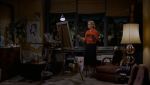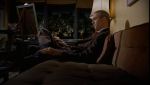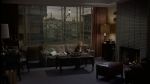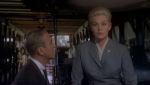
Psycho (1960)

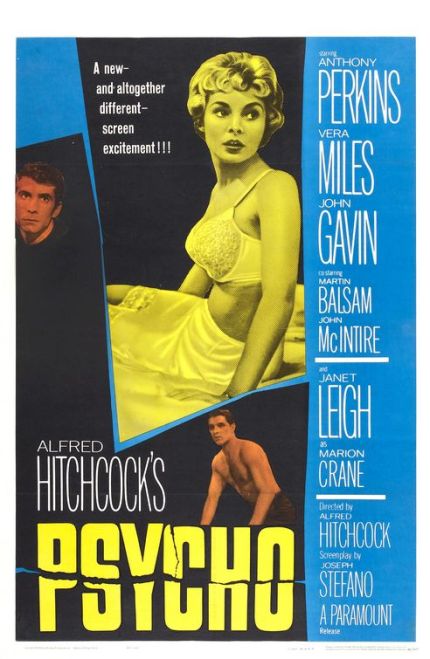
Psycho (poster)

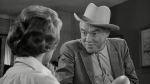
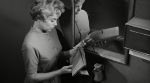
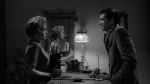
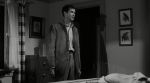
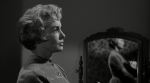
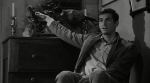
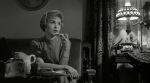
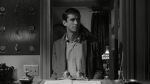
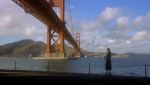
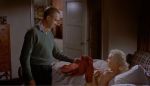
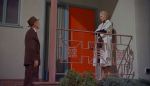
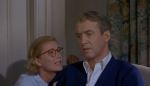
Today’s cinema adventure: Psycho, Alfred Hitchcock’s classic 1960 shocker about a series of gruesome murders at an out-of-the-way roadside motel.  Based on Robert Bloch’s novel of the same name, which was in turn inspired by the real-life case of Ed Gein, a deranged Wisconsin farmer who stole numerous bodies from a local cemetery and murdered several women while living with the corpse of his long-deceased mother, it was heavily deplored by most- but not all- critics at the time.  Thanks, however, to Hitchcock’s sensationalistic marketing strategies and his popularity as the host of the then-current TV anthology series, Alfred Hitchcock Presents, it was an enormous box office success; it played an important role in changing the film industry’s outdated standards for “acceptable” subject matter and spawned scores of imitators, paving the way for the “slasher” sub-genre of horror films and wielding immeasurable influence over generations of subsequent filmmakers.  Its critical reputation quickly grew, and it is now almost universally recognized as one of the greatest movies of all time, or certainly, at least, one of the most important.

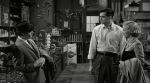
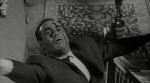
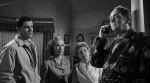
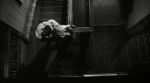
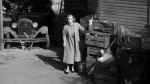
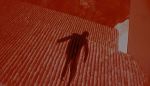
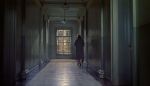
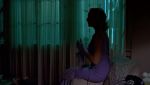
Psycho is one of those films that is so widely known as to be ingrained in the cultural consciousness; it is hard to imagine that anyone in 2012, whether they have actually seen it or not, would be unfamiliar with the once-notorious plot twist that prompted Hitchcock to implore movie audiences not to reveal the ending after they had seen it.  However, on the assumption that there are such people out there who might be reading this, I offer fair warning that beyond this point you will encounter “spoilers,” and you might want to stop here.  Psycho begins in Phoenix, Arizona, with a lunchtime tryst in a cheap hotel between Marion, a secretary, and Sam, her divorced lover from out of town, who cannot afford to marry her because of his crippling alimony payments.  Later, at the real estate office where she works, Marion’s boss entrusts her with $40,000 in cash, instructing her to take it to the bank on her way home; seeing a chance to put an end to the dead-end arrangement of her love life, she instead packs a bag and takes the money to start a new life with Sam, heading down the highway towards Fairvale, the small California town in which he lives.  When a blinding rainstorm makes driving unsafe, she stops for the night at an isolated motel off the main highway, operated by an awkward but sweet young man, Norman, who lives with his elderly mother in a Victorian house on the hill behind the office.  Norman is warm and polite, inviting his weary guest to join him at the house for a light dinner; but after Marion overhears a heated argument between her host and his mother, who angrily refuses to let him bring a female guest into her home, he instead brings a plate of sandwiches to the motel, and the two of them share a meal in the office parlor.  During their conversation, Norman tells Marion that his mother is mentally disturbed and prone to fits of anger, but that he feels obliged to care for her, though it means sacrificing his own freedom, because “a boy’s best friend is his mother.”  When Marion returns to her room, she decides to take a relaxing shower before going to bed- only to have it brutally cut short when the dark figure of Norman’s mother creeps into the room and stabs her to death with a butcher knife.  Upon discovering his mother’s savagery, Norman decides to do the dutiful thing and clean up the mess, disposing of the body and all evidence of Marion’s ill-fated visit- including the stolen cash, still wrapped in a newspaper- in a nearby swamp.  A few days later, in nearby Fairvale, Sam is visited in his hardware store by Lila, Marion’s sister, who has come in hopes that she will find her missing sibling there; they are quickly joined by a private investigator named Arbogast, hired by Marion’s boss to retrieve the stolen money without involving the authorities.  When it becomes clear that Sam is as ignorant as they are to Marion’s whereabouts, Arbogast begins to canvas the area looking for signs of the missing girl’s presence; eventually he arrives at Norman’s motel, where he quickly deduces the young man is hiding something.  After sharing his suspicions in a phone call to Sam and Lila, he sneaks into the house in search of Norman’s mother, thinking to get more information from her, and quickly becomes the next victim in the deranged woman’s bloody rampage.  With Arbogast’s disappearance, Sam and Lila decide to take the investigation into their own hands, and head to the motel to seek answers- but neither is prepared for the dark secrets they will uncover before they can solve the mystery of Marion’s disappearance.

As detailed in the current film, Hitchcock, Psycho was a major departure for the legendary director, a small-budget, black-and-white, sordid and sensationalistic shock piece that no studio wanted to touch.  Even with his prestigious reputation and his popular status as a television star in his own right, Hitchcock had to finance the film himself in order to make it.  It was a risky venture, to say the least, but one which paid off for him in a very big way; the film broke box office records, becoming the highest-grossing release of his career and making him a millionaire.  Its success forced critics to re-evaluate it- those who had been initially dismissive of it as a tastelessly lurid, low-budget shocker, beneath the usual standards of the “master of suspense,” soon praised it enthusiastically and included it on their “best of the year” lists, and it was ultimately nominated for numerous awards (including four Oscars).  In the end, Psycho rewarded its director with the late-life revitalization of an already extraordinary career, made him an even greater power player than he had been before, shattered industry taboos against depictions of sexual and violent content, and won him a new generation of fans- and all at a cost of less than a million dollars.

It was no accident of fate, either; the canny Hitchcock understood exactly what he was doing, and he exerted his meticulous craftsmanship on every aspect of the production in order to achieve the kind of visceral, ground-breaking effect he knew would electrify audiences seeking a new kind of thrill.  To this end, he had chosen his source material for its deeply unsettling subject matter, as well as for its deliberate and merciless manipulation of readers’ sympathies. To keep the budget down, he chose to shoot in black-and-white, using mostly the personnel from his TV series; a few trusted collaborators, however, were also hired, such as graphic artist Saul Bass, editor George Tomasini, and composer Bernard Herrmann, whose previous contributions to his film work had proven invaluable.  He cast the roles with familiar and experienced actors, but avoided using big stars, both to keep salaries down and to prevent personality from overshadowing the story; and- after rejecting an initial screenplay by James Cavanaugh, who had written several scripts for his TV series- he hired screenwriter Joseph Stefano (who had only one previous writing credit, but possessed extensive personal experience as a patient in psychotherapy) to adapt Bloch’s book for the screen.

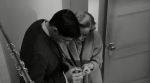
Stefano’s screenplay remains fairly faithful to the novel in its plot, though a few changes were made to accommodate the requirements of the cinematic medium; most significantly, the central character of Norman Bates was transformed from an overweight, middle-aged alcoholic to a youthful, squeaky-clean boy-next-door.  This was Hitchcock’s direct input, designed to make the character more readily sympathetic to the audience; his likability was crucial for the director’s purpose, which involved tricking the audience- and here’s the big spoiler, for those who care- into identifying with a psychotic murderer.  Indeed, the narrative of Psycho is one piece of trickery after another, enhanced by Hitchcock’s casting of his biggest star, Janet Leigh, as a character who is killed off a third of the way through the movie, and his other biggest star, Anthony Perkins, as someone who not only covers up her death but ultimately turns out to be her killer.  The crucial plot twist- that Norman’s mother is in fact her stolen, mummified corpse and that he himself suffers from a split personality in which he commits the murders while assuming her identity- is kept hidden by shrouding the mother figure in mystery, keeping her offscreen except in shadow, silhouette, or oblique camera angles, and hearing her conversations with Norman from off-camera- which has the added effect of making the audience feel like an eavesdropper.  This is another important element of Psycho, the sense that we are clandestine observers of some forbidden ritual, and it of course constitutes the biggest trick of all- Hitchcock turns us into voyeurs, getting our cheap thrills by peeking through windows, listening at doors, and sneaking into private rooms.  It’s a now-familiar tactic, used extensively by filmmakers wishing to enhance our connection to their subjects and to subvert our affectations of propriety, and Hitchcock was certainly not the first to use it; but in Psycho, he brought it out of the art house, where European and avant-garde directors had been experimenting with it, and into the popular cinema, thrusting mass audiences into a wholly subjective experience and smashing through the “fourth wall” of the camera by making it into a substitute for the eye itself.  We are subtly drawn into this personalized experience from the very beginning of the film, when the camera slowly zooms from a panoramic view of the Phoenix skyline through the window of a darkened hotel room to spy on Sam and Marion as they finish their midday liaison; throughout the rest of the movie we are kept in the action with the heavy use of point-of-view shots, scenes filmed through doors, windows, phone booths, and even a peep hole, and the theme of clandestine observation is layered in by the characters themselves, who overhear, watch, question, and spy on the actions of others throughout the film.

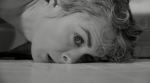
This voyeuristic approach was nothing new for Hitchcock, but rather the culmination of a motif with which he had long been fascinated; throughout his career he had developed techniques for enhancing the audience’s identification with the lens, emulating the natural movement of the human gaze with his camera, using the same point-of-view perspectives and many of the other tricks which would become the dominant mise-en-scène of Psycho.  Likewise, many other of his favorite thematic elements are contained within the narrative- doubtless one of the reasons he was attracted to the material.  Many of Hitchcock’s films feature problematic relationships with domineering parents (sometimes played for laughs, but always containing a decidedly dark undercurrent); his heroes are frequently flawed, even seriously broken, and often unsympathetic, while his villains are usually charming and likable; law enforcement figures are mostly ineffectual or downright incompetent, and “polite” or “normal” society is generally seen to be a hypocritical veneer for hiding any number of unsavory character traits; and, of course,  there is the ever-present icy blond, a beacon of inaccessible beauty, repressed sexuality, and, usually, possessed of a compromised virtue which must be regained.  All of these are deeply embedded in the fabric of Psycho– there are even two icy blonds- and used relentlessly to undermine the audience’s ingrained expectations.  The heroine is a thief, but her victim is a fatuous boor, and her motives are understandable, if misguided; her sister is prudish and severe, while her boyfriend is morose and belligerent; the police are condescending and dismissive, the private eye pushy and sardonic; Norman, however, is shy, kind and endearing, even if his hobby of stuffing birds is a little weird, and he is, of course, the epitome of the dutiful son.  In any standard narrative, it would be clear where our sympathies should lie, but here everything is turned upside down; we root for Marion, and when she is suddenly and cruelly taken from us, we easily transfer our affections to her killer.  We make this willing shift partly because we do not yet know he is guilty, it’s true, but Hitchcock has built his trap so craftily that we would likely take the leap even if we did.  By the end of the film, the director has successfully made us emotional accomplices to both grand larceny and murder, and with his final shot of Marion’s car being pulled from the mud, a lifeless shell representing all that is left of her naive hope for a happy future, he rubs our faces in it.

There is another layer to all this subversive irony, though, beyond just a trickster’s impulse to make us feel dirty.  Our willingness to empathize with first a thief, then a killer, is grounded in what we think we see, what we want to believe, and what we have been trained to expect.  There are plenty of warnings- all the information we need to see the truth is plainly given as we go along, and yet we choose to bestow our sympathy based on romantic illusion.  We want the pretty, decent Marion to be able to “buy off unhappiness,” and we assume the boyish, mild-mannered Norman to be the innocent victim of his mother’s cruelty- from which we hope he can somehow break free without repercussions for his role in covering up her crimes.  This emotional manipulation is achieved by Hitchcock’s mastery of image; he carefully arranges what we see and hear in order to place us in conflict with ourselves, torn between our direct instinctive reactions and our intellectual assessment.  It’s a master con, made possible because of our tendency to mistake image for reality, but we buy into it willingly even as Hitchcock tauntingly tips us off all the way through.  Just as he gives us indications throughout that could easily lead us to recognize the truth about Norman and his mother, he inundates us with reminders about the relationship between image and reality; virtually every scene features mirrors or windows which allow us to see both the characters and their reflections, and most of the plot’s complications arise as a result of decisions based on faulty perception of the surface.  Marion is able to steal the cash because she seems trustworthy, she trusts Norman because he seems harmless, and everyone believes in his mother’s existence because she seems to be in the house.  Even the town sheriff, upon learning about the supposed involvement of a woman he knows to have been dead for years, is uninterested in investigating further because he forms an explanation that satisfies his assumptions.  In the end, Psycho is not about solving mysteries or exposing the pathology of a homicidal personality; it is an examination of- and a warning against- the dangers of living in a fantasy derived from what we want to believe.  We, as the audience, arrange the images to tell the story we expect to see, and when we are brutally reminded by Marion’s ignoble exit from the scenario that all is not what it seems, we fall right back into the clutches of illusion by transferring our sympathies to Norman.  In the climactic revelation, the sight of Norman, shrieking maniacally in his cheap wig and dress as Sam wrestles him into submission and his desperate illusions fall away along with the last vestige of his sanity, we cannot even comfort ourselves that we had no way to see it coming.  It may be a shock, but when we re-examine what has gone before, it is not really a surprise.  We let ourselves be deluded every step of the way, allowing our preconceived judgments color our perceptions; or to put it another way, to paraphrase a key subject from the parlor discussion between Marion and Norman, we have stepped into our own private trap.  This is the true heart of the film- the self-created cage of perception that traps us each and defines the way we see the world.  The image we embrace becomes identified as our reality, but as Hitchcock loves to remind us- and nowhere more vividly than in Psycho– this is an illusion, and one which can lead to the direst of consequences.

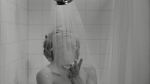
With so many volumes having been written about Psycho, it was not my intent to add much to it; clearly, however, I have been caught up in the spell of this much-discussed classic.  Something about this movie begs to be analyzed, explored, and revisited time and again.  There is so much here to stimulate, to intrigue, to perplex.  One can watch the film simply to revel in Hitchcock’s pure technical mastery: the aforementioned ways in which he invites us to participate in his own voyeurism; his ability to build tension with his deliberate pacing and editing, utilizing long, leisurely scenes interrupted by sharp, violent shocks that echo the stabbing of the knife; his use of visual means to keep us off-balance and on edge, such as dramatic camera angles, uncomfortably extreme close-ups, overhead shots, and other signature Hitchcock touches; and of course there is the justly famous shower scene, a 45-second collage of spliced film that terrorized the entire culture in 1960 and still inspires a particular kind of fear today.  You could also focus on Bernard Herrmann’s iconic musical score, a haunting and nerve-jangling composition for strings that Hitchcock himself credited for being 33% responsible for the film’s effectiveness and has been consistently placed at or near the top on lists of the greatest film soundtracks ever written; during the opening credits, you can marvel at the way the music is complemented by the title sequence created by the great Saul Bass, a no-less-iconic jumble of broken, intersecting lines that suggest the jagged turmoil of a disturbed mind as they spell out the pertinent names and assignments of the movie’s participants.

Of course, you can also reap the rewards of Psycho if you dedicate a viewing entirely to an appreciation of the performances.  Anthony Perkins’ work here is as fine an example of screen acting as you are ever likely to see, a masterpiece of understatement with subtle nuances revealing themselves upon every repeat viewing.  It was a role that matched him perfectly, allowing an intertwining of personal experience and fictional subtext that gives Norman a rare level of authenticity and makes him as heartbreaking as he is disturbing; though the character permanently defined his career and resulted in years of typecasting, it provided the young actor with a chance to leave a legacy the likes of which few others can claim.  Often overlooked, but no less definitive, is Janet Leigh’s outstanding work as Marion Crane; offering us an utterly convincing portrait of an everyday working girl, smart and clearly independent, but hiding a desperate longing to find the happier life of which she dreams, she wins us over immediately- and not only because of the obvious sex appeal of the opening scene, in which she helped to break down the so-called “decency code” by appearing in only a bra and a slip- and makes us keenly feel along with her the frustration of her mundane life, the irresistible thrill of her impromptu escape, and the mounting distress and paranoia that comes as she begins to recognize the consequences of her choice.  She is powerfully likable, which makes it doubly cruel when she is abruptly taken from us; this was Hitchcock’s goal, of course, carefully orchestrated by expanding Marion’s story from the brief episode it comprises in the original novel and by casting his most widely-known star in the role.  Leigh was his first choice, and she eagerly agreed to the project without even reading the script or discussing her salary; she was rewarded for her enthusiasm with an Oscar nomination, and, like her co-star, she created an unforgettable piece of cinema history, a rich and layered performance that is so good precisely because it contains no overt histrionics with which to call attention to itself.  The rest of the cast, though their roles are not as complex in dimension, are equally memorable- despite the fact that the director was vocal in his dissatisfaction with John Gavin (whom he referred to as “the stiff”) and that he was, by all reports, punishing Vera Miles for her abandonment of his earlier Vertigo (she became pregnant and bowed out before filming began, forcing Hitchcock to replace her with Kim Novak) by making her character here as unappealing as possible.  As Sam and Lila, respectively, both performers actually provide exactly the right qualities to their roles, making it impossible to imagine the film any other way; and, rounding out the main cast as Arbogast, Martin Balsam is likewise a perfect fit, giving us a canny portrait of a no-nonsense professional whose blunt and rumpled exterior belie the crafty shrewdness underneath.

There is so much to write about Psycho; I could go on with discussions of the layered themes and the techniques used by Hitchcock to explore them, or the brilliance of the stark black-and-white photography and its visual symphony of light and shadow, the contrast between the unglamorous, utilitarian settings and the austere design of the now-famous Edward-Hopper-inspired house that glowers down over the motel- the list is inexhaustible.  Similarly, I could write volumes about the history surrounding the film.  The battles with the censors over such things as the raciness of the opening hotel room scene, the use of the word “transvestite,” and the inclusion of a toilet (never before shown in an American film); the painstaking creation of the shower scene, which took a week to film, and generated obvious controversy upon release as well as much future argument about factors like whether it was Leigh or a body double that was used in the majority of its shots or the extent of involvement by Saul Bass, who drew the storyboards for the sequence but later claimed to have directed it in its entirety; the depth of contribution by Hitchcock’s wife and creative partner, Alma Reville, who- as she had on every film of her husband’s career- collaborated on every aspect of the movie from pre-production to final editing; all these things and more are legendary chapters in the story of Psycho, and you can (and should) read about them in so many other places that it is unnecessary to take any more time with them here.

The most pressing issue regarding Psycho, perhaps, for the “typical” modern viewer, who may have little scholarly interest in the film as a piece of cinematic art history and probably doesn’t care about the virtually unfathomable influence it has had upon every horror film that came after it, is simply whether or not it is still holds up.  Does this seminal, deceptively simple thriller live up to its reputation for inducing terror and inspiring nightmares for weeks after seeing it?  The answer, honestly, is probably not.  By today’s standards, even the most squeamish viewer is unlikely to find any of the film’s once-controversial violence hard to take; the gore factor is minimal, even in the famous shower scene with its chocolate-syrup blood, and, with a mere two killings taking place onscreen, the body count is decidedly low.  Taking this into account, along with the fact that it is virtually impossible to go into the movie without knowing its twist ending (or at least being familiar enough with its many imitators that it becomes easy to spot from very early on), Psycho is unlikely to generate many shocks with jaded modern audiences, and indeed is more apt to produce laughter- a development, incidentally, that would likely have pleased Hitchcock, who always claimed that the film was meant to be a very dark comedy.  Still, even if it has lost its power to scare us outright, it nevertheless casts an eerie and unsettling spell; even with its now-tame level of splatter, the shower scene is a deeply disturbing psychological jolt which plays on our most primal fears and reminds us of our innate vulnerability in the most common and universal of activities, and there is an undeniable creepiness that pervades the scenario, compounding as it progresses so that the Bates Motel and its adjoining house become more ominous and sinister in the bright light of day than in the earlier scenes at night.  Furthermore, instead of a neat and positive happy ending, Hitchcock leaves us with the mocking reminder that the world’s evil can be temporarily vanquished, but it will still remain, hidden in the most innocent-seeming of places, awaiting its opportunity to catch us unprepared; the final sequence of Norman, sitting alone in his cell as we hear “mother’s” voice in his mind, undermines any sense of safe, comfortable normalcy that might have been re-established by the previous explanatory denouement in which the smugly self-satisfied forensic psychiatrist unfolds his pat diagnosis of the murderer’s tormented psyche, and the final aforementioned shot of Marion’s car being pulled from the mud reminds us of the ugly reality of her senseless death- defying any attempt that might be made to assign it a meaning or purpose.  There is no comfort here, only tragedy and a chaos so deeply imbedded it can never be excised.  The power of these observations is as tangible today as it was five decades ago, whether or not Psycho frightens on a direct level, and any viewer seeking more than a cheap, visceral thrill will soon be drawn into the movie’s seductive web of delusion and consequence.  In short, Psycho may be better approached by the modern viewer as a psycho-drama, without expectations of blood-chilling fright and nausea-inducing carnage; indeed, it can be viewed, as its director did, as a comedic exploration of the fantasies in which we wrap ourselves and the mishaps in which they might result, though admittedly this requires a particularly morbid sense of humor.  In truth, of course, Psycho was never really meant to be a horror film, though it may have horrified; as in all of Hitchcock’s work, the real purpose is hidden behind the “McGuffin,” his term for the seemingly vital element around which his plots appear to revolve but which is actually a ruse through which his true concerns can be explored.  The McGuffin here is the mystery itself- ultimately the theft, the murders, and the psychotic delusions of the central character are all merely smoke and mirrors for Hitchcock’s master plan, in which he pulls the rug right out from underneath us and leaves us grasping for support that is no longer there.  Though he dresses Psycho in the trappings of the horror genre, its real riches lie beneath that exploitative exterior, and are ultimately more profoundly upsetting than any cheap momentary shock tactics could ever be.  On this level, from which it has always, truly, derived its greatness, Psycho is as fresh and relevant as the day it was released, and remains a must-see requirement for anyone who considers themselves even a casual film fan.  Personally, I first saw it at the age of ten, alone in my second-story bedroom on a tiny black-and-white TV screen.  It didn’t scare me, much, even at that tender age, but it certainly made a deep impression, and it most likely provided the single film experience that started me on my lifetime cinema adventure.  I’ve since seen it an uncountable number of times, and each time I never fail to be drawn in and to discover something new to consider.  If you are lucky, Psycho will hook you the way it hooked me; at the very least, it will make you think twice about leaving the bathroom door unlocked the next time you shower in a motel.

http://www.imdb.com/title/tt0054215/
Nosferatu, A Symphony of Horror / Nosferatu, eine Symphonie des Grauens (1922)
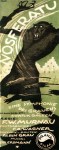
Nosferatu (poster)

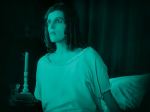
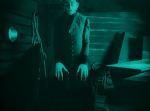
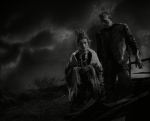
Today’s cinema adventure: Nosferatu, A Symphony of Horror (Nosferatu, eine Symphonie des Grauens), the 1922 German film adaptation of Bram Stoker’s Dracula, directed by the acclaimed and influential F.W. Murnau. An elaborate production, filmed largely on location, it was the first major film to focus on a vampire and has exerted a strong and lasting influence over the 90 years since its release; yet it was almost lost due to the fact that the production studio- Prana Films- never obtained the rights to Stoker’s novel and was sued by his widow, resulting in their declaration of bankruptcy and an order to destroy all copies of the movie. Fortunately, one copy had already been shipped out, and thanks to its survival Nosferatu (as it is now commonly known) was eventually heralded as a true classic, developing a cult following and becoming a cultural icon.

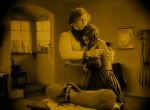
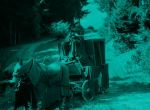
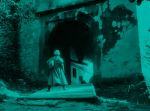
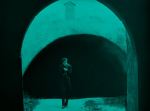
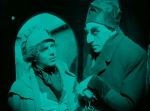
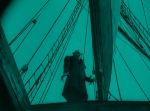
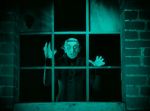
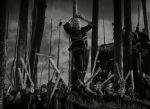
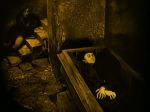
The plot is more or less familiar to anyone who has read or seen Dracula in any of its more “official” versions, but the setting and the names of the characters have been changed, and several new ideas are introduced in addition to the creation of a significantly altered ending. It opens with idyllic scenes of life in the fictional port town of Wisborg; a young man, Thomas Hutter, is being sent to faraway Transylvania by his employer, a real estate agent named Klock, in order to conduct a transaction with the mysterious Count Orlok, who wishes to buy a house in their town. Though his beautiful and virtuous wife, Ellen, has dark forebodings about the trip, Hutter leaves her in the care of friends and enthusiastically embarks on his journey. Once he arrives at Orlok’s ruined castle, however, he begins to suspect that the reclusive count- a thin, ghoulish-looking eccentric who evokes deep fear in the local villagers- may have darker intentions than a simple change of scenery; after the deal is finalized, the young man is horrified to discover that his host is indeed a member of the undead, a powerful vampire who sleeps by day in a coffin under the castle- but the knowledge comes too late, for Hutter finds himself imprisoned in his room, watching helplessly from a window as Orlok loads several coffins full of dirt into a wagon and departs for Wisborg. Fearing for the safety of his home town- and especially of his beloved wife- he manages to escape from the castle and begins to make his way back to Wisborg, hoping he can arrive in time. The count, meanwhile, travels by ship, concealed below deck in one of his coffins; along the way, he victimizes every port town at which they stop, leaving behind rumors of plague. He also preys upon the crew, killing them one by one until the boat arrives in Wisborg, seemingly a ghost vessel inhabited only by rats- brought on board within Orlok’s spare coffins. Believing the rodents have carried the spreading plague to their town, the authorities warn the citizens to remain secluded in their homes, and Orlok, having moved into his new abode and using the supposed epidemic as his cover, begins to feed upon the terrified population. When Hutter finally arrives home, he finds that Ellen, to his relief, is so far unharmed, but she is consumed by melancholy and terrified of the new neighbor who stares at her from his window at night. Though her husband tries to hide the truth from her, she discovers from his books the true nature of the threat, and learning that the vampire can only be destroyed by direct sunlight, she resolves to undertake a dire strategy by which she might lure Count Orlok to his doom.

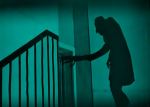
The screenplay for Nosferatu, which has received much praise for its deliberate, rhythmic pacing and its pervading air of cool melancholy, was authored by Henrik Galeen, an Expressionist writer hired by the film’s producers for his expertise in the dark romantic style they wished to capture. Though the great Murnau is usually given credit for the movie’s eerie mise-en-scène, Galeen’s script was in fact quite detailed in its meticulous, shot-by-shot description; he included specific instructions for each scene, with directions for timing, camera angles and composition, and lighting, even providing sketches for reference in framing shots. The result is a haunting, dream-like exploration of the primal fears hiding in the dark corners of man’s imagination, given form through the persistent folklore that has resisted the rise of science and reason since the days of the Black Death. Though the vampire myth is ancient and universal, its most familiar and lasting incarnation springs from the superstitious tales of Central Europe, where bubonic plague wiped out whole medieval villages and prompted the survivors to imagine other-worldly causes for its indiscriminate and unstoppable devastation- not only vampires, but werewolves and other insidious monsters of the night became the dreaded scapegoats for this seemingly unexplainable onslaught of death, and legends of their continuing existence endured throughout the centuries as a reminder of those dark times. Galeen’s scenario, borrowed as it may have been from Stoker’s then-still-fairly-recent novel, stirs up all of these arcane fears embedded in cultural memory. Indeed, before Orlok ever appears onscreen there are scenes of a werewolf prowling the night (with a striped hyena- a bizarre-looking and fearsome creature that was largely unfamiliar to most 1922 moviegoers- standing in for the supernatural beast), and memories of the ancient plague are clearly tapped by the tale’s conceit of using the threat of just such a rat-borne pestilence as a subterfuge to mask Orlok’s killing sprees; even the vampire’s makeup, with his large, pointed ears and pronounced, close-set fangs, is designed to be rat-like and enhance the correlation between monster and disease. Though Nosferatu is set in the 1830s and was made in the 1920s, as we watch it in the 2010s our subconscious is undeniably returned to the Dark Ages, when the night concealed forces which we could neither fathom, foresee, nor combat, and safety was an illusion that could only be maintained by the light of day.

As for Murnau, even if he was guided extensively by the wishes of the screenwriter, his genius clearly shows through. His meticulously faithful adherence to Galeen’s directives is infused with his own brand of cinematic poetry, creating a striking visual statement that leaves lingering images in the viewer’s mind. His skill at using light and shadow is here used to great advantage, with his particular gift for capturing the almost tactile properties of both helping immeasurably to build the heightened, nightmare reality of the film. Nosferatu, after all, is pure Expressionist cinema- albeit tempered by the sensibilities of gothic romance- and as such is intended to simulate a sort of dream-state, in which the impulses of the unconscious psyche are manifested in outward form; Murnau’s ability to create this hallucinogenic, psychically resonant feel onscreen is largely responsible for its overwhelming success at this objective. Nor should his efforts with the mechanics of storytelling be ignored; he drives his film at precisely the right pace, neither too slowly or too quickly, but with a strong feeling of inexorability that feeds our cumulative sense of dread and pulls us deeper into the narrative. This effect was neither accidental nor accomplished after the fact through editing; the director filmed each scene with precision timing, even using a metronome to guide his actors, and controlled the rhythm and flow of the movie with such a musicality that its subtitle, “A Symphony of Horror,” is not at all hyperbolic.

The film’s other components should be noted, as well, for they all support Murnau’s artistry by building a cohesive visual unity. The director’s remarkable portrayal of light- such a tangible force it is itself almost a character in the drama- is made possible by the luminous work of cinematographer F.A. Wagner- who, amazingly, accomplished the entire shoot (even the extensive location footage) with only a single camera. Contributing immensely to the visual style, which not only makes heavy use of the theatrical, larger-than-life elements of Expressionism but also draws extensively on older, more traditional influences from Germany’s rich and varied artistic heritage, is the set-and-costume design of Albin Grau. His creations- with the help of Murnau and Wagner’s intricate lighting- evoke paintings by the great masters, but they also lend themselves to the edgy avant-garde milieu of the then-present-day; this melding of the familiar with the jarringly strange is yet another way in which Nosferatu derives its power. Grau was one of the film’s producers, and indeed had first conceived the idea of making the movie, inspired by an incident during his service in WWI, when a Serbian farmer told him that his father was a vampire; no doubt haunted by his imaginings of this farmer’s undead patriarch ravaging the countryside at night, he knew it was the sort of irrational dream material that was perfect for expression through film. It might be said that, more than Galeen or even Murnau, Nosferatu was his film; accordingly, his considerable design contributions, infused with the passion of a personal vision, should not be overlooked.

Though it was, of course, a silent film, music was nevertheless intended to play an important role in Nosferatu. Sadly, the original score composed to accompany its screening, written by Hans Edermann, was long thought lost. As a result, there have been numerous alternative scores created over the years, in styles ranging from lush orchestral romanticism to dissonant avant-garde minimalism. The print I watched recently (available on Netflix streaming video) features a score composed in 2000 by the Silent Movie Orchestra, consisting of a fairly contemporary-sounding ensemble utilizing such elements as electronic organ and heavy percussion; personally, I found it highly effective, but obviously it’s a matter of taste. Many feel that the score for a silent movie can only be appropriate if it is created in the style of- and with the instrumentation available in- the era in which the film was made; others have a more flexible preference, and obviously the majority of casual viewers will most likely find such a question immaterial (though I would venture to say that many of those who claim they cannot enjoy silent films are basing their opinion on the experience of seeing one with a generic, woefully inadequate musical accompaniment- the effect of music on this art form cannot be overstated). There are a number of prints available, with different scores to accommodate every taste, so if this aspect of the film is a concern, you would be well-advised to do a little research before choosing which version to watch. The now-reconstructed Edelmann score is featured on Kino’s restored print, which also offers probably the cleanest video quality available today, complete with the original, all-important chromatic tinting to differentiate day from night (in pure black-and-white, as most silent films were commonly shown for decades, time of day becomes a confusing issue); obviously, watching this edition is the best option, if possible; otherwise, there are numerous other versions available for free viewing online- after all, the movie is in the public domain, at least in the United States.

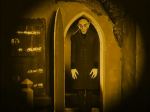
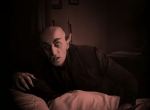
Whatever musical accompaniment you might favor, if you are a serious cinema aficionado, watch Nosferatu you should. Though many other horror films pre-date it, it is unquestionably the first unqualified masterpiece of the genre, from which all subsequent entries have sprung; not only have Galeen’s screenplay and Murnau’s direction spawned thousands of imitators throughout the past century, their film contains the first bona-fide horror icon (with the possible exception of Conrad Veidt’s somnambulistic murderer in The Cabinet of Dr. Caligari) in the form of Count Orlok. As embodied by character actor Max Schreck, the count is a nightmarish figure indeed; a far cry from the darkly romantic charm of Bela Lugosi and other later interpretations of the Dracula character, he is utterly devoid of humanity, spectral, repellant and coldly detached. He famously grows uglier as the film progresses, with fangs and talons seeming to grow larger as he becomes more steeped in bloodshed and death. Like an anthropoid vermin, he moves his spindly frame with a grotesque grace and gazes with dull malevolence through his not-quite lifeless eyes; it’s easy to see why Schreck has been shrouded with mystery in the popular imagination, even being portrayed as a real vampire in the fictional 2000 film about the making of Nosferatu, Shadow of the Vampire. For many years, cinematic legend surrounding the film has wrongly implied his surname was adopted for this role due to its translation into the English word “fright,” but Schreck was indeed his birth name, and he had enjoyed a long and prominent career in German theatre and film prior to being cast as Orlok. He deserves full recognition for his performance, a masterful creation in which he uses his physicality to bring the full essence of this loathsome character to the screen; to attribute his effectiveness solely to savvy casting, though Murnau reportedly picked him for his ugliness alone, is to discount the level of commitment this fine actor brought to the role, helping to make it one of the most definitive and influential screen depictions of a horror character ever filmed- an even more remarkable feat considering that he is actually on screen for a total of less than 10 minutes

The rest of the cast, though many of them have much more screen time, are not quite as unforgettable as Schreck- how could they be? This doesn’t mean their work is inferior, however; all of the players provide vivid portraits of their characters, delivering top-notch performances in the accepted style of the day. Gustav von Wangenheim, a noted theatrical writer/director and performer, and film’s true leading actor, is robust and florid as Hutter, a little over the top, perhaps, but more endearing by far than most of the wooden, stiff-upper lip types offered by later incarnations of the story’s parallel character, Jonathan Harker; the stately and beautiful Greta Schröder adds a touch more weight and dignity than expected to the role of Ellen, making her less the helpless victim than the tragic heroine; and as Knock, the psychically-enslaved real estate broker who serves as the film’s version of Renfield, Alexander Granach gives us a comically exaggerated- but still unsettling- personification of the archetypal greedy old man, here driven to the point of lunacy by the influence of his demonic master and presenting an obvious allegory, in his affiliation with the vampire, for the adulation of wealth and power represented by such figures- which gives Nosferatu a suggestion of sociopolitical commentary, in the sense that Knock becomes a scapegoat for the villagers, who blame and persecute him for the onset of the plague, though- despite his eager participation in the evil that besets them- he is, in reality, just another victim, a symptom of a larger malady that transcends political or economic concerns.

Nosferatu is one of those rare works from the early years of cinema that remains eminently watchable by the average viewer today; there is something about it, perhaps a sense of the dark despair hidden beneath even the brightest promise of happiness and prosperity, which allows it to strike a universal and timeless chord. There are so many haunting and indelible images here: the silhouetted horses fleeing from the marauding werewolf; the spectral coach speeding eerily in stop-motion as it bears Hutter to Orlok’s castle; the ghostly ship gliding inexorably through the night as it delivers the vampire across the waters; the angry mob destroying a scarecrow in its pursuit of Knock; and, of course, every moment of Orlok’s presence, from his first appearance as the sinister driver of the coach to his furtive and decidedly unromantic feeding upon his final victim. The stylized artistry of its presentation, far from making it inaccessible, seems to crystallize it and capture its essence in a form that is instantly familiar. It’s impossible to say, 90 years later, whether the imagery of Murnau’s movie has become integrated into our collective cultural consciousness or if it drew its inspiration from the dark imaginings that were already there; wither way, the effect is the same- Nosferatu is an experience that feels like it is coming from within us, not from without.

http://www.imdb.com/title/tt0013442/
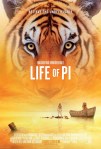
Life of Pi (2012)

Life of Pi (poster)

Today’s cinema adventure: Life of Pi, the 2012 film adaptation of Yann Martel’s popular novel of the same name, relating the tale of a boy who, stranded by shipwreck in the middle of the Pacific, must survive alone in a lifeboat with a ferocious Bengal tiger.  In development for several years, it was assigned to a number of directors before finally being offered to acclaimed filmmaker Ang Lee; under his guidance, the challenging material was shaped into a 3D blockbuster, utilizing extensive CG effects to realize the logistically daunting circumstances of its plot.  Long anticipated by fans of the book, many of whom undoubtedly regarded it unlikely that an adequate film could be made from the delicate source material, it has thus far been greeted with overwhelmingly positive response by both critics and audiences, who have marveled at its visual beauty and technical wizardry, as well as expressing admiration for its handling of the novel’s important metaphysical themes.

Adapted more or less faithfully from Martel’s original by screenwriter David Magee, the film begins in Canada, with an interview between an unnamed writer and the possible subject for his new book- Piscine “Pi” Patel, a teacher from India who, as a teenager, survived the sinking of a trans-Pacific freighter and spent nearly a year adrift in a lifeboat before reaching safety on the shores of Mexico.  Pi proceeds to tell his tale, first detailing his childhood in Pondicherry, India, as the younger son of a zookeeper and his wife.  Exposed at an early age to not only his native Hindu religion, but also Christianity and Islam, he becomes devout in all three- though his family, particularly his father, tries to encourage him to take a more practical, scientific approach to life.  Eventually, as Pi approaches adulthood, the family decides to start a new life in America; father arranges passage on a freighter, upon which they can also transport the zoo animals.  Halfway through the journey, however, Pi awakens in the middle of the night to discover the ship is sinking; forced into a lifeboat by the frantic crew, he soon finds himself the only human survivor, stranded thousands of miles from land- but not quite alone.  Under the canopy of the lifeboat lurks an enormous tiger, the last remaining member of his father’s menagerie.  In order to survive his ordeal at sea, Pi must establish a precarious relationship with the huge carnivore, simultaneously his only companion and his greatest threat, while also learning to procure the fresh water and food they will both need in order to survive.  The experiences and adventures they share form a strange bond between boy and beast, and Pi’s journey becomes a rite of passage in which he must come to terms with his place in the universe and define his relationship with the absolute.

Life of Pi is one of those movies that is exceptionally difficult to write about in any meaningful way; even a description of the plot is impossible to accomplish without either giving away key story elements or making the whole thing sound like an implausibly far-fetched boy’s adventure yarn.  The film’s advertising campaign makes it clear, however, that it is a movie meant to inspire a sense of wonder, so it’s no spoiler to reveal that director Lee approaches the novel’s scenario with an eye towards capturing the mystical experience of it; and rightly so: like Hemingway’s The Old Man and the Sea, from which it clearly bears a direct lineage, Martel’s novel is as much a metaphor as a narrative, offering a portrait of inner transformation through its description of outward events.  It is precisely this quality that makes the notion of transposing it to film so questionable, since translating the esoteric into a visual milieu can be problematic, to put it mildly, particularly when the outward circumstances of the story are not only limited by its setting but also extraordinarily difficult to capture on film by conventional means- the 1957 film version of Hemingway’s tale, well-acted as it may have been by Spencer Tracy, is proof enough of that.  Fortunately, Life of Pi benefits immeasurably from the technological advances in filmmaking that have allowed the convincing depiction of almost anything imaginable; even more importantly, it benefits from the supervision of a truly gifted film artist who understands the importance of using all these high-tech enhancements to serve his material, rather than the other way around.

Ang Lee is an exceptional filmmaker, one who has proven time and again his particular gift for approaching Western subject matter with the perspective of his Asian background.  With films like The Ice Storm and Brokeback Mountain, he has explored distinctively American subjects and settings with the cool and sensitive eye of a shrewd outsider, distilling humanity at its essence from the conflict between the cultural and personal mores of his characters; with Life of Pi, he is given the opportunity to merge these differing viewpoints in a story which draws from the elements of both.  In Martel’s novel- and fortunately, in Magee’s screenplay- the literal, narrative-based traditions of the West are blended with the symbolic, inscrutable mysticism of the East, creating a story which satisfies the needs of both; it is simultaneously a tall tale and an object for meditation, an invitation to participate in both a rousing adventure and a spiritual journey, and a celebration of both the outward and inward beauties of the universe.  With a keen understanding of this material, Lee once more coaxes the innermost revelations from his meticulously crafted arrangement of surface details, resulting in a remarkable film that combines his characteristic observational lyricism with the kind of shimmering magic that elevated his Crouching Tiger, Hidden Dragon from a straightforward martial arts genre picture to an unforgettable cinematic experience.

Unlike Crouching Tiger, however, Life of Pi is not exactly a fantasy picture; but Lee shoots it as if it were, giving even its most mundane settings a feeling of being larger than life.  He gives us a world where everything seems to shine with an inner glow, possessed of a deeper nature just beneath its surface, and in all his settings- the streets of Pondicherry with their fusion of European and Indian influence, the lush wonderland of the zoo, the cavernous, animal-filled cargo hold of the freighter, the exotic jungle of the mysterious floating island Pi discovers late in the film, and of course the alternately idyllic-and-punishing timelessness of existence in the isolated void of the ocean- everything we see has the a priori familiarity of an archetype, a deeply-embedded subconscious memory of a place we’ve never been.  This is accomplished by the surreal visual atmosphere the director achieves with the help of his artistic and technical team (particularly through the golden-hued palette captured by cinematographer Claudio Miranda and the hauntingly ethereal score by Mychael Danna), but also by a sublime artistic sense that allows him to put all the pieces together with just the right balance of dream-like ephemera and visceral tangibility.

It needs also to be observed that Ang Lee chose to make Life of Pi as a 3D movie, and though I’m not a fan of the current trend towards putting almost everything into this unnecessarily costly and often gratuitous format, his film demonstrates- like Martin Scorsese’s Hugo– what can be done with it in the hands of a truly gifted filmmaker.  Lee uses the extra depth to enhance and expand our experiences in the world of his film, particularly in regard to suggesting the overlay of different perspectives and realities that is of such great importance to the thematic core of the story.  Indeed, though Life of Pi can most certainly be enjoyed and appreciated in the conventional format, I might even venture to say that, at least in terms of artistic relevance to the material, it is the greatest use to date of three-dimensional technology; if at all possible, its a film that definitely warrants the extra effort and expense of an outing to your nearest 3D-equipped multiplex.

Besides the 3D effects, as mentioned before, there are many other technical aids that contribute to Life of Pi; it is safe to say the film would be impossible without them, for though most of the story’s circumstances could likely be provided by standard, pre-digital-age camera trickery, there is at least one crucial element that could probably never be realized without the help of the advanced computer wizardry on display here.  I refer, of course, to the tiger- who has a name I will not reveal here, since I am loath to spoil even the smallest of the movie’s many delights.  The relationship between Pi and this formidable creature is the crux of the entire film; through it comes the majority of the boy’s revelatory experience, his attempts to establish a connection to the awesome and terrifying power of the universe and come to terms with his own true nature.  The beast must seem as fully alive, perhaps even more so, as his human co-star, and it is a testament to the artistry of Lee and his CG technicians that this condition is met beyond any reasonable expectation. Remarkably, the tiger’s presence is almost entirely created digitally- the only live footage comes when he is swimming, and it is virtually impossible to tell the difference.  Pi’s feline companion exudes a palpable reality and a distinct personality, making him arguably the most impressive of the film’s triumphs.

The tiger’s utterly convincing presence is by no means the only triumph of Life of Pi, though, and while the beast is a display of special effects at their most dazzling level, it never overwhelms or upstages the rest of the film.  Rather, the tiger plays its role alongside the flesh-and-blood human cast members so seamlessly that the film’s advertising tag line, “Believe the Unbelievable,” seems entirely apt.  As for the humans, they form a superb ensemble of players, embodying their roles so perfectly as not to call attention to themselves as actors at all.  As so frequently happens in a film of this magnitude, the performers are so much a part of the cohesive whole that they tend to go unnoticed, but nevertheless they deserve praise for their fine work.  In particular, Bollywood actress Tabu and Anil Hussain make an impression as Pi’s mother and father, respectively, as does the lovely Shravanthi Sainath as a girl with whom the young hero enjoys a brief romance before he begins his fateful journey.  As the adult Pi, Irrfan Khan (another Bollywood stalwart) is serene and approachable, yet perhaps, somehow haunted- he makes us want to hear the tale of the journey that shaped him into this enigmatic figure.  As the writer to whom he tells it, Rafe Spall is appropriately likable (suitably enough for a character whose role is to stand in for the audience), but also offers a faint aura of desperation, suggesting that underlying his practical interest in Pi’s narrative as inspiration for his work is the deeper need of a spiritual seeker.  As an interesting side note, Spall was cast only after actor Tobey Maguire had already completed filming his own performance in the role; Lee decided Maguire was too recognizable and his presence would call undue attention to what was essentially, though important, a minor role, and reshot all of his scenes with Spall instead.  Interestingly, iconic French star Gérard Depardieu makes an appearance in another small- but ultimately significant- role as a chef aboard the freighter, making one wonder if his scenes might have been reshot for the film’s French release.

Clearly, though, the most crucial performance must come from the young actor playing 16-year old Pi, whose experiences- both exterior and interior- provide the main body of the film.  Making his screen debut in the role, first-time actor Suraj Sharma rises admirably to the occasion.  Chosen by Lee out of 3000 candidates, he actually attended the audition as an escort to his younger brother, but the director was taken by his appearance and asked him to try for the part; though he went through several rounds of readings, he was eventually chosen to star in the film, but before filming began he underwent extensive training- not only in acting, but in yoga and meditation practices as well as ocean survival.  The resulting performance is as magnificent a film debut as any young actor could hope to deliver, requiring Sharma to portray a profound range of emotional and psychological transformations, and he does so with utter conviction- and charisma on top of that.  He takes us every step of the way through Pi’s journey, without faltering for a moment.  It is a superb piece of film acting, and proves that this young man fully deserves a long and active future in front of the cameras, should he choose to continue on that path.

Though I haven’t said it yet, in so many words, it should be obvious be now that I think Life of Pi is a pretty great movie.  I should accompany that endorsement with the disclaimer that I am a huge fan of the book and also of Ang Lee; but even considering any personal bias, I feel pretty confident in my assessment of the film as one of the best films of 2012.  No doubt there are those who might be skeptical, particularly those unfamiliar with the original book who might suspect it of bring some sort of gooey boy-and-his-tiger adventure.  Rest assured, it is not.  Life of Pi is the story of man’s quest to form a relationship to the mysteries of existence, to reconcile the delicate balance between life and death, and to find within himself the strength and determination to keep going in the face of the uncertain and unknowable.  Like its protagonist, it draws influences from the three religious traditions mentioned above, as well as from a healthy dose of existentialism; it uses its story to explore not only themes of personal development, but of the nature of perception and reality itself.  Some viewers may feel that Pi’s tale is too preposterous to be believable, and to be sure, it strains plausibility increasingly as it progresses; to that, I can only say that this is in itself a part of the film’s unusual power, and that in the end, the story’s very unlikeliness is in fact a key factor to its purpose. Ultimately, Life of Pi asks a great many questions about existence, questions that each of us must face in our own lives, but it doesn’t answer any of them; instead, it challenges us to find our own answers, leaving us puzzled and pondering, stimulated and shaken- but most of all, amazed and- just maybe- a little bit more enlightened.

Before offering a whole-hearted recommendation for Life of Pi, I must also caution that, in spite of the presence of zoo animals and its adventurous overtones, this is not a typical “family” movie; not only does it deal with the sophisticated, “heavy” themes discussed above, it also contains much that could be very upsetting to young children- indeed, even to most adults.  Lee does not shy away from showing us the universe in its most chaotic, destructive, and unmerciful aspect, and though the movie contains a considerable amount of humor and counters its more terrifying content by also capturing the world in its most blissful and sublime beauty, his purpose is not to offer a comforting, sentimentalized vision of a reality in which, despite the scary parts, everything will always turn out alright.  That said, there is nothing inappropriate for young people in Life of Pi, and with guidance and participation from parents, it is probably a much finer choice for family viewing than the majority of safe and formulaic pabulum churned out around the holiday season; I would recommend it heartily above such “tweener” crowd-pleasers as the latest Twilight installment.  As for the rest of the film-going public, I can think of no qualification to offer with my encouragement to see this movie; it is one of those rare examples of mainstream moviemaking that successfully achieves the status of great art, and I have little doubt it will become a classic.  Thus far, Life of Pi has performed respectably at the box office, though it has been predictably overshadowed in a season that also offers impressive revisitations of James Bond and Abe Lincoln in addition, of course, to Twilight’s doe-eyed teenage vampires; let’s hope that it manages to hold its own long enough to ensure an opportunity for all fans of great cinema to experience it in its full glory on the big screen.  If you miss that chance, though, it will still be worth your while to pick it up as soon as it becomes available for home release- and buy, don’t rent.  This one’s a keeper.

http://www.imdb.com/title/tt0454876/

Freaks (1932)


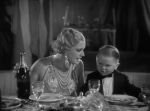
Today’s cinema adventure: Freaks, the infamous 1932 film by director Tod Browning, about- and starring- the disfigured performers of a circus sideshow; controversial from the moment of its release and still disturbing today, it was lambasted by critics who found it repugnant, and was quickly pulled from circulation after provoking public shock and moral outrage.  Considered an affront to decency, it was barred from exhibition in many U.S. states and in countries around the world, and effectively ended the career of a director who had been one of Hollywood’s most respected talents; nevertheless, over the ensuing decades it gained a reputation- no doubt enhanced by its lack of ready availability- and became, in the ’60s and ’70s, a cult favorite, frequently screened as a midnight movie despite the fact that many of the prohibitions against it were still in place, making it technically illegal to be shown in many states.  Its rediscovery led to a critical re-evaluation, and today (thanks to modern society’s more enlightened, less reactionary view of its subject matter) it is widely regarded as a genuine classic, a brave and truly unique piece of filmmaking and a seminal influence within the horror genre.

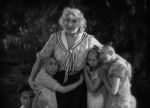
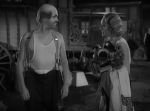
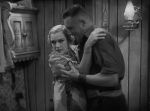
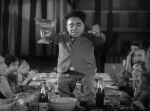
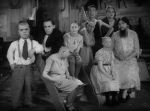
The story takes place entirely within the insular world of a traveling circus, focusing on the day-to-day existence and relationships of its cast- particularly the collection of malformed misfits that comprises its sideshow, which includes dwarfs and midgets, “pinheads,” conjoined twins, a legless boy, a human torso, and numerous other bizarrely-shaped and differently-abled individuals who, despite their deformities, enjoy a comfortable and seemingly pleasant existence within the rarified environment of the circus, living together in a tightly-knit community with its own sort of exclusivity- as well as its own unwritten code that governs their interaction with the outside world.  One of their number, a midget named Hans (who has recently become engaged to Frieda, another little person in the troupe), has become obsessed with the “normal” Cleopatra, the show’s new trapeze artist, an exotic beauty who indulges his attentions with flirtation and flattery; privately, however, she is only amused by his affections, making cruel fun of him with her real lover, the circus’ opportunistic strongman, Hercules.  Though warned by his fellow “freaks” that she is not sincere, Hans continues to pursue Cleopatra, eventually spurning his fiancée for her; she humors him in order to take advantage of the lavish gifts he gives her, and when she discovers that he is secretly the heir to an enormous fortune, she and Hercules decide to steal it for themselves.  She concocts a plan to marry the little man so that she can become his beneficiary, and then slowly poison him, making his death seem due to illness and allowing her to claim the money and run away with the strongman.  At their wedding feast, however, she becomes drunk, reacting with disgust when the freaks attempt to accept her as one their own and inadvertently revealing her affair with Hercules.  Though she is seemingly able to allay the suspicions of her new husband- who has grown weak from the poison she has already begun to administer- the other sideshow performers are onto her scheme, and they resolve to take matters- and justice- into their own hands.

Director Tod Browning had spent his early youth in the circus (which he had run away from his privileged family to join) where he had formed a strong connection to the specialized society of its inhabitants; when he encountered the short story, Spurs, by Tod Robbins, he immediately knew he wanted to use it as the basis for a film.  He had built an impressive career as a director of silent films, making a name for himself through his extensive collaboration with renowned horror star Lon Chaney, with whom he created a number of classic films known for not only their moody eeriness, but for their remarkable level of humanity; after continuing his success into the sound era (as the director of Dracula, the 1931 hit which made a star of Bela Lugosi), he was able to convince MGM Studios- with whom he had worked on the Chaney films- to allow him to develop a film based on Robbins’ story.  Though the studio had serious reservations, production head Irving Thalberg gave Browning his full support, even in his decision to use real sideshow performers in the film instead of actors in makeup.  Consequently, working from a screenplay that combined basic elements from the original story with the concocted plot of Cleopatra’s treachery, as well as episodes inspired by his own experiences in the circus, Browning was able to realize his dream project.

In the end, he may have wished he had not; his use of genuinely deformed actors caused an outcry from public and critics alike, who felt their presence made the film far too disturbing to watch.  Worse yet, Browning was accused of exploiting these unfortunates for his own profit, much in the way that real-life carnivals and sideshows had done for years.  Whether or not this was true, the film’s preview screenings were a disaster, with audience response so vehemently negative- and one female patron threatening to sue MGM over a miscarriage supposedly brought on by the movie- that the studio edited out 30 minutes of the most upsetting footage before its general release, leaving it with a running time scarcely over an hour.  Even with these cuts, a new prologue, and a more upbeat happy ending tacked on for good measure, Freaks was a failure at the box office; not only did it fail to make back its cost, it generated so much negative publicity for the studio that, after a short release, they pulled it from theaters and put it on the shelf- though it would later emerge in exploitative road show tours, under lurid-sounding titles such as Forbidden Love and Nature’s Mistakes, and sometimes accompanied by such titillating underground fare as amateur films of nudist camps.  As for Browning, he was more or less blacklisted from making any more important movies, relegated to helming a few low-grade horror entries until he gave up his career in 1939, and he passed away in relative obscurity in 1962- just a few years before the resurgence of interest in classic horror films that would doubtless have restored his fame and reputation, never to see the day when a youthful counterculture would turn his greatest failure into his greatest triumph.

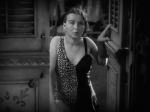
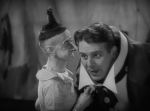
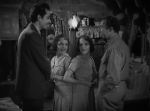
Calling Freaks a triumph, actually, might not be an apt description; it possesses a raw and unfinished quality that has nothing to do with the removal of so much footage (all of which is now, sadly, considered lost).  Its story is sensationalistic, more a transposition of conventional melodrama into an unfamiliar setting than a real attempt at exploring this rarely-seen world, and it capitalizes on the irrational fears of the lowest common denominator to achieve its horrific effect.  Despite these things, however, and perhaps even because of them, it has a unique power that makes it nearly as shocking today as it was 80 years ago; watching it is as difficult as it is fascinating, evoking a decided sense of seeing something you’re not supposed to see.  It’s actually very easy to understand why audiences in 1932 would react so violently to Browning’s film, unaccustomed as they were to the kind of distorted imagery of the human body that has since been portrayed onscreen.  Even today, thanks to advances in medical and nutritional science and the ready availability of pre-natal care which have made such dramatic and heartbreaking birth defects a much rarer occurrence, the sight of all these non-CG-enhanced distortions of physical humanity is more than a little unsettling. The real power of Freaks, though, is only apparent for those who can get past the deliberate gross-out factor of its surface and invest themselves in its story, the clear message of which is that true ugliness lies not in physical appearance but in the soul.  Without exception, the so-called freaks are good-natured, trusting, generous and sweet (though Hans may be blinded by desire into making some foolish choices); it is the “normals” who are the real monsters here, with Cleopatra’s gold-digging cruelty and Hercules’ brutish arrogance making them truly among the most loathsome villains in classic cinema.  Of course, it would be contrary to Browning’s message to make all of the normal characters so unpleasant; the others exhibit varying degrees of likability, in terms of their relation to the freaks, from the uncharitable but relatively benign attitudes of the circus’ tumblers (a decidedly non-athletic-looking pair, incidentally, to be holding such a job) to the kindness and total acceptance offered by the film’s ostensible romantic leads, the lovely seal-trainer Venus and her clown boyfriend Phrozo, who even risk their own safety to come to the aid of their oddly-shaped friends.  Though the narrative approach is simplistic and heavy-handed, the black-and-white morality is part of what makes it work; it should be obvious that true humanity exists under the skin, having nothing to do either with physical beauty or the lack of it, and it is one of the defining characteristics of the insensitive and the mean-spirited that they neither see nor care about this basic truth- they are, in fact, the real “freaks” in this story, the unnatural evil that must be weeded out in order to restore harmony.  It is a testament to Browning that he makes their comeuppance both horrific and immensely satisfying, accomplishing the somewhat Hitchcockian feat of transferring audience identification to the perpetrators of violence in order to underscore his subversive point.

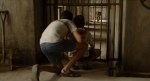
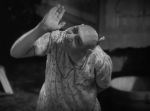
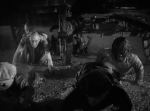
Freaks does not dwell entirely in the dark and moralistic realm of its main plotline; throughout the film are vignettes, many of them drawn from Browning’s real-life memories of his own years in the circus, of existence in the sideshow world.  It’s a place where, despite the extraordinary nature if its inhabitants, the details of daily life are mundanely familiar- Frieda the midget having girl talk with Venus while hanging laundry, lovers’ politics between the conjoined twins and their paramours (both of whom are, by the way, normals), the joyful bedside gathering of friends when the bearded lady gives birth- and go a long way towards endearing us to the misshapen cast of characters.  Some of these moments are played for laughs hinging on the idea of these outwardly strange individuals behaving like average people (a conceit which, though likely very true to real life, was also a staple of the sideshow and vaudeville acts in which they performed); others are touching and revelatory, such as the early scene in which a landowner stumbles upon Madame Tetralini, the sideshow’s “headmistress,” accompanying several of her more drastically deformed charges on an outing in the woods.  A few of these sequences awaken a genuine sense of wonder and open a window into these unusual lives, such as the famous scene when Prince Randian, the “Human Torso,” expertly lights a cigarette using only his mouth or, most particularly, when a passionate kiss bestowed on one of the conjoined sisters sends a tingling wave of arousal through her twin.  These humanizing moments, some of them unforgettable, contribute to the effects of the well-known scene of Hans and Cleo’s wedding feast; we feel the infectious joy of their raucous celebration- sharing in the fun of Koo-Koo the Bird Girl dancing on the table rather than experiencing the appalled reaction of an uninitiated gawker, respecting the true generosity of their chanted ritual of acceptance for the new bride (“Gooble-gobble, Gooble-gobble, One of Us, One of Us!”) instead of cringing at its seemingly ominous implications, and recognizing Cleopatra and Hercules’ drunkenly flagrant contempt and disrespect for their hosts as the deep affront that it is rather than identifying with it.  For the film’s harrowing climax, however, though these efforts to bond us with the freak community may allow us to be on their side, our sympathy does nothing to alleviate the sheer visceral terror they evoke when we see them lurking in the shadows or crawling slowly but inexorably towards their helpless quarry.  This is Browning’s true mastery coming to its fruition- he helps us to subdue our instinctive and primordial fears around these outwardly disturbing figures and then brings those fears to life for us in a way which simultaneously repulses and elates us.  In this way, he offers a film which transcends its own morality to deliver a pure, non-intellectualized reaction, and one which has rarely been matched, let alone surpassed.

As disquieting as this famous climactic sequence may be, modern audiences will only be able to imagine what it was once like.  Following the film’s overwhelming rejection by preview audiences, MGM made Browning cut a large portion of it; the original version featured the brutal castration of Hercules and included a lengthy and graphic mutilation of Cleopatra by the vengeful freaks.  There was also a longer version of the sideshow epilogue, in which the former strongman was seen on display, singing soprano, before the final revelation of the once-beautiful Cleopatra transformed into a grotesque duck woman- webbed feet, feathers and all.  This latter image, of course, remains in the film, no less disturbing for its lack of logical explanation, and justly infamous for its sheer audacious shock value.  It was meant to be the final moment, a lingering horror to send the audience home to their personal nightmares; in most existing prints of the movie, however, it is followed by a short finale- hurriedly filmed after the cuts were made, in hopes of leaving audiences on a more hopeful note- which shows the reconciliation of little Hans and his faithful Frieda, a pleasant enough conclusion, but juxtaposed against what we have just witnessed, one that feels a little hollow.

In terms of its production values, Freaks was a fairly high-budget project, and it shows.  Many of its scenes were shot on location (that is to say, outdoors) giving it an expansive, realistic feel that is missing in many of the more set-bound films of this early talkie period.   The cinematography (by Merritt B. Gerstad) is a masterpiece of chiaroscuro black-and-white moodiness, and the artistic design captures the authenticity of its circus setting in all its rough-edged, seedy glamour.  As for the acting, the “normal” cast all deliver perfectly acceptable performances in the somewhat stagy, melodramatic style of the day, with Olga Baclanova appropriately standing out as the flamboyantly callous and deceitful Cleopatra.  The specialty players, though all were seasoned performers in the real-life sideshow and vaudeville circuit, were not trained actors; even so- though their delivery is sometimes stilted, their diction often indecipherable, and their characterizations generally simplistic- they are so genuinely themselves that they win us over with the power of sheer personality.  This is especially true in the case of some of the more profoundly compromised actors, such as the microcephalics (“pinheads” being the less-sensitive but more commonly-known term)- particularly “Schlitzie,” (in real life, despite the dress, a man named Simon Metz), whose infectious charm practically leaps off the screen- and those others affected by especially severe genetic defects. Also memorable are Johnny Eck (the legless boy, a handsome and particularly gifted performer who was well-known and popular in Vaudeville), the aforementioned Prince Randian, and Violet and Daisy Hilton (the Siamese twins, also well-established as entertainers offscreen and later the subject of two stage musicals and an acclaimed documentary).  In many cases, these performers continued to work and thrive for many years after their appearance in Freaks (though with the decline of vaudeville many of them eventually faded into obscurity); indeed, one of the movie’s prominent dwarfs, Angelo Rossitto, went on to enjoy a long career as a film actor, culminating in his appearance as the key character of “Masterblaster” (or, at least, the “Master” half) in the 1985 action/sci-fi fantasy, Mad Max Beyond Thunderdome.

For most casual audiences, the most important question is this: does Freaks live up to its reputation?  My answer is an enthusiastic “Yes!” Truncated and brightened-up as it may be, Freaks is still a powerful film experience, one which achieves the rare objective of truly forcing the audience to confront its own level of humanity.  It’s hard not to feel compassion for these examples of nature gone wrong, but Browning’s film makes it clear that it is not our pity that matters- rather it is our acceptance.  Pity is another form of judgment, after all, no different perhaps than the less charitable attitude of dismissive contempt exhibited by the film’s scheming villains; it is based on a presumption of inferiority, and even of powerlessness- a presumption Cleopatra and Hercules, to their misfortune, discover to be very much mistaken.  Browning’s movie, for all its deliberate creepiness and sensationalism, is ultimately a powerful reminder of the old admonishment not to judge anything- or anyone- by appearances, and more than that, a strong plea for tolerance and equality.  The circus, after all, is a classic metaphor for the world itself, and the sideshow freaks stand in for all those social misfits who are outcast for their differences.   It is no wonder that Freaks was rescued from cinematic oblivion by the counterculture of the ’60s, and has been embraced ever since by those who, for whatever reason, stand apart from mainstream culture and disdain the shallow hypocrisy they see there; the appeal is obvious to anyone who has ever felt shut out because of who or what they are- and which of us can say they’ve never felt that?  Freaks, then, is a parable that validates the disenfranchised.  It also (to borrow a phrase) comforts the disturbed and disturbs the comfortable, which it’s probably fair to say is what Tod Browning set out to do with his magnum opus.  Though it may have cost him his future, I’m sure it would be some consolation for him to know that, even if it did take decades to happen, he is dearly appreciated for having succeeded.

http://www.imdb.com/title/tt0022913/


Cinderella (1950)

Today’s cinema adventure: Cinderella, Walt Disney’s 1950 animated adaptation of the classic folk tale immortalized by 17th-Century author Charles Perrault, a simple tale about a young orphaned girl, forced to work as a menial servant by her vain stepmother and stepsisters, who is granted a wish to attend a royal ball where her sweet nature and her beauty win her the heart of a handsome prince.  The first fully animated feature produced by the Disney Studio after World War II, it was something of a gamble, an expensive undertaking which would have likely resulted in bankruptcy had it failed to attract an audience; it did not fail, however, instead becoming an overwhelming success which provided the financial base for the expansion of the Disney company during the 1950s, paving the way not only for more features, but for the establishment of their television division and the beginnings of their theme park empire.  It remains one of their most enduring titles, commonly ranking near the top on lists of the greatest animated films of all time and continuing to enchant viewers of all ages as it inspires new generations of would-be princesses to believe in their dreams.

The basic plot of Cinderella dates back to ancient times, and can be found in folklore from a wide range of cultures and eras.  One version even found its way into Shakespeare’s King Lear, albeit with a tragic twist, through the story of the mythic Princess Cordelia, who not only marries her dream prince but defeats her cruel and ambitious sisters with his army; another dark variation on the tale can be found in the stories of the Brothers Grimm, who included such details as the stepsisters cutting off portions of their feet and their being blinded by attacking birds.  The most familiar version today, however, arises from Perrault’s story, which added the iconic elements now indelibly associated with it, including the fairy godmother and the magic pumpkin coach; Disney’s artistic team used this as their source, eliminating some of the darker aspects and placing a heavy emphasis on the peripheral adventures of the heroine’s animal allies, which are played for child-pleasing comic effect.  Indeed, the main events of the plot comprise relatively little screen time, and the story is largely told through the behind-the-scenes perspective of the mice, whose machinations are largely responsible for Cinderella’s eventual triumph.  The film opens with a narrated prologue in which the tale’s background is set; Cinderella is the daughter of a widowed aristocrat who takes a second wife with two daughters of her own, hoping to provide his child with a motherly influence, but upon his premature demise this new stepmother becomes a domineering tyrant, forcing Cinderella to live the life of a servant while doting on her own vain and mean-spirited girls.  Despite her lowly existence, Cinderella grows into a lovely and sweet-natured young woman, befriending the animals of the household, including the mice and birds, and treating them all with kindness- even her stepmother’s spoiled and vindictive cat, appropriately named Lucifer.  One day, an proclamation arrives from the palace that all eligible young ladies in the kingdom are invited to a royal ball in honor of the Prince, whom the King hopes will choose a bride from among them; Cinderella hopes to attend along with her stepsisters, but their scheming and jealous mother burdens the girl with extra chores in order to prevent her having the time to prepare a suitable dress.  Her loyal animal friends manage to make a lovely gown from the cast-off scraps of the stepsisters’ wardrobes, but when the elated Cinderella rushes to join her family as they prepare to depart, the two selfish girls accuse her of theft, and rip the borrowed items from her dress, leaving her in tatters as they head off to the palace.  Her tears of despair quickly disappear, however, when a kindly old woman materializes, proclaiming that she is Cinderella’s fairy godmother; she promptly transforms a pumpkin into an elegant coach and the girl’s torn dress into a sumptuous gown, and sends her off to the ball- admonishing her, however, that she must return before midnight, when the spell will be broken and all her magical accoutrements will return to their original, non-enchanted form.  At the palace, the young Prince is bored and unimpressed by the procession of bachelorettes vying for his hand- that is, until the late arrival of a mysterious beauty, to whom he is immediately drawn.  They waltz together and wander the palace grounds- until the clock begins to strike midnight, when she hastily flees, leaving behind no clue to her identity except a single glass slipper, lost on the palace steps in her hurry to escape before the final chime can break the spell and reveal her lowly state.  Determined to find the mystery girl who has won his son’s heart, the King declares that the slipper will be tried on the foot of every maiden in the kingdom until a match is found, but Cinderella’s destiny may still be jeopardized by the efforts of her malicious stepmother, who is bent on seizing this last chance to secure a royal marriage for one of her own unpleasant children.  With time running out, it will be up to the heroine’s animal friends to come to the rescue and ensure that her “happily ever after” dreams will at last come true.

As with all of Disney’s early productions, the screenwriting and directing duties on Cinderella were handled by multiple individuals, working in concert under the tight supervision of Walt himself and in close collaboration with the chief animators.  It is a testament to the strength of Disney’s vision that these films emerged as cohesive works of art, blending the styles and influences of their various contributors together into a unified whole.  At the time of Cinderella, the studio had spent several years languishing under the budgetary constraints of wartime, when their output had been limited to the obligatory shorts- still popular, but eclipsed by the success of Warner Brothers’ edgier Looney Toons and Merrie Melodies cartoons- and omnibus features which packaged several of them together or mixed short animated segments with live action footage.  Though the great features of the pre-war era had earned them much acclaim and a formidable reputation, only the first of them- Snow White and the Seven Dwarfs–  had been a bona fide hit, and full-length animation was too risky to warrant the considerable expense required for its production during the wartime economy; even so, the studio had honed its skills during these lean years, particularly in its recognition of the importance of music as a means to generate interest- and additional income- for their films.  Disney’s return to the field of feature-length animation was therefore bolstered by a deliberate effort to create songs which could not only add to the movie’s appeal, but which could become an asset in their own right, and Walt enlisted three established popular songwriters- Mack David, Jerry Livingston, and Al Hoffman- to compose tunes which could also be marketed on their own through the studio’s music division (the song rights for the previous films had been sold to other music publishers).  Even with this hedging of its bets, Disney was taking a major risk with Cinderella, releasing a family-oriented fairy tale into a market dominated by the grittier, world-weary cynicism and social commentary that had grown prevalent in post-war American films; but, whether by instinct, luck, or savvy foresight, Walt’s return to the medium which made him famous came at precisely the right time, heralding a revival of optimism and a growing taste for glossy fantasy that would mark the new and prosperous decade.

Watching Cinderella today, it’s remarkable to see the seeds of Eisenhower-era sensibility so clearly visible in its framework.  The “American Dream” is here encapsulated by the movie’s story of success earned by hard work and a positive attitude, and its focus on the feminine perspective emphasizes the role of women in that objectified way of life- namely, to strive for fulfillment through the ultimate life accomplishment of marriage to a successful man.  Cinderella, after all, is trained from the outset to be a devoted wife, with a deep attachment to her father and years of experience tending to every household chore; and her fitness as a mother is plainly seen in her nurturing relationship with her animal friends- particularly the two foremost mice, Jaq and Gus, who are more or less characterized as children in animal form.  Of course, the importance of beauty is also stressed, most strongly in the significance of Cinderella’s ball attire, with both the simple-but-charming dress constructed by the animals and the sumptuously dazzling gown into which it is magically transformed being afforded considerable weight in the film’s plotline.  Throughout the movie, even in the animal subplots, traditional gender roles are subtly reinforced, and the principal male characters- the human ones, anyway- are firmly established as the natural beneficiaries of masculine privilege, a status heightened by their identification as royalty in the hierarchy of the story.  On top of all these social foreshadowings, the visual design of the film is replete with precursors to 1950s fashion, from the rich color palette, to the lines of the clothing, to the predominance of old-fashioned Euro-elegance in the settings and decor.  As a final touch, the lush and dreamy music, at once catchy and soothing, fits directly into the mold of the popular songs that would dominate the sound of the coming decade- until the advent of Elvis and his rock-and-rolling ilk, that is.  In short, Cinderella, in the clarity of hindsight, looks very much like a blueprint for life in the ’50s, and one which may have had more influence on the shape of that decade than its creators had ever envisioned.

Aside from these signposts of its place in the timeline of cultural history, Cinderella also offers a look at the state of its art form at the time.  Despite Warner’s’ dominance in the realm of popular cartoons, Disney was still the undisputed master of the genre; nobody else could do the things they were doing, and their drive to continually advance the art was still strong, perhaps even more so after years of being held back by the war.  Even so, the creative juices flowing through Cinderella seem flavored less by the hunger of young visionaries than by the confidence of mature artists; there is an obvious delight in their work here, a feeling of seasoned professionalism taking enjoyment in showing off a hard-earned mastery.  There is also a softening in tone, a gentleness which marks a shift from the more heightened drama of such films as Pinocchio and Bambi to an easier-going sensibility more in keeping with the middle-of-the-road values the studio would come to represent over the coming decades.  This is not to say that Cinderella is devoid of drama or suspense; on the contrary, it takes full advantage of its creators’ cinematic skills in order to increase the tension in a story which is, to be quite frank, lacking in the type of high-stakes conflict found in the studio’s earlier classics- extreme perspectives, rapid editing, heavy use of light and shadow, and all the other tricks of the trade with which these animated filmmakers not only enhanced their storytelling, but which were imitated by live-action directors and thereby bore significant influence on the future development of cinema in general.  Even so, it is undeniable that Cinderella is more calculated, for want of a better word, in the sense that it makes a deliberate effort to evoke reactions to its narrative, rather than allowing its form to be a direct expression of the needs of the story itself.  This is, perhaps, an intangible distinction, and one which arises more from the nature of the story being told than a change in the attitudes of the artists, but it is a noticeable factor in the ongoing development of the Disney animation machine, and one which would later result in what many critics would characterize as a decline in the immediacy and relevance of their work.

None of those later criticisms apply, however, to Cinderella; it’s a fresh and heartfelt piece of entertainment, and whatever subliminal social agenda might be read into it by progressive modern thinkers, it transcends such retro-fitted concerns with its imaginative approach to a timeless story.  Sweet without being sugar-coated, funny without undermining its deeper themes, and stylish without being shallow, it is a fine representative of Disney at its magical best.  It goes without saying that the animation is stunningly executed; in their quest to infuse the film with a high level of reality, the animators turned once more to their technique of utilizing live action footage as a guide, filming a heavy percentage of the movie with real costumed actors and models in order to give themselves a reference from which to capture the illusion of real movement and expression.  This was not accomplished through rotoscoping- the actual frame-by-frame tracing of live footage- but by free-hand drawing to recreate the filmed sequences, a painstaking process, but one which affords a considerable amount of leeway for artistic interpretation.  In this way, the Disney artists seamlessly blend the realistic style of their human characters with the more overtly cartoonish animals, bridging the two worlds with the intermediate characterization of such comic figures as the King and the Stepsisters.  It’s a fully realized world, enhanced further by the magnificent work of the background artists and the conceptual designers.  I am not one to belittle the advances in technology which have given us the remarkable computer-generated wonders seen in today’s movie houses, but when confronted with the sheer beauty of a film like Cinderella, made all the more dazzling by the intangible influence of the direct human touch, it is difficult not to lament the all-but-lost art of hand-drawn animation.

The visual artistry here, as usual with a Disney production of this nature, is in the service of a story that, for all its simplicity and kid-friendly humor, strikes deep chords in the hands of these gifted artists.  Though contemporary audiences may quibble about the story’s pre-feminist underpinnings, Cinderella‘s message is not simply a reinforcement of the traditional belief that a woman’s place is in the home with a man to take care of her; rather, the emphasis is placed on the theme of believing in yourself and having faith in your dreams.  Likewise, though outward appearance is clearly a factor in the fantasy being portrayed- Cinderella must be lovely, after all, and the Prince must be handsome, just as the stepsisters cannot be anything but homely- it is not these surface qualities that are central to the plot; it is Cinderella’s kindness and good nature that make her deserving not only of our sympathies, but of the fierce loyalty of her animal friends and the help of her fairy godmother, and it is the selfishness and jealous vanity of her two stepsisters that make them truly ugly.  Disney knew what he was doing, too; Walt himself made cuts to the screenplay in order to remove episodes that implied less attractive qualities in his heroine, and great care was taken to ensure that her happy ending hinged not on her pretty face, but on the positive effects of her inner beauty.  Finally, the brightness of the slick romantic fantasy is countered by the palpably dismal atmosphere surrounding Cinderella’s family life; despite the extensive humor provided by the mice and the comic exaggeration of the stepsisters’ unpleasant personalities, the film makes clear the grim reality of its heroine’s existence, making the best of a miserable situation in which she is treated, essentially, as a slave and a prisoner, and victimized by the severe psychological abuse of her menacing stepmother- whose cold and calculated cruelty is no less horrific for the certainty that she will, in the end, fail to prevent her ward from finding happiness.

As previously observed, Cinderella is the result of extensive collaboration, and there is little point in reciting a list of names here; the names of the directors, writers, supervising animators and designers, all of whom deserve praise for their work, can easily be found on any number of other websites.  A few individuals, however, deserve to be singled out for their particularly notable contributions.  Perhaps most significant of these is Mary Blair, credited as “color stylist,” whose concept art featured a distinct array of primary hues but went beyond the creation of a color palette to infuse the entire film with her own subtly whimsical-but-elegant visual style; her work on this and subsequent Disney projects- including the creation of Disneyland- helped to define and influence the familiar “look” of much of the studio’s output throughout the next two decades.  Also important is the voice work done by a talented cast of Disney stalwarts, particularly Ilene Woods (as Cinderella)- who landed the role after friends recorded her singing voice and sent the tape to Disney without her knowing, and who ended up also modeling the character in the live action reference footage, a duty she would later repeat for other Disney heroines- and Eleanor Audley (as the Stepmother), whose chillingly austere vocal talents would be used again in another iconic villain role- the evil Maleficent in Sleeping Beauty– and in Disneyland’s “Haunted Mansion” attraction.  Lastly, the aforementioned trio of songsmiths provide one of Disney’s most memorable and popular scores, which includes at least two songs that would become signature tunes for the studio (“A Dream is a Wish Your Heart Makes” and the Oscar-nominated nonsense tune, “Bibbidi-Bobbidi-Boo”), and which yielded a number of successful recordings by popular singers of the era.

I must confess that though I am, perhaps obviously, an unrepentant fan of Disney movies (at least, of their canon of classic animated features), Cinderella has never been a particular favorite of mine.  Perhaps it is that my own taste runs towards the darker, more dramatic flavor of the studios original array of classics, or that the “princess” theme doesn’t have a strong appeal for me.  Even so, I am quick to acknowledge the superb artistry behind it; every frame is rich with the kind of imaginative detail that infuses the movie with a life of its own and separates a Disney film from the pedestrian efforts of lesser producers.  It contains many of the studio’s most beloved and iconic sequences, such as the architectural construction of Cinderella’s would-be party dress by the determined crew of mice and birds, the architectural construction of the fairy godmother’s magical creation of the coach and gown, the lovely scene in which a scrubbing Cinderella sings harmonies with herself while reflected in floating soap bubbles, and the ethereal beauty of her rendezvous with Prince Charming (who is, incidentally, never referred to by that name- nor any other, for that matter).  The character animation is superb, bringing to life one of Disney’s most disturbing villains in the Stepmother- a completely human monster who is more terrifying than many of the supernatural antagonists created for the studio’s other films- as well as the delightfully engaging mice, Jaq and Gus, and their nemesis, Lucifer the cat, whose ongoing conflict provides much of the film’s real action as well as its comedy.  Lucifer, in particular, is a marvelous creation, with an instantly recognizable feline personality and just the right balance of menace and silliness to make him both a tangible threat and a buffoonish foil for the antics of his rodent quarries.  All in all, there is a lot to love about Cinderella, a radiant and charming piece of filmmaking with its heart in the right place, no matter what accusations may be leveled by modern-day social critics; even if, in the end, I can’t say it places as highly on my personal “best of animation” list as it does on so many others, I still recommend it heartily, without reservation, as a fine example of Disney artistry in its prime.  In the end, or course, my opinion- or that of any other critic- is irrelevant; Cinderella is a classic, destined to remain with us for a long time to come.  After all, it has appealed to generations of children- and quite a few grown-ups- as strongly as it did upon its first release, over a half-century ago, and all those little princesses certainly couldn’t be wrong.

http://www.imdb.com/title/tt0042332/?licb=0.9790095793792765

Bride of Frankenstein (1935)

Today’s cinema adventure: Bride of Frankenstein, the classic 1935 sequel to James Whale’s Frankenstein, once more directed by Whale and starring Boris Karloff as the iconic monster and Colin Clive as his creator, as well as featuring Elsa Lanchester and Ernest Thesiger in new roles.  Though it did have its detractors, it was mostly seen as a triumph even upon its initial release, and it is widely hailed today as one of the few movie sequels to surpass the original, not only representing the artistic pinnacle of Universal’s cycle of horror films, but considered by many to be the defining masterwork of Whale’s short career.

After a sumptuous prologue in which Mary Shelley- author of the original Frankenstein novel, for those who don’t know- regales her husband Percy and their friend Lord Byron with the continuation of her macabre tale, Bride of Frankenstein picks up where the first film left off, at the smoldering wreckage of the windmill in which, after throwing his creator to an almost certain death, the monster has presumably been burned alive.  As the mob which had trapped him there disperses, the parents of a child he had murdered linger to assure themselves of the creature’s demise, only to make the fatal discovery that, having found refuge in the mill’s flooded basement, he has survived after all.  Meanwhile, after being transported back to his baronial castle, Dr. Frankenstein is also found to have survived, much to the joy of his fiancée Elizabeth, who vows to nurse him back to full health so that they may finally celebrate the wedding postponed by the rampage of his marauding creation.  His recuperation is interrupted by a visit from his former professor, Dr. Pretorius, who reveals that his own experiments in the creation of life have also met with success and insists that the two join forces in order to continue the work; Frankenstein, despite the horrific experiences that resulted from his previous efforts, is fascinated and drawn in by the possibilities.  In the outside world, the monster wanders the countryside, seeking safe haven and experiencing disastrous encounters with terrified townspeople.  Eventually captured and imprisoned, he breaks his chains and escapes into the woods, where he finally finds refuge with a lonely blind hermit, who treats him with kindness and teaches him to speak and to enjoy the simple pleasures of life.  This idyllic respite is short-lived, however; a pair of hunters discover the creature, the hermit’s cottage is accidentally set ablaze in the ensuing struggle, and the forlorn fugitive flees as his new friend is led away to safety by the interlopers.  With the entire countryside on his heels, the monster hides away in a dilapidated crypt, where he unexpectedly encounters none other than Dr. Pretorius.  The scientist befriends him, and promises that, with his help, he can persuade Dr. Frankenstein to make a new creature, a female that will at last offer the lonely outcast the companionship for which he longs.  When the good doctor, newly married and about to embark on his honeymoon, refuses to cooperate, Pretorius instructs the monster to abduct Elizabeth, and promises Frankenstein her safe return upon the completion of the new creation.  Though he has been forced into participation, the doctor becomes enthusiastic about the project in spite of himself, and soon- thanks to some unsavory assistance procured secretly by Pretorius to find a suitable heart for the new creature- the experiment reaches its successful fruition.  The original monster’s intended mate, however, has a mind of her own, an unexpected development which leads to disastrous complications.

Following the success of the original Frankenstein in 1931, Universal was eager to produce a sequel; they publicized their intention to make one almost immediately, but director Whale was uninterested in returning to the material, feeling that he had exhausted the possibilities with his first effort.  It took several years for the pieces to come together, during which time the filmmaker was persuaded to helm the project as part of a package deal- he was given the chance to direct another film in which he was interested (the now-virtually-forgotten One More River) in exchange for accepting the assignment on the Frankenstein sequel, over which he was also promised absolute artistic control- and work commenced at last on the long-awaited film.  Whale believed, however, that a sequel would be unable to surpass his original movie, so he decided to take a different approach; seeking to turn the film into a black comedy, he rejected several scripts before settling on an adaptation by John Balderston (who had adapted the first film for the screen) of an episode in the original novel in which Frankenstein is coerced into building a mate for his creation.  Another writer, William Hurlbut, was brought in to add the macabre touches of humor desired by Whale, and it was ultimately his screenplay from which Bride of Frankenstein was made; it is clear, however, that he worked in close collaboration with the director, for the film bears Whale’s unmistakable stamp on every frame.

With his background in design and direction for the theatre and his taste for the techniques of German Expressionism, James Whale was an ideal choice as a creator of gothic horror films, something Universal- and its chief executive, Carl Laemmle, Jr.- fully appreciated; the director himself, however, was bored with the genre by the time he made Bride, and frustrated with being pigeonholed into the category of “horror director.”  This conflict seems to have created the perfect foundation for Whale’s precocious creativity to manifest itself on film.  With the rare artistic freedom that was his price for doing the job, he turned the project into something more interesting for himself than just another A-list shocker.  His movie is rich with subversive subtext, taking the accepted conventions of horror melodrama and slyly turning them inside out; he infuses the plot with sly social commentary, finding a sense of the absurd in every scenario and exploiting it for dry comic effect even as he takes delight in its horrific elements.  The representatives of decency and normality are presented as grotesque caricatures, exhibiting ignorance, intolerance, hypocrisy and cruelty at every turn, while the film’s outsiders are treated with dignity and sympathy; whereas in the original film, Frankenstein himself is the main protagonist, a misguided but well-intentioned visionary who takes on the role of Prometheus, in Bride of Frankenstein there can be no mistake about the fact that it is the monster who is our hero.  The angry mobs- a cliché ripe for satire even in 1935- are here the enemy, and the unfortunate victims of the monster’s wrath are merely collateral damage in a reactionary war against the unknown and misunderstood.  As for the doctor himself, he is now an overwrought, uptight coward, denying his true nature to pose as a bastion of decent society; he has been supplanted instead by Pretorius, a figure of dubious motivation but possessed of an undeniable charm which makes us like him despite the shadier aspects of his character.  Pretorius is clearly bent on the destruction of the status quo, and given the unflattering portrait we are given of the society around him, such a goal cannot help but seem reasonably understandable; thus he, like the lonesome creature he befriends and ultimately exploits, becomes a focus for audience identification.

Whale’s film is filled with deliciously subtle wit, even in its most horrifying scenes- Pretorius is a major source of the verbal comedy, although other characters deliver some intentionally unintentional zingers, such as the stodgy burgomaster’s assertion that it’s time for decent men and their wives to be in bed.  This kind of tongue-in-cheek naughtiness is largely responsible for the film’s status as a “camp” classic, which further has given it a reputation for having a heavy homosexual subtext.  Whale was openly gay, and other members of his cast and crew were either known or rumored also to be so; it is not surprising that a connection could be made between the movie’s dominant theme of social ostracism and an expression of gay experience in 1930s culture, and the film’s ironic tone and anti-social perspective certainly suggest an alternative sensibility.  The most obviously gay element, of course, is the prominence of Dr. Pretorius, whose arch attitude and fey demeanor go beyond the level of the typical codified “sissy” characters of the period to make him clearly identifiable as gay to all but the least sophisticated audiences, even in 1935.  Many of Whale’s contemporaries have vehemently dismissed the notion that he deliberately intended the film’s content to be read as “gay,” either overtly or by inference; watching Bride of Frankenstein, however, it is hard to imagine that a director of such obvious intelligence and command of his art would be unaware of the implications inherent in many of the movie’s situations.  Perhaps it is an overstatement, based on a retro-fitting of modern ideas, to interpret (for example) the extended sequence of the monster’s relationship with the blind hermit as an allegory for same-sex unions; but it seems equally unlikely to think that Whale and his associates were not aware of the obvious metaphor of an “unnatural monster” being persecuted and driven to the fringes of society to find acceptance.  Of course, social isolation is a universal experience, and one of Bride‘s great strengths is the clarity with which it is portrayed; Whale’s acute personal connection to the monster’s plight no doubt played an important role in his ability to bring it to the screen with such powerful resonance.  Like all great artists, he drew inspiration from his own psyche to infuse his work with a conviction and authenticity that is accessible to all.

Whether or not the supposed gay subtext was intentional, Bride of Frankenstein contains a considerable amount of sexual innuendo which most definitely was meant to be there.  Nevertheless, these elements were not the source of the film’s difficulty with the Hays Office; rather, the censors objected to the film’s heavy use of religious iconography and its extreme (for the time) violence.  Whale loaded his movie with crosses and crucifixes, at one point even featuring a scene in which the monster, captured by the irate villagers, is lashed to a post and raised is an unmistakably Christ-like pose before being loaded into a cart for transport to a jail cell; while much of this material remains, the Hays censors insisted on the removal of some even more overt scenes which they deemed to be blasphemous.  The director was known by his colleagues to be irreligious, but even so it is doubtful he intended disrespect by including these aspects in the film; more likely, it was a pointed observation on the irony of the decidedly un-Christian treatment visited on the monster by the supposedly righteous mob, and perhaps also, subtly, an inversion of the Christ story, in which a being raised from the dead is persecuted and rejected by an fearful and inhospitable populace.  As for the violence, it probably goes without saying that it is hard to see, by today’s standards, how there could be any objection to the few brief moments in which the monster dispatches yet another irate villager; there is no visible bloodshed, we are given no gruesome close-ups or buckets of gore, and most of the killings are over before we even realize they are happening.  Still, the body count in Bride of Frankenstein is considerably higher than that of the original film, and quick as they may be, some of the murders are admittedly disturbing on a psychic level that has nothing to do with the gross-out factor which has today replaced the deeper shocks favored by horror filmmakers of old.  Consequently, extensive cutting was necessary to obtain a passing certification from the Hays Office, and at least one new scene had to be hurriedly added before release in order to bridge the story gaps created by these edits.  Thanks to Hollywood’s self-imposed decency standards, therefore, Whale did not quite achieve the complete artistic control he had been offered; indeed, the studio also reneged on its promise in one key instance, demanding a happy ending (and one which might facilitate the possibility of yet another sequel) to replace the one Whale shot, in which (“spoiler” alert) all the principal characters perished.  Consequently, new footage was shot at the last minute, depicting the escape of Dr. Frankenstein and Elizabeth (who is technically, of course, the actual title character of the film); however, due to budgetary constraints, it was not possible to reshoot already finished footage of the exploding laboratory, so that in the final version, the good doctor can still be seen pressed against the wall as the room collapses into rubble.  Though this was contrary to the director’s plan, there is a certain ambiguity to the hollowness of this tacked on reprieve, which evokes questions of how this hopelessly scarred couple can ever hope to free themselves of the nightmarish experiences they have lived through- particularly the doctor, already a visibly broken man, who was at least partly responsible for the preceding events having ever taken place.  In any case, the survival of these two characters does nothing to alleviate the sense of tragedy which permeates the film’s final moments; if anything, it underscores the sadness we feel at the fate of the film’s true protagonist.

Analytical discussion aside, there is much to praise in Bride of Frankenstein; Universal considered it one of their most important productions, having established a lucrative domination of the horror market and fully anticipating a major hit with the eagerly awaited continuation of one of their most popular films.  Consequently, the production values are sumptuous, from the elegant period decor and costumes of the Romantic Era prologue to the elaborate blend of gothic futurism that dominates the laboratory in the movie’s climactic scenes.  The special effects were top-notch for their time, and black-and-white cinematography (by John J. Mescall) is a glorious example of the bygone aesthetic of light and shadow that made films of this era such a magnificent, ethereal beauty.  Franz Waxman’s eerie, unresolved score provides a darkly romantic atmosphere throughout and drives the story relentlessly towards its cataclysmic finale.  Whale’s skill as a director manifests itself not only through his overseeing and coordination of all these elements, but in his edgy visual style; with rapid cutting, extreme angles, and a highly mobile camera, he manages to build a film that keeps the viewer breathlessly off balance, ensuring that it works as a horror movie independently of the black comedy that simultaneously exists for those audiences savvy enough to see it.

To paraphrase the ending credits, a good cast is worth mentioning, and no discussion of Bride of Frankenstein would be complete without mention of its star, Boris Karloff, whose fame and popularity were so great at the time that he was billed simply by his last name.  The pathos which he brought, somewhat unexpectedly, to his portrayal of the monster in the original film, is here brought to the front and center of the proceedings, and he provides genuine heart to the story, which prevents the loopy comedy from undermining the movie’s seriousness and keeps the sensationalism of the horror elements from overpowering its deeper message.  It is well-known that the actor objected to the creature’s development of speech within this movie, feeling that it would create an awkward and jarring effect that might alienate the audience- or worse, make them laugh; even so, he rose to the occasion well, delivering his stilted, remedial dialogue with as much conviction and sincerity as he performed the physicality of the monster.  The addition of speaking did have a somewhat unfortunate side effect, in that Karloff was unable to remove his dental plate as he had in Frankenstein, which meant that the formerly sunken-cheeked monster had a fuller face this time around; but the iconic makeup (designed by the uncredited Jack Pierce) was adapted to reflect the damage caused by the windmill fire that ended the original film, so the change was perhaps less noticeable than it might have been.  As for Colin Clive, the other returnee from the first film, his severe alcoholism had progressed considerably, and its ravages were plainly visible onscreen- the actor looks considerably older this time around, and his distraught, unfocused persona is a far cry from the clear-eyed drive and passion of his former appearance as Dr. Frankenstein.  His deterioration was doubtless made all the more evident by the fact that he broke his leg in a horseback riding accident shortly after filming began, requiring him to be seated for most of his scenes and in excruciating pain for the ones in which it was not possible.  Though this was obviously a tragic state of affairs for Clive, who would die at the age of 37 just a few months after the release of Bride, it gave him a decidedly convincing edge in his nerve-wracked, tormented performance as the unfortunate doctor.  Replacing Mae Clarke, who was battling health problems and unable to return as the hapless Elizabeth, was 17-year-old Valerie Hobson, whose melodramatic performance, while hardly memorable, adds an appropriate touch of the hysterical to the mix; and the aforementioned Ernest Thesiger, an English stage actor of considerable reputation who was a friend of Whale’s, makes one of the most memorable appearances in the history of horror as Dr. Pretorius, dripping with prissy irony and presenting a veneer of good-natured gentility which magnifies, rather than masks, the malevolent intent behind it.  As for the justly famous appearance by Elsa Lanchester as the monster’s would-be mate, it is without question the film’s electrifying highlight- not just because of the iconic design of the character, with her Nefertiti-inspired lightning bolt hairstyle, but because of the actress’ brilliant, jerky performance (which she said was based on angry swans), punctuated by shrill shrieks, deadly hissing, and other sub-human vocalizations.  Often overlooked, however, is Lanchester’s other performance as Mary Shelley in the film’s opening scenes; she sets the tone for the entire movie, offering up a demure and delicate persona with the unmistakable glimmer of a twisted and demonic imagination underneath it.  Rounding out the cast is the delightful Una O’Connor, as Frankenstein’s busybody housemaid, whose encounter with the monster early on is another of the film’s highlights; she provides comic relief, of course, but there is an undercurrent of ugliness within her character that continually reminds us of the small-minded baseness of the common throng.

Bride of Frankensteinin (which was referred to in publicity material with “The” in front of the title, though the word is absent in the credits), by today’s standards, is not a scary movie.  Modern audiences expect much more gruesome and explicit shocks, and the lingering Victorian morality which pervades horror movies of the past now seems quaint and laughable.  Nevertheless, it is, by any standards, a superb movie.  Once its conditions are accepted, it offers a compelling and surprisingly affecting story while laughing with us at the ridiculous conceits the genre requires.  Regardless of whether Whale intended it or not, it contains a rich subtext that reflects both his personal experiences and the larger social fabric of the time, and touches on a universal nerve that is timeless in its relevance.  Most importantly, it contains a treasure of rich, indelible images that transcend the material itself to become icons of the popular cultural imagination.  On top of all that, it is what Whale himself declared it would be: a “hoot.”

http://www.imdb.com/title/tt0026138/

Vertigo (1958)

Today’s cinema adventure: Alfred Hitchcock’s Vertigo, the 1958 psychological mystery that recently replaced Orson Welles’ Citizen Kane in the #1 spot on Sight and Sound Magazine’s influential once-a-decade list of the best films ever made. Initially considered a disappointing entry to the Hitchcock canon, at the time of its release it received mixed reviews and barely broke even at the box office- an exception to the usual popularity and success enjoyed by the director’s films. Though Hitchcock himself cited it as one of his personal favorites among his films, it remained largely ignored by his admirers, even during the major reevaluation of his work by a new generation of critics that recognized the director as a true cinematic artist instead of merely a maker of popular entertainment. However, when it was withdrawn from circulation in the 1970s (along with four other titles for which Hitchcock had bought back the rights, intending them as an asset to be passed to his daughter upon his death), its reputation soared, and when it once again became available in 1983 it enjoyed a highly successful theatrical re-release and sweeping critical acclaim. In ensuing years, it has been cited by many as Hitchcock’s masterpiece (a view clearly held by the critics who vote in the Sight and Sound poll); but dissenting voices have argued that it is a flawed, over-rated, self-conscious exercise in pure technique, lacking the director’s usual polished storytelling and sense of humor. In view of this controversy (renewed and exacerbated by its recent promotion to the coveted #1 spot) I couldn’t resist the opportunity to chime in with my assessment- particularly given my own fascination with and appreciation for the work of Hitchcock, surely one of the single most important and influential filmmakers in history, whose innovations and techniques helped to shape the cinematic art form and continue to do so today.

Vertigo, prominently and famously set in San Francisco, is the story of John “Scottie” Ferguson, a former police detective who has opted for an early retirement after his crippling fear of heights led to the death of a fellow officer during a rooftop pursuit. As he struggles to overcome the trauma- and his resultant guilt and depression- with the help of his best friend (and one-time fiancée), “Midge” Wood, he is approached by a former acquaintance, one Gavin Elster, to undertake a private investigation; Elster fears that his wife’s erratic behavior and mysterious wanderings are signs of a growing mental instability which may jeopardize her safety, and after some persuasion, Ferguson agrees to take the case. He follows the coldly beautiful Madeleine Elster on her seemingly aimless, trancelike meanderings around the city, gradually discovering that she has become obsessed with her great-grandmother, Carlotta Valdes, who descended into madness and suicide after being abandoned by her wealthy lover; the fascination becomes more ominous when he learns from Elster that Madeleine is unaware of her own relation to the late Carlotta- or of anything about her- which has led him to suspect she has become possessed by the tragic woman’s restless spirit. Refusing to believe in ghosts (and developing his own obsessions), Ferguson continues to tail Madeleine, until, on one of her endless daily excursions, she abruptly jumps into San Francisco Bay. Forced to come to her rescue, he becomes personally involved with her; determined to help her discover the real cause of her strange psychological condition, he begins to accompany the troubled beauty on her obsessive expeditions, and the two develop a powerful attraction that quickly blossoms into an affair.  Now deeply enmeshed in a mystery- one which has taken on a new urgency with his feelings for Madeleine- Ferguson struggles to uncover the sinister cause of her strange compulsions, even as the diabolical secret of her connection to Carlotta threatens to bring on a tragedy that will once again shatter his own life.

The screenplay for Vertigo is based on D’Entre les morts, a novel by French authors Pierre Boileau and Thomas Narcejac, whose previous work, Celle qui n’était plus, had been unsuccessfully pursued by Hitchcock before being filmed by director Henri-Georges Clouzot as his masterpiece, Les Diaboliques. Though not written directly by Hitchcock, the script was prepared, as with most of the director’s films, under his strict and meticulous guidelines; an early version by playwright Maxwell Anderson was rejected outright, and a second draft by Alec Coppel was completely rewritten by Samuel Taylor- who worked exclusively from the director’s detailed synopsis to create the screenplay which was eventually used.  The resulting scenario, not surprisingly, is rife with classic Hitchcockian elements; most prominent, of course, is the focus on an icy blonde woman who irresistibly lures the hero into a web of illusion and deceit. Vertigo may be Hitchcock’s most personal statement on film in the sense that he uses the slow unwinding of its plot to explore in depth the themes which run throughout his other works. The simultaneous adulation and mistrust of women, the cynical view of romance, the Freudian emphasis on sexuality (the sexual subtext throughout is palpable, at times shockingly overt for a film produced at the time), the psychological connection between sex and death, and- perhaps most importantly- the obsessive fascination with image and illusion and the manipulation of these things to obscure the truth; all these are present, and magnified from their usual level of underlying texture to become the main concern of the film.  In “Scottie” Ferguson’s desperate attempt to fix his broken psyche by rescuing another tormented soul, he becomes fixated on Madeleine Elster as an object of desire; his sexual attraction merges with his efforts to conquer his fears and she comes to represent for him a return to wholeness- to attain her would be to repair his damaged life. However, his perception of her is flawed, partly by deliberate obfuscation, yes, but also by his own self-delusion, and his insistence on making her into his own fantasy threatens to drag him into the very madness from which he believes he is saving her- and also to blind him to the woman she really is.  It’s a dark journey, even for Hitchcock, and offers a grim counterpoint to the idealized love affairs that were so popularly portrayed in many of the glossy and sentimental romantic melodramas of the same era.

This decidedly bleak depiction of love may be one of the keys to why Vertigo failed to capture Hitchcock’s loyal followers upon its first release. His most popular formula was always a blend of romance, humor, and suspense, tinged with darkness, perhaps- even the director’s most likable characters were possessed of a few unpleasant quirks, and his villains were often more sympathetic (or at least more charming) than his heroes- but ultimately reinforcing the traditional Hollywood message that love conquers all, in the end. Vertigo was a marked departure from this tradition, even going so far as to use the audience’s expectations to lure them into the psychological trap its creator had planned,  The film’s first scene- after the expository opening in which we see the tragic rooftop incident that ends its protagonist’s police career and establishes the necessary premise of his paralyzing acrophobia- lulls us into the comfort of familiar Hitchcock territory with the playfully flirtatious banter between Ferguson and his erstwhile girlfriend Midge as he lounges in her apartment; our hero seems down-to-earth, well-adjusted and pleasant, and the tone is decidedly light- indeed, almost jarringly light, considering the gruesome events we have just witnessed.  In true Hitchcock fashion, the scene takes a foreboding turn toward the end, revealing the truth that all is not as well as it seems; but unlike most of his previous work, the ensuing drama never brings us back to the light.  Instead, the mystery into which we are pulled- part ghost story, part psychodrama- takes us deeper and deeper into uncomfortable territory, as we witness Ferguson’s spiral into desperation and obsession; as the film progresses, his banter with Midge becomes increasingly tense and forced as their unreconciled relationship falls apart, and his determination to conquer his inner demons seems more and more like denial. Though the plot is ostensibly centered on solving the mystery of Madeleine Elster, we are really watching the slow and inevitable disintegration of a man who refuses to face the truth about himself- and is therefore incapable of seeing the truth of the situation into which he has been drawn. Hitchcock’s well-known device of the “MacGuffin” (a supposedly important object or situation in the plot that is ultimately irrelevant to the film’s true purpose) is here taken to perhaps its extreme; the entire plot is in fact only a vehicle for the director to delve into the dark corners of the flawed human psyche.

That the mystery story is unimportant is made clear by the fact that Hitchcock solves it for us two-thirds of the way through- another reason for contemporaneous dissatisfaction with the movie; herein, however, lies the brilliance of the piece, for it is in the final section that the true, disturbing power of Vertigo emerges. It is difficult to discuss these scenes without giving away key story points for those yet to see the film, but suffice to say that Hitchcock uses the situation he has craftily set up in order to present an unsettling pageant of dysfunction between two people, each pursuing a fantasy (one of the past, one of the future) and deluding themselves about the true nature of their relationship, marked by psychological abuse, unhealthy fetishization, emotional isolation, and denial of the underlying issues that fuel this twisted romance.  It’s brutal to watch; we know it cannot possibly end well, and that it probably shouldn’t, but because Hitchcock is a master of transferring sympathies we desperately hope- along with these emotionally crippled characters- that it will.

From a technical filmmaking standpoint, there can be no argument against the greatness of Vertigo.  Hitchcock was at the peak of his powers here, with the means at his disposal to accomplish his vision to its utmost perfection. He tells his tale visually, with the eye for angles and composition that made him justly renowned, a fluid camera that pulls our eye subtly but unwaveringly to what he wants us to see, and an uncanny skill for timing and editing that manipulates our emotions irresistibly. He incorporates numerous subliminal means to underscore his true intentions; there is an omnipresent motif of spiraling patterns- not only in the story and in the visual design, but also in the magnificently lush, iconic score by favorite collaborator Bernard Herrmann- that continually reinforces his dominant theme of obsession, a state of mind in which endless repetition and revolution around a central focal point are the key characteristics; a heavy use of reflections to emphasize the interplay between illusion and reality (particularly with regard to identity, another important theme which is further supported by the fact that virtually all of the key characters are called by a different name from their given one); and, of course, the favorite technique of using point-of-view shots to help us identify with the characters onscreen- and, more to the point, to make us into voyeurs.

Always one to strive for full coordination of all elements towards a cohesive whole, Hitchcock’s vision extends through the work of his collaborators, never more clearly than in Vertigo.  To begin with, the legendary graphic artist Saul Bass, who also designed the movie’s classic advertising imagery, contributes a sharp and stylish opening credits sequence, establishing the spiraling motif that permeates the film.  Then there is the aforementioned score by Herrmann, a masterpiece of jangled nerves, relentless tension, melancholy longing, and spectacular release; echoing the strains of Wagner’s Tristan und Isolde– another tale of doomed romance- but possessed of the composer’s own unmistakable aural style and distinctively struck in the modernist sound of the mid-20th Century, it is one of the most recognizable pieces of film music ever written- and one of the most effective.  The cinematography of Robert Burks is a masterpiece of late ’50s gloss, capturing not just the mood and atmosphere of the era but of San Francisco- indeed, the extensive location footage provides a dazzling view of the famous local scenery, such that Vertigo could serve as a travelogue for the city; in addition, his exploitation of various qualities of light, from the shimmering haze of a sunny churchyard to the murky gloom of a redwood forest, creates an almost dreamlike immediacy to the images on the screen.  Perhaps most noticeably, there is the stunning use of color throughout the film, painstakingly created by Burks, art directors Henry Bumstead and Hal Pereira, set decorators Sam Comer and Frank McKelvy, and costume designer Edith Head; thanks to their work (and Hitchcock’s meticulous guidance), Vertigo is possibly the most striking example of symbolic color coordination on film- from the dramatic contrast between Madeleine’s blue wrap and the red wallpaper in Ernie’s restaurant, to the jarring dissonance of her blond hair and her classic gray suit, to the surreal neon blue that bathes her apartment at night, the film delivers a magnificently lush palette of bold and subtle hues that elicit primal responses from beginning to end.  This effect is all the more powerful since a 1996 digital restoration (one of the first to be undertaken) returned the movie to its original, pristine condition after years of neglect had left it faded and almost monochromatic.  Having seen both an old print and the restored version, I can tell you it’s like watching a completely different movie, and it makes the greatest imaginable difference in the film’s overall power. Of course, any discussion of Vertigo would be incomplete without a mention of its special effects work, which includes the superb matte effects used to create several important sequences (most notably the bell tower at the mission where both of the film’s climaxes take place), the much-imitated nightmare sequence designed by John Ferren, and the famous “Vertigo Zoom,” used here for the first of countless times, in which a disorienting effect is achieved by simultaneously zooming in on a focal point and pulling back the camera.

Besides all these invaluable contributions, Vertigo benefits from the work of its cast.  Hitchcock, in later interviews, attempted to explain his film’s relative failure by attributing it to the disparity in age between his leading player, James Stewart, and the 26-year-younger Kim Novak, as well as unfairly- and inaccurately- claiming that Stewart had passed his prime and his popularity had waned (the actor actually enjoyed several more years of considerable box office success following his work in Vertigo); it’s true that Stewart may have been a factor in the public’s disappointing reaction to the film, but if so, it had to do with the fact that his character here is a far cry from the light, easy-going persona with which he was associated.  His previous work with Hitchcock had often pushed the boundaries of his gee-whiz image, as had numerous other of his later roles, but with John “Scottie” Ferguson, Stewart’s lovable personality was turned inside out; the good-natured, lackadaisical charm serves as a mask for a morose, deeply troubled psyche, full of self-loathing and capable of great cruelty.  Despite the fact that the actor’s many loyal fans had difficulty accepting him as such a flawed individual, in retrospect it is clear that Vertigo represents one of his finest onscreen achievements; he embraces Ferguson’s bitter darkness whole-heartedly, without attempting to soften it by resorting to sentimentality.  Playing on his own image, he offers a disturbing portrait of a man whose decency and humanity are eroded by depression and obsession, and his haunting performance is the driving strength of the movie- it’s impossible to imagine another actor in the role.  His co-star, Kim Novak, was not Hitchcock’s first choice for the complicated part of Madeleine- he had initially cast the young Vera Miles, who appeared in his previous film, The Wrong Man, but delays in the shooting schedule led to her having to drop out due to pregnancy- but, again, its now hard to picture anyone but Novak as the cool, mysterious, and ethereal focus of the hero’s- and the film’s- compulsive attention.  The director also later criticized Novak’s work, saying that, in retrospect, he felt she was miscast; and others have complained that she frequently seems uncomfortable, stilted and artificial.  Given the nature of her role, however (and once more I am limited by a desire not to provide any “spoilers” for those who haven’t seen the movie), these qualities seem completely apt.  Madeleine, like Ferguson, is hiding her true nature; and Novak ultimately lets us see that underlying her artifice is a sadness and vulnerability that make her heartbreakingly compelling as a tragic heroine.  She is particularly effective in the film’s final third, allowing her warmth- and her real desperation- to come through.

The supporting cast is led by Barbara Bel Geddes, as Midge, Ferguson’s gal-pal, who- though seemingly more solid and straightforward than the two leads- hides her own not-so-secret feelings for her former flame with an act of sly sophistication and smartly casual cynicism; she provides much-needed comic relief, but her own obsession- which leads to serious errors in judgment- is unveiled throughout, tempering the humor with an increasingly uncomfortable sense of emotional panic.  In addition, she represents Ferguson’s last link to the larger world outside of his fixations, and when she exits the film, with the literal slamming of a door and a slow, sad walk down a bleak and empty corridor, her absence is significantly felt; thanks to Bel Geddes’ understated, textured performance, Midge becomes one of the most memorable personifications of the glasses-wearing, “unwanted” woman so frequently found in Hitchcock’s work.  Tom Helmore, as Elster, seems the sad, impotent milquetoast in his few scenes (a characterization which ultimately adds yet another layer to the mysterious plot), and the rest of the cast- which includes some familiar character actors (Henry Jones, Raymond Bailey, Lee Patrick, Ellen Corby, Konstantin Shayne) along with several unknowns- essay their deceptively small roles with just the right amount of appropriate attitude to further Hitchcock’s subtle psychological manipulation.

It should be obvious by now that I have a lot to say about Vertigo; this is no surprise, because almost everyone who sees it- critic, scholar, or movie fan- has a lot to say about this strange and beautiful film.  It has been suggested that one of the reasons it enjoys such adulation from cinema literati is, in fact, that there is so much to say about it- it is unquestionably a work of art, visually stunning and laden with layers upon layers of symbolism, subtext, and psychology.  Watching Vertigo is strongly reminiscent of viewing a painting in motion, not only because of the richness of its visuals but because of the seemingly endless amount of detail on the screen, each piece of which bears some significance to the film’s overall meaning- or rather, meanings, because like all great art, it opens itself to a multitude of interpretations.  From this standpoint, it certainly qualifies, as much as any of the other contenders, for the honor of being named as the best film of all time.  However, many less-admiring critics have pointed out that, on the more immediate level of pure entertainment, Vertigo fails to accomplish its purpose; the intricate plot is confusing, hampered by a lack of real action, bogged down by clumsy exposition, and hampered by long, uneventful sequences (such as the interminable scenes of Ferguson following Madeleine through the city in his car) that slow the pace to a crawl.  In addition, the story contains details that not only prove to be ultimately irrelevant but, indeed, make no sense; and once the mystery is solved, the central conceit on which the film’s final developments depend is so far-fetched as to pre-empt the willing suspension of disbelief required to make it work.  From my own memory of seeing Vertigo for the first time, I can freely say that all these points affected my reaction to it; die-hard Hitchcock fan as I was (and am), I could not help but be disappointed.  Yet there was a fascination for me here which I could not explain- a nagging feeling that there was something I had missed.  It was years later before I came back to it, but when I did- free from the need to follow a story I already knew- I discovered that to see Vertigo once is not to see it at all.  Dozens of viewings later, I am still discovering it.

Consider this fair warning, then- for the casual viewer, the charms of this much-hyped classic may prove to be invisible.  For those who choose to venture a second look, however, Vertigo begins to unfold itself and display its hidden majesty.  Like the beautiful woman at its center, it is not what it seems- beneath its cold and problematic exterior lies a rich and complex trove of treasures that yields new wonders upon each return visit.  You may not agree with the assessment of Sight and Sound that it is the greatest movie ever made- I can’t say that I do, either- but you would be hard-pressed to find another film which packs so much into such a deceptively simple package.  It is doubtful that Hitchcock- master though he was- consciously intended to create the myriad resonant details which arise throughout his arguable masterpiece; he second-guessed himself frequently during its making, and, indeed, wanted to make changes that were prevented by studio demands- perhaps a rare instance in which such interference resulted in a better movie.  The endless analysis to which this, like all Hitchcock films, has been subjected, would no doubt baffle and amuse a director who, after all, was just trying to make a good movie; nevertheless, as with all great art, the content of the canvas may yield more than even its creator can suspect.  Vertigo reveals much about the depths from which it came, perhaps more than its director could even recognize; it is, in this way, the quintessential Hitchcock film, in which virtually all of the filmmaker’s perennial obsessions were given full expression.  Other of his works may be more entertaining, more frightening, more believable, and more polished- but this one is undoubtedly the most personal, and as such, it is the key to Hitchcock’s universe, in all its darkly beautiful glory.

http://www.imdb.com/title/tt0052357/


Lawrence of Arabia (1962)


Today’s cinema adventure: Lawrence of Arabia, the 1962 epic about the controversial military hero who led a successful rebellion by the Arabs as part of the British campaign against their Turkish occupiers during WWI. It’s a film that won 7 Academy Awards, made a star of Peter O’Toole, and is widely proclaimed as the masterwork of its director, David Lean. It’s also my favorite movie. Indeed, my love for it is so deeply rooted that it would be laughable for me to attempt anything like an objective review. However, it would also be unthinkable for me to have a blog dedicated to my passion for movies and not to write about my all-time favorite film; so today’s cinema adventure will be a list of the five reasons why Lawrence of Arabia is the greatest movie ever made. Forgive me in advance: I may gush.

1. The cinematography. The process of making Lawrence of Arabia took place over a grueling three-year period on location in Jordan, Morocco, and Spain. The conditions were punishing, with the cast and crew enduring the extremity of the elements for a longer period than was taken by the historical events depicted in the film. Nevertheless, cinematographer Freddie Young, using the massive and unwieldy cameras required for the film’s 70mm CinemaScope presentation, was able to capture the beauty and majesty of the desert setting to an extent unequalled before or since. The full character of the land is here to see: from the intricate rivulets of blowing sand that make the pristine dunes into a tapestry of constantly changing patterns, to the vast scope of a landscape that seemingly transforms an army of mounted warriors to the size and significance of ants, to the myriad of colors and textures that exist within the deceptively monotonous veneer. By transferring all these subtle details to the screen, Young successfully allows the desert to serve as far more than the mere backdrop it might have been in a lesser film; it plays a full-fledged role in the drama, with the constant assertion of its presence and its ever-shifting mood exerting a continual influence on the actions and the fate of the characters. In a way, Lawrence of Arabia could be characterized as a love story between its eponymous hero and the desert itself; thanks to Freddie Young, the chemistry between them is palpable.

2. The music. French composer Maurice Jarre was not the first choice for the task of creating musical accompaniment for Lean’s epic; he was virtually unknown at the time and was only approached when William Walton (elder statesman of British film composers) and Malcolm Arnold (who had worked with Lean on the highly successful Bridge on the River Kwai) were unavailable. To say he rose to the challenge is an understatement. His sweeping symphonic score is haunting and multi-faceted, from the magisterial strains of the now-familiar main theme to the rousing military marches interpolated throughout, providing the perfect complement to the enigmatic figure at the center of the story and the diverse, turbulent situation that surrounds him. Jarre’s accomplishment was made even more remarkable by the fact that he was only given two weeks to write the entire score; he also reportedly took over leading the orchestra for most of the recording sessions when credited conductor Adrian Boult was unable to coordinate his timing with the cues required by the film’s editing. It was not only the beginning of a long and prolific career as a prominent film composer, but also of a continuing work relationship with Lean that lasted for the rest of the director’s life.

3. The screenplay. Producer Sam Spiegel talked Lawrence’s younger brother into selling him the rights to Seven Pillars of Wisdom, Lawrence’s own published memoir, to use as the basis for the film. A screenplay was written by Michael Wilson that centered on the political and military aspects of the story, but Lean was unhappy with that focus. Playwright Robert Bolt was brought in to rewrite the script instead as an examination of Lawrence himself. The result is a layered and intelligent portrait of one of the century’s most controversial heroes, presenting him as a contradictory figure- an egotist plagued by self-doubt, torn between loyalty to his country and love for the Arab cause, uncomfortable with his own people, haunted by his ignoble origins, and determined to write his own destiny. Bold for its time, the script overtly implies his homosexuality, depicts his torture and presumptive rape at the hands of a sadistic Turkish commander, portrays his sadomasochistic tendencies and includes his eager participation in the bloody massacre of a retreating enemy column. Yet despite this in-depth treatment, and though he is described variously by other characters throughout as everything from a “monster” to a “genius,” he remains as much a mystery at the end as he is at the beginning- and the film’s most urgent question, as voiced to Lawrence across the Suez Canal by a stranger in black near the end of its first act, remains unanswered- “Who are you?” Don’t assume, however, that this microscopic attention to its central character means that Lawrence of Arabia avoids the other subjects that factor into his story; not content to take a simple us-against-them perspective about war, the film presents a shrewdly cynical picture of the complicated agendas being shaped by both the British and their Arabian allies-of-convenience, offering insight on a historical period that laid the foundation for a complex and volatile Middle Eastern political arena that still exists today. Its treatment of the realities of warfare reveals the horror and tragedy that lie beneath the illusion of excitement and glory. Within its sweeping scope, it explores the larger theme of destiny vs. self-determination, not with lofty philosophical discourse, but through the course of events that arise in its story- calling into question whether history is shaped by men whose actions determine it, or whether the men are in fact shaped by the events which determine their actions, indeed whether they ultimately have any more significance or influence than pawns on a cosmic chessboard. In short, Lawrence of Arabia is an epic of the largest stature, encompassing important ideas, momentous events and literally thousands of people- but it is also the intimate, personal story of a single man and his journey of self-discovery. Thanks to the brilliantly literate and insightful work of Mr. Bolt, it works on both levels.

4. The performances. For the leading role, Lean’s first choice was Albert Finney, then a relatively unknown actor, and producer Spiegel wanted Marlon Brando. Both declined, and another unknown actor was eventually chosen- Peter O’Toole. It was the perfect match of actor and role. O’Toole completely owns Lawrence, commanding the screen with his flamboyant charisma and his piercing intensity. He conveys all the complexities discussed above without softening any of it for the sake of audience sympathy, and yet by virtue of his sheer honesty and commitment, his deliciously ironic humor, and- perhaps most of all- his underlying humanity, he makes this maddening, difficult, arrogant man into someone we can admire, pity, identify with, and yes, even like. He is surrounded by a superb all-star cast of international actors, all delivering some of the best performances of their careers. Alec Guinness, one of Lean’s favorite collaborators, plays Prince Feisal, leader of the Arab rebel forces and heir presumptive to their throne, who transitions from warrior to diplomat over the course of the film, and shows us the qualities of both in each. Every word he utters is laden with significance and layered with multiple meanings, and not one of them seems contrived or forced. Anthony Quinn embodies a lion of the desert as Auda abu Tayi, a shrewd and ferocious chieftain who initially allies himself with Lawrence’s rebel army primarily for personal profit, but whose loyalty and support are unwavering. He, too, captures the multiple facets of a potentially despicable character and makes them beautiful, turning Auda into both a lovable rogue and a force to be reckoned with. Omar Sharif, also then an unknown, at least outside of his native Egypt, is magnetic as Sherif Ali, another tribal leader, who clashes with Lawrence early on only to become his trusted comrade and closest friend- and perhaps more. Sleekly handsome, his intelligence and sensitivity make Ali an ideal counterpoint to the earthiness of Auda, and the chemistry he displays with O’Toole is tangible, clearly establishing the subtext that makes their characters’ relationship feel unmistakably like the film’s romantic subplot. Jack Hawkins is deceptively straightforward as General Allenby, the chief commander of British forces in the Arabian campaign, making his bemused, stiff-upper-lip demeanor an effective mask for the calculated, strategic thinking with which he manipulates Lawrence- as well as a shield against the uncomfortable moral implications of his Machiavellian tactics. Veteran character actor Claude Rains delivers one of the film’s most delightful and memorable performances as Mr. Dryden, a composite figure designed to represent the diplomatic forces at work behind the scenes and to serve as a sort of mentor to the younger Lawrence; oozing with mischievous charm, he wears the obvious duplicity of his role in the proceedings like a comfortable shroud, providing contrast with Allenby, and giving the impression of an expert puppet-master proudly enjoying his handiwork. As Col. Brighton, the liaison between the British military authority and the Arab forces, Anthony Quayle gives us the stolid presence of a career soldier, honorable, loyal, brave and more than a little dull- though not unintelligent; he makes an excellent foil for Lawrence’s dazzling shine, and provides a necessary and refreshing flavor of the ordinary. Arthur Kennedy brings a distinctively American perspective to the tale as Jackson Bentley, a cynical Chicago news reporter who documents Lawrence’s campaigns and makes him an international hero- and also serves as a kind of Greek chorus, providing a more objective viewpoint to the action and giving voice to the outrage evoked by the perspective of an outsider. Jose Ferrer makes a brief but unforgettable contribution as the sadistic Turkish Bey who interrogates and tortures Lawrence, exuding an oily, jaded dissipation as he gradually makes it clear that his intentions are not military but sexual in nature; somehow, even this dark character elicits a glimmer of sympathetic humanity as Ferrer embodies him with the full weight of his circumstance, making us feel the frustration and dehumanizing detachment that arise from his duties and his isolation. I could continue down the list of actors, all the way to the extras who provide stunning impressions in their few seconds of screen time, but you get the idea.

5. The direction. By the time he made Lawrence of Arabia, David Lean was already respected for both his technical skill and his aesthetic vision, but this film would elevate him to the ranks of a genuine master, eventually to be held in the same esteem as auteurs like Hitchcock, Fellini and Kurosawa. It’s easy to understand why. Lean constructs his film with a keen instinct for visual storytelling, establishing complicated situations, relationships, and thematic elements, packing an entire scene’s worth of exposition into a single, elegantly composed shot. He makes every location an integral part of the action, whether it is the powerful, ever-changing desert landscape, the interior of a tent swaying uneasily in the breeze, or the austere and museum-like halls of the military headquarters. His command of the imagery is not just limited to artful composition; with the abilities derived from working as an editor throughout his early film career (a role which he continued to personally undertake when he moved into the director’s chair), he meticulously pieces together all of his remarkable footage to create this epic true-life adventure in a way that conveys all the subtleties of both the global and personal levels of the story even when he is painting in broad strokes, and never feels slow for a second, despite the film’s notorious running time of nearly 4 hours. It’s no wonder, then, that Lawrence of Arabia has provided an inspirational blueprint for directors ranging from Stephen Spielberg to David Lynch; Lean’s perfectionism is obvious in every frame, and with it he crafts a movie of dazzling complexity out of simple, economical building blocks put together in just the right way. It’s a textbook example of great filmmaking, and even if Lawrence had been Lean’s only great film (which it certainly was not) it would be enough to ensure his place on the short list of the greatest directors of the 20th Century.

It’s only fair to point out that the movie has had its detractors over the years. Lawrence’s brother deeply regretted selling the rights to the story after seeing the film, protesting that the man portrayed in Lean’s vision bore no resemblance to the one he knew in life (though others who knew Lawrence said the film’s depiction was accurate, if somewhat exaggerated); in addition, the family of chieftain Auda abu Tayi pursued legal action against Columbia Studios over the movie’s representation of him as driven by a desire for personal gain, and the family of General Allenby also lodged formal complaints. Newsman Lowell Thomas (whose coverage of Lawrence and his desert campaign were responsible for making him and his exploits famous) called the movie “pretentious and false,” disparaging its accuracy, and many historians have taken exception to its mixture of fact and fiction; real people are mixed together with fictional composites, events are chronologically rearranged for dramatic purposes, some important occurrences are omitted entirely while complete fabrications are given pivotal significance, and some of the true politics surrounding this important chapter in world history have been significantly altered in order to facilitate Lean’s storytelling agenda. These criticisms are all undeniably valid, from a certain perspective- after all, a movie which purports to offer a true presentation of historical facts would do well to stick to those facts with a minimum of artistic license. However, Lawrence of Arabia is not such a movie. It’s not a documentary, nor is it really even a biographical drama; it is a work of fiction, based on a true story, yes, but not merely a regurgitation of documented information. Lean and screenwriter Bolt are more interested in exploring the personal and political facets of human experience than in offering a retrospective of facts, and they follow in the footsteps of many other artists- Shakespeare among them- by altering the historical truth in order to get at the more intangible truths inside it. It may not offer up a fair portrait of its hero- or any of its other characters, real or imagined, and it may not be a reliable document of what really happened on the Arabian Peninsula in 1917-18, but it is a compelling study of human strength and frailty, an insightful commentary on political and social interaction, and a gripping saga of high adventure in an exotic time and place. Criticizing it for being inaccurate is the equivalent of criticizing a painting for not being a photograph.

Of course, there are those who dislike Lawrence of Arabia for reasons other than its historical inaccuracies. Those too young to remember when movies were shown with an intermission may quail at its length- even theater owners of its time protested, prompting the unfortunate cutting of several scenes, only some of which have since been able to be restored. Others have criticized it as male-centric, citing its lack of feminine presence (no women have speaking roles, and indeed, few females appear onscreen at all); and many have protested, variously, its perceived negative portrayal of native Arabs and its use of western actors in most of the major Arab roles- even Omar Sharif, an Egyptian, was an objectionable choice in many parts of the Middle East. Some have called the film “shallow” (an unbelievable criticism, in my view) or “Imperialist” (equally ludicrous), and still others have simply dismissed it as the outdated product of a bygone era. To these opinions, I can only say that everyone is entitled to their personal tastes, though for those who see the film as having an anti-Arab bias I would have to point out that its portrayal of westerners is hardly complementary, either. For those of us who love Lawrence of Arabia, however, its heartening to know we are in good company- its a film that consistently places in the top ten of most lists of the greatest movies of all time, and the contributions of almost all of its participants is widely considered among the finest work in their respective careers.

If you are among those who have yet to see Lawrence of Arabia, there couldn’t be a better time than now. In honor of the film’s 50th anniversary, a painstaking digital restoration has been prepared, returning it to a level of beauty that reportedly even surpasses its pristine, original magnificence. This new version has been screened at several major film festivals and will enjoy a one-day-only theatrical release today (October 4, 2012). If you are lucky enough to be able to get to one of these big-screen presentations, I guarantee you will enjoy an unforgettable cinematic experience. If you can’t make it, though, take heart; it will be released on BluRay for home viewing soon (its already available in the UK), and given the film’s enduring popularity and reputation, you can be assured it will make frequent returns to the big screen- where it was truly meant to be seen and where its full power reveals itself in ways unimaginable in your living room, no matter how sophisticated your equipment may be- for many years to come. If you are anything like me (and if you are reading this, odds are good that you probably are) you will jump at the chance to see it this way, whenever possible. If nothing else, it will remind you that movies, which all too often serve as mere distractions for us in this era of easy access and rapid downloads, are at their best when they are an event- and there are few films more deserving to be treated as an event than Lawrence of Arabia.

http://www.imdb.com/title/tt0056172/


Lawrence of Arabia 50th Anniversary Event: Digitally Restored

For its 50th Anniversary, David Lean’s Oscar-wining masterpiece has been restored to better than its original glory and is being screened for one day only at theaters across the U.S.  This stunningly beautiful movie can only be fully appreciated on the big screen, so if you are free this Thursday (Oct. 4, 2012) and you are reasonably close to one of the locations, I strongly advise you to jump on this rare opportunity to see it the way it was meant to be seen.  You can get tickets at the website below!  Maybe I’ll see you there!

Lawrence of Arabia 50th Anniversary Event: Digitally Restored.

Bringing Up Baby (1938)

Today’s cinema adventure: Bringing Up Baby, the 1938 classic by director Howard Hawks, teaming Katharine Hepburn and Cary Grant as a pair of misfits who become entangled with each other in a complicated adventure involving (among other things) a tame leopard, a rambunctious terrier, a priceless dinosaur bone, several cases of mistaken identity, and a million dollars.  Despite good reviews and popularity with audiences in more sophisticated urban markets, it was a major box office flop upon its first release, leading to both its director and its female star being released from their contracts with RKO Pictures, the studio that produced it- indeed, Hepburn, who had headlined a string of financially disappointing movies, was labeled “box office poison” following this failure, and had to return to the Broadway stage in order to restore her reputation and her clout.  Nevertheless, a generation later, the film was rediscovered through the new medium of television, and has subsequently taken its place as one of the greats, a definitive example of the “screwball comedy” sub-genre, one of the finest vehicles to feature either of its iconic stars, and an influential piece of filmmaking that has inspired countless imitations and homages over the years.

The plot, based on a short story by Hagar Wilde (who also co-authored the screenplay with Dudley Nichols), focuses on one David Huxley, a paleontologist who, on the eve of his wedding to no-nonsense colleague, Miss Swallow, is sent to secure a million dollar donation to the Manhattan museum for which they both work.   It seems an open-and-shut deal- all that is required is a meeting with the donor’s attorney, upon whose approval the money will be bestowed; but David’s appointments with the lawyer are repeatedly interrupted by Susan Vance, a dizzy young society woman who seems to turn up everywhere he goes- and whose precocious antics involve him in enough confusion and mishap to blow his chances at obtaining the money.  As it happens, though, Susan turns out to be the niece of the museum’s would-be benefactor- a wealthy widow named Mrs. Random- and she promises David (with whom she has become smitten) she will persuade her aunt to donate to the museum anyway.  She enlists his help, against his will and his better judgment, to accompany him to her aunt’s country estate in order to deliver a pet leopard (named Baby) that has been sent as a gift from her big-game-hunter-brother; once they arrive, more confusion erupts, starting with Susan’s false introduction of David as a mentally unstable friend of her brother’s, and complications continue to arise- including the theft of David’s precious brontosaurus clavicle by Mrs. Random’s dog, a mix-up between Baby and an escaped (and mean-tempered) leopard from a traveling circus, and the interference of a crotchety local constable.  Through it all, David struggles to resolve the situation and make it back to the city in time for his wedding, but it becomes clear that Susan is doing everything she can to delay him and keep him by her side.

A description of the plot, in print, seems ridiculously far-fetched and convoluted; that, however, is what gives Bringing Up Baby its zany appeal on film.  The entire movie is a whirlwind of unlikely circumstances and coincidental relationships, bound together by a premise that is as flimsy as one of the diaphanous costumes that Hepburn sports onscreen.  This is the nature of the screwball comedy; we take for granted that the scenario will be ridiculous, and as long as it yields the kind of laughs we expect, we don’t mind suspending our disbelief in the absurdity of its situations.  As scenarios go, that of Bringing Up Baby is more ridiculous than most- in fact it borders on the surreal, but we accept it without batting an eye, because it also delivers more laughs than almost any other film of its era- or any other, for that matter.  It certainly helps that director Hawks drives the proceedings at a breakneck pace, scarcely giving us time to think about the credibility gaps or even to register the fast-and-furious jokes until they have already passed us by.

Much of the hilarity, however, arises from the chemistry of the two stars, perfectly matched and clearly relishing their roles; their comic banter arises so effortlessly as to belie the artificiality of the dialogue- indeed, the two performers ad-libbed some of the film’s best jokes- and they so completely inhabit their roles as to make us easily forget the many other personas they adopted on the screen over their long individual careers.  Grant in particular made a breakthrough here; his previous career had been mostly comprised of more-or-less dramatic (and none-too-weighty) leading man roles, and though he had previously appeared in The Awful Truth– another screwball classic in which he demonstrated his particular flair for comedy- nothing had prepared audiences for his work here.  Playing gleefully against type, the impossibly handsome Grant pulls off the role of the timid, nervous and befuddled bookworm without ever letting us doubt his awkward ineptitude; at the same time, he rattles off his barbed dialogue with the timing and wit of a master, making it clear that he is up to the challenge of sharing the screen with the formidable Hepburn.

As for The Great Kate, it’s hard to see her performance here and understand why she should be deemed a liability by studio executives; her sharp, patrician bearing is brilliantly undercut with a little-girlish softness that makes her instantly lovable no matter how maddeningly daffy she gets.  Careening from haughty and indignant to doe-eyed and tender and back again through all stops in between, her portrayal of Susan drives the film and gives it a heart; and even when her behavior is at its most inane, her glittering intelligence always shines through, giving this upper-crust oddball an edge that leaves no doubt of her absolute control over the entire madcap situation.  She never overwhelms her co-star, however; the two make a magnificent team, one that is immediately recognizable as perfect for each other (a conceit on which, of course, the entire movie depends), and the obvious real-life affection between them translates into an onscreen chemistry that has rarely been matched and makes this pairing one of the most iconic co-starring turns in cinematic memory.

Perfect as they may seem in their roles, both of the stars initially had trouble with the project.  Grant feared being unable to project the necessary intellectual quality of a career scientist, and was only able to relax into the the character when director Hawks told him to base his performance on the persona of silent screen comedian Harold Lloyd; Hepburn was stymied by the over-the-top zaniness of Susan, and struggled with finding the right approach until Hawks asked veteran character actor Walter Catlett, who was playing a minor role, to coach her in the art of playing outrageous comedy- he taught her the effectiveness of underplaying and naturalistic delivery (as opposed to the more deliberately comedic style she was attempting), and she was so grateful for the help that she insisted his part- the town constable with whom she tangles in the film’s climactic scene- be expanded to give her a chance to work with him more extensively.  Their initial reticence allayed, both the film’s stars settled into the rhythm of their characters and created the sparkling joint accomplishment that makes Bringing Up Baby so delightful to this day.  Their enjoyment of each other is clear to see, and infectious; they had so much fun working together on this film that shooting went over schedule (and over budget) due to their difficulty in completing their scenes without laughing.  Though doubtless this was a thorn in the side of RKO executives who were already anxious over the project, the fun translates to the screen.

Apart from the obvious joys of Hepburn and Grant’s interplay and their attractiveness both individually and as a couple, there is a more subtle aspect to their dynamic that lends a unique flavor to the goofball romance at the center of Bringing Up Baby.  Grant, though decidedly masculine in his energy and personality, plays the passive, pursued role in this relationship, while Hepburn is clearly the active aggressor.  It seems a minor twist, but by reversing the traditional gender roles of courtship in such a way, Baby sets itself apart from most of the romantic comedies that came before it.  It would be wrong to credit the film for being the first work of fiction to do this- after all, Shakespeare wrote several plays in which this inversion was explored- but Hollywood has always been known for reinforcing stereotypes, and by swapping these accepted standards of masculine and feminine behavior Bringing Up Baby became a milestone in the depiction of gender identity on the big screen.

This in itself is enough to have given the movie a special significance for GLBT audiences; but there is another point of interest here for cinema historians which also gives the movie its “gay appeal.”  In one memorable scene, Cary Grant, dressed in a frilly and feminine house robe (having had his clothes stolen by Hepburn whilst showering), is forced to meet the returning aunt- a formidable dowager- at her own front door.  The understandably flustered woman, confused by the presence of a strange man in her house, presses him impatiently with questions, and most adamantly (for some reason, though it seems the least alarming aspect of the situation) she wants to know why he is wearing those clothes; the badgered Grant, already pushed to the limit of his patience by Hepburn’s continued hijacking of his formerly sedate life, leaps in the air and shouts, “Because I just went gay, all of a sudden!”  This line, ad-libbed by Grant on the set, may be the very first instance in mainstream fiction that the word “gay” was used to denote homosexuality, though within the underground gay community it had been used as a code word since at least the 1920s.  It may not have been intentional (though frankly, it’s unlikely that a group of Hollywood sophisticates such as these would be unaware of the double meaning- particularly Grant, whose famous long-term relationship with “roommate” Randolph Scott is still the subject of much debate among his many fans), but whether it was or it wasn’t, this bold double-entendre provides one of the biggest laughs in the film, and is yet another reason why Bringing Up Baby has been accorded landmark status.

Historical footnotes aside, there are plenty of reasons to watch this little gem of late-Depression escapism today.  Not only are Hepburn and Grant a rare treat to watch, they are supported by a fine cast of character players that bring to life the assortment of other lunatics surrounding the film’s dotty protagonists.  In addition to the aforementioned Walter Catlett, whose comically cagey turn as the rural lawman provides Hepburn with a magnificent foil late in the film, there’s Charlie Ruggles (as a mild-mannered and easily flustered hunter who turns up as a guest to Mrs. Random’s estate), Barry Fitzgerald (as a heavy-drinking Irish gardener, a bit of now-inappropriate ethnic profiling that nevertheless seems innocent of malice and manages to still be funny today), perennial screen waiter Fritz Feld (here cast as a smugly pompous psychiatrist whose path keeps crossing with Hepburn’s, adding to the already-convoluted tangle of misunderstandings), and the redoubtable May Robson (as the somewhat battle-axish Mrs. Random).

More vital than any of these notables, however, are the non-human members of the supporting cast, and they too deserve mention.  Nissa, the leopard, a veteran of numerous B-movie jungle adventures, plays the dual role of both Baby and the dangerous circus escapee; the other four-legged star, in the role of the mischievous bone-thief, George, was Skippy, a terrier whose fame as “Asta” in the popular Thin Man movies made him nearly as big a draw as the human headliners, and his appearance here is highly memorable, exhibiting the exuberant canine personality that made him a natural and ensured his place as one of the immortal screen animals.

On top of the performances, Bringing Up Baby offers a fine look at late-thirties fashion and design through its sets (a sumptuous blend of Art Deco and neo-classical influences alongside the elegantly rustic charms of the Random estate, overseen by the legendary Art Director, Van Nest Polglase) and its costumes (most particularly the various range of outfits worn by Hepburn, with which designer Howard Greer manages to add some sly satirical commentary on the frivolity of fashion into the movie’s comedic recipe).  In addition, tech aficionados may find some interest in the early special effects- quite sophisticated for the time- with which the actors are sometimes made to appear with the leopard in close proximity (especially Grant, who wouldn’t go near the creature- though the fearless Hepburn directly interacted with it and can even be seen petting it in a few scenes); in several of the split screen sequences, a moving center line was required, creating a complex challenge for the technicians of the day.  They rose to it admirably; the seams are virtually invisible to all but the most attentive observers.

Bringing Up Baby, it may be clear by now, is a seminal movie for me; I have fond memories of watching it on TV with my parents, all of us laughing out loud together, and through the years I have seen it countless times- I can practically recite the dialogue along with the actors, and yet a viewing will still have me giggling uncontrollably throughout, as well as discovering nuances and subtleties that I had never noticed before.  No doubt there are many others out there with a similar relationship to this film; it was, after all, one of the first movies selected for preservation by the Library of Congress, and it has been consistently named on lists of the 100 best or funniest movies of all time.  For most, it is the movie that comes immediately to mind when the term “screwball comedy” is mentioned, and for good reason- it’s about as screwball a comedy as you can get without veering into the realm of the Looney Tunes.  For those who have yet to discover its sublime wackiness, I will give away no more than I already have; and for those who feel their modern tastes are too sophisticated for a 75-year-old comedy to provide much amusement, I can only challenge anyone to sit through Bringing Up Baby without cracking at least a smile.  After all, it has been called more than once a movie ahead of its time- which may, better than anything, explain why a film that temporarily sank the careers of both its director and its leading lady (though not, tellingly, that of the resilient Cary Grant) went on to become one of their most enduring and beloved creations.

http://m.imdb.com/title/tt0029947/