An American Werewolf in London (1981)

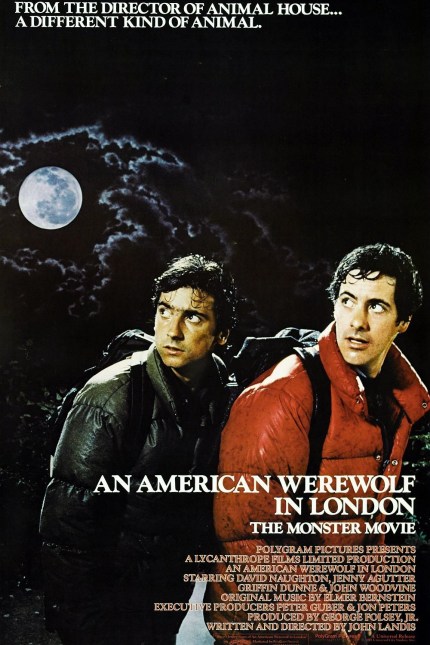
An American Werewolf in London (poster)

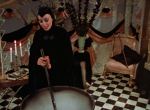
Today’s cinema adventure: An American Werewolf in London, the 1981 comedy-horror film by John Landis, about a young American who survives an attack by a mysterious assailant while backpacking through England, only to find that he has become cursed to transform into a monster by the light of the full moon.  A quirky mix of madcap humor and gruesome horror, it was a fairly respectable hit upon its release, despite mixed reviews, and has since become something of a cult classic.  It was particularly notable for its then-groundbreaking make-up effects, which garnered their creator, Rick Baker, the first-ever Academy Award in the new category created to honor such work.

The movie opens on the moors of Northern England, where two young American friends, David and Jack, are on the first leg of a European hiking tour.  Arriving at nightfall in a remote village, they decide to stop off at the town pub in order to get some rest and sustenance.  The locals view them with suspicion, and when Jack asks about a strange 5-pointed star carved into the wall, they become downright hostile; the two young men decide to leave, and though they are warned to stick to the roads they soon become lost on the moor.  Things get much worse when they realize they are being stalked by a mysterious animal; when they try to run, it abruptly attacks them, savagely killing Jack and mauling David before the villagers arrive and shoot the beast dead as the young traveler loses consciousness.  He wakes up some days later, in a London hospital, where he has been sent by the locals to recover from his injuries.  The physician, Dr. Hirsch, and the attending nurse, the lovely Alex, are kind and sympathetic, but their young patient is troubled by the villagers’ official report that he and Jack were attacked by an escaped lunatic and not a ferocious animal.  Though the police put little stock in his traumatized memories, Dr. Hirsch decides to do a little further investigation on his own; meanwhile, David strikes up a relationship with Nurse Alex, moving in with her upon his release from the hospital.  Their romance is blissfully therapeutic, despite the young man’s troubling, violent nightmares; but harder to ignore are the visits from the increasingly decomposed ghost of his unfortunate friend Jack, who claims that they were actually attacked by a werewolf, and that David is now a werewolf himself.  Worse yet, Jack and all the other victims of the monster’s bloodthirsty rage are doomed to wander the earth until their killer’s bloodline has been severed- meaning that David, as the last surviving carrier of the curse, must die before the next full moon can transform him into a ravenous beast and lead to more senseless slaughter.  Though David is skeptical of the warnings, Hirsch is sufficiently convinced by a visit to the moors that his former patient may be a danger to himself and others, and he joins forces with Alex in an attempt to protect the young man from the darkness- whether supernatural or psychological- that threatens to take control of his destiny.

As written by Landis, who was inspired over a decade earlier when he witnessed a group of Central Europeans performing a ritual to prevent a deceased fellow villager rising from his grave, this grim and familiar tale is laced with the kind of hip, contemporary humor that marked the youth-oriented films of the period; arch, ironic, tongue-in-cheek, and self-referential, the comedy is a major ingredient in the mix, but Landis stops short of letting it undermine the gravity of his horror story.  It seems an odd juxtaposition, and many critics were at a loss to reconcile the seeming opposition of the movie’s two aspects; nevertheless, the apparent cross purposes complement each other in a way that makes for a unique and highly entertaining ride.  In addition, the two cultural sensibilities reflected in the film’s title are brought into the equation through the film’s overall style; the flip jocularity of the American mindset is superimposed against a background of traditional English influences that resembles a blend of Hammer horror and the Carry On series, with a slight dash of Monty Python thrown in for good measure.  The resulting subtextual implication in which the youthful, callow naïveté of the distinctly American personality is thrust into the Old World subtlety of European experience, suggests a story that is ultimately, perhaps, about the dangers of being overconfident in a world that is deeper and more complex than we know.

That’s not to propose that Landis’ purpose here involves any kind of socio-political statement; the “babe in the woods” undercurrent, extrapolations about cultural identity aside, serves mainly as a foundation for the uneasy sense of foreboding that pervades the film from its opening frames, when the hazy atmosphere of the isolated moors seems pregnant with ominous possibility and fills us with the dread of something unknown, lurking just beyond the hills or, perhaps, hiding in plain sight.  Confronted from the start with this landscape that is at once familiar and alien, we immediately bond with the two fresh-faced adventurers who, a few moments later, arrive on the scene- in a truck full of sheep, like proverbial lambs to the slaughter (to reinforce this idea, the pub through which they will soon begin their descent into horror is called “The Slaughtered Lamb”).  We are charmed by their banter, comfortable in their camaraderie, and touched by their friendship; we share their bemused outsiders’ perspective because we, too, are outsiders here, a commonality that helps us identify with them, but because they are so endearing, we also genuinely like them.  It is this factor, cannily accomplished by Landis in his script, that makes us cringe at a deeper level when they become victims of the inevitable carnage; and with this foundation laid, as the film follows the subsequent adventures of David, despite the cheeky comic tone maintained throughout, we can never quite escape or ignore the soul-sickening undercurrent of sadness which pursues us to the end.

Landis is able to pull off this delicate balance largely because he seems unconcerned with pre-conceived limitations of genre; as the director of the wildly popular Animal House and The Blues Brothers, he was the undisputed master of the kind of irreverent and iconoclastic humor that is on display in American Werewolf, and he confidently delivers the same lampooning style in his approach.  There is a definite anti-establishment flavor here that is cut from the same cloth as those earlier films, manifested in a continual opposition between stodgy decorum and free-spirited permissiveness.  The guarded discretion of the villagers regarding their town’s dark secret, the by-the-book attitude of the bumbling policemen assigned to de-brief David, and the stiff-upper-lip dispassion of Dr. Hirsch and even Nurse Alex as they become more deeply involved with their patient; all these are contrasted with the repeated disregard for rules of behavior displayed by the young Americans.  Jack and David challenge local custom with their questions in the pub, and later on, David flies against procedural form with passionate protests regarding the truth about his attacker on the moors, and he skirts propriety by crossing professional boundaries to initiate a relationship with his nurse; it is a similar lack of concern for the rules that allows Landis to blur the lines between comedy and horror with such disarming audacity.  In a way, it is as if he is attacking repressive authority on multiple fronts; not only does he sideswipe convention and cliche with satirical absurdity, and disturb order and decorum with gruesome violence, he also flaunts conservative standards of decency with a high level of sexual frankness and pointedly gratuitous nudity.

An American Werewolf in London uses all these ingredients, ultimately, in the service of providing entertaining thrills for the youth audience at which it was targeted.  The hip, comedic tone and the willful exploitation of sex and violence create an appealingly loose, edgy atmosphere, but it is the narrative itself that keeps us hooked, and Landis the director handles it skillfully.  The leisurely opening sequence is a small masterpiece in itself, and could stand on its own as a fine short film; the jocularity of the protagonists is slowly overtaken by the undercurrent of menace in a textbook example of building tension through visual storytelling.  As the tale progresses, we are subjected to alternating moments of hilarity and terror, often spiking one with the other, keeping us off balance at a visceral level while Landis fills the screen with artfully arranged variety of culturally telling details, from the recurring ironic presence of a Mickey Mouse figurine to the ludicrous porno send-up being shown at the cinema where David has his final meeting with Jack.  Along the way he continues to build on our emotional connection to David (as well as to Alex and, to a lesser extent, Dr. Hirsch, who become his allies) and offers up numerous stylish set pieces- a handful of nightmare sequences, a zany romp at the London Zoo, a gripping predator-and-prey chase in a “tube” terminal, an erotically-charged love scene between David and Alex in the shower- until he reaches the climax, an over-the-top blow-out of carnage and confusion in Piccadilly Circus that plays like a deadly slapstick farce.  Up until this point, his recipe works; the excesses of the finale somehow push the limits of plausibility to the breaking point, and the callousness with which he treats the deaths of all these innocent bystanders feels a little too mean-spirited to be excused under the license of black comedy.  The final tragic confrontation which closes the film, a forgone conclusion since the very first frame, is also, undeniably, a bit of a letdown, and the promising potential for emotional payoff remains unrealized; it’s as if Landis, who has expertly managed to pad out what is essentially a familiar and simple scenario with clever distractions, has reached the bottom of his bag of tricks and decided to end his movie by hurriedly delivering the expected ending with as little fuss as possible.  Despite this anticlimax, however, Landis’ has invested enough into his main characters, on a deeper level than the snarky disaffection of the movie’s surface, to leave us in a state of satisfied melancholy as the end credits roll, and though we may have wished for an worthier ending for his clever mash-up, it must be admitted that his effort to present an oft-told tale in a fresh and surprising package has been, on the whole, a success.

A good deal of that success deserves to be credited to the charm of Landis’ leading players; in particular, of course, the considerable appeal of his star, David Naughton, whose earlier career as a pitchman for Dr. Pepper had made him a familiar face for most audiences, contributes significantly.  Attractive, affable, sincere, and possessed of a devilishly sly but somehow wholesome quality that makes him both sexy and endearing, his personality is well-suited to the demands of both the lightweight and dramatic aspects of American Werewolf, and watching him here makes us regret that, for whatever reason, he failed to become the rising star that his talent seemed to promise.  Matching him well is the beautiful Jenny Agutter, another familiar face (Logan’s Run¸ Equus) who never quite achieved full stardom, at least in the U.S., as Alex; she carries the same, sweet-but-sexy aura as her leading man, with an added layer of maturity and intelligence that makes her far more interesting than the standard damsel-in-distress usually found in monster movies.  John Woodvine is witty and refreshingly likable in his role as the benevolent older authority figure, Dr. Hirsch, and the assortment of recognizable English actors that constitute the cadre at the “Slaughtered Lamb” do a fine job of infusing life and dimension into the stock “superstitious villagers” characters that they represent.  The standout performance, though, comes from Griffin Dunne, as the doomed Jack; his lovably nebbish, self-deprecating nerd persona provides a perfect complement to Naughton’s all-American boy, and the chemistry they share is tangible- a factor that helps to add resonance to later developments when the deceased Jack returns to haunt his best friend.  Dunne manages, in those scenes, to bring the likable humanity of his character to the forefront despite the progressively hideous make-up he wears, undercutting the body horror of his walking-dead image with wit, pathos, and personality.

On the subject of the make-up, the aforementioned Rick Baker- whose prolific work in this field has always helped to redefine and push the limits of the craft- leads the pack in terms of kudos for Landis’ technical crew.  Not only do his remarkably detailed and gruesome prosthetic creations make for an utterly convincing conversion of Dunne into a grisly walking corpse, his work with Naughton’s transformation sequence, in which the handsome actor becomes the fearsome title creature, is a ground-breaking display of wizardry; a far cry from the old stop-motion effects used to morph Lon Chaney, Jr. in the classic Universal Wolf Man and its sequels, it is a truly hair-raising (literally and figuratively) pre-CG spectacle that reminds us all that movie magic did not begin with the computer age.  Also noteworthy is the cinematography by Robert Paynter, capturing the character and mood of the numerous English locations, from the desolate moors to the garish lights of Piccadilly, with a richness that gives weight to the proceedings; again, it’s a reminder of a now-bygone time, before the distinctive visual quality created by photography on actual film was supplanted by the high-definition digital imaging that dominates cinema today.  Finally, Landis gives his film a soundtrack that is comprised partly of effectively unsettling original scoring by veteran composer Elmer Bernstein, and partly of a rather tongue-in-cheek selection of various popular recordings linked together by the subject of the moon, with several varied renditions of the standard, “Blue Moon,” Creedence Clearwater Revival’s “Bad Moon Rising,” and Van Morrison’s “Moondance,” each figuring prominently in highly memorable sequences.

An American Werewolf in London is another one of those films that figured prominently in my own younger years; I have fond memories of seeing it, multiple times, on the big screen, and there was a time when I could quote virtually every line of dialogue.  In the ensuing years I assumed that my youthful enthusiasm, coupled with a fondness for monster movies and all things English, had probably paid a large part in my enjoyment of a film which, really, was little more than pulp cinema.  Upon my recent viewing, I was pleasantly surprised to discover that, in fact, Landis’ odd little film holds up extremely well, and, in fact, boasts many nuances- some of which are explored above- that I had not previously recognized.  It’s really a tight, stylish, and yes, classy movie; though it deliberately strives for the lurid, sensational atmosphere of both Hollywood exploitation cinema and British “penny dreadfuls,” and it offers up a considerable amount of nudity, sex and violence (the gory, nightmarish kind so gleefully proffered by the blood-spattered horror films produced in England throughout the ‘60s and ‘70s), it nevertheless maintains an elegant, restrained sensibility, suggesting far more than it shows and allowing the audience’s imagination to fill in a lot of the blanks.  Landis, for all his excess, does himself credit in his handling of the werewolf and its reign of terror, giving us only brief glimpses of the beast itself and using cinematic artistry- sound, camera perspective, editing- to build the suspense and fear; of course, we would feel cheated if he didn’t also deliver some good old blood-and-guts, and he gives us just enough of those to make us happy (if that’s the right word), but its also to his credit that we walk away feeling as if we’ve seen much more of a bloodbath than we actually have.  In the end, though, American Werewolf is most truly memorable for its unique hybrid personality, which lets us laugh, cringe, and cry a good deal more than we might expect.  It’s a smart, sexy, and surprisingly affecting film that has aged well, which is more than can be said for many of the more lauded-at-the-time works from the period.  Though it may not, at the time, have been as highly esteemed as Landis’ previous hits (mentioned above), and though, for many, his most important and lasting creation will always remain his video for Michael Jackson’s “Thriller,” An American Werewolf in London  may well, in truth, be his best work as a filmmaker; at the least, it’s a definite crowd-pleaser, guaranteed to evoke a grin and a grimace from even the most hardcore horror buff.

http://www.imdb.com/title/tt0082010/

Desperate Living (1977)

Desperate Living (poster)

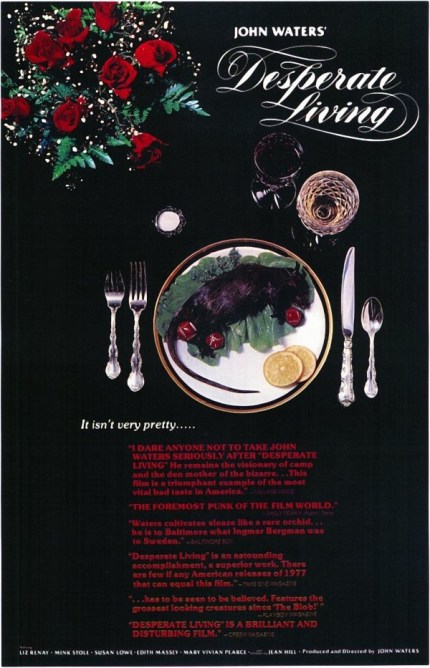
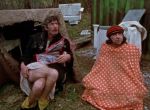
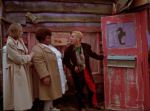
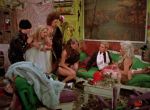
Today’s cinema adventure: Desperate Living, the 1977 feature by underground filmmaking icon John Waters, featuring an assortment of his “Dreamland” players in the tale of a deranged suburban housewife who is exiled with her maid to a shantytown full of social rejects.  Financed, as all of Waters’ early projects were, on a shoestring budget, it generated notoriety through the outrage it sparked among the lesbian community for its treatment of same-sex female relationships, but it failed to catch on with the public to the extent of his previous hits, Pink Flamingos and Female Trouble, probably due in part to the absence of his signature star, Divine (who was unavailable to appear because of his commitment to a theatrical project in New York) but also because the “midnight movie” fad which had provided the perfect venue for the earlier films had largely subsided by the time of its release.  Nevertheless, it has taken its place as a cult classic alongside the director’s other works of the period, with which it shares an outrageous, anarchic sensibility and a deliberate intention to provide shock value through its depiction of socially taboo behavior.

The plot follows the misadventures of Peggy Gravel, a housewife from an affluent Baltimore suburb, who has recently returned home- perhaps prematurely- from a stint in a mental hospital.  Paranoid, delusional, and disgusted by virtually everything, she harangues those around her with wild and hysterical rants, accusing the neighborhood children of trying to kill her and reproving her husband for his ineffectualness.  When he attempts to calm her by administering her medication, she assaults him, calling for aid from her maid, Grizelda, an obese black woman whom Mr. Gravel has recently caught stealing from the household, and who now, believing she is protecting Peggy, smothers him to death by sitting on his face.  When the two realize they have committed murder, they go on the run together, attempting to drive out of town in Peggy’s car, but they are stopped by a policeman; instead of arresting them, however, he demands their underpants and some kisses for his cross-dressing, auto-erotic pleasure.  In exchange, he offers to let them escape to Mortville, a sort of hobo jungle on the outskirts of town where the criminal dregs of local society can find safe haven among their own degenerate kind.  The two women make the journey, and find themselves in a derelict town built mostly of cardboard and garbage; after trading a lottery ticket for a guest house owned by hard-edged lesbian Mole McHenry and her girlfriend, Muffy St. Jacques (“the most beautiful woman in Mortville”), they learn that the community is ruled by Queen Carlotta, a sadistic and self-serving tyrant who takes pleasure in degrading her subjects and dispensing draconian punishment to any who dare to displease her or disobey her absolute commands.  As the unlikely comrades settle into Mortville life, they begin their own lesbian affair, despite Peggy’s revulsion; meanwhile, Queen Carlotta’s egalitarian daughter,  Princess Coo-Coo, has fallen in love with the trash collector, and renounces her privileged life to elope with him.  The angry Carlotta has him killed, and when Coo-Coo flees with his body, she seeks refuge in the home of Peggy and Grizelda.  Peggy immediately alerts Carlotta’s goons, and Grizelda, attempting to protect the Princess, is killed in the ensuing struggle when she causes the house to collapse on herself.  Peggy, however, is rewarded for her loyalty to the Queen by being appointed as the replacement for the now-imprisoned Coo-Coo, and as her first duty she sets into motion the royal plan to infect the entire town with rabies, starting with Coo-Coo herself.  Back outside the “palace,” the lottery ticket Mole accepted as rent has proven to be a winner, so she uses the prize money to buy a bargain basement sex change for herself, thinking it will please Muffy, who has been goading her with fantasies about men.  Instead, it repulses her, causing her to admit that she loves Mole just the way she is; the sewn-on penis is severed and thrown to the neighborhood dog, and with their bond renewed, the couple leads the Mortvillians in a revolt against Peggy and the Queen, at last exacting vengeance for the brutality of their regime.

If this narrative sounds a bit convoluted, it’s no surprise; Desperate Living constitutes Waters’ attempt at an epic fairy tale, with multiple characters in interwoven subplots, and part of his particular milieu– at least in these earlier films- is a disregard for logical coherence in narrative structure.  Waters’ story lines are usually threads intended to link together his depraved set pieces, and a great deal of the fun comes from the fact that they are generally irrelevant to the real purpose of the movie, which is mainly to delight and disgust his viewers, preferably at the same time.  The downside to this approach, from a certain point-of-view, is that many of his movies have a tendency to “peter out” rather than build to a climax, with the final resolution often being little more than a means to tie up the loose ends; but Waters, always the iconoclast, has never concerned himself with following rules, and such an aesthetic consideration is as immaterial to his agenda as laws and social mores are to his characters.

This latter point is not strictly true, actually.  Waters’ films are usually populated by people who are greatly concerned with codes of conduct, albeit warped or inverted ones.  Here, for instance, Peggy is motivated by a fanatical devotion to her own brand of decency and decorum, a world view in which she, as a member of the social elite, is the natural recipient of preferential treatment and should be immune from the disgusting unpleasantries of the world; it happens that, for her, those unpleasantries include any form of natural impulse or show of sentimentality or affection.  She hates nature, is repelled by her husband’s touch, and would rather be raped by the kinky policeman than submit to his kiss; yet she is willing to ally herself with an oppressor and give up her own life in service of the ideal of autocratic privilege.  Similarly, the avowed man-hater, Mole, is prepared to transform herself into the very object of her own loathing in order to satisfy the needs of the woman she loves, not just because of her desire to please her lover, but because she is dedicated to her role as protector and provider.  The irony of both characters, of course, is that they personify the things they themselves despise; the victim becomes the victimizer and the militant feminist embodies the negative masculine stereotype she has rejected in others.  In similar ways, the other denizens of Desperate Living enact this paradoxical principle, or else they perform the meaningless reactionary pantomime of the social bystander, chasing their own self-serving needs and pleasures, deluding themselves with rationalizations and platitudes, and expressing outrage when they are met with opposition; Waters shows us a world of degenerates, overseen by other degenerates, and the only unacceptable transgression is the assumption of authority.  Of course, one could open up a discussion about the layers of social satire, political allegory, psychological commentary, or mythological inversion that can be seen within this low-rent fantasy melodrama; or perhaps we might speculate about the filmmaker’s intentions regarding such things as alienation of the audience, subversion of societal values and norms, or the use of cinema as an expression of counter-cultural concerns.  In the long run, however, Waters’ interest in such matters is clearly parenthetical, at best, and his work here- as with all of his films, particularly the “Trash Trilogy” consisting of this and the two previous efforts- has more to do with his creation of a signature mise-en-scène which can best be described as “transgressive camp.”  Even more than that, perhaps, it has to do with sharing his warped sensibilities through the medium he loves.

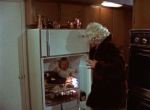
That Desperate Living is an expression of the filmmaker’s own imagination is certain; as the producer, writer, director and cameraman, he makes sure what shows up on the screen is pure Waters.  The histrionic dialogue, the over-saturation of de-glamorized nudity and sex, the exploration of fetish behavior and insular communities, the skewering of respectable society, the fixation on repellent imagery and ideas; these are trademark elements in his films, and they are all present here in spades.  Desperate Living features copious full-frontal nudity (both male and female), the sexualization of children, a baby in a refrigerator, the human consumption of vermin, sodomy with a firearm, cannibalism, and penile amputation, to name just a few of its dubious delights, and in typical Waters fashion, they are de-sensationalized to the point of banality- which is why they amuse us rather than outrage us.  This, of course, is precisely the point, if there must be a point; Waters shows us that the only thing more ridiculous than human behavior is to be offended by it.

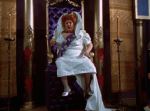
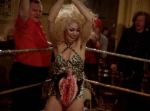
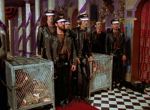
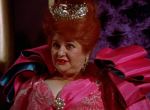
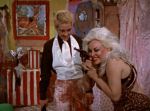
Indulging in this pageant of absurd excess is a cast mostly comprised of the director’s regulars, a troupe of stalwart non-actors upon whose services he has relied upon from his earliest days.  Leading the pack is the incomparable Mink Stole, a fixture in Waters’ films who is here given her most prominent role as Peggy, sinking her teeth with relish into the character as she alternates between hysterical wailing and some of the most ferocious bitchery you will ever see.  She is perhaps (apart from the late Divine) the most proficient purveyor of the curiously bad-but-somehow-great acting that defines the style of the filmmakers’ canon, and Desperate Living offers probably the best showcase of her unique talents.  Accompanying her on the adventure is Jean Hill, a greeting-card model turned actress whose jubilant sass makes her a fitting complement to Stole’s venomous ice queen, and the two exude an undeniable chemistry as they act out their perverted fantasia on Imitation of Life.  Waters newcomer Liz Renay (a notorious burlesque queen, former gun moll, and convicted perjurer, whose scandalous autobiography prompted the director to pursue her for his film) brings a surprising freshness of personality- not to mention her sizable breasts, unfettered onscreen for a good deal of the film- as Muffy, and Susan Lowe as the pugnacious Mole, normally one of the director’s bit players, manages to hold her own admirably in the role originally intended for Divine.  Also notable is Mary Vivian Pearce as the goofily likable Coo-Coo, and “Turkey Joe” in his deliciously trashy cameo as the cross-dressing cop.  The standout performance, though, comes from the sublime Edith Massey, the snaggle-toothed ex-waitress who became a sort of muse for John Waters and a cult icon to boot, as Queen Carlotta.  With her inimitably amateurish delivery, her indescribable physical presence, and her inescapable authenticity, she makes this grotesque character into a mesmerizing spectacle; gleefully punishing her groveling subjects, turning her leather-boy lackeys into sexual objects with whom she engages in lewd- and graphic- excesses, or sweetly bestowing gifts on a pigeon like the skid row vision of a Disney Princess and her animal friends, she is the indisputable highlight of Desperate Living.  The lady had charisma, there’s no denying it.

In spite of the fact that the cast is entirely on target, however, the absence of Waters’ supreme diva, Divine, is keenly felt in Desperate Living.  There is a void, somehow, in the center of the movie, that none of the other personalities can fill.  This is not to say that any of them are lacking in commitment or ability- at least, the kind of ability required of them here- but that some intangible quality is missing that none of them are quite able to provide; it’s possible that this is due to the lack of a strong character to provide central focus in the story, for Desperate Living, in truth, is all over the map- but then so are most of Waters’ films, a fact which audiences easily overlook with Divine’s electric presence as an anchor.  It’s hard, though, to place the blame wholly on this gap for the fact that the movie doesn’t quite work- for, unfortunately, it doesn’t.  Though it is a veritable treasure trove of deliciously quotable lines and ripe with the kind of unforgettable lunatic imagery that keeps us engaged in any given individual moment of the film, it never really grabs us with the unexpected visceral urgency of some of his other works; all the pieces are there, but the whole package leaves us decidedly unsatisfied.  It may be due to the attempted scope of the story, or the fact that the fantasy is so far removed from real experience that it loses the sliver of plausibility which gives the director’s preposterously lurid tales their outrageous edge, but for whatever reason, Desperate Living loses steam soon after it takes us to Mortville, a fact that is particularly disappointing in face of the fact that the film’s first ten minutes are pure, vintage Waters, containing some of the most inspired expressions of his wicked genius he ever managed to create, and setting the bar at a high level which the rest of the movie is then, sadly, unable to match.

Still, for Waters’ many fans, this kind of critical quibbling makes no difference to their enjoyment of its many riches, and for those who are exploring this alternative auteur for the first time, the fact that Desperate Living is not as complete a package as the masterful Female Trouble doesn’t make it any less essential an experience.  There was a certain magic at work in these heady, early years of the Dreamland crew, and it is just as evident in this movie- with its guerilla-filmmaking feel, its grainy 16mm photography, its elaborately shoddy sets built from found objects and refuse, its celebration of filth, and its mockery of traditional cinematic forms- as in any of the others.  What makes it so… well… refreshing (for want of a better word) is that, as always, Waters’ subversive trash is not merely intellectual posturing, nor is it exploitation, for it is clear that all of his participants are equally complicit in his effort to inundate us with perversity; John Waters is a subversive filth-monger because he finds it fun, and because it is an expression of self rather than a calculated pose, he makes it irresistibly fun for the rest of us.  Of course if you are someone who has, as Peggy Gravel puts it, “never found the antics of deviants to be one bit amusing,” you are best to leave this one alone, as well as the rest of Waters’ canon; although his work, for all its over-the-top shock value and subversive topsy-turvy morality, is ultimately as good-natured and sweetly innocent as, say, two naked children playing doctor, for somebody whose sense of humor is not well-tuned to this kind of trashy treat, it’s about as appetizing as a fried rat on a plate.

http://www.imdb.com/title/tt0075936/

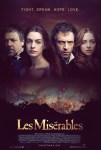
Les Miserables (2012)

Les Miserables (poster)

Today’s cinema adventure: Les Misérables, the 2012 film adaptation of the hit stage musical by Alain Boublil and Claude-Michel Schönberg, based in turn on the classic 1862 Victor Hugo novel of the same name.  Affectionately referred to as “Les Miz” by many of its legion of fans, the show had one of the longest runs in both London and Broadway history, as well as hundreds of international and touring productions, and continues to be a major draw in theaters around the world to this day; needless to say, the blockbuster film version, in development (off-and-on) for nearly 25 years, had a sizable built-in audience awaiting its debut on Christmas Day.  Directed by Tom Hooper, who was at the helm of 2010’s Oscar-winner, The King’s Speech, and produced with heavy involvement from the show’s original creators, including producer Cameron Mackintosh, it has opened to mostly positive reviews, already scored multiple nominations and wins among the various year-end film awards, and been greeted -if the crowded audience I saw it with was any clear indication- with wildly enthusiastic response from the public.

Adapted for the screen by William Nicholson, the floridly romantic score by Boublil and Schönberg (with English lyrics translated by Herbert Kretzmer) makes it to the screen remarkably intact, a rarity in Hollywood transpositions of stage musicals, with very few passages removed and a minimum of strategic re-ordering; consequently, as with the original production, almost the entire story is told through singing, with only a smattering of spoken dialogue.  The epic tale begins, as does the novel, in 1815 France, a country that has reverted to despotic monarchy only a few short years after its bloody revolution deposed the reigning aristocracy.  We are introduced to two men: Jean Valjean, a hardened convict who is being paroled after spending 19 years on a chain gang for stealing a loaf of bread to feed his starving family; and Javert, the strict and stalwart policeman who oversees their labor.  Upon Valjean’s release, his status as a paroled felon prevents him from finding work or shelter, and the cruelty and humiliation he suffers reinforce his hatred and mistrust of humanity, until an act of kindness by an elderly bishop inspires him to transform his life and dedicate himself to God.  He knows he cannot live under the draconian terms of his parole, however, and so he tears up his papers, vowing to begin a new life.  The story then shifts 8 years into the future, when Valjean has established himself under a new identity as a successful factory owner and is now the mayor of Montreuil-sur-Mer, a small seaport city.  One of his workers, a young woman named Fantine, is dismissed by the foreman when it is discovered that she is an unwed mother; with no job, she is unable to send support for her child- a little girl named Cosette who is in the care of a tavern-keeper and his wife in a nearby town- and she soon discovers her only avenue is to join the ranks of the town’s prostitutes.  Meanwhile, Valjean is made uneasy by the arrival of the town’s new police inspector- none other than Javert himself, whose suspicions are aroused by the mayor’s familiar appearance.  When Fantine, now gravely ill, is arrested in an altercation with an abusive “customer,” Valjean intervenes, and promises his dying former employee that he will take care of the child she leaves behind; but when he learns that another man has been mistaken for him and arrested in his name, he knows he cannot secure his own freedom at the expense of an innocent soul.  He reveals his identity to the court, then evades Javert in order to rescue little Cosette from her cruel guardians and flee with her to Paris, where he disappears into yet another life- this time as a loving and protective father.  Another 9 years go by; Valjean and the now-grown Cosette live in comfortable but secluded anonymity, and Javert now patrols the streets of Paris, where poverty and social injustice have bred a new generation of revolutionaries- a band of students under the leadership of the charismatic Enjolras.  One of their number, Marius, becomes smitten with Cosette when they see each other in the street; but their budding romance is interrupted by fate, as her former foster parents, the scheming Thénardiers (now also living in Paris, with their real daughter, Eponine), have recognized Valjean, prompting the longtime fugitive to plan an escape to England with his beloved ward.  On the eve of their departure, the student rebellion begins, throwing Paris into turmoil and bringing the destinies of the characters together for a climactic confrontation that will determine all of their fates forever.

In the original stage version of the musical, numerous liberties were taken with Hugo’s original novel, in the interest of simplifying the complex narrative and restructuring it for the needs of theatrical presentation; even so, through clever staging and production design, the epic sweep of the original was captured and maintained in a way that helped to redefine and reassert the musical theater art form for a new generation.  In re-expanding the story from the confines of the stage to the endless possibilities of the cinematic format, screenwriter Nicholson and director Hooper have returned to the source material for inspiration in filling in the background details, which successfully fleshes out the saga with the epic stature it deserves, but they have faithfully maintained the plot structure of Boublil and Schönberg’s version.  Part of this may be because of the involvement of Mackintosh, whose insistence on keeping the integrity of the show has been a factor throughout its history, and also because any significant changes would doubtless awaken the wrath of the musical’s sizable army of devoted followers, thereby alienating the lion’s share of their target audience.  Whatever the reason behind it, the decision to present the musical largely as written has resulted, perhaps ironically, in a brave and groundbreaking piece of filmmaking; since the decline of the film musical as a viable box office draw in the late 1960s, and particularly since the undeniably brilliant screen version of Cabaret directed by Bob Fosse in 1972, Hollywood has had a fear of allowing the conceits of the genre to be manifested onscreen.  To put it simply, the idea of characters breaking out into song and dance in order to express themselves fell from fashion with the rise of a jaded generation raised on contemporary realism; the “hokiness” of musicals was rejected by an audience that associated it with the values of their parents’ era, and filmmakers have since been reluctant to put them on the big screen without justifying the song-and-dance elements by the use of some stylized approach- usually separating them from the narrative by treating them as fantasy or by presenting them as staged performances within the world of the film.  There have been few movie musicals over the course of the last two or three decades, and with few exceptions they have largely been lackluster efforts which have failed to score with either critics or audiences.  In recent years, however, the popularity of the Broadway musical has undergone a sort of revival in the popular imagination, and the comparative success of such stage-to-film transitions as Hairspray and Sweeney Todd: The Demon Barber of Fleet Street has given tentative indication that audience acceptance for such fare is growing in movie houses, as well.  With Les Misérables, Hollywood takes the bold step of returning to the traditional approach, at last permitting the musical score to be performed, without qualification or apology, as the primary medium through which the story is told.  Unlike Hairspray, with its kitshy camp sensibilty, or Sweeney Todd, with its dark, cartoonish stylization, Les Misérables is grounded in a gritty period realism, and yet its characters express not only their inner monologues through song, they converse, confront and comfort each other through it as well.  In today’s cinema, such a basic, play-as-written approach to such material seems a novel concept, and it is precisely for this reason that it breaks free of its theatrical roots and comes to life as pure cinema.

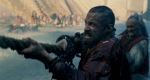
To be sure, it takes a little adjusting for audiences unused to the genre, and even for those familiar with it.  The spectacular opening sequence, in which scores of rough-edged prisoners drag the enormous wrecked hull of a sunken ship while they sing of the cruelty and hopelessness of their existence, thrusts us immediately into the film’s operatic milieu, without fanfare or warning; it’s a jarring, alien experience, at first, but the utter conviction with which it is performed and presented soon carry us into acceptance, and by the time the story comes to its final fruition 150-odd minutes later the cumulative power of the score rewards us with an emotional catharsis rarely achieved by standard, non-musical methods.  That is, it rewards those who are able to surrender to it; there are undeniably viewers who simply don’t like musicals, and no amount of discussion about the aesthetics or traditions of the genre is likely to persuade them to open their minds to Les Misérables.  Make no mistake, this is a hardcore musical, and anyone who has trouble suspending their disbelief in a world where thieves, prostitutes and soldiers sing in unison would be well-advised to steer clear.  At the risk of seeming confrontational, I might also say they would be well-advised not to try and spoil it for the rest of us.

Of course, there are also those who, as die-hard fans of the musical, will be coming into the theater with their own high standards and expectations about the piece; “Les Miz” aficionados generally have their favorite recordings of the show, with every vocal and instrumental nuance memorized by heart, or perhaps envision a “dream cast” in which their favorite performers from the various productions might somehow be united into one perfect rendition if the show.  These viewers are likely to be disappointed in what they see (and hear) here, as, indeed, they would be bound to be with any version of the piece short of the one they have in their imagination.  In fact, it’s probably fair to say that anyone who is a stickler for “legit” singing will probably have difficulty accepting the vocal performances in Les Misérables; though its cast is composed primarily of actors who are trained and experienced singers, the film’s highly unusual approach to capturing their vocals has yielded a different sound than might be anticipated.  In order to focus on the immediacy and spontaneity of the scenes- particularly since virtually the entire film is sung- the decision was made to forego the usual technique of pre-recording all the songs and lip-syncing to a playback on the set during filming.  Instead, the actors sang everything live on camera, with a piano providing accompaniment through concealed earpieces and the full orchestral underscore being added in post-production.  The result of this approach is a raw, improvisational quality- decidedly different from the meticulously phrased, measured delivery found on most musical theater recordings- that gives the songs an unpredictable, electric vitality; it is not the first time such a tactic has been employed, but it is certainly the most extensive use of it to date, and though it may not satisfy the ears of purists, it creates a hitherto unseen level of honesty in the performances, with each actor given the opportunity to fully express emotional reality in the moment without being hindered by a forced layer of artificiality.  This is not to say that the vocals are in any way inadequate- on the contrary, the cast of Les Misérables is more than capable of the meeting the demands of the material- but rather that they do not adhere to expectations; there is understatement where there is usually bombast and vice versa, and tempos are stretched or tightened according to interpretive need (all dictated, incidentally, by the actors themselves), giving the familiar score a freshness and an urgency that would have been impossible had the performers merely attempted to recreate the sound of those who have gone before.

To execute these performances, Hooper has assembled an ensemble of prestigious actors that, though they may not constitute a typical “Les Miz dream cast,” certainly lay claim to their iconic roles and bring them to life with a clear and infectious relish.  Heading this gallery of versatile “A-listers” is Hugh Jackman as Valjean, finally given the chance to bring to the screen the skills that made him a star on the musical stage before his days as an action-adventure star.  Those who know him only as Wolverine may well be surprised by his magnificent performance here; his renditions of Valjean’s signature songs display his prodigious musical talent and his clear, soaring tenor voice while bringing a depth and emotional immediacy that make them completely his own, and he charts this archetypal character’s journey from hardened thug to selfless benefactor with a brave and powerful range, finding surprising nuances of strength and vulnerability that continually remind us of his humanity.  As Javert, Russell Crowe is perhaps less noticeably effective, due to his stoic, seemingly emotionless presence as this ultimate champion of the letter of the law; his singing is metered and free of all but the sparsest of ornamentation, and he avoids playing into potentially passionate moments with the rigorous restraint of an ascetic.  For some, this approach to the character may seem like a missed opportunity, but in fact it is a remarkably honest interpretation, faithful to Hugo’s original portrayal, of a character whose life is devoted to a code which permits no room for personal choice; Javert does his duty, nothing more, and Crowe is to be commended for resisting the temptation to add showy flourishes.  Anne Hathaway, as the tragic Fantine, delivers the film’s standout performance, a heartbreaking portrait of a young woman driven to desperation by the cruel oppression of her time, and her stunning performance of the musical’s best-known song, “I Dreamed a Dream,” is destined to go down in cinema history as one of those great, unforgettable scenes that shows up in montages paying tribute to classic moments from the movies.  As the Thénardiers, Sacha Baron Cohen and Helena Bonham Carter provide double-edged comic relief in roles that could probably be described as the “Sacha Baron Cohen and Helena Bonham Carter” characters- which may sound like a bit of a dig, but in fact it is a testament to their skill at portraying these kinds of audaciously unpleasant types.  They seem absolutely right as this pair of opportunistic reprobates, and it is hard to imagine anyone else playing them.  As Marius, the immensely gifted Eddie Redmayne truly shines, taking this crucial character and making him a likable, genuine young man with a passionate soul, and not just another handsome romantic juvenile; his own belief in his “love at first sight” is so sincere, we are swept up in it easily- and not just because we accept the convention as a necessary part of the story-, and later in the film, his rendition of “Empty Chairs at Empty Tables, a mournful elegy to his fallen companions and an expression of his own post-traumatic-shock demons, is riveting and heart-rendingly real.  As Cosette, Amanda Seyfried is likewise believably dimensional, rising above the level of mere ingénue, and though her character gives her less chance to stand out, she invests it with so much charm and life that it seems she has a much bigger role than she really does.  Samantha Barks, one of the two principal cast members to have previously played their role onstage, gives a sweet and sad performance as Eponine, capturing the simultaneous joy and despair of her own signature number, “On My Own,” without the affectation that its heart-tugging mixture of despair and joy might inspire in a lesser performer.  Broadway actor Aaron Tveit makes a compelling Enjolras, brandishing a powerfully eloquent singing voice and a piercing intensity that perfectly embodies the enigmatic young revolutionary and makes him utterly convincing as a figure that might inspire other young men to follow him to their deaths; young Daniel Huttlestone (the other “Les Miz” stage veteran) easily wins our affections as the scrappy Gavroche, giving us just enough of the “precocious urchin” persona to make him familiar without adding the sentimentality that would turn him into a cliche; similarly, Isabelle Allen plays the young Cosette without cloying cuteness, delivering her song, “Castle on a Cloud,” with endearing honesty and refreshing simplicity.  Indeed, every member of the cast, from the cadre of student rebels to the gaggle of gossipy factory women, does stellar work and provides a memorable contribution to the whole, making Les Misérables feel like a true ensemble effort. Lastly, in a fitting touch that adds a certain intangible resonance to the proceedings, Colm Wilkinson, the Irish folk-singer-turned-actor who became an international star when he originated the role of Valjean in both the London and Broadway productions, makes a cameo appearance, giving an all-too-brief, transcendent performance as the Bishop of Digne, whose act of kindness sets Valjean on the path to redemption.  It’s also worth a mention that many of the film’s extras and “chorus” members are also alumni of stage productions of the show, including original Eponine Frances Ruffelle, who plays a fairly sizable role as a prostitute.  Their involvement is a testament to the powerful spell of the show, which engenders a lasting bond and loyalty among those who have participated in it and consider themselves all to be part of a family- a family which has every reason to be proud of its newest members, who have joined their ranks through this film.

With such a collection of fine performances on display, it is only right that the film should deliver an equally impressive production to showcase them; thanks to the efforts of Tom Hooper and his creative staff, it does better than that.  Les Misérables goes beyond the perfunctory spectacle provided by its painstaking recreation of 19th Century France and endeavors to re-invent the classic film musical in terms of contemporary cinematic approach.  Hooper does not rely on traditional methods of capturing the show for the screen, but utilizes the language of modern filmmaking to bring the experience into the 21st Century, complete with CG enhancements, rapid editing, and extensive use of steadi-cam photography.  To be sure, there are times when the constant visual motion of the film threatens to overwhelm, and one can’t help but feel that certain moments- particularly in the numerous “arias,” mostly shot in tight close-up to capture the intimacy of the experience- might have been better served with the occasional use of a wider angle lens; certainly, in some of the bigger musical sequences, for example the musical montage, “One Day More,” a more expansive perspective feels needed in order to give full reign to the magnitude of the forces in play.  There is a trade-off to be made here, though; after all, film is an entirely different medium than theater, and it is fitting that a movie should provide an experience impossible to receive from a stage performance.  There is little point to constructing a motion picture that endeavors only to recreate what has already been seen on stage, beyond preserving it for archival purposes, though this is precisely the approach that has been taken with many stage-to-screen transfers; the best cinematic transpositions of theatrical pieces come when a director re-imagines the material without attempting to make the camera lens a mere substitute for a proscenium arch.  Hooper has made his epic with this clearly in mind, and his eye for exploring the visual possibilities of the art form, from the repeated use of overhead perspective to the vastness of the crowded streets of Paris to the closer-than-close revelation of every subtle shift of expression in the performers’ faces.  In particular, he exploits the advantage of realism in the depiction of the crushing conditions of 19th Century poverty, an important factor of the story that can, on stage, only be suggested (or worse, glossed over), as well the contrasting Empire-era opulence of the salons and gardens of the wealthy. Set against the impressive splendor of the production design by Eve Stewart, clothed in the sumptuous authenticity of Paco Delgado’s costumes, and captured with the larger-than-life digital graininess of Danny Cohen’s pseudo-cinema-verité photography, Les Misérables meets and exceeds any reasonable standard for visual style, and- from a technical standpoint, at least, regardless of how picky audiences may respond to the interpretation of the content- provides a total movie-going experience worthy of its beloved source material.

Once again, it seems, I am in the position of having to make full disclosure of the fact that I am, in fact, a fan.  Though I have personally had an ambivalent relationship with the musical theater genre (as opposed to outright film musicals, of which I am an unrepentant enthusiast), Les Misérables is a piece which captured me from the very first time I heard it, and I have seen several stage productions over the years (including the original Broadway run);though its pop-opera format might seem, for some, to cheapen the translucent sincerity of Hugo’s masterful novel, its message of humanism and social awareness shines through in a way that never fails to leave me deeply moved and inspired.  Though this long-awaited film version is not, nor could it ever have been, a perfect rendition, and though I will admit to finding myself overly critical of details and choices throughout as I watched it (on opening day, of course), in the final analysis I have only praise to give it.  The deciding factor for me lies in the simple fact that, at the end, not only was I personally affected by the emotional upheaval to which it carried me- despite my every-lyric-by-heart familiarity with the show- but my companion, a skeptical died-in-the-wool disparager of musicals, was also moved to a prodigious outpouring of tears, as was, indeed, every member of the packed audience.  Make no mistake about it, Les Misérables is a tear-jerker of the highest order, and the enormity of its scope only serves to intensify its effectiveness as such.  If such fare is normally unappealing to you, or if you are one of those aforementioned musical non-lovers, you might want to skip this one, no matter how many awards it may end up getting.  You might want to, but my advice is: don’t.  Go and see it.  Give it a chance.  Like my companion, you may find yourself unexpectedly opened up and transported to a new level of appreciation for the possibilities of the genre.  It’s not a guarantee, but Les Misérables has the power to affect such a softening of the heart, and this movie largely succeeds in capturing the qualities that give it that power.  Those qualities, ultimately, rest in the soul of the story, and not in its spectacle; Les Misérables is not about revolution, nor romance, nor social injustice, nor even the desire for a better life- an oft-repeated theme within its narrative, and one from which it admittedly derives a great deal of its humanistic appeal.  It’s about the redemption which comes from the simple Christian ethic of self-sacrifice, of caring more for another than for oneself; this principal is embodied in the story of Jean Valjean, which remains the central focus throughout the interwoven subplots and ultimately yields the final epiphany towards which the entire saga builds.  When it comes, the catharsis which results from our sharing of it is powerful and cleansing, and no matter what quibbles you may or may not have about this or that detail of the film’s interpretation of the musical, they seem inconsequential in the face of that experience.  In that sense, Les Misérables completely succeeds in its purpose, and at the end of the day (if you’ll pardon the expression) you can’t expect more than that.

http://www.imdb.com/title/tt1707386/

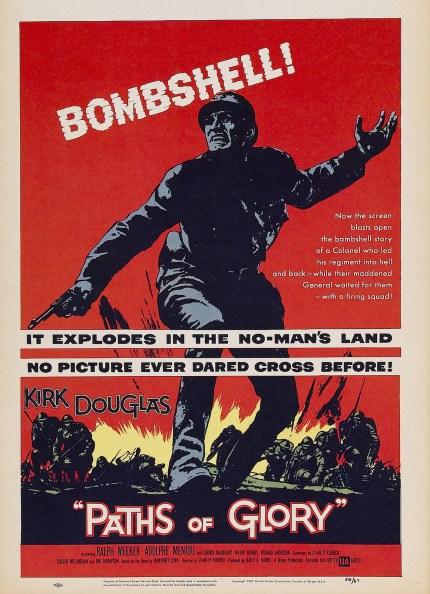
Paths of Glory (1957)

Paths of Glory (poster)

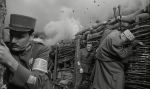
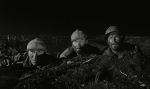
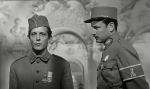
Today’s cinema adventure: Paths of Glory, the 1957 World War I drama by Stanley Kubrick, an early example of the filmmaker’s much-lauded mastery of the cinematic medium starring Kirk Douglas as a French colonel who finds himself caught in the middle when the personal and political motivations of his superiors force him to order his men on an impossible mission.  Based on a 1935 novel by Humphrey Cobb that was itself inspired by a true-life incident, it was a project spearheaded by Kubrick- who had read the book as a youth- when the critical success of his low-budget film, The Killing, got him hired to develop projects for MGM production head Dore Schary.  Though Schary rejected Paths of Glory for its lack of commercial appeal, he was eventually fired from the studio, freeing Kubrick and his producer, James Harris, to shop it elsewhere, and they managed to salvage their film by gaining the interest of actor Douglas, whose enthusiasm and guaranteed participation allowed them to find backing at United Artists.  With its harsh anti-war sentiments, its cynical take on military politics, and its bleak ending, nobody anticipated it would be a box office hit; it did, however, fare better than expected, despite heavy controversy in the European market- it was withheld from release in France for several years due to diplomatic protests, and it was heavily edited in other countries.  More importantly, in the long term, it earned massive critical acclaim for its director, thrusting him further along on his own “path of glory” towards his future status as one of the all-time great auteurs in the history of cinema.

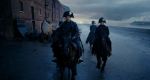
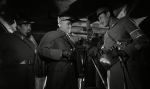
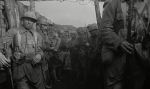
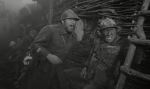
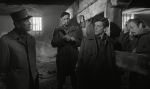
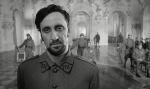
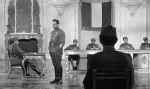
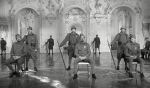
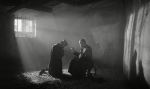
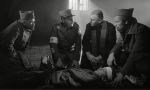
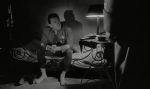
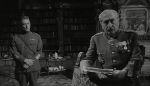
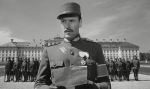
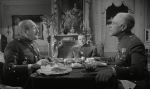
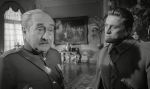
Paths of Glory is set at the French western front in 1916, where the soldiers endure the hellish conditions of trench warfare while their executive superiors reside in the luxurious nearby palace that has been temporarily transformed into military headquarters.  It is in the comfort of the latter location that General Mireau, who oversees a division near the key German position known as “the Anthill,” is visited by his superior, General Broulard, a member of the French General Staff.  Broulard has come to propose an attempt by Mireau’s men to take the heavily fortified German stronghold, a mission which, if successful, could win favorable response for the French war effort in the press and the political arena- and presumably advance the careers of the military commanders involved.  At first, Mireau is adamant in his refusal of the commission, citing the impossibility of the task and the devastating casualties that would be inflicted on his soldiers; when Broulard brings up the possibility of an upcoming promotion, however, which might be adversely affected by his choice, the ambitious subordinate quickly changes his mind, and agrees to order his troops to make the attack.  Mireau makes a visit to the trenches, a hellish war zone under a continuous blanket of shelling and gunfire, where he takes the time to exchange a few military platitudes with the already demoralized men- and deliver a strict dressing down to one shell-shocked soldier whom he accuses of being a coward- before delivering his orders to the division’s commander, Colonel Dax.  Dax, a dedicated soldier and a capable leader, is likewise skeptical of their chances for success, deeming the attack a suicide mission, but when the general threatens to relieve him of his command, he reluctantly agrees to lead his men in the attempt- though he knows the cost in human life will be high.  The next morning, the assault on “the Anthill” commences, with Dax personally leading the men through a horrific barrage of shells and machine gun fire; the effort proves futile, with most of the first wave killed or wounded without gaining much ground towards the goal, and the second wave refusing to join the attack.  A desperate Mireau, watching the battle from behind the lines, attempts to order his artillery commander to fire on the reluctant men; the officer refuses to comply without written orders, further enraging the general.  Meanwhile, despite Dax’s attempts to rally the men, the onslaught of German resistance proves too much and the surviving troops fall back, putting an end to the mission.  Mireau is furious, accusing his men of cowardice and mutiny; he demands punishment for the failure of the mission, and orders that each of the three company commanders choose a man to be court-martialed and executed for treason, as an example to the rest.  Colonel Dax is appalled, and volunteers to defend the three soldiers in the proceedings against them; a skilled lawyer in civilian life, he is frustrated in his efforts by the court’s disregard for the men’s legal rights and its refusal to hear any mitigating evidence on their behalf.  Despite Dax’s vehement objections and impassioned pleas, the men are found  guilty and sentenced to die by firing squad.  Dax makes a last ditch effort to save the doomed soldiers, bringing evidence to General Broulard about Mireau’s thwarted attempt to fire on his own army; nevertheless, the execution proceeds as scheduled, and afterwards, when he orders an investigation into Mireau’s actions, Broulard offers Dax the disgraced general’s command, believing that he has been angling for the job all along.  The disgusted Dax refuses the promotion, admonishing the wily Broulard for his manipulative role in the whole tragic affair.  Leaving the headquarters, he overhears the soldiers singing along with a young German girl in a pub, and resolves to let them enjoy their brief respite for a short while longer before ordering them, as he must, back to the nightmare of the trenches.

The film’s taut and eloquent screenplay was credited to Kubrick and Calder Willingham, along with noted “pulp” fiction author Jim Thompson; in reality, most of the script was written by the latter two men, though the director took equal credit for his supervisory contributions- a sign of his frequently- noted desire for complete control of his films.  Needless to say, perhaps, the stridently anti-establishment sentiment of the story, combined with its indictment of power and patriotism as a mask for self-promotion and exploitation, generated much controversy in the political environment of the mid-1950s Eisenhower era; despite its setting within the French military, Paths of Glory was decried as un-American and doubtless seen as an example of Communist influence in the Hollywood film industry by the remaining proponents of McCarthyism.  Indeed, actor Douglas was vilified in the press during the production of the film for his involvement in such a project, though he remained unwavering in his dedication to it.  He was not alone in his confidence, either.  Though Kubrick himself had planned, for box office purposes, to compromise the story by changing its ending to a happy one, he was persuaded to keep to the novel’s original, bitter conclusion; when the studio balked at the depressing finale of the script and demanded the proposed happy ending instead, producer Harris resubmitted the original version without changes under the somewhat cynical assumption that nobody would bother to re-read it. He was right, and after the film’s completion the studio execs were so impressed with the final product that they agreed to release it without alteration.  The relative lack of significant opposition for Paths of Glory might have been a sign of the times- after all, another film with a strong anti-war message, David Lean’s The Bridge on the River Kwai, was one of the year’s big hits, even winning multiple Academy Awards, including Best Picture- and despite its relatively humble box office showing, it certainly made an impact on viewers, paving the way for a coming decade in which movies would take critical attitudes towards the accepted establishment to a new level.

Whether or not Paths of Glory captured the public, it quickly became a darling of the reviewers.  Praise for the film was almost universal, with critics expressing particular admiration for its unvarnished portrayal of the realities of warfare and its stark black-and-white cinematography.  Decades later, it is easy to look at Kubrick’s work here and recognize his familiar style, developed to mastery even at this early stage in his career.  The lauded cinematography (executed by George Krause) bears the hallmark of the director’s fondness for natural lighting, capturing the harsh glare of the uncovered bulbs in the trenches, the cold and hazy sunlight of the battlefield, and the heavy diffusion of the enormous palace interior with a palpable aura of tangibility; the relentless but deliberate mobility of the camera, including the classic and influential reverse tracking shot of Colonel Dax moving through the trenches on the morning of the fateful attack, prefigures future use of the same techniques in such films as 2001: A Space Odyssey and The Shining, to name but two notable examples; the thematic motif of a story in which human endeavor is destined to fail because of inherent flaws in the character of its participants, and the shrewdly observational approach to revealing these flaws through the cool detachment of the empirical camera, is classic Kubrick, a thread which weaves its way through every film in the director’s canon; the unmistakable framing and shot composition, the triangulated relationships, the photographer’s fascination with capturing the human face in its myriad expressions of emotion- all these things and more are present in Paths of Glory, bearing witness to the concrete vision this then-youthful genius had already created for himself.  Already established, as well, was his penchant for demanding absolute control and his sometimes excruciating perfectionism.  His insistence on getting every frame of the movie exactly as he wished resulted in numerous confrontations and difficulties on the set, including a notorious incident in which, after 17 takes of a scene with Adolphe Menjou, the veteran actor exploded with rage and frustration at the director and ferociously derided the younger man’s inexperience at working with performers, in front of the full cast and crew of the film; after patiently allowing Menjou to expend his fury, Kubrick quietly called for another take.  It was but a foreshadowing of the kind of troublesome relations with collaborators for which he would be known throughout his career, but his exacting methods resulted, undeniably, in a legacy of masterpieces that continue to influence and inspire filmmakers- and dazzle audiences- to this day.

Though Kubrick deservedly takes the lion’s share of credit for the excellence of Paths of Glory, note must be taken of the fine contributions of the others involved.  To begin with, as noted, the screenplay is a well-crafted, tight piece of cinematic storytelling, peeling away expectation and cliché to reveal the unscrupulous, the cowardly, the vindictive, and the opportunistic qualities of its characters in an unrelenting portrait of war and its tendency to bring out the worst of human behavior.  Justice and compassion are thrown aside in favor of maintaining the status quo, ostensibly deep loyalties and ethics are forsaken at the first hint of personal consequence, and humanity is disregarded in the face of the ego-driven politics of the established social order.  The disparity between classes and ranks allows the free reign of corruption at all levels, and any trace of nobility or true honor is presumed to be just another pose adopted for the sake of gaining leverage in the quest for personal advancement.  Kubrick’s level of involvement in the writing of the screenplay is uncertain to me, but the majority of actual text was composed by Willingham and Thomas, both of whom would work with the director again despite his having downplayed their contributions here; these men have since justly earned proper recognition for this and many other projects, and each of them left the clear imprint of their particular style on Paths of Glory, helping to define its distinctive flavor of gritty humanism and undeniably playing an immeasurable part in making it the instant classic it became.

The cast, too, deserves a nod of appreciation, and not just for enduring their director’s tyrannical methods or the grueling conditions of the film shoot.  Kirk Douglas, who was then a top star, fresh from his acclaimed performance as Vincent Van Gogh in Lust for Life, helped Kubrick on his road to greatness with his support for this project (he would later be instrumental in getting the filmmaker hired to replace Anthony Mann as the director of Spartacus, a movie which would further cement his reputation and his status as a power player in the industry, and though the two would ultimately fall out during the making of this latter epic, Douglas has remained staunch in his admiration for Kubrick’s abilities as an artist).  The actor may have suffered some backlash for his involvement, but it was well worth it in terms of his long-term reputation; his performance as Colonel Dax is widely considered one of his finest pieces of work, a passionate, intelligent, and utterly convincing portrait of a decent man in the midst of madness, and he not only gives us a hero with whom we can place our sympathies, he serves as a much-needed reminder that even in a nest of vipers, men of quality can still exist.  As for Adolphe Menjou, outbursts on the set notwithstanding, he gives the performance of his long career as General Broulard, hiding his ruthless Machiavellian machinations behind the smiling pleasantries of good manners in a way that makes it clear how much he enjoys being the master of the game; he is the film’s true villain, untouchable in his power and utterly without scruples, the picture of self-serving bureaucracy and elitist entitlement.  George Macready is equally loathsome as Mireau, another species of political opportunist, whose greedy ambition makes him an easy target for the manipulations of men like Broulard, and whose thirst for power- probably stoked by decades of forced subservience- allows him to rationalize the most appalling decisions in pursuit of his personal glory, but also makes him prone to grievous errors in judgment which will ultimately prove to be his downfall; Macready, sporting a facial scar as a constant reminder that he has undoubtedly earned his position (and that he is, in fact, a product of the military system in which he has likely spent his entire adult life), is every inch the blustery martinet, but there is something about the desperation of his manner that makes us almost- but not quite- feel sorry for him.  Also memorable is Wayne Morris, as a drunken lieutenant who abuses his position to eliminate a subordinate that threatens his security (and his conscience); as the three condemned men, Ralph Meeker, Joseph Turkel, and Timothy Carey offer compelling examples of differing attitudes in the face of death, each of them representing aspects of humanity that defy easy judgment; Richard Anderson (later a familiar face of ‘70s television as Oscar Goldman, the handler of both The Six Million Dollar Man and The Bionic Woman) is quietly superb as Mireau’s assistant, an officiously sycophantic administrator who relishes his opportunity to shine as the prosecutor in the court-martial of the accused mutineers, but who gives us, in his final scenes, more than a hint that the moral implications of his actions may be a heavier burden to bear than he had anticipated; and Susanne Christian (who would soon after become Mrs. Stanley Kubrick, a role which she would fill for the rest of the director’s life) is lovely and heartbreaking as the German singer, presumably a prisoner in the French-occupied town surrounding the military headquarters, who captures the hearts and souls of her unruly audience as she is forced to entertain them in the pub during the film’s final scene.

Paths of Glory is one of those flawless pieces of filmmaking that reminds us of just how good the medium of cinema can be.  It is- and has been from almost the moment of its release- a textbook example of great film technique, and its deeply compelling story makes it a riveting experience even for those with little interest in the technical side of the art form.  Director Steven Spielberg is one of many who has claimed it as a favorite film, and its plotline and themes have been borrowed or provided inspiration for countless other works over the years, from an episode of The Young Indiana Jones Chronicles to a song by Faith No More.  Its status as a true masterpiece is so unquestionable that it tends, sometimes, to be forgotten in discussions of great filmmaking simply because it is such an obvious example.  In truth, though Kubrick’s later, more high-profile works have often been the subject of disagreement and controversy among scholars and critics, this early gem is almost always regarded with reverence by even the director’s most vehement detractors.  If you’ve never seen it, what are you waiting for?  It’s one of only a few films that I can confidently recommend, without qualification, to anyone; whether you are an avid movie buff or a casual entertainment seeker, you are bound to find yourself enthralled by this powerful little movie, and even those with a short attention span can rest assured that, at a fast-moving 88 minutes, it will have no trouble keeping their interest.  It’s a timeless classic, as powerful and riveting today as it was over a half-century ago, proving the words uttered by its star, Kirk Douglas, barely a decade after its release, to have been absolutely prophetic: “There’s a picture that will always be good, years from now. I don’t have to wait 50 years to know that; I know it now.”  You were right, Kirk.  I know it, too.

http://www.imdb.com/title/tt0050825/

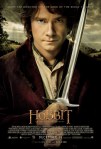
The Hobbit: An Unexpected Journey (2012)

The Hobbit - An Unexpected Journey (poster)


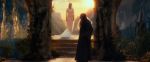
Today’s cinema adventure: The Hobbit: An Unexpected Journey, Peter Jackson’s long-anticipated return to the works of celebrated fantasy author J.R.R. Tolkien, whose three-part saga, The Lord of the Rings, provided the basis for the director’s phenomenally successful and critically-acclaimed trilogy of the same name.  Adapted- and expanded- from Tolkien’s earlier novel, The Hobbit, it constitutes the first part of a second trilogy which serves as a sort of prequel to The Lord of the Rings, telling of the young Bilbo Baggins’ adventures when he joins the quest of a band of Dwarves to reclaim their homeland from an ancient dragon who has taken it as his own- an expedition which sets into motion several events that will have great consequence in the later story.  Sure to be a major success on the basis of fan interest alone, it has met so far with somewhat mixed response- mostly due to Jackson’s decision to supplement the relatively short novel with additional material that connects it to the later events portrayed in The Lord of the Rings– and facilitates the splitting of its narrative into three separate films.  Reaction has also been divided about his choice to shoot the film at 48 frames per second (twice as fast as the standard rate), resulting in an ultra-high resolution image which gives his movie an almost hyper-real look, particularly when coupled with the 3D and IMAX formats in which it has been widely released.  Nevertheless, the majority of critics and audiences have been enthusiastic in their welcome for this adaptation of the much-beloved tale, and it undoubtedly marks the beginning of another triumphant achievement for Jackson and his creative collaborators.

The Hobbit, published over a decade earlier than The Lord of the Rings, was written by Tolkien as a stand-alone book, though its narrative was part of the much longer and intricately detailed story of Middle-earth that he had been developing since his youth.  The book was a success- so much so that it achieved classic status, eventually allowing Tolkien to publish the iconic trilogy of novels which turned him- and the mythical world he created, along with its inhabitants- into a cultural icon.  In an appendix at the end of The Lord of the Rings, the author provides a detailed timeline of the entire history of Middle-earth, with particular emphasis on the events leading up to the War of the Rings, which is specifically chronicled within the trilogy.  The beginnings of this great conflict coincide with the timeline of The Hobbit, through which Tolkien provided glimpses of his larger saga within the peripheral details of the central plot.  An Unexpected Journey, as mentioned, incorporates this material into its adaptation of The Hobbit proper, placing the story into the larger context of the complete epic tale.  The film begins in precisely the same time and place as the previous trilogy, at the home of Bilbo Baggins, an aged hobbit (or “halfling”) who has begun to write the history of his personal adventures, many years before, in the far-flung corners of Middle-earth.  We are transported back, as he remembers his youth, to a day 60 years prior, when Gandalf, a wandering wizard once acquainted with his family, arrives at his door to invite him on an adventure.  Bilbo, accustomed (as most of his people are) to the predictable comfort and security of his home in the Shire, declines; Gandalf, however, is not dissuaded so easily, and later that night the young hobbit is surprised to be playing host to a company of Dwarves who arrive unexpectedly, claiming to have been summoned to his home- by the wizard, who explains that he has offered Bilbo’s services as a “burglar” to assist the Dwarves in a quest to regain their ancient home under the distant Lonely Mountain, where a powerful dragon named Smaug, many years before, laid waste to their kingdom, Erebor, and claimed their vast wealth as his own private treasure trove.  Bilbo, horrified, again declines to join the expedition, protesting that he not only has no experience as a burglar but that he would, in fact, be useless on any such quest- an assessment with which the Dwarves are inclined to agree, particularly their leader, Thorin Oakenshield, heir to the throne of the kingdom under the mountain and a proven and powerful warrior.  Nevertheless, the shrewd wizard eventually persuades Bilbo, who has long suppressed a childhood yearning for adventure, to accept the job, and the hobbit joins his new comrades as they begin their long journey.  As they make their way, they encounter obstacles and enemies the likes of which the fledgling adventurer has never seen, including hungry trolls, greedy goblins, and bloodthirsty orcs- foul, mutated creatures who seem bent on pursuing them, and whose ferocious chieftain seeks a personal vendetta against Thorin.  Meanwhile, it becomes apparent that Gandalf has a larger agenda as he accompanies the fellowship; in his secret role as one of the White Council, an alliance of wizards and elves that serve as protectors of Middle-earth, he has begun to sense the growing influence of a dark and ancient presence returning to the land- a fear which he shares with his fellow guardians when the company arrives for a brief respite at the Elven capitol of Rivendell.  However, the answers he seeks remain yet hidden in the shadows, and the fate of the Dwarvish quest demands his more immediate attention.  Eventually, the band’s travels bring them within sight of their destination- but not before Bilbo manages his first successful “burglary” by stealing away the most “precious” possession of a treacherous subterranean creature named Gollum, beginning a greater adventure that will eventually decide the fate of Middle-earth itself.

The Hobbit, as written by Tolkien, was aimed at younger readers; though not exactly a children’s book, it is considerably lighter in tone than the epic trilogy which followed, with a less austere literary style and a higher level of whimsy to soften the heaviness of the story’s darker elements.  Even so, the heart of its story lies in the fabric of this remarkable writer’s meticulously plotted history of Middle-earth, a complex and lifelong undertaking inspired by his desire to create a definitively English mythology and informed by his passion for philology.  This imaginary chronicle, produced over the course of decades, provided a depth of background for his writings that lends an unprecedented level of authenticity to the fantasy world in which they are set, complete with vivid geographical detail, cultural and linguistic traditions for all of the various races which populate it, and a fully developed cosmology.  This fullness is one of the qualities which helped to make both The Hobbit and The Lord of the Rings into cultural phenomena, and legions of fans have hungrily devoured every scrap of the copious background material from which it arises, through its later publication in books like The Silmarillion, by Tolkien himself, and the collected volumes of history assembled by his son.  It is with these kinds of fans in mind that Peter Jackson- along with his partner, Fran Walsh, and their longtime collaborator, Philippa Boyens- decided to expand the narrative of The Hobbit with the inclusion of story elements that provide background and foundation for the later events depicted in The Lord of the Rings.  Operating from the conceit that Bilbo’s adventures, as related in the novel itself, are only a part of the whole story, the screenplay, by the three aforementioned collaborators (along with Guillermo del Toro, who was originally slated to direct), weaves the story of the Dwarves’ quest into the larger story arc that links The Hobbit to its more ambitious successor; the introduction of the great ring of power, pilfered by Bilbo in the subterranean lair of the pathetic Gollum (the only episode in the novel that bears significant continuity into the later books), is here seen within the context of other circumstances revealed by Tolkien only in his extraneous writings.  Thus, An Unexpected Journey is not simply an adaptation of The Hobbit, but an ambitious effort to create a more complete vision of Tolkien’s mythic realm, fleshing out the depiction of “behind the scenes” activity- such as the meeting of the White Council and the discoveries of Radagast the Brown- in order to tell more of the complete saga as the author composed it in his own imagination.

Of course, it goes without saying the Jackson and his co-writers are themselves the kind of fans at which they have aimed their own movie; it’s clear from the outset that An Unexpected Journey is as much a labor of love as The Lord of the Rings, and even more of a dream project in the sense that the creators have the opportunity for bringing to light many of the things that have, until now, remained tantalizingly hidden between the lines.   The inclusion of these “extra” scenes, of course, begs the question of how faithful Jackson et al‘s vision can be to Tolkien’s intent when the author himself chose not to include them in the book.  The answer is, I think, very faithful indeed.  An Unexpected Journey contains very little that doesn’t come directly from Tolkien, except for the kind of embellishment of detail that is necessary when realizing a written work into cinematic form; the author wrote descriptions of all the so-called “extra” scenes, and though they were omitted from The Hobbit because they were irrelevant to the book’s self-contained purpose, they were nevertheless part of his complete vision.  Jackson and crew have given us a chance to see that vision come to life, and they have done it with relish.

There is actually very little I can say about The Hobbit: An Unexpected Journey, at least in terms of standard critical commentary.  There are those who have a passion for this kind of fantasy adventure story, and there are others who have an equally passionate dislike.  No argument is likely to persuade one side or the other to change their view, and those two camps are going to either love this movie, or hate it, regardless of what anyone says; but for those many viewers in between, some guidance may be offered.  Casual fans of Tolkien’s books, who may not be well-versed in the surrounding lore, may find themselves confused by the inclusion of characters and concerns from the later trilogy, and might also feel that these elements muddle the focus of the main narrative, which centers wholly on Bilbo and his transformation from humble homebody to seasoned adventurer.  Likewise, those who have only come to the world of Middle-earth through exposure to Jackson’s earlier films might find themselves feeling a sense of all-too-familiarity over things we’ve seen before, or may not get the point of spending time on a plot line for which we have already seen the eventual outcome; this, of course, is always the pitfall of  “prequels,” and it is one which many viewers might feel is particularly needless here, when the source material does not itself contain these elements.  It is important to remember, however, that An Unexpected Journey is the first installment of a trilogy, and much of its content is meant as a set-up to the events which are to follow; though one may quibble about the necessity for padding out an already rich and complex storyline, or question the motivation for turning a single novel (which is, incidentally, shorter in itself than any of the three volumes of The Lord of the Rings) into multiple sure-fire hit movies, Jackson’s vision is an ambitious one.  He is bent on building as complete an embodiment of Tolkien’s mythos as possible, one which draws not only on the content of the novels as published but on the supplementary material with which the author infused them.  To put it another way, he is thinking “outside the box” in order to capture the total experience of the author’s epic saga in a cinematic form that both elaborates on its details and remains true in spirit to his ultimate intent and purpose.  As with any artistic translation of a pre-existing work- particularly when the original artist is no longer around to consult- there is a necessity for personal interpretation; but Jackson and his team, who are die-hard fans of the first degree, are certainly as qualified to interpret with as much validity as anyone, and with their proven mastery of the kind of breathtaking visual storytelling required, they are obviously more than up to the task.

The level of perfection and coherence to which Jackson aspires is evidenced by the painstaking efforts he has made to connect his new trilogy to the previous one with as much unity as possible.  Settings which are shared by both are duplicated in detail, and returning characters are portrayed by the same actors (with the semi-exception of Bilbo, whose younger incarnation is now represented by Martin Freeman- though original actor Ian Holm reprises his appearance as the older version of the title character).  In addition, the visual style of the original film series is maintained through the richly detailed design work, inspired by the decades of illustrative art connected to Tolkien’s books- in particular those of Alan Lee and John Howe, who served as visual consultants on this film (and its future follow-ups) as they did on the original Jackson trilogy; needless to say, the high-tech magic used to bring life to the various denizens of Middle-earth and their exploits is once again a marvel of imagination merged with state-of-the-art wizardry, and the creation of props, costumes and make-up which convincingly capture the cultural character of the land and its population is once again executed with astute perfectionism.  An Unexpected Journey is cut so distinctly from the same cloth as its spectacular predecessors that it is clear the filmmaker intends, when all is said and done, for this new trilogy to be seamlessly bound to The Lord of the Rings as a single, unified whole.

Further enhancing this continuity is the welcome return of Howard Shore’s magisterial musical scoring, an indispensable element of The Lord of the Rings, which manages the remarkable feat of incorporating here the themes and motifs created for the previous trilogy while weaving them into the new material composed specifically for The Hobbit.  It’s the same technique which gave each of the three original films their own distinctive sound yet tied them all together, as well as adding a valuable aural component to the storytelling, and once again it serves its purpose well; the soundtrack has that rare quality of seeming instantly familiar, like music you have somehow known all your life without ever having heard it before, much in the same way that the story feels like an ancient memory of some long-forgotten dream.  Tolkien’s books touch the realm of archetypes, and, like Jackson, Shore has the skill to enhance this deep unconscious connection in a powerful and irresistible way.

In the same vein are the performances; though this kind of acting is rarely acknowledged when awards are handed out every year, the ability to convey humanity and make emotional connection while playing in a necessarily heightened style is a delicate gift, and Jackson has once more populated his epic with performers who are up to the job.  Returnees Ian McKellen (whose magnificent Gandalf has been one of the highlights of the series from the beginning, and is a particular delight this time around), Hugo Weaving, Cate Blanchett, and the venerable Christopher Lee (whose personal expertise on the Tolkien canon has been of vital importance to Jackson’s project offscreen, as well)- as well as the aforementioned Holm and Elijah Wood (in a brief cameo)- are all seasoned purveyors of this craft, by now, and have become the quintessential embodiment of their characters; it is a pleasure to see them, however brief their involvement.  The new cast members, however, are every bit their equal in terms of capturing the necessary flavor; Jackson’s month-long pre-filming regime of combat and horseback training, designed with the dual purpose of establishing a tight-knit camaraderie among the players, no doubt contributed to the chemistry that is evident onscreen, and his ensemble provides a superbly symbiotic assortment of performances which are each destined to become as iconic as those from The Lord of the Rings.  Of particular note are Richard Armitage- whose brooding intensity gives Thorin Oakenshield a powerful charisma which complements his role as the destined ruler of the Dwarves- and Sylvester McCoy- whose memorable turn fleshes out Radagast the Brown, a peripheral character that has always been a subject of fan curiosity through importance of his role in the saga and the brief-but-vivid descriptions he received in Tolkien’s work.  Mention must be made as well of Andy Serkis, whose mesmerizing performance as Gollum- achieved through motion capture technology but executed live on set with his co-stars and derived entirely from his real expressions and physicality- was one of the most acclaimed elements of The Lord of the Rings and comes close to stealing the entire movie in his single scene here.  Finally, Martin Freeman is the perfect Bilbo Baggins; down-to-earth, likable, comical, and yet endowed with a great and generous spirit that shines through from early on, it is no wonder that he was Jackson’s first and only real choice for the role- the production schedule was completely rearranged to fit the actor’s availability- and his understated, everyman charm (rightly, since it’s Bilbo’s story) provides the heart and soul to the film.

There are so many wonders on display in An Unexpected Journey, and to list them all would be pointless; far better to let you discover them for yourself.  On that subject, the issue of presentation becomes an important factor.  Jackson’s audacious decision to shoot his film in the double-rate format of 48 fps. has generated much debate- and quite a few complaints from viewers who find the resulting depth and clarity to be disorienting and distracting- particularly when combined with the seemingly obligatory 3D and IMAX formats, as well as a tendency to make the various and extensive special effects trickery appear, well, obviously fake.  In answer to this, I can only say it’s entirely a matter of personal taste; I myself have seen the film twice now, once in the full-blown mega-tech format and once in the plain old 2D standard version.  I was mesmerized both times, and I had no complaints- though I will say that my second viewing, free from the “ooh-aah” factor which accompanied my first time through, allowed me to focus more attention on the content of the story itself without the bedazzlement of total sensory experience.  The content is, of course, what ultimately matters more than the gimmickry of its presentation, and it must be noted that eventually, when the film is viewed as it will later be, without the trappings of big screen showmanship on millions of smaller home screens around the world, it will be that content upon which viewers will base their judgment of the film.  In the meantime, those with a low threshold for technical bells and whistles might do well to skip the deluxe experience and visit your humble neighborhood theater; the tickets will be cheaper, and you will be able to focus on the essence of the film without the distraction of feeling more completely immersed in an imaginary world than you want to be.

The Hobbit: An Unexpected Journey is, ultimately, a film for fans.  That doesn’t make for a limited appeal, in this case; Jackson’s Lord of the Rings trilogy was one of the most popular and acclaimed film franchises of all time, and the devotion that it engenders in its fans rivals that of such other cultural phenomena as Star Wars and Harry Potter.  There will be many, of course, who will adopt a dilettante attitude towards the new trilogy, perhaps for no other reason than to separate themselves from the crowd, just as there have been critics who seemingly were poised and ready to attack the film before it was even released.  There are probably audiences who will feel that this new film is really just “more of the same,” and admittedly there are a few elements that seem like repetition of things we’ve already seen- though of course these moments are faithful to the source material, and to change or excise them would be untrue to Tolkien’s story.  No doubt the majority of fans, however, will be thrilled at the chance to return to Jackson’s rendition of Middle-earth, and will eagerly anticipate the remaining entries over the course of the next two years.  I must, in the interest of full disclosure, admit than I am definitely in this last category; it would be hard for me to have found fault with An Unexpected Journey, short of a total botch job by its director, which was never very likely- though not it’s certainly not unheard of for a trusted filmmaker to drop the ball when remounting a beloved franchise (dare I mention George Lucas’ The Phantom Menace?).  The truth is that expectation has so much to do with the enjoyment of a cinematic experience that it is sometimes impossible to have an objective reaction, particularly with a highly anticipated film such as this one.  To be sure, what it delivers might not match the expectations of many- but in reading some of the harsher reviews that have so far been published of An Unexpected Journey, I find it hard to believe they are talking about the same film I saw.  Perhaps it comes down to the “what-have-you-done-for-me-lately?” attitude that seems to pervade popular culture today, which results in a loss of interest for that which was once popular and a snarky skepticism about any attempt to revive a former glory.  Whatever the reason, there are many who would disparage Jackson for returning to familiar territory instead of taking a new direction; but exciting filmmaking does not always have to break new ground, nor does the desire to revisit a successful formula indicate a lack of creativity.  It is obvious that this New Zealander considers the definitive transfer of Tolkien’s work to the screen to be his life’s work, at least for now, and I, for one, couldn’t be more delighted.

http://www.imdb.com/title/tt0903624/


Psycho (1960)

Psycho (poster)

Today’s cinema adventure: Psycho, Alfred Hitchcock’s classic 1960 shocker about a series of gruesome murders at an out-of-the-way roadside motel.  Based on Robert Bloch’s novel of the same name, which was in turn inspired by the real-life case of Ed Gein, a deranged Wisconsin farmer who stole numerous bodies from a local cemetery and murdered several women while living with the corpse of his long-deceased mother, it was heavily deplored by most- but not all- critics at the time.  Thanks, however, to Hitchcock’s sensationalistic marketing strategies and his popularity as the host of the then-current TV anthology series, Alfred Hitchcock Presents, it was an enormous box office success; it played an important role in changing the film industry’s outdated standards for “acceptable” subject matter and spawned scores of imitators, paving the way for the “slasher” sub-genre of horror films and wielding immeasurable influence over generations of subsequent filmmakers.  Its critical reputation quickly grew, and it is now almost universally recognized as one of the greatest movies of all time, or certainly, at least, one of the most important.

Psycho is one of those films that is so widely known as to be ingrained in the cultural consciousness; it is hard to imagine that anyone in 2012, whether they have actually seen it or not, would be unfamiliar with the once-notorious plot twist that prompted Hitchcock to implore movie audiences not to reveal the ending after they had seen it.  However, on the assumption that there are such people out there who might be reading this, I offer fair warning that beyond this point you will encounter “spoilers,” and you might want to stop here.  Psycho begins in Phoenix, Arizona, with a lunchtime tryst in a cheap hotel between Marion, a secretary, and Sam, her divorced lover from out of town, who cannot afford to marry her because of his crippling alimony payments.  Later, at the real estate office where she works, Marion’s boss entrusts her with $40,000 in cash, instructing her to take it to the bank on her way home; seeing a chance to put an end to the dead-end arrangement of her love life, she instead packs a bag and takes the money to start a new life with Sam, heading down the highway towards Fairvale, the small California town in which he lives.  When a blinding rainstorm makes driving unsafe, she stops for the night at an isolated motel off the main highway, operated by an awkward but sweet young man, Norman, who lives with his elderly mother in a Victorian house on the hill behind the office.  Norman is warm and polite, inviting his weary guest to join him at the house for a light dinner; but after Marion overhears a heated argument between her host and his mother, who angrily refuses to let him bring a female guest into her home, he instead brings a plate of sandwiches to the motel, and the two of them share a meal in the office parlor.  During their conversation, Norman tells Marion that his mother is mentally disturbed and prone to fits of anger, but that he feels obliged to care for her, though it means sacrificing his own freedom, because “a boy’s best friend is his mother.”  When Marion returns to her room, she decides to take a relaxing shower before going to bed- only to have it brutally cut short when the dark figure of Norman’s mother creeps into the room and stabs her to death with a butcher knife.  Upon discovering his mother’s savagery, Norman decides to do the dutiful thing and clean up the mess, disposing of the body and all evidence of Marion’s ill-fated visit- including the stolen cash, still wrapped in a newspaper- in a nearby swamp.  A few days later, in nearby Fairvale, Sam is visited in his hardware store by Lila, Marion’s sister, who has come in hopes that she will find her missing sibling there; they are quickly joined by a private investigator named Arbogast, hired by Marion’s boss to retrieve the stolen money without involving the authorities.  When it becomes clear that Sam is as ignorant as they are to Marion’s whereabouts, Arbogast begins to canvas the area looking for signs of the missing girl’s presence; eventually he arrives at Norman’s motel, where he quickly deduces the young man is hiding something.  After sharing his suspicions in a phone call to Sam and Lila, he sneaks into the house in search of Norman’s mother, thinking to get more information from her, and quickly becomes the next victim in the deranged woman’s bloody rampage.  With Arbogast’s disappearance, Sam and Lila decide to take the investigation into their own hands, and head to the motel to seek answers- but neither is prepared for the dark secrets they will uncover before they can solve the mystery of Marion’s disappearance.

As detailed in the current film, Hitchcock, Psycho was a major departure for the legendary director, a small-budget, black-and-white, sordid and sensationalistic shock piece that no studio wanted to touch.  Even with his prestigious reputation and his popular status as a television star in his own right, Hitchcock had to finance the film himself in order to make it.  It was a risky venture, to say the least, but one which paid off for him in a very big way; the film broke box office records, becoming the highest-grossing release of his career and making him a millionaire.  Its success forced critics to re-evaluate it- those who had been initially dismissive of it as a tastelessly lurid, low-budget shocker, beneath the usual standards of the “master of suspense,” soon praised it enthusiastically and included it on their “best of the year” lists, and it was ultimately nominated for numerous awards (including four Oscars).  In the end, Psycho rewarded its director with the late-life revitalization of an already extraordinary career, made him an even greater power player than he had been before, shattered industry taboos against depictions of sexual and violent content, and won him a new generation of fans- and all at a cost of less than a million dollars.

It was no accident of fate, either; the canny Hitchcock understood exactly what he was doing, and he exerted his meticulous craftsmanship on every aspect of the production in order to achieve the kind of visceral, ground-breaking effect he knew would electrify audiences seeking a new kind of thrill.  To this end, he had chosen his source material for its deeply unsettling subject matter, as well as for its deliberate and merciless manipulation of readers’ sympathies. To keep the budget down, he chose to shoot in black-and-white, using mostly the personnel from his TV series; a few trusted collaborators, however, were also hired, such as graphic artist Saul Bass, editor George Tomasini, and composer Bernard Herrmann, whose previous contributions to his film work had proven invaluable.  He cast the roles with familiar and experienced actors, but avoided using big stars, both to keep salaries down and to prevent personality from overshadowing the story; and- after rejecting an initial screenplay by James Cavanaugh, who had written several scripts for his TV series- he hired screenwriter Joseph Stefano (who had only one previous writing credit, but possessed extensive personal experience as a patient in psychotherapy) to adapt Bloch’s book for the screen.

Stefano’s screenplay remains fairly faithful to the novel in its plot, though a few changes were made to accommodate the requirements of the cinematic medium; most significantly, the central character of Norman Bates was transformed from an overweight, middle-aged alcoholic to a youthful, squeaky-clean boy-next-door.  This was Hitchcock’s direct input, designed to make the character more readily sympathetic to the audience; his likability was crucial for the director’s purpose, which involved tricking the audience- and here’s the big spoiler, for those who care- into identifying with a psychotic murderer.  Indeed, the narrative of Psycho is one piece of trickery after another, enhanced by Hitchcock’s casting of his biggest star, Janet Leigh, as a character who is killed off a third of the way through the movie, and his other biggest star, Anthony Perkins, as someone who not only covers up her death but ultimately turns out to be her killer.  The crucial plot twist- that Norman’s mother is in fact her stolen, mummified corpse and that he himself suffers from a split personality in which he commits the murders while assuming her identity- is kept hidden by shrouding the mother figure in mystery, keeping her offscreen except in shadow, silhouette, or oblique camera angles, and hearing her conversations with Norman from off-camera- which has the added effect of making the audience feel like an eavesdropper.  This is another important element of Psycho, the sense that we are clandestine observers of some forbidden ritual, and it of course constitutes the biggest trick of all- Hitchcock turns us into voyeurs, getting our cheap thrills by peeking through windows, listening at doors, and sneaking into private rooms.  It’s a now-familiar tactic, used extensively by filmmakers wishing to enhance our connection to their subjects and to subvert our affectations of propriety, and Hitchcock was certainly not the first to use it; but in Psycho, he brought it out of the art house, where European and avant-garde directors had been experimenting with it, and into the popular cinema, thrusting mass audiences into a wholly subjective experience and smashing through the “fourth wall” of the camera by making it into a substitute for the eye itself.  We are subtly drawn into this personalized experience from the very beginning of the film, when the camera slowly zooms from a panoramic view of the Phoenix skyline through the window of a darkened hotel room to spy on Sam and Marion as they finish their midday liaison; throughout the rest of the movie we are kept in the action with the heavy use of point-of-view shots, scenes filmed through doors, windows, phone booths, and even a peep hole, and the theme of clandestine observation is layered in by the characters themselves, who overhear, watch, question, and spy on the actions of others throughout the film.

This voyeuristic approach was nothing new for Hitchcock, but rather the culmination of a motif with which he had long been fascinated; throughout his career he had developed techniques for enhancing the audience’s identification with the lens, emulating the natural movement of the human gaze with his camera, using the same point-of-view perspectives and many of the other tricks which would become the dominant mise-en-scène of Psycho.  Likewise, many other of his favorite thematic elements are contained within the narrative- doubtless one of the reasons he was attracted to the material.  Many of Hitchcock’s films feature problematic relationships with domineering parents (sometimes played for laughs, but always containing a decidedly dark undercurrent); his heroes are frequently flawed, even seriously broken, and often unsympathetic, while his villains are usually charming and likable; law enforcement figures are mostly ineffectual or downright incompetent, and “polite” or “normal” society is generally seen to be a hypocritical veneer for hiding any number of unsavory character traits; and, of course,  there is the ever-present icy blond, a beacon of inaccessible beauty, repressed sexuality, and, usually, possessed of a compromised virtue which must be regained.  All of these are deeply embedded in the fabric of Psycho– there are even two icy blonds- and used relentlessly to undermine the audience’s ingrained expectations.  The heroine is a thief, but her victim is a fatuous boor, and her motives are understandable, if misguided; her sister is prudish and severe, while her boyfriend is morose and belligerent; the police are condescending and dismissive, the private eye pushy and sardonic; Norman, however, is shy, kind and endearing, even if his hobby of stuffing birds is a little weird, and he is, of course, the epitome of the dutiful son.  In any standard narrative, it would be clear where our sympathies should lie, but here everything is turned upside down; we root for Marion, and when she is suddenly and cruelly taken from us, we easily transfer our affections to her killer.  We make this willing shift partly because we do not yet know he is guilty, it’s true, but Hitchcock has built his trap so craftily that we would likely take the leap even if we did.  By the end of the film, the director has successfully made us emotional accomplices to both grand larceny and murder, and with his final shot of Marion’s car being pulled from the mud, a lifeless shell representing all that is left of her naive hope for a happy future, he rubs our faces in it.

There is another layer to all this subversive irony, though, beyond just a trickster’s impulse to make us feel dirty.  Our willingness to empathize with first a thief, then a killer, is grounded in what we think we see, what we want to believe, and what we have been trained to expect.  There are plenty of warnings- all the information we need to see the truth is plainly given as we go along, and yet we choose to bestow our sympathy based on romantic illusion.  We want the pretty, decent Marion to be able to “buy off unhappiness,” and we assume the boyish, mild-mannered Norman to be the innocent victim of his mother’s cruelty- from which we hope he can somehow break free without repercussions for his role in covering up her crimes.  This emotional manipulation is achieved by Hitchcock’s mastery of image; he carefully arranges what we see and hear in order to place us in conflict with ourselves, torn between our direct instinctive reactions and our intellectual assessment.  It’s a master con, made possible because of our tendency to mistake image for reality, but we buy into it willingly even as Hitchcock tauntingly tips us off all the way through.  Just as he gives us indications throughout that could easily lead us to recognize the truth about Norman and his mother, he inundates us with reminders about the relationship between image and reality; virtually every scene features mirrors or windows which allow us to see both the characters and their reflections, and most of the plot’s complications arise as a result of decisions based on faulty perception of the surface.  Marion is able to steal the cash because she seems trustworthy, she trusts Norman because he seems harmless, and everyone believes in his mother’s existence because she seems to be in the house.  Even the town sheriff, upon learning about the supposed involvement of a woman he knows to have been dead for years, is uninterested in investigating further because he forms an explanation that satisfies his assumptions.  In the end, Psycho is not about solving mysteries or exposing the pathology of a homicidal personality; it is an examination of- and a warning against- the dangers of living in a fantasy derived from what we want to believe.  We, as the audience, arrange the images to tell the story we expect to see, and when we are brutally reminded by Marion’s ignoble exit from the scenario that all is not what it seems, we fall right back into the clutches of illusion by transferring our sympathies to Norman.  In the climactic revelation, the sight of Norman, shrieking maniacally in his cheap wig and dress as Sam wrestles him into submission and his desperate illusions fall away along with the last vestige of his sanity, we cannot even comfort ourselves that we had no way to see it coming.  It may be a shock, but when we re-examine what has gone before, it is not really a surprise.  We let ourselves be deluded every step of the way, allowing our preconceived judgments color our perceptions; or to put it another way, to paraphrase a key subject from the parlor discussion between Marion and Norman, we have stepped into our own private trap.  This is the true heart of the film- the self-created cage of perception that traps us each and defines the way we see the world.  The image we embrace becomes identified as our reality, but as Hitchcock loves to remind us- and nowhere more vividly than in Psycho– this is an illusion, and one which can lead to the direst of consequences.

With so many volumes having been written about Psycho, it was not my intent to add much to it; clearly, however, I have been caught up in the spell of this much-discussed classic.  Something about this movie begs to be analyzed, explored, and revisited time and again.  There is so much here to stimulate, to intrigue, to perplex.  One can watch the film simply to revel in Hitchcock’s pure technical mastery: the aforementioned ways in which he invites us to participate in his own voyeurism; his ability to build tension with his deliberate pacing and editing, utilizing long, leisurely scenes interrupted by sharp, violent shocks that echo the stabbing of the knife; his use of visual means to keep us off-balance and on edge, such as dramatic camera angles, uncomfortably extreme close-ups, overhead shots, and other signature Hitchcock touches; and of course there is the justly famous shower scene, a 45-second collage of spliced film that terrorized the entire culture in 1960 and still inspires a particular kind of fear today.  You could also focus on Bernard Herrmann’s iconic musical score, a haunting and nerve-jangling composition for strings that Hitchcock himself credited for being 33% responsible for the film’s effectiveness and has been consistently placed at or near the top on lists of the greatest film soundtracks ever written; during the opening credits, you can marvel at the way the music is complemented by the title sequence created by the great Saul Bass, a no-less-iconic jumble of broken, intersecting lines that suggest the jagged turmoil of a disturbed mind as they spell out the pertinent names and assignments of the movie’s participants.

Of course, you can also reap the rewards of Psycho if you dedicate a viewing entirely to an appreciation of the performances.  Anthony Perkins’ work here is as fine an example of screen acting as you are ever likely to see, a masterpiece of understatement with subtle nuances revealing themselves upon every repeat viewing.  It was a role that matched him perfectly, allowing an intertwining of personal experience and fictional subtext that gives Norman a rare level of authenticity and makes him as heartbreaking as he is disturbing; though the character permanently defined his career and resulted in years of typecasting, it provided the young actor with a chance to leave a legacy the likes of which few others can claim.  Often overlooked, but no less definitive, is Janet Leigh’s outstanding work as Marion Crane; offering us an utterly convincing portrait of an everyday working girl, smart and clearly independent, but hiding a desperate longing to find the happier life of which she dreams, she wins us over immediately- and not only because of the obvious sex appeal of the opening scene, in which she helped to break down the so-called “decency code” by appearing in only a bra and a slip- and makes us keenly feel along with her the frustration of her mundane life, the irresistible thrill of her impromptu escape, and the mounting distress and paranoia that comes as she begins to recognize the consequences of her choice.  She is powerfully likable, which makes it doubly cruel when she is abruptly taken from us; this was Hitchcock’s goal, of course, carefully orchestrated by expanding Marion’s story from the brief episode it comprises in the original novel and by casting his most widely-known star in the role.  Leigh was his first choice, and she eagerly agreed to the project without even reading the script or discussing her salary; she was rewarded for her enthusiasm with an Oscar nomination, and, like her co-star, she created an unforgettable piece of cinema history, a rich and layered performance that is so good precisely because it contains no overt histrionics with which to call attention to itself.  The rest of the cast, though their roles are not as complex in dimension, are equally memorable- despite the fact that the director was vocal in his dissatisfaction with John Gavin (whom he referred to as “the stiff”) and that he was, by all reports, punishing Vera Miles for her abandonment of his earlier Vertigo (she became pregnant and bowed out before filming began, forcing Hitchcock to replace her with Kim Novak) by making her character here as unappealing as possible.  As Sam and Lila, respectively, both performers actually provide exactly the right qualities to their roles, making it impossible to imagine the film any other way; and, rounding out the main cast as Arbogast, Martin Balsam is likewise a perfect fit, giving us a canny portrait of a no-nonsense professional whose blunt and rumpled exterior belie the crafty shrewdness underneath.

There is so much to write about Psycho; I could go on with discussions of the layered themes and the techniques used by Hitchcock to explore them, or the brilliance of the stark black-and-white photography and its visual symphony of light and shadow, the contrast between the unglamorous, utilitarian settings and the austere design of the now-famous Edward-Hopper-inspired house that glowers down over the motel- the list is inexhaustible.  Similarly, I could write volumes about the history surrounding the film.  The battles with the censors over such things as the raciness of the opening hotel room scene, the use of the word “transvestite,” and the inclusion of a toilet (never before shown in an American film); the painstaking creation of the shower scene, which took a week to film, and generated obvious controversy upon release as well as much future argument about factors like whether it was Leigh or a body double that was used in the majority of its shots or the extent of involvement by Saul Bass, who drew the storyboards for the sequence but later claimed to have directed it in its entirety; the depth of contribution by Hitchcock’s wife and creative partner, Alma Reville, who- as she had on every film of her husband’s career- collaborated on every aspect of the movie from pre-production to final editing; all these things and more are legendary chapters in the story of Psycho, and you can (and should) read about them in so many other places that it is unnecessary to take any more time with them here.

The most pressing issue regarding Psycho, perhaps, for the “typical” modern viewer, who may have little scholarly interest in the film as a piece of cinematic art history and probably doesn’t care about the virtually unfathomable influence it has had upon every horror film that came after it, is simply whether or not it is still holds up.  Does this seminal, deceptively simple thriller live up to its reputation for inducing terror and inspiring nightmares for weeks after seeing it?  The answer, honestly, is probably not.  By today’s standards, even the most squeamish viewer is unlikely to find any of the film’s once-controversial violence hard to take; the gore factor is minimal, even in the famous shower scene with its chocolate-syrup blood, and, with a mere two killings taking place onscreen, the body count is decidedly low.  Taking this into account, along with the fact that it is virtually impossible to go into the movie without knowing its twist ending (or at least being familiar enough with its many imitators that it becomes easy to spot from very early on), Psycho is unlikely to generate many shocks with jaded modern audiences, and indeed is more apt to produce laughter- a development, incidentally, that would likely have pleased Hitchcock, who always claimed that the film was meant to be a very dark comedy.  Still, even if it has lost its power to scare us outright, it nevertheless casts an eerie and unsettling spell; even with its now-tame level of splatter, the shower scene is a deeply disturbing psychological jolt which plays on our most primal fears and reminds us of our innate vulnerability in the most common and universal of activities, and there is an undeniable creepiness that pervades the scenario, compounding as it progresses so that the Bates Motel and its adjoining house become more ominous and sinister in the bright light of day than in the earlier scenes at night.  Furthermore, instead of a neat and positive happy ending, Hitchcock leaves us with the mocking reminder that the world’s evil can be temporarily vanquished, but it will still remain, hidden in the most innocent-seeming of places, awaiting its opportunity to catch us unprepared; the final sequence of Norman, sitting alone in his cell as we hear “mother’s” voice in his mind, undermines any sense of safe, comfortable normalcy that might have been re-established by the previous explanatory denouement in which the smugly self-satisfied forensic psychiatrist unfolds his pat diagnosis of the murderer’s tormented psyche, and the final aforementioned shot of Marion’s car being pulled from the mud reminds us of the ugly reality of her senseless death- defying any attempt that might be made to assign it a meaning or purpose.  There is no comfort here, only tragedy and a chaos so deeply imbedded it can never be excised.  The power of these observations is as tangible today as it was five decades ago, whether or not Psycho frightens on a direct level, and any viewer seeking more than a cheap, visceral thrill will soon be drawn into the movie’s seductive web of delusion and consequence.  In short, Psycho may be better approached by the modern viewer as a psycho-drama, without expectations of blood-chilling fright and nausea-inducing carnage; indeed, it can be viewed, as its director did, as a comedic exploration of the fantasies in which we wrap ourselves and the mishaps in which they might result, though admittedly this requires a particularly morbid sense of humor.  In truth, of course, Psycho was never really meant to be a horror film, though it may have horrified; as in all of Hitchcock’s work, the real purpose is hidden behind the “McGuffin,” his term for the seemingly vital element around which his plots appear to revolve but which is actually a ruse through which his true concerns can be explored.  The McGuffin here is the mystery itself- ultimately the theft, the murders, and the psychotic delusions of the central character are all merely smoke and mirrors for Hitchcock’s master plan, in which he pulls the rug right out from underneath us and leaves us grasping for support that is no longer there.  Though he dresses Psycho in the trappings of the horror genre, its real riches lie beneath that exploitative exterior, and are ultimately more profoundly upsetting than any cheap momentary shock tactics could ever be.  On this level, from which it has always, truly, derived its greatness, Psycho is as fresh and relevant as the day it was released, and remains a must-see requirement for anyone who considers themselves even a casual film fan.  Personally, I first saw it at the age of ten, alone in my second-story bedroom on a tiny black-and-white TV screen.  It didn’t scare me, much, even at that tender age, but it certainly made a deep impression, and it most likely provided the single film experience that started me on my lifetime cinema adventure.  I’ve since seen it an uncountable number of times, and each time I never fail to be drawn in and to discover something new to consider.  If you are lucky, Psycho will hook you the way it hooked me; at the very least, it will make you think twice about leaving the bathroom door unlocked the next time you shower in a motel.

http://www.imdb.com/title/tt0054215/

Hitchcock (2012)

Hitchcock (poster)

Today’s cinema adventure: Hitchcock, the 2012 film exploring the relationship between legendary film director Alfred Hitchcock and his wife (and most trusted collaborator) Alma Reville during the process of creating his most famous film- the 1960 horror classic, Psycho.  Directed by Sacha Gervasi, and featuring tour-de-force performances by acclaimed Oscar-winners Anthony Hopkins and Helen Mirren, it was a project long in development and eagerly anticipated, stirring high interest and expectations among film literati over its portrayal of a true cinema icon at work.

Based on Stephen Rebello’s non-fiction book, Alfred Hitchcock and the Making of “Psycho,” a meticulously researched classic long considered a cornerstone in the literature of film studies, the movie’s screenplay, by John J. McLaughlin, takes a less documentary style than its source material, opting instead for a sort of mature Hollywood romance which focuses primarily on the complex dynamics between Hitchcock and his wife.  It opens in 1959 with the premiere of the director’s North by Northwest, a glamorous, wildly popular comic thriller which marked a triumphant return to familiar form after the box office disappointment of darker experiments like The Wrong Man and Vertigo; back at the top of the game, but unsettled by suggestions that he should now, at 60, settle back on his laurels and quit while he’s ahead (and by reviews which unfavorably compare the comfortable safety of his latest hit with the edgy freshness of his earlier work), Hitchcock begins to search for a new project unlike any he had done before.  Rejecting sure-fire hits and the solicitations of his wife to adapt her friend Whitfield Cook’s newest book into a film, he sets his sights instead on a sordid little novel by Robert Bloch, a gruesome tale of madness and murder inspired by the real-life case of 1940s serial killer Ed Gein.  Determined to make a film totally unlike anything he’s done before, he undertakes the project, even mortgaging his house for provide his own financing when his studio will not pay for the production.  Though initially skeptical, his beloved Alma throws herself into the project at his side, as always, providing her uncredited expertise in every aspect of the film- as she has done throughout their 30-plus years of marriage.  The pressures of working on such a risky endeavor, however, begin to take their toll, as Hitchcock’s personal obsessions begin to overwhelm him- his fixation on his icy, unattainable leading ladies in particular- and his overbearing demeanor pushes Alma to the limit of her patience, driving her to seek solace in the task of helping Cook- who may or may not have romantic designs on her, as well- to adapt his novel into a screenplay.  As jealousy on both sides threatens to drive a wedge between the Hitchcocks, both personally and professionally, the making of Psycho suffers from delays, personality conflicts, studio interference, and pressure from the censorship board, making the prospect of failure uncomfortably tangible.  Facing both financial ruin and the loss of his considerable reputation, Hitchcock must overcome his dysfunctional tendencies and restore the good faith of his most indispensable collaborator in order to salvage the film and avert disaster.  More importantly, however, he must suppress his massive ego and humble himself in order to repair the damage it has caused in his marriage and win back the only woman who has ever really mattered in his life.

Rebello’s book was written in 1990, and the exhaustive research the author undertook included access to Hitchcock’s personal notes and every available archival resource, as well as interviews with almost every individual who had worked on Psycho that was still living at the time, including stars Anthony Perkins and Janet Leigh.  The wealth of information he compiled resulted in an intricately detailed portrait of Hitchcock’s creative process, and inevitably yielded considerable insight into the personal factors that informed the director’s work at this particular time in his career.  The book is a scholarly work, albeit an entertaining one as well, which is intended to document the making of a seminal film which would go on to have far-reaching influence on the future of the movie industry and, indeed, on the art of cinema itself; the details and observations of the Hitchcocks’ relationship, while fascinating, are primarily important to show how essential Alma was to her husband’s work and how integral the couple’s teamwork was to the ultimate success of the movie.  McLaughlin’s screenplay reverses this emphasis, shifting the primary focus to the domestic life of this legendary power couple and using the making of Psycho as a means to reflect the personal issues threatening their relationship.  The reason for this may seem obvious; building an engaging story around the nuts-and-bolts construction of a film- or any work of art, for that matter- might easily result in a dry and unemotional narrative, intellectually stimulating, perhaps, but lacking the kind of human connection necessary to appeal to a typical movie-going audience.  Even so, in the process of transforming the documentary book into a fictional narrative, Hitchcock crosses over into the territory of Hollywood fantasy, offering up a sanitized and streamlined version of real-life events in its effort to make its two leading figures into an unlikely pair of romantic protagonists.  This is not necessarily a bad thing; though McLaughlin glosses up the facts with fancy and compresses complicated situations into neat little packages, he gets the gist of it right, and though purists may squirm over some of the more overtly sentimentalized indulgences or take exception to some of the artistic license that simplifies painstaking creative decisions into 30-second vignettes, these conceits serve the larger purpose of revealing the great director’s human side- an aspect he kept closely guarded behind his iconic public persona- and the true extent of his wife’s involvement and influence in his work.

Whether or not you prefer a subtler, more realistic approach to your bio-drama, if you are a fan of Hitchcock in general, or of Psycho in particular, you are sure to find a good deal of enjoyment in the film’s playful exploration of these almost mythic cultural touchstones.  Hitchcock adopts the drily comedic tone so readily associated with the Master of Suspense, particularly in connection to his classic television anthology series- a program that was current during the making of Psycho and which had transformed the already famous director into an instantly recognizable celebrity figure and a household name.  Indeed, the movie even frames its story with segments reminiscent of the ones that bookended every episode of Alfred Hitchcock Presents, in which the rotund host would provide wry commentary on the story being showcased; this conceit also serves to set up another device concocted by McLaughlin, in which Hitchcock engages in an ongoing fantasy dialogue with the aforementioned murderer, Ed Gein- a suitably macabre touch for a movie about an artist whose name is virtuously synonymous with the word.  Hitchcock maintains a close connection to the sensibilities of its central figure, using wit, intelligence, and a heavy dose of irony to tell its story and making sly observations about human nature as it entertains us with the surface details which are ostensibly its focus; and like any real Hitchcock film, it features the “McGuffin.”  For those that don’t know, of course, this is the term coined by the Master to describe a key plot device upon which the characters place great significance, providing an impetus for the story and seeming, on the surface, to be of the utmost importance, but which is, in fact, ultimately irrelevant to the real purpose of the movie.  In Psycho, for example, it takes the form of the $40,000 stolen by the movie’s ill-fated heroine; in Hitchcock, however, the McGuffin is Psycho itself.  It is the making of the movie that is the supposed center of the the plot, but in reality, it merely provides a lens through which is revealed the characters’ psychological and emotional traits, and serves as a catalyst for their personal transformations- the true subject at hand.

Entertaining as it may be, one can’t help feeling that there are a great many missed opportunities in Hitchcock.  To begin with, though the film’s overall ambiance bears a strong connection to Hitchcock’s ouvre, director Gervasi makes only a perfunctory attempt to emulate his visual style.  One longs for the kind of crazy tilted angles, overhead perspectives, stylized dream sequences, and other such dramatic elements that helped Hitch become one of the most influential and distinctive directors in cinema history.  Although I’m not one to criticize a movie for what it isn’t, it seems as if more of an effort could have been made to shape the film in homage to its subject; after all, the deliberate inclusion of the framing device sets us up for a Hitchcockian experience, and by the end of the movie, we are still waiting for it.  In addition, in its attempt to generate suspense (since history tells us that the Hitchcocks were more than successful in their efforts to turn Psycho into a game-changing hit), McLaughlin and Gervasi seem to be implying that Hitchcock himself is in danger of slipping into madness and indulging in a little murder and mayhem of his own- a patently ridiculous notion made even more pointless by the simple fact that no such occurance ever took place.  Their movie might have been better served by taking the time used up by this unnecessary digression to explore other interesting relationships, such as Hitchcock’s collaboration with composer Bernard Herrmann (who is only represented in a single scene depicting the now-famous disagreement over the use of music in Psycho’s notorious shower scene) or the couple’s relationship with daughter Pat, who appeared in a small role in Psycho (and several other of her father’s films) but who is never even mentioned here.

Nevertheless, there is much to enjoy in this reverent portrayal of Hollywood royalty, not the least of which is its sumptuous recreation of mid-century life through its costumes and decor, and its all-too-few-and-too-brief recreations of the filming of Psycho.  When all is said and done, however, what makes Hitchcock a treat to watch, for either the dedicated Hitch-o-phile or the uninitiated novice, are the stunning performances of its two leading players.  As Hitchcock, the great Anthony Hopkins reminds us once more that he is one of the best actors in the business, capturing every nuance of the familiar voice and demeanor with uncanny accuracy; though he is buried beneath layers of makeup, prosthetics, and body padding- all of which physically transform the star into a remarkable facsimile of the iconic director- he conveys a deep and multidimensional portrait of this troubled genius, giving us an impressive display of his ability to capture the inner truth of a character and not just a highly skilled piece of mimicry.  Superb as he is, however, it is co-star Helen Mirren who truly dazzles us, shining through with yet another marvelous portrayal.  As Alma Reville, she is sharp, grounded, warm, strong, loving, and confident, a consummate artist and a woman who needs no validation from the Hollywood circus which surrounds her- as long as she has the acknowledgment of her husband, whom she makes clear from her very first moments onscreen is the object of her undying love.  Simultaneously simple and complex, direct and reserved, ebullient and stoic, and- above all-  radiant, she is the undisputed center of attention in her every scene, and when she delivers the inevitable climactic speech in response to her husband’s paranoia-fueled confrontation, the credibility and good will she has earned throughout turns it into the emotional highlight of the film and keeps us from minding that it is, in essence, a predictably formulaic device to move the story into its final chapter.  She and Hopkins are an utter delight together, captivating us with the sheer effortlessness of two seasoned veterans still very much at the height of their powers, and they constitute far and away the most powerful reason to see this movie.

The rest of the cast also performs admirably, with the lovely Scarlett Johansson, as Janet Leigh, standing out as she negotiates the difficult task of providing the director with his latest “Hitchcock blond” with grace, charm, and genuine sweetness.  Toni Collette is memorable as Hitchcock’s trusted and invaluable personal assistant, Peggy Robertson; James D’Arcy captures the twitchy, nervous persona of troubled boy-next-door actor Anthony Perkins; Kurtwood Smith is appropriately severe and amusingly officious as powerful censorship chieftain Geoffery Shurlock; and Ralph Macchio makes a quirky surprise cameo as screenwriter Joseph Stefano, who wins the job of penning Psycho by revealing the issues that he discusses with his own psychotherapist.

I am, as some of you may have guessed, a passionate fan of Alfred Hitchcock and his work.  Like most others who share my enthusiasm for him, I have been eagerly anticipating the release of this film, though I confess to having felt some trepidation when it was announced that the title was shortened from Alfred Hitchcock and the Making of “Psycho” to simply Hitchcock.  That change says it all; it reveals the shift in focus that turned the project from a dramatization of a historical event into a biopic trying to convey the man’s entire persona in less than two hours- though in truth, a better choice in title might have been The Hitchcocks.  For me, film biographies work best when they approach their subject within a slice-of-life setting, revealing aspects of their character through the examination of a specific, limited episode- Frost/Nixon comes to mind, or last year’s My Week With Marilyn, a film which bears a good deal of similarity to this one.  Hitchcock does take this more narrow approach, to an extent, but within its finite framework it tackles the ambitious agenda of encapsulating the director’s complicated personality- with all its obsessions, foibles, and dysfunctions- into a definitive portrait, a sort of Cliff’s Notes dossier that sums up, explains, and resolves the myriad questions and observations about this enigmatic man and shapes them all with a particular point of view.  It offers us a conflict and a resolution and gives us the obligatory happy ending, and while these things are not altogether untrue- Mr. and Mrs. Hitchcock did indeed remain a deeply devoted couple until his death in 1980, and he did publicly acknowledge her contribution to his work on many occasions- the way they are presented here seems far too pat, too simplistic to be completely believed.  It’s not that anything in the movie is a lie, exactly, but the need to turn their story into a plot with a beginning, middle, and ending somehow makes it feel like one.  Was I disappointed in Hitchcock?  The answer, obviously, is yes.  I do not, however, think it is a bad film; on the contrary, it is exceptionally well-made and phenomenally well-acted, an intelligent and entertaining piece that is more than worthy of its subject.  I recommend it to almost any audience- a knowledge of Hitchcock himself or even of Psycho is not necessary to enjoy the movie’s many pleasures- and I am confident that the upcoming awards season will be ripe with many well-deserved accolades for its stars.  My only caveat is this: Hitchcock is a film about the making of a masterpiece, but it is not a masterpiece itself.   Understand this going in, and you will undoubtedly have a good time- though if you’re anything like me, you may find yourself watching Psycho (for the 217th-or-so time) at home later that evening.

http://www.imdb.com/title/tt0975645/

Nosferatu, A Symphony of Horror / Nosferatu, eine Symphonie des Grauens (1922)

Nosferatu (poster)

Today’s cinema adventure: Nosferatu, A Symphony of Horror (Nosferatu, eine Symphonie des Grauens), the 1922 German film adaptation of Bram Stoker’s Dracula, directed by the acclaimed and influential F.W. Murnau. An elaborate production, filmed largely on location, it was the first major film to focus on a vampire and has exerted a strong and lasting influence over the 90 years since its release; yet it was almost lost due to the fact that the production studio- Prana Films- never obtained the rights to Stoker’s novel and was sued by his widow, resulting in their declaration of bankruptcy and an order to destroy all copies of the movie. Fortunately, one copy had already been shipped out, and thanks to its survival Nosferatu (as it is now commonly known) was eventually heralded as a true classic, developing a cult following and becoming a cultural icon.

The plot is more or less familiar to anyone who has read or seen Dracula in any of its more “official” versions, but the setting and the names of the characters have been changed, and several new ideas are introduced in addition to the creation of a significantly altered ending. It opens with idyllic scenes of life in the fictional port town of Wisborg; a young man, Thomas Hutter, is being sent to faraway Transylvania by his employer, a real estate agent named Klock, in order to conduct a transaction with the mysterious Count Orlok, who wishes to buy a house in their town. Though his beautiful and virtuous wife, Ellen, has dark forebodings about the trip, Hutter leaves her in the care of friends and enthusiastically embarks on his journey. Once he arrives at Orlok’s ruined castle, however, he begins to suspect that the reclusive count- a thin, ghoulish-looking eccentric who evokes deep fear in the local villagers- may have darker intentions than a simple change of scenery; after the deal is finalized, the young man is horrified to discover that his host is indeed a member of the undead, a powerful vampire who sleeps by day in a coffin under the castle- but the knowledge comes too late, for Hutter finds himself imprisoned in his room, watching helplessly from a window as Orlok loads several coffins full of dirt into a wagon and departs for Wisborg. Fearing for the safety of his home town- and especially of his beloved wife- he manages to escape from the castle and begins to make his way back to Wisborg, hoping he can arrive in time. The count, meanwhile, travels by ship, concealed below deck in one of his coffins; along the way, he victimizes every port town at which they stop, leaving behind rumors of plague. He also preys upon the crew, killing them one by one until the boat arrives in Wisborg, seemingly a ghost vessel inhabited only by rats- brought on board within Orlok’s spare coffins. Believing the rodents have carried the spreading plague to their town, the authorities warn the citizens to remain secluded in their homes, and Orlok, having moved into his new abode and using the supposed epidemic as his cover, begins to feed upon the terrified population. When Hutter finally arrives home, he finds that Ellen, to his relief, is so far unharmed, but she is consumed by melancholy and terrified of the new neighbor who stares at her from his window at night. Though her husband tries to hide the truth from her, she discovers from his books the true nature of the threat, and learning that the vampire can only be destroyed by direct sunlight, she resolves to undertake a dire strategy by which she might lure Count Orlok to his doom.

The screenplay for Nosferatu, which has received much praise for its deliberate, rhythmic pacing and its pervading air of cool melancholy, was authored by Henrik Galeen, an Expressionist writer hired by the film’s producers for his expertise in the dark romantic style they wished to capture. Though the great Murnau is usually given credit for the movie’s eerie mise-en-scène, Galeen’s script was in fact quite detailed in its meticulous, shot-by-shot description; he included specific instructions for each scene, with directions for timing, camera angles and composition, and lighting, even providing sketches for reference in framing shots. The result is a haunting, dream-like exploration of the primal fears hiding in the dark corners of man’s imagination, given form through the persistent folklore that has resisted the rise of science and reason since the days of the Black Death. Though the vampire myth is ancient and universal, its most familiar and lasting incarnation springs from the superstitious tales of Central Europe, where bubonic plague wiped out whole medieval villages and prompted the survivors to imagine other-worldly causes for its indiscriminate and unstoppable devastation- not only vampires, but werewolves and other insidious monsters of the night became the dreaded scapegoats for this seemingly unexplainable onslaught of death, and legends of their continuing existence endured throughout the centuries as a reminder of those dark times. Galeen’s scenario, borrowed as it may have been from Stoker’s then-still-fairly-recent novel, stirs up all of these arcane fears embedded in cultural memory. Indeed, before Orlok ever appears onscreen there are scenes of a werewolf prowling the night (with a striped hyena- a bizarre-looking and fearsome creature that was largely unfamiliar to most 1922 moviegoers- standing in for the supernatural beast), and memories of the ancient plague are clearly tapped by the tale’s conceit of using the threat of just such a rat-borne pestilence as a subterfuge to mask Orlok’s killing sprees; even the vampire’s makeup, with his large, pointed ears and pronounced, close-set fangs, is designed to be rat-like and enhance the correlation between monster and disease. Though Nosferatu is set in the 1830s and was made in the 1920s, as we watch it in the 2010s our subconscious is undeniably returned to the Dark Ages, when the night concealed forces which we could neither fathom, foresee, nor combat, and safety was an illusion that could only be maintained by the light of day.

As for Murnau, even if he was guided extensively by the wishes of the screenwriter, his genius clearly shows through. His meticulously faithful adherence to Galeen’s directives is infused with his own brand of cinematic poetry, creating a striking visual statement that leaves lingering images in the viewer’s mind. His skill at using light and shadow is here used to great advantage, with his particular gift for capturing the almost tactile properties of both helping immeasurably to build the heightened, nightmare reality of the film. Nosferatu, after all, is pure Expressionist cinema- albeit tempered by the sensibilities of gothic romance- and as such is intended to simulate a sort of dream-state, in which the impulses of the unconscious psyche are manifested in outward form; Murnau’s ability to create this hallucinogenic, psychically resonant feel onscreen is largely responsible for its overwhelming success at this objective. Nor should his efforts with the mechanics of storytelling be ignored; he drives his film at precisely the right pace, neither too slowly or too quickly, but with a strong feeling of inexorability that feeds our cumulative sense of dread and pulls us deeper into the narrative. This effect was neither accidental nor accomplished after the fact through editing; the director filmed each scene with precision timing, even using a metronome to guide his actors, and controlled the rhythm and flow of the movie with such a musicality that its subtitle, “A Symphony of Horror,” is not at all hyperbolic.

The film’s other components should be noted, as well, for they all support Murnau’s artistry by building a cohesive visual unity. The director’s remarkable portrayal of light- such a tangible force it is itself almost a character in the drama- is made possible by the luminous work of cinematographer F.A. Wagner- who, amazingly, accomplished the entire shoot (even the extensive location footage) with only a single camera. Contributing immensely to the visual style, which not only makes heavy use of the theatrical, larger-than-life elements of Expressionism but also draws extensively on older, more traditional influences from Germany’s rich and varied artistic heritage, is the set-and-costume design of Albin Grau. His creations- with the help of Murnau and Wagner’s intricate lighting- evoke paintings by the great masters, but they also lend themselves to the edgy avant-garde milieu of the then-present-day; this melding of the familiar with the jarringly strange is yet another way in which Nosferatu derives its power. Grau was one of the film’s producers, and indeed had first conceived the idea of making the movie, inspired by an incident during his service in WWI, when a Serbian farmer told him that his father was a vampire; no doubt haunted by his imaginings of this farmer’s undead patriarch ravaging the countryside at night, he knew it was the sort of irrational dream material that was perfect for expression through film. It might be said that, more than Galeen or even Murnau, Nosferatu was his film; accordingly, his considerable design contributions, infused with the passion of a personal vision, should not be overlooked.

Though it was, of course, a silent film, music was nevertheless intended to play an important role in Nosferatu. Sadly, the original score composed to accompany its screening, written by Hans Edermann, was long thought lost. As a result, there have been numerous alternative scores created over the years, in styles ranging from lush orchestral romanticism to dissonant avant-garde minimalism. The print I watched recently (available on Netflix streaming video) features a score composed in 2000 by the Silent Movie Orchestra, consisting of a fairly contemporary-sounding ensemble utilizing such elements as electronic organ and heavy percussion; personally, I found it highly effective, but obviously it’s a matter of taste. Many feel that the score for a silent movie can only be appropriate if it is created in the style of- and with the instrumentation available in- the era in which the film was made; others have a more flexible preference, and obviously the majority of casual viewers will most likely find such a question immaterial (though I would venture to say that many of those who claim they cannot enjoy silent films are basing their opinion on the experience of seeing one with a generic, woefully inadequate musical accompaniment- the effect of music on this art form cannot be overstated). There are a number of prints available, with different scores to accommodate every taste, so if this aspect of the film is a concern, you would be well-advised to do a little research before choosing which version to watch. The now-reconstructed Edelmann score is featured on Kino’s restored print, which also offers probably the cleanest video quality available today, complete with the original, all-important chromatic tinting to differentiate day from night (in pure black-and-white, as most silent films were commonly shown for decades, time of day becomes a confusing issue); obviously, watching this edition is the best option, if possible; otherwise, there are numerous other versions available for free viewing online- after all, the movie is in the public domain, at least in the United States.

Whatever musical accompaniment you might favor, if you are a serious cinema aficionado, watch Nosferatu you should. Though many other horror films pre-date it, it is unquestionably the first unqualified masterpiece of the genre, from which all subsequent entries have sprung; not only have Galeen’s screenplay and Murnau’s direction spawned thousands of imitators throughout the past century, their film contains the first bona-fide horror icon (with the possible exception of Conrad Veidt’s somnambulistic murderer in The Cabinet of Dr. Caligari) in the form of Count Orlok. As embodied by character actor Max Schreck, the count is a nightmarish figure indeed; a far cry from the darkly romantic charm of Bela Lugosi and other later interpretations of the Dracula character, he is utterly devoid of humanity, spectral, repellant and coldly detached. He famously grows uglier as the film progresses, with fangs and talons seeming to grow larger as he becomes more steeped in bloodshed and death. Like an anthropoid vermin, he moves his spindly frame with a grotesque grace and gazes with dull malevolence through his not-quite lifeless eyes; it’s easy to see why Schreck has been shrouded with mystery in the popular imagination, even being portrayed as a real vampire in the fictional 2000 film about the making of Nosferatu, Shadow of the Vampire. For many years, cinematic legend surrounding the film has wrongly implied his surname was adopted for this role due to its translation into the English word “fright,” but Schreck was indeed his birth name, and he had enjoyed a long and prominent career in German theatre and film prior to being cast as Orlok. He deserves full recognition for his performance, a masterful creation in which he uses his physicality to bring the full essence of this loathsome character to the screen; to attribute his effectiveness solely to savvy casting, though Murnau reportedly picked him for his ugliness alone, is to discount the level of commitment this fine actor brought to the role, helping to make it one of the most definitive and influential screen depictions of a horror character ever filmed- an even more remarkable feat considering that he is actually on screen for a total of less than 10 minutes

The rest of the cast, though many of them have much more screen time, are not quite as unforgettable as Schreck- how could they be? This doesn’t mean their work is inferior, however; all of the players provide vivid portraits of their characters, delivering top-notch performances in the accepted style of the day. Gustav von Wangenheim, a noted theatrical writer/director and performer, and film’s true leading actor, is robust and florid as Hutter, a little over the top, perhaps, but more endearing by far than most of the wooden, stiff-upper lip types offered by later incarnations of the story’s parallel character, Jonathan Harker; the stately and beautiful Greta Schröder adds a touch more weight and dignity than expected to the role of Ellen, making her less the helpless victim than the tragic heroine; and as Knock, the psychically-enslaved real estate broker who serves as the film’s version of Renfield, Alexander Granach gives us a comically exaggerated- but still unsettling- personification of the archetypal greedy old man, here driven to the point of lunacy by the influence of his demonic master and presenting an obvious allegory, in his affiliation with the vampire, for the adulation of wealth and power represented by such figures- which gives Nosferatu a suggestion of sociopolitical commentary, in the sense that Knock becomes a scapegoat for the villagers, who blame and persecute him for the onset of the plague, though- despite his eager participation in the evil that besets them- he is, in reality, just another victim, a symptom of a larger malady that transcends political or economic concerns.

Nosferatu is one of those rare works from the early years of cinema that remains eminently watchable by the average viewer today; there is something about it, perhaps a sense of the dark despair hidden beneath even the brightest promise of happiness and prosperity, which allows it to strike a universal and timeless chord. There are so many haunting and indelible images here: the silhouetted horses fleeing from the marauding werewolf; the spectral coach speeding eerily in stop-motion as it bears Hutter to Orlok’s castle; the ghostly ship gliding inexorably through the night as it delivers the vampire across the waters; the angry mob destroying a scarecrow in its pursuit of Knock; and, of course, every moment of Orlok’s presence, from his first appearance as the sinister driver of the coach to his furtive and decidedly unromantic feeding upon his final victim. The stylized artistry of its presentation, far from making it inaccessible, seems to crystallize it and capture its essence in a form that is instantly familiar. It’s impossible to say, 90 years later, whether the imagery of Murnau’s movie has become integrated into our collective cultural consciousness or if it drew its inspiration from the dark imaginings that were already there; wither way, the effect is the same- Nosferatu is an experience that feels like it is coming from within us, not from without.

http://www.imdb.com/title/tt0013442/

Freaks (1932)


Today’s cinema adventure: Freaks, the infamous 1932 film by director Tod Browning, about- and starring- the disfigured performers of a circus sideshow; controversial from the moment of its release and still disturbing today, it was lambasted by critics who found it repugnant, and was quickly pulled from circulation after provoking public shock and moral outrage.  Considered an affront to decency, it was barred from exhibition in many U.S. states and in countries around the world, and effectively ended the career of a director who had been one of Hollywood’s most respected talents; nevertheless, over the ensuing decades it gained a reputation- no doubt enhanced by its lack of ready availability- and became, in the ’60s and ’70s, a cult favorite, frequently screened as a midnight movie despite the fact that many of the prohibitions against it were still in place, making it technically illegal to be shown in many states.  Its rediscovery led to a critical re-evaluation, and today (thanks to modern society’s more enlightened, less reactionary view of its subject matter) it is widely regarded as a genuine classic, a brave and truly unique piece of filmmaking and a seminal influence within the horror genre.

The story takes place entirely within the insular world of a traveling circus, focusing on the day-to-day existence and relationships of its cast- particularly the collection of malformed misfits that comprises its sideshow, which includes dwarfs and midgets, “pinheads,” conjoined twins, a legless boy, a human torso, and numerous other bizarrely-shaped and differently-abled individuals who, despite their deformities, enjoy a comfortable and seemingly pleasant existence within the rarified environment of the circus, living together in a tightly-knit community with its own sort of exclusivity- as well as its own unwritten code that governs their interaction with the outside world.  One of their number, a midget named Hans (who has recently become engaged to Frieda, another little person in the troupe), has become obsessed with the “normal” Cleopatra, the show’s new trapeze artist, an exotic beauty who indulges his attentions with flirtation and flattery; privately, however, she is only amused by his affections, making cruel fun of him with her real lover, the circus’ opportunistic strongman, Hercules.  Though warned by his fellow “freaks” that she is not sincere, Hans continues to pursue Cleopatra, eventually spurning his fiancée for her; she humors him in order to take advantage of the lavish gifts he gives her, and when she discovers that he is secretly the heir to an enormous fortune, she and Hercules decide to steal it for themselves.  She concocts a plan to marry the little man so that she can become his beneficiary, and then slowly poison him, making his death seem due to illness and allowing her to claim the money and run away with the strongman.  At their wedding feast, however, she becomes drunk, reacting with disgust when the freaks attempt to accept her as one their own and inadvertently revealing her affair with Hercules.  Though she is seemingly able to allay the suspicions of her new husband- who has grown weak from the poison she has already begun to administer- the other sideshow performers are onto her scheme, and they resolve to take matters- and justice- into their own hands.

Director Tod Browning had spent his early youth in the circus (which he had run away from his privileged family to join) where he had formed a strong connection to the specialized society of its inhabitants; when he encountered the short story, Spurs, by Tod Robbins, he immediately knew he wanted to use it as the basis for a film.  He had built an impressive career as a director of silent films, making a name for himself through his extensive collaboration with renowned horror star Lon Chaney, with whom he created a number of classic films known for not only their moody eeriness, but for their remarkable level of humanity; after continuing his success into the sound era (as the director of Dracula, the 1931 hit which made a star of Bela Lugosi), he was able to convince MGM Studios- with whom he had worked on the Chaney films- to allow him to develop a film based on Robbins’ story.  Though the studio had serious reservations, production head Irving Thalberg gave Browning his full support, even in his decision to use real sideshow performers in the film instead of actors in makeup.  Consequently, working from a screenplay that combined basic elements from the original story with the concocted plot of Cleopatra’s treachery, as well as episodes inspired by his own experiences in the circus, Browning was able to realize his dream project.

In the end, he may have wished he had not; his use of genuinely deformed actors caused an outcry from public and critics alike, who felt their presence made the film far too disturbing to watch.  Worse yet, Browning was accused of exploiting these unfortunates for his own profit, much in the way that real-life carnivals and sideshows had done for years.  Whether or not this was true, the film’s preview screenings were a disaster, with audience response so vehemently negative- and one female patron threatening to sue MGM over a miscarriage supposedly brought on by the movie- that the studio edited out 30 minutes of the most upsetting footage before its general release, leaving it with a running time scarcely over an hour.  Even with these cuts, a new prologue, and a more upbeat happy ending tacked on for good measure, Freaks was a failure at the box office; not only did it fail to make back its cost, it generated so much negative publicity for the studio that, after a short release, they pulled it from theaters and put it on the shelf- though it would later emerge in exploitative road show tours, under lurid-sounding titles such as Forbidden Love and Nature’s Mistakes, and sometimes accompanied by such titillating underground fare as amateur films of nudist camps.  As for Browning, he was more or less blacklisted from making any more important movies, relegated to helming a few low-grade horror entries until he gave up his career in 1939, and he passed away in relative obscurity in 1962- just a few years before the resurgence of interest in classic horror films that would doubtless have restored his fame and reputation, never to see the day when a youthful counterculture would turn his greatest failure into his greatest triumph.

Calling Freaks a triumph, actually, might not be an apt description; it possesses a raw and unfinished quality that has nothing to do with the removal of so much footage (all of which is now, sadly, considered lost).  Its story is sensationalistic, more a transposition of conventional melodrama into an unfamiliar setting than a real attempt at exploring this rarely-seen world, and it capitalizes on the irrational fears of the lowest common denominator to achieve its horrific effect.  Despite these things, however, and perhaps even because of them, it has a unique power that makes it nearly as shocking today as it was 80 years ago; watching it is as difficult as it is fascinating, evoking a decided sense of seeing something you’re not supposed to see.  It’s actually very easy to understand why audiences in 1932 would react so violently to Browning’s film, unaccustomed as they were to the kind of distorted imagery of the human body that has since been portrayed onscreen.  Even today, thanks to advances in medical and nutritional science and the ready availability of pre-natal care which have made such dramatic and heartbreaking birth defects a much rarer occurrence, the sight of all these non-CG-enhanced distortions of physical humanity is more than a little unsettling. The real power of Freaks, though, is only apparent for those who can get past the deliberate gross-out factor of its surface and invest themselves in its story, the clear message of which is that true ugliness lies not in physical appearance but in the soul.  Without exception, the so-called freaks are good-natured, trusting, generous and sweet (though Hans may be blinded by desire into making some foolish choices); it is the “normals” who are the real monsters here, with Cleopatra’s gold-digging cruelty and Hercules’ brutish arrogance making them truly among the most loathsome villains in classic cinema.  Of course, it would be contrary to Browning’s message to make all of the normal characters so unpleasant; the others exhibit varying degrees of likability, in terms of their relation to the freaks, from the uncharitable but relatively benign attitudes of the circus’ tumblers (a decidedly non-athletic-looking pair, incidentally, to be holding such a job) to the kindness and total acceptance offered by the film’s ostensible romantic leads, the lovely seal-trainer Venus and her clown boyfriend Phrozo, who even risk their own safety to come to the aid of their oddly-shaped friends.  Though the narrative approach is simplistic and heavy-handed, the black-and-white morality is part of what makes it work; it should be obvious that true humanity exists under the skin, having nothing to do either with physical beauty or the lack of it, and it is one of the defining characteristics of the insensitive and the mean-spirited that they neither see nor care about this basic truth- they are, in fact, the real “freaks” in this story, the unnatural evil that must be weeded out in order to restore harmony.  It is a testament to Browning that he makes their comeuppance both horrific and immensely satisfying, accomplishing the somewhat Hitchcockian feat of transferring audience identification to the perpetrators of violence in order to underscore his subversive point.

Freaks does not dwell entirely in the dark and moralistic realm of its main plotline; throughout the film are vignettes, many of them drawn from Browning’s real-life memories of his own years in the circus, of existence in the sideshow world.  It’s a place where, despite the extraordinary nature if its inhabitants, the details of daily life are mundanely familiar- Frieda the midget having girl talk with Venus while hanging laundry, lovers’ politics between the conjoined twins and their paramours (both of whom are, by the way, normals), the joyful bedside gathering of friends when the bearded lady gives birth- and go a long way towards endearing us to the misshapen cast of characters.  Some of these moments are played for laughs hinging on the idea of these outwardly strange individuals behaving like average people (a conceit which, though likely very true to real life, was also a staple of the sideshow and vaudeville acts in which they performed); others are touching and revelatory, such as the early scene in which a landowner stumbles upon Madame Tetralini, the sideshow’s “headmistress,” accompanying several of her more drastically deformed charges on an outing in the woods.  A few of these sequences awaken a genuine sense of wonder and open a window into these unusual lives, such as the famous scene when Prince Randian, the “Human Torso,” expertly lights a cigarette using only his mouth or, most particularly, when a passionate kiss bestowed on one of the conjoined sisters sends a tingling wave of arousal through her twin.  These humanizing moments, some of them unforgettable, contribute to the effects of the well-known scene of Hans and Cleo’s wedding feast; we feel the infectious joy of their raucous celebration- sharing in the fun of Koo-Koo the Bird Girl dancing on the table rather than experiencing the appalled reaction of an uninitiated gawker, respecting the true generosity of their chanted ritual of acceptance for the new bride (“Gooble-gobble, Gooble-gobble, One of Us, One of Us!”) instead of cringing at its seemingly ominous implications, and recognizing Cleopatra and Hercules’ drunkenly flagrant contempt and disrespect for their hosts as the deep affront that it is rather than identifying with it.  For the film’s harrowing climax, however, though these efforts to bond us with the freak community may allow us to be on their side, our sympathy does nothing to alleviate the sheer visceral terror they evoke when we see them lurking in the shadows or crawling slowly but inexorably towards their helpless quarry.  This is Browning’s true mastery coming to its fruition- he helps us to subdue our instinctive and primordial fears around these outwardly disturbing figures and then brings those fears to life for us in a way which simultaneously repulses and elates us.  In this way, he offers a film which transcends its own morality to deliver a pure, non-intellectualized reaction, and one which has rarely been matched, let alone surpassed.

As disquieting as this famous climactic sequence may be, modern audiences will only be able to imagine what it was once like.  Following the film’s overwhelming rejection by preview audiences, MGM made Browning cut a large portion of it; the original version featured the brutal castration of Hercules and included a lengthy and graphic mutilation of Cleopatra by the vengeful freaks.  There was also a longer version of the sideshow epilogue, in which the former strongman was seen on display, singing soprano, before the final revelation of the once-beautiful Cleopatra transformed into a grotesque duck woman- webbed feet, feathers and all.  This latter image, of course, remains in the film, no less disturbing for its lack of logical explanation, and justly infamous for its sheer audacious shock value.  It was meant to be the final moment, a lingering horror to send the audience home to their personal nightmares; in most existing prints of the movie, however, it is followed by a short finale- hurriedly filmed after the cuts were made, in hopes of leaving audiences on a more hopeful note- which shows the reconciliation of little Hans and his faithful Frieda, a pleasant enough conclusion, but juxtaposed against what we have just witnessed, one that feels a little hollow.

In terms of its production values, Freaks was a fairly high-budget project, and it shows.  Many of its scenes were shot on location (that is to say, outdoors) giving it an expansive, realistic feel that is missing in many of the more set-bound films of this early talkie period.   The cinematography (by Merritt B. Gerstad) is a masterpiece of chiaroscuro black-and-white moodiness, and the artistic design captures the authenticity of its circus setting in all its rough-edged, seedy glamour.  As for the acting, the “normal” cast all deliver perfectly acceptable performances in the somewhat stagy, melodramatic style of the day, with Olga Baclanova appropriately standing out as the flamboyantly callous and deceitful Cleopatra.  The specialty players, though all were seasoned performers in the real-life sideshow and vaudeville circuit, were not trained actors; even so- though their delivery is sometimes stilted, their diction often indecipherable, and their characterizations generally simplistic- they are so genuinely themselves that they win us over with the power of sheer personality.  This is especially true in the case of some of the more profoundly compromised actors, such as the microcephalics (“pinheads” being the less-sensitive but more commonly-known term)- particularly “Schlitzie,” (in real life, despite the dress, a man named Simon Metz), whose infectious charm practically leaps off the screen- and those others affected by especially severe genetic defects. Also memorable are Johnny Eck (the legless boy, a handsome and particularly gifted performer who was well-known and popular in Vaudeville), the aforementioned Prince Randian, and Violet and Daisy Hilton (the Siamese twins, also well-established as entertainers offscreen and later the subject of two stage musicals and an acclaimed documentary).  In many cases, these performers continued to work and thrive for many years after their appearance in Freaks (though with the decline of vaudeville many of them eventually faded into obscurity); indeed, one of the movie’s prominent dwarfs, Angelo Rossitto, went on to enjoy a long career as a film actor, culminating in his appearance as the key character of “Masterblaster” (or, at least, the “Master” half) in the 1985 action/sci-fi fantasy, Mad Max Beyond Thunderdome.

For most casual audiences, the most important question is this: does Freaks live up to its reputation?  My answer is an enthusiastic “Yes!” Truncated and brightened-up as it may be, Freaks is still a powerful film experience, one which achieves the rare objective of truly forcing the audience to confront its own level of humanity.  It’s hard not to feel compassion for these examples of nature gone wrong, but Browning’s film makes it clear that it is not our pity that matters- rather it is our acceptance.  Pity is another form of judgment, after all, no different perhaps than the less charitable attitude of dismissive contempt exhibited by the film’s scheming villains; it is based on a presumption of inferiority, and even of powerlessness- a presumption Cleopatra and Hercules, to their misfortune, discover to be very much mistaken.  Browning’s movie, for all its deliberate creepiness and sensationalism, is ultimately a powerful reminder of the old admonishment not to judge anything- or anyone- by appearances, and more than that, a strong plea for tolerance and equality.  The circus, after all, is a classic metaphor for the world itself, and the sideshow freaks stand in for all those social misfits who are outcast for their differences.   It is no wonder that Freaks was rescued from cinematic oblivion by the counterculture of the ’60s, and has been embraced ever since by those who, for whatever reason, stand apart from mainstream culture and disdain the shallow hypocrisy they see there; the appeal is obvious to anyone who has ever felt shut out because of who or what they are- and which of us can say they’ve never felt that?  Freaks, then, is a parable that validates the disenfranchised.  It also (to borrow a phrase) comforts the disturbed and disturbs the comfortable, which it’s probably fair to say is what Tod Browning set out to do with his magnum opus.  Though it may have cost him his future, I’m sure it would be some consolation for him to know that, even if it did take decades to happen, he is dearly appreciated for having succeeded.

http://www.imdb.com/title/tt0022913/


Lincoln (2012)


Today’s cinema adventure: Lincoln, the long-awaited feature by director Steven Spielberg about the efforts of Abraham Lincoln (and his cabinet) to ensure the passage of a constitutional amendment making slavery illegal in the United States.  Starring Daniel Day-Lewis as the 16th American president, with a host of high caliber actors in supporting roles and a screenplay by Angels in America playwright Tony Kushner, it was the culmination of more than ten years of development and production; released in the wake of a divisive election in a polarized nation, its timing has no doubt contributed significantly to the general acclaim it has so far received from both the critics and the public, helping to make it Spielberg’s best-received film in over a decade.

Inspired by and partly based on Doris Kearns Goodwin’s book, Team of Rivals: The Political Genius of Abraham Lincoln, the film’s plot confines itself to the last four months of Lincoln’s life, when he undertook to force the passage of the 13th Amendment in the House of Representatives before the end of the Civil War.  With the opposition party firmly against the proposed law, and his own side sharply divided, it’s a seemingly uphill battle, and his cabinet, staff, and advisors urge him to wait until the start of the new term, when the congressional numbers will be in his favor; but the savvy Lincoln knows that once the war is ended, support for the cause will diminish.  Therefore he sets his administration to the task of securing the necessary votes- by whatever political means necessary- to approve the amendment in congress before the window of opportunity is closed.  With his attention focused on this objective, he must also cope with pressures in his private life- the ongoing grief over the death of his middle son, his strained relationship with his eldest son Robert, and the emotional fragility and possible mental instability of his wife Mary.  These various situations play out against the backdrop of a volatile and still-rustic Washington D.C., where murky back-room deals, political maneuvering, and ethical compromises are clearly seen to have been as much a daily routine as they are in the modern world.  It won’t be giving anything away to say that the amendment passes, in the end; but the road to that political victory is a fascinating and enlightening one, and thanks to Spielberg’s masterful direction and Kushner’s highly intelligent script, the journey keeps us as engaged and invested as if we didn’t know where it was taking us.  The film ends, predictably enough, with the death of the president on the morning after he is shot at Ford’s Theatre, but it serves more as a tragic coda than as the culmination of the story- which is less about the man himself than it is about the road to what is arguably his greatest achievement.

The fact that Lincoln is an important American film is self-evident (if you’ll pardon the expression).  It is the first serious big screen attempt to focus on any part of the great man’s life in over 70 years (since Abe Lincoln in Illinois, a 1940 adaptation of Robert E. Sherwood’s biographical Broadway play of the same name, with Raymond Massey reprising his stage role), and therefore the first film to address the key subject of his abolition of slavery from a post-Civil-Rights-Era perspective; additionally, it focuses on political and social issues with distinct reverberations in the modern U.S., in particular evoking parallels with contemporary congressional partisanship as well as with the currently ongoing struggle towards recognition of equal rights for the gay and lesbian community.  The brilliance of Tony Kushner’s screenplay lies in its ability to strike these chords without forcing them on the viewer; he devotes himself entirely to the factual circumstances of his subject, focusing on the historical battle over the passage of abolition and allowing the material to raise present-day associations on its own.  He never loses sight of his primary objective, to present a fictionalized representation of historical events, but through the choices he makes about which themes to highlight and which concerns to bring to the forefront, he makes clear the connections between those events and their modern-day counterparts, as well as inviting reflection on the modern state of race relations in America- both how far we’ve come, and how far we have still to go.  Likewise, he brings his dramatist’s sense of practical storytelling to the daunting task of painting a portrait of the title character, a towering and near-mythic figure not just in American political history but in the cultural imagination of the entire world; working from contemporaneous accounts of Lincoln, the man, Kushner endeavors to give us a human being instead of a larger-than-life icon, avoiding the temptation to include recreations of famous speeches or historic moments and offering a vision of a man striving to measure up to his role in a larger history of which he is all too aware.  We see Lincoln’s confidence, determination, and ethical fiber, but we also see his self-doubt, his insecurity, and his difficulty overcoming the strains on his relationship with his family; if at times he seems idealized, or too good to be true, it is perhaps because our jaded modern sensibilities place his real-life actions outside of our capacity to believe in a man whose motivations seem so noble- but Kushner places strategic curtains over Lincoln’s private feelings, leaving us to speculate whether there is a gap between his personal beliefs and his political convictions, and to ponder his possible struggle to reconcile such differences.  In the end, whether idealized or not, the movie’s vision of Lincoln feels like flesh and blood, and if there is any trace of the super-human about him, it lies in his ability to see beyond the personal and short-term needs of the present in order to exert the sheer force of will needed to push the world forward towards a greater ideal.

If Kushner’s vision of Lincoln works- and it does- an equal share of credit must go to the actor whose intimidating task it is to play him.  There could be no better choice than Daniel Day-Lewis, unquestionably one of the finest actors of his generation, whose ability to completely immerse himself in a role is legendary and whose unwavering dedication to finding the human truth of a character is the one absolutely necessary quality to personifying Lincoln.  With it, he is able to maneuver past the pitfalls inherent in playing such a revered figure, concentrating on the immediacy of each moment and capturing the emotional realities that help us reach across a century and a half to connect with a man who exists for most if us only as an exalted image in our cultural consciousness.  Day-Lewis plays Lincoln close to the chest, governing his emotions the way a president must, even in his intimate domestic exchanges, but still letting us see the flickers of true feeling as they rise and fall; he inhabits the character so completely that we cannot help but feel we are watching the man himself, even capturing an uncanny physical resemblance to Lincoln seemingly without the use of elaborate make-up.  Perhaps best of all, he avoids the trap of dwelling in the iconic leader’s somber aspects, instead making him a charming and delightful personality, undercutting his seriousness with an obvious fondness for spinning yarns and making jokes- even off-color ones.  This trait, well-documented and deliberately written into the film, becomes Day-Lewis’ avenue into finding the lightness and the joy in his character, and allows us to like this national hero as much as we respect him.  It is a breathtakingly good performance, so much so that we almost forget it is a performance, and the actor himself disappears into the lifelike authenticity if his creation; rest assured, though, Day-Lewis is there, fully invested in yet another consummate performance that is fully worthy of the subject he portrays and making himself a strong contender for a record-breaking third Oscar for Best Leading Actor.

Though the film belongs (as it should) squarely to its star, the ensemble cast provides uniformly excellent support; every player breathes absolute life into his or her role, no matter how small, giving the entire film an authenticity as rich as the one provided by the performance at its center, and all deserve equal praise- but there are, of course, a few standouts.  Most obviously, by virtue of placement, is Sally Field, another consummate and fiercely honest performer, who is no less fully invested than her co-star, as Mary Todd Lincoln; Field is heartbreakingly real in her portrayal of the high-strung First Lady, still consumed by grief and guilt over the loss of her child, frustrated at the loss of connection in her marriage, and painfully aware- and terrified- of her own precarious mental health.   Her scenes with Day-Lewis exude both a desperate tenderness and a palpable ache, heightening the awareness of inevitable tragedy, both past and yet-to-come, that pervades the relationship, but we never get the sense the two have anything less than undying love for each other, no matter what recriminations or conflicts may arise, for better or for worse.  The film’s other primary co-star is perhaps more of a surprise; as Thaddeus Stevens, the Radical Republican congressman whose extreme stance on abolition makes him both its greatest champion and its greatest obstacle, Tommy Lee Jones is so eminently watchable he threatens to steal the movie from its star.  Bristling with intelligence, humor and passion, armed with a barbed wit and a ready vocabulary, and exuding the masterful, confident presence of a weathered veteran of the political circus, he commands his every scene and catches us unexpectedly at every turn with his thorny blend of effortless bravado and deft understatement; it is Jones, ultimately, that provides the true heart of the film, giving contemporary audiences an access point through his character’s sensibly modern moral viewpoint- which permits him to give voice to some of the movie’s most satisfying dialogue- and thereby bringing home its most emotionally resonant moments through the personal identification we make with him.  It’s a sublime performance, every bit as impressive in its way as Day-Lewis’ work, and proof once more that this solid, likable actor deserves perhaps more recognition than he has traditionally received- Academy Award notwithstanding.

There are others: David Strathairn as Lincoln’s Secretary of State- and close friend- William Seward, James Spader as rough-edged proto-lobbyist William Bilbo, Joseph Gordon-Levitt as Robert Lincoln, Lee Pace as flamboyant pro-slavery Congressman Fernando Wood, Jackie Earle Haley as Confederate Vice President- and peace emissary- Alexander Stevens, Jared Harris as Ulysses S. Grant, and a fine child performance by Gulliver McGrath as the precocious 12-year-old Tad Lincoln.  The list goes on and on, but special mention should be reserved for the great Hal Holbrook (who won an Emmy for playing Lincoln himself, back in the ’70s), adding his own particular brand of dignity to the role of Francis Preston Blair, an elderly and influential statesman- one of the founders of the Republican Party- who agrees to help Lincoln by endorsing the amendment in exchange for being allowed to attempt the brokering of a peace deal with the Confederacy.

Aside from its stellar cast, Lincoln benefits from all the blessings that come with being a first-string prestige project.  The period costumes and sets are exquisitely executed, with the patina of genuine, lived-in use that makes every frame look like a real historical photo from 1865.  This effect is aided by the extensive use of location shooting in several key areas of Virginia, where many historical buildings have been preserved and maintained, and by the muted tones achieved by cinematographer Janusz Kamiński, a long-time Spielberg collaborator; watching the film, one can almost smell the mustiness and imbedded cigar smoke pervading the air.  Another familiar Spielberg associate, veteran composer John Williams, provides an appropriately majestic Copland-esque score which conjures an aura of deep-rooted Americana, adding to the sense that we are watching a definitive vision of this chapter of national history.  In short, Lincoln is an example of top-notch, A-list production, containing all the exemplary elements necessary to make a fine film, contributed by seasoned professionals and awaiting the sure hand of a master director to assemble them into a finished product.

That director, of course, is Steven Spielberg, the one-time wunderkind who is now one of the most powerful and influential filmmakers in the industry, the head of his own entertainment empire, and perhaps the most publicly recognizable face of the Hollywood establishment to which he once seemed to represent the fresh alternative.  He has earned that place, without question, with several genuine classics under his belt, from the career-and-genre-defining visceral thrills of Jaws to the iconic adventure of Raiders of the Lost Ark to the haunting humanity of Schindler’s List.  No one would deny his supreme gift as a technical filmmaker; he has molded the textbook styles of influences like Ford, Lean and Kurosawa together with the up-to-the-minute edgy techniques of modern cinema to create his own distinctive brand of visual storytelling, and his best work stands with that of the masters from whom he has drawn so much inspiration.  However, since his 1982 sci-fi/family film mash-up, E.T., The Extraterrestrial,” there have been many critics and audiences that have noted a tendency towards heavy-handed sentimentality in his work, not to mention a penchant for shaping his films around a personal, socio-political agenda.  To be sure, using cinematic trickery to manipulate an audience’s hearts and minds is nothing to be criticized- after all, it is the foundation upon which the art form is based- but it’s a delicate process, and when handled without careful restraint the results can be characterized as disingenuous at best, and as outright propaganda at their worst.  It can’t be denied that Spielberg sometimes gives in to the urge to turn the dial one notch too high in his effort to make an emotional point in his films, and from time to time his methods could be described as “a sledgehammer approach.”  Even his best films have been occasionally marred by this quality, though in his earlier work, admittedly, it is a tactic that served him well; in his more “serious” projects, however, it has the effect, for some, of undermining the feeling of sincerity.  Such a criticism is a matter of taste, of course, but with only a few exceptions, it applies to most of Spielberg’s post-1982 work.

Lincoln, happily, is one of those exceptions.  As if the deep integrity of his subject demanded the use of restraint, Spielberg pulls back on the emotional throttle, allowing the honest power of the script and the actors to take us where he wants us to go, and using his considerable skills to reinforce rather than to assert.  He fills the screen with a rich display of light and shadow, contrasting the somber weight of the 19th-Century environment with delicate and luminous infusions of sunshine and candlelight, using the windows with their lacy curtains to great advantage during interior scenes which evoke the powerful silent film images of such directors as Murnau and Griffith.  There are a minimum of scenes depicting the brutal horrors of the Civil War, but these brief episodes are more than sufficient to convey the nightmare that raged beneath Lincoln’s fatal presidency, constructed with the same unflinching, terrifying realism with which the director filled his WWII drama, Saving Private Ryan; and though the majority of the story unfolds through dialogue, he creates a sense of action throughout with his constantly mobile camera, and- with the help of editor Michael Kahn, yet another frequent collaborator- he keeps a tight pace which drives the movie forward and makes it feel shorter than its two-and-a-half-hour running time.  Most cinematic of all, he conveys volumes of subtext and a wealth of vital plot information through his masterful visual sense, composing eloquent shots and creating powerful montages that fill in the blanks without the need for gratuitous exposition or unwieldy language.  There are a few- just a few- moments when the “Spielberg touch” threatens to emerge; but for the most part, Lincoln is the work of a mature and self-assured director with nothing to prove- a subtle, layered, and thoughtful meditation on history, politics, and morality that never insults its audience by forcing a perspective.

There are those, undoubtedly, that will object to Lincoln for reasons of their own- personal politics, a revisionist view of history, an iconoclastic desire to deconstruct this mythic hero and expose his less attractive qualities.  If you are looking for a film that treats Abe Lincoln as anything less than a national saint, you will not find it in Spielberg’s opus.  Such a film might well have its place, and personally, I would be very interested in seeing it, but Lincoln, ultimately, is as respectful a portrait of the man as you are likely to find, despite its concerted- and largely successful- effort to humanize him.  This does not, however, mean it is somehow sugar-coated, or less than truthful; nor is it one of those “Important” Hollywood epics that reeks of smug self-satisfaction in its pious pretentiousness.  I must confess, this latter quality is what I fully expected, though I also anticipated a transcendent performance from Daniel Day-Lewis; instead, I got the pleasant surprise of experiencing a piece of elegant filmmaking that is as honest and heartfelt as it is significant- a rarity in today’s high-stakes movie industry, to say the least.  Though it may not be the greatest film ever made about American history, or even be Spielberg’s greatest film, it is a far better film than most people likely expected it to be; more importantly, it offers a cultural touchstone, a sort of celluloid monument at which we may pause to reflect upon our national identity- to which this president certainly contributed an enormous share in shaping- and connect with each other through its portrayal of a man whose achievements stand to validate our belief in the very best qualities within us all.

http://www.imdb.com/title/tt0443272/