The Pit and the Pendulum (1961)

Today’s cinema adventure: The Pit and the Pendulum, the 1961 thriller which was the follow-up to Roger Corman’s surprisingly successful House of Usher, and the second of what would ultimately be eight of Corman’s Poe-based independent features. Once again starring horror film stalwart Vincent Price, and shot on an elaborate set built from cannibalized pieces rented from other studios, it was an even bigger hit than its predecessor and achieved a substantial amount of critical acclaim, despite its low budget, becoming a classic staple of later TV “creature feature” programs and providing considerable influence over the future of horror films, particularly those produced in Italy through the late ’60s and ’70s.

The original short story by Edgar Allan Poe is a brief, moody affair, more or less the description of a prisoner’s experience as he is tortured by the Spanish Inquisition with the swinging, bladed contraption of its title. This being clearly insufficient as the basis for a feature-length film, Corman re-hired Usher screenwriter, Richard Matheson- a respected wordsmith responsible for, among other things, numerous well-known stories and several classic episodes of The Twilight Zone– to fashion a suitable narrative that could feature Poe’s horrific scenario as part of a longer tale. Matheson’s solution is the 16th-Century tale of a young Englishman who travels to the remote Spanish castle of Don Nicholas, son of an infamous Inquisitor, seeking an explanation for the unexpected death of his sister, who had been the Don’s bride. Though his host is cordial and consumed with sorrow over the loss of his love, the young man’s suspicions begin to deepen as dark secrets are revealed surrounding the castle and its lord- including the presence of a horrific torture chamber which lies beneath it. The common threads of Poe’s work- madness-inducing grief, untimely death, premature burial- are intricately woven into Matheson’s script, giving it a strong feeling of authenticity, though there is little resemblance to anything in the author’s actual story; even the original setting within the Spanish Inquisition has been distanced, if not quite removed, by an intervening generation- though the connection has been maintained enough to provide the means of replicating Poe’s vision for film’s climactic sequence. Matheson was (and is) a highly renowned writer, and it is probably not an exaggeration to say that it was ultimately his contribution, more than any other, that raised The Pit and the Pendulum, as well as many of the other Poe features, above the level of the usual cheap exploitative fodder for which Corman was known; his fabricated storyline includes compelling situations and characters, clever and intricate plotting with a heavy sense of irony, and rich thematic layering which touches on our most universal fears and subconscious concerns.

It’s not prestige-picture material, though, make no mistake. Many of the conceits Matheson puts into place to facilitate the developments of his melodramatic plot do not hold up to even the most cursory logic. It’s also worth mentioning that some of the dialogue has a jarringly modern, banal sound to it, especially against the gothic backdrop and in comparison with some of the more florid passages in his script; coupled with the contemporary bearing and mannerisms of most of the performers, who seem vaguely uncomfortable and out of place in their period costumes, it makes for a certain low-brow quality that reminds us just how far-fetched the whole thing is. But that, of course, is part of the fun; The Pit and the Pendulum is a no-brainer, designed to keep its audience on edge not because of some vague intellectual idea of horror, but in anticipation of the inevitable gruesome shocks promised by its premise. Corman’s filmmaking agenda as a producer was always about knowing what his audience wanted and giving it to them, and he knew that what they would want was no different with these Poe films than from any of his other shockers, despite their literary pedigree. His goal was to provide a good hour and twenty minutes of chills and thrills, and that is what he delivered, with little concern for stylistic considerations that would make for a more erudite filmgoing experience.

This is not to say, however, that Corman the director eschews all artistic concerns; on the contrary, his work here is remarkably polished and coherent, with a highly effective visual style that goes a long way towards creating the film’s luridly baroque air. He adheres to a conceptual notion in which the events of the film, like Poe’s fiction, represent the contents of the subconscious, welling up to manifest in his woeful tale; consequently, he takes pains to establish his setting as isolated from the real world, surrounding the seaside castle with endlessly crashing waves and stormy skies. Further underlining the psychological nature of the drama, he depicts various memories and perceptual experiences in heightened style, shooting some sequences in deep monochromatic hues, using extreme distortion and camera angles, and steeping everything in a garish, dramatic palette- starting with a psychedelically surreal opening sequence featuring swirling pools of liquid color. Beyond his deliberate visual touches, he also delivers a well-paced, savvy piece of cinematic narrative, keeping the aura of tension and impending menace quite tangible despite the fact that much of the film contains no overtly horrific content. To be sure, when it’s there, he lays it on as thick as the cobwebs which cover the walls of the castle’s secret dungeon, which of course, as has been noted, is precisely what we want; and when we reach the payoff, the final sequence in which our young hero is subjected by his now-demented brother-in-law to the titular torture device, Corman’s efforts come to their fruition. It’s a genuinely hair-raising scene, enhanced by weird and stylized filmmaking, which truly captures the core of what makes this concept horrific- the psychological terror of awaiting the inevitable, grisly doom that methodically descends like clockwork, an imagined outcome that is ultimately far more disturbing than any blood-soaked act of dismemberment that might actually be shown onscreen.

Corman’s success at cashing in on popular trends with his cheaply-made quickies (he famously shot one of his most lucrative earlier films, The Little Shop of Horrors, in two days and one night) had by this point in his career afforded him the opportunity of securing bigger-name talent to help hedge his bets at the box office. Vincent Price, well established as a popular horror star, had taken on the lead role in Usher, and here returns once more, as he would continue to do throughout Corman’s “Poe cycle.” This time around he plays Don Nicholas, a sensitive soul living in the shadow of his father’s cruel public image and even crueler private deeds, and driven to the point of madness by the tragic death of his beautiful wife. It’s a foregone conclusion that he will eventually lose his sanity, of course; and Price plays with that boundary like the pro that he is, giving us a doe-eyed, fragile gentility that contrasts- and yet nevertheless offers frequent glimpses of- the roaring monster he will become by the end, with lots of overwrought moments of soul-shaking despair and horror thrown in throughout. It’s a flamboyantly campy performance, really- almost, but not quite, over-the-top; but after all, this kind of vaguely hokey melodrama requires a bit of hamminess in order to keep the emotional pitch high, and Price certainly provides it. Upon the film’s release, his work was roasted by several critics as laughable; in retrospect, however, it’s precisely the right blend of the serious and the ridiculous to keep us engaged and entertained, and the sense of gentle self-parody it suggests has come to be seen as one of the familiar hallmarks of this particular style and era.

It’s a good thing, actually, that Price’s work here is so gleefully theatrical, for his co-stars are considerably blander. The ostensible leading man, John Kerr, was a Tony-winning actor who started his Hollywood career as one of the most promising young actors of the late ‘50s; by the time he made this film, his star was almost faded. He is handsome and capable, but there is a lack of passion here that makes him far less interesting or sympathetic than his supposed antagonist, and he has a certain frat boy quality that hampers his believability as an early Renaissance nobleman. I’m not saying his performance is weak- indeed, he is more than adequate and far more convincing than many of the actors who filled this type of role in other Corman films, and by the time he gets strapped down under that swinging blade in the finale we definitely care about his fate- but he is far less compelling or memorable than Price. More interesting is Barbara Steele, fierce and beautiful as the doomed, not-quite-innocent young bride- though Corman dubbed her lines with another actress, fearing that Steele’s coarse English accent would not jibe with the sound of the other players. Luana Anders exudes kindness and refreshing normalcy as Price’s younger sister and Kerr’s obligatory love interest; and Anthony Carbone is fine as the family friend and doctor, though he would be likely be more convincing as a Vegas mobster in a slick suit. On the whole, unquestionably, it’s Price’s show- but that, perhaps, is as it should be.

No doubt due to the fact that, by the time of The Pit and the Pendulum, Corman and his crew were well-schooled in the art of movie-making on the fly, the film overall has fine production values. Considering it was filmed in three weeks with a reported budget of $300,000- a third of which was Price’s salary- it has a surprisingly polished and professional look. The sets are truly impressive, executed by Daniel Haller and Harry Reif on a large soundstage and using, as mentioned above, rented set pieces from other studios to patch together the interiors of the Don’s foreboding castle. For the exterior shots, process shots featuring matte paintings create a decidedly artificial look (it should be remembered that these kind of effects looked considerably more convincing, somehow, on a big screen) which nevertheless contributes to the film’s dreamlike- or should I say nightmarish- effect. The cinematography by Floyd Crosby is rich and weighty, and the score by Les Baxter (who was a well-known singer and arranger of jazz and popular music) is serviceably eerie, if not exactly memorable.

The Pit and the Pendulum is one of those movies that has become a classic despite itself, a monument to a particular era of filmmaking that contains numerous influential elements; these elements were not intended, necessarily, to be groundbreaking, just to be scary- such as the shots of a desiccated corpse frozen in the agony of trying to claw free of a premature grave, an iconic moment which has been echoed countless times over the subsequent decades. The movie’s status is partly to do with its exposure on television, where a whole generation of impressionable young people was acquainted with its fruity frights. Just because it’s a classic, however, doesn’t mean it’s a masterpiece; it’s still an example of hack-work elevated by the contributions of a few ringers, and boosted by the self-assured confidence that comes from being on a roll, as Corman and his team certainly were. Still, even if it’s not a great movie, it’s a damn good one, with a respectable commitment to quality and a strong dedication to good story-telling. If that story is ultimately more than a little cheesy, it is nevertheless engaging and- more to the point- undeniably spooky and disturbing, even as it generates laughs (which may not be as unintentional as one might think. This is no small feat, and it doesn’t happen accidentally; The Pit and the Pendulum succeeds thanks to the skill of the artists behind it, whose sole purpose was to stir up the uncomfortable corners of the psyche, and in the end, that’s about as close to the spirit of Edgar Allan Poe as any filmmaker could hope to get.

http://www.imdb.com/title/tt0055304/

Carnival of Souls (1962)

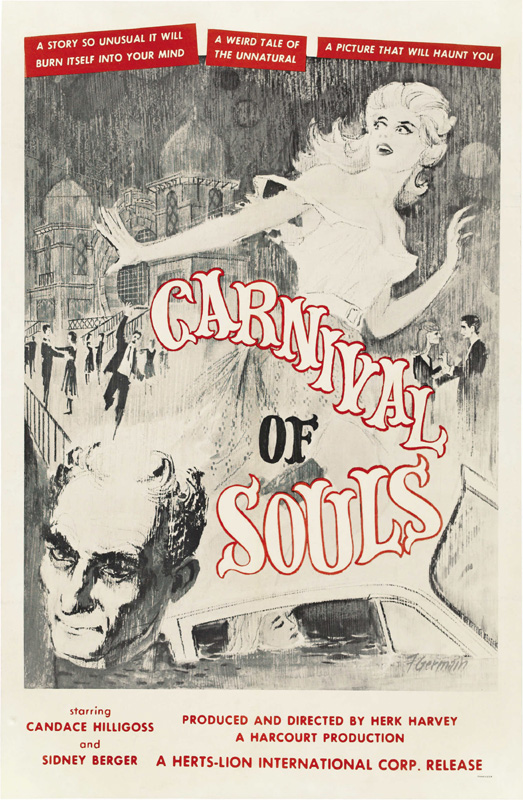
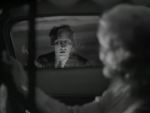
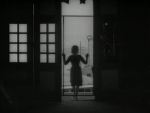
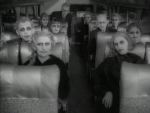
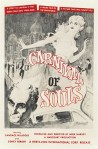
Today’s cinema adventure: Carnival of Souls, a 1962 low-budget horror film that was more or less ignored on its release, but which has gone on to become a highly influential cult classic.  Directed by Herk Harvey, a prolific lifelong creator of educational and industrial films who never made another theatrical feature, it was shot on location in Lawrence, Kansas and Salt Lake City, Utah, using a 16mm camera and reportedly with a budget of around $30,000- a cost which today would probably not even cover the price of the car that goes off a bridge in the first reel.  Needless to say, it’s a film that relies solely on atmosphere and cinematic storytelling to provide its scares, and the fact that it does so very well is no doubt responsible for its importance in the history of the modern horror genre.

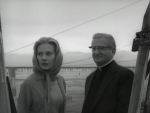
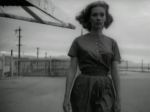
Despite its humble origins, the film’s screenplay, written by John Clifford from Harvey’s original story, is surprisingly sophisticated in its layering of thematic elements and even in the believability of its dialogue- considering the nature of its subject matter, that is.  The plot concerns Mary Henry, a young woman who works as church organist though she has no particular interest in religious sentiment.  A week before she is to begin employment in a new town, she becomes the only survivor of a car accident in which two of her friends are drowned.  Determined to go on with her life, she makes the trip to start her job as planned, but she soon finds herself being stalked by a mysterious specter- who cannot be seen by anyone else- and inexplicably drawn to an abandoned carnival pavilion on the shores of a local lake.  Her strangely cold and detached behavior, coupled with her increasing hysteria and delusional episodes, begin to alienate her new friends and associates, and she finds she must confront the mysteries that haunt her in order to escape them.  The story contains little action, per se; it mainly follows Mary as she attempts to start her new life.  Nevertheless, the tension builds steadily throughout, shrouded in a dreamlike surreality and accompanied by a tangible sense of foreboding.

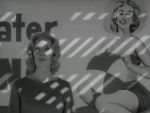
Much of the film’s unsettling mood has to do with the locations.  Director Harvey supposedly got the idea for his movie while driving past the abandoned Saltair Pavilion on the Great Salt Lake in Utah.  Though most of the rest of the movie was shot in Lawrence, where he was based, he paid the Salt Lake City Chamber of Commerce $50 for one week of filming at the ruined location; it was a good investment, because the scenes in this eerie, decrepit monument to cheap thrills long past can stand with some of the creepiest images ever put on film.  It’s a marvelous symbolic element- a giant, decaying fun palace in the middle of a desolate wasteland, a haunted shell evoking the futility of the good times it once housed in the face of the eternal emptiness that surrounds it.  To put it another way, it’s an apt reminder that, in the midst of life, we are in death, making it a perfect metaphor for the uneasy thematic core of the film.

The majority of Carnival of Souls, however, takes place in the kind of quiet, small town setting that can so easily serve to conjure thoughts of malicious forces lurking beneath the mundane familiarity of its surface- particularly when captured in the stark black-and-white palette of Maurice Prather’s cheap-but-effective cinematography.  Sunlit parks or dark nighttime highways, a crowded nightclub or an empty church, a bus depot or a department store- no place feels quite right or completely safe.  Even before the car accident in the opening scene, the lonely country roads seem threatening, and from the moment Mary emerges, dripping, from the watery scene of the crash, we spend the rest of the film waiting for the drop of another proverbial shoe.

It would not be fair, though, to place all the credit for this oppressive creepiness on the happenstance of starkly-photographed scenery.  The film’s humble director was clearly a man with a vision, evidenced by the fact that he worked, without salary and with money he raised himself, to make Carnival of Souls in three weeks with a crew of five- including himself.  Though there is definitely a clunkiness in his cinematic style, this has more to do with the limitations of his budget than with his understanding of the craft or his talent; the abrupt edits and the sloppy continuity are at least partly the consequence of a tight shooting schedule and insufficient funds.  There is ample proof, throughout the film, of Harvey’s ability as a director; he frames his shots with an eye for arresting composition, and his instinct for pacing belies his lack of experience with narrative fiction.  There are numerous moments when his use of clever camera trickery parallels that of directors like Hitchcock- whose work he no doubt studied- and the overall sense of inexorable menace, though enhanced by the settings and the visual style, is ultimately achieved by his cinematic rhythm- leisurely takes punctuated by short, sharp shocks at just the right moment- and his choices of what to show us and when to show it.  To top it all off is his choice of musical accompaniment- an otherworldly organ score composed by Gene Moore, a natural extension of the heroine’s occupational duties which provides the perfect aura of fruity gothic gloom to the proceedings.

As for the actors, most of the roles are handled by local Lawrence “talent,” unprofessional actors acquainted with Harvey through his industrial work; admittedly, there are some embarrassing performances on display throughout the film, though Sidney Berger deserves a mention for his unexpectedly complex work as a loutish boarding-house neighbor who tries to woo the oddly disaffected heroine.  A nod must also go to director Harvey himself, who makes a personal appearance onscreen as the ghoulish figure who plagues Mary, sporting pale makeup and leering malevolently- which may sound easy, but requires a certain finesse to pull off effectively, which he certainly does.  Obviously, though, his movie hinges on the leading actress, and he shrewdly spent his casting budget there, hiring an unknown but highly-trained and experienced performer named Candace Hilligoss; strikingly beautiful and fully committed to her role, she carries the weight of the picture on her capable shoulders, convincingly playing a variety of far-fetched conceits and walking a thin line between ethereal detachment and frightened vulnerability.  It would be overstating the case to say that she gives a great performance, but it’s a good one- certainly much better than the vast majority of would-be starlet turns in this sort of sub-B-grade horror movie.

That, of course, is exactly what Carnival of Souls is, despite the considerable praise it may have garnered over the 50 years since its inauspicious debut.  It’s unquestionably the kind of lowbrow drive-in fodder that was churned out ad infinitum during its era- it’s just that Harvey’s enthusiasm and dedication make it several cuts above most of the others.  To be sure, there is a level of artistry here that is hard to define; it’s not quite accurate to call the director a talented amateur, and the film’s stylistic strength is not accidental- he definitely knew what he was doing.  Even so, the power of this strange little film may lie beyond the full scope of his intentions or abilities, and is perhaps rooted in the notion that lies at its heart, the one which ultimately provides its twist ending- predictable as it may be, in this day and age.  Beneath its bogey-man thrills, it conjures a profound despair, perhaps the result of touching on some deep, unnamable dread, leaving a disturbing feeling that lingers long past its final frames.  It is this quality, more than the diamond-in-the-rough technical prowess of its director, which has placed Carnival of Souls so highly in the esteem of modern horror enthusiasts and provided dark inspiration for later, greater filmmakers like George Romero, David Lynch, and Quentin Tarantino.

It probably goes without saying that by today’s standards, the fright factor of this film is very low; and by any standards, its production quality is ridiculously shoddy.  The average modern viewer will probably find it laughable, the kind of movie that has gained its popularity from falling into the so-bad-it’s-good category.  Certainly, a screening with a bunch of quick-witted friends would probably yield some pretty snarky zingers, and that’s a good enough reason to recommend it; but while you’re laughing, make sure you take a close enough look to admire the weird beauty that emanates from Carnival of Souls.  However jaded you may be, there is something there that demands attention and commands respect.

 http://www.imdb.com/title/tt0055830/

Batman Begins (2005)

Today’s cinema adventure: Batman Begins, the 2005 action fantasy feature with which director Christopher Nolan initiated his vision of the classic comic-book hero, embodied by actor Christian Bale, re-envisioning the character and his world in a darker, more realistic vein that influenced a number of other subsequent franchise re-boots and brought a new level of depth and sophistication to the genre.  Focusing on Batman’s origins, Nolan traces the story of billionaire Bruce Wayne from childhood, when he witnesses the senseless murder of his parents by a mugger, through his recruitment and training by a mysterious organization called the League of Shadows, to his eventual return to Gotham City and his efforts to fight its rampant crime and corruption using both the skills he has learned and the high-tech gadgetry made available to him by the limitless financial resources he has inherited.  As he faces a host of opponents, he must also confront the enemies inside himself, learning to conquer his own guilt, anger, and fear in order to emerge as the symbolic hero he is driven to become.

It’s a familiar premise, by now, and one which has fueled a variety of interpretations since it was first invented by DC Comics artist Bob Kane in 1939; originally presented with a serious tone,  by the 1960s cultural “sophistication” had become such that the character had deteriorated to the level of a campy and outright comedic TV series- a classic in its own way, to be sure, but a far cry from the darker complexity suggested by the original comic books themselves and loyally embraced by generations of their fans.  Though the character was later reclaimed from this goofy image by such now-renowned graphic novelists as Frank Miller and Alan Moore, his incarnations on the big screen maintained a decidedly cartoon-like sensibility.  When Nolan was approached to resuscitate the franchise on film, he decided to take an approach more in step with the traditions of the comic books themselves.  With co-writer David S. Goyer, he fashioned an adult-oriented screenplay, centering more on the exploration of the character himself than on his far-fetched exploits- and making those exploits seem less far-fetched by infusing them with a hearty dose of realism.  The standard conceits of the story are built from the ground up, explained with a fresh perspective that makes them seem plausible; everything from the hero’s dual identity and theatrical tactics to the “Bat-cave” and “Bat-mobile” (which are never referred to as such) are presented as logical and necessary extensions of his self-creation, formed from the building blocks of his unique personal situation and the psychological forces which drive him, instead of being taken as rote.  It’s an imaginative approach that breathes life into the given clichés of the material, making the well-known mythology of the character feel fresh and contemporary.  In addition, by paying more than just perfunctory attention to the dominant themes of the Batman mythos- the importance of a father figure, the thin line between hero and villain, the relationship between fear and power, the purifying role of ethical behavior in a corrupt and chaotic world- Nolan and Goyer manage to give their film at least as much weight as most mainstream films aimed at a mature audience- and more than many.

All of which is not to say that Nolan’s vision of Batman is in any way light on action.  On the contrary, he fills his film with exciting set pieces made all the more satisfying by the care he has taken in laying a solid foundation; the various technological tools are more impressive for having been de-mystified, and the personal drama woven into the action raises the stakes and solidifies our investment in the outcome.  Furthermore, the action is structured into the story in such a way that the narrative is never put on hold; instead of digressing into extended displays of flashy spectacle, the plot advances through these sequences, making certain that there isn’t an extraneous or gratuitous moment in the film’s 140 minutes.

Much of the success of Batman Begins obviously hinges on its cast.  Nolan, drawing inspiration from classic seventies-era blockbusters like Superman, peppers his movie with an all-star list of gifted players, designed not just to lend credibility to the project but to provide the depth and complexity necessary for his conception.  It is not just the central figure that is subject to the director’s humanizing treatment; the entire array of familiar characters is infused with the kind of detail that raises them from the level of stock cardboard cutouts to three-dimensional beings with a life of their own.  Clearly, the writing plays a major part in this process, but the performances are a crucial factor, and the actors rise to the challenge admirably.  Heading the list is beloved veteran Michael Caine, whose portrayal of trusted manservant Alfred Pennyworth transforms the character from a mere source of comic relief to a powerful force to be reckoned with; thanks to Caine’s justly renowned skills, this aged gentleman’s gentleman is also a man’s man, wise and compassionate, brave and capable, serving both as a much-needed surrogate father and an indispensable ally to the troubled billionaire playboy in his charge- but grounded firmly in a reality that prevents him from ever seeming too good to be true.  As the future Police Commissioner, Jim Gordon, Gary Oldman matches Caine’s understated style in the creation of a sympathetic, powerful character, far from the pompously oblivious buffoon so often seen in previous versions; representing the traditional values of honesty, humility and family, he is an Everyman who becomes an unlikely hero, a worthy and equal partner in Batman’s fight against the forces of evil.  Liam Neeson is dangerously cool as Ducard, the mysterious figure who first becomes Bruce Wayne’s mentor and then his adversary in the fight for justice; Morgan Freeman provides his usual air of approachable dignity and intelligence as Lucius Fox, the techno-genius behind Batman’s bag of tricks; and Cillian Murphy brings an eerie, off-kilter edge to the proceedings as a corrupt psychiatrist with a dual identity of his own.  Rounding things out are Tom Wilkinson, memorable as an arrogant mob boss who finds himself a pawn in a game more powerful than his own, and Katie Holmes, earnest and likable as Wayne’s childhood friend and potential love interest.

It is Christian Bale, however, that must make or break the film with his interpretation of its iconic central character; and make it he does, going well beyond the usual troubled hero persona associated with the role and giving us a layered, remarkably specific and deeply personalized incarnation.  He fully inhabits Bruce Wayne, giving us a clear window into the young billionaire’s psyche and charting his psychological journey as he grows from an angry, vengeful youth to a passionate champion of justice; we believe in his commitment to the ideal because he allows us to see where it comes from, and because he invests so much of himself in Wayne’s emotional landscape he makes it possible for us  to identify with him- a rarity in screen portrayals of this character, which usually make him an aloof, distant figure, hard to fathom and harder to relate to.   In addition, Bale plays Batman as a clear extension of Wayne, a heightened version of his real self rather than a differentiated personality; indeed, in this version, it is the persona of the shallow playboy that seems artificial, a sham perpetrated half-heartedly by a young man for whom worldly extravagances hold no appeal and whose true nature chafes at being confined in so trivial a role- all of which, of course, serves to make us like him even more.  The only unsatisfying element of Bale’s work here is his lack of chemistry with Holmes; their relationship exhibits little of the spark that might give it meaning beyond its obligatory presence in the plot, so that when the would-be emotional payoff finally comes it feels like an afterthought.  Nevertheless, it’s a minor quibble in an otherwise wholly engaging performance.

This impressive line-up of A-listers inhabits a superbly realized vision of Gotham City, created by Nolan in collaboration with production designer Nathan Crowley, which draws heavily on visual influences from Ridley Scott’s classic, Blade Runner, incorporating the use of informed imagination in its depiction of the cityscape; featuring layered architectural styles that reflect the changing tastes of its long history and the mix of elegance and squalor that marks any major real-life metropolis, it’s a place that goes a long way towards establishing the realistic base from which Nolan draws his story.  Contrasting this claustrophobic urban atmosphere are the stately expanse of Wayne Manor and the breathtaking Himalayan landscape of the early scenes, all beautifully photographed by cinematographer Wally Phister, giving Batman Begins a distinctive look and feel that lingers in the mind’s eye.  It’s worth mentioning that Nolan chose to create the environment of his film largely through old-fashioned filmmaking techniques, using extensive footage of actual locations, soundstage mockups, and miniatures, and relying only minimally on computer graphic effects (mostly for animation of the elevated train sequences and construction of scenery using a composite of different locations layered together).  The action sequences were likewise completed with live action stunt work instead of computer-generated trickery, making the slick perfection of the film’s effects somehow even more dazzling.

The force that brings everything together, of course, is Nolan’s powerful and decisive direction.  He landed this project fresh on the heels of his surprise indie hit, Memento, and instead of choosing to helm yet another predictably generic franchise-based blockbuster, he decided to make the film his own, bringing into the mix such now-familiar trademark elements as his inventive, intricate plotting, his exploration of thought-provoking psychological and metaphysical themes, and his noir-influenced use of dark, morally ambiguous characters and situations- all of which fit the Batman milieu like a glove.  Aided by a moody, atmospheric score (jointly composed by Hans Zimmer and Thomas Newton Howard, who resist using the theme-driven formats typically found in films of this genre), he keeps the story driving forward with his heavy use of fast-paced editing and his intercutting of parallel threads, seamlessly interweaving themes and character development as he goes.  Keeping the momentum is key to Nolan’s purpose here: the film, after all, is called Batman Begins for a reason; though it has a completeness and a distinctive energy of its own, it is in fact a prologue, the first chapter of a saga that is meant to continue through a full cycle of films.  The director shrewdly provides sufficient thrills and closure to allow his film to stand on its own, but one can’t help feeling that he is holding back the use of his full arsenal to leave us wanting more.  As Batman Begins rolls to its conclusion, the final scenes feel more like a pause than a full stop, and the sequel-minded hints dropped within the final minutes only serve to feed an anticipation that Nolan has already been building from the very first frames.

As to that sequel, it will hardly be a spoiler for me to say that it was to become the single most successful movie of all time (at least until it was recently deposed by another comic-book film, The Avengers) and that its financial triumph was equally matched by its critical reception; but I’ll touch more on that subject later this week, in anticipation of the imminent release of the final installment of Nolan’s Batman trilogy.  My purpose here is to revisit the first of these remarkable, genre-defying films, which, though it falls somewhat short in comparison with at least one of its future companion pieces, gives more than a sufficient hint of the audacious brilliance that is to come.  Batman Begins is polished and powerful, a movie that treats its source material with the respect and maturity it deserves and, at long last, frees the “comic-book movie” from the assumed stigma of being second-rate schlock, opening it to the possibility of being considered as worthy and important as any “serious” genre.  It’s the first movie in which a so-called superhero (though technically, of course, this particular hero possesses no super powers) is presented in a manner realistic enough to be believable, and even if its fantasy elements are strong enough to ultimately keep it from breaking completely free of its genre, it sets the stage for its creators to accomplish that landmark feat with their next effort.  All these considerations aside, however, it’s more than enough to say that Batman Begins is a pulse-quickening piece of entertainment, fully deserving of its own considerable success and worthy to stand alongside the best this increasingly popular genre has to offer.

http://www.imdb.com/title/tt0372784/

Abraham Lincoln: Vampire Hunter (2012)

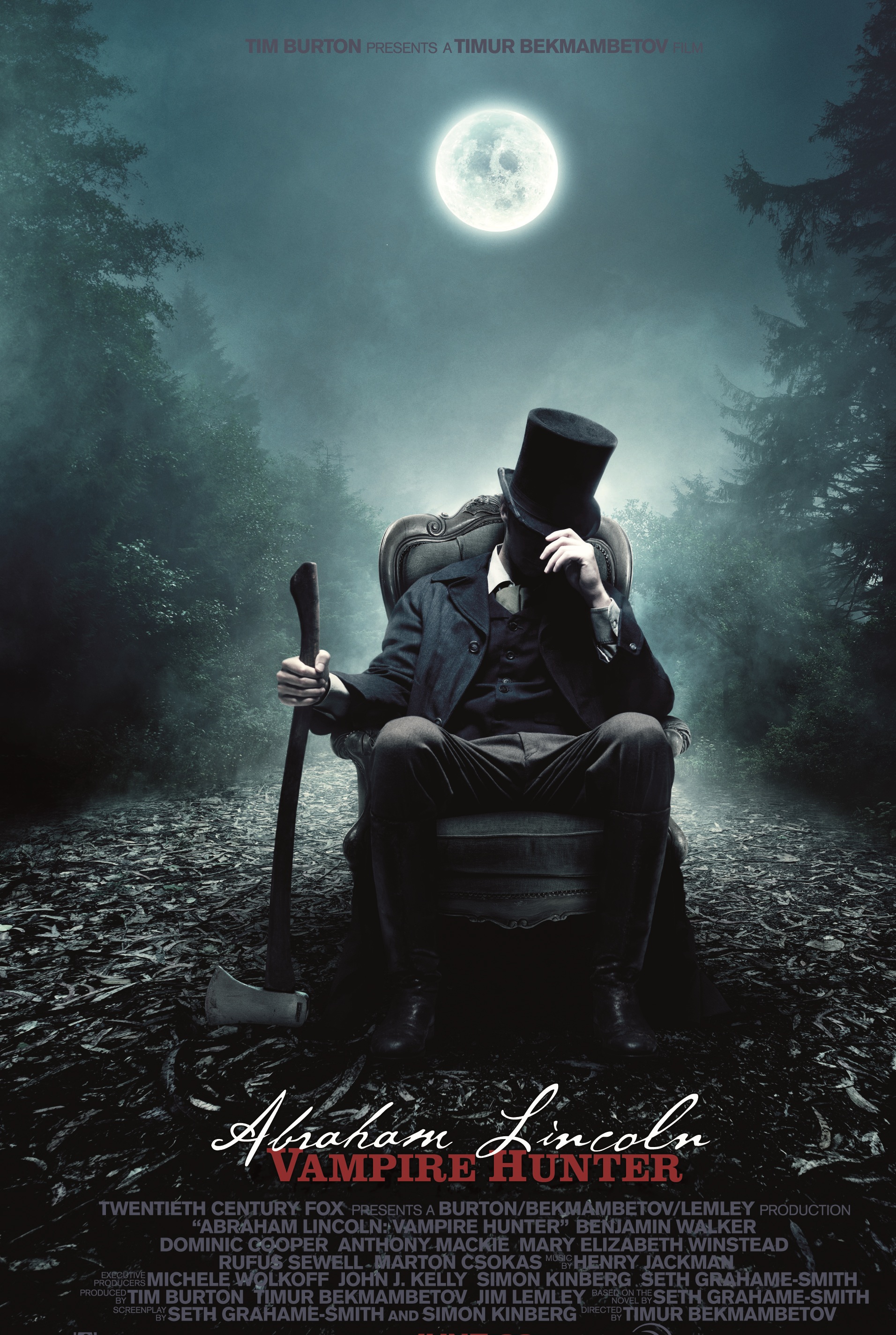
Today’s cinema adventure: Abraham Lincoln: Vampire Hunter, the 2012 feature based on the bestselling historical fantasy/horror novel by Seth Grahame-Smith, casting the already-heroic 16th American president in the even more heroic role of a secret slayer of the undead.  Directed by Timur Bekmambetov and adapted by the novelist himself, it’s a movie that hinges on a bold juxtaposition of historical fact and supernatural adventure, with a flashy visual style and an emphasis on bloodshed and action.  The plot follows Lincoln from his childhood, when his mother is ostensibly poisoned by his father’s former employer; upon reaching manhood, he seeks to avenge her murder, only to discover that her killer is in fact an undead monster.  Narrowly escaping death himself, he is rescued by a mysterious stranger, who reveals to him the secret existence of vampires living in the midst of human society and offers to teach him the skills he needs to become a warrior in the ongoing battle against them.  He becomes a master hunter, and his discovery of an insidious connection between vampires and slavery fuels his parallel political career, culminating in his presidency and providing underlying motivation for the Civil War.

With such a blatantly ridiculous premise, one might expect a substantial amount of tongue-in-cheek self-mockery, coupled with a sense of goofy fun for its own sake.  These elements are definitely present, but Abraham Lincoln: Vampire Hunter takes a decidedly serious tone in its approach to this genre-mashing mixture of history and hokum; Lincoln’s secret calling is no parenthetical side job, but is integrally woven into the events that shape both his private and public lives, as well as into the fabric of some of our nation’s still-most-painful memories.  It would be unforgivably glib of the film’s creators to make these connections without investing an appropriate amount of weight in the proceedings; accordingly, Lincoln’s dedication to vampire-killing stems from deeply personal motivation, rooted in the monsters’ victimization of his family, and their thirst for blood is linked directly to the most contentious and shameful issue ever to face the United States.  Of course, tying these various personal and national tragedies to a narrative about inhuman, bloodsucking parasites may have rich metaphoric possibilities- which, unfortunately, remain largely unexplored beyond the obvious implications of the situation- but it doesn’t do much for fueling the kind of escapist melodrama promised by the audaciously wacky concept.

Most of the critical unkindness towards this film has revolved around its insistence on anchoring its bloodlust-fulfillment fantasy in a sense of earnest importance, as if its purpose were to present a legitimate portrait of Honest Abe and his far-sighted principles.  Indeed, the world of Abraham Lincoln: Vampire Hunter is a place where lofty ethical considerations seem moot, a given condition of the larger political order, perhaps, but out of place with the more immediate conflicts of our hero’s secret occupation.  The situation cries out for the kind of unapologetic amorality found in a down-and-dirty exploitation film, contrasting Lincoln’s public face as a wise and compassionate leader with his role as a one-man boundary between the forces of darkness and the unknowing society he is sworn to protect.  The very title of this movie suggests a no-nonsense, merciless killing machine, and that is not only what we expect to see, it’s what we want.  Instead, we are given an idealized version of the real man, and a slice of his personal drama thrown in to boot- for which, presumably, we could easily wait until next year’s highly anticipated Spielberg biopic.

All of these problematic reservations can be attributed to the screenplay, written by Grahame-Smith with an eye towards keeping the emotional stakes high enough to keep viewers connected to the characters in the midst of all the slaughter.  By giving the plot a sense of purposeful noblilty and including a substantial dose of Lincoln’s private life as a lover, friend, husband, and father, the author hoped, presumably, to avoid turning the whole affair into a garish cartoon.  The effort is commendable, as is the attempt to maintain at least a tenuous connection to historical accuracy (with a few notable exceptions), in the use of names and relationships, actual events and chronology, etc., even if the details are rearranged considerably.  However well-intentioned he may have been, and however well these factors may have worked in his novel, the writer may have miscalculated; though normally I am adamantly in favor of the thoughtful, character-driven approach to storytelling for the screen, in this case I believe the film as a whole would have benefited from a lighter, less self-consciously sincere touch- and more scenes of Mr. President wielding his silver-edged axe.  The very notion which drives the plot demands a film which doesn’t take itself too seriously, and thanks to its script, this one often does.

I have always, however, been an advocate of taking a movie on its own terms, and with that in mind, Abraham Lincoln: Vampire Hunter is by no means a failure.  Though the weighty trappings of pseudo-biographical drama make for some slow going from time to time, when the movie does release the giddy adolescent joyride at its core, it takes off like a silver cannonball.  Director Bekmambetov delivers the same kind of flashy, multi-speed, computer-assisted action that helped to make his previous film, Wanted, a hit, transporting us decisively into the realm of superhuman feats, where we can at last get a taste of the thrills inherent in the idea of our chief executive moonlighting as a bad-ass monster-killer.  There are a number of these electrifying set pieces scattered throughout the film- a chase across the backs of a stampeding herd of horses, a gruesome monsters’ ball in a decrepit plantation, a climactic fight on the rooftop of a moving train- all saturated with grisly, blood-spattered, and deliciously satisfying violence.  It is in these segments that the movie really comes to life, and, like a true showman, Bekmambetov always leaves us wanting more; though everything in between often feels like filler, the payoff we receive from this kind of exciting screen action is almost worth the patience it takes to get there.

Bekmambetov ‘s slick modern style brings a contemporary edge to the movie that contrasts sharply with its period setting- which is firmly established with authenticity in the clothes and the physical surroundings, and further complemented by the effect of using muted, faux-sepia tones in the cinematography (possibly the film’s finest asset, accomplished by the legendary Caleb Deschanel).  This color palette has the odd benefit of seeming both old-fashioned and yet somehow very high-tech, a double-edged description that could be used to sum up the overall production design (by François Auduoy); the look and feel of the film, heavily reliant on computer graphics, creates a heightened reality, reminiscent of the dramatic visual style of a comic book.  Though this stylized environment adds a layer of artificiality to the proceedings, it also reinforces the supernatural atmosphere necessary to sustain the film’s absurd conceit.

The actors are more than adequate for the task at hand, with Dominic Cooper and Rufus Sewell standing out in the showiest of the supporting roles- Lincoln’s mentor and the vampires’ supreme leader, respectively.  Obviously, though, it’s the title character who must shoulder the heaviest burden here, and young Benjamin Walker’s shoulders are broad enough to do it.  He does a fine job of walking the thin line between Lincoln the man, Lincoln the statesman and Lincoln the terminator, and, on top of that, is convincing playing the great man from youth to weathered middle age.  He even bears a resemblance to Lincoln, though he is considerably more handsome- a requisite Hollywood touch.

There is something about Abraham Lincoln: Vampire Hunter that draws me in.  Maybe I’m just a sucker for this kind of preposterous “what if?” speculation, or maybe I’m just a big kid at heart, but from the very moment I heard about this movie, I was excited to see it.  Though in the end it was not quite the kind of adrenaline-pumping silliness I was hoping for, I can’t say I was disappointed, either.  Sure, I would have liked a little more of the gory action that worked and a little less of the pedestrian costume drama that didn’t; but there is plenty in this movie to tickle my juvenile fancy and keep me interested throughout its running time.  Even if that weren’t the case, the final scene contains an amusing twist that left me fairly delighted as the end credits rolled- and if I can walk out of the theater with a smile on my face, I think that’s a good enough reason to recommend a film.  So consider it recommended, but with the following qualification: it’s a stupid movie, but perhaps not stupid enough.  If you can get past that, you’ll have a great time.

http://www.imdb.com/title/tt1611224/

The Many Faces of Peter O’Toole

Today we take a rest stop on our cinema adventure to pay tribute to the magnificent Peter O’Toole, who announced his retirement this week after over fifty years as an actor.  One of the true greats, and one of the last of a generation of working-class English actors who changed everything about the British stage and screen, he became an international star with Lawrence of Arabia and has been an icon ever since, elevating even the most pedestrian of his movies with his presence.  Just shy of his 80th birthday, he has declared it’s time to “chuck in the sponge.”  You have to respect a man who knows when it’s time to quit, even when he will be sorely missed.  His legacy is enviable, and even though everyone likes to talk about the fact that he has the worst Oscar record of any actor so far (8 nominations, no wins), he has made more classic and unforgettable films than almost any winner I can think of.  Enjoy your rest, Pete.  You’ve earned it.

Click on the tribute collage above and see how many of his movies you can name.  Just for fun!

The God Who Wasn’t There (2005)

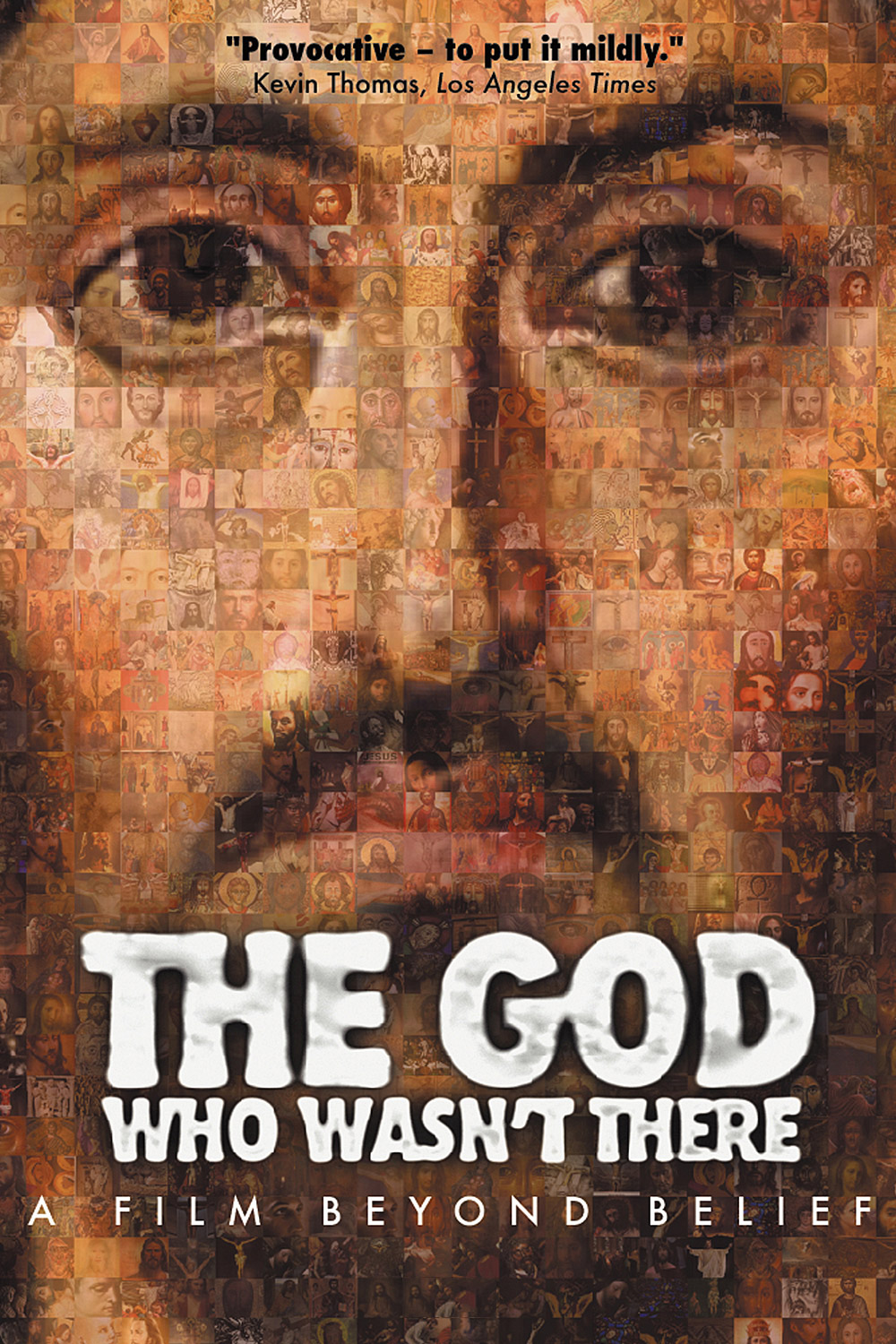
Today’s cinema adventure: The God Who Wasn’t There, a 2005 documentary by Brian Flemming, which examines fundamentalist Christian beliefs in contrast against the historical facts around the origin of the religion and explores the impact of such beliefs in a modern social and political environment. Controversial by its very nature, the film makes no pretense of objectivity, presenting its case with a heavy tone of bemused irony and using duplicitous confrontational tactics to elicit responses from interviewees, and ultimately representing the filmmaker’s personal attempt to repudiate, once and for all, his own past as a fundamentalist Christian and take a stand against the supposed moral authority that dominated his former life. More in the nature of propaganda than documentary, it’s a film that nevertheless succeeds in making its point with verifiable and persuasive facts, and, perhaps more importantly, does so in a highly entertaining manner.

The man behind the camera (and occasionally in front of it) is no stranger to controversy over his work; his previous film, Nothing So Strange, sparked outrage over its depiction of a fictitious assassination of Bill Gates, presented in “mockumentary” style. This time around, he fueled the fires already swirling about his film with various marketing and publicity ploys, including an internet contest offering free DVDs of the movie for the first 1001 people to submit a video in which they blaspheme themselves by denying the existence of the Holy Spirit. Needless to say, the filmmaker exhibits a fondness for deliberate incitement that finds its way into The God Who Wasn’t There.

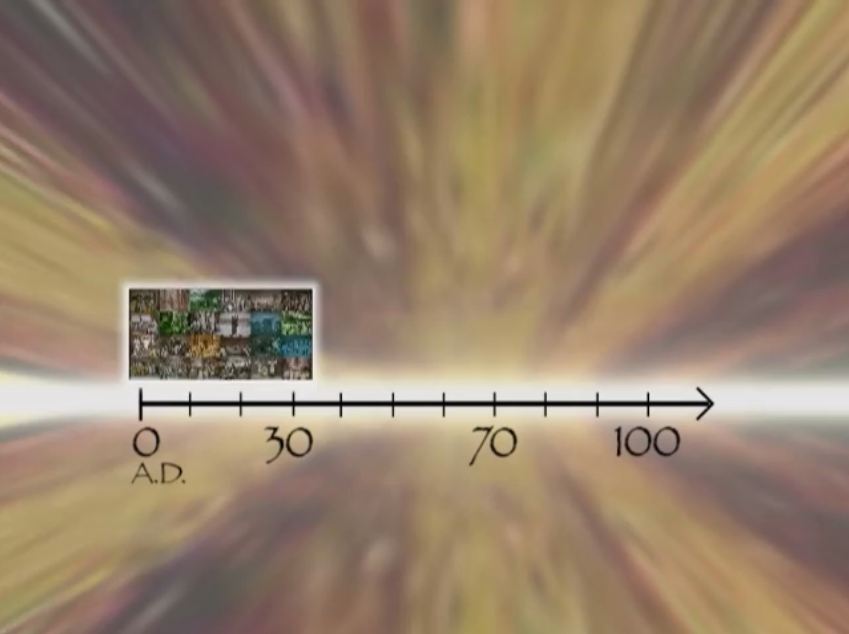
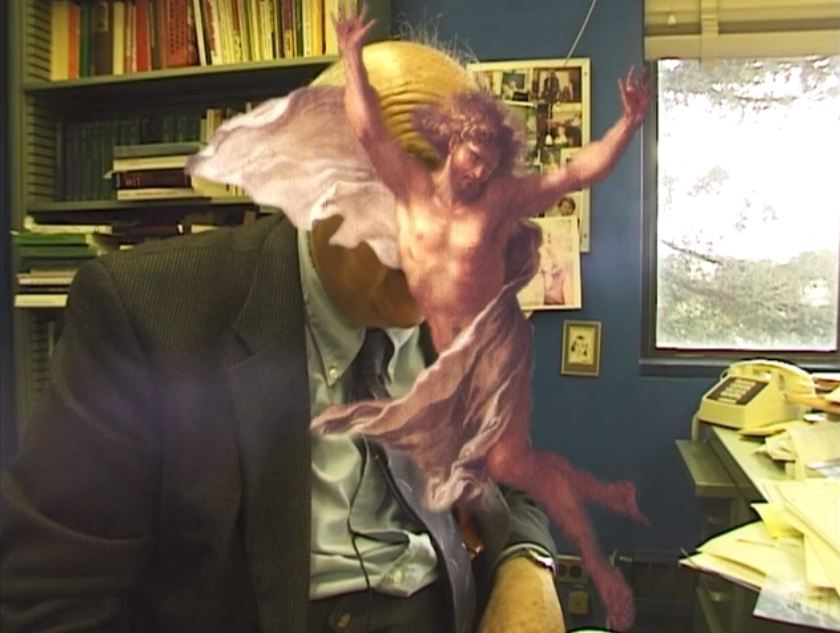
Flemming structures his film into two distinct parts. In the first half, he looks at the difference between the commonly held ideas surrounding the early days of the Christian faith and the factual information in the historical record, making the case that the commonly accepted story of Jesus is a myth, deliberately created by the founders of the church and understood as such by both them and their early followers; he goes so far as to suggest that Jesus never existed as a real person, and that literal interpretation of his life story as presented in the Bible and the surrounding traditions is in direct opposition not only to historical evidence, but even to the writings of early Christians such as the apostle Paul. In the second part of the film, he explores the effect of fundamentalist beliefs in modern society, including the idea of “The Rapture,” and culminates with a visit to the principal of the private Christian elementary school he attended as a child, examining the doctrine that the one unforgiveable sin is to disbelieve the existence of the Holy Spirit- and drawing his conclusion that the greatest blasphemy of all, in the eyes of the Christian church, is to think.

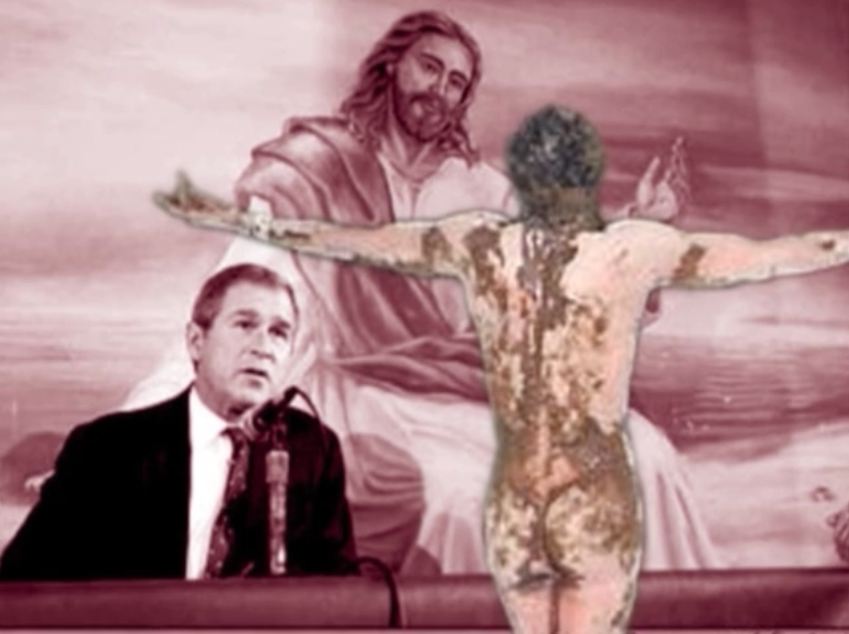
Despite its title, Flemming’s film does not directly address the existence or non-existence of God, per se; his purpose is a temporal one, namely to expose the fallacies and contradictions at the core of modern Christianity and illustrate how a belief in these outdated and misinterpreted ideas affects life in a contemporary world- not just life for the believers, but for everyone else in a society largely influenced by their prejudices and moral agendas. To say that his premise is contentious is an understatement; but it’s certainly nothing new. The ideas he presents in his analysis of the supposed life of Jesus and its basis in literal historical fact are familiar to anyone who has ever examined the faith from the perspective of comparative mythology, and there are literally hundreds, if not thousands, of books devoted to the subject- indeed, the authors of some of these books are among the experts Flemming interviews in his movie. As for the portrayal of fundamentalist Christians and their relationship to the larger culture, the basic conflict between religious dogma and reasonable political policy has been a subject of debate ever since the dawn of the Age of Reason- a fact clearly reflected by the long-standing democratic doctrine mandating the separation of church and state. The God Who Wasn’t There is not a groundbreaking source of new information or world-changing ideas; rather, it is a presentation of well-documented, oft-repeated facts, heavily flavored with flippant cynicism born of the necessity for addressing the issue yet again in a modern, supposedly enlightened world.

It is, in fact, this snarky tone that makes Flemming’s movie enjoyable. In illustrating his points, he finds amusing and pointed ways to emphasize the enormous gap between contemporary reason and the antiquated notions of fundamentalist religious beliefs. From his opening narration detailing the centuries-long dispute between science and faith regarding the revolution of the earth around the sun (or vice-versa, as the church would have kept it), to his heavy utilization of excerpts from The Passion Play (an early, stodgy French silent about the life of Jesus) and The Living Bible (a creaky “educational” film from the 1950s), he makes it clear that- in his estimation, anyway- the fiercely held tenets of Christianity are seriously out-of-step with the intellectual standards demanded by life in the present day; and through his use of interviews with hardcore believers in the faith, he underscores his observation that the majority of modern fundamentalists are not only misinformed and ignorant of the true history of their religion, they are in fact defiantly uninterested in learning anything about it. Their alliance to faith is so deeply ingrained, they exhibit skepticism and mistrust towards empirical knowledge rather than entertain any ideas which might lead them to question their beliefs. It would be easy to accuse Flemming of painting Christians as uneducated and delusional, were it not that some of the experts he brings to the discussion profess their own belief in a more enlightened interpretation of the faith- though it’s also worth noting that, in one sequence, the filmmaker points out that the idea of “moderate” Christianity, taken from the standpoint of strict adherence to Biblical teachings, is in fact not Christianity at all.

The God Who Wasn’t There features a number of sequences that are both entertaining and alarming, but one in particular stands out. Roughly midway through the film’s short running time, serving as a sort of segue from the mythological analysis into the more direct examination of the modern church, Flemming looks at the connection between Christianity and the earlier, blood-sacrificing religions that marked the culture in which it sprang up. There are obvious correlations in these ancient mythologies to the Christian idea of a man being brutally, ritualistically murdered in order to redeem the sins of everyone else; but Flemming points out how this obsession with bloodshed seems to persist within Christian consciousness even today, centuries beyond these primitive, paganistic origins. To illustrate this, he looks at the popularity of Mel Gibson’s 2004 film, The Passion of the Christ, by far the most financially successful movie ever made about Jesus; using clips from the film, edited together for maximum effect, he focuses attention on the excessive amount of highly explicit blood and gore used by Gibson, creating a scene-by-scene gore analysis showing that only a small percentage of the running time is actually blood-free, and pointing out that such an overwhelming use of graphic violence is the result of a calculated, deliberate effort on the part of the director- and one which, clearly, paid off, tapping sufficiently into something deep within the Christian community that made them come to see his movie in droves. Gibson, it’s worth mentioning, tried unsuccessfully to bring legal action against Flemming. Apparently, the free publicity for his movie was not enough to make him comfortable with the implication that his pious epic was motivated by exploitative greed.

It probably goes without saying that Flemming’s movie is designed to provoke controversy and stimulate discussion about its subject matter. It is also no surprise that the issues it deals with are so emotionally volatile; the challenge of maintaining religious faith in the face of ever-increasing scientific knowledge has never been easy, and it grows more difficult every day in our world of stem-cell research and Higgs-Boson particles. The fact is, however, that The God Who Wasn’t There, like the numerous other contemporary films which challenge dogmatic religious beliefs, is not likely to be seen by many of the viewers at which it is optimistically aimed; and even if it were, those for whom fundamental belief is a cornerstone of daily life are not prone to being swayed by any amount of factual information, an observation made abundantly clear by Flemming in the film itself. As a result, his movie can be characterized as the proverbial “preaching to the choir,” in the sense that most of his audience will already be sympathetic, if not pre-acquainted, with the concepts he presents. Nevertheless, it’s a fun presentation to sit through, if you’re comfortable with using intellect in the realm of spirituality- his use of graphics in illustrating his research is eye-catchingly flashy and clever, and his musical accompaniment (executed by himself, under the pseudonym “DJ Madson”) is appropriately hip and contemporary, at least by 2005 standards. It’s also possible that there is an audience, situated in the middle-ground of this question, who may benefit from Flemming’s work here; those who are on the brink, indoctrinated by years in a church-centric environment who nevertheless have questions and doubts- in short, people who are like he once was, himself. For them, watching The God Who Wasn’t There might be an eye-opening, life-altering experience, one which has the potential to make a difference in the way they see the world and, by extension, the way they affect it. After all, the social and political issues examined here have grown even more pertinent over the seven years since the movie was made; the conflict between fundamentalist thinking and social progressivism has never been more pronounced- or more imperative- in recent memory.  I, for one, hope there are those who are drawn to Flemming’s movie by curiosity and find that it helps them choose, finally, to come over the fence on which they have been sitting for so long.

http://www.imdb.com/title/tt0455507/

Parting Glances (1986)

Today’s cinema adventure: Parting Glances, the 1986 first (and only) feature by writer/director Bill Sherwood, hailed as a landmark in the history of gay cinema and also notable for featuring actor Steve Buscemi in his first major film role.  Made on a shoestring budget in 1984 and finally released two years later, it was chosen as the first movie to be restored by the Outfest Legacy Project in 2007, and it still stands today as one of the most refreshingly authentic representations of gay life yet to be seen on the American screen.

Shot entirely on location in New York, the film follows a young upwardly mobile couple, Michael and Robert, through the events of a 24-hour period; Robert is preparing to leave for a two-year work assignment in Africa, while Michael, facing the prospect of being left alone, ponders the uncertainty of their future together- as well as the inevitable demise of his AIDS-infected ex-boyfriend, Nick, with whom he still shares a deep bond.  As the couple attend a dinner party with Robert’s boss and then a farewell gathering with their friends, the movie gives us a cross-sectional slice-of-gay-life view of mid-eighties New York, using the various interactions and activities of its characters to explore not only the relationships at its center, but also the concerns and issues that affect them as a community and as individuals.

One of the primary reasons for the importance of Parting Glances, of course, is the window it provides into the days when the AIDS epidemic was at its height; it was a time when being diagnosed with the disease was, in essence, a death sentence, and the gay community was being ravaged.  This humble little film was one of the first to deal with this issue, and certainly the first to treat it with candor rather than with alarmist sensationalism.  Though only one of the characters is afflicted by the virus, it is clear through the conversations and situations we are privy to throughout that it’s a situation that deeply affects them all; it hovers around the edges of their lives like the ominous Don Giovanni-inspired specter that appears to Nick in a few key scenes, a factor in everything they do, say, or plan.  Despite its omnipresence, however, the subject of AIDS does not receive the kind of dour and mournful treatment one might expect, particularly from a film made in the midst of its darkest hold on the hearts and minds of the gay community; nor is it handled with the precious, maudlin sentimentality of so many of the movies that came after.  On the contrary, though its weight and seriousness are never in question, Parting Glances takes a disarmingly light-hearted approach to the disease: Nick does not play the morose and tragic victim; his ultimate decline and fall are a given, but, for now at least, he is still relatively healthy, and his brash,  vibrant personality is the heart of the movie.  He faces his fate with staunch acceptance, yes, but also with a hearty helping of gallows humor and nothing-to-lose directness.  The dire eventuality of his situation is implicit, and this film feels no need to hammer the audience with it; its focus, rather, is on the present moment, and the opportunity it affords for taking stock, seizing the day, and perhaps most importantly, tending the needs of the heart.

Though AIDS looms heavily over Parting Glances, it is by no means the only subject with which the film concerns itself.  The central storyline, after all, deals with the relationship of Michael and Robert, and its future- or its lack of one- is not contingent on a life-threatening disease; rather, it hinges on their own respective ambivalence, their fear of commitment, and their ability to be emotionally available to each other.  In short, the obstacles in their joint path, though they may be somewhat obscured or confused by the comparatively minor attendant factors of same-sex unions, are the same ones faced by any couple, gay or straight; the film does an admirable job of underlining this universality, placing the pair in juxtaposition with other couples, straight and not-so-straight, throughout its proceedings, and while it makes no judgments regarding the validity or moral superiority of any of these relationships, the dynamic between our two protagonists seems to stack up at least as favorably, more or less, as any of the others.  Michael’s relationship with Nick is also a key factor here- their easy chemistry and bantering rapport contrast sharply with the often strident interactions of Michael and Robert, opening up questions about compatibility and the line between romance and friendship- particularly among same-sex partners.  There are plenty of non-romantic relationships on display here, too: Michael and several other characters connect closely with Joan, the “hag” who hosts the going-away party and serves as a sort of combination best gal-pal and den mother; there’s also Robert’s boss and his wife, who bond with Robert and Michael, respectively; Robert’s former high school girlfriend, now married but still a confidante; and a number of other friends and acquaintances who interact with the couple and each other throughout the course of the film.  All of these exchanges offer insight into the social tapestry of this insular community, and key us into the pulse of this specific time and place, as well as revealing the repetition of timeless patterns and themes within the sphere of human connectivity, gay, straight, or anywhere in between.

It might seem like there’s a lot going on in Parting Glances, and of course, there is; but despite its busy agenda, it never feels as if it were packed too full, nor does any of it seem forced.  Thanks to Sherwood’s witty, flowing screenplay, all the major issues and themes work their way unobtrusively into the dialogue, weaving through the conversations naturalistically and convincingly instead of being introduced as didactic rhetoric; these are real people discussing their lives, not mouthpieces presenting a case, and as a result, the movie feels like a stimulating party instead of a public debate.  This organic quality is enhanced all the more by Sherwood’s engaging cast, who are clearly having a wonderful time as they present us with a wide variety of familiar “types” (as opposed to stereotypes) within the gay and gay-friendly community.  As Michael and Robert, respectively, are Richard Ganoung and John Bolger; both are attractive and likable, but they are not a cookie-cutter couple- each has their own distinctive persona, and they both clash with and complement each other in a highly realistic and believable manner.  Kathy Kinney plays Joan, providing a grounded, female presence with a character that rises above potential cliché; she is both insightful and incorrigible, and she conveys- subtly, and without self-pity- the resignation of a life possibly lived vicariously through her friends.  Also memorable is Adam Nathan, as a self-assured young “twinkie” who sets his sights on Michael; ready to claim the world from an elder generation that is not willing, quite yet, to give it up to him, he succeeds in being endearing instead of insufferable, and his scene with Nick on the stairs outside the party is a highlight of the film.  The standout performance, though, comes from Buscemi, who does a remarkable job of playing Nick; the character is doomed but delightful, a combination which could easily seem glib and artificial in the hands of a lesser actor, but he pulls it off superbly, making it clear that his sardonic wit and his edgy personality are part and parcel of who he is- not an affectation in response to his status as a member of the walking dead- and that underneath them there is a large and generous heart.  His desire to leave behind a legacy for his friends goes beyond the material items in his last will, semi-substantial though they may be (he is, it seems, a minor rock-and-roll star); he actively means to make a difference in their lives, and Buscemi’s work allows us to see the genuine love at the source of these efforts.  Lest we think his Nick is too good to be true, though, he still manages to get across, in little ways, here and there, that he is not altogether okay with what is happening to him, despite his brave face; but this never gets in the way of the positive energy he exudes throughout.  It’s a performance that should have made Buscemi a star, much sooner, and would have, no doubt- if the movie had been more widely seen.

There are numerous other enjoyable qualities here, not the least of which is the way the film captures the look and feel of mid-eighties New York; this is no surprise, of course, considering that is when and where it was filmed, but some credit is still deserved by the production designer (John Loggia), the art directors (Daniel Haughey and Mark Sweeney), and the set decorator (Anne Mitchell) for deciding what should go into the series of well-appointed homes and apartments that provide the setting, as well as to cinematographer Jacek Laskus for deciding how to film it, with special kudos to all involved for making it look so polished despite the bargain-basement budget.  Also contributing to its evocation of time and place are the soundtrack choices, a combination of songs by Bronski Beat and original, very posh-sounding piano music by Mike Nolan, with some operatic selections thrown in, by way of Nick’s LP player, for good measure.

It seems somehow wrong to say that a movie made at the height of the AIDS crisis, featuring AIDS as a major subject and set among the gay community, is entertaining and fun; but that’s exactly what Parting Glances is.  Though it is unquestionably dramatic in its overall scope and intention, it makes sure even the heaviest matter is carried along by an effervescent current, and precisely because it doesn’t continually remind us of how poignant and moving it should be, it ends up being extremely poignant and extremely moving- particularly, I might add, for those who have lost friends like Nick in the long battle with AIDS.  As its title suggests, this is a movie about saying goodbye, not just to the dead, but to the living as well- the continuation of Michael and Robert’s relationship is by no means a sure thing at the end, after all; but bittersweet as it may be, it is also a film about moving forward.  The script clips along, the actors and the camera are constantly in motion, and the entire flow carries us through to the end, leaving us with a tangible momentum.  People come and go, things change, but the world keeps moving, and maybe part of what Parting Glances suggests is that our only real way of leaving something of ourselves in the mix is to make sure our lives touch those of the people who surround us.  In this day and age, it’s possible to watch Parting Glances and entertain the hope that Nick will be one of those lucky survivors who managed to hang on to life until medical science caught up enough with the disease to at least stave off death, and that he, like so many millions today, could still be out there thriving as an HIV-positive man.  If so, he would be luckier than the film’s creator, who passed away from the disease in 1990, without making another film and without surviving to see the way this one was embraced and revered by his own community, as well as by the larger cinematic world.  His movie stays with us, however, and through it, he continues to touch lives today.  So perhaps, truly, he was a very lucky man indeed.

http://www.imdb.com/title/tt0091725/

Crash (1996)


Today’s cinema adventure: Crash, David Cronenberg’s highly controversial and disturbing feature about a group of car crash survivors and the obsessive sexual fetishism they develop around their experience. Based on the equally controversial novel by J.G. Ballard, it was banned from public screening in its country of origin (Canada) as well as in many other countries, and released in both an R- and NC-17-rated form in the U.S. Despite widespread protest and outrage over its combination of graphic sexual and violent content, it was widely acclaimed by critics for its bold depiction of an uncomfortable and unorthodox subject matter, as well as for the cinematic prowess of its director in bringing his twisted vision to the screen.

The plot, such as it is, focuses on James, a sexually adventurous film producer whose marriage to the beautiful Catherine is spiced up by the reports they bring back to each other of their mutual infidelities. After a traumatic automobile accident requiring a lengthy hospital rehabilitation, he becomes involved with a community of other survivors that has gathered around Vaughan, a charismatic and hyper-sexual figure who encourages- and participates in- the merging of their sexual impulses with their fixation on the crash experience; James draws Catherine into the circle to join him, and with the others they explore ever-riskier fantasies in the pursuit of their dark passions. Though there is a structural arc to the story, which involves Vaughan’s role as sexual mentor and the gradual transference of his obsessions to James and Catherine, the narrative takes a back seat, if you’ll pardon the expression, to Cronenberg’s perverse fantasia of sexual deviancy.

From the very first scene, in which we see Catherine pressing her exposed breasts against the fuselage of an airplane during a clandestine encounter in an airport hangar, Cronenberg sets up his motif, a juxtaposition of soft flesh and hard metal which strives to make the viewer’s experience as close as possible to a tactile one; as the film progresses, it moves through its brief interstitial scenes- ostensibly necessary for the advancement of the plot, but in actuality merely required for establishing the next sexual scenario- into one graphic encounter after another, each one pushing us further past our comfortable boundaries and deeper into an unfamiliar realm of extreme sexual fetishism. Taboos fall away one by one as we witness erotic acts between various combinations of genders, performed in private and in public, involving sexual and non-sexual body parts, and almost always in connection with cars. This saturation of sexual imagery is not gratuitous: Cronenberg’s aim is to turn us on, certainly; but by mingling blatant eroticism with the adrenaline rush of recklessly driven vehicles, the carnage of roadside disasters, and a heavy dose of the body horror he so frequently returns to in his films, he triggers our sexual response alongside our conflicting reactions of fear and repulsion- alerting us to the possible dark corners in our own libidos and making us paraphiles by association. It’s an effect that makes Crash a highly unique cinematic experience, a sexual horror film which completely removes the distancing elements between our shock and our arousal- the subject he shows us is the object of both.

Of course, this experiment in dysfunctional autoeroticism is not for the squeamish; even those comfortable with explicit sexual content may find themselves turning away from the accompanying depictions of twisted metal and disfigured body parts, and most especially the frequent merging of the two. Those who are able to brave it out, however, might find themselves in awe of the way Cronenberg uses his skill to manipulate their wiring, like some sort of mad psychosexual scientist, to elicit responses ordinarily deemed inappropriate in the face of such stimuli. At the very least, the film begets a grudging admiration for its director’s ability to exploit the basic similarity between the primal reactions to sex and horror, and to use it in a visceral exploration of themes usually handled in the realm of intellect- the role of social conditioning in defining “normal” sexuality, the aphrodisiac effects of dangerous or forbidden behavior, and the age-old psychological connection between sex and death.

In bringing Ballard’s novel to the screen, Cronenberg (who also wrote the screenplay) updates it from its original 1970s setting and transposes the action from London to Toronto, but the underlying feeling of participating in something you shouldn’t remains the same, as does the tantalizing use of the author’s last name for the leading character, though Ballard denied any autobiographical connections (which didn’t stop eyebrows being raised when he was seriously injured in a car accident shortly after the book’s publication). To add another coincidental wrinkle, the character shares his first name with the actor portraying him, James Spader. Cronenberg’s shrewd casting adds another layer to the motif of contrasting textures, with outwardly cool, aloof performers- Spader and Deborah Kara Unger (as his wife)- colliding with the hot, rough, seething energy of Elias Koteas as Vaughan. The sparks are palpable; Koteas exudes raw, musky sensuality in every scene, making it clear how this underground sexual prophet attracts his furtive, broken followers. As a fellow survivor of the same crash, whose affair with James is the first step on his journey into dangerous obsession, Holly Hunter gives us a straight-laced, almost asexual surface that belies the ravenous carnal appetite underneath; and Rosanna Arquette, as another of Vaughan’s acolytes, is the ultimate embodiment of the film’s grotesque fantasy, a mangled sexpot encased in a set of rigid metal braces, beautiful and terrifying as some sort of steampunk sex robot- the perfect object of paraphiliac desire.

Rounding out the total package is the moody cinematography by Peter Suschitzky, which somehow gives a glossy, candy-shell shine to the dark and shadowy atmosphere of the film’s environment; and the background score, by longtime Cronenberg colleague Howard Shore, which underlines the director’s dominant concerns with a piercing, metallic guitar sound that manages to be both dissonant and harmonious.

Crash is one of those films that falls definitively into the category of cinema as art; there are doubtless many viewers who would disagree, citing its subject matter as unworthy or its deliberately titillating sexual content as exploitative. It’s a film that challenges us, that makes us uncomfortable by forcing us to cross boundaries we accept as sacred, and the first response to such material is often to dismiss it as trash. However, just like controversial works in other media- such as “Piss Christ” or “The Human Printing Press,” or the writings of the Marquis de Sade- there is a powerful voice behind this movie, one with a purpose and a need to express something about the human experience that can enlighten us despite our defensive reaction to its form. That said, it should be duly noted that Crash is not meant as entertainment, at least not for the casual movie-goer; though it is loaded with sex scenes and car chases, they are not in the nature of the ones which normally make for box office appeal. I can’t say that I enjoyed this movie- I’ve had a much better time watching other Cronenberg films, disturbing though they usually are- and I’m not even sure I can say it enriched me, in any way. I can, however, say that it forced itself into my consciousness and made itself a permanent part of my psyche, for better or for worse, and that in itself is enough for me to recommend it highly, at least to those adventurous cinemaphiles who are willing to be disturbed, or even outraged. It’s not safe cinema, but then, as the denizens of the secret world portrayed in Crash would tell you, there are sometimes more important things than being safe.

http://www.imdb.com/title/tt0115964/

Crash (1996)

;

Today’s cinema adventure: Crash, David Cronenberg’s highly controversial and disturbing feature about a group of car crash survivors and the obsessive sexual fetishism they develop around their experience. Based on the equally controversial novel by J.G. Ballard, it was banned from public screening in its country of origin (Canada) as well as in many other countries, and released in both an R- and NC-17-rated form in the U.S. Despite widespread protest and outrage over its combination of graphic sexual and violent content, it was widely acclaimed by critics for its bold depiction of an uncomfortable and unorthodox subject matter, as well as for the cinematic prowess of its director in bringing his twisted vision to the screen.

The plot, such as it is, focuses on James, a sexually adventurous film producer whose marriage to the beautiful Catherine is spiced up by the reports they bring back to each other of their mutual infidelities. After a traumatic automobile accident requiring a lengthy hospital rehabilitation, he becomes involved with a community of other survivors that has gathered around Vaughan, a charismatic and hyper-sexual figure who encourages- and participates in- the merging of their sexual impulses with their fixation on the crash experience; James draws Catherine into the circle to join him, and with the others they explore ever-riskier fantasies in the pursuit of their dark passions. Though there is a structural arc to the story, which involves Vaughan’s role as sexual mentor and the gradual transference of his obsessions to James and Catherine, the narrative takes a back seat, if you’ll pardon the expression, to Cronenberg’s perverse fantasia of sexual deviancy.

From the very first scene, in which we see Catherine pressing her exposed breasts against the fuselage of an airplane during a clandestine encounter in an airport hangar, Cronenberg sets up his motif, a juxtaposition of soft flesh and hard metal which strives to make the viewer’s experience as close as possible to a tactile one; as the film progresses, it moves through its brief interstitial scenes- ostensibly necessary for the advancement of the plot, but in actuality merely required for establishing the next sexual scenario- into one graphic encounter after another, each one pushing us further past our comfortable boundaries and deeper into an unfamiliar realm of extreme sexual fetishism. Taboos fall away one by one as we witness erotic acts between various combinations of genders, performed in private and in public, involving sexual and non-sexual body parts, and almost always in connection with cars. This saturation of sexual imagery is not gratuitous: Cronenberg’s aim is to turn us on, certainly; but by mingling blatant eroticism with the adrenaline rush of recklessly driven vehicles, the carnage of roadside disasters, and a heavy dose of the body horror he so frequently returns to in his films, he triggers our sexual response alongside our conflicting reactions of fear and repulsion- alerting us to the possible dark corners in our own libidos and making us paraphiles by association. It’s an effect that makes Crash a highly unique cinematic experience, a sexual horror film which completely removes the distancing elements between our shock and our arousal- the subject he shows us is the object of both.

Of course, this experiment in dysfunctional autoeroticism is not for the squeamish; even those comfortable with explicit sexual content may find themselves turning away from the accompanying depictions of twisted metal and disfigured body parts, and most especially the frequent merging of the two. Those who are able to brave it out, however, might find themselves in awe of the way Cronenberg uses his skill to manipulate their wiring, like some sort of mad psychosexual scientist, to elicit responses ordinarily deemed inappropriate in the face of such stimuli. At the very least, the film begets a grudging admiration for its director’s ability to exploit the basic similarity between the primal reactions to sex and horror, and to use it in a visceral exploration of themes usually handled in the realm of intellect- the role of social conditioning in defining “normal” sexuality, the aphrodisiac effects of dangerous or forbidden behavior, and the age-old psychological connection between sex and death.

In bringing Ballard’s novel to the screen, Cronenberg (who also wrote the screenplay) updates it from its original 1970s setting and transposes the action from London to Toronto, but the underlying feeling of participating in something you shouldn’t remains the same, as does the tantalizing use of the author’s last name for the leading character, though Ballard denied any autobiographical connections (which didn’t stop eyebrows being raised when he was seriously injured in a car accident shortly after the book’s publication). To add another coincidental wrinkle, the character shares his first name with the actor portraying him, James Spader. Cronenberg’s shrewd casting adds another layer to the motif of contrasting textures, with outwardly cool, aloof performers- Spader and Deborah Kara Unger (as his wife)- colliding with the hot, rough, seething energy of Elias Koteas as Vaughan. The sparks are palpable; Koteas exudes raw, musky sensuality in every scene, making it clear how this underground sexual prophet attracts his furtive, broken followers. As a fellow survivor of the same crash, whose affair with James is the first step on his journey into dangerous obsession, Holly Hunter gives us a straight-laced, almost asexual surface that belies the ravenous carnal appetite underneath; and Rosanna Arquette, as another of Vaughan’s acolytes, is the ultimate embodiment of the film’s grotesque fantasy, a mangled sexpot encased in a set of rigid metal braces, beautiful and terrifying as some sort of steampunk sex robot- the perfect object of paraphiliac desire.

Rounding out the total package is the moody cinematography by Peter Suschitzky, which somehow gives a glossy, candy-shell shine to the dark and shadowy atmosphere of the film’s environment; and the background score, by longtime Cronenberg colleague Howard Shore, which underlines the director’s dominant concerns with a piercing, metallic guitar sound that manages to be both dissonant and harmonious.

Crash is one of those films that falls definitively into the category of cinema as art; there are doubtless many viewers who would disagree, citing its subject matter as unworthy or its deliberately titillating sexual content as exploitative. It’s a film that challenges us, that makes us uncomfortable by forcing us to cross boundaries we accept as sacred, and the first response to such material is often to dismiss it as trash. However, just like controversial works in other media- such as “Piss Christ” or “The Human Printing Press,” or the writings of the Marquis de Sade- there is a powerful voice behind this movie, one with a purpose and a need to express something about the human experience that can enlighten us despite our defensive reaction to its form. That said, it should be duly noted that Crash is not meant as entertainment, at least not for the casual movie-goer; though it is loaded with sex scenes and car chases, they are not in the nature of the ones which normally make for box office appeal. I can’t say that I enjoyed this movie- I’ve had a much better time watching other Cronenberg films, disturbing though they usually are- and I’m not even sure I can say it enriched me, in any way. I can, however, say that it forced itself into my consciousness and made itself a permanent part of my psyche, for better or for worse, and that in itself is enough for me to recommend it highly, at least to those adventurous cinemaphiles who are willing to be disturbed, or even outraged. It’s not safe cinema, but then, as the denizens of the secret world portrayed in Crash would tell you, there are sometimes more important things than being safe.

http://www.imdb.com/title/tt0115964/


&nbsp

Fahrenheit 451 (1966)

Today’s cinema adventure: Fahrenheit 451, François Truffaut’s 1966 film adaptation of Ray Bradbury’s classic dystopian novel, and the great French director’s first- and only- English-language film.  Set in a non-specified (but not-too-distant) future society, where firemen no longer put out fires but start them- in order to burn books, which have been outlawed- it tells the story of one such officer, Montag, whose curiosity leads him to start reading in secret, resulting in his gradual dissociation from wife, job, and culture.  Though it was misunderstood by the critics and the public upon release, meeting with lukewarm reaction and largely being dismissed as an interesting failure, it has gained in reputation and respect over the years and is now regarded as a minor classic- and certainly as a seminal influence on the development of the sci-fi genre.

The choice of Bradbury’s story as source material for Truffaut was an odd one, considering the director’s previous work.  As one of the founders of the French New Wave movement, he had won much critical and scholarly renown with genre-defying films that broke from traditional ideas of cinematic structure and conventional storytelling, tackling social themes in a peripheral way but focusing more intently on the dynamics of human relationships.  His decision to helm a science fiction story- not only a specific genre but one which he had specifically stated was uninteresting to him, before he read Bradbury’s novel- was surprising in itself, to say nothing of it being a film that required adherence to a specifically structured plot and dealt directly with social and political issues.  Odd choice or not, he felt strongly enough about it to spend several years acquiring financing.  In addition, this would be his first film in English- a language he himself did not speak well- and his first in color.  Clearly, there were a lot of expectations awaiting Fahrenheit 451 when it finally arrived onscreen in November of 1966.

Despite its seeming opposition to Truffaut’s usual milieu, the scenario contains numerous elements, such as self-destructive obsession and the dehumanizing effects of authority, which echo some of the director’s recurring themes.  It’s no surprise, then, that his treatment of Bradbury’s novel brings these features to the forefront; he drives the plot   mainly through his portrayal of the cold and robotic firemen and the protagonist’s slow unraveling through his growing passion for the books he is supposed to destroy.  In addition, the two worlds between which Montag is torn are represented by a woman from each one (both played, in fact, by the same actress, Julie Christie), suggesting the triangular relationships which often figure prominently in Truffaut’s films.  It’s also not surprising that many of the original’s overtly sci-fi trappings have been removed in this version; the technology in use here mostly consists of familiar, contemporary stuff revamped with a futuristic design- indeed, many of the everyday devices shown in the film look specifically antique.  When we do see elements that indicate a more advanced technological world, such as the anti-gravity packs used by the airborne squad hunting Montag near the end, they seem jarringly out-of-place.

It is this seeming gap between artist and material that likely created much of the critical dissatisfaction that met with Fahrenheit 451 at the time.  Truffaut’s sensibilities as a filmmaker were geared toward capturing the immediate, reflected in a style that seemed- indeed, often was- improvised on the spot, designed to bring attention to the ineffable perfection of the moment that was happening right now.  For him to tackle a story of the future, then, created a conflict between his personal style and the needs of the material, and there were many viewers who felt that the director failed to reconcile these differences.  This, however, seems to fall under the category of judging a film for what it isn’t, rather than for what it is, which, as I believe I have pointed out before, might be missing the point.  After all, Truffaut’s success was built upon his notion that film should not be bound by expectations and convention, so it seems fitting that his contribution to science fiction cinema should be a film that is markedly different in tone and form to the accepted standards previously set for the genre.  The world he depicts is not so much a distant, future community as it is an exaggerated representation of our own- an inherent conceit (indeed, the entire point) of the whole sub-genre of dystopian fiction, and one which Truffaut emphasizes through his visualization of the novel.  Though we are given a few stylized nods to forward-thinking design- the elevated train which provides public transport, the oddly boat-like fire truck- the majority of the setting looks very much like the then-present day surroundings familiar to contemporary audiences.  Most of the buildings have the elegant, mid-century-modern look that was so popular at the time (and indeed, remains so today), as do the clothes and the décor; contrasted with that self-consciously chic style are the obviously old-fashioned homes and trappings of the counter-cultural characters, whose refusal to embrace the modern trend could arguably be seen as a dead giveaway to their subversive tendencies.  The primary means with which Truffaut emphasizes the difference in this social setting to that of our own is by his exaggeration, sometimes satirical and sometimes horrifying, of the more alarming similarities; the unending banalities that mark every interaction (even between husband and wife), the desire for popularity and personal advancement which seems to be the only real concern for most of the inhabitants, and the intrusive presence of the wall-screens through which the unspecified powers-that-be both control and placate the masses.  The latter is particularly prominent, and- along with the telling opening credits, which are read by voice-over rather than seen in printed form, over a montage of TV antennas- underlines the dominant premise of both the book and the film- not the censorship of literature and free thinking by a draconian government, but the erosion of knowledge and wisdom through the superficiality of a popular culture dictated by an ever-shrinking attention span and an ever-growing desire to shut out the unpleasant realities of life.  It is public mandate that has created the disturbing environment of Fahrenheit 451, not the forced domination of a powerful overlord; the citizens of the future are reaping the fruits of their own intellectual and emotional laziness.

Though re-evaluation has led to a much greater appreciation of the film than was present in its initial critical assessment, there are still a few flaws that cannot be completely ignored.  Truffaut was disappointed in the dialogue, which he felt was stilted and pedantic; though he himself had written the screenplay with Jean-Louis Richard, his own lack of proficiency in English limited his ability to create the kind of witty, stimulating exchanges he wished to include- though from a more objective standpoint the marked lack of character in the language of the film creates a strong impression of the puppet-like artificiality of the people that inhabit it.  More unfortunate, really, is the performance of Oskar Werner as Montag; having previously worked with Truffaut in Jules and Jim, the Austrian actor was a last-minute replacement in the role (when Terence Stamp dropped out over fears he would be upstaged by the aforementioned double-casting of Julie Christie), and had substantial disagreement with the director over the way the character should be played.  Truffaut wanted Montag’s humanity to be apparent, Werner felt that he should be stoic and mechanical; the resulting conflict brought an end to the friendship the two men had previously enjoyed, and Werner’s dissatisfaction and refusal to co-operate even led to deliberate sabotage- for example, cutting his hair before filming the final scenes in order to create continuity errors.  His final performance is, as he wanted, detached and largely unemotional- when his passions begin to emerge as a result of his forbidden interests, they seem to surface more as arrogant anger than as deeper awareness- and as a result, it is hard to care about him as more than a vehicle for audience perspective on the story.  As for Ms. Christie, although her twin performances were derided by some critics at the time as being different only in her hairstyle, her work here is highly effective; the similarities between the two women she plays, Montag’s outsider friend and his vapid wife, only serve to enhance the differences that result from their respective interests in the substantial and the trivial.

Truffaut’s vision of Bradbury’s work is realized by a superbly distinctive construction of its physical environment.  The production design by Syd Cain incorporates the contrast between then-contemporary ideas of futuristic styling and a taste for the comfort of familiarity presumably held by the unimaginative residents of this future, unnamed city.  Likewise, Tony Walton’s costume design opposes the gay and cheery hues and smart styles of everyday life against the ominous black fascism of the firemen’s uniforms and the earthy traditional feel of the clothing worn by the “book people.”  The vibrant cinematography, by Nicholas Roeg (whose later work as a director in his own right would sometimes suggest influences from this film), captures it all in a dazzling color palette that reflects the height of mid-sixties fashion.  As for the soundtrack, Bernard Herrmann- the master composer responsible for some of the iconic scores heard in films by Alfred Hitchcock, who was Truffaut’s favorite director- provides a haunting musical accompaniment in his own unmistakable vein, creating an influence, as he always did, that contributes immeasurably to the final overall effect of the movie.

Ultimately, though Fahrenheit 451 has become an acknowledged milestone in the direction of science fiction on screen, and it is now viewed as a little gem of its era, it does fall short in comparison to other works by its auteur director.  Nevertheless, even a weak film by François Truffaut is a work of art, with much to offer and much to appreciate.  It is something of a curiosity in his canon, an out-of-character project undertaken in an alien environment- his limited English made filming in London an isolated and unpleasant experience for him.  It’s worth noting that, despite substantial changes made to his original plot, author Bradbury publicly stated many times that he was pleased with the film, and even that some of the changes (specifically the choice to allow Clarisse, the intellectual schoolteacher who sparks Montag’s curiosity about the books he burns, to survive to the end of the story) were pleasant improvements.  In the final analysis, perhaps, what makes Truffaut’s adaptation work is the thing which drew him to the story in the first place: the director was a lover of books and literature, a fact which is evident in the way he portrays them onscreen.  The weathered and dog-eared volumes seen throughout the film evoke substance and endurance, and the lingering detail in which he depicts their burning emphasizes not so much their destruction as their beauty and their eternal appeal; and the climactic scene in which the exiled literati walk around reciting their memorized books, surrounded by a delicately beautiful snowfall, packs an unexpectedly powerful emotional punch- despite the cold inaccessibility of Werner’s performance as our would-be hero- resulting from this worshipful, loving appreciation of the printed word.  It is a worthy message Truffaut presents here, and one which seems even more urgent as our modern society- in which crucial information is provided in easily digestible factoids by thousands of broadcasted feeds, and bookstores are increasingly difficult to find- grows more and more to resemble the one portrayed here.  That he was successful in translating that message to the screen is made powerfully apparent by the fact that, after watching Fahrenheit 451, I had a sudden and overwhelming urge to go and read a book.

http://www.imdb.com/title/tt0060390/