Sinister (2012)

Sinister (poster)

Today’s cinema adventure: Sinister, the 2012 horror feature by director Scott Derrickson, about a true-crime writer whose research into the unsolved murder of an entire family uncovers links to a decades-long series of similar killings and connections to an ancient malevolent force.  Combining a standard cinematic narrative with elements of the now-prevalent “found footage” format employed by the horror genre, it relies heavily on mood and atmosphere, eschewing overt violence and gore for the terrors of a stimulated imagination and the deliberate build of suspense through tried-and-true methods of filmic storytelling.  Benefitting from intelligent writing and a strong and experienced cast headed by Ethan Hawke, it received mostly positive response from critics and was even named by some as the best horror film of the year.

Inspired by a nightmare in which he discovered a home movie documenting the hanging death of an entire family, Derrickson built a screenplay, co-written with C. Robert Cargill, in which this situation serves as the premise for a tale of real-life obsession and supernatural evil.  It begins as crime author Ellison Oswalt, moves with his family into a house located in a small rural town where a family has been brutally murdered the year before- except for a young daughter, who disappeared without a trace.  Hoping to recapture the success of his first bestseller after a string of subsequent failures, Ellison plans to research the sensational case up close; unbeknownst to his wife and children, he has gone so far as to purchase the very house in which the killings took place.  While exploring the attic, he discovers a box containing an old projector and several reels of Super 8 home movies; obviously curious, he takes them into the office he has set up in a spare bedroom and begins to watch.  When he begins with the most recently-dated film, he finds- to  his horror- that it shows the murder of the house’s former occupants, although any shots of the murderer have been edited out; even more disturbingly, the remaining films, dated over the course of six decades, contain a visual record of other, similar murders- each one the ritualized slaughter of an entire family by different, equally horrifying methods- and in each one, upon close inspection, can be found a glimpse of an ominous, dark-eyed figure watching the gruesome proceedings.  Though at first he considers bringing the films to the police, Ellison’s ambition to regain his fame and fortune wins out; he decides to pursue the investigation by himself, hoping to solve the case on his own and use it as the basis for his triumphant return to the bestseller lists.  With the help of a star-struck deputy sheriff and a local expert on the occult, he begins to piece together a pattern linking the various filmed murders, but the mystery only deepens- as does his obsession with it, leading him to heavy drinking and driving a wedge of alienation between himself and his family, who have begun to be affected by the sinister aura of the house.  It soon becomes apparent that Ellison’s ego-driven quest for answers has uncovered an ancient and diabolical secret, and that he may unwittingly be placing himself and his loved ones at risk by continuing to pursue the truth.

Derrickson’s efforts to create a truly frightening film went beyond the development of the screenplay itself, and involved a heavy focus on the creation of the central villain, whose wordless presence gives Sinister the bulk of its creepy power.  After abandoning his original conception of an evil “Willy Wonka” figure, luring children into his murderous trap, and transforming the character into an legendary Sumerian spirit rather than a demonic entity (to avoid rooting the film in a specific religious setting), he researched over half a million online images and drew inspiration from the visual style of “black metal” music- which is extensively used in the soundtrack- in order to achieve the look and persona of “Bughuul,” fondly known as “Mr. Boogie” by the children who fall under his spell.  The filmmaker’s instinct to get it right was a wise one- many otherwise effective horror films have been sunk by the presence of an unconvincing or laughable monster, but Sinister succeeds in dispensing chills largely because of the primal fear effortlessly elicited by its elegantly simple, utterly terrifying boogeyman. Made all the more disturbing by his ephemeral presence on the fringes of consciousness and reality, he appears only fleetingly onscreen, yet he leaves haunting, indelible images in the mind and makes us search for another look at him even as we dread the prospect of it.  Though the plot of the movie is driven, like so many other films in the genre, by characters making mind-numbingly stupid choices (why do horror characters never reach for a light-switch when they enter a darkened room?) and implausibilities that stretch the willing suspension of disbelief dangerously close to its limit, we forgive these clichés of the formula because of the palpable aura of inevitable doom conjured by our brief encounters with this otherworldly phantom.  From the first moment we see him, we know where things are going, and we are drawn into the journey towards that horrific culmination with the same illogical, obsessive fascination as the characters onscreen.

Not that Sinister is devoid of strengths besides the portrayal of its Sumerian specter; although the perfunctory and predictable pitfalls of the genre- cheap and sudden shocks, the usual reliance on creepshow staples such as evil children and menacing animals, the aforementioned brainless behavior of the potential victims- are undeniably present here, Derrickson and Cargill have infused their screenplay with enough intelligence to bring a sort of sense to these elements.  Their clever use of modern technology to facilitate the story not only allows for the visceral immediacy of the supposed “actual footage” upon which the premise hangs, but also for streamlining the narrative; the pursuit of information requires no more than a few keystrokes on a laptop, eliminating the need for lengthy expository scenes at the local library.  In addition, the rooting of the story in a tech-savvy modern world helps to heighten the contrast with the antiquated force of evil within it, and- more importantly, perhaps- serves to compound the isolation of our protagonist, whose vulnerability increases the as he retreats deeper into his self-created solitary confinement.  In addition, Sinister re-imagines the stock characters of the genre to a sufficient degree that they almost seem original.  The town sheriff is not a pompous buffoon, but a smart and authoritative figure with refreshing candor and obvious wisdom, and our confidence in Ellison is undermined almost from the outset, simply through the hostility and lack of respect he bestows upon this man; likewise, the deputy who later assists in Ellison’s research, though he seems, at first, to be the slack-jawed yokel we’ve seen so many times before, soon proves to be a sharp and savvy investigator, who might be a valuable ally if the ostensible hero were not blinded by his own sense of intellectual superiority; finally, Ellison’s wife and children, though ultimately relegated to the position of a plot condition, are not the clichéd ciphers so often seen in these roles- the kids, though troubled (understandably and believably so), are possessed of genuine and endearing personalities, and his wife (played by the lovely and substantial Juliet Rylance) is strong, supportive- within reason- and eloquent enough to deliver the film’s keystone monologue about her husband losing sight of his life’s true purpose in the pursuit of fortune and glory.

It is this last point that underscores what truly elevates Sinister above the level of schlock horror and gives it the weight and substance that allows it to be more than just a spooky campfire story.  In Ellison’s self-destructive determination to recapture his worldly success, he abandons his role as protector and companion to his family; indeed, he effectively separates himself from the rest of mankind, devaluing all outside influence and presuming to stand alone against a powerful evil which he has yet to fully comprehend.  Cut off from the source of his humanity, and with his stubborn ego undermined by self-doubt and self-loathing, he can only watch, powerless, as the forces he has unleashed proceed to overwhelm him and infiltrate the world around him.  It is this portrait of a man haunted from within, driven by his ambition but paralyzed by his fear of failure, that gives Derrickson’s movie its real power; the story of Bughuul and his ancient evil becomes a metaphor for the soul-consuming effect of displacing one’s humanity in favor of the blind pursuit of material success, and Ellison’s spiraling downfall is as much an indictment of the so-called “American Dream” as Willy Loman’s delusional road to suicide in Death of a Salesman over a half-century ago.  Of course, this is not to say that Sinister has social commentary as its ultimate purpose; the film is aimed squarely at scaring the bejeezus out if its audience, and it succeeds wickedly.   Nevertheless, while it is relatively easy to shake off the chills it brings by exploiting our fear of things that go bump in the night, this deeper level allows those chills to sink to the bone, leaving us unsettled and uncertain long after the final, gruesome images have faded from the screen.  It is also the presence of this underlying theme that allows the film to seem fresh and original even as it evokes and pays homage to the genre classics which influenced its director- most obviously The Shining, a movie with which Sinister bears many similarities in story, subject, and mood.

Derrickson’s slick direction goes a long way towards making the whole thing work.  He heavily utilizes his soundtrack, both musical and ambient, to create near-unbearable tension; the big visual scares come as surprises, emerging from the periphery of our gaze or rising from the shadows of the background; his use of authentic Super 8 film to recreate the ghostly snuff films which lure both protagonist and audience into the story lends a grainy realism that makes these sequences all the more disturbing, and his choice to cut away from these at their most gruesome moments, or show us the gore out-of-focus, in a reflection or in the background, forces our imagination to complete the picture with images more horrific and unthinkable than anything he could have put on film.  The director’s cleverness behind the camera, however, would be for naught without a strong performance from his star, and Ethan Hawke- an oft-overlooked but genuinely fine actor, particularly adept at playing likable losers on a downward spiral- delivers just that; in Hawke’s capable hands, Ellison avoids coming off as just another cocksure golden boy paving the road to his own deserved comeuppance and instead becomes a sympathetic Everyman, flawed but inherently decent, well-intentioned despite his over-confidence, and ultimately more devoted to his family’s welfare than his own success.  Though we see from the beginning that he is an unreliable figure in which to place our trust, we are drawn to identify with him nevertheless, largely due to Hawke’s honesty, which lets us inside the conflicted and desperate mind which drives him; he takes us along for the ride, bouncing between determination and fatalism, buoying himself with self-assured good cheer even as morbid self-doubt eats away at his core, and never letting us forget that Sinister, for all the arcane circumstances at its surface, is really about a man’s struggle with demons on the inside.

This review may seem like a rave, and in a way, it is.   I must admit that, for the most part, contemporary horror movies do very little for me; I find them gimmicky, shallow, and unimaginative, relying on gross-out tactics and cheap scares to make an impact without challenging the intellect.  They debase human behavior, fetishize violence and cruelty, and reinforce a simplistic morality even as they present a nihilistic view of a hostile and malicious universe.  Of course, these criticisms of the genre are not unique to its most recent expressions- far more horror movies have been lowbrow schlock than have been cinematic gems, no matter what the era- and there are certainly exceptions.  Sinister is one of those, a movie in which the shocks resonate to a deeper level and strike at fundamental issues in our collective psyche; it taunts us not just with primal fear of horrors hiding in the dark, but with the more sophisticated terrors of living in the real world- of failure, of inadequacy, of getting it all wrong, and perhaps worst of all, of playing in a rigged game where even your most determined effort only serves to ensure your ultimate defeat.  Sinister is not, in the end, a film of the caliber of such cinema greats as Rosemary’s Baby or The Exorcist, which weave philosophical contemplation about the true nature of evil seamlessly into their narratives, nor does it approach the subversive genius of Golden Age classics like King Kong or Bride of Frankenstein, in which the hypocrisy, greed, and intolerance of so-called normalcy are used to cast the “monsters” as more worthy of sympathy than those they terrorize; like those and other films of the genre, it invites us to think and to feel as it thrills us, but it falls short of true brilliance by never quite breaking free of standard formula, no matter how expertly it adapts the tropes to its own ambitious needs.  Nevertheless, it succeeds in chilling us to the bone without expecting us to shut off our higher functions in exchange for the thrill, and it manages to breathe new life into its clichés without being too clever for its own good (see my review of The Cabin in the Woods).  Sinister may not be a great movie, but it is, in my estimation, a good horror movie- and coming from me, that is high praise indeed.

http://www.imdb.com/title/tt1922777/?ref_=fn_al_tt_1

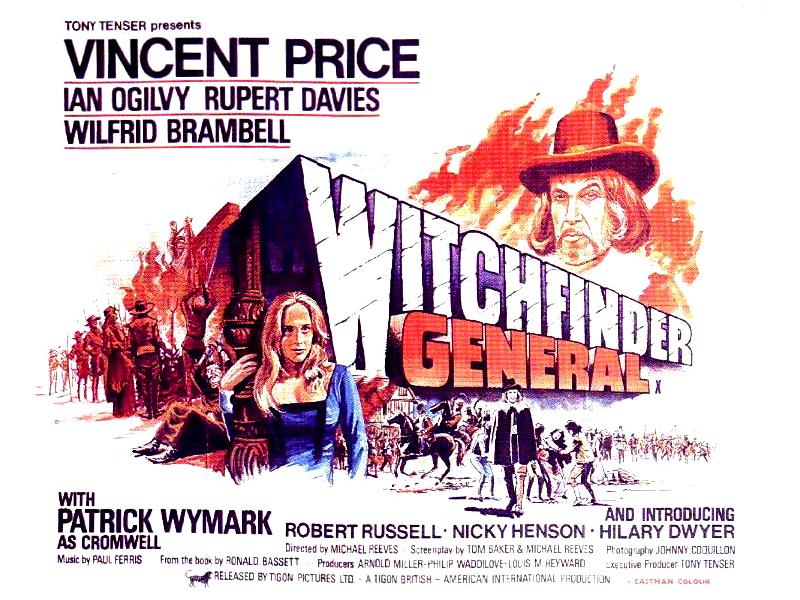
Witchfinder General – U.S. Title: The Conqueror Worm (1968)

Witchfinder General (poster)Conqueror Worm (poster)

Today’s cinema adventure: Witchfinder General (released in the U.S. as The Conqueror Worm), the 1968 historical horror drama directed by short-lived filmmaker Michael Reeves and starring Vincent Price as Matthew Hopkins, a 17th-century lawyer who used his self-appointed position as a prosecutor against sorcery and witchcraft to fuel a reign of terror across the countryside of Eastern Britain during the English Civil War.  Produced on a modest budget by Britain’s Tigon Studio, in partnership with American International Pictures (the U.S. company renowned for its success in churning out cheap exploitation films for the drive-in and grindhouse crowd), it was largely deplored by English critics for its then-excessive depictions of sadistic torture and violence and dismissed by American critics as insignificant and mindless pulp; nevertheless, it enjoyed considerable box office success on both sides of the Atlantic and was soon championed by a handful of critics as an underrated gem.  No doubt bolstered by the fact that its young director died of an accidental overdose of prescribed barbiturates and alcohol less than a year after its release, the film gained a sizable cult following and influenced a number of important horror movies over the next decade, and it is now regarded by many critics and enthusiasts as one of the best representatives of its genre.

Based on a little-known novel by Ronald Bassett, Witchfinder General is set in 1645, in the midst of the tumultuous war between the British Monarchy and the rebellious Parliamentary Party.  With bloody fighting going on across England and a lack of central governmental control, a state of near-anarchy prevails- particularly in the small rural villages which dot the countryside.  In the rebel-controlled region of East Anglia, an unscrupulous lawyer named Matthew Hopkins takes advantage of the chaotic atmosphere- and the puritanical fervor that exists in the area’s isolated, superstitious communities- by offering his services as a hunter of witches and sorcerers, extracting a steep fee from local magistrates in exchange for forcing confessions from suspected servants of the Devil and carrying out their subsequent execution.  With his unsavory assistant, John Stearne, he carries out sadistic torture and punishment upon the unfortunate accused, using his self-proclaimed power to terrorize and blackmail his way from town to town.  In the Suffolk village of Brandeston, he carries out one such persecution against the town priest, a kindly soul named John Lowes, from whose niece, Susan, he elicits sexual favors in exchange for showing mercy; when she is raped by Stearnes, Hopkins loses interest, and proceeds to torture and execute the old man- despite his previous promises- before leaving town to continue his bloody campaign and abandoning the devastated Susan to suffer the torment and ridicule of the locals.  Shortly thereafter, her fiancé Richard Marshall, a promising and heroic young soldier in the Parliamentary army, arrives to discover what has taken place; horrified and enraged, he “marries” Susan by his own authority in the desecrated town church, vows to extract vengeance on Hopkins and Stearne for their crimes against her, and sends her to another village, Lavenham, to await him.  Tracking the two scoundrels to the next town, he confronts Stearne in a tavern, but the henchman manages to escape and warn his master that they are being pursued.  Bound to return to duty with his regiment, Marshall must temporarily abandon his quest for justice; meanwhile, his quarry make their way to none other than the town of Leavenham.  There, as they perpetrate their usual horrific cruelty and murder in the name of justice, they discover the relocated Susan, and realizing that her young husband must sooner or later arrive to join her, the two scheme to turn him into a victim of their bogus inquisition before he can strike against them, setting the stage for a grisly final confrontation.

Director Reeves had previously been responsible for two well-received low-budget horror films, Revenge of the Blood Beast and The Sorcerer; he was hired to make Witchfinder General by Tigon executive Tony Tenser, who had read Bassett’s novel before publication and thought it would make the basis for a powerful film.  Reeves enlisted lifelong friend and previous collaborator Tom Baker to co-write the screenplay, but their first two attempts were rejected by the British censorship board on the basis of the heavy inclusion of graphic violence and torture.  The third draft, substantially tamed down, was approved; even so, the finished film still required so much editing before the board would permit its release that Reeves walked away from it, refusing to make any more cuts himself and leaving the studio to make the final extractions.  In America, censorship was not an issue, and the movie was released more or less intact, but the controversy over its gruesome content almost certainly helped to buoy its performance at the box office.

It is the violence of Witchfinder General, of course, that distinguishes it from so many of the era’s other horror movies- indeed, without it, the film could only marginally be called a horror movie, but rather would more accurately be described as historical drama.  From the standpoint of plot, it owes as much to the revenge tragedies of classical theatre as it does to the genre to which it belongs, but there is nothing highbrow about its script.  Reeves and Baker follow the standard formulas and conventions of such fare, and their dialogue, while not exactly banal, is hardly eloquent.  Nor are there any weighty socio-political observations made here; the film is not an indictment of religious hypocrisy or intolerance.  Hopkins is merely an unscrupulous opportunist acting in his own interest with no pretensions of moral superiority, and those who enlist his services seem unconcerned with church doctrine or spiritual corruption; the travesties of justice they carry out are motivated by greed and hatred, a desire to advance personal agendas rather than a firm belief, however delusional, in a religious cause.  If Witchfinder General has any cultural or psychological theme, it has to do with the breakdown of humanity in the absence of social order.  Where it rises above the ordinary crop of this era’s thrillers is in its pervasive mood, its evocation of unspeakable horror lying within the most mundane or idyllic surroundings.  The green and sun-drenched English countryside serves as a backdrop for monstrous cruelty and violence; from the deeply disturbing opening sequence in which a hysterical woman is dragged across a moor to be hanged by a strangely disaffected mob, we are inundated with scenes of brutality and bloodshed in the midst of picturesque beauty.  Soldiers are ambushed and perish in sudden explosions of gore, a sunlit field is the setting for an ugly rape, a quaint village square plays host to a gruesome immolation; the furtive torments enacted by Hopkins take place mostly in the dark, secret rooms and dungeons we expect, but they are only a portion of the savage grotesquery displayed by the population of this seemingly pastoral world.  Even the heroic efforts of our protagonist, cloaked though they may be in righteous outrage, amount to self-satisfying transgressions against the suspended ethical norm; and despite the viciousness of the film’s violence and suffering, in the end the most unsettling element is the calm, detached manner in which it is both perpetrated and observed.  Reeves gives us a world of cold dehumanization, in which the tranquility of the surroundings takes on an ominous chill, rendering the pretty landscape into a nightmarish wasteland in which nature itself stands in cruel mockery of man and his struggles.  There is ultimately no comfort, and no justice, that is not sullied and degraded by the cruelty of selfism, and in the absence of that moral center provided by a sense of community with others, there is no hope of respite or redemption.

Because it paints such a grim picture of human behavior, Witchfinder General remains a chilling and profoundly disturbing film experience despite the fact that over four decades of carnage on the big screen have rendered its once-extreme violence less shocking than quaint.  The amount of visible blood is minimal and unconvincing in its garishly-red theatrical stylization; the scenes of torture and torment are less upsetting for what they show us than for the off-handed manner in which they are enacted.  It probably goes without saying that modern-day horror fans will find it tame and even laughable, but for those with an appreciation for subtler-yet-deeper shocks will be rewarded for the time they devote to screening this unusual classic.  Apart from its overall effect, there are a number of other significant things offered here, such as the sweeping orchestral score by Paul Ferris- once usurped on home video versions, due to copyright issues, by an overdubbed electronic replacement, but restored in most available prints today.  Also notable is the use of authentic locations for the outdoor scenes; set against the backdrop of genuine architecture dating from the period, the bloody injustices perpetrated against victims of opportunistic persecution evoke the uncomfortable realization that similar events did, in reality, take place- events beside which, no doubt, the horror of these dramatized recreations would pale in comparison.

For most viewers, however, and particularly for those who are fans and buffs of classic cinema and its people, the primary interest will lie in the performance of horror icon Vincent Price as Matthew Hopkins.  It is well-documented that Price and director Reeves had a very difficult relationship during the making of the film.  Reeves wrote Witchfinder General with Donald Pleasance in mind for the lead role, a familiar but lesser-known actor who embodied the kind of soft-spoken, officious menace the filmmaker wished to portray; American International Pictures, however, insisted (in exchange for their investment in the production) that Price, their resident horror star and headliner of their highly lucrative series of Edgar Allan Poe adaptations, play the part instead.  Reeves was openly hostile and disparaging to Price on the set, and the normally gracious and polite actor responded- perhaps rightly so- by being argumentative and uncooperative.  In spite of this- or perhaps because of it- the finished product offers Price giving perhaps the performance of his career.  Eschewing his usual hammy, florid delivery and over-the-top expressions, the legendary actor instead presents us with a brusque, understated persona that makes Hopkins all the more deadly; he is a true monster, devoid of affectation or charm, and unlike most of Price’s creations makes no appeal to our sympathies.  The film hinges on this cold, inhuman quality, and the actor delivers it to perfection.  Price himself considered it one of his best performances, and it is a testament to the actor’s professionalism and manners that, once he saw the finished film, he wrote a letter to Reeves praising his direction and apologizing for his own behavior; nevertheless, he did suggest afterwards that, had the director been more straightforward in communicating with him what was wanted, he would have been happy to deliver it without protest.

The rest of the acting, perhaps surprisingly for a low-budget film of this nature, is fairly high in caliber, though there are a few clunky moments.  In the role of hero Richard Marshall, Ian Ogilvy- another lifelong friend of Reeves’ who appeared in his other films as well- is suitably likable while still maintaining a sort of rigid aloofness that helps to fuel his obsessive quest for revenge; contrasting this is Hilary Dwyer as his fiancée-then-wife Susan, whose warmth and sensuality shine through the prim and modest exterior her social role of her character demands, and who is able to communicate- though no dialogue alludes to it- that she herself might be better pleased to put the horrors of her experience behind her and seek refuge in a new life with her beloved than to watch him pursue vengeance in her name.  Robert Russell makes for an intimidatingly malicious Stearnes, though his naturally high-pitched voice resulted in having his dialogue over-dubbed by another actor (Jack Lynn, who appears in another small role in the film).  A few somewhat recognizable British character actors also pepper the cast, with Rupert Davies as the doomed John Lowe, and brief appearances by Patrick Wymark (as Oliver Cromwell), and Wilfrid Brambell (best known as Ringo’s dad in A Hard Day’s Night).  These and the other performers mostly distinguish themselves with their work, though Price dominates by virtue of his star charisma and his showy role; still, it would be wrong to call Witchfinder General his show- the film owes its eerie power to the vision of Reeves, whose ability to turn his mediocre script into a movie of true stature testifies to a keen talent that might have yet yielded greater works had his tragic death not prevented the continuation of his promising career.

Witchfinder General, it’s worth noting, was marketed in the U.S. by AIP as a pseudo-entry in its aforementioned series of Poe films; retitled The Conqueror Worm, the American print featured an overdubbed reading by Price from the 19th-Century author’s poem of that name, but apart from this manufactured connection there was no connection between Reeve’s movie and any of Poe’s works.  This piece of blatant commercial chicanery no doubt contributed to the fact that it was,  like many such films among its contemporaries, disparaged and disregarded by “serious” critics and scholars.  Despite this initial reception, its popularity and subsequent reassessment led to its becoming an influential and seminal work in horror cinema.  It spawned a host of similarly-themed imitators and has been credited with inspiring an entire sub-genre of macabre films with seemingly idyllic rural settings, culminating in the masterful cult classic The Wicker Man.  For my own part, though, Witchfinder General falls a bit short of the reputation it has gathered; to be sure, it contains a great deal of effective filmmaking, particularly in terms of establishing and maintaining mood.  The weaknesses of its script, however, compounded by a degree of sloppiness in the visual storytelling, keep it from reaching the level of quality necessary to classify it as a truly exceptional picture.  It’s not all Reeves’ fault- budgetary constraints- not to mention the imposition of censors’ demands- were at least partly responsible for the rough-edged clumsiness that sometimes overtakes the proceedings.  Even so, rather than a definitive masterpiece, the movie is ultimately just an ordinary thriller, decidedly amateurish in many ways, but distinguished by the imagination and talent of a promising young director and the work of a few worthy professionals among the cast and crew.  It is for this reason that it remains worth seeing today, but to call it one of the greats is an overstatement.  Instead, it stands as a sad indicator of what might have been possible for its young creator had his own tragic fate not intervened.

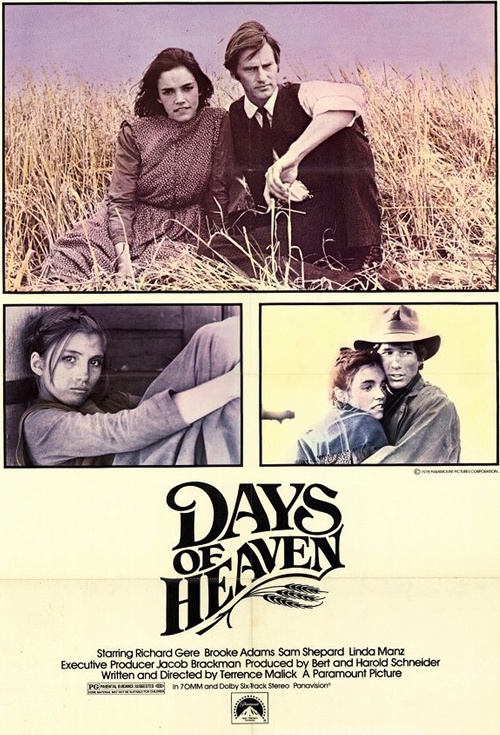
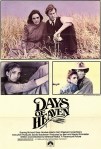
Days of Heaven (1978)

Days of Heaven (poster)

Today’s cinema adventure: Days of Heaven, the 1978 second feature by director Terrence Malick, featuring a young Richard Gere alongside Brooke Adams and actor/playwright Sam Shepard in an elegiac tale of two migrant workers who scheme to con a dying farmer out of his fortune on the early-20th-century Texas panhandle.  Universally lauded for its visual beauty, it was nevertheless snubbed at the time of its release by critics who found it shallow and unengaging; in the years since, however, it has come to be recognized as one of the best films of the seventies, perhaps partly due to a two-decade hiatus taken by its director following its completion, during which time a sense of nostalgic retrospect- coupled with wide exposure on art-house cinema screens, cable TV, and home video- prompted a re-evaluation of its merits.

Set in 1916, Days of Heaven unfolds mostly through its visuals and the overdubbed commentary of Linda, the younger sister of its lead male character.  The movie opens in Chicago, where Bill, a short-tempered steel mill laborer, accidentally kills his foreman in an on-the-job fight.  Fleeing the scene, the young man collects his sister and his girlfriend, Abby, and the trio jumps a train with dozens of other poor laborers seeking opportunities in the wide-open spaces of the American Midwest.  Their journey takes them to the expansive plains of the Texas panhandle, where they find work as harvesters alongside other migrants on a large wheat plantation owned by a shy and sickly young farmer.  To avoid talk among the other workers, the unmarried young couple pose as brother and sister, and for awhile the little makeshift family finds a sort of idyllic peace in their simple existence here, despite the grueling and dangerous work required of them, and despite a growing interest in Abby from the lonely young farmer.  When Bill accidentally overhears a conversation in which a visiting doctor informs the farmer that an unspecified illness leaves him only a few months to live, the ambitious and opportunistic young laborer begins to concoct a scheme by which he and his companions might trick the dying man into leaving them his considerable fortune.  He encourages Abby to accept the farmer’s advances; she does so, reluctantly at first, but gradually warms to him as their relationship progresses.  All goes according to plan- the farmer marries Abby, and moves her into his house along with her supposed siblings- but as time passes and his health remains stable, the delicate balance of this romantic triangle grows ever more precarious.  With Abby’s feelings becoming more and more conflicted, and the suspicions of the farmer’s trusted foreman threatening to expose the plot, Bill’s jealousy and impatience grow, and he begins to contemplate other means of removing their gullible benefactor from the picture.

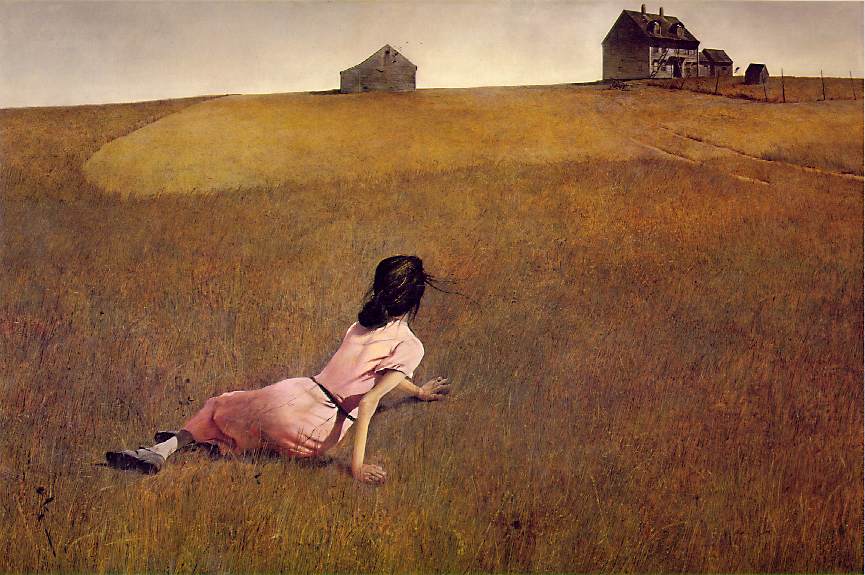
Director Malick, who earned a degree in philosophy before turning to filmmaking, had made an impressive debut with Badlands, a 1973 drama starring Martin Sheen and Sissy Spacek as a young couple on a crime spree; produced independently, it garnered such acclaim at the New York Film Festival that Warner Brothers bought the distribution rights for three times the amount it cost to make.  For his follow-up project, Malick teamed with producer Bert Schneider, who negotiated a deal with Paramount Studios in which he and the director would be given complete artistic control over the project; the studio paid for the film, with Schneider agreeing to cover any amount spent beyond the allotted budget.  Malick, meanwhile, developed his vision for Days of Heaven with acclaimed Spanish-born cinematographer Nestor Almendros, drawing inspiration from paintings by Andrew Wyeth (specifically “Christina’s World”) and Edward Hopper (“The House by the Railroad,” an iconic image upon which the farm house in the film was based) and planning a narrative presented more through imagery than dialogue.   Filming took place in Alberta, Canada, despite the Texas setting, and thanks to Malick’s and Almendros’ wish to shoot mostly during the so-called “magic hours” (the 20-or-so minutes around sunrise and sunset) in order to capitalize on the special quality of light present at these times, it was a painstakingly slow and frustrating process for the actors and crew.  Things were made worse by Malick’s unorthodox shooting schedule, in which he would frequently diverge from the loosely organized daily plan according to his own whims and changing ideas; this caused expensive delays, as did the director’s choice partway through production to jettison his scripted dialogue and allow the actors to craft the story through guided improvisation.  In the end, the project went severely over budget- Schneider had to mortgage his house in order to live up to his deal with the studio- and took so long to complete that key participants (including Almendros) had to leave in order to fulfill other commitments.  To further exacerbate matters, Malick then took two full years to piece together the movie from the miles of footage he had shot; a full year after filming wrapped, he had to call his actors to Los Angeles in order to shoot assorted pick-up shots, famously including close-ups of Sam Shepard taken under a freeway overpass and an underwater take of Richard Gere’s submerging face captured in a large aquarium in Sissy Spacek’s living room.  When Days of Heaven was finally finished and released, the lavish praise it received for its visuals was undermined by the mixed critical reactions to its content, and though it turned a small profit at the box office, it was widely considered a financial failure.

Nevertheless, all the painstaking work undertaken by its director, maddening as his process may have been to his colleagues and his studio, resulted in a film of breathtaking beauty, and though its simple story is seen as if through a prism, detached from the reality of its circumstances and affecting our emotions only obliquely as we take in the wonder of the pretty pageant displayed before us, it nevertheless has a cumulative power that strikes deeply resonant chords within us.  It’s not a deep tale, and its inescapable conclusion is obvious to us even as its premise develops, but that is part of the movie’s haunting charm.  Our intellect is not the target, but rather our senses, and through them that deeper level of understanding where we can appreciate the profound beauty of sadness.  For sadness is the overpowering emotion in Days of Heaven, creeping around the edges of every scene, even those full of joy; it comes from the implicit knowledge that everything is temporary, that the world is in a constant state of change- a theme underlined by the importance of the seasons in the life of the farm, the ominous juxtaposition of industrial age machinery in the pastoral life of its workers, the certainty that the security of regular wages will come to an end with the harvest, and the specter of death that haunts the doomed farmer.  It is exuded in Linda’s narration, filled with wistful nostalgia and philosophical observation rather than direct reminiscence, and it is inherent in the entire situation presented by the film’s central plot- a timeless and oft-repeated saga of the heart being subjugated for worldly gain, of people yearning and struggling for a life better than the one they know, in which brief happiness is attained and lost by all involved.  Days of Heaven, ultimately, is a meditation on the transience of all worldly things, almost biblical in its message; indeed, the title itself is a scriptural reference, and biblical connections are conjured by a number of elements, not the least of which is a plague of locusts that settles on the farm during the film’s climax.  It is not, however, a preachy polemic warning us of the wages of sin, but rather an invitation to embrace life in all its pleasure and its pain, to appreciate the good moments as they come and weather the bad ones with the knowledge that they, too, shall pass; most of all, it is an evocation of things past, a commentary on the repetitive and universal patterns of human behavior, and a chance to mourn our own losses and celebrate our own memories.

Malick’s success at realizing his vision- laborious and, perhaps, badly organized as it was- cannot be denied, nor can credit be denied him for making a film of such unique and delicate beauty; it would be wrong, however, to ignore the tremendous contribution of cinematographer Nestor Almendros on the artistic success of Days of Heaven.  He worked extensively with Malick from the beginning of the process, having been chosen by the director for his earlier efforts (particularly The Wild Child, a 1970 effort by French master François Truffaut, with whom Almendros had a long-standing professional relationship); the two men were much in tune with each other’s sensibilities, and Almendros was impressed by Malick’s knowledge and understanding of cinematography, both technically and aesthetically.  Their collaboration and the loosely-structured, improvisational process they used in creating the all-important look of the film may have led to dissatisfaction and frustration among the rest of the crew (there were claims that the two men “didn’t know what they were doing”), but it resulted in a truly stunning visual experience that still ranks as one of the most gorgeous films ever shot.  Malick’s vision works because of the power of the imagery which Almendros helped him to realize, deliberately drawn from the painters which first inspired the film- not only the aforementioned Wyeth and Hopper, but Johannes Vermeer and other old masters, whose distinctive visual style is referenced throughout in the play of light and shadow- and the techniques of silent filmmaking, with its penchant for the ethereal qualities of natural lighting and its reliance on the importance of wordless storytelling; indeed, these infusions are a perfect fit with the period and setting of Days of Heaven, enhancing its sense of time and place trapped in a bottle, and giving it a magical, shimmering quality that pervades even its earthy and most brutal moments.  The achievement is more remarkable because not only was Almendros, as a foreign national, not allowed to operate the camera himself (due to union regulations), he was also beginning to lose his eyesight at the time, and had to prepare the shots in advance with the cameraman by taking polaroids of the set-ups and studying them through his glasses. It is important to note, in the interest of giving full credit where it is due, that another legendary cinematographer, Haskell Wexler, was brought in to complete the shooting process when Almendros had to leave; the two worked together for a week ahead of time, and Wexler made every effort to duplicate the style that his predecessor had set for the film.  Unfortunately, though over half the footage in the completed movie was shot by Wexler (according to his own letter to critic Roger Ebert), he received credit only for “Additional Photography,” rendering him ineligible to share the Academy Award ultimately received for the cinematography in Days of Heaven.  This oversight resulted in some degree of controversy within the industry, but it has been widely acknowledged by all involved parties that both men played an important role in bringing Malick’s opus to the screen, and the work that they did stands among the best in either of their careers.

Andrew Wyeth's "Christina's World," the painting that primarily inspired Malick to make "Days of Heaven."

Andrew Wyeth’s “Christina’s World,” the painting that primarily inspired Malick to make Days of Heaven

Edward Hopper's "House by the Railroad," another important visual influence on Days of Heaven

Edward Hopper’s “House by the Railroad,” another important visual influence on Days of Heaven

The magic of Days of Heaven is also bolstered immeasurably by Ennio Morricone’s ethereal score, borrowing from Camille Saint-Saëns’ “The Aquarium” (from Carnival of the Animals), which is played over the film’s main tiles, and carrying its mood and motifs into the original music he provides for the narrative.  The remarkably authentic period atmosphere is made possible largely through the costumes designed by Patricia Norris, which she made with old fabric and used clothing items, giving everything a faded look of well-worn realism; also important here are the authentic period vehicles- everything from early automobiles to monolithic farm equipment to a bi-plane carrying a troupe of traveling entertainers- and, most prominently, the farm house, designed and constructed by Jack Fisk, which dominates the landscape of the film, both physically and psychologically, built from plywood and fully dressed with period detail inside and out.  This latter piece was used to film both exterior and interior scenes (a rare occurrence; standard practice, especially at the time, would be to shoot the interiors on a set in a soundstage) and leaves a lingering impression on the memory well after the film has faded to its final close.  It is, in its way, as iconic a structure as the house from Hitchcock’s Psycho (also based, coincidentally, on a painting by Hopper), and gives Days of Heaven a concrete center, a simple, serviceable image rich with multiple layers of symbolic meaning.  Finally, the cast cannot be overlooked.  Though Malick sought to evoke memories of the silent era, there is no bombastic posturing here, no emotional histrionics; instead, his players complement his elegantly simple plot with performances of equal simplicity, avoiding bravura displays and offering instead a low-key naturalism which implies volumes through its very restraint- likely a result of the improvisational nature of Malick’s shooting process.  All four principals give unforgettable performances; Brooke Adams provides a heartbreaking balance of pragmatism and romance as Abby, Linda Manz is hard-shelled but touching as the worldly-wise-before-her-time Linda, Sam Shepard mixes melancholy and earnestness into an appealing package as the unnamed farmer, and Richard Gere uses his almost impossible physical beauty as a powerful tool both to express a genuinely good nature and to mask the darkness brooding inside it in his portrait of the charismatic Bill.  Mention should also go to Robert Wilke, the craggy-faced character actor who manages to touch us deeply in his brief screen time as the farmer’s loyal foreman and surrogate father figure.

Terrence Malick, after Days of Heaven, spent twenty years as a virtual recluse from the movie industry, finally returning in 1998 with The Thin Red Line, a WWII drama which sharply divided critics who found it either a masterpiece or a pretentious sham.  The same response, by and large, has been generated by his subsequent films.  For many, myself included, the jury remains out on whether he is in fact a genius or a charlatan; but regardless of any assessment of his later work, Days of Heaven– especially taken in combination with his earlier Badlands- is more than enough to ensure his status as a true cinematic master.  The way it uses imagery to convey its story, as well as its underlying subtext and the thematic elements which drive it, is a rare and remarkable achievement in utilizing the full power of cinema as a visual medium, and the magnificent beauty of that imagery is still unsurpassed over thirty years later.  Those seeking a passionate romance, with all the typical heart-tugging excesses of standard Hollywood fare, are likely to find it a cold and distant experience, like watching fish behind the glass of an aquarium- a comparison that is, upon reflection, more apt (and less critical) than it might seem.  Malick’s triangulated tale of tragic love is more compassionate for being less sentimental, more deeply moving in its preoccupation with the surface than any number of films that strive to explore the inner experiences of its characters; though it has all the makings of a melodrama, it is a tale without heroes, heroines, or villains, and its characters all contain elements of each, making it impossible to take sides or to judge their actions.  Through the director’s well-considered lens he shows us life, plain and simple, using his art as a means to reveal beauty rather than to manipulate emotion.  As a result, though we may feel somewhat removed from the events and characters, they have the unmistakable ring of truth, and our reactions to them are as honest as they come; for this reason, I count Days of Heaven as one of my personal favorite films, and despite my ambivalent feelings towards its director, consider him one of the greatest filmmakers of his time.  I don’t like to make hyperbolic proclamations like that, so coming from me, you can consider it a pretty strong recommendation.

http://www.imdb.com/title/tt0077405/?ref_=sr_1


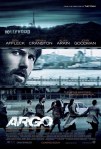
Argo (2012)

Argo (poster)

Today’s cinema adventure: Argo, the winner of the 2012 Academy Award for Best Picture, directed (and starring) Ben Affleck and offering a fictionalized chronicle of the real-life rescue of six American refugees from Tehran during the 1979-1980 Iranian hostage crisis.  With a screenplay by Chris Terrio (who also won an Oscar for his work) and a talented ensemble cast that includes veteran actors Alan Arkin and John Goodman, as well as acclaimed Breaking Bad star Bryan Cranston, it was an instant critical and financial success upon its release, revitalizing Affleck’s career and garnering much praise for its intelligent, character-driven approach to the story- though it has also received criticism for its use of embellishments and fabrications to increase the drama of its narrative, as well as for its selective arrangement of facts to maximize its pro-American sentiments.

Based on Tony Mendez’ personal memoir, The Master of Disguise, and Joshuah Bearman’s magazine account of the mission, “Escape from Tehran,” Argo begins with the 1979 storming of Tehran’s U.S. embassy by militants following the Iranian revolution which supplanted the American-backed Shah with radical Islamic cleric Ayatollah Khomeni as leader of the nation.  The embassy staff have barely enough time to shred their confidential papers before they are taken hostage by the angry throng, who seek to exchange them to the U.S. for the return of the former Shah, so that he can be tried and executed by the new revolutionary government.  Unbeknown to the militants, however, six Americans have managed to escape through a side door, and have found refuge in the Canadian embassy; as the world’s attention turns to the tense diplomatic standoff over the captive diplomats, the C.I.A. tries to develop a plan for the safe extraction of these secret fugitives before the Iranian militants can discover their existence.  Called in to consult, “exfiltration” expert Tony Mendez hatches an unlikely plot by which the six can be safely flown out of the country under the very noses of the Iranian government; posing as a Canadian film producer, he will enter Iran under the pretext of scouting exotic locations for a new science fiction epic, then- with the aid of falsified passports provided by the Canadian government- the six refugees can depart with him, posing as his film crew.  With the help of a Hollywood contact- Oscar-winning makeup designer John Chambers- Mendez enlists a famous producer to help set up a production company for his phony epic, thereby establishing a convincing cover story through the Hollywood publicity machine, and with all the pieces in place, sets out for Tehran to enact his outrageous plan.  Before he can succeed, though, he must first convince the six terrified diplomats to cooperate with the scheme and turn them into a believable facsimile of a movie crew; to further complicate matters, the ever-changing political tides at home threaten to undermine C.I.A. support for the mission, and the Iranians- who are painstakingly restoring the shredded embassy records- are on the verge of discovering that there are six Americans still unaccounted for and at large somewhere within the city.  With time running out and no other option besides eventual capture and probable execution, there is no choice but to follow through with their desperate ruse and hope that their luck holds out.

In crafting a screenplay from these true-life events, Terrio has created, in essence, a caper film; the story is molded in the classic form of an adventure in which a diverse team of mismatched characters must work together to execute an elaborate scheme, wherein intricate planning and precise timing- and a healthy dose of good luck- are required to achieve success.   The premise is not far removed from such films as The Sting or Ocean’s 11, except that instead of a heist the players are attempting an escape.  Since the outcome is a matter of relatively well-known history, the challenge is to generate suspense as the action unfolds; in order to achieve this, the writer wisely chose to focus much of his attention on the personalities of the people involved, heightening the suspense with a personal dynamic that places much of the interest in seeing how these various characters manage to rise to the challenges they face.  This allows for a strong sense of ensemble among the actors and a layered tapestry of nuanced performances, bringing the plot to life with a richness that evokes the character-driven political dramas of the era in which Argo takes place.

The other tactic by which the movie creates suspense, while it is standard practice in the dramatization of true events, could be considered a bit of a cheat; Terrio has fabricated a number of circumstances within the narrative that did not occur in real life.  The six American escapees were never in imminent danger of detection by the Iranian militants, nor was there any suspicion or investigation of the Canadian embassy while they were lodged there; the C.I.A. never withdrew support for the rescue mission, and the Carter administration approved the plan well before the eleventh-hour climax portrayed in the film; and when the time came for the clandestine travelers to make their escape, they walked easily onto the plane and flew out of the country without so much as a second glance by the security at the airport.  Using artistic license is certainly an accepted method- even an expected one- for creating a more eventful and exciting film narrative, and it serves well in Argo, though historical purists may quibble; more questionable are the deliberate omissions and slanted characterizations that diminish the real-life role played by the Canadians in the operation, cast the British and other governments in an unsympathetic light, and depict the Iranians in a manner which reinforces an already problematic cultural bias.  Nevertheless, setting aside questions of fairness or historical accuracy in what is, after all, a movie “based on” a true story (as opposed to a recreation of actual events), Terrio’s screenplay is a superb piece of Hollywood myth-making, building a gripping and compelling story out of its concern for character instead of the intricacies of the plot, and doing it with a great deal of intelligence and- both surprisingly and refreshingly- a great deal of humor.

As for Affleck’s direction of the piece, he picks up the obvious connection of Argo to seventies cinema and uses it as the basis for his mise-en-scène; though modern day technical trickery has been used to achieve certain ends (such as the transformation of the Istanbul filming locations into the city of Tehran and the dilapidated state of the iconic “Hollywood” sign- another historical inaccuracy, since the landmark was actually restored a full year before the events depicted in Argo), the visual milieu of his movie is constructed with a deliberate eye towards capturing the time and place in which it takes place.  There are no ostentatious displays of effects wizardry, no high-def action sequences designed to dazzle and distract; Argo is made to look and feel like a product of seventies sensibility, with influences drawn from such films as All the President’s Men and an authentically grainy look to Rodrigo Prieto’s cinematography- achieved by shooting on film, cutting the images down by half, then blowing them up 200%.  Affleck heavily utilizes authentic archival footage from the real historical events, both within the film (as TV newscasts) and as a guide for recreating the environment; the costumes (by Jacqueline West) are superbly realized recreations of late-seventies fashion, executed with authenticity rather than caricature (though in some instances- such as the scene in which a bogus cast, decked out in a ludicrous, disco-influenced wardrobe of campy science fiction designs, assembles for a read-through of the fictional film- the line between caricature and authenticity is non-existent); and all the trappings of the film’s environment- the architecture of the carefully chosen locations, the sensibility of the décor, even the artistic style of the various corporate logos and advertising which are almost omnipresent in the background- contribute tremendously towards transporting us back to this not-too-distant time in our cultural history.

Affleck’s work in coordinating all these technical asepects is impressive enough in itself, but his handling of Argo is also polished from the perspective of cinematic storytelling.  He keeps the movie moving at a pace which is tight but never hurried, superbly utilizing cross-edited footage to move different elements of the story simultaneously; he captures the claustrophobic experience of the American refugees with tight close-ups and jerky hand-held shots, he suggests the bustle of governmental bureaucracy with scenes of offices in constant motion and characters endlessly walking down long corridors (bristling with purpose, of course), and he evokes the loneliness of his protagonist’s chosen career with artfully composed scenes of his isolation in the midst of crowds, sumptuous rooms, and exotic locations.  It’s a strong, workmanlike effort, undoubtedly the young director’s best work to date, and though it is not exactly visionary or groundbreaking in nature, it is exactly fit to the material he is presenting; his omission as a nominee for the Best Director Oscar is certainly an oddity, particularly considering that he won the honor at many of the other awards ceremonies and that his film eventually took the Best Picture prize- though such a seeming paradox is not unheard of, as Oscar trivia buffs will quickly point out.  Honors and awards aside, Argo is a career-changing work for Affleck, and will doubtless provide the momentum for future projects which will (hopefully) stretch his artistic boundaries even further.

The cast, a crack ensemble of skilled professionals ranging from old hands to promising newcomers, does an excellent job across the board; there is a singleness of vision in the performances that allows each individual player to shine without any one of them seeming to stand out above the others.  The most screen time, of course, belongs to Affleck, and though his self-casting as the half-latino Mendez has generated some raised eyebrows from those who feel a more culturally appropriate choice would have been better, he makes for a likable hero, a man whose personal issues provide the impetus to redeem himself through his professional duties.  Bryan Cranston is memorable as Mendez’ superior, fleshing out what amounts to a stock character with rich personality, and Victor Garber is the picture of genteel compassion as Ken Taylor, the Canadian ambassador who harbors the fugitive Americans and- historically, at any rate, if not within the context of Argo­– was the primary engineer of the plan to get them to safety.  As the harried refugees, a sextet of actors- Tate Donovan, Clea Duvall, Scoot McNairy, Rory Cochrane, Christopher Denham, and Kerry Bishé- creates distinctive portraits of each one despite a shortage of screen time, with McNairy given the most prominent of these roles as a skeptical holdout to the plan who ends up playing a crucial part in its success.  A number of familiar faces also turn up in smaller parts, but the film’s biggest stars, in the two most colorful roles, are the great Alan Arkin and John Goodman, as the two Hollywood players who make Mendez’ subterfuge possible.  In a movie that casts the movie industry itself in a heroic role, it is only fitting that its representatives should be larger than life, and both of these fine actors fit the bill.  Goodman is characteristically robust and colorful as makeup designer John Chambers, but Arkin is particularly effective as fictional producer Lester Seigel (in real life the producer of the bogus movie was impersonated by an associate of Chambers’ named Robert Sidell), letting us see the pull of a deeper purpose in his choice to become involved with the mission.

Argo is a movie that is hard to fault, in terms of execution.  It features top-notch work all around and tells a story which is important to American cultural identity and has clear implications within the current political situation (in regards to the still-strained relationship with Iran).  It addresses, by implication, the consequences of former American policies in the Middle East, and it offers a chance to cheer for heroic deeds that transcend the ever-shifting needs of politics.  For my own part, I can admire the work done here by Affleck and company, but I can’t help but wish it had been done without the omissions and exaggerations that create a false impression of the roles of various participants in the saga- both national and individual.  Drama, traditionally, has always played fast and loose with facts in the interest of telling a good story, but this particular story may be a bit too close to home for such tactics to be entirely appropriate, and as a result, no matter how effective Argo is as entertainment, it smacks, vaguely, of propaganda.  Though it is an exemplary piece of intelligent popular filmmaking,  Affleck’s movie panders more than a little to its audience in the way that it manages to avoid taking either a liberal or conservative stance on its subject, adopting populist attitudes and embracing clichéd assumptions, and presenting America in a way that allows us to recognize its flaws while still feeling good about it.  As a result, it narrowly misses the mark of true greatness and instead settles firmly on the ground of romanticized dream factory escapism.  Not that there’s anything wrong with that; far too few big film projects achieve that ideal with as much success and integrity as Argo.  Clearly, given its tally of major industry awards, it’s a movie that strikes all the right chords, and even if it does so by means of manipulation, that is, after all, what filmmakers do.  Nevertheless, of the six (out of nine) nominees for the Best Picture Oscar of 2012 that I have thus far seen, Argo would have been my last choice for the winner.  It’s a very good movie, solid, polished, and safe; but if you expect to be blown away- as the accumulated hype may by now have led you to- you are likely to wonder what all the fuss was about.

http://www.imdb.com/title/tt1024648/?ref_=sr_1

Beasts of the Southern Wild (2012)

Beasts of the Southern Wild (poster)


Today’s cinema adventure: Beasts of the Southern Wild, the 2012 first feature from director Benh Zeitlin, a movie which rose from acclaim in the festival circuit to become hailed as one of the best films of the year.  The story of a little girl and her father who face the destruction of their way of life as rising sea levels threaten to submerge their Louisiana fishing community, it not only took top awards at the Sundance, Los Angeles, and Cannes film festivals (among many others), it also surprised many industry insiders by earning nominations for several Academy Awards- including Best Picture, Best Actress (for Quvenzhané Wallis, at 9 years old the youngest person nominated to date for this award), and Best Director, with newcomer Zeitlin edging out several favored contenders to gain his slot in the latter category.

Adapted by Zeitlin and Lucy Alibar from the latter’s one-act play, Juicy and Delicious, the film unfolds through the perspective of Hushpuppy, a 5-year-old black girl who is part of an isolated community on the Isle de Charles Doucet, known to its residents as “the Bathtub,” an island in the mouth of the Mississippi River delta at the southernmost edge of Louisiana.  Following a generations-long tradition, the people of the Bathtub eke out their simple existence by harvesting the riches of the sea; they are separated from the wider world by geography- and the levee which protects the population of the north from the fluctuations of the tides and the weather- but they are fiercely proud of their heritage and their independence, despite the precarious nature of their existence at the mercy of the ever-rising sea levels.  Little Hushpuppy- though she lives by herself in a separate house- is under the care of Wink, her short-tempered but loving father; she is also, like all the children of the community, under the watchful eye of Miss Bathsheba, the island’s schoolteacher, who tells them how the melting ice caps will cause the ocean to eventually submerge the Bathtub.  Her lessons also include stories about their prehistoric ancestors and the fierce wild beasts- the aurochs- which preyed upon them.  These things have a deep impact upon Hushpuppy’s inner life- she imagines the great aurochs slowly being released from their frozen sleep by the melting ice, and slowly making their way towards the Bathtub.  She also maintains an imaginary relationship with her long-absent mother, as well as making drawings which she intends to be found by “scientists of the future.”  As for Wink, his health is clearly deteriorating; he disappears for days, eventually returning in a hospital gown, and he sometimes collapses into a near-catatonic state, but he refuses to acknowledge this weakness to his daughter.  An approaching storm soon supersedes all other concerns, and though some islanders opt to abandon their homes for higher ground, many stubbornly refuse to leave.  Wink and Hushpuppy weather the violent storm, but when it subsides, the Bathtub is flooded underneath several feet of water.  The two form a camp with fellow survivors to wait for the flood to recede, but their hardships are only beginning; the salt water lingers, slowly killing the land beneath it, until Wink develops a desperate plan to solve the problem by sabotaging the levee.  The resulting consequences could lead to the islanders’ forced evacuation from the land they love, as well as the separation of father and daughter.  As the aurochs grow nearer in Hushpuppy’s imagination, she resolves to undertake a journey which might help her to flee the troubles which have enveloped her world- or to find the answers and the strength she needs to face them.

Zeitlin’s movie is a remarkably unique accomplishment, to be sure.  He takes us into a world most of us have never seen or even known about, revealing its conditions with a documentarian’s style while using it as the basis for a multi-layered metaphor infused with humor, drama, and fantasy, one that addresses human concerns from the most basic and primal to the most pressing and contemporary.  With a restless, hyper-mobile camera, mostly utilized for extreme close-ups and wide establishing shots, he pieces together a clear, compelling narrative that grabs us from the beginning and keeps us riveted throughout.  He tells his story through impressions, a whirlwind of fleeting images that somehow conveys all the pertinent information we need to follow the plot and connect with the emotional reality of its people, while also suggesting the perspective of its tiny lead character on the constantly-fluctuating reality that surrounds her.  This is all the more remarkable in light of the fact that he never looked at any of the raw footage from the shooting process until it was time to edit the film into completed form.  Any of these feats alone would be enough to mark Zeitlin as a gifted young director; taken all together, they herald him as a prodigy.

All of his prowess behind the camera would be for naught, however, if not for the casting of young Wallis in the film’s central role.  At 6, she possesses more screen charisma than that shown by any number of established starlets in their entire careers, and the sheer power of her diminutive presence is enough to make Beasts of the Southern Wild an unforgettable film.  It’s one of the most impressive film debuts in recent memory, and certainly one of the strongest juvenile performances in cinematic history; Zeitlin builds his movie around it, and it never comes up short.  Of course, considering the young lady’s age- and the certain fact that film is a director’s medium- it is possible that Wallis’ formidable performance may be at least partly the result of careful editing, pieced together by Zeitlin himself to achieve maximum effect; even if this were the case, however, the little girl’s presence, personality, and raw honesty are undeniably on display, and these qualities cannot be faked even by the most gifted film technician.  She is well-deserving of all the kudos she has received.  She is ably supported by Dwight Henry, as her father; a non-professional, like the rest of the film’s cast, he is a New Orleans’ bakery owner whose life experience as a survivor of two real-life hurricanes- Betsy in his childhood, and Katrina as an adult- helps to infuse his performance with an innate understanding of the precariousness of his character’s situation, and he is equally capable of capturing the volatile psychological chemistry that makes Wink both charismatic and intimidating.  The rest of the cast is as authentic a collection of local faces and personalities as ever seen in a fictional film, underscoring the documentary feel and helping to transport us completely into the unfamiliar world it depicts.

There are any number of reasons why Beasts of the Southern Wild is an excellent and exciting piece of filmmaking, the aforementioned performances and direction among the foremost.  For many viewers, it will doubtless be considered great; for me, however, despite its many strengths, it falls just short of that mark.  For all its imagination, its blend of harsh social realism and youthful fantasy is held together by a plot that is ultimately as typically “Hollywood” as any mainstream studio family picture you might think of.  Zeitlin and Alibar’s screenplay undertakes from the very beginning to tug at our heartstrings in a manner which would seem insultingly blatant if not for the film’s edgy style, and despite the seemingly detached empiricism of the director’s approach, Beasts of the Southern Wild has a calculated feel in the way it manipulates our sympathies throughout.  We never really get the chance to make up our own minds about how we feel towards Hushpuppy, Wink, or the Bathtub itself and its way of life; we are guided to our conclusions by Zeitlin’s steamroller approach to the story.  Of course, it is a work of fiction, so there are no aesthetic or ethical reasons why the writing and direction should not be designed to elicit a desired response from the viewer; and it’s not as if the movie lacks any sincerity- on the contrary, it’s clear throughout that it is a work of deeply heartfelt passion.  Nevertheless, there is a heavy-handed quality to the narrative that ultimately leaves us feeling less satisfied than wheedled into submission.

This is not to say that Zeitlin’s film is a failure, by any means; Beasts of the Southern Wild is a refreshing example of the kind of cinematic magic that can be created outside of the numbers-driven system of mainstream movie-making, and it leaves an indelible impression upon any viewer.  Audiences whose tastes run towards sentimentality will undoubtedly find it an exceptionally rich experience, and even those who prefer a less “precious” approach will be moved by it, if not overwhelmed.  It may not be the masterpiece that some have hailed it to be, but it’s still an impressive work of art by a promising young director.  To be truthful, Quvenzhané Wallis alone provides a good enough reason to see it; but beyond her remarkable performance, there is also a thought-provoking and resonant meditation on the nature of human existence in the universe, both as individuals and as a whole, which contemplates everything from parental bonds to global warming and manages to leave us with a thrilling sense of hope and possibility despite a story which dwells in desperation and dysfunction.  It’s a rare film that can pull off a trick like that, and even if some of the trickery might be a little obvious, it’s still an accomplishment that deserves to be lauded.

http://www.imdb.com/title/tt2125435/?ref_=sr_1


Flesh Gordon (1974)

Flesh Gordon (poster)


Today’s cinema adventure: Flesh Gordon, a 1974 semi-“porno” feature spoofing the classic sci-fi movie serials of Hollywood’s golden age, directed by Michael Benveniste and Howard Ziehm and starring… well, probably no one you’ve ever heard of.  Rooted in the irreverently hedonistic sensibility of the so-called “sexual revolution” of the seventies, it lampoons the old-fashioned conventions of the original Flash Gordon adventures by sexualizing all of the story elements and adding lots of gratuitous nudity and sex.  Campy, juvenile, and amateurish, it nevertheless has a certain goofy charm that helped to make it a favorite on the midnight movie circuit and something of a cult classic.  It is also notable for its cheap-but-well-executed special effects, which were orchestrated by several future industry legends (most notably specialty make-up pioneer Rick Baker) and were sufficiently impressive to put the film into consideration for an Oscar nomination for Visual Effects- though ultimately the Academy opted to skip the category that year due to a shortage of suitable contenders.

As written by co-director Benveniste, the plot follows the story of the classic Flash Gordon serial so closely that the filmmakers had to include a disclaimer before the credits, expressly stating that the movie was meant as a parody and “homage,” in order to avoid a lawsuit from Universal Pictures, copyright holders of the original.  As the film opens, the titular hero is traveling by plane, summoned by his scientist father to help in the effort to stop a mysterious attack from outer space; the earth, it seems, is being bombarded by a “sex ray,” which causes widespread havoc by causing people to break into spontaneous orgies, and young Flesh is so far immune to its effects.  Unfortunately, the plane is hit mid-flight by a blast from this deadly extra-terrestrial aphrodisiac; its pilots abandon the cockpit in order to join the sexual frenzy in the passengers’ cabin, and the unmanned aircraft begins to plummet from the sky.  Flesh manages to rescue Dale Ardor, a young female passenger with whom he struck up an acquaintance before the ray hit (compelling her to rip off her clothes, of course), and the two parachute to safety on the ground below.  There, they find themselves at the secluded home of Dr. Flexi Jerkoff, an eccentric scientist who has traced the source of the sex ray to the planet Porno, and has built a spaceship- decidedly phallic in design- in which he plans to go there.  Flesh and Dale, naturally, decide to join him, and the three new comrades set out on their journey through space.  It doesn’t take long to arrive- this is super science, after all- and they soon find themselves in the palace of Emperor Wang the Perverted, who plans to dominate the universe through its libido; the deviant despot conscripts Jerkoff into his service, declares Dale as his new bride, and sends Flesh off to be castrated.  However, Amora, the Queen of Magic, has become smitten with the young hero; planning to make him her consort, she abducts him from the palace, with Wang’s men in pursuit.  Though Amora’s vessel is shot down, Flesh escapes intact; Jerkoff, meanwhile, has managed to flee from the palace, as well.  The two adventurers reunite, and, joining forces with Porno’s rightful ruler, Prince Precious, they undertake to rescue Dale, destroy the sex ray, and overthrow the evil Wang once and for all.  To do so, they must defeat a tribe of evil lesbian Amazons, outwit Wang’s spies, and defeat the Great God Porno, a giant satyr-like beast awakened from his long slumber by the evil Emperor himself.

It’s probably unnecessary for me to have provided even such limited detail in the above synopsis; like most so-called adult movies, the plot of Flesh Gordon is really immaterial.  It exists merely to provide a framework for the various titillations and parodies which are, of course, the only reason for the film to exist.  As far as titillation goes, though virtually every scene features some degree of nudity, and there are a number of scenes in which people are seen having sex, the truth is that Flesh Gordon is really pretty tame, even by 1974 standards.  Part of the reason for this is that, although the film originally included numerous scenes of explicit, hardcore sex, both straight and gay, the filming of such material was illegal in Los Angeles at the time it was made (hard as that may be to believe now); to prevent their prosecution for pandering, the filmmakers were forced to surrender all such footage the L.A. vice squad, and Flesh Gordon was released without explicit pornographic content.  This was undoubtedly seen as a setback by its makers, but in the long run it was better for the movie; if it had been full-fledged porn, it would not have been as widely seen- or perhaps, at least, not by the same audiences- and would likely not have achieved the popularity it eventually enjoyed.  In the more “soft-core” form it was forced to take, it managed to become as much a lampoon of “skin flicks” (as they were euphemistically called in those days) as it was of the corny space operas of old.

This brings us to the satirical side of the film.  Though Flesh Gordon is loaded with crude sexual innuendo and sophomoric jokes, it somehow manages to be endearingly cute.  Sure, the humor is as juvenile as the nudity and sex are gratuitous, but this in itself is part of the charm.  Benveniste’s script does not pretend to be anything other than a collection of cheap laughs; it is free of the kind of hip, self-aware cleverness that mars so many similar attempts at this kind of send-up.  The comedy is so obvious and so gleefully raunchy, so painfully and ludicrously obvious, and just so plain silly, that it is impossible for any but the most snobbish viewers to be unamused; you roll your eyes and shake your head, but you chuckle as you do so.  One of the main reasons for this is the movie’s underground feel; the cheap sets, the grainy 16 mm look of the photography, and the hopelessly amateur acting, all give the impression of watching some weekend garage-filmmaking project undertaken by naughty teenagers while their parents are out of town.  The two directors clearly have limited knowledge of how to make a movie, with poor staging, sloppy editing, and muddled storytelling that sometimes obscures the intended focus of scenes and prevents us from getting an adequate view of would-be sight gags.  It’s somewhat frustrating, at times, but it has the effect of making much of the movie’s funniest material play like throwaway gags, the kind of parenthetical comic detail that contributes to the underlying wackiness that pervades the piece as a whole.  At times, the film’s raw quality is similar to the early work of John Waters- certainly the sex and nudity has the same glamorless, unattractive sensibility as one finds in Waters’ films from this same era- but with more of an attempt at emulating the polish of mainstream Hollywood.  It’s an attempt that falls far short of the mark, but, of course, that’s part of the joke.

Despite the low budget and the obvious inexperience of its directors, however, Flesh Gordon manages to impress with its special effects.  Certainly, these are not the high-tech visual feats of magic one could expect from an A-list studio production, but cheap though they may be, there is a sense of artistry on display here that lifts the movie above the level of low-grade exploitation cinema.  Under the supervision of Walter R. Cichy (one of the film’s three producers, along with Ziehm and Bill Osco), the designers and artists involved- many of whom, as mentioned, were established or soon-to-be established industry professionals- manage to infuse their bargain-basement work with the kind of imagination and tongue-in-cheek humor that makes the cheapness seem like a choice.  With an obvious nod to the spaceship-on-strings style of classic sci-fi history, the movie delivers deliciously cheesy visual delights to go with its inane dialogue and corny story; shaky walls, cannibalized props and sets, and primitive in-camera trickery create the appropriately campy environment, populated by such ridiculous creatures as “Penisauruses” and the aforementioned Great God Porno (voiced, sans credit, by the then-young-and-unknown Craig T. Nelson) which are brought to life by surprisingly deft stop-motion animation.  In addition, the thrift-store pastiche of costumes and the over-the-top execution of the makeup give the whole thing a Halloween party tackiness that somehow puts the perfect finishing touch on the whole package.

As for the cast, the only name of note is Candy Samples, a former pin-up and porn actress who earlier had worked with Russ Meyer, who makes a cameo as Queen Nelly, the eye-patched (and breast-patched) ruler of the Amazon lesbian tribe.  For the most part, the performances are as banal as one might expect, with Jason Williams and Suzanne Fields, as Flesh and Dale, respectively, barely able to muster the sense of excited urgency that is, pretty much, all that is required of them- well, except for their bodies, of course, both of which are suitably sexy in that pre-personal-trainer (and pre-silicon) early seventies way.  As Dr. Jerkoff, Joseph Hudgens (in his only credited film role) manages to combine likable earnestness with a Vaudevillian sensibility that, for some reason, conjures memories of Groucho Marx, and Lance Larsen exhibits signs of personality as the deposed Prince Precious, a leotard-clad Robin-Hood-like figure, mercifully keeping his mincing to a minimum as he allows the character’s name to do most of the work in conveying his sexual preferences.  The acting highlight, as far as it goes, is the performance of William Dennis Hunt as Emperor Wang, sporting outrageous Fu Manchu makeup as he chews the scenery with appropriate relish, laughing maniacally as he incites his mostly naked subjects to copulate and calling his minions “dildoes.” To be sure, none of these performances are Oscar-worthy, but they work well enough for a film which gets most of its charm from being deliberately bad.  There’s something about bad actors doing their best- even when it’s terrible- that is much less painful than good actors purposely trying to be bad; in this case, it complements the style of the film and, somehow makes it all the more satisfying.

Don’t get me wrong here; though it might seem I’ve raved about Flesh Gordon, it’s hardly some sort of visionary masterpiece.  It’s pure schlock, in fact, and shoddily made schlock, at that.   What makes it entertaining is its sheer unpretentiousness.  Benveniste and Ziehm were simply trying to make a cheap, funny, sexy movie that would appeal to youthful audiences; the vehicle they chose was designed to poke fun at the old-fashioned entertainment of an older generation, and whether by accident or canny exploitation, they managed to ride a wave of nostalgia that was rising in popular culture at the time.  These factors may have helped to give their movie a bit more push than it otherwise deserved, but what made it become a sort of mini-phenomenon was the fact that, for all its ridicule of the serials that inspired it, it exhibits a clear love for that source material.  Despite its effort to reinvent Flash Gordon as a blue movie, Flesh Gordon is undeniably sweet, amusingly naive, and more than a little geeky.  It’s these qualities that make it worth sitting through, not just once but over and over, despite the lousy acting and bad jokes; personally, I would rather watch Flesh Gordon a hundred times than have to watch the abysmal 1980 remake of Flash Gordon even once more.  Though this movie makes fun, it also celebrates the original; in truth, it’s really pretty true in spirit to those old melodramatic space operas, because they, too, were designed to appeal to the lowest common denominator by exploring the public’s sensationalistic urges for action, fantasy and, yes, even sex.  After all, the costumes worn in those 1930s movies were pretty sexy, for their time; by 1974, they might have had to eliminate costumes all together in order to get the same effect, but the principle is still the same.  Obviously, Flesh Gordon is not for die-hard prudes; but you are likely to see racier stuff on late-night cable TV than you will in this movie, so anyone else is encouraged to check it out, at least once.  It’s likely to be one of the more unique cinema adventures you’ve had, and besides, do you really want to miss a movie where the only way to defeat the villain is to use the “pasties of power?”

http://www.imdb.com/title/tt0068595/?ref_=fn_al_tt_1
 

Django Unchained (2012)

Django Unchained (poster)


Today’s cinema adventure: Django Unchained, Quentin Tarantino’s 2012 epic revenge-fantasy western, a movie that generated (and continues to generate) much controversy over its handling of the still-raw issue of slavery in the American past.  The tale of a freed slave who joins forces with a white bounty hunter to rescue his still-captive wife from a Mississippi plantation, it’s a characteristically violent entry to the Tarantino canon, paying homage to the exploitation films of old and using a mashed-up blend of genres to address complex social issues in a way that flies in the face of contemporary ideas about political correctness.  Unsurprisingly, it has drawn both passionate praise and passionate objection, primarily focused on its depiction of racism and its over-the-top violence.

Tarantino’s screenplay, like most of his others, brings together explicit influences from numerous pieces of cinematic history, most notably the spaghetti westerns and “blaxploitation ” films of the ’60s and ’70s- with a liberal sprinkling of the prime-time television shows from the same era.  Most specifically, he takes inspiration (and the theme song) from a particular 1966 spaghetti western called Django, directed by Sergio Corbucci, a bloody tale of revenge which was considered at the time to be the most violent western ever made.  Though its plot has no resemblance to Tarantino’s story, nor does it involve issues of racism or slavery, the spirit of this original film is nevertheless a tangible part of Django Unchained– a title which also references Hercules Unchained, another Italian epic about a mythic hero who breaks the bonds of slavery to rescue the woman he loves.  Alongside these pulpy pop-culture sources, though, Tarantino draws from the Nordic legend of Brünhilde and Siegfried, adding a deeper mythic connection to the story and rooting its true thematic purpose to an archetypal level that transcends the racial subject matter on its surface.  Set in 1858, the film opens as a pair of slave traders march their chained captives- barefoot- through the Texas desert at night.  They are intercepted by a horse-drawn wagon driven by a courtly German, a traveling dentist named Dr. King Schultz, who has traced a particular slave to them.  After questioning the man he seeks, whose name is Django, Schultz offers to buy him, but the traders, uncomfortable with the German’s attitude and wary of the manner of his approach, refuse to sell; they order Schultz to leave and threaten to shoot him if he does not comply, at which point their visitor draws his gun and fires, killing one trader and trapping the other under the body of his fallen horse.  He gives the wounded survivor money for Django, takes the keys to unchain his purchase, and leaves the rest of the chain gang to free itself and deal with their former captor as they see fit.  Schultz, as he informs Django, is a bounty hunter, who tracks wanted criminals and kills them for the reward money; he is very good at his job, and he has sought out his new companion because the men he is now tracking were former foremen at a plantation upon which Django was once a slave, and he needs someone who can positively identify them.  He tells Django- whom he treats as an equal- that in exchange for helping find the wanted men, he will receive his freedom and a share of the reward.  As the two men travel in search of the fugitives,  Django reveals that he and his wife had both been slaves on his former plantation, but after they had tried to run away together, their owner had them sold to separate buyers as punishment; he plans to use his share of the bounty to pay for her freedom, but Schultz fears that a black man, legally free or not, will be at high risk if he returns to the heart of the slave empire alone.  The German makes a proposition- if Django (who clearly has a knack for the work) will partner with him as a bounty hunter for the winter, the two will find and liberate his wife together.  Django agrees, and the pair begins a series of adventures that will culminate in a deadly confrontation with one of the most notoriously cruel slave owners in the country.

Tarantino makes movies that are a critic’s dream, in the sense that they are- for better or for worse- an unapologetic expression of love for the medium of cinema in all its forms. He borrows elements from all genres, disregarding accepted notions of worthiness or quality, and puts them together in an eclectic mishmash of style that is distinctly his own.  He is as much an auteur as Kubrick, as great a showman as DeMille, and as much a master of exploitation as Russ Meyer, and, without discrimination between these differing aspects of the medium, he blends them into one audacious approach that invites comparison to another great maverick filmmaker, Orson Welles.  It may be premature to place him in such company, but his impact on the art form has been substantial and significant, legitimizing styles and forms from outside the mainstream that were previously dismissed as irrelevant or inferior, confronting difficult or taboo subject matter in a way which challenges and provokes his audiences, and breaking the established rules and conventions of cinematic storytelling even as he uses them like a master.  In short, his movies elicit strong reactions and give us a lot to think, talk, and argue about.  Django Unchained, with its pulp-fiction storyline constructed squarely around the inherently divisive subject of racism, is unquestionably his most provocative effort to date- and that’s saying a lot.

So much has already been written and said about Tarantino and his work; I’ve discussed him in my earlier review of Death Proof (a vastly inferior movie to Django Unchained) and I don’t feel it necessary to repeat myself here.  A description and analysis of his signature style is available in a vast number of other places.  In discussing Django Unchained, it is far more relevant to address the elephant in the room; by making a movie about slavery in which a black hero avenges himself on the white people who have perpetrated unspeakable cruelty upon him and his kind, the filmmaker throws aside any semblance of a protective veil and confronts his audience squarely with the difficult issue of race- or, perhaps more accurately, of attitudes towards race, both within the setting of the film and in contemporary society.  Here is a white filmmaker, using a traditionally white milieu (the Western, with all its mythic reverberations in the ethical and psychological landscape of American culture) to tell a story about white guilt and black revenge; this in itself invites debate about everything from Tarantino’s suitability to address the topic to his motivations and methods of doing so, as well as invoking questions of social responsibility in the approach he has chosen to take.  The film has been accused of racism against both blacks and whites, criticized for its perceived advocation of violence, and even described as an incitement to race war; it has been lambasted for both exaggerating and trivializing the horrors of slavery and for making this abhorrent institution the basis for a piece of slick pop culture escapism.  It has also been acclaimed for daring to address the subject of America’s heritage of slavery without equivocation, apology, politics, or preaching.  In other words, like all great art, it serves as a mirror; the interpretations and reactions of its audience are reflections of their own viewpoints.  Like an ink blot, it shows us the content of our own psyche.

This is not to say that Tarantino has put nothing of himself into the film; obviously, it is an extremely personal statement for him, one which expresses his own character and personality and clearly- in my interpretation- reflects his utter disdain for the entire concept of racism.  Django Unchained assumes at its core the inherent wrongness of racist thinking.  Without exception, those who embrace the idea of slavery are depicted as monsters, and though racism is the central condition of the movie’s world, it is ultimately a symptom of the overall inhumanity that pervades the social order.  Though it is a film which deals with race, the conflict here is not between black and white, but between ignorance and enlightenment.  Furthermore, it reflects a populist sensibility in its suggested equation of the proponents of slavery to the economic elite, who maintain their wealth and power by means of a legally-sanctioned hierarchy of enforced dominance; this is underlined by the fact that one of the film’s most loathsome villains is in fact a black man, completely indoctrinated into a system that dehumanizes himself and the rest of his race by the personal status he holds within it.  Conversely, the white Schultz, despite his mercenary profession, is clearly a fierce opponent of racial inequality and injustice (he refers to slavery as “malarkey” at one point), risking his own life and livelihood to strike a blow for freedom whenever the opportunity arises; and despite the title character’s assertion that his new vocation is appealing because he gets to “kill white people” and be paid for it, his true purpose is to seek justice for himself and the woman he loves.  Django and Schultz are champions of the oppressed and downtrodden, and neither their compassion nor their wrath are conditional upon race.  The story here is classic western fare, really; a wronged man seeking frontier justice against those who have done him harm, except instead of the archetypal white cowboy he is a freed black slave.  Though some may find this new twist to the old formula to be somehow disrespectful or inappropriate, the real shame, in my view, is that it took until 2012 for a mainstream Hollywood film to attempt it.  It’s a natural fit, and the inescapable sociological questions that it conjures, however difficult or painful they may be to those who would avoid them, are long overdue for confrontation.

Django Unchained is not, however, the first mainstream Hollywood film to address the issue of racism in a controversially irreverent manner; it’s not even the first western to do so.  In 1974, Mel Brooks similarly outraged and shocked the movie-going public with Blazing Saddles, a raucous and raunchy lowbrow farce that attacked the issue head-on, openly mocking racial stereotypes and exposing the inherent racism of Hollywood’s traditional myth of the Great American West.  Brooks’ film created controversy with its deliberately excessive use of “the ‘N’ word” (which I will not use in this forum, to avoid opening myself up to the same kind of controversy), intended to detoxify it through over-exposure and to turn it against itself by using it as an instrument of comedy.  It’s ironic that Tarantino’s film, 38 years later, has fallen under criticism for breaking the exact same taboo, using the epithet so much that it becomes a mere banality.  Ironic, but not surprising, considering that Mark Twain’s The Adventures of Huckleberry Finn, written well over a century ago, still falls regularly under criticism for the same reason despite its anti-racist message.  Django Unchained is not Huckleberry Finn, nor is it Blazing Saddles, for that matter, though these works form an artistic heritage from which it is definitely descended.  Like them, it addresses a serious social issue- perhaps, ultimately, the most serious one affecting American culture- with a considerable amount of humor.  To be sure, it’s a grim sort of humor, to say the least; but it is irresistible, and the way he connects it with horrific imagery is one of the most significant devices he uses to give Django Unchained its unique power.  Nevertheless (though some have suggested it), Tarantino’s film is not a comedy- not even a dark one.  Like all of his work, it defies exact classification; though it follows the formula of a melodrama, it’s infused with elements of so many other genres, and marked by such a ferocious and unrelenting pattern of escalating tension and ultra-violent release, that the most accurate description is probably just to call it a Tarantino film and leave it at that.

Like the other movies that fit into that exclusive category, Django Unchained is not for every taste; those sensitive viewers who are easily disturbed by profanity and excessive violence- including violence towards animals- will likely be out of their depth here, and those for whom the issue of race relations is an uncomfortable topic are almost certain to find themselves offended.  For the rest of us, however, it’s a film that offers a wealth of cinematic riches.  Gorgeous cinematography by Robert Richardson evokes the visual qualities of Tarantino’s beloved filmic influences while asserting its own distinct flavor; imaginative, detailed costume design by Sharen Davis adds its own subtle commentary and playfully- but meticulously- incorporates iconic inspirations that help to establish the purposefully derivative pop-culture tone; the eclectic, carefully chosen mix of musical selections, which includes everything from segments of scoring lifted out of other films to ’70s pop standards to modern rap, continues Tarantino’s tradition of deliberate anachronism on his soundtracks, a technique which helps contemporary audiences to connect to the material and provides its own kind of commentary through the associations it creates; and, of course, there are the performances.

Tarantino’s writing, like Woody Allen’s, requires his actors to convincingly speak in his own voice, another hallmark of his canon; his dialogue, laced with intricate wordplay and possessed of his own distinctive syntax and structure, at once creates vivid individual characterizations and unifies his work with a singular verbal style, and challenges his actors to strike a perfect balance of stylization and reality.  The cast of Django Unchained meets this challenge triumphantly, with solid and unforgettable performances from all.  Jamie Foxx makes a perfect western hero, a seamless blend of Clint Eastwood and Isaac Hayes that bridges the gap between genres and helps the film to successfully accomplish the same feat; Leonardo DiCaprio is well-cast against type as the dissipated and off-handedly sadistic slave master into whose empire the heroes must venture to achieve their quest; and Kerry Washington, playing the object of that quest with quiet dignity, shines in her relatively silent presence amidst all the bombastic rhetoric spewed around her.  There are a number of familiar faces in smaller roles, ranging from TV icon Don Johnson (complete with white jacket) in a featured turn to screen veteran Bruce Dern in an unbilled cameo; even Franco Nero, the original “Django” from the aforementioned 1966 classic, turns up to participate in the most blatant of the film’s many in-jokes.  All these players contribute to Tarantino’s vision, both with their talented work and by virtue of the associations they bring with them.

The standouts, though, are the mesmerizing performances of Tarantino stalwarts Christoph Waltz and Samuel L. Jackson.  As Schultz, the former glitters with wit and intelligence without once letting us lose sight of his serious subtext; he gives us a man of scrupulous honor, grim determination, and unparalleled capability, as charming as he is deadly and as noble as he is practical.  He makes his character a ray of dazzling light in a very dark world, and brings the ethics of contemporary reason into the film’s primitive setting like an inexorable wave of progress bent on sweeping away the stubborn ignorance of the past.  In direct opposition to this paladin-like force of justice is Jackson, as the “old retainer” of DiCaprio’s household; a re-invention of the well-worn “Uncle Tom” figure, he fumes with what one of my friends called “misdirected rage,” diverting his considerable intelligence and power towards the protection of his master’s world- in which he enjoys his own high status- at the expense of his own people.  Wily, cantankerous, and proud, he is the true villain of the piece, having gone beyond mere acquiescence to an oppressive and inhumane system to become a ferocious guardian of it; in his complete lack of compassion, and in his unrepentant commitment to upholding the brutal status quo, he becomes arguably more reprehensible than the master he adores, and Jackson- though he finds the human truth of this twisted soul and plays it with utter conviction- makes no attempt to sugarcoat or shy away from the ugliness of this character.  It’s a delicious performance, perhaps the finest of the actor’s career, and its lack of sentiment drives home the movie’s indictment of compromise in the face of racial inequality by peeling off the benign mask of a stereotype and revealing the tragic betrayal of humanity that it represents.

The true star of Django Unchained, however, is Quentin Tarantino himself, and I’m not referring to his signature cameo appearance late in the film; no matter how big the names in his cast, it is his own name above the title which provides the biggest draw, making him part of an elite club of filmmakers whose reputation and celebrity in itself is enough to ensure substantial box office sales.  He has earned this status by his ability to make films that provide visceral, audience-pleasing thrills while still stimulating the intellect and stretching the boundaries of the art form.  Django Unchained is no exception; he keeps us riveted with a story which compels us at an almost primal level, confronts us with situations which force us to think about difficult issues, and dazzles us with his technical and aesthetic mastery of the medium.  He provokes us by finding visual poetry in horrific violence, creates profoundly resonant imagery with the elegant simplicity of his composition, and combines lowbrow content with highbrow concept to manipulate our emotions and bring us to a catharsis that satisfies on every level at once.  Perhaps most important (and ultimately, perhaps, most controversial); he invites us to laugh at things which would normally disturb us, helping us to distance ourselves from the issues at hand and simultaneously letting us share in his own perspective on the absurdity of human behavior; like his penchant for building tension through dialogue and his heightened, over-the-top stylistic choices, his use of macabre and ironic humor as a tool for audience alienation betrays an unmistakably theatrical sensibility, yet thanks to his gift for the medium of film, what he creates with these elements is pure cinema.

I could, of course, go on and on about Django Unchained, dissecting its details, tracing its themes, identifying its influences, and analyzing its effect; as I said, we love to write about Tarantino films.  In the end, it’s up to individual viewers to determine the merits of his latest piece of “dangerous art” for themselves.  As I mentioned above, it’s a movie that gives us back what we bring into it; Tarantino himself has discussed, in interviews, his love for “subtextual criticism,” the discussion and analysis of facets of a film that were not, in fact, intended by its creator, but which are present, nonetheless, by virtue of their having been perceived by the viewer.  It’s no surprise, therefore, that he builds his work in a way that encourages these kind of individualized reactions, and it’s highly likely he would acknowledge the validity of any point of view towards Django Unchained, no matter how far it veers from his own intentions in making it.  For myself, I’ve expressed my take on the issues at hand, and I’ve probably made my admiration for the movie itself pretty clear.  If I were to make comparative value judgments, I would probably place it pretty high on my list of Tarantino’s films, slightly above the youthful bravado of Pulp Fiction, about equal with the devilish boldness of Inglorious Basterds, and slightly below my personal favorite, the sublimely elegant two-part (so far) Kill Bill saga; but such distinctions are unimportant, really, when one considers his entire body of work as a series of variations on his recurring themes.  One arrangement of the melody may please you more than another, but it’s a pretty good tune all the way through, regardless.  For those who would avoid Django Unchained out of objections to any of its content or its handling thereof, there is probably nothing I can say to change your mind; but in addressing at least one of these concerns- the idea that Tarantino’s ultra-violent fantasy of revenge is itself a call to violence- I think it is important to remember that film, like all art, presents a metaphor for reality.  Though Django exacts a high payment in blood from his oppressors, and the filmmaker takes great pleasure in making us enjoy his lethal victories and cheer him on as the body count gets higher and higher, he- and the scourge of his vengeance- are not meant to be emulated in a literal sense, but rather to be seen as a symbolic cleansing of antiquated, ethnocentric fallacies, once and for all, from our culture.  We must be as ruthless and unforgiving in our quest to eradicate racism in our thinking as Django and Schultz are to eliminate the racists who stand against them.  That’s what the ink blot shows me, anyway.  You may see something different; but whatever it is, it’s a pretty sure bet that you will never forget it.  Django Unchained is that kind of movie; it stamps itself on your mind immediately, and refuses to fade away.  For that reason alone, there’s no arguing that, whether you love it or hate it, it’s destined to be a classic.

http://www.imdb.com/title/tt1853728/?ref_=sr_1


The Cabin in the Woods (2012)

The Cabin in the Woods (poster)

Today’s cinema adventure: The Cabin in the Woods, the genre-twisting feature, from the team of Joss Whedon and Drew Goddard, that satirizes horror movie conventions within a larger science fiction framework as it tells the tale of five college-age friends who are secretly manipulated by a mysterious high-tech agency during a weekend getaway at a mountain lake.  Filmed in 2009, it was held from release by the bankruptcy of its studio, MGM, which could not afford the cost of marketing and publicity; eventually picked up by Lionsgate Films, it finally hit screens in early 2012, when the long anticipation by Whedon’s many fans turned it into a major box office success.  Lauded by many critics for its clever restructuring and skewering of the “slasher movie” genre, it managed to find its way onto several best-of-2012 lists in addition to becoming one of the year’s biggest financial hits.

The movie begins with the back-and-forth intercutting between scenes of a large-scale government tech lab where final preparations are under way for an elaborate and unspecified project, and a group of five young people getting ready for a trip to a secluded mountain cabin.  The kids- Dana (the sweet and comparatively wholesome “good girl”), Jules (the bleached-blonde sexpot), Curt (Jules’ jock boyfriend), Holden (Curt’s studious friend, brought along as a blind date for Dana), and Marty (the pot-smoking nerd)- set out in an  RV, and, though they have an unsettling encounter with the attendant at a run-down gas station on the road to the cabin, they remain in high spirits, looking forward to a weekend of good times.  Meanwhile, it becomes clear they are being remotely monitored by the technicians in the mysterious lab, who seem to have complete control over their environment.  Upon arrival at their destination, the five friends discover that the cabin- recently purchased by a cousin of Curt’s- is an odd and disconcerting place, adorned with gruesome art, fearsome stuffed animals, and see-through mirrors, and they eventually stumble upon a trap door which leads to a secret basement full of odd and arcane relics.  Among these objects they find a diary, written by the daughter of the cabin’s original owners; as Dana reads it aloud, it reveals a horrific tale of torture, disfigurement, and murder, practiced by the family in the service of their twisted puritanical beliefs, and includes a strange Latin invocation- which she also reads aloud, unwittingly calling the long-deceased clan back from the dead.  Perhaps even more sinister is the fact that all of these events seem to be under the orchestration of the observing lab technicians, who watch with satisfied interest as the murderous zombies slink towards the unsuspecting young people in the cabin.  Needless to say, the weekend getaway is soon to become a terrifying fight for survival, in which the would-be victims will discover that their perilous situation has larger implications more dire than any of them could suspect.

The screenplay for The Cabin in the Woods was co-written by Whedon and Goddard, who worked together on Whedon’s cult-classic TV series, Buffy the Vampire Slayer; though it took them only three days to write, it is undeniably clever.  It’s difficult to discuss it in much detail without giving away too many of its secrets, but it is safe to describe it as a mash-up of Friday the Thirteenth and Night of the Living Dead as conceived by H.P. Lovecraft. This in itself is creative enough, but it’s also apparent that the pair have a definite agenda here, in which they use a sort of meta-drama- self-consciously utilizing all the stock characters and conceits of the slasher film scenario- to explore the deeper psychological origins of the horror genre, linking it both to its ancient roots in the superstitions and religions of ancient cultural memory and to its modern role as a fetishized outlet for the primordial and antisocial urges that still lie at its core.  The story of the five not-so-innocent kids is enfolded into a larger plot that allegorizes the makers of such formulaic horror vehicles themselves, using an elaborate metaphor to satirize their motivations and criticize the growing trend towards “torture porn” within the genre.  The concept is ingenious, audacious and inspired; the writers have constructed a puzzle box of a movie, in which several layers of plot fit neatly inside each other, with each addressing larger and more significant themes, ultimately providing both homage to and an indictment of a genre which celebrates the bloodlust lurking in the core of human nature.  At the same time, they endeavor to create a movie which works simultaneously as a high-concept art piece and a wildly entertaining example of schlock cinema.  With the first goal, they come respectably close; with the second, however, they are much further from the mark.

On a conceptual level, The Cabin in the Woods works well; the underlying conceit, though veiled, is apparent from the beginning, allowing us to appreciate the way it informs the narrative as it gradually emerges to our full understanding.  It’s a good choice, because on the surface level, what we are given is far too ordinary to hold our interest for long.  The movie-in-a-movie storyline, with its hapless young victims being stalked and slaughtered one by one, is so familiar and predictable as to be completely devoid of shock; it’s deliberately derivative, of course, but the unimaginative, by-rote handling of the formula is no less dull for its intentions.  To make matters worse, the dialogue, loaded with obligatory comic banter and snarky “fanboy” in-jokes, is stale and stilted, with a decidedly sophomoric reliance on cliché and self-indulgence; the characters, though an effort is made to give them more personality and depth than the typical stock figures in such fare, still behave like one-dimensional stereotypes, and despite the fact that we are clearly told that their actions are being manipulated by their white-collar puppeteers, again, it makes little difference to our level of emotional investment in them- or rather, our lack of it.  It’s true that. as the movie expands from the killer zombie hillbilly scenario, they (the survivors anyway) are seen to have a little more on the ball than they’ve managed to show so far, but by the time this larger plot has taken over, so much screen time has been squandered on the regurgitation of shallow horror convention that it’s hard to care.  Even though it happens too late in the game, the development of the framing plot, in which we discover the real horrors of the cabin in the woods, is far more original and engaging, though it, too, suffers from the malady of unconvincing dialogue; the film’s final quarter is so much more interesting that it heightens our disappointment over everything that has gone before.  Still, when the movie finally reaches its endgame, fully revealing its devilishly clever dual purpose as a satirical exploration of form and a cynical commentary on human nature, it succeeds in winning us over with its sheer audacity, leaving us with a sort of grudging delight and making us wish that Whedon and Goddard had spent more than three days writing their screenplay.

The movie built on that script is certainly made well enough; directed by Goddard, with Whedon serving as producer (presumably too involved with his myriad other creative endeavors to get behind the camera on this one), it succeeds in emulating the stylistic sensibilities of the teen scream genre it draws from, using time-honored techniques of visual vocabulary to tell its story (with a good bit of sly humor) and expanding to a slicker, more contemporary mode as the focus shifts loose from the constraints of genre formula. There is nothing truly mind-blowing here, in terms of visual style or innovation, just smart utilization of the established tricks of the trade, but Goddard has clearly done his homework, and he pulls it off in a workmanlike fashion. More overtly impressive, from the standpoint of cinematic creativity, is the work of the movie’s designers and technicians, who give us a number of delicious visual treats, particularly in the climactic scenes involving an everything-but-the-kitchen sink catalogue of movie monsters ranging from the familiar (murderous clowns, werewolves, sadistic hell-spawn) to the not-so-familiar (a killer unicorn, a lamprey-faced ballerina, and a decidedly grotesque merman). These sequences were accomplished by an impressive assemblage of the finest effects artists and technicians in the industry, requiring the rental of extra facilities to accommodate the sheer number of workers, and shooting at the huge aerospace building of the British Columbia Institute of Technology, since the available studio space was inadequate for the necessary scale. The unprecedented effort was worth it- this section is by far the most fun and memorable few minutes in the movie, generating more actual laughs and thrills than the entire pick-em-off-one-by-one saga that takes up the first three-quarters of screen time.

The film’s other production values are solid, as well; the cinematography by Peter Deming, the musical score by David Julyan, the production design by Martin Whist – all these are several cuts above the level of the low-budget exploitation thrillers upon which The Cabin in the Woods depends for inspiration, which is not necessarily a good thing. A little amateurish roughness around the edges might have gone a long way towards bestowing Goddard’s film with more of the authentic grindhouse flavor it sorely needs.  The higher quality is appreciated, however, when it comes to the performances, since bad acting is rarely a plus, and since the film requires a bit more nuance from its players than the typical horror entry.  Though it’s notable that two of the cast members are Chris Hemsworth (as Curt) and Richard Jenkins (who shot their roles here before making it big as Thor and earning an Oscar nomination for The Visitor, respectively), the true stars are Kristen Connolly and Fran Kranz, as Dana and Marty, who are both charming enough, and more importantly project the intelligence and spunk needed to make them into a convincing hero and heroine.  Jenkins and Bradley Whitford are goofily likeable as the pair of elder-generation nerds who serve as team leaders for the mysterious behind-the-scenes project, and Hemsworth, Anna Hutchison, and Jesse Williams, as the remainder of the youthful adventurers, succeed in making their characters more than the mere ciphers they might have been.  Sigourney Weaver, who seems to have made a supplemental career for herself playing self-referential cameos in this kind of satirical sci-fi fare, makes a surprise appearance near the end, but disclosing the nature of her role would be too much of a spoiler; suffice to say that her presence onscreen is welcome and her performance is amusing without being over-the-top.

I suppose I should confess that I have never been particularly fond of the “slasher movie” sub-genre, though most of my generation, which grew up with them, seems to consider them essential touchstones of pop culture experience.  I always thought they were predictable and dull, and rarely frightening; consequently, I am perhaps not the best person to judge the effectiveness of The Cabin in the Woods, either as a legitimate entry or as a parody.  Many viewers have responded much more positively than I to Whedon and Goddard’s Lovecraftian mind-bender, but even I can say that it’s worth a look.  Even though, ultimately, I found it as predictable and unengaging as the films it sends up, it contains many aspects that impressed me, and yes, even entertained me.  For one thing, it has a lot more “heart” than most of these cold-blooded slaughter-fests, reminding us that alongside those savage instincts in our unconscious there are also nobler ones; though, in the end, the film’s “message,” if you can call it that, is cynical and even nihilistic, it leaves you with a more or less positive view of mankind- in the individual, if not in the collective.  It’s also a very smart movie, with canny observations about human behavior on the personal, social, and cultural level, and it weaves these into its formulaic plot in a way that illuminates the stock situations and conventions, revealing the deeper implications of the well-worn narrative structure and helping us to see it as more than mere repetitive drivel.  Finally, I can truly embrace its creators’ avowed purpose of decrying the level to which the horror genre has sunk in our modern era; most horror movies today are mindless spatter films, capitalizing on flavor-of-the-week trends and using sensationalistic formats to earn a quick buck and nothing more.  At best, they are meaningless, and at worst, they are thought pollution, celebrating cruelty and violence for their own sake and reinforcing some very ugly behavioral tendencies in an audience that is typically of a very impressionable age.  The Cabin in the Woods attempts to address this state of affairs by offering an alternative which both satisfies the need for a good scare and stimulates the intellect, as many (though certainly, admittedly, not all) of the so-called “old school” horror films tried to do.  It’s very clever, alright; unfortunately, in the end, it’s too clever for its own good.  Those who are likely to clue into the brainier aspects of the film will probably not respond to the horror, and those who are in it for the cheap thrills will undoubtedly be disinterested in any higher purpose.  Of course, there is a convergent group of viewers- most of them, probably, already fans of Whedon’s nerdy-cool fictional universe- who will find both levels of The Cabin in the Woods right up their alley, and they are the ones for whom this movie is made.  You might not be one of them, but it’s still worth watching; even if it doesn’t quite work (and even if it doesn’t look like it, at first glance), it’s refreshingly intelligent filmmaking.  There’s precious little enough of that out there, so get it where you can.

http://www.imdb.com/title/tt1259521/?ref_=sr_1

WARNING: If you haven’t seen the movie, you should know that looking at the pictures below might be a mistake.  I try not to provide spoilers, but some of these images might give things away that you don’t want to know ahead of time, and once you see something, you can’t unsee it, so view at your own risk.

Serpico (1973)

Serpico (poster)


Today’s cinema adventure: Serpico, the 1973 classic by director Sidney Lumet, based on the true story of the first New York police officer to speak up about the widespread graft and corruption in the city’s police force, featuring Al Pacino in an iconic early performance that cemented his status as one of Hollywood’s hottest stars and offering one of the finest examples of the kind of gritty, authentic filmmaking that made the seventies one of the richest and most influential decades in the history of cinema.  Shot entirely on location in the streets and interiors of New York City, it was made on a budget of a million dollars- small even for the time- and made over 30 times that amount at the box office, riding on a wave of anti-establishment sentiment that had begun in the late sixties; its financial success helped pave the way for a sort of mini-genre that exposed injustice and corruption in government while exploring the difficulty of maintaining individual honor and integrity in such a dishonest system- a theme found in many of the period’s greatest films, reflecting the zeitgeist of an era marked by disillusionment in the powers that be and a growing mistrust of once-respected institutions of authority.

Adapted from Peter Maas’ bestselling book, the film follows the true story of policeman Frank Serpico beginning with his graduation from the New York police academy and his subsequent rapid rise from beat cop to plainclothes detective; a dedicated and exceptional officer, he excels at his job, using his spirit of innovation and his street-savvy sensibility to become the best cop he can be.  Along the way, however, he repeatedly encounters colleagues who resort to unethical behavior- physical abuse of suspects, accepting handouts and bribes, and, most pervasively, extorting money in the form of shakedowns and payoffs from criminals in exchange for looking the other way.  It’s a tradition that seems to be as old as the police force itself, and one in which everyone is expected to participate; those who refuse are viewed with suspicion, intimidated, scorned, and threatened by other officers.  Though at first Serpico is able to remain aloof to the widespread corruption, the pressure from his colleagues eventually becomes unbearable; he tries to take action through official channels inside the police department, only to find that the entire chain of command- all the way to the top- seems bent more on ignoring and covering up the problem.  When he finally joins forces with a lawyer friend and takes his story to the Mayor’s office, he is again rebuffed.  When his personal life also begins to crumble due to the emotional strain of his professional situation, he finally decides to go public, telling his story to the press and forcing the department to begin a widespread internal investigation.  It is Serpico’s testimony that will be the key to exposing the extensive wrongdoing on the force; perceived as a traitor to his fellow policemen, he is soon placed deliberately in danger while on duty, set up by his partners during a drug bust; shot in the face and abandoned at the scene, he nevertheless survives to bear witness at the hearings conducted by the Knapp Commission, a government agency set up to investigate largely because of his determination to make his story heard.

Though the screenplay for Serpico does take a few liberties with the true events, it is for the most part a faithful depiction of the real story.  Maas’ book, written with the participation of the real Frank Serpico, was adapted faithfully for the screen by Waldo Salt, with later modifications by Norman Wexler, who restructured the narrative when director Lumet decided it was too long.  In order to pack the decade-long saga into a manageable running time, the story is told in a sort of collage, constructed of mostly short scenes which document the progression of events over time; most of the faces change as Serpico is variously transferred throughout the department and makes changes in his personal life, but the thread of continuity is maintained by the main character’s presence at the center throughout and the unchanging circumstances of his dilemma- though the names and places may be different, the underlying situation is always there, showing not only the widespread nature of the problem but suggesting, by extension, that such corruption is a universal issue.  It’s an approach which also helps to reduce the sense that we are seeing a “movie” with actors (though many of them are recognizable faces), lending the piece instead a feeling of genuine, fly-on-the-wall credibility.  This kind of pseudo-documentary authenticity was no doubt enhanced by Serpico’s direct involvement; he was initially present on the set during shooting, until Lumet and producer Martin Bregman deemed him too distracting (or, perhaps, too intimidating) for the cast, and he was Pacino’s guest for several weeks at a rented house in Montauk, where the actor spent time with him in order to gain insight in preparation for the role.

The slice-of-life perspective Serpico uses to take us through this true story of heroism is ultimately made possible by its director.  Sidney Lumet was a filmmaker with a long and varied career, starting as a child actor on Broadway (indeed, the memorable party scene early in the film was shot in the apartment of Sidney Kingsley, the playwright who hired the 11-year-old Lumet to appear in the original production of his classic Dead End), whose studied, realistic approach and emphasis on the psychology of his characters had developed through years of work in the theatre and the early days of live television drama, and had made him the kind of “actor’s director” perfect for helming the strong, character-driven films that dominated the cinematic heyday of the mid-seventies.  Marked by a refusal to sentimentalize and an observational sensibility that allows both an empirical detachment and an intensely emotional connectivity, his style reached its peak during this era when polished Hollywood glamour was supplanted by a stripped-down, cinéma vérité honesty in popular filmmaking, and nowhere is it more clearly on display than in Serpico.  He wasn’t the first choice for the project, however; originally slated to direct was John G. Avildsen, but creative differences with Bregman led to his eleventh-hour replacement- a fortuitous twist of artistic fate, for it’s nearly impossible to imagine the film through the lens of another director.  Lumet’s instincts are a perfect match to Serpico’s story, and his  love for the craft of filmmaking- and for the city of New York, in all its contrasting splendor and squalor, photographed with equal reverence by Arthur G. Ornitz- is as evident as his technical skill here, helping to capture a visceral, on-the-scene portrait not just of the city, but of its people, and transporting us so completely into the place and time that we feel we know it as well as if we were there ourselves.  It’s a more genuine environment than most of the plastic-and-glass urban settings we see in modern police dramas, and one that reflects the economic reality of urban bureaucracy; it also provides a tangible sense of the rough-edged, oppressive conditions which may contribute, in some way, to the temptation for many to abuse their positions for personal gain.  Lumet’s most powerful and effective tool though, is the respect he gives his actors, allowing them to command every scene and placing primary emphasis, always, on their characterizations.  There are no flashy feats of camera artistry here; Lumet uses his lens unobtrusively, in full service of his cast, knowing that the story comes to life through them, and not through cinematic trickery.

Specifically, of course, it comes to life through the actor at its center.  Al Pacino, already proven as an intense and charismatic performer through his star-making role in The Godfather, solidified his status as one of “New Hollywood’s” hottest talents with his scorching portrayal of the title role; he gives us a man of intelligence, humor, compassion and honor, without being afraid to show us his flaws with equal honesty.  His Serpico is a hero whose fight for moral integrity also becomes a fight against himself, as the escalating frustration and pressure bring out his anger, depression, pettiness and self-doubt, and Pacino lets us have it all in an unvarnished and compelling tour-de-force that deservedly earned him an array of award nominations and wins.  It’s all the more remarkable in light of the fact that the film was shot in reverse sequence, in order to accommodate the changes in Serpico’s appearance.  Since his facial hair was required to become progressively more pronounced throughout the story, Pacino grew out his hair and beard before shooting began, and then gradually trimmed it back throughout the course of production; it is routine for a movie to be shot out of sequence, but even so, the clarity of Serpico’s emotional throughline is astonishing, considering it was achieved, essentially, backwards.  Though Pacino carries the vast majority of the film himself, he is surrounded by a fine gallery of supporting players, most significantly Tony Roberts, lending his dry and urbane charm to the role of the department lawyer who becomes Serpico’s friend and ally, and including such stalwart and familiar (or soon-to-be-familiar) actors as John Randolph, Jack Kehoe, Lewis J. Stadlen, F. Murray Abraham, M. Emmet Walsh, Judd Hirsch, and Tony Lo Bianco.  The entire cast becomes fully immersed in the film’s reality, without a single “actorish” performance among them- though Barbara Eda-Young and Cornelia Sharpe, as the two significant women in Serpico’s life, seem stiff and more than a little out of their depth as they attempt to share the screen with their formidable co-star.

Serpico, when it was released four decades ago, was as topical and current a movie as you could get, offering for consideration a subject and story fresh from the nightly newscasts and the national papers.  Today, of course, it seems somewhat dated, to the casual viewer; the world it shows us, though utterly authentic in its day, now feels almost quaint, a nostalgic reminder of a time before cell phones and computer networks became standard operating equipment and video surveillance equipment captured virtually every move an officer could make on duty.  The environment and the situations strike us as a pastiche of familiar cop show clichés threaded with liberal naïveté; indeed, the corruption of Serpico’s fellow officers is amateur stuff compared with the staggering cases of corporate and governmental chicanery that have come to light, over and over, in the years that have gone by since.  Even so, Serpico remains a powerful cinematic document of its time and place, infused with a sense of moral outrage and antiestablishment fervor that is still quite capable of moving us.  Much of this has to do with Pacino’s electrifying, impassioned performance, of course; but it’s the film’s focus, built into its screenplay and shrewdly maintained by its director, that ultimately allows it to transcend its era and stand as more than a well-crafted period piece.  Lumet doesn’t care about the details of the corruption against which his hero fights- the nuts and bolts of the investigation are passed over in his movie, with only enough specific circumstance to set the stage for the real drama that concerns him.  That drama is not about the external events of Serpico’s life, but about the effect those events have on his inner self- the struggle, the emotional stress, the conflicting guilt that comes of being forced to betray one deeply held ideal in order to uphold another.  Serpico emerges, most of all, as a meditation on heroism- not the guts-and-glory kind that is usually the focus of police dramas, but the kind required to withstand the inner turmoil that makes standing up for your principles something that is easier said than done.  It offers us a portrait of a real life figure willing to sacrifice the thing which mattered most to him- being a cop- in order to be right with his own conscience, and it does so without the kind of cloying sentimentality that so often makes such movies feel more insincere than inspirational.  The real-life Frank Serpico told Al Pacino, when the actor asked him why he decided to come forward about the corruption inside the NYPD, that he had done it because, “if I didn’t, who would I be when I listened to a piece of music?”  It’s a rare man who can recognize the importance of such a distinction, and a rare movie that can help us recognize it, too.  Serpico is such a movie, and that in itself- even more than the towering performance of its star- is what makes it a classic.

http://www.imdb.com/title/tt0070666/?ref_=sr_1


John Carter (2012)

John Carter (poster)

Today’s cinema adventure: John Carter, the 2012 sci-fi/action blockbuster based on the first book of Edgar Rice Burroughs’ seminal series of adventures about a former Civil War soldier who is mysteriously transported to Mars (known as “Barsoom” by its inhabitants), where he becomes a hero in the planet’s struggle against domination by an immortal race of super-beings. A lavish production from Disney Studios, it marks the first “live action” feature to be helmed by Andrew Stanton, the acclaimed director responsible for Pixar’s Finding Nemo and WALL-E, although the extensive use of CG technology blurs that definition somewhat; the studio’s certainty that the project was a sure-fire hit is evidenced by the fact that they spent a whopping $250 million dollars to make it. Unfortunately, with such a price tag, the film was required to gross near-record sums in order to simply break even; thanks to a lukewarm critical response and even less enthusiastic audience reception, it instead became one of the most notorious box office flops of all time, leading to recriminations and resignations within the studio and a massive financial loss on the quarterly report. It’s a shame, really, that the movie has now become known as a notorious bomb- an assessment that is not entirely accurate, for overseas returns were substantially better than in the U.S., and home video release ensures that, in the long term at least, it will ultimately recoup its losses and turn a decent profit- because John Carter is not at all a bad film, for what it is, and will likely prove, in time, to gain an appreciative following.

Adapted by Stanton, Mark Andrews, and Michael Chabon from Burroughs’ novel, A Princess of Mars, John Carter concerns a struggle for power between two Martian city-states- Helium, a peace-loving capitol of science, art, and learning, and Zodanga, the “walking city,” a warlike and totalitarian kingdom bent on absolute rule of the planet. The battle has raged for generations, but now, with the aid of a powerful new weapon that has been bestowed upon their leader, the ruthless Seb Than, by a mysterious alien race, the tide is turning in favor of the Zodangans. Meanwhile, on the planet Earth (where it is the late 19th Century), a former Confederate officer named John Carter searches for his fortune in the frontier of the American West; while fleeing an Apache war party, he inadvertently discovers a legendary cave of gold, in which mysterious carvings and glyphs seem to come from an ancient and forgotten civilization- and where an altercation with a mysterious robed figure results in Carter’s sudden and seemingly inexplicable transport to a vast, unfamiliar plain located (as he will later discover) on Mars. After adjusting to the effects of the differing gravity- which, due to his Earth-born bone density, gives him superhuman strength and the ability to leap hundreds of yards in single bound- he soon finds himself captured by a tribe of four-armed, green-skinned humanoids, called Tharks, led by a chieftain named Tars Tarkas. This is only the beginning of his adventure, however, as his fate brings him into the heart of the conflict over the destiny of the Red Planet, in which he must help the Princess of Helium to discover the source of Seb Than’s mysterious new power before she is forced to marry the Zodangan warlord and doom her people to eternal domination.

There’s not much point in offering a more detailed synopsis of John Carter’s convoluted plot than the one above; like the novel from which it is derived, it is a piece of melodramatic pulp fiction in which the story is merely an excuse for the action, romance and imaginative fantasy that keeps an audience coming back for more. Burroughs’ novel was originally published in serialized form of course, in All-Story magazine, beginning in 1912. It was by no means the first episodic science fiction story, but the way it combined elements of other popular genres- sword-and-sorcery adventure, westerns, romance- was a unique and ultimately influential feature that makes A Princess of Mars the direct forerunner of Flash Gordon, Buck Rogers, Star Trek, and Star Wars, to name only an obvious few. This particular sub-genre, known as “planetary romance,” has proven more enduringly successful than science fiction proper (in its strictest sense, that is), and continues to inventively manifest itself through, among other things, the vast wealth of comic book literature (and its related media) that has developed into an increasingly massive force in the entertainment industry. In other words, for anyone out there who is a fan of The Avengers, it all started here. With this in mind, it is only fitting that the saga of Burroughs’ planet-hopping hero should be given, at long last, the kind of lavish, top-shelf Hollywood treatment that has been afforded to so many of its offspring, and though many critics complained of the film’s sprawling, sometimes incoherent storyline and questioned its emphasis on action and spectacle over character and logic, these things are in fact part of the essence of this particular style of fiction; Burroughs was out to thrill his readers with imaginative and impossible scenes of otherworldly escapism, not to stimulate their higher cognitive functions. More accurately, perhaps, he was out to make money by doing it, and the fact that he succeeded- to the point of building an empire that pre-dated Walt Disney, Gene Roddenberry, or George Lucas by decades- is a fact made clear simply by looking up the origin history of Tarzana, California.

The world of a hundred years ago, however, was obviously a different one than we live in today; decades of technological advances- including probes and landing craft on Mars that have yet to discover the existence of mobile cities or multi-limbed green giants- have made us much less naive about the notion of interplanetary adventure, at least this close to home. Part of the commercial failure of John Carter must be ascribed to this; the premise of Burroughs’ story, though always far-fetched, of course, seems particularly dated in the 21st Century, with its swashbuckling warriors and princesses in distress evoking memories of our own antiquated fictional heritage rather than visions of otherworldly experience. Though such elements are present in more contemporary sagas like Star Wars, they are easier to swallow by virtue of a distance in time and place- not to mention a heightened sense of metaphor- which is carefully established from the outset. Not so with John Carter, which takes place in a recognizable part of our own history and asks us to believe in a conceit that feels old-fashioned and far too familiar to be taken seriously.

However, its familiarity is not due to its being derivative or formulaic, in the usual sense; rather, it results from the fact that a century of imitators has made Burroughs’ original seem old hat. Even those who have never read (or even heard of) A Princess of Mars and its sequels will know exactly what to expect in the story of John Carter, because they’ve seen it all before; and though the reason is that this, in fact, is the original blueprint for all those space-adventure-clichés, it makes little practical difference for those who are looking for something new and exciting to occupy two hours’ worth of their attention. This is, in essence, little removed from the cheesy space-opera serials of the ’30s, except by the feature-length format and the gargantuan budget which allows for breathtakingly realistic special effects instead of miniature spacecraft on wires; it is pure escapist nonsense, boy’s adventure at its most rambunctious, designed to stir excitement and elicit fantasies- and, hopefully, to sell the next installment. Except, thanks to the perceived failure of the undertaking, there is not likely to be a next installment.

As I said before, however, John Carter is not a bad movie; though it suffers somewhat from the need to pack too much story into a commercially viable running time, thereby eliminating the opportunity for anything more than perfunctory character development, and lacks the kind of mythological scope that gives such emotional resonance to the Star Wars films, it is nevertheless an obvious labor of love. Corny as it is, it has an infectiously earnest sensibility that makes it hard to dislike- at least, for those approaching it with reasonable expectations. It strikes well the difficult balance in tone that keeps it from becoming too campy- like the painful 1980 adaptation of Flash Gordon, with which it shares numerous parallels- without taking itself too seriously. That’s the key to enjoying John Carter; remembering that it was never intended to be the kind of “important” sci-fi epic that has now become the standard of the genre, with serious undertones of sociopolitical allegory or philosophical subtext, allows us to simply surrender to its lightweight melodrama without faulting it for not being something it was never intended to be. This is not brainy, Asimovian science fiction designed to stimulate the intellect, but pure, testosterone-driven wish-fulfillment at its most adolescent.

Indeed, there is a lot to enjoy in this unapologetically overblown spectacle, once you accept it as it is. Burroughs’ Martian civilization is given the kind of intricately detailed, fully realized treatment that only big studio money can buy. The cities, with their spacious, retro-futuristic architecture, full of bridges and balustrades, palatial throne rooms, and majestic plazas, are executed with imaginative grandeur; the various alien technology, from great, bird-like airships to pseudo-scientifically-powered cosmic map rooms, as well as all the creatures- besides the Tarks, there are giant fanged apes, massive dinosaurian beasts that serve as mounts, and an oddly lovable amphibian-esque dog that becomes Carter’s loyal pet and protector- are brought to life by state-of-the art screen wizardry in a slick style that combines the iconic illustrative work of artists like Frank Frazetta with a modern-flavored Steampunk sensibility, resulting in a visual design that reimagines the classic Victorian milieu of the original with a firmly contemporary twist. These elements are imposed upon location settings in Utah- where, in fact, the author created his saga over a century ago- which are used to great effect in creating the arid, desolate Martian landscape, with its harsh deserts and monumental geography, making for an utterly convincing otherworldly environment. Of course, it’s no surprise that the film would be visually stunning, given the monumental budget and the participation of Disney’s all-star design and technical staff; as always with such effects-heavy blockbusters, the real test of quality lies in the less showy creative aspects of direction, writing, and acting.

As for the first of these, Andrew Stanton is a proven master of visual storytelling, and he uses his skills here to forge a clear path through the oft-confusing details of the plot, setting up early the crucial points and maintaining a strong through-line as he takes us through the meandering, episodic developments that make up the narrative. He keeps the pace quick with rapid edits and a roving camera, and composes his shots succinctly to convey a maximum of information without lengthy exposition. This is particularly helpful in keeping the audience on track, given the multiple storylines in play here- which brings us to the second foundational element of the film, its screenplay. It has already been mentioned that the novel’s sprawling narrative has been compressed too tightly into the relatively short running time of John Carter; the story might have been better served by being split over two movies, as has become the trend, for better or worse, with other big fantasy epics in recent years. Given the probable demise of this would-be franchise, it’s fortunate that Stanton and his co-writers did not choose that path, but if any one thing could have made John Carter a more satisfying film, it would have been the chance to invest more time in getting to know its characters. Pulpy as the material may be, a more in-depth exploration of the people that inhabit it- both human and non-human- might have gone a long way towards winning the emotional involvement of the audience in its action. Instead, we are presented with short, lightning-quick character sketches that give us the pertinent information about what makes each one tick, and then we’re off and running, knowing everything we need to know about them in order to understand their place- and easily predict their actions- in the story, long before it reaches its climax. As a result, the entire saga often feels as if it were a mere pageant, populated by one-dimensional ciphers who are mainly present to model the costumes and lend scale to the sets; since the story’s heart necessarily lies in its human element, such streamlined writing places a substantial burden on the director and cast to fill in the blanks and provide a greater depth of characterization than is apparent in the dialogue. Stanton, whose previous directorial outings have featured casts of animated characters (each of which are brought to life not only by actors, but a whole team of artists skilled in adding layers of nuance to every movement and expression), may have been at a loss here; his ensemble of performers seem to have been left to their own devices in filling out the inner lives of their roles.

Which leads us to that third crucial pillar of good filmmaking, the acting. The cast of John Carter is, if nothing else, a marvelous-looking bunch; Taylor Kitsch, in the title role, spends most of the film without his shirt, displaying the kind of chiseled body that was presumably much rarer in the 19th Century than it is today- after all, this was a time before the advent of personal trainers and nutritional supplements. Likewise, his co-star, the beautiful Lynn Collins, is costumed in a manner which strategically showcases her considerable physical assets, and most of the other human cast is similarly dressed- or rather, undressed- throughout. Not that there’s anything wrong with that; sex appeal is a big part of what makes these kinds of epic adventures so exciting to their target audience- the young teenager in all of us. In order to elevate these larger-than-life characters above the level of mere pin-ups, however, there must be something under the pretty exterior that will keep us interested, and though both the film’s stars make a noticeable and admirable effort, neither manages to give us much beyond the immediate requirements of any given moment. Their performances are all surface, convincing but never compelling, and though they carry themselves suitably enough for the stature of their roles, there is a decidedly contemporary flavor to their personae; they seem more like a pair of fitness models at a photo shoot than a hardened soldier and an enlightened princess. In the supporting roles, James Purefoy shows some charisma and character as a loyal second-tier hero and would-be sidekick to Carter, but his role is far too brief for him to make more than a fleeting impression; the gifted Ciarán Hinds, as the Princess’ father, is utterly wasted, as is Breaking Bad star Bryan Cranston as a cavalry officer who inadvertently becomes Carter’s companion for the discovery of the cave in which his destiny lies; and the film’s primary villains, Mark Strong and Dominic West, are saddled with two of the least interesting characters in the film- the former disaffected and aloof, the latter merely a mindless brute- and are therefore unable to make either into the kind of formidable antagonist needed in such a swashbuckling tale as this. Perhaps not surprisingly, the most engaging and memorable performances come from the actors lending their voices and movements (through motion capture technology) to the principal Thark characters (Willem Dafoe, Samantha Morton, and Thomas Hayden Church), who provide us with a hero, heroine, and villain, respectively, that we can truly care about. This may be because of the higher caliber of their acting (Dafoe, as Tars Tarkas, reportedly accepted the role because he relished the challenge of giving a performance dressed in pajamas while walking on stilts, and, arguably the film’s most prestigious star, he brings no dishonor to his reputation here), but it is surely not just coincidence that these roles are essentially animated characters- the kind with which director Stanton is clearly more within his comfort zone.

It’s interesting to know that John Carter probably holds the record for the longest development period in cinema history. It was 1931 when Bob Clampett- later to become known for his genius work with Warner Brothers’ Looney Tunes series- approached Edgar Rice Burroughs to purchase the rights to A Princess of Mars and the rest of the Barsoom novels; he planned to make an animated adaptation, knowing that a live action version would be impossible at the time, and he did manage to produce several reels of test footage before the studio (MGM) pulled the plug with fears that stories of an Earthman’s exploits on Mars would be too ridiculous for most American audiences. There were later efforts to produce a screen version throughout the next 80 years, but various creative conflicts and financial concerns sank the project, each time. Finally, when Disney considered the title (for the second time, having intended to produce it in the 1980s as a vehicle for Tom Cruise), Stanton- a fan of the books since childhood- fought hard to get it approved, with himself as the creative force behind it. Based on his previous track record, Disney okayed it- a decision they likely came to regret. By all reports, Stanton’s inexperience with live action production proved an obstacle which may have inflated the film’s already-massive budget, and his rejection of studio ideas about marketing and publicity might very well have been the deciding factor in making John Carter one of the biggest flops in Disney’s long history. There is a theory- which I more or less agree with- that the most significant reason for the movie’s failure was the decision to change the title (already altered from the book’s original name) from John Carter of Mars to John Carter. Stanton said he preferred this because the movie was an “origin story” that told how the character became John Carter of Mars, and studio executives reportedly changed it due to a study which showed that films with the word “Mars” had all suffered some degree of financial failure- including their own Mars Needs Moms. Whatever the reason, and whoever was responsible, it was ultimately this change, coupled with the vague and unexciting marketing campaign that accompanied the movie’s first release, that sealed the doom of Stanton’s lifelong dream project; though earlier generations may have needed no reminders about who John Carter was, in today’s market, where many have never even heard of his creator, Edgar Rice Burroughs, let along the hero himself, it was vital to give audiences more of a clue about what the film was about. Without such a clue, they stayed home and saved their money for the then-upcoming release of The Avengers.

It’s unfortunate that in writing about John Carter, I have to focus so much attention on its supposed financial failure (again, it was not really a flop, just not the mega-hit the studio had hoped for), but sadly, it is a significant part of the public’s perception about the movie, and it must be addressed; as years go by, its box-office receipts will become less and less important to commentators, and perhaps it can be discussed on the basis of quality alone. I hope so. Despite my quibbles about the script and the acting, I enjoyed John Carter, rather more than I had expected. Indeed, I tried very hard not to like it; but by about the halfway point I gave in to its goofy, old-fashioned charms, and by the end I was- dare I say it- glad the movie had been made. It deserved to be made. After a hundred years in which filmmakers have “pillaged” Burroughs’ stories for their own derivative efforts (the reason cited by director Robert Zemeckis when he turned down this project, specifically in reference to George Lucas and Star Wars), it’s fitting that the granddaddy of all those swashbuckling outer space fantasies should at last get the Hollywood treatment that has long avoided it. Fanatical followers of the novels (and they still are legion, even a hundred years later) may wish it had done better justice to the original, and many other audiences may wish it had made more of an effort to contemporize or sophisticate the material, but there are many, too, who will enjoy it just the way it is. Indeed, there are many who already have enjoyed it, myself included, and the seemingly passionate dislike the movie has generated from some (and some who have not even seen it, I might add) makes me once again question the value of judging a piece of art on the basis of personal expectation rather than on its actual merits; if we are too busy complaining about a movie’s not being what we want it to be, how can we enjoy it for what it actually is? Of course, there is also an unavoidable debate about the wisdom of spending enough to feed a small country for a decade on an inflated piece of escapist fluff like this one, but that is a question of ethical economics better left for discussion in another forum; in the long run, the fact that John Carter of Barsoom is at last represented in cinematic form, whether or not he is all he could have been, is a good thing, and though I have yet to discover if the movie proves more rewarding on multiple viewings (which I suspect it will), I am certainly looking forward to doing so.

http://www.imdb.com/title/tt0401729/?licb=0.42602754768506235