Trumbo (2015)

mv5bmjm1mdc2otq3nv5bml5banbnxkftztgwnzq0njq1nje-_v1_uy1200_cr9006301200_al_Today’s Cinema Adventure was originally published in

The Pride L.A.

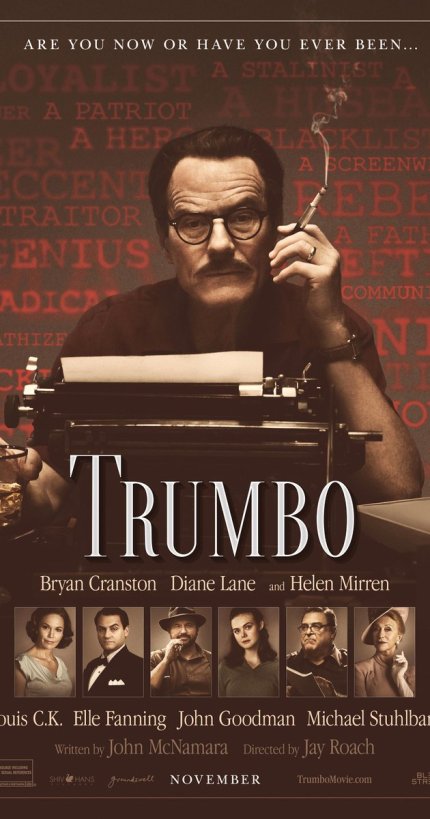
When most younger Americans hear the phrase “Cold War,” it likely conjures vague impressions of backyard bomb shelters and spy vs. spy intrigue in far-flung corners of the world; but when confronted with the acronym “HUAC,” odds are good that many of them will be able to come up with nothing more than a blank stare.  That’s a pity, because in today’s political climate, the history of the House Un-American Activity Committee should be an essential cornerstone of our cultural knowledge.  For that reason alone, “Trumbo,” director Jay Roach’s new biopic about the most prominent member of the so-called “Hollywood Ten,” is a must-see.

I won’t go into detail about the anti-Communist hysteria in post-WWII America- after all, this is a film review, not a history lesson.  Suffice to say that Dalton Trumbo was a prominent Hollywood screenwriter, called before congress to answer questions about his affiliations to the American Communist Party.  Standing on his constitutional rights, he refused to cooperate; not only was he convicted of contempt, political pressure on the Hollywood establishment resulted in a blacklist which prevented the hiring of film artists who would not testify before the congressional committee, and he was left with no means to make a living despite being one of the most lauded scribes in the industry.  “Trumbo,” recounts this history, and goes on from there to detail the story of the writer’s determined climb out of the ashes.

John McNamara’s screenplay focuses its attention on the man himself, giving us a whirlwind tour of his 13-year struggle, and intertwining the political with the personal through an emphasis on private scenes- as well as some healthy dashes of humor along the way.  Through the periphery of Trumbo’s story, we are given glimpses of careers destroyed, lives ruined, and good people forced to betray their friends and their ideals.  The result is a film that delivers a timely socio-political warning about governmental overreach, disguised as a safe, middle-of-the-road narrative.

Some might argue that the story of this dark chapter in Hollywood history might be better told by a less “Hollywood” movie.  Even through its darkest moments, we know that the hero will triumph and the powers that oppress him will be vanquished.  Most were not so lucky; their careers were permanently derailed, and the few survivors still had to wait years after the blacklist fell before getting work.  In addition, though it strives to convey the complex ethics of the situation, it paints at least one character (notorious gossip columnist Hedda Hopper) as a clear target for the audience’s moral outrage without offering any satisfactory insight into the motivations which may have driven her.  It should also be said that “Trumbo” “re-arranges” facts for smoother story-telling- standard movie-making procedure, perhaps, but regrettable, nonetheless.

Such quibbling aside, the film delivers a solid, honorable account of a determined man’s journey through darkness.  Contributing to that is a meticulous recreation of the mid-century period, achieved through set and costume designs that convey the passage of time by reflecting subtle changes in the prevailing styles.  More important, though, are the strong performances, provided by an ensemble ranging from familiar Oscar-winners to relative unknowns.  A few standouts: Michael Stuhlberg, portraying actor Edward G. Robinson through suggestion rather than impersonation; John Goodman, hilarious as the no-nonsense producer who employed Trumbo during the blacklist; and Helen Mirren as Hopper, who reveals the tough-as-nails power-player masquerading as a blowsy busybody while still managing to give us glimmers of her humanity- despite the script’s failure to do so.

The impressive cast, however, rightly takes a back seat to Bryan Cranston, who displays his astonishing range with every subtle shift of expression.  He completely inhabits the larger-than-life Trumbo with an authenticity that never makes him seem affected.  He’s a delight to watch- the image of him doggedly typing away in the bathtub is bound to become iconic- but never afraid to show us Trumbo’s ugly side; and despite his exceptional work throughout, he saves the best for his final, moving recreation of a late-in-life speech that and leaves us with a powerful impression of Trumbo’s integrity.

That integrity, of course, is a given from the beginning of the film; but “Trumbo” is not meant to surprise.  It is meant, rather, to retell of a story that should always be retold.  As its postscript reminds us, the Communist witch hunt affected people in all segments of the population, not just members of the Hollywood elite.  Though set in a time gone by, the film is chillingly contemporary; and if paranoia and political opportunism can combine to persecute a wealthy white man, then who is really safe?  It’s easy to point out that none of us are Trumbo- but his story serves as a reminder that he could be any one of us.

Guys Reading Poems (2016)

c8mxwwiuwaa1zok

Today’s Cinema Adventure was originally published in

The Los Angeles Blade

“WHEN you have tidied all things for the night,
And while your thoughts are fading to their sleep,
You’ll pause a moment in the late firelight,
Too sorrowful to weep.”

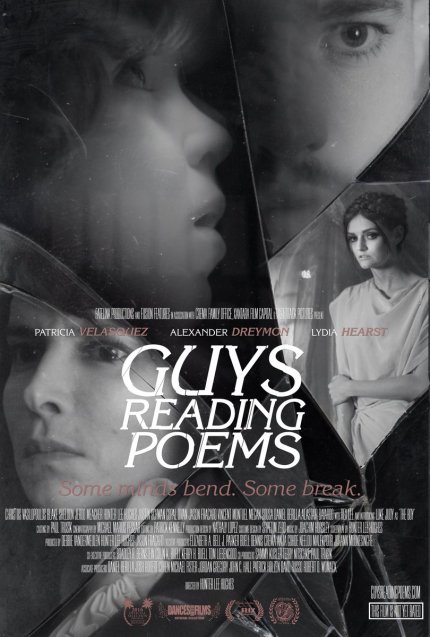
So begins “Solitude,” by Harold Monro, one of 32 works that comprise most of the spoken words in Harold Lee Hughes’ new feature, “Guys Reading Poems.”  The mood it captures is tangible, and suggests the ideal state of wistful melancholy from which to appreciate this delicate cinematic creation.

The film tells the story of a boy whose unstable mother imprisons him in a puppet box and builds an art installation around him; to cope, the boy imagines a group of young men who read poetry to him, and these recitations echo through scenes of his past, his future, and his fantasies.  This ostensible premise serves as the centerpiece in a complex jigsaw puzzle charting the reverberations of a traumatic childhood, through which the resulting psychological fallout- fear and grief, anger and sorrow- is evoked both by the masterful language of the poems and by Hughes’ haunting black-and-white visuals.

It’s an ambitious undertaking to pack so much heavy emotional content into an average-length movie; many filmmakers have tried to channel these kinds of demons into some kind of celluloid catharsis, only to fall short of the mark.  Such efforts are often constructed either as overwrought psychodramas which offer trite resolutions for the sake of closure, or else as fantasies which obscure the issues behind mythological tropes and pseudo-symbolic whimsy.

Hughes has taken a middle path; “Guys Reading Poems” is both drama and fantasy- which means that it is also neither.  Instead, it walks a line between realism and artistic conceit; multiple layers emerge from each other as a progression of imagery takes us from past to present to future, through reality and fantasy and places in between.

The storytelling is elegantly simple, and almost entirely visual; a prologue depicting the courtship of father and mother plays like a lovely pantomime of archetypes, and the rift which develops between them later- as well as the conflict it creates in their child- is eloquently communicated by body language and artful cinematography.  As for the reciting interlopers, they may be somewhat disorienting, at first, but soon become a comfortable presence; like a Greek Chorus, they give voice to the soul of the story.  It’s largely due to them that the film’s elevated stylization can yield an authentic emotional connection, allowing both plot and purpose to be revealed like a lotus flower blossoming in a dream.

The array of poems incorporated includes works by Blake, Whitman, Wordsworth, Dickinson, Yeats, and WeHo poet laureate Steven Reigns, among many others; no less crucial, however, is the visual poetry achieved by Hughes and cinematographer Michael Marius Pessah.  Lushly lit and richly photographed, “Guys Reading Poems” is a movie that revels in its black-and-whiteness, evoking a noir sensibility that pays homage to its cinematic heritage and makes every frame feel like a deeply imbedded memory.  Combined with a flair for artistic design and a deft use of symbolism (which avoids heavy-handedness without sacrificing clarity), this results in a movie of distinctive style and beauty which lingers in the mind’s eye long after viewing.

As for the onscreen talent, they face the task communicating complex relationships mostly without the aid of dialogue, and they succeed admirably.  At the center is young Luke Judy as the boy, moving and endearing in a performance as refreshingly natural as any of his adult co-stars; but it is Patricia Velasquez as the mother- brooding and cold, yet vulnerable and tragic- who, appropriately, dominates the screen.  Rounding out the principal cast is Alexander Dreymon as the father; charismatic, and impossibly handsome, he balances tenderness with a hint of swagger as he provides an embodiment of the elusive masculine ideal.

Of course, the movie is called “Guys Reading Poems,” so the true stars of the show are the ensemble of young men who fill those title roles.  Their soulful delivery provides the movie’s beating heart, and gives weight to what might otherwise be nothing but a succession of pretty vignettes.  Each of them provides a differing perspective, standing in for various aspects of the young protagonist’s psyche as he makes sense of his experience- and each of them, like Dreymon, are stunning examples of the male aesthetic.

In fact, the preponderance of maleness, along with an underlying current of unrequited yearning for masculine affection (piercingly established with the departure of the boy’s beloved father), inevitably suggest a gay subtext.  This tale of a boy locked away in childhood provides an unmistakable allegory for a life shaped in the closet; the isolation from family and society, the entwined longing and resentment, the combination of loneliness and self-sufficiency- all these themes have deep resonance within the LGBTQ community, and all are intricately woven into every fiber of “Guys Reading Poems.”  Never overt, but vivid nonetheless, it’s a layer of meaning that makes this a full-fledged addition to the queer cinema canon.

Even so, Hughes’ film has a universal appeal.  By channeling the pain of damaged youth into a unique filmic meditation, he has created a touchstone for anyone who struggles to reconcile these psychic scars within their own life.  It’s an interior landscape that can be recognized by almost anyone, of course; and by treating it with candor, acknowledging its dark beauty, and honoring its inseparability from identity, Hughes has given us a movie which illuminates the path to transcendence.

“Guys Reading Poems” is unequivocally an art film, and as such unlikely to achieve widespread success at the box office; but for those of us who appreciate the bravery required not only to confront these difficult issues, but to explore them in such a public and honest manner, it is a much-appreciated effort and worthy of being sought out.  It deserves to be called essential viewing.

Goodnight Mommy [Ich seh, Ich seh] (2014)

509614

Today’s Cinema Adventure was originally published in

The Pride L.A.

With Halloween right around the corner, most of the cool kids will want to include an outing to a nice, creepy horror flick amongst all the other seasonal festivities.  If that includes you, but you are bored to death by variations on the “Found Footage” formula (and their perfunctory cheap scares), you might want to seek out a showing of Goodnight Mommy.  Written and directed by Veronika Franz and Severin Fiala, it was Austria’s 2014 submission for the Best Foreign Language Film category at the Academy Awards.  It didn’t get the nomination- but don’t let that dissuade you from seeing it.

Set at an isolated house in a deceptively tranquil woodland, Goodnight Mommy evokes a modern-day Grimm’s Fairy Tale as it introduces us to Lukas and Elias, a deeply-bonded pair of twin pre-teen brothers whose mother has just returned home from having extensive facial surgery.  Almost immediately it becomes apparent to them that more has changed about her than just the features still concealed beneath those intimidating bandages.  Her personality is different: she is colder, harsher, and, worst of all, inexplicably intent on driving a wedge between her two sons.  Gradually they become convinced that she is an imposter, and they begin an effort to expose her- but soon it becomes clear that the biggest question may be how far they are willing to go to discover the truth.

There are a lot of things that grab you right away about this movie.  The opening sequence, in which we first see the twins roaming together through a cornfield, immediately sets the tone.  They (and we) are inside a vast bubble of isolation, one which seems serene and peaceful but is in fact alive with unseen and vaguely unsettling activity- revealed by the carefully orchestrated soundscape of buzzing insects and rustling winds, just the beginning of a soundtrack which favors natural ambience over the use of music.  There is a score, but it only emerges for brief and infrequent intervals, and is all the more effective for it.  Then there is the cinematography, the opposite of what you see in the Paranormal Activity movies and their ilk.  Instead of a herky-jerky handheld camera, we get the stately elegance of widescreen, 35mm photography with the kind of artful framing and clean lines that make the film as good-looking and stylish as the country house of its setting.

All this technical excellence makes it clear that Goodnight Mommy is not a film made by hacks, but it would count for far less if the content were not on the same par.  The directors make sure that it is: their script is complex and tantalizing, doling out clues and hinting at secrets even as it provokes us with new mysteries and confronts us with surprises.  We know from early on that we are being manipulated; Franz and Fiala show us the world only through the eyes of the two young protagonists, carefully filtering our perceptions through them and making us both dread and anticipate the shift in perspective which we sense must be coming.  This sense of impending menace is compounded by the performers: real-life twins Lukas and Elias Schwarz are perfectly cast, exuding both sweet sadness and a kind of otherworldly distance which makes them the perfect blank slate upon which to hang the audience’s expectations; and Susanne Wuest, as Mother, walks the thin line between being menacing and sympathetic with dexterity, keeping us unsure, almost until the very end, whether we should fear her or feel for her.

Of course, it wouldn’t be much of a horror film if there were not also some outright creepy, maybe even gruesome imagery along with all the psychological unease, and although I don’t want to give anything away, I can promise that it delivers (and that if you are squeamish about bugs, you might want to be prepared to look away a few times).

Goodnight Mommy does have its flaws.  The cost of keeping its characters ambiguous enough to preserve our uncertainty is that sometimes it’s hard to connect with- and therefore care about- any of them; and like many horror films, the story hinges on a gimmick, one which will probably be fairly obvious to most savvy moviegoers pretty early on.  Nevertheless, the film works superbly because it doesn’t rely on standard elements of genre formula to have its unsettling effect.  Again, I don’t want to give anything away, but Goodnight Mommy disturbs because it reveals real-life horror, the kind that makes us lie awake at night and worry about those we love.  In the end, it seems more tragedy than thriller.

That said, it’s still pretty thrilling.

Absolutely Fabulous: The Movie (2016)

absolutely-fabulous_1468883174

Today’s Cinema Adventure was originally published in

The Pride L.A.

When reviewing the latest entry in a popular movie franchise, such as the “Star Wars” saga or the various offerings from the Marvel “Universe,” a critic is faced with a serious dilemma.  Should the usual tools of film criticism- principles of cinematic theory, analysis of script and direction, interpretation of thematic elements, and so on- even be applied?  Or are we to accept that these movies are instead designed to satisfy the specific criteria of their legions of fans?  Although it’s not exactly “Star Wars: The Force Awakens” or “Captain America: Civil War,” “Absolutely Fabulous: The Movie” presents the same challenge.

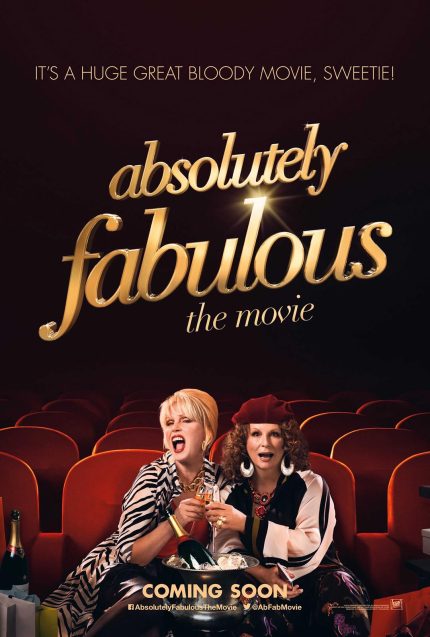
As anyone reading this is likely to know, “AbFab” (as it has been lovingly abbreviated by its fans) is a BBC cult comedy series following the misadventures of P.R. guru (and wannabe fashionista) Edina “Eddy” Monsoon (Jennifer Saunders) and her best chum, fashion editor and perennial party monster Patsy Stone (Joanna Lumley).  These two self-absorbed, socially inept, politically incorrect survivors- or more accurately, relics- of “swinging” sixties London have spent more than two decades pursuing one ludicrous scheme after another- and delighting their (mostly gay) audiences by simultaneously skewering and celebrating the absurd whirlwind of popular culture.

Now this whole crazy circus has finally made its long-anticipated leap to the big screen, with a story that owes as much to the farcical cinema of Eddy and Patsy’s sixties heyday as it does to the “new/now/next” world of the show itself.  Having hit rock bottom (yet again) in her career, Eddy is feeling irrelevant.  When Patsy lucks onto an insider tip that supermodel Kate Moss is seeking a new P.R. rep, it looks like a chance to help her friend regain her mojo.  The two women hatch a plan- but, as usual, things don’t go smoothly, and Moss ends up in the Thames, presumably drowned.  The pair is soon on the run from the law, fleeing to the South of France with one last-ditch strategy to achieve the glamorous life of leisure for which they have always thirsted.

As penned by Saunders, the series’ star (and co-creator, with former comedy partner Dawn French), the “AbFab” movie follows the same formula as most of the small-screen episodes- which means the plot is little more than a wispy premise upon which to drape a wickedly irreverent blend of satire and slapstick.  Essentially, it’s an extra-long installment of more-of-the-same, with Eddy and Patsy stumbling through an over-inflated crisis of their own creation and lampooning the world of fame, fortune and fashion.  They are accompanied, of course, by such long-suffering bystanders as Eddy’s uptight daughter Saffron (Julia Sawalha), dotty assistant Bubble (Jane Horrocks), coyly subversive mother (June Whitfield), and a host of other returning faces from the show’s long run.  To spice things up, there are also some new characters- like Eddy’s uber-gay stylist Christopher (Chris Colfer, from “Glee”) and Saffy’s daughter Lola (the gorgeous Indeyarna Donaldson-Holness)- as well as a sea of celebrities doing good-natured cameos in which they spoof their own personas.

Yes, it’s all constructed around a now-familiar formula, and no, none of the characters seem to have changed or grown throughout their twenty-plus years of madness-on-a-loop.  That is, of course, entirely appropriate.  Nobody needs a softer, wiser version of these two champagne-guzzling anti-heroines, nor a mellower Saffy, nor a smarter Bubble.  So Saunders and director Mandie Fletcher have shrewdly delivered the movie that any “AbFab” follower might expect, and their only concession to the new format is that they spend a lot more screen time taking advantage of gorgeous location scenery in London and on the timelessly elegant French Riviera.

This means that “AbFab: The Movie” is not exactly a stand-alone experience.  Anyone unfamiliar with its endearingly awful characters and their terrible behavior will probably find much of it going over their head.  The dialogue is characteristically rapid-fire, many of the cultural and celebrity references are specifically British, and there are some regional dialects which will be an obstacle for the uninitiated.  On the other hand, Saunders and Lumley- whose interplay is always a sheer delight- lead a cast which is clearly having a blast; their sheer enjoyment is infectious, and even those who have never seen an episode of the TV show might find it hard to resist.

.Ultimately, though, this movie is blatantly, unapologetically, for the fans.  Fortunately, I count myself among their number, so I enjoyed every second of it.  I also appreciated its many subtle references to the comic cinema of the past; any movie that caps itself with a nod to one of the greatest film comedies of all time is okay in my book.  So yes, I highly recommend “AbFab: The Movie.”

To borrow a phrase from Patsy, “don’t question me!”  After all, I’m a film critic, sweetie.

Kubo and the Two Strings (2016)

kubo-and-the-two-strings-poster-the-ice-fields


Today’s Cinema Adventure was originally published in

The Pride L.A.

There is a popular perception that animated movies are pure kid-stuff, designed to lure families to the box office and to generate lucrative marketing tie-ins.  After all, animation pioneer Walt Disney used this formula as the foundation for a financial empire that continues to dominate the entertainment industry today.  Of course, Disney’s films (at least the early ones) were also artistic triumphs, and there have since been numerous others that rival them in stature.  Nevertheless, even the most open-minded critics often tend to join the general public in considering “cartoons” as belonging to a separate-and-unequal category from live-action filmmaking, and often overlook them in any discussion of serious cinema.

This intellectual bias may often be warranted; but occasionally, a film like “Kubo and the Two Strings” comes along to challenge it.  Set in Ancient Japan, it’s the story of a boy who lives with his strangely afflicted mother in a cave by the sea.  Every night, she tells him half-remembered tales of his long-lost Samurai father; every day he spins them into adventurous yarns to entertain the nearby villagers- aided by magic which allows him to manipulate pieces of paper with the music from his shamisen. He is careful, though, to heed his mother’s warning and return home before nightfall, in order to avoid the watchful eye of his grandfather, the Moon King, who wishes to steal him away to his kingdom in the sky.  One day, however, Kubo lingers too long at a village festival, and suddenly finds himself caught up in an adventure of his own- aided by a monkey and a man-sized beetle, with his two terrifying aunts, the Daughters of the Moon, pursuing him every step of the way.

This deceptively simple setup provides the basis for a magnificent visual journey, full of magic, which blurs the lines of reality and challenges us to jump seamlessly between different levels of existence.  This is no small feat, and the fact that we never question it is a testament to the brilliance of its technical execution- the bulk of which was performed using the same basic techniques that took King Kong to the top of the Empire State Building over 80 years ago.  Though some assistance was provided by modern CG technology, most of what we see on the screen was achieved by posing models, one frame at a time, in front of a camera.  This painstaking effort certainly pays off; Kubo’s story comes to life with such palpable reality that the viewer might almost forget to be dazzled by it.

What’s impressive about “Kubo and the Two Strings,” though, is that its story more than lives up to the technical wizardry surrounding it.  Though it evokes the traditional folk tales of Japan, “Kubo” is entirely original, its screenplay written by Marc Haimes and Chris Butler from a story by Shannon Tindle.  Even so, as guided by director Travis Knight, it maintains a strong sense of mythological authenticity as it delivers its own version of the classic hero’s journey; the mystical elements which comprise much of the story’s framework are presented as factual conditions of the plot, yet the deeply resonant symbolism they possess- a quality downplayed by most such films aimed at contemporary American audiences- is given equal weight.  Similarly, while the film doesn’t avoid sentimentality, it never manufactures it to generate an unearned emotional response; rather, it allows the story and its characters to provide it, in appropriate doses, when it arises naturally.  As a result, “Kubo” manages to amuse, frighten, touch, and surprise its viewers- whatever age they might be- all the way through to its lovely, delicate, and bravely bittersweet ending.

Of course, there are many other factors contributing to the film’s success.  Its visual design is a marvelous blend of stylization and historical detail, effectively transporting us to the story’s time and place from the very first frames- with the aid of a majestic and immersive score by Dario Marianelli.   As for the voice cast (led by Art Parkinson as the title character and including the likes of Charlize Theron, Matthew McConaughey, Rooney Mara, and Ralph Fiennes), it must be mentioned that “Kubo” has drawn some heat for using mostly white actors.  Conroversy aside, those actors deserve credit for their fine work, which plays a big part in making “Kubo” into the special experience it is.

It’s a bit early to start making lists of the year’s best films, but when the time comes, I think it’s a safe bet that “Kubo and the Two Strings” will be on a few of them- anti-animation prejudices notwithstanding.  It fully deserves that honor.  It’s a multi-layered, visually stunning work which tells a powerful story without pandering to its viewers- and a film like that, animated or not, is very rare indeed.

Florence Foster Jenkins (2016)

ffj_1sht_characters_meryl

Today’s Cinema Adventure originally appeared in

The Pride L.A.

Walking into the theater to see “Florence Foster Jenkins,” it’s a given that you are about to watch another tour-de-force by Meryl Streep.  I’ll waste no time in saying that she delivers on that expectation.  The story of a real-life society matron who realized her life-long dream of singing at Carnegie Hall despite a complete inability to carry a tune, this bio-pic is tailor-made for her talents; it can be no surprise that she gives arguably her most delightful performance in years.

What’s surprising is that nobody sharing the screen with her disappears behind her shadow.  On the contrary, her co-stars contribute just as much as she does to the movie’s overall charm, helping it to become much more than just a showcase for the talents of a beloved silver-screen diva.

To give full credit, it is necessary to recognize that this is not just a Meryl Streep vehicle, but the latest entry on the resumé of British filmmaker Stephen Frears, who first gained international recognition with his iconic 1985 gay romance, “My Beautiful Laundrette,” and who has helmed a number of prominent movies over the decades since- “Dangerous Liaisons,” “The Grifters,” “The Queen,” and “Philomena,” to name only a few.

No stranger to working with legendary talent, one of Frears’ great strengths as a director is his ability to enlist them in the service of his own sure-and-steady storytelling skills, allowing them to be actors instead of stars, and to enhance his work instead of dominating it.  It’s an approach geared towards the character-driven projects he prefers; his movies, though they often involve unorthodox situations or famous figures, are always ultimately about universally-shared human experience, and they benefit from the workmanlike performances though which he guides his players.
In this case, of course, the incomparable Meryl is front-and-center, as she should be.  Her Florence has all the hallmarks of a great Streep role.  She is a larger-than-life personality, almost cartoonish, but in Streep’s hands she is never anything less than completely, believably human.  She displays impeccable comedic abilities in one moment and slips seamlessly into heartbreaking pathos the next, without ever relying on clownish mugging or heavy-handed sentiment- and on top of it all, she does her own bad singing without sounding like she’s trying to sing badly.  In short, she gives the kind of performance that has put her in the echelon of such stars as Hepburn and Davis.

Even so, she is not the whole show.  The movie’s real surprise is certainly Hugh Grant.  Usually regarded more as a personality with a pretty face than as a high-caliber actor, he more than rises to the occasion here as Florence’s devoted (if not-quite-faithful) husband, who uses his connections in both the high and low strata of New York society to help her accomplish her improbable dream.  Carrying himself with the slightly-obsequious swagger of a ne’er-do-well cad, he undercuts that demeanor with a layered performance which never leaves you in doubt of his sincerity.  His aging-but-still-handsome features convey a depth of feeling which reveals “Florence Foster Jenkins” to be, at its core, a love story.

In the third key role, Simon Helberg (of “The Big Bang Theory”) portrays Florence’s reluctant accompanist, Cosmé McMoon, in a style which (in keeping with the film’s period setting) suggests the codified “sissy” characters of old Hollywood.  His homosexuality is never explicitly addressed, but the film derives some good-natured humor from his obvious orientation- which, rather than demeaning or marginalizing him, serves to place him, along with all such characters, in his rightful role as an integral part of society.  Queerness aside, Helberg gives us a marvelous serio-comic turn as a timid outsider who finds the strength of his own spirit through his dedication to his unlikely employer; he fully earns the right to share the screen with his two co-stars.

The rest of the cast, though their names and faces are less recognizable, are equally effective in portraying their roles.  In addition, the film benefits from breathtaking production design (by Alan MacDonald) and sumptuous costuming (by Consolata Boyle).  Finally, as is always the case for a strong film, the screenplay (by Nicholas Martin) is well-crafted, literate, and thoughtful, providing a strong foundation upon which the other artists can build their own great work.

“Florence Foster Jenkins” is not a deep or ground-breaking piece of cinema.  It’s a refined crowd-pleaser, a serio-comic slice of life designed to touch and delight its audiences.  That’s not a bad thing.  In a summer filled with noisy blockbusters, it’s refreshing to be treated to a movie with such quiet class- particularly when it has as much talent on display as this one.  After all, when a Meryl Streep performance is just the icing on top, you know that has to be one delicious cake.

Weiner-Dog (2016)

wiener-dog-poster01

Today’s Cinema Adventure originally appeared in

The Pride L.A.

Todd Solondz doesn’t make movies to offer you an escape from your problems; he makes movies to confront you with them.  Ever since his 1995 breakthrough, “Welcome to the Dollhouse,” he has repeatedly offered up grim, uncomfortable stories of the dysfunction lurking just beneath the banal surface of suburban American life.  His films are variations on the interconnected themes of failure, depression, and emotional isolation.  Not exactly the stuff blockbusters are made of.

Yet the quirky writer/director has developed a loyal cult following who continue to be mesmerized by his sardonic vision of the world and the broken, faltering lives of the people who live in it.  Indeed, there is an almost masochistic fascination to these sad little fables of modern life, not unlike that can’t-look-away feeling you get when passing a gruesome accident scene on the highway.  Coupled with this morbid appeal is his tendency to feature recurring characters in his films (usually portrayed by different actors) alongside the new ones.  The desire to see what has happened to some of these familiar figures (and the hope that they have somehow managed to improve their dismal lives) is undoubtedly key in keeping his fans coming back for more, and it provides a major hook for the filmmaker’s latest effort, “Weiner-Dog.”

Those familiar with “Dollhouse,” which remains Solondz’ most popular and successful work, will immediately recognize this title as the nickname bestowed on that film’s pathetic anti-heroine, middle-schooler Dawn Wiener.  Though clearly intended to invoke that connection, and though that much-beloved character does indeed make her long-anticipated return here, in this case the name refers to a new central figure- a dachshund who becomes the pet of four different, unconnected people through the course of her life.

First, she is gifted to a young cancer survivor, Remi (Keaton Nigel Cooke), providing the boy with a brief respite from the stark home environment created by the antagonistic and seemingly loveless marriage of his affluent parents (Julie Delpy and Tracy Letts).  Then, she is adopted by the now-adult Dawn Wiener (the gifted Greta Gerwig)- still awkward and desperate for affection- who takes her along for the ride as she accompanies an old schoolmate on a road trip.  Changing hands again, she becomes the pet of Dave Schmerz (Danny DeVito), a has-been screenwriter barely clinging to his job as an unappreciated teacher at a film academy.  Finally, she ends up as a companion animal for Nana (the always-stellar Ellen Burstyn), an elderly and misanthropic invalid who receives a surprise visit from her long-absent granddaughter, Zoe (Zosia Mamet).

That’s it.  The dog connects the segments by her presence, but otherwise these are stand-alone vignettes, composed around Solondz’ usual themes and exploring the various ways in which human beings treat each other- and themselves- very badly.  As anyone familiar with the director’s work would anticipate, there’s not much hope to be found in these stories, and where there are glimmers of it they are subverted by the surrounding circumstances; and yet, the film has a strange and terrible beauty.

This is the hallmark of Solondz’ work; he shows us life at its cruelest and most demeaning- almost always with the explicit qualifier that it is we ourselves who are responsible- and yet he makes it somehow lovely.  He also makes it darkly funny; he is, above all, a social satirist whose stunted, minimalist dialogue conveys both depth of insight and an arch sense of ironic humor that revels in making us laugh at the things which most disturb us.  It might be argued that the laughter is a defensive reflex, a release of uncomfortable tension; this may be true, but it’s an authentic response, nonetheless.

Cut from the same cloth as his earlier films, this is perhaps Solondz’ most elegantly-made work to date.  Cinematographer Ed Lachman delivers a low-key study in composition that subtly elevates the aesthetic and allows us just enough of a cool perspective to distance ourselves without being able to completely detach.  That’s important, because Solondz wants us to reconnect with the primal emotions- fear, shame, guilt, loneliness, resentment- within us all.  He warns us that if they are left in the darkness to be stoked by our failures and losses, they can make our lives like those he shows us on the screen; those lives might seem absurd, exaggerated, and extreme, but he never lets us believe they are anything other than truthful.  Brutally truthful.

For non-Solondz-fans, it should be noted that “Weiner-Dog” (like all of his work) is likely to put off many viewers.  It’s bleak and unrelenting, with a pall of despair that hangs over it from beginning to end.  Animal lovers, especially, should be warned to consider carefully before seeing it; for the sake of avoiding spoilers, I’ll just leave it at that.

1473523071_skrin3


Midnight Special (2016)

Today’s Cinema Adventure originally appeared in

The Pride L.A.

MIDNIGHT SPECIALadamdriverAndjaedenlieberher

Movie “mash-ups” are a hallmark of our Postmodern era.  It is as if everything that has come before in cinema has been collectively smashed into pieces, and filmmakers freely pick up whatever shards they like and combine them to make something new.  It doesn’t matter if the pieces are recognizable, nor is it necessary to justify the appropriation by calling it an “homage.” This is, arguably, how it should be.  Each generation redefines the culture on their own terms, and it has always been standard practice for artists to “borrow” from those who have exerted a strong influence over their own work.  However, when they are not driven by a cohesive vision that makes the whole greater than the sum of its parts, far too many films fall short, no matter how sincere their creator’s intentions may be.  Unfortunately, “Midnight Special,” the newest feature from writer/director Jeff Nichols, is one of them.

Drawing heavily on the work of Steven Spielberg in his heyday, it combines several genres- chiefly science fiction and family drama- to tell the story of Alton (Jaeden Lieberher), a boy with mysterious powers who has been kidnapped by his father, Roy (Michael Shannon), from the compound of a religious cult that believes he is their only hope to survive the imminent apocalypse.  With the help of an accomplice, Lucas (Joel Edgerton), the fugitives flee across the country in an attempt to reunite with the boy’s mother (Kirsten Dunst) and journey towards a mysterious destination to which Alton’s visions seem to be leading them- all the while trying to stay ahead of the cult’s operatives as well as a government task force, spearheaded by Paul Sevier (Adam Driver), that wants to find Alton for reasons of their own.

There are a lot of threads to follow in “Midnight Special.”  Nichols takes his time unraveling them for us, and doles out information sparingly as he goes.  In the first few minutes, he effectively introduces us to the main elements of his premise; from this point on, however, his film develops into a continuing series of complications, each one serving only to lead to the next, while offering only the merest scraps of information about the deeper mystery at the heart of the proceedings.  By the time we get to the big revelation- which is simply announced to us, somewhat anti-climactically- we have already been led through so many confusing turns that it’s difficult to still be invested in the outcome.

Of course, anyone familiar with Spielberg’s “Close Encounters of the Third Kind” will sense from early on where the story is going.  “Midnight Special” has so many echoes of that classic (among others) that it is hard not to compare the two works.  To go into detail about the connections would spoil the current film, but it is worth noting that the things that make Spielberg’s movie so memorable are painfully absent here.  The sense of adventure is replaced by a feeling of impending doom; and although both movies center on families threatened and pulled apart by momentous events, “Close Encounters” nevertheless manages to be joyous and fun while “Midnight Special” struggles to stay just this side of despair.  It’s fair to say that they are different movies from different eras, but one still cannot help but think that Nichols movie takes itself far more seriously than needed.

It’s not the fault of the cast, who mostly deliver heartfelt performances.  Young Lieberher is engaging and likable while still managing to be suitably grave.  As his adult protectors, Shannon, Dunst, and Edgerton all play admirably against sentimentality, and if they come off as unrelentingly dour it seems more a function of the script and direction than the integrity of their work.  As the cult leader, the venerable Sam Shepard (whose presence underscores strong parallels with another vintage film, Daniel Petrie’s “Resurrection”) provides understated sorrow instead of predictable menace.  The standout performance, though, comes from Driver, whose turn as the government expert trying to unlock Alton’s secrets evokes the wonder and excitement so sorely missing from the rest of the film.  His screen time is all too brief.

“Midnight Special” is not a complete failure; it offers an intriguing exploration of the way that belief- whether in religion, science, or worldly concerns- can keep us blinded to truths that lay outside our understanding, and it avoids pandering to its audience with easy answers or familiar clichés.  In the end, though, there is little payoff for these ruminations, and the movie leaves us wondering far more about the details of its plot than the implications of its ideas.  It disappoints us more than it challenges us- and considering the sources from which it draws its inspiration, it is a strong disappointment, indeed.

Anomalisa (2015)

ANOMALISA

Today’s Cinema Adventure originally appeared in

The Pride L.A.

Screenwriter Charlie Kaufman has completed only a small handful of features since his 1999 debut (“Being John Malkovich”), yet despite his relatively sparse output, his name and reputation loom large, particularly among those cinephiles whose tastes run toward the edgy and intellectual.  His narratives, which seem to flow from dream logic rather than dramatic structure, are more like psychological case studies disguised as heavily symbolic brain-teasers, inhabited by figures that feel less like individual characters and more like shattered fragments of a single personality.  His latest effort takes the form of an animated film, but though “Anomalisa” is markedly different in its execution, it is cut from the same unmistakable cloth.

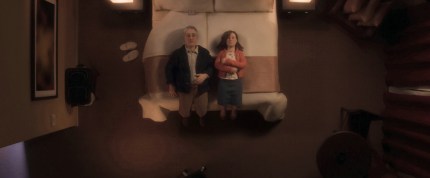
Kaufman’s screenplay is adapted from his own “sound play” of the same title, and, for the second time (the first was for 2008’s “Synecdoche, New York”), he steps into the director’s chair, as well- though he shares it with co-producer Duke Johnson.  It focuses on Michael Stone, a successful self-help author who travels to a Cincinnati hotel in order to speak at a conference.  Though he is an expert on interpersonal relations, Michael is unable to distinguish people as individuals.  Everyone with whom he interacts possesses the same male face and voice- even the women- until he encounters Lisa, a young woman attending his seminar.  She is distinctively herself within the sea of homogeneous banality that surrounds him, and he begins to hope she can at last release him from the boredom and isolation he has felt for so long.

The above description may not read like the synopsis to an animated film, but “Anomalisa” is no ordinary animated film.  Shot in stop motion style, it utilizes puppets partly manufactured by 3-D printing, resulting in a somewhat unsettling effect that is simultaneously stylized and naturalistic.  It’s an effective style for the story being told; the world of the movie seems concrete enough to anchor it in reality, allowing us to forget the animated format as we are gradually drawn into the premise.  Much of the credit for this aspect of “Anomalisa” belongs to co-director Johnson, who supervised the creation of its technically stunning, intricately detailed animation.

The content of “Anomalisa,” while equally as creative as its visuals, is perhaps less innovative- at least to those familiar with Kaufman.  As with most of his work, it’s an observational fable that takes place within a Kafkaesque landscape of psychological dysfunction.  It challenges our ideas about the nature of identity and explores the effects of perception on our experience of the world around us.  It presents characters unable to make the emotional connections they desperately desire, who live in private bubbles of perspective and fumble blindly in their interactions with others.  And then there are the puppets; puppets have always figured prominently in Kaufman’s imagination, and here, they even take the place of live actors.  To say the film revisits Kaufman’s recurring themes is by no means a negative criticism, however.  On the contrary, those themes strike deep and resonant chords; they always yield new insights into our shared human experience, and the writer’s quirky imagination ensures that his work is always full of surprises.

Though the provocative ideas and visuals are the real stars here, credit also goes to the fine work of the voice cast.  David Thewlis (as Michael), Jennifer Jason Leigh (as Lisa), and Tom Noonan (as everyone else) eschew the usual exaggerated vocal styling of animation in favor of a nuanced, naturalistic approach.  Their effectiveness is likely due in large part to the fact that all three performed their roles in the original play, as well.  Composer Carter Burwell also carries over from the stage version (he actually produced it), contributing a delicate, moody score which perfectly serves the melancholy tone of the overall piece.

“Anomalisa” is certainly melancholy, even dark.  In addition to its complex and mature themes, it features profanity, full-frontal nudity, and even a somewhat explicit sex scene.  Needless to say, it is not for children, despite being an animated film.  Many adults might also have a hard time with it; its intellectualism, coupled with its stylistic conceit, creates an emotional distance that may leave some viewers cold.  This is a frequent issue with Kaufman’s introspective creations, but as always, those willing to stick with it will find that it has a lot of heart hiding under all its conceptual constructs.  There’s also a lot of humor in the mix.  Despite the philosophical weightiness of his material, Kaufman never takes himself too seriously; he somehow always manages to be both thought-provoking and entertaining, and it is this that makes him one of the most original voices in American film.  “Anomalisa” is a worthy entry to his canon, and like most of his work, it fully deserves to be called essential viewing.

Nosferatu, A Symphony of Horror / Nosferatu, eine Symphonie des Grauens (1922)

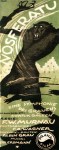
Nosferatu (poster)

Today’s cinema adventure: Nosferatu, A Symphony of Horror (Nosferatu, eine Symphonie des Grauens), the 1922 German film adaptation of Bram Stoker’s Dracula, directed by the acclaimed and influential F.W. Murnau. An elaborate production, filmed largely on location, it was the first major film to focus on a vampire and has exerted a strong and lasting influence over the 90 years since its release; yet it was almost lost due to the fact that the production studio- Prana Films- never obtained the rights to Stoker’s novel and was sued by his widow, resulting in their declaration of bankruptcy and an order to destroy all copies of the movie. Fortunately, one copy had already been shipped out, and thanks to its survival Nosferatu (as it is now commonly known) was eventually heralded as a true classic, developing a cult following and becoming a cultural icon.

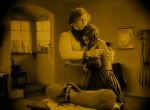
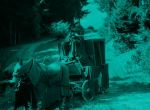
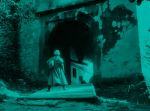
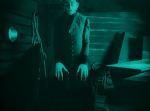
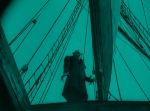
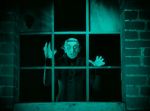
The plot is more or less familiar to anyone who has read or seen Dracula in any of its more “official” versions, but the setting and the names of the characters have been changed, and several new ideas are introduced in addition to the creation of a significantly altered ending. It opens with idyllic scenes of life in the fictional port town of Wisborg; a young man, Thomas Hutter, is being sent to faraway Transylvania by his employer, a real estate agent named Klock, in order to conduct a transaction with the mysterious Count Orlok, who wishes to buy a house in their town. Though his beautiful and virtuous wife, Ellen, has dark forebodings about the trip, Hutter leaves her in the care of friends and enthusiastically embarks on his journey. Once he arrives at Orlok’s ruined castle, however, he begins to suspect that the reclusive count- a thin, ghoulish-looking eccentric who evokes deep fear in the local villagers- may have darker intentions than a simple change of scenery; after the deal is finalized, the young man is horrified to discover that his host is indeed a member of the undead, a powerful vampire who sleeps by day in a coffin under the castle- but the knowledge comes too late, for Hutter finds himself imprisoned in his room, watching helplessly from a window as Orlok loads several coffins full of dirt into a wagon and departs for Wisborg. Fearing for the safety of his home town- and especially of his beloved wife- he manages to escape from the castle and begins to make his way back to Wisborg, hoping he can arrive in time. The count, meanwhile, travels by ship, concealed below deck in one of his coffins; along the way, he victimizes every port town at which they stop, leaving behind rumors of plague. He also preys upon the crew, killing them one by one until the boat arrives in Wisborg, seemingly a ghost vessel inhabited only by rats- brought on board within Orlok’s spare coffins. Believing the rodents have carried the spreading plague to their town, the authorities warn the citizens to remain secluded in their homes, and Orlok, having moved into his new abode and using the supposed epidemic as his cover, begins to feed upon the terrified population. When Hutter finally arrives home, he finds that Ellen, to his relief, is so far unharmed, but she is consumed by melancholy and terrified of the new neighbor who stares at her from his window at night. Though her husband tries to hide the truth from her, she discovers from his books the true nature of the threat, and learning that the vampire can only be destroyed by direct sunlight, she resolves to undertake a dire strategy by which she might lure Count Orlok to his doom.

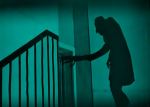
The screenplay for Nosferatu, which has received much praise for its deliberate, rhythmic pacing and its pervading air of cool melancholy, was authored by Henrik Galeen, an Expressionist writer hired by the film’s producers for his expertise in the dark romantic style they wished to capture. Though the great Murnau is usually given credit for the movie’s eerie mise-en-scène, Galeen’s script was in fact quite detailed in its meticulous, shot-by-shot description; he included specific instructions for each scene, with directions for timing, camera angles and composition, and lighting, even providing sketches for reference in framing shots. The result is a haunting, dream-like exploration of the primal fears hiding in the dark corners of man’s imagination, given form through the persistent folklore that has resisted the rise of science and reason since the days of the Black Death. Though the vampire myth is ancient and universal, its most familiar and lasting incarnation springs from the superstitious tales of Central Europe, where bubonic plague wiped out whole medieval villages and prompted the survivors to imagine other-worldly causes for its indiscriminate and unstoppable devastation- not only vampires, but werewolves and other insidious monsters of the night became the dreaded scapegoats for this seemingly unexplainable onslaught of death, and legends of their continuing existence endured throughout the centuries as a reminder of those dark times. Galeen’s scenario, borrowed as it may have been from Stoker’s then-still-fairly-recent novel, stirs up all of these arcane fears embedded in cultural memory. Indeed, before Orlok ever appears onscreen there are scenes of a werewolf prowling the night (with a striped hyena- a bizarre-looking and fearsome creature that was largely unfamiliar to most 1922 moviegoers- standing in for the supernatural beast), and memories of the ancient plague are clearly tapped by the tale’s conceit of using the threat of just such a rat-borne pestilence as a subterfuge to mask Orlok’s killing sprees; even the vampire’s makeup, with his large, pointed ears and pronounced, close-set fangs, is designed to be rat-like and enhance the correlation between monster and disease. Though Nosferatu is set in the 1830s and was made in the 1920s, as we watch it in the 2010s our subconscious is undeniably returned to the Dark Ages, when the night concealed forces which we could neither fathom, foresee, nor combat, and safety was an illusion that could only be maintained by the light of day.

As for Murnau, even if he was guided extensively by the wishes of the screenwriter, his genius clearly shows through. His meticulously faithful adherence to Galeen’s directives is infused with his own brand of cinematic poetry, creating a striking visual statement that leaves lingering images in the viewer’s mind. His skill at using light and shadow is here used to great advantage, with his particular gift for capturing the almost tactile properties of both helping immeasurably to build the heightened, nightmare reality of the film. Nosferatu, after all, is pure Expressionist cinema- albeit tempered by the sensibilities of gothic romance- and as such is intended to simulate a sort of dream-state, in which the impulses of the unconscious psyche are manifested in outward form; Murnau’s ability to create this hallucinogenic, psychically resonant feel onscreen is largely responsible for its overwhelming success at this objective. Nor should his efforts with the mechanics of storytelling be ignored; he drives his film at precisely the right pace, neither too slowly or too quickly, but with a strong feeling of inexorability that feeds our cumulative sense of dread and pulls us deeper into the narrative. This effect was neither accidental nor accomplished after the fact through editing; the director filmed each scene with precision timing, even using a metronome to guide his actors, and controlled the rhythm and flow of the movie with such a musicality that its subtitle, “A Symphony of Horror,” is not at all hyperbolic.

The film’s other components should be noted, as well, for they all support Murnau’s artistry by building a cohesive visual unity. The director’s remarkable portrayal of light- such a tangible force it is itself almost a character in the drama- is made possible by the luminous work of cinematographer F.A. Wagner- who, amazingly, accomplished the entire shoot (even the extensive location footage) with only a single camera. Contributing immensely to the visual style, which not only makes heavy use of the theatrical, larger-than-life elements of Expressionism but also draws extensively on older, more traditional influences from Germany’s rich and varied artistic heritage, is the set-and-costume design of Albin Grau. His creations- with the help of Murnau and Wagner’s intricate lighting- evoke paintings by the great masters, but they also lend themselves to the edgy avant-garde milieu of the then-present-day; this melding of the familiar with the jarringly strange is yet another way in which Nosferatu derives its power. Grau was one of the film’s producers, and indeed had first conceived the idea of making the movie, inspired by an incident during his service in WWI, when a Serbian farmer told him that his father was a vampire; no doubt haunted by his imaginings of this farmer’s undead patriarch ravaging the countryside at night, he knew it was the sort of irrational dream material that was perfect for expression through film. It might be said that, more than Galeen or even Murnau, Nosferatu was his film; accordingly, his considerable design contributions, infused with the passion of a personal vision, should not be overlooked.

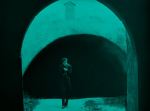
Though it was, of course, a silent film, music was nevertheless intended to play an important role in Nosferatu. Sadly, the original score composed to accompany its screening, written by Hans Edermann, was long thought lost. As a result, there have been numerous alternative scores created over the years, in styles ranging from lush orchestral romanticism to dissonant avant-garde minimalism. The print I watched recently (available on Netflix streaming video) features a score composed in 2000 by the Silent Movie Orchestra, consisting of a fairly contemporary-sounding ensemble utilizing such elements as electronic organ and heavy percussion; personally, I found it highly effective, but obviously it’s a matter of taste. Many feel that the score for a silent movie can only be appropriate if it is created in the style of- and with the instrumentation available in- the era in which the film was made; others have a more flexible preference, and obviously the majority of casual viewers will most likely find such a question immaterial (though I would venture to say that many of those who claim they cannot enjoy silent films are basing their opinion on the experience of seeing one with a generic, woefully inadequate musical accompaniment- the effect of music on this art form cannot be overstated). There are a number of prints available, with different scores to accommodate every taste, so if this aspect of the film is a concern, you would be well-advised to do a little research before choosing which version to watch. The now-reconstructed Edelmann score is featured on Kino’s restored print, which also offers probably the cleanest video quality available today, complete with the original, all-important chromatic tinting to differentiate day from night (in pure black-and-white, as most silent films were commonly shown for decades, time of day becomes a confusing issue); obviously, watching this edition is the best option, if possible; otherwise, there are numerous other versions available for free viewing online- after all, the movie is in the public domain, at least in the United States.

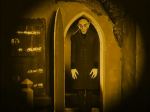
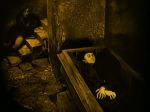
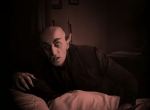
Whatever musical accompaniment you might favor, if you are a serious cinema aficionado, watch Nosferatu you should. Though many other horror films pre-date it, it is unquestionably the first unqualified masterpiece of the genre, from which all subsequent entries have sprung; not only have Galeen’s screenplay and Murnau’s direction spawned thousands of imitators throughout the past century, their film contains the first bona-fide horror icon (with the possible exception of Conrad Veidt’s somnambulistic murderer in The Cabinet of Dr. Caligari) in the form of Count Orlok. As embodied by character actor Max Schreck, the count is a nightmarish figure indeed; a far cry from the darkly romantic charm of Bela Lugosi and other later interpretations of the Dracula character, he is utterly devoid of humanity, spectral, repellant and coldly detached. He famously grows uglier as the film progresses, with fangs and talons seeming to grow larger as he becomes more steeped in bloodshed and death. Like an anthropoid vermin, he moves his spindly frame with a grotesque grace and gazes with dull malevolence through his not-quite lifeless eyes; it’s easy to see why Schreck has been shrouded with mystery in the popular imagination, even being portrayed as a real vampire in the fictional 2000 film about the making of Nosferatu, Shadow of the Vampire. For many years, cinematic legend surrounding the film has wrongly implied his surname was adopted for this role due to its translation into the English word “fright,” but Schreck was indeed his birth name, and he had enjoyed a long and prominent career in German theatre and film prior to being cast as Orlok. He deserves full recognition for his performance, a masterful creation in which he uses his physicality to bring the full essence of this loathsome character to the screen; to attribute his effectiveness solely to savvy casting, though Murnau reportedly picked him for his ugliness alone, is to discount the level of commitment this fine actor brought to the role, helping to make it one of the most definitive and influential screen depictions of a horror character ever filmed- an even more remarkable feat considering that he is actually on screen for a total of less than 10 minutes

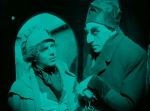
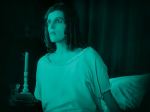
The rest of the cast, though many of them have much more screen time, are not quite as unforgettable as Schreck- how could they be? This doesn’t mean their work is inferior, however; all of the players provide vivid portraits of their characters, delivering top-notch performances in the accepted style of the day. Gustav von Wangenheim, a noted theatrical writer/director and performer, and film’s true leading actor, is robust and florid as Hutter, a little over the top, perhaps, but more endearing by far than most of the wooden, stiff-upper lip types offered by later incarnations of the story’s parallel character, Jonathan Harker; the stately and beautiful Greta Schröder adds a touch more weight and dignity than expected to the role of Ellen, making her less the helpless victim than the tragic heroine; and as Knock, the psychically-enslaved real estate broker who serves as the film’s version of Renfield, Alexander Granach gives us a comically exaggerated- but still unsettling- personification of the archetypal greedy old man, here driven to the point of lunacy by the influence of his demonic master and presenting an obvious allegory, in his affiliation with the vampire, for the adulation of wealth and power represented by such figures- which gives Nosferatu a suggestion of sociopolitical commentary, in the sense that Knock becomes a scapegoat for the villagers, who blame and persecute him for the onset of the plague, though- despite his eager participation in the evil that besets them- he is, in reality, just another victim, a symptom of a larger malady that transcends political or economic concerns.

Nosferatu is one of those rare works from the early years of cinema that remains eminently watchable by the average viewer today; there is something about it, perhaps a sense of the dark despair hidden beneath even the brightest promise of happiness and prosperity, which allows it to strike a universal and timeless chord. There are so many haunting and indelible images here: the silhouetted horses fleeing from the marauding werewolf; the spectral coach speeding eerily in stop-motion as it bears Hutter to Orlok’s castle; the ghostly ship gliding inexorably through the night as it delivers the vampire across the waters; the angry mob destroying a scarecrow in its pursuit of Knock; and, of course, every moment of Orlok’s presence, from his first appearance as the sinister driver of the coach to his furtive and decidedly unromantic feeding upon his final victim. The stylized artistry of its presentation, far from making it inaccessible, seems to crystallize it and capture its essence in a form that is instantly familiar. It’s impossible to say, 90 years later, whether the imagery of Murnau’s movie has become integrated into our collective cultural consciousness or if it drew its inspiration from the dark imaginings that were already there; wither way, the effect is the same- Nosferatu is an experience that feels like it is coming from within us, not from without.

http://www.imdb.com/title/tt0013442/