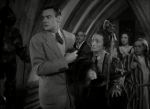
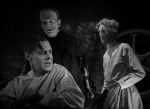
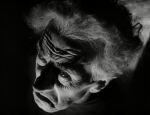
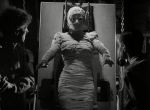
Bride of Frankenstein (1935)

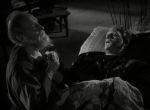
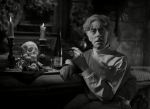
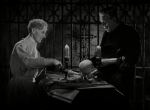
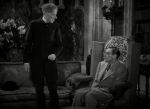
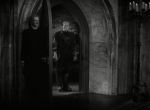
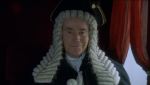
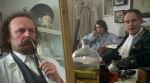
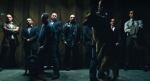
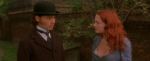
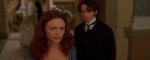
Today’s cinema adventure: Bride of Frankenstein, the classic 1935 sequel to James Whale’s Frankenstein, once more directed by Whale and starring Boris Karloff as the iconic monster and Colin Clive as his creator, as well as featuring Elsa Lanchester and Ernest Thesiger in new roles.  Though it did have its detractors, it was mostly seen as a triumph even upon its initial release, and it is widely hailed today as one of the few movie sequels to surpass the original, not only representing the artistic pinnacle of Universal’s cycle of horror films, but considered by many to be the defining masterwork of Whale’s short career.

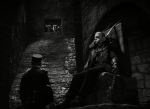
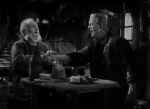
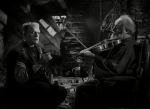
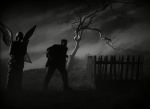
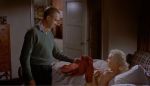
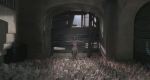
After a sumptuous prologue in which Mary Shelley- author of the original Frankenstein novel, for those who don’t know- regales her husband Percy and their friend Lord Byron with the continuation of her macabre tale, Bride of Frankenstein picks up where the first film left off, at the smoldering wreckage of the windmill in which, after throwing his creator to an almost certain death, the monster has presumably been burned alive.  As the mob which had trapped him there disperses, the parents of a child he had murdered linger to assure themselves of the creature’s demise, only to make the fatal discovery that, having found refuge in the mill’s flooded basement, he has survived after all.  Meanwhile, after being transported back to his baronial castle, Dr. Frankenstein is also found to have survived, much to the joy of his fiancée Elizabeth, who vows to nurse him back to full health so that they may finally celebrate the wedding postponed by the rampage of his marauding creation.  His recuperation is interrupted by a visit from his former professor, Dr. Pretorius, who reveals that his own experiments in the creation of life have also met with success and insists that the two join forces in order to continue the work; Frankenstein, despite the horrific experiences that resulted from his previous efforts, is fascinated and drawn in by the possibilities.  In the outside world, the monster wanders the countryside, seeking safe haven and experiencing disastrous encounters with terrified townspeople.  Eventually captured and imprisoned, he breaks his chains and escapes into the woods, where he finally finds refuge with a lonely blind hermit, who treats him with kindness and teaches him to speak and to enjoy the simple pleasures of life.  This idyllic respite is short-lived, however; a pair of hunters discover the creature, the hermit’s cottage is accidentally set ablaze in the ensuing struggle, and the forlorn fugitive flees as his new friend is led away to safety by the interlopers.  With the entire countryside on his heels, the monster hides away in a dilapidated crypt, where he unexpectedly encounters none other than Dr. Pretorius.  The scientist befriends him, and promises that, with his help, he can persuade Dr. Frankenstein to make a new creature, a female that will at last offer the lonely outcast the companionship for which he longs.  When the good doctor, newly married and about to embark on his honeymoon, refuses to cooperate, Pretorius instructs the monster to abduct Elizabeth, and promises Frankenstein her safe return upon the completion of the new creation.  Though he has been forced into participation, the doctor becomes enthusiastic about the project in spite of himself, and soon- thanks to some unsavory assistance procured secretly by Pretorius to find a suitable heart for the new creature- the experiment reaches its successful fruition.  The original monster’s intended mate, however, has a mind of her own, an unexpected development which leads to disastrous complications.

Following the success of the original Frankenstein in 1931, Universal was eager to produce a sequel; they publicized their intention to make one almost immediately, but director Whale was uninterested in returning to the material, feeling that he had exhausted the possibilities with his first effort.  It took several years for the pieces to come together, during which time the filmmaker was persuaded to helm the project as part of a package deal- he was given the chance to direct another film in which he was interested (the now-virtually-forgotten One More River) in exchange for accepting the assignment on the Frankenstein sequel, over which he was also promised absolute artistic control- and work commenced at last on the long-awaited film.  Whale believed, however, that a sequel would be unable to surpass his original movie, so he decided to take a different approach; seeking to turn the film into a black comedy, he rejected several scripts before settling on an adaptation by John Balderston (who had adapted the first film for the screen) of an episode in the original novel in which Frankenstein is coerced into building a mate for his creation.  Another writer, William Hurlbut, was brought in to add the macabre touches of humor desired by Whale, and it was ultimately his screenplay from which Bride of Frankenstein was made; it is clear, however, that he worked in close collaboration with the director, for the film bears Whale’s unmistakable stamp on every frame.

With his background in design and direction for the theatre and his taste for the techniques of German Expressionism, James Whale was an ideal choice as a creator of gothic horror films, something Universal- and its chief executive, Carl Laemmle, Jr.- fully appreciated; the director himself, however, was bored with the genre by the time he made Bride, and frustrated with being pigeonholed into the category of “horror director.”  This conflict seems to have created the perfect foundation for Whale’s precocious creativity to manifest itself on film.  With the rare artistic freedom that was his price for doing the job, he turned the project into something more interesting for himself than just another A-list shocker.  His movie is rich with subversive subtext, taking the accepted conventions of horror melodrama and slyly turning them inside out; he infuses the plot with sly social commentary, finding a sense of the absurd in every scenario and exploiting it for dry comic effect even as he takes delight in its horrific elements.  The representatives of decency and normality are presented as grotesque caricatures, exhibiting ignorance, intolerance, hypocrisy and cruelty at every turn, while the film’s outsiders are treated with dignity and sympathy; whereas in the original film, Frankenstein himself is the main protagonist, a misguided but well-intentioned visionary who takes on the role of Prometheus, in Bride of Frankenstein there can be no mistake about the fact that it is the monster who is our hero.  The angry mobs- a cliché ripe for satire even in 1935- are here the enemy, and the unfortunate victims of the monster’s wrath are merely collateral damage in a reactionary war against the unknown and misunderstood.  As for the doctor himself, he is now an overwrought, uptight coward, denying his true nature to pose as a bastion of decent society; he has been supplanted instead by Pretorius, a figure of dubious motivation but possessed of an undeniable charm which makes us like him despite the shadier aspects of his character.  Pretorius is clearly bent on the destruction of the status quo, and given the unflattering portrait we are given of the society around him, such a goal cannot help but seem reasonably understandable; thus he, like the lonesome creature he befriends and ultimately exploits, becomes a focus for audience identification.

Whale’s film is filled with deliciously subtle wit, even in its most horrifying scenes- Pretorius is a major source of the verbal comedy, although other characters deliver some intentionally unintentional zingers, such as the stodgy burgomaster’s assertion that it’s time for decent men and their wives to be in bed.  This kind of tongue-in-cheek naughtiness is largely responsible for the film’s status as a “camp” classic, which further has given it a reputation for having a heavy homosexual subtext.  Whale was openly gay, and other members of his cast and crew were either known or rumored also to be so; it is not surprising that a connection could be made between the movie’s dominant theme of social ostracism and an expression of gay experience in 1930s culture, and the film’s ironic tone and anti-social perspective certainly suggest an alternative sensibility.  The most obviously gay element, of course, is the prominence of Dr. Pretorius, whose arch attitude and fey demeanor go beyond the level of the typical codified “sissy” characters of the period to make him clearly identifiable as gay to all but the least sophisticated audiences, even in 1935.  Many of Whale’s contemporaries have vehemently dismissed the notion that he deliberately intended the film’s content to be read as “gay,” either overtly or by inference; watching Bride of Frankenstein, however, it is hard to imagine that a director of such obvious intelligence and command of his art would be unaware of the implications inherent in many of the movie’s situations.  Perhaps it is an overstatement, based on a retro-fitting of modern ideas, to interpret (for example) the extended sequence of the monster’s relationship with the blind hermit as an allegory for same-sex unions; but it seems equally unlikely to think that Whale and his associates were not aware of the obvious metaphor of an “unnatural monster” being persecuted and driven to the fringes of society to find acceptance.  Of course, social isolation is a universal experience, and one of Bride‘s great strengths is the clarity with which it is portrayed; Whale’s acute personal connection to the monster’s plight no doubt played an important role in his ability to bring it to the screen with such powerful resonance.  Like all great artists, he drew inspiration from his own psyche to infuse his work with a conviction and authenticity that is accessible to all.

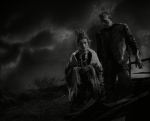
Whether or not the supposed gay subtext was intentional, Bride of Frankenstein contains a considerable amount of sexual innuendo which most definitely was meant to be there.  Nevertheless, these elements were not the source of the film’s difficulty with the Hays Office; rather, the censors objected to the film’s heavy use of religious iconography and its extreme (for the time) violence.  Whale loaded his movie with crosses and crucifixes, at one point even featuring a scene in which the monster, captured by the irate villagers, is lashed to a post and raised is an unmistakably Christ-like pose before being loaded into a cart for transport to a jail cell; while much of this material remains, the Hays censors insisted on the removal of some even more overt scenes which they deemed to be blasphemous.  The director was known by his colleagues to be irreligious, but even so it is doubtful he intended disrespect by including these aspects in the film; more likely, it was a pointed observation on the irony of the decidedly un-Christian treatment visited on the monster by the supposedly righteous mob, and perhaps also, subtly, an inversion of the Christ story, in which a being raised from the dead is persecuted and rejected by an fearful and inhospitable populace.  As for the violence, it probably goes without saying that it is hard to see, by today’s standards, how there could be any objection to the few brief moments in which the monster dispatches yet another irate villager; there is no visible bloodshed, we are given no gruesome close-ups or buckets of gore, and most of the killings are over before we even realize they are happening.  Still, the body count in Bride of Frankenstein is considerably higher than that of the original film, and quick as they may be, some of the murders are admittedly disturbing on a psychic level that has nothing to do with the gross-out factor which has today replaced the deeper shocks favored by horror filmmakers of old.  Consequently, extensive cutting was necessary to obtain a passing certification from the Hays Office, and at least one new scene had to be hurriedly added before release in order to bridge the story gaps created by these edits.  Thanks to Hollywood’s self-imposed decency standards, therefore, Whale did not quite achieve the complete artistic control he had been offered; indeed, the studio also reneged on its promise in one key instance, demanding a happy ending (and one which might facilitate the possibility of yet another sequel) to replace the one Whale shot, in which (“spoiler” alert) all the principal characters perished.  Consequently, new footage was shot at the last minute, depicting the escape of Dr. Frankenstein and Elizabeth (who is technically, of course, the actual title character of the film); however, due to budgetary constraints, it was not possible to reshoot already finished footage of the exploding laboratory, so that in the final version, the good doctor can still be seen pressed against the wall as the room collapses into rubble.  Though this was contrary to the director’s plan, there is a certain ambiguity to the hollowness of this tacked on reprieve, which evokes questions of how this hopelessly scarred couple can ever hope to free themselves of the nightmarish experiences they have lived through- particularly the doctor, already a visibly broken man, who was at least partly responsible for the preceding events having ever taken place.  In any case, the survival of these two characters does nothing to alleviate the sense of tragedy which permeates the film’s final moments; if anything, it underscores the sadness we feel at the fate of the film’s true protagonist.

Analytical discussion aside, there is much to praise in Bride of Frankenstein; Universal considered it one of their most important productions, having established a lucrative domination of the horror market and fully anticipating a major hit with the eagerly awaited continuation of one of their most popular films.  Consequently, the production values are sumptuous, from the elegant period decor and costumes of the Romantic Era prologue to the elaborate blend of gothic futurism that dominates the laboratory in the movie’s climactic scenes.  The special effects were top-notch for their time, and black-and-white cinematography (by John J. Mescall) is a glorious example of the bygone aesthetic of light and shadow that made films of this era such a magnificent, ethereal beauty.  Franz Waxman’s eerie, unresolved score provides a darkly romantic atmosphere throughout and drives the story relentlessly towards its cataclysmic finale.  Whale’s skill as a director manifests itself not only through his overseeing and coordination of all these elements, but in his edgy visual style; with rapid cutting, extreme angles, and a highly mobile camera, he manages to build a film that keeps the viewer breathlessly off balance, ensuring that it works as a horror movie independently of the black comedy that simultaneously exists for those audiences savvy enough to see it.

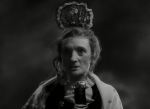
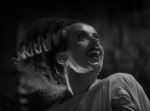
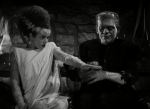
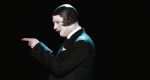
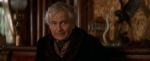
To paraphrase the ending credits, a good cast is worth mentioning, and no discussion of Bride of Frankenstein would be complete without mention of its star, Boris Karloff, whose fame and popularity were so great at the time that he was billed simply by his last name.  The pathos which he brought, somewhat unexpectedly, to his portrayal of the monster in the original film, is here brought to the front and center of the proceedings, and he provides genuine heart to the story, which prevents the loopy comedy from undermining the movie’s seriousness and keeps the sensationalism of the horror elements from overpowering its deeper message.  It is well-known that the actor objected to the creature’s development of speech within this movie, feeling that it would create an awkward and jarring effect that might alienate the audience- or worse, make them laugh; even so, he rose to the occasion well, delivering his stilted, remedial dialogue with as much conviction and sincerity as he performed the physicality of the monster.  The addition of speaking did have a somewhat unfortunate side effect, in that Karloff was unable to remove his dental plate as he had in Frankenstein, which meant that the formerly sunken-cheeked monster had a fuller face this time around; but the iconic makeup (designed by the uncredited Jack Pierce) was adapted to reflect the damage caused by the windmill fire that ended the original film, so the change was perhaps less noticeable than it might have been.  As for Colin Clive, the other returnee from the first film, his severe alcoholism had progressed considerably, and its ravages were plainly visible onscreen- the actor looks considerably older this time around, and his distraught, unfocused persona is a far cry from the clear-eyed drive and passion of his former appearance as Dr. Frankenstein.  His deterioration was doubtless made all the more evident by the fact that he broke his leg in a horseback riding accident shortly after filming began, requiring him to be seated for most of his scenes and in excruciating pain for the ones in which it was not possible.  Though this was obviously a tragic state of affairs for Clive, who would die at the age of 37 just a few months after the release of Bride, it gave him a decidedly convincing edge in his nerve-wracked, tormented performance as the unfortunate doctor.  Replacing Mae Clarke, who was battling health problems and unable to return as the hapless Elizabeth, was 17-year-old Valerie Hobson, whose melodramatic performance, while hardly memorable, adds an appropriate touch of the hysterical to the mix; and the aforementioned Ernest Thesiger, an English stage actor of considerable reputation who was a friend of Whale’s, makes one of the most memorable appearances in the history of horror as Dr. Pretorius, dripping with prissy irony and presenting a veneer of good-natured gentility which magnifies, rather than masks, the malevolent intent behind it.  As for the justly famous appearance by Elsa Lanchester as the monster’s would-be mate, it is without question the film’s electrifying highlight- not just because of the iconic design of the character, with her Nefertiti-inspired lightning bolt hairstyle, but because of the actress’ brilliant, jerky performance (which she said was based on angry swans), punctuated by shrill shrieks, deadly hissing, and other sub-human vocalizations.  Often overlooked, however, is Lanchester’s other performance as Mary Shelley in the film’s opening scenes; she sets the tone for the entire movie, offering up a demure and delicate persona with the unmistakable glimmer of a twisted and demonic imagination underneath it.  Rounding out the cast is the delightful Una O’Connor, as Frankenstein’s busybody housemaid, whose encounter with the monster early on is another of the film’s highlights; she provides comic relief, of course, but there is an undercurrent of ugliness within her character that continually reminds us of the small-minded baseness of the common throng.

Bride of Frankensteinin (which was referred to in publicity material with “The” in front of the title, though the word is absent in the credits), by today’s standards, is not a scary movie.  Modern audiences expect much more gruesome and explicit shocks, and the lingering Victorian morality which pervades horror movies of the past now seems quaint and laughable.  Nevertheless, it is, by any standards, a superb movie.  Once its conditions are accepted, it offers a compelling and surprisingly affecting story while laughing with us at the ridiculous conceits the genre requires.  Regardless of whether Whale intended it or not, it contains a rich subtext that reflects both his personal experiences and the larger social fabric of the time, and touches on a universal nerve that is timeless in its relevance.  Most importantly, it contains a treasure of rich, indelible images that transcend the material itself to become icons of the popular cultural imagination.  On top of all that, it is what Whale himself declared it would be: a “hoot.”

http://www.imdb.com/title/tt0026138/
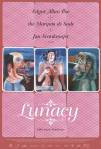
Lunacy/Sileni (2005)

Today’s cinema adventure: Lunacy (Šílení), a darkly comic 2005 horror film by celebrated Czech filmmaker Jan Švankmajer; based on two short stories by Edgar Allan Poe and drawing inspiration from the writing and philosophies of the Marquis de Sade, its an odd, quirky and disturbing foray into the horror genre by a director known for his odd, quirky and disturbing movies, featuring his trademark mixture of macabre puppetry and animation as well as his usual surrealist influences.  Like most of Švankmajer’s work, it initially received little attention outside of Europe (and the few remaining “art house” theaters), but it has since found an audience, alongside the rest of his canon, among the ranks of his loyal international cult following.

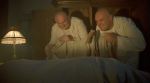
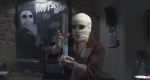
Though it begins, ostensibly, in a present day-setting, the story is quickly drawn anachronistically into the 18th Century, as its protagonist, Jean, is befriended by a wealthy and mysterious marquis (in full period garb) who travels by horse-drawn coach and is attended by a mute servant.  Jean is plagued by recurring nightmares in which two leering goons accost him in his sleep and attempt to forcibly restrain him with a straight jacket; after one such dream causes him to destroy his hotel room in a somnambulant struggle, the marquis comes to his aid by paying for the damages, and then invites the young man to travel with him to his home.  Jean soon discovers, however, that his new benefactor possesses a cruel streak; during his stay he is subjected to cruel pranks- including a bizarre and secretive nocturnal interment- and surreptitiously witnesses a blasphemous ritual in which God and morality are denounced and a young woman in chains is beaten and raped.  Eventually, he accompanies his host to a local asylum, where he is persuaded to remain as a voluntary patient in order to receive treatment for his nighttime disturbances.  His agreement to this arrangement, however, is in reality spurred by the presence there of the girl abused in the black mass, whom he fears to be trapped within the sinister machinations of the marquis and his friend who runs the institution.  Vowing to rescue her and expose the sadistic purposes of her captors, he sets about discovering the hidden truth of the hospital- a place where the inmates and staff are virtually indistinguishable, where chaos and debauchery seem to rampage unchecked, and where a dark secret lies hidden behind the walls, waiting to be set free.

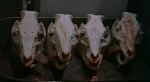
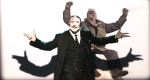
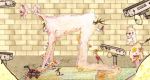
Švankmajer (who provides a spoken introduction to the film in which he plainly states its purpose and emphatically proclaims it not to be “a work of art”) draws the  inspiration for his narrative from Poe’s stories, The System of Doctor Tarr and Professor Fether and The Premature Burial, but the underlying thematic premise is derived from the views espoused by the notorious Marquis de Sade- upon whom the film’s primary antagonist is clearly based.  The argument of both the real and fictional marquis- that man is a product of nature, cruel and carnal by design, and that notions of God and morality are false constructs based in fear and designed to impose control over the weak and foolish- is the central idea which fuels the story, alongside the added intellectual exploration of two opposing methods to governing the insane: absolute control and absolute freedom.  As to the latter, the director states unequivocally in his prologue that the state of the modern world is a combination of the worst aspects of each of these methods, but- apart from this rather glib assessment- his film offers no real support for this theory beyond the extrapolations that can be made from the allegorical elements of the scenario.  Regarding man’s bestiality, however, Švankmajer gives us plenty of meat- literally.  Providing a sort of running commentary to the action are short segments, produced with the filmmaker’s familiar stop-motion techniques, featuring slabs of raw meat animated into performing various activities reminiscent of basic instinctual behavior- such as eating, fighting, and sexual intercourse-  continually reinforcing the idea of humanity as mere senseless flesh driven by primal impulses.  These vignettes, intercut with the main action, also serve to give Lunacy much of its “creep” factor, though as always in Švankmajer’s films, there is good amount of tongue-in-cheek humor that makes us grin even as we cringe.  On a less abstract level, within the narrative proper, the idea of man’s natural urge towards sex and cruelty is illustrated repeatedly in scenes best left for the viewer to discover for himself, with Jean and his enigmatic damsel-in-distress as the only representatives of sanity- as equated to decency, that is.  However, in keeping with the film’s source material, not to mention its creator’s penchant for surrealism, it is never exactly clear that our assumptions are true, and the question of what constitutes sanity- or decency, for that matter- is one which Lunacy leaves unanswered, choosing rather to provide cynical observation on the basic state of humanity.

Švankmajer has built his unique reputation with decades of imaginative filmmaking, blending live action with animation in ways that are at once deceptively simple and devilishly clever.  Influenced by an early career in puppet theatre, he has brought his traditional stagecraft sensibilities into his cinematic language, establishing himself as a genuine auteur with his shorts and feature films that incorporate not only the aforementioned stop-motion techniques, but claymation, a mixture of realistic and stylized scenery as well as puppets and live actors (and sometimes live actors dressed as puppets), and a generally theatrical style possessed of unmistakably ancient roots that stretch back to the Commedia dell’Arte and beyond.  Lunacy, however, like many of his recent works, utilizes a greater proportion of more-or-less straightforward live action footage; indeed, apart from the previously described meat-in-motion sequences, it contains relatively little of Švankmajer’s familiar visual trickery.  This is not to say the movie is short on the director’s usual delight in showmanship; throughout the story are numerous sequences that clearly draw from his love for the stage- the black mass, viewed from the perspective of an unseen audience (Jean peering through a window), is blatantly theatrical, and a tableau vivant of Delacroix’s La Liberté guidant le peuple is later staged by the marquis at the asylum, a nod to the historical de Sade’s direction of plays featuring other inmates when he was at Charenton asylum- as well as to Marat/Sade, the famous avant-garde dramatization of those real-life “productions.”  In addition, the trappings of theatre are scattered throughout the film- costumes, wigs, false facial hair- and the marquis’ entire persona seems to be a sort of performance, as if he is always centerstage in the theatre of his own life.  All of this plays into Švankmajer’s eternal fascination with illusion and the tricks of perception that allow us to be deceived by our own minds, which in turn fits neatly into the Poe-inspired horror scenario, hinging as it does on this very idea; further, the subject matter gives Lunacy‘s theatricality the specific flavor of true Grand Guignol, a style named for the 19th Century Parisian theatre that popularized the staging of horror spectacles, steeped in gore and blasphemy, known for inducing a kind of sexual response to their sensationalistic thrills- which is, of course, highly appropriate in a piece so infused with the spirit of De Sade.

Lunacy is not, of course, a play, and though it borrows much from the theatrical milieu, it also revels in its cinematic nature.  Švankmajer’s understanding of his medium is absolute; he directs with the confidence- even the cockiness- of someone like Hitchcock or Kubrick, delighting in his offbeat style and audaciously presenting his subversive ideas with imagery that is as indelible as it is absurd.  That Lunacy is a self-proclaimed horror film makes little difference in the director’s approach; the choices and tactics he employs are no more horrific than those in any given Švankmajer film, and indeed, he shows considerable restraint here, leaving many things to the imagination that might, with a different director behind the camera, be exploited for their full shock potential.  Providing shock has never been of interest to Švankmajer; rather, he prefers to unsettle us, to disturb the comfort of our psyches by inundating it with the illogical and the impossible, simulating the peculiar flow of a dreamlike consciousness where the contradictory makes perfect sense and the ordinary seems unnatural and menacing.  He creates a hallucinatory landscape in which the demons of our imagination appear before our eyes in all their unexpected familiarity, and because he is so good at doing so, the things he doesn’t show us are all the more potent.

Lunacy, like all of Švankmajer’s films, is ultimately beyond the realm of standard criticism; it exists as a thing unto itself, and to this whimsically macabre visionary’s loyal legion of acolytes, it is one more perfect creation in a body of work that, thankfully, continues to grow.  That said, however, watching his effort at a bona fide horror film (though truthfully, in my view, all of his work could be classed as such) is something of a disappointment.  Given the genre into which he has ventured, one might expect a hitherto unseen level of grotesquery, if not in outright terror and gore, at least in the ferociousness of his approach; but although the film contains several highly effective set pieces (the aforementioned black mass- with its mixture of the arcane, the blasphemous, and the erotic- pushes a lot of buttons for those uncomfortable with such improprieties, and the entire premature burial sequence is a mini-masterpiece of evoking chills with atmospheric story-telling) and it maintains a palpable sense of dread and impending doom throughout, it seems strangely subdued- particularly given its influences from Poe and de Sade, neither of whom could be called masters of restraint. It’s true that the film is meant to be comedic as well, albeit in the darkest sense; but again, this can be said of most of Śvankmajer’s work.  Furthermore, his narrative- despite the anachronisms, non-sequiturs, and other occasionally jarring surrealist ornamentation- is uncharacteristically straightforward, linear, and grounded in a relatively concrete reality (with the exception of the ongoing interpolation of animated meat, that is).  Taken on the whole, Lunacy is less engaging than his Faust, and less disturbing than his Lewis Carroll adaptation, Alice, both of which push the limits of our preconceived boundaries with more enthusiasm and, consequently, linger in our memories far more pervasively.

Comparisons with his other work aside, Švankmajer’s horror film is still an impressively imaginative piece of work, capturing in its unorthodox framework both the delirious psychic instability that makes Poe’s stories feel like a fever dream and the perverse thrill that lies at the heart of de Sade’s nihilistic hedonism.  It’s not terrifying- though parts of it may cause faint hearts to beat faster- and its eventual conclusion is predictable for anyone who even a passing familiarity with the conceits of horror fiction; nevertheless, it succeeds better, both on an intellectual and a deeply primal level, than most of the formulaic, shock-oriented thrillers churned out by the mainstream film industry in its pursuit of teenage dollars.  Of course, its bizarre stylization may prevent many casual audiences from finding it appealing; Švankmajer’s movies are not for every taste, certainly, though in truth, Lunacy may be more accessible than much of his more directly avant-garde work.  As for those with more eclectic tastes, those who are already indoctrinated into the peculiar joys of this Czech master may find, as I did, that Lunacy fails to generate the same deliciously mind-twisting effects as some of his other projects- though doubtless there will be those, with whom it strikes a particular chord, who will quickly adopt it as a new favorite; those adventurous cinema enthusiasts who have yet to see a Švankmajer film, however, are likely to find it a pleasant introduction to a strange and darkly wondrous world unlike anything they have seen before.  It’s as good an introduction as any, and if it leaves you wanting more, you can take comfort in the fact that a five-decade body of work exists, awaiting your discovery.

http://www.imdb.com/title/tt0407236/

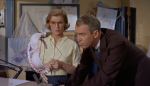
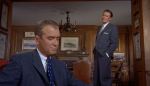
Vertigo (1958)

Today’s cinema adventure: Alfred Hitchcock’s Vertigo, the 1958 psychological mystery that recently replaced Orson Welles’ Citizen Kane in the #1 spot on Sight and Sound Magazine’s influential once-a-decade list of the best films ever made. Initially considered a disappointing entry to the Hitchcock canon, at the time of its release it received mixed reviews and barely broke even at the box office- an exception to the usual popularity and success enjoyed by the director’s films. Though Hitchcock himself cited it as one of his personal favorites among his films, it remained largely ignored by his admirers, even during the major reevaluation of his work by a new generation of critics that recognized the director as a true cinematic artist instead of merely a maker of popular entertainment. However, when it was withdrawn from circulation in the 1970s (along with four other titles for which Hitchcock had bought back the rights, intending them as an asset to be passed to his daughter upon his death), its reputation soared, and when it once again became available in 1983 it enjoyed a highly successful theatrical re-release and sweeping critical acclaim. In ensuing years, it has been cited by many as Hitchcock’s masterpiece (a view clearly held by the critics who vote in the Sight and Sound poll); but dissenting voices have argued that it is a flawed, over-rated, self-conscious exercise in pure technique, lacking the director’s usual polished storytelling and sense of humor. In view of this controversy (renewed and exacerbated by its recent promotion to the coveted #1 spot) I couldn’t resist the opportunity to chime in with my assessment- particularly given my own fascination with and appreciation for the work of Hitchcock, surely one of the single most important and influential filmmakers in history, whose innovations and techniques helped to shape the cinematic art form and continue to do so today.

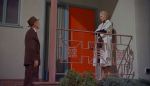
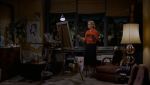
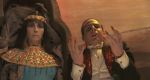
Vertigo, prominently and famously set in San Francisco, is the story of John “Scottie” Ferguson, a former police detective who has opted for an early retirement after his crippling fear of heights led to the death of a fellow officer during a rooftop pursuit. As he struggles to overcome the trauma- and his resultant guilt and depression- with the help of his best friend (and one-time fiancée), “Midge” Wood, he is approached by a former acquaintance, one Gavin Elster, to undertake a private investigation; Elster fears that his wife’s erratic behavior and mysterious wanderings are signs of a growing mental instability which may jeopardize her safety, and after some persuasion, Ferguson agrees to take the case. He follows the coldly beautiful Madeleine Elster on her seemingly aimless, trancelike meanderings around the city, gradually discovering that she has become obsessed with her great-grandmother, Carlotta Valdes, who descended into madness and suicide after being abandoned by her wealthy lover; the fascination becomes more ominous when he learns from Elster that Madeleine is unaware of her own relation to the late Carlotta- or of anything about her- which has led him to suspect she has become possessed by the tragic woman’s restless spirit. Refusing to believe in ghosts (and developing his own obsessions), Ferguson continues to tail Madeleine, until, on one of her endless daily excursions, she abruptly jumps into San Francisco Bay. Forced to come to her rescue, he becomes personally involved with her; determined to help her discover the real cause of her strange psychological condition, he begins to accompany the troubled beauty on her obsessive expeditions, and the two develop a powerful attraction that quickly blossoms into an affair.  Now deeply enmeshed in a mystery- one which has taken on a new urgency with his feelings for Madeleine- Ferguson struggles to uncover the sinister cause of her strange compulsions, even as the diabolical secret of her connection to Carlotta threatens to bring on a tragedy that will once again shatter his own life.

The screenplay for Vertigo is based on D’Entre les morts, a novel by French authors Pierre Boileau and Thomas Narcejac, whose previous work, Celle qui n’était plus, had been unsuccessfully pursued by Hitchcock before being filmed by director Henri-Georges Clouzot as his masterpiece, Les Diaboliques. Though not written directly by Hitchcock, the script was prepared, as with most of the director’s films, under his strict and meticulous guidelines; an early version by playwright Maxwell Anderson was rejected outright, and a second draft by Alec Coppel was completely rewritten by Samuel Taylor- who worked exclusively from the director’s detailed synopsis to create the screenplay which was eventually used.  The resulting scenario, not surprisingly, is rife with classic Hitchcockian elements; most prominent, of course, is the focus on an icy blonde woman who irresistibly lures the hero into a web of illusion and deceit. Vertigo may be Hitchcock’s most personal statement on film in the sense that he uses the slow unwinding of its plot to explore in depth the themes which run throughout his other works. The simultaneous adulation and mistrust of women, the cynical view of romance, the Freudian emphasis on sexuality (the sexual subtext throughout is palpable, at times shockingly overt for a film produced at the time), the psychological connection between sex and death, and- perhaps most importantly- the obsessive fascination with image and illusion and the manipulation of these things to obscure the truth; all these are present, and magnified from their usual level of underlying texture to become the main concern of the film.  In “Scottie” Ferguson’s desperate attempt to fix his broken psyche by rescuing another tormented soul, he becomes fixated on Madeleine Elster as an object of desire; his sexual attraction merges with his efforts to conquer his fears and she comes to represent for him a return to wholeness- to attain her would be to repair his damaged life. However, his perception of her is flawed, partly by deliberate obfuscation, yes, but also by his own self-delusion, and his insistence on making her into his own fantasy threatens to drag him into the very madness from which he believes he is saving her- and also to blind him to the woman she really is.  It’s a dark journey, even for Hitchcock, and offers a grim counterpoint to the idealized love affairs that were so popularly portrayed in many of the glossy and sentimental romantic melodramas of the same era.

This decidedly bleak depiction of love may be one of the keys to why Vertigo failed to capture Hitchcock’s loyal followers upon its first release. His most popular formula was always a blend of romance, humor, and suspense, tinged with darkness, perhaps- even the director’s most likable characters were possessed of a few unpleasant quirks, and his villains were often more sympathetic (or at least more charming) than his heroes- but ultimately reinforcing the traditional Hollywood message that love conquers all, in the end. Vertigo was a marked departure from this tradition, even going so far as to use the audience’s expectations to lure them into the psychological trap its creator had planned,  The film’s first scene- after the expository opening in which we see the tragic rooftop incident that ends its protagonist’s police career and establishes the necessary premise of his paralyzing acrophobia- lulls us into the comfort of familiar Hitchcock territory with the playfully flirtatious banter between Ferguson and his erstwhile girlfriend Midge as he lounges in her apartment; our hero seems down-to-earth, well-adjusted and pleasant, and the tone is decidedly light- indeed, almost jarringly light, considering the gruesome events we have just witnessed.  In true Hitchcock fashion, the scene takes a foreboding turn toward the end, revealing the truth that all is not as well as it seems; but unlike most of his previous work, the ensuing drama never brings us back to the light.  Instead, the mystery into which we are pulled- part ghost story, part psychodrama- takes us deeper and deeper into uncomfortable territory, as we witness Ferguson’s spiral into desperation and obsession; as the film progresses, his banter with Midge becomes increasingly tense and forced as their unreconciled relationship falls apart, and his determination to conquer his inner demons seems more and more like denial. Though the plot is ostensibly centered on solving the mystery of Madeleine Elster, we are really watching the slow and inevitable disintegration of a man who refuses to face the truth about himself- and is therefore incapable of seeing the truth of the situation into which he has been drawn. Hitchcock’s well-known device of the “MacGuffin” (a supposedly important object or situation in the plot that is ultimately irrelevant to the film’s true purpose) is here taken to perhaps its extreme; the entire plot is in fact only a vehicle for the director to delve into the dark corners of the flawed human psyche.

That the mystery story is unimportant is made clear by the fact that Hitchcock solves it for us two-thirds of the way through- another reason for contemporaneous dissatisfaction with the movie; herein, however, lies the brilliance of the piece, for it is in the final section that the true, disturbing power of Vertigo emerges. It is difficult to discuss these scenes without giving away key story points for those yet to see the film, but suffice to say that Hitchcock uses the situation he has craftily set up in order to present an unsettling pageant of dysfunction between two people, each pursuing a fantasy (one of the past, one of the future) and deluding themselves about the true nature of their relationship, marked by psychological abuse, unhealthy fetishization, emotional isolation, and denial of the underlying issues that fuel this twisted romance.  It’s brutal to watch; we know it cannot possibly end well, and that it probably shouldn’t, but because Hitchcock is a master of transferring sympathies we desperately hope- along with these emotionally crippled characters- that it will.

From a technical filmmaking standpoint, there can be no argument against the greatness of Vertigo.  Hitchcock was at the peak of his powers here, with the means at his disposal to accomplish his vision to its utmost perfection. He tells his tale visually, with the eye for angles and composition that made him justly renowned, a fluid camera that pulls our eye subtly but unwaveringly to what he wants us to see, and an uncanny skill for timing and editing that manipulates our emotions irresistibly. He incorporates numerous subliminal means to underscore his true intentions; there is an omnipresent motif of spiraling patterns- not only in the story and in the visual design, but also in the magnificently lush, iconic score by favorite collaborator Bernard Herrmann- that continually reinforces his dominant theme of obsession, a state of mind in which endless repetition and revolution around a central focal point are the key characteristics; a heavy use of reflections to emphasize the interplay between illusion and reality (particularly with regard to identity, another important theme which is further supported by the fact that virtually all of the key characters are called by a different name from their given one); and, of course, the favorite technique of using point-of-view shots to help us identify with the characters onscreen- and, more to the point, to make us into voyeurs.

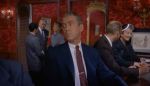
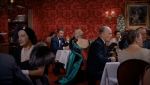
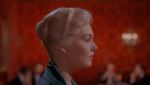
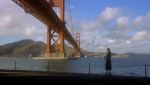
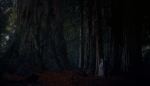
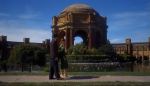
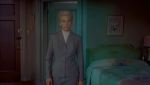
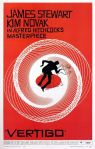
Always one to strive for full coordination of all elements towards a cohesive whole, Hitchcock’s vision extends through the work of his collaborators, never more clearly than in Vertigo.  To begin with, the legendary graphic artist Saul Bass, who also designed the movie’s classic advertising imagery, contributes a sharp and stylish opening credits sequence, establishing the spiraling motif that permeates the film.  Then there is the aforementioned score by Herrmann, a masterpiece of jangled nerves, relentless tension, melancholy longing, and spectacular release; echoing the strains of Wagner’s Tristan und Isolde– another tale of doomed romance- but possessed of the composer’s own unmistakable aural style and distinctively struck in the modernist sound of the mid-20th Century, it is one of the most recognizable pieces of film music ever written- and one of the most effective.  The cinematography of Robert Burks is a masterpiece of late ’50s gloss, capturing not just the mood and atmosphere of the era but of San Francisco- indeed, the extensive location footage provides a dazzling view of the famous local scenery, such that Vertigo could serve as a travelogue for the city; in addition, his exploitation of various qualities of light, from the shimmering haze of a sunny churchyard to the murky gloom of a redwood forest, creates an almost dreamlike immediacy to the images on the screen.  Perhaps most noticeably, there is the stunning use of color throughout the film, painstakingly created by Burks, art directors Henry Bumstead and Hal Pereira, set decorators Sam Comer and Frank McKelvy, and costume designer Edith Head; thanks to their work (and Hitchcock’s meticulous guidance), Vertigo is possibly the most striking example of symbolic color coordination on film- from the dramatic contrast between Madeleine’s blue wrap and the red wallpaper in Ernie’s restaurant, to the jarring dissonance of her blond hair and her classic gray suit, to the surreal neon blue that bathes her apartment at night, the film delivers a magnificently lush palette of bold and subtle hues that elicit primal responses from beginning to end.  This effect is all the more powerful since a 1996 digital restoration (one of the first to be undertaken) returned the movie to its original, pristine condition after years of neglect had left it faded and almost monochromatic.  Having seen both an old print and the restored version, I can tell you it’s like watching a completely different movie, and it makes the greatest imaginable difference in the film’s overall power. Of course, any discussion of Vertigo would be incomplete without a mention of its special effects work, which includes the superb matte effects used to create several important sequences (most notably the bell tower at the mission where both of the film’s climaxes take place), the much-imitated nightmare sequence designed by John Ferren, and the famous “Vertigo Zoom,” used here for the first of countless times, in which a disorienting effect is achieved by simultaneously zooming in on a focal point and pulling back the camera.

Besides all these invaluable contributions, Vertigo benefits from the work of its cast.  Hitchcock, in later interviews, attempted to explain his film’s relative failure by attributing it to the disparity in age between his leading player, James Stewart, and the 26-year-younger Kim Novak, as well as unfairly- and inaccurately- claiming that Stewart had passed his prime and his popularity had waned (the actor actually enjoyed several more years of considerable box office success following his work in Vertigo); it’s true that Stewart may have been a factor in the public’s disappointing reaction to the film, but if so, it had to do with the fact that his character here is a far cry from the light, easy-going persona with which he was associated.  His previous work with Hitchcock had often pushed the boundaries of his gee-whiz image, as had numerous other of his later roles, but with John “Scottie” Ferguson, Stewart’s lovable personality was turned inside out; the good-natured, lackadaisical charm serves as a mask for a morose, deeply troubled psyche, full of self-loathing and capable of great cruelty.  Despite the fact that the actor’s many loyal fans had difficulty accepting him as such a flawed individual, in retrospect it is clear that Vertigo represents one of his finest onscreen achievements; he embraces Ferguson’s bitter darkness whole-heartedly, without attempting to soften it by resorting to sentimentality.  Playing on his own image, he offers a disturbing portrait of a man whose decency and humanity are eroded by depression and obsession, and his haunting performance is the driving strength of the movie- it’s impossible to imagine another actor in the role.  His co-star, Kim Novak, was not Hitchcock’s first choice for the complicated part of Madeleine- he had initially cast the young Vera Miles, who appeared in his previous film, The Wrong Man, but delays in the shooting schedule led to her having to drop out due to pregnancy- but, again, its now hard to picture anyone but Novak as the cool, mysterious, and ethereal focus of the hero’s- and the film’s- compulsive attention.  The director also later criticized Novak’s work, saying that, in retrospect, he felt she was miscast; and others have complained that she frequently seems uncomfortable, stilted and artificial.  Given the nature of her role, however (and once more I am limited by a desire not to provide any “spoilers” for those who haven’t seen the movie), these qualities seem completely apt.  Madeleine, like Ferguson, is hiding her true nature; and Novak ultimately lets us see that underlying her artifice is a sadness and vulnerability that make her heartbreakingly compelling as a tragic heroine.  She is particularly effective in the film’s final third, allowing her warmth- and her real desperation- to come through.

The supporting cast is led by Barbara Bel Geddes, as Midge, Ferguson’s gal-pal, who- though seemingly more solid and straightforward than the two leads- hides her own not-so-secret feelings for her former flame with an act of sly sophistication and smartly casual cynicism; she provides much-needed comic relief, but her own obsession- which leads to serious errors in judgment- is unveiled throughout, tempering the humor with an increasingly uncomfortable sense of emotional panic.  In addition, she represents Ferguson’s last link to the larger world outside of his fixations, and when she exits the film, with the literal slamming of a door and a slow, sad walk down a bleak and empty corridor, her absence is significantly felt; thanks to Bel Geddes’ understated, textured performance, Midge becomes one of the most memorable personifications of the glasses-wearing, “unwanted” woman so frequently found in Hitchcock’s work.  Tom Helmore, as Elster, seems the sad, impotent milquetoast in his few scenes (a characterization which ultimately adds yet another layer to the mysterious plot), and the rest of the cast- which includes some familiar character actors (Henry Jones, Raymond Bailey, Lee Patrick, Ellen Corby, Konstantin Shayne) along with several unknowns- essay their deceptively small roles with just the right amount of appropriate attitude to further Hitchcock’s subtle psychological manipulation.

It should be obvious by now that I have a lot to say about Vertigo; this is no surprise, because almost everyone who sees it- critic, scholar, or movie fan- has a lot to say about this strange and beautiful film.  It has been suggested that one of the reasons it enjoys such adulation from cinema literati is, in fact, that there is so much to say about it- it is unquestionably a work of art, visually stunning and laden with layers upon layers of symbolism, subtext, and psychology.  Watching Vertigo is strongly reminiscent of viewing a painting in motion, not only because of the richness of its visuals but because of the seemingly endless amount of detail on the screen, each piece of which bears some significance to the film’s overall meaning- or rather, meanings, because like all great art, it opens itself to a multitude of interpretations.  From this standpoint, it certainly qualifies, as much as any of the other contenders, for the honor of being named as the best film of all time.  However, many less-admiring critics have pointed out that, on the more immediate level of pure entertainment, Vertigo fails to accomplish its purpose; the intricate plot is confusing, hampered by a lack of real action, bogged down by clumsy exposition, and hampered by long, uneventful sequences (such as the interminable scenes of Ferguson following Madeleine through the city in his car) that slow the pace to a crawl.  In addition, the story contains details that not only prove to be ultimately irrelevant but, indeed, make no sense; and once the mystery is solved, the central conceit on which the film’s final developments depend is so far-fetched as to pre-empt the willing suspension of disbelief required to make it work.  From my own memory of seeing Vertigo for the first time, I can freely say that all these points affected my reaction to it; die-hard Hitchcock fan as I was (and am), I could not help but be disappointed.  Yet there was a fascination for me here which I could not explain- a nagging feeling that there was something I had missed.  It was years later before I came back to it, but when I did- free from the need to follow a story I already knew- I discovered that to see Vertigo once is not to see it at all.  Dozens of viewings later, I am still discovering it.

Consider this fair warning, then- for the casual viewer, the charms of this much-hyped classic may prove to be invisible.  For those who choose to venture a second look, however, Vertigo begins to unfold itself and display its hidden majesty.  Like the beautiful woman at its center, it is not what it seems- beneath its cold and problematic exterior lies a rich and complex trove of treasures that yields new wonders upon each return visit.  You may not agree with the assessment of Sight and Sound that it is the greatest movie ever made- I can’t say that I do, either- but you would be hard-pressed to find another film which packs so much into such a deceptively simple package.  It is doubtful that Hitchcock- master though he was- consciously intended to create the myriad resonant details which arise throughout his arguable masterpiece; he second-guessed himself frequently during its making, and, indeed, wanted to make changes that were prevented by studio demands- perhaps a rare instance in which such interference resulted in a better movie.  The endless analysis to which this, like all Hitchcock films, has been subjected, would no doubt baffle and amuse a director who, after all, was just trying to make a good movie; nevertheless, as with all great art, the content of the canvas may yield more than even its creator can suspect.  Vertigo reveals much about the depths from which it came, perhaps more than its director could even recognize; it is, in this way, the quintessential Hitchcock film, in which virtually all of the filmmaker’s perennial obsessions were given full expression.  Other of his works may be more entertaining, more frightening, more believable, and more polished- but this one is undoubtedly the most personal, and as such, it is the key to Hitchcock’s universe, in all its darkly beautiful glory.

http://www.imdb.com/title/tt0052357/
 

Faust (1994)

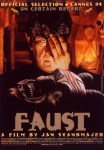
Today’s cinema adventure: Faust, the 1994 feature by celebrated Czech filmmaker Jan Švankmajer, a surrealist take on the classic German legend in which a scholar trades his soul to the Devil in exchange for worldly knowledge and experience.  Set in modern day Prague and incorporating the director’s trademark blend of live action with stop-motion animation, claymation and puppetry, as well as his disturbingly textural use of sound, it represents the culmination of Švankmajer’s long fascination with the tale and stands- along with his other highly distinctive work- as a major influence on more well-known directors such as David Lynch, Tim Burton, and Terry Gilliam.

Presenting its own loose adaptation of the familiar morality fable, Švankmajer’s film borrows elements (and, occasionally, entire scenes) from previous versions by the likes of Christopher Marlowe and Goethe, as well as from the early folk stories of its origin, more or less faithfully following the traditional structure of the narrative; but thanks to the director’s surrealist sensibilities, it recasts the tale in the form of a nightmarish hallucination centered around a nondescript middle-aged everyman who stands in for the mythic scholar.  When this hapless protagonist is handed a flyer in the street, upon which is printed only a simple map of the city with a location marked in red, his curiosity- coupled with some unusual occurrences in his apartment- leads him to a mysterious, ruined theatre; there, after donning costume and makeup, he begins to read from a charred and tattered script, setting in motion a hallucinatory cycle in which he enacts the role of Faust.  Assisted- and manipulated- by an assortment of other “actors,” human and otherwise, his own identity merges with that of the character he plays, and it becomes clear that his own fate is being determined by the scripted events of the ancient drama in which he has become enmeshed- in which he strikes a bargain with Mephistopheles, an agent of the Devil, to instruct him in the secrets of the universe and guide him through the pleasures of earthly life for a period of 24 years, after which he will surrender his soul to be damned into Hell for all eternity.

A dark and moralistic story like this one, born of the same dour Germanic heritage that yielded the Grimm fairy tales and other such cautionary parables, could easily be translated to the screen laden with the ponderously heavy trappings of deep tradition and humorless Puritanism; likewise, given the fact that this legend has provided the inspiration for countless adaptations and re-inventions (from Shakespeare’s Macbeth to Brian DePalma’s The Phantom of the Paradise), the familiarity of its basic plot and its themes make it challenging, to say the least, for any artist attempting a new version to find a fresh approach that might prevent predictability and redundancy from undermining the proceedings- and the audience’s interest in the outcome.  In Švankmajer’s hands, however, the entire well-known saga is transformed into an audaciously non-traditional package of surprises, each one as delightful as it is disturbing, appropriately dark in tone but laced throughout with macabre, tongue-in-cheek humor, and loaded with the peculiar blend of the cinematic and the theatrical that gives this director a reputation for visual magic that is unlike the work of any other.  A self-proclaimed surrealist, Švankmajer creates a movie that captures the peculiar flow of nonsensical logic one follows in a dream, making the experience of watching Faust feel thoroughly like a visit to the realm of the unconscious; he tells the story clearly and succinctly, but he does it through a deeply symbolic progression of seeming non-sequiturs, building a mass of perplexing puzzle pieces that fall seamlessly into place as the narrative resolves itself.  By transposing the story deeply into a hallucinogenic reality in which rules of plausibility and common sense no longer apply, the director not only allows himself free use of arcane and metaphoric artistic conceits, he manages to frame his oft-told tale in such a way that every development seems completely new and unexpected, giving us the opportunity to discover its hidden meanings and significant themes by discovering them from an unfamiliar perspective.

That perspective, shrewdly, moves the Faust story out of the medieval past and into a milieu more relevant to a modern audience; Švankmajer doesn’t exactly update his drama, but rather rehearses it within a contemporary framework.  Our protagonist is established from the outset as a decidedly present-day figure, emerging amidst a crowd of commuters from a subway station- just another anonymous drone.  He is drawn into the web that will seal his fate by a pair of men passing out flyers on a street corner, a sight so mundane in our modern world we scarcely take notice; this, of course, sets up a recurring theme for Švankmajer, that of the mystical contained within the ordinary, a motif that manifests itself throughout the film and tempts us, like Faust, with the promise of secret wonders hiding just beneath the bland surface of our everyday lives.  In our demystified era of utilitarian buildings and dehumanized masses, we long for the thrill of the unknown, a glimpse of something mysterious behind the mask of our predictable, well-ordered existence; such a revelation, however, is as unsettling as it is exhilarating, a source of terror as much as enlightenment, and therein lies the essence of Faust.  To obtain the key to this secret world, we must be willing to sacrifice our very selves, to give up everything that defines us- our souls, if you will; for to be privy to the secret workings of the universe is to be torn irrevocably from our humanity, confronted with an absolute power that renders our previous understanding meaningless and dissolves our identity by shattering the precepts upon which we build our relationship with the world.  In a modern age full of the smug assumptions and easy explanations derived from centuries of scientific exploration, the idea of an unseen order to things is perhaps even more terrifying than it was to our superstitious forefathers, whose imaginations conjured the tale of Faust to warn against delving too deeply into the hidden mysteries of life.  They feared the cost of knowledge and worldly experience was the loss of the soul, but we who have embraced these things may be more frightened by the possibility that they were right.  Švankmajer’s Faust, then, is about the rediscovery of the soul by modern man, and the disturbing notion that he has already sacrificed it.

That Švankmajer conveys all this in his movie is remarkable; but convey it he does, in a manner which gives testimony to his skills as an artist and a visual storyteller.  How he does it, exactly, is beyond the power of words to describe, and at any rate is best left to be experienced firsthand. Suffice to say that, in order to bring our modern sensibility into the mystical world of his story, he takes us into the last remaining stronghold of magic, the realm of the theater.  By trapping his protagonist into a re-enactment of an ancient text, not only does he provide the obvious metaphor of man’s fate being dictated by his repetition of the patterns of the past, he opens the door for his own use of all the tricks of the trade in the service of creating his goofy nightmare.  Puppets, both life-sized and miniature, stand in for other characters- and occasionally, for Faust, too- and interchange with live actors; painted backdrops appear in naturalistic settings, and vice-versa, patently theatrical objects and occurrences manifest in the real world, and events move freely back-and-forth between the containment of the theater and the expanse of nature, underscoring Švankmajer’s dissolution of the boundary between reality and illusion; dialogue is recited, arias are sung, ballet dancers perform, and an audience observes the proceedings, though most of Faust’s key scenes take place “backstage,” at least ostensibly.  Of course, the director’s familiar techniques of stop-motion animation are directly drawn from this theatrical background, and fit in seamlessly here- particularly effective is his claymation rendition of Mephistopheles, growing from a ball of clay into a vaguely humorous demonic face that then transmutes into a mirror image of Faust’s own appearance, giving us, once again, the mystical inside the familiar.  Throughout the film, Švankmajer utilizes all these devices to draw us along on this metaphysical journey, using his surrealist tactics to provide cryptic images that simultaneously amuse and appall us- an egg baked inside a loaf of bread, a baby transforming into a skull, a severed leg wrapped in plastic, a puppet demon sexually assaulting a puppet angel, and countless other blasphemous delights- and, in the end, achieve their cumulative goal of revealing the film’s underlying mystery.  It’s worth mentioning, too, that Švankmajer also indulges his usual fascination with food, offering us numerous important scenes that revolve around eating; he also provides his trademark, hallucinatory soundscape, a collection of rustling, scratching, rattling noises that crosses the sensory boundaries to make us feel the surfaces we hear- and creeps us out, in the bargain.  The entire film, ultimately, has this effect- it’s something akin to visiting a haunted house at Halloween, in which we want to feel our skin crawl and our hair stand on end, but we want to giggle with glee over the pure silliness of it all.

Jan Švankmajer is something of a national treasure in his native Czechoslovakia, and rightly so.  His visionary work, at once quirky and powerful, represents the kind of purely artistic sensibility that is rarely found in modern cinema; with the personal spirit of a true auteur, he makes certain his films are distinctly his own, and whether or not audiences respond is not his concern.  Though much of his work has been rarely seen in the U.S., thanks to Cold War restrictions and prejudices that impaired his ability to distribute it on this side of the Iron Curtain (and, sometimes, even to produce it at all), he has gained a steady and growing following among fans of animation, surrealism, and cinema in general.  His decidedly adult adaptation of Alice in Wonderland (simply titled Alice) is partly responsible for breaking him through into Western culture, but many of his other films- including this one- have been championed by critics and other filmmakers alike, and the ready availability of the digital age has now made it possible for almost anyone to partake of the disturbing delights he offers.  Since Faust, like all of his films, is virtually impossible to describe- even stills fail to capture it, since Švankmajer’s visual sense is so connected to motion and juxtaposition of images- I strongly recommend a viewing.  I can praise it all I want, but, ultimately, it’s a movie that speaks far more eloquently for itself.

http://www.imdb.com/title/tt0109781/

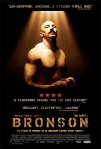
Bronson (2008)

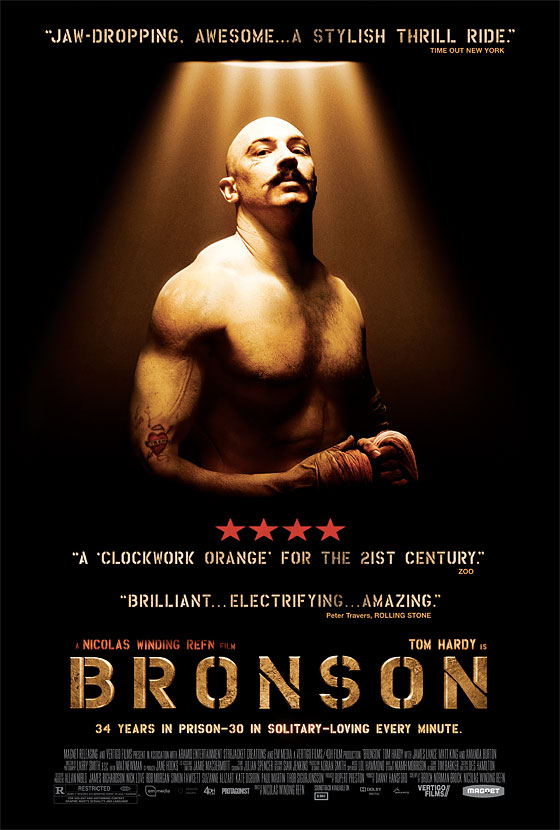
Today’s cinema adventure: Bronson, the 2008 biopic about England’s most notorious prison inmate, Michael Peterson (who changed his name to Charles Bronson during his brief career as a boxer), whose reputation for violence and trouble-making has led to his having spent the majority of his adult life behind bars- and most of that in solitary confinement.  Directed by Nicholas Winding Refn and starring Tom Hardy in the title role, the film takes Peterson’s real-life story and presents it in a highly stylized, theatrical manner, focusing on fictionalized vignettes and incorporating some real-life footage to depict some of the most infamous incidents from his long history.  Rather than a straightforward biography, the movie is more a meditation on the enigmatic nature that causes such antisocial behavior, ultimately leaving its subject’s motivations a mystery and offering no concrete explanation for the impulse towards violence.

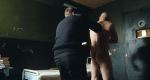
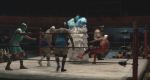
Bronson frames its story with a narrative conceit in which Peterson presents his own story, to an unseen but appreciative audience, on a bare stage; in various stages of theatrical make-up, and with a considerable amount of flourish, he gleefully relates his life story, beginning with his childhood as the son of typical middle-class parents in the London suburb of Luton.  Intercutting portrayals of real events with his “performance” in the theater, the film proceeds to relate the general outline of his life.  We see his early marriage to a co-worker who witnesses his first crime (the theft of money from a cash drawer in their shop), his subsequent arrest and incarceration for the armed robbery of a post office, and the continual extension of his 7-year sentence due to his repeated assaults on his guards and fellow inmates.  When frequent transfers to different facilities throughout the penal system fail to curb his violent tendencies, he is declared insane and moved to a mental institution, where despite heavy sedation he nevertheless attempts to murder another patient.  Further transfers lead to further incidents, so he is declared sane and set free.  His return to the outside world is short-lived, however.  After a short career as a fighter in the illegal sport of bare-knuckle boxing (for which, at the suggestion of his promoter, he adopts his new name), a jewelry store robbery lands him back in prison after only 69 days, where he promptly resumes his  escalating cycle of violence, despite showing an interest- and some talent- in art, leading to an ongoing campaign of riots, beatings, and  hostage-taking that continues not only up to the making of the film, but to this day.

The challenge for a filmmaker trying to tell this story is to find a way to avoid making it seem repetitive; Peterson’s life is one brutal fight after another, almost all of which happen in prison cells.  In the screenplay for Bronson, co-written by director Refn with Brock Norman Brock, an elegant solution is found with the bold and decidedly stylized narrative device in which the film’s subject presents his own vision of his life in the “theater of the mind.”  Besides providing a unique means of breaking up the action and offering pithy commentary, this technique creates an almost Brechtian detachment in which, constantly alienated from the story by the obvious artificiality of this conceit, we are encouraged to examine Peterson’s tale with our intellect instead of our emotions; yet, at the same time, by allowing the darkly charismatic criminal to speak for himself, Refn and Brock also make it possible for us to make a connection with him that would be impossible in a more standard approach to his tale.  He is permitted to be polished and eloquent in the spotlight of his fantasy, a stark contrast to the brutish, inarticulate beast we see in the scenes of his real life, and the self-satisfied irony of his performance persona confronts us with a defiantly mocking challenge to our attempts to find reason or logic behind his ferocious nature.  In short, the interstitial theatrics convert the proceedings from a straightforward- if stylish- biographical drama to a somewhat surreal cinematic exploration of the violent mind and its disquieting opposition to the standards of civilized normalcy we take for granted.

Despite this artistic spin, Bronson still struggles with the issue of redundancy; the film’s more concrete depiction of events returns, by necessity, to scenes of its anti-hero beating his handlers to a pulp, making it feel like something of a one-note symphony.  Director Refn, however, a Danish-born wunderkind whose later film, Drive, has firmly established him as an auteur on the rise, manages to find a number of creative stylistic tweaks which prevents the movie from seeming like it is stuck in a loop.  Even when we are not within the clearly marked boundaries of the theatrical framing device, Refn maintains a dreamlike sensibility that keeps us unsure of where we stand in the continuum of reality and illusion; he creates a visually arresting and mentally stimulating atmosphere through his use of bold primary colors, odd lenses and camera angles, and an absurdist perspective in his approach to the mundane aspects of the institutionalized settings.  He varies the environment as much as possible, choosing a number of distinctively different backdrops for Peterson’s myriad brawls and acts of terror (particularly memorable is the re-purposed ballroom that serves as a Fellini-esque purgatory for the scenes in the mental institution) and utilizing a surprisingly diverse assortment of jail cells and common rooms- which has the added effect of underscoring just how many times responsibility for “England’s most violent prisoner” is passed from one facility to another.  Most importantly- and more to Refn’s purpose- the ever-changing backdrops and the hallucinatory sense of heightened reality yield a disorientation that keeps us from anchoring ourselves as we experience Peterson’s journey and, ultimately, reminds us that everything we see here is filtered through the skewed perspective of his mind.

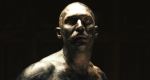
In the center, standing in for the larger-than-life figure himself, is Tom Hardy, making a substantial breakthrough in a career which has since led him to participation in blockbusters such as Inception and The Dark Knight Rises.  Given his powerful, commanding performance, it’s no surprise that he has become one of the industry’s most promising stars; his vision of Peterson- with whom he met in person before filming began- is an impressive creation, full of raw, animalistic power (his massive, rock-solid physique contributes greatly in this department) and yet with the spark of considerable native intelligence that makes it impossible to explain away his brutal tendencies as the product of ignorance.  This is a man who knows exactly what he is doing- his violence is a conscious choice, even a calling, and Hardy makes it clear how much pride he takes in it.  What makes his portrayal most effective, perhaps, and in precise tune with Refn’s approach, is the humor he brings to it; ironic, dark and unsettling humor, but effective in helping us into the mind of this flamboyant character.  We may not understand what we find there, but in Hardy’s performance at least, we are captivated by it.  The rest of the performances- small roles, for the most part, reflecting the peripheral nature of others in Peterson’s personal universe- are effective as well, though no one gets much opportunity to shine, save for Matt King as the convict’s fey and seedy former-prison-acquaintance-turned-boxing-promoter and Juliet Oldfield as the young call girl with whom he has a dalliance during his brief taste of freedom.  It’s not meant to be an ensemble piece, however; Bronson is, for all intents and purposes, a one-man show for Hardy, who certainly proves himself up to the challenge.

With such a strong performance to recommend it, showcased in a stylish and visually exciting vehicle by its exceptionally talented director, Bronson succeeds in providing an engaging look at its notorious subject, albeit a highly fictionalized one- numerous facts are significantly altered and others are omitted or made up entirely to suit the purpose of Refn’s vision, which is more along the lines of an expressionist horror film.  The director casts his real-life subject as a sort of monster, though the story is seen from his point of view; Peterson is depicted as a force of chaos, a willful representative of the uncontrollable nature that lurks behind our civilized veneer, and much in the way that Godzilla represented the nuclear demons that lurked in the post-war Japanese zeitgeist, so does this destructive beast stem from our own uneasiness about the wild, untamed impulses surging beneath the surface of our blandly dehumanized society.  Though we struggle to understand the deeper motivations for Peterson’s deranged behavior, he himself offers the simple explanation that he wants to be famous; and in a world where fame and celebrity are the only way to rise above the dull existence of the common throng, it is discomfortingly reasonable to assume that this may, in fact, be the truth.  If he is a monster, he is a monster we have created, and the irony which permeates Hardy’s performance and the film itself aptly underlines this.

Thought-provoking and compelling though this thematic perspective may be, Bronson never really shakes us up in the way other films with a similar take on society have done.  Refn crafts his movie carefully, giving it a distinctive flavor of its own while evoking the memory of such iconic works as Kubrick’s A Clockwork Orange and Lindsay Anderson’s If…, but despite- or perhaps because of- the clear calculation of his vision, in the end the film feels more like an exercise in style than an expression of truth.  Still, that style has considerable appeal, and Bronson, while it may not be gripping, is never boring to watch.  This in itself would earn the film a recommendation, but when Hardy’s deeply committed tour-de-force performance is added into the mix, it’s an irresistible combination.  It may not be a great film, but it offers an exciting early glimpse at the prodigious talent of its two driving forces; both Refn and Hardy are still relatively new in the game, but they seem poised on the brink of long and significant careers, and based on the potential they reveal here, it’s easy to see why.

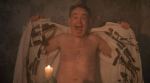
It should be mentioned that Bronson features a considerable amount of full-frontal nudity, all of it provided by Tom Hardy, thanks to the title character’s penchant for stripping down and covering his body with “war paint” before a brawl.  Depending on your viewpoint regarding such content- and your feelings about Mr. Hardy- this could provide further incentive to schedule a viewing, ASAP.

http://www.imdb.com/title/tt1172570/

Santa Sangre (1989)


Today’s cinema adventure: Santa Sangre, the surreal 1989 horror fantasy by director Alejandro Jodorowsky, about a young man, raised in a circus, who is dominated by his puritanical mother and driven by her to exact revenge for the sinful impurity which led to her brutal dismemberment.  Hallucinatory, disturbing, and gruesome, it received only limited release in the U.S. despite its director’s status as a revered avant-garde legend and the enthusiastic reception of critics, but quickly became a cult classic and has since been made widely available for home viewing.  Hailed by many as a masterpiece, it’s a bizarre visual feast, pervaded by a garish carnival atmosphere and a sense of sickly wonder, which offers the guilty thrills of Grand Guignol horror alongside religious, psychosexual, and social themes, providing an unforgettably nightmarish cinematic journey through the arcane and the unspeakable.

The story centers on Fenix, whom we first see as a patient in a mental institution- naked, animalistic, and uncommunicative, but beginning to emerge from his isolated state in response to the gentle coaxing of his doctor.  Through flashbacks, the origins of his traumatized state are revealed; we see his childhood as the son of a circus impresario and his aerialist wife, performing as a juvenile magician and surrounded by the extreme environment and eccentric denizens of their show-business world.  His libidinous father is enamored of his newest act, a tattooed contortionist whose abused deaf-mute daughter, Alma, has become a new companion for Fenix; his mother is also the fanatical leader of a cult dedicated to the memory of a little girl whose arms were cut off by rapists.  When the authorities close and demolish her church, and she catches her husband with his tattooed mistress, it is too much for mother to take- she attempts to punish the philanderer for his faithlessness, resulting in a tragic turn of events that leads to his death and her dismemberment, a tragedy witnessed by their horrified child.  When the film returns to the present, we see the adult Fenix gradually reawakening to his memories, culminating in his escape from the hospital and a reunion with his now-armless mother; together, they form an act in which his arms become hers- an odd symbiosis which carries over into their strange and secretive offstage life.  It gradually becomes apparent that Fenix’ limbs have become subservient to his mother’s will, and he is forced to do her bidding despite his own wishes- even when it means committing murder.  The situation becomes even more complicated with the reappearance of Alma, now grown into a beautiful woman; his feelings for her threaten to disrupt the twisted bond between mother and son, triggering a final battle of wills in which Fenix must attempt to regain control of his destiny and put an end to his mother’s vengeful reign of blood, once and for all.

This scenario may seem convoluted and illogical, but in Jodorowsky’s screenplay, co-written with Roberto Leoni and producer Claudio Argento, it all makes its own kind of sense.  It is clear from the beginning of the film, when we are first introduced to our damaged protagonist (crouching naked in a white room adorned with only a severed tree trunk, which he uses much in the way of a monkey at the zoo) that we are visiting a universe where the rules of common sense and linear thinking do not apply.  It’s a primal place, a realm of deep unconscious impulses and associations, where every occurrence seems symbolic and yet has simultaneous real-world significance.  In short, it is a dream reality, and one marked by the kind of feverish dread and sadness from which we long to awaken.  Into this soul-sick, delirious setting, the film weaves its epic tale of good and evil, complicated by deep-rooted familial bonds, contradictory moral strictures, and the personal needs of heart, body and spirit.  Along the way it mercilessly exploits our expectations and challenges our sensibilities, forcing us to endure depictions of unthinkable cruelty, incomprehensible depravity, and devastating heartbreak, so that when we are confronted with the grisly violence of murder, it seems almost a relief.  Certainly these scenes provide a kind of cathartic release for all the accumulated emotional saturation to which Jodorowsky’s film subjects us; but this does not mean that Santa Sangre condones or glorifies killing.  On the contrary, these periodic bursts of bloodshed only serve to compound the psychic despair that drenches the movie, until it seems that true evil is everywhere and all the good intentions in the world are powerless to stop it.  This, of course, is the ultimate point of Santa Sangre:  it is not enough to bewail and bemoan the workings of evil, or to regret one’s own unwilling or unknowing participation in them; the consequences may be dire, and the effort may be great, but conquering evil means taking responsibility for one’s own actions and exercising one’s free will by refusing to perform its bidding.  In a film so outwardly monstrous, the biggest shock of all may be that it is, ultimately, about the triumph of good over evil.

In support of his overriding theme, Jodorowsky has assembled a film worthy of his legendary surrealist pedigree.  He fills the screen with a progression of remarkable images, drawing heavily on the filmmakers who have influenced him- particularly Federico Fellini- but infused with his own darkly visionary sensibility.  Over the course of Santa Sangre he gives us a dancing dwarf, an elephant funeral, a pimp who gives cocaine to mentally handicapped children, naked whitewashed corpses rising from their graves, dogs and chickens feasting on human blood, a cross-dressing wrestler, and any number of other fascinating, macabre, unsettling sights and sounds; it’s an inundation of the bizarre that is so perversely gripping that looking away is simply not an option.  Jodorowsky is not merely being outrageous for the sake of shock value, however; every element, no matter how bewildering it may seem, has a concise purpose here.  The theatricality of the early scenes reminds us of the traditional view of the circus as a metaphor for life, but its larger-than-life atmosphere carries over into the film’s “real-world” setting- particularly in the nighttime streets of Mexico City, bedecked with the morbidly cartoonish imagery of Dia de los Muertos and populated with a frightening menagerie of revelers- suggests that the absurdity of life itself requires no exaggerated artistic conceit to expose its folly and decadence; the recurrence of quasi-religious iconography underpins an examination of hypocrisy in a moralistic dogma more concerned with punishment than salvation, more fixated on death than life, and more reverent of representation than of reality; and the heavy use of deep psychological themes throughout- symbolic bird imagery, the multilayered opposition of illusion to unadorned reality, the merging of sex and violence, the conflict between paternal and maternal influences- is carefully accumulated towards the director’s ultimate purpose of peeling back such complications to reveal the truth that choice, in the end, is what defines us.

For those who are just looking for a horror movie, Santa Sangre delivers on those terms, as well.  All of Jodorowsky’s avant-garde explorations are woven around a lurid tale of psychosis, murder, and mayhem that could easily have come from a mind like Stephen King’s.  In keeping with the film’s ironic title, much blood is spilled during the course of its story, in celebrations of gleeful gore managed with the flair of a true cinematic master; the macabre humor with which these killings are played out is worthy of Hitchcock- whose work, like Fellini’s, is echoed throughout.  Indeed, despite its serious agenda, Jodorowsky’s movie is laced with comical moments; part of the director’s style is to capitalize on the absurdity of what he shows us, eliciting laughter in the face of the strange and unfamiliar.  In a similar manner, he finds beauty in the grotesque and joy in the sorrowful, giving Santa Sangre an unexpectedly transcendent quality for such a gruesome saga.

Populating Jodorowsky’s epic is an assorted collection of personalities, some professional actors and many, clearly, not so professional.  At least a half-dozen cast members are relatives of the director, including his sons Axel and Adan, who portray Fenix as a young man and child, respectively.  Both deliver performances to do their father proud; as does the fiery Bianca Guerra as Concha, the unforgiving mother.  Also worth mentioning are Guy Stockwell as Fenix’ über-masculine, contradictory father and Thelma Tixou as his gyrating, tattooed mistress; many of the film’s remaining cast fall into the “where-did-he-find-these-people” category, conjuring memories of Tod Browning’s Freaks– another seminal influence for Jodorowsky’s vision- and providing indelibly-stamped images for the memories of any viewer.  The acting, needless to say, is not always stellar amongst these motley supporting players, though many of them do acquit themselves admirably; but even the most stilted and awkward performances contribute to the overall surrealism of the piece, an effect that is further enhanced by the obvious dubbing of some of the dialogue- a factor no doubt made necessary by Jodorowsky’s inexplicable decision to shoot his film in English, despite its Mexican setting and the fact that most of his previous work was produced in Spanish.

Santa Sangre is one of those film experiences that reminds viewers of the dazzling potential of the cinematic medium.  It transports us to a world that we have never seen, or even imagined, and opens pathways to the deepest, most private places of our psyches, making us aware on a level that erases the extraneous differences in our lives and connects us to the shared consciousness that unites us with the rest of humanity.  It manifests its own, utterly unique style while drawing from a sea of visual influences that includes not only the aforementioned filmic inspirations but such diverse sources as Frida Kahlo, the psychedelic counterculture, and the garish camp of lucha libre.  It’s a pity, though hardly a surprise, that this and Jodorowsky’s other films have remained more-or-less obscure; their edgy, unorthodox visual poetry is hardly the stuff of safe, commercial filmmaking, and the director’s long history and reputation as an iconoclastic free spirit has no doubt kept him distant from the profit-driven film industry establishment.  Nevertheless, the French-Chilean auteur maintains a large and loyal cult following throughout the world, and has enjoyed a long and remarkable career of which filmmaking is only a single facet; he is renowned as an artist, a theatrical director, an author, and a creator of comic books, as well as for his extensive work and research in the field of “psychomagic,” which has included a painstaking recreation of the classic Marseilles Tarot deck and the development of several therapeutic practices drawing on ideas from various so-called “occult” fields towards the purpose of psychological healing.  At the time of this writing, he is 83 and still active, at last report working on a film version of his autobiography, with which his stated goal is “to lose money.”  Perhaps the recent re-emergence of Santa Sangre, lovingly restored on DVD and BluRay and widely available on web-based streaming video platforms everywhere, will introduce the dark wonders of his world to a wider segment of the population and help to create a larger audience for his latest project.  At the very least, it may lead viewers to seek out and discover Jodorowsky’s other works, such as El Topo and The Holy Mountain, so that he may, at last, get the recognition he richly deserves as one of the great auteur filmmakers of our time.

http://www.imdb.com/title/tt0098253/


Requiem for a Dream (2000)

Today’s cinema adventure: Requiem for a Dream, Darren Aronofsky’s 2000 film exploring the dehumanizing, destructive effects of addiction through its depiction of three seasons in the lives of a group of interconnected characters. Noted for bringing the promising Aronofsky to the forefront of attention as one of Hollywood’s hottest new directors, it garnered many accolades- especially for the performance of its veteran star, Ellen Burstyn, for whom it provided a comeback of sorts, and for its powerful musical score by Clint Mansell. It also generated much controversy over its use of graphic drug-related and sexual imagery, receiving an NC-17 rating from the MPAA despite Aronofsky’s protest and appeals. When the director refused to make cuts, the distributor, Artisan, showed rare support by deciding to release the film without a rating; on subsequent home video release, a slightly edited R-rated version was made available in addition to the original cut, ironically missing only a few brief graphic sexual images- evidently, the hardcore drug use was considered less objectionable than the sex.

The film’s interwoven plot follows the fate of four Brooklyn-ites: Sarah, an aging Jewish widow whose life is mainly occupied with watching television infomercials; her son Harry, whose recreational drug habit is funded by the repeated pawning of his mother’s TV (which she promptly buys back, every time); his girlfriend Marion, an aspiring fashion designer supported by her wealthy parents; and his best friend Tyrone, who dreams of living up to his mother’s high hopes for him even as he slings drugs on the street. When Harry and Tyrone decide to go into the heroin business for themselves, using Tyrone’s connections as a source and planning to use the profits to open a shop for Marian’s designs, the future starts to look brighter for the three young people; meanwhile Harry’s mother is notified that she has been chosen to appear as a contestant on a game show, giving her a new lease on life, as well. However, the promise of these new developments quickly sours: Tyrone is arrested after being caught in the middle of a drug gang assassination, requiring Harry to use most of their profits to bail him out; and in her desire to lose weight for her impending TV appearance, Sarah becomes dependent on prescription amphetamine diet pills. To make matters worse, a heroin shortage forces Harry and his companions to resort to desperate- and progressively more degrading- means in obtaining the drugs to support their own worsening addictions, and Sarah is plagued by disturbing hallucinations as her sanity begins to deteriorate rapidly. With their dreams of a better life now hopelessly out of reach, there is nothing for any of them to do but spiral deeper into their private hells, driven by their addictions and haunted by the memories of what might have been.

Adapted from the novel by Hubert Selby, Jr., the screenplay, co-written by Aronofsky and the author himself, paints a bleak and harrowingly realistic picture of the horrors of drug addiction; despite this, however, the film is not so much a polemic against drug abuse as it is an exploration of the very nature of addiction itself. Each of its characters uses escapism as a salve to ease the pain and monotony of their lives, whether it be heroin, food, sex, or mindless TV programming. The drugs which ultimately destroy their lives are merely a metaphor for the so-called “American Dream;” the film’s ultimate purpose is to expose it as a lie, a fabricated ideal of success which obscures the real human experiences of family, love, and community. In the pursuit of an unattainable goal, such tangible rewards go unappreciated and ignored, and are eventually lost; each of the film’s four central characters are inherently likable, essentially good-hearted individuals who embrace an illusion as a means to bring them the happiness they are sure will follow when they achieve their goals- but the means itself is a destructive, uncontrollable force which creates chaos, pulling them ever further from the fulfillment for which they long. It’s a powerful message, and the disturbing form in which it is delivered suggests some very uncomfortable questions about the level of addiction- in all its guises- permeating our society. Through the joined tales of each protagonist, we are shown the ease with which an average person can make the journey to becoming one of the millions of broken, lost souls from whom we quickly look away, terrified of being reminded of the nightmare existence which goes on between the cracks in our culture’s cheery, prosperous façade.

Jolting as the screenplay may be, what makes Requiem for a Dream such a ferocious and unforgettable film experience is Aronofsky’s audacious and hallucinatory visual style. The director keeps a clinical distance from his subjects, discouraging the formation of a sentimental connection by way of his constantly shifting perspective and his use of camera-and-editing-room trickery. He alternates between omniscient long distance shots and intimate extreme close-ups, underscores ironic parallels and repetitive patterns with rapid-fire cuts (known, incidentally, as “hip hop montage”), highlights isolation and disconnection with extensive split screen effects, heightens the surreal atmosphere with time-lapse and slow-motion photography, and takes us into the psyche of his characters with the use of lenses which recreate the grotesque and distorted imagery of their delusional perceptions. With all these visual elements in play, he still manages to build the pace steadily with progressively shorter scenes and more rapid and frequent intercutting as the movie moves towards its conclusion. It’s a visual thrill ride worthy of the Coney Island setting which provides a backdrop for several of its scenes, and a display of technical mastery that leaves no doubt of this director’s prodigious cinematic talent. More than that, though, the carefully maintained emotional detachment facilitates an empirical quality to his film, allowing him to place the emphasis on observation rather than drama. As his characters move through their experiences, Aronofsy lets the circumstantial developments of the plot serve merely as a means to elicit reactions from them, focusing instead on their behavior and psychology; he pays particular attention to the ritualization of their addictions, the fantasies and associations that arise from the situations in which they find themselves, and the ways in which they blind themselves to their own vulnerability. It’s an approach which sometimes makes us feel like a voyeur, with the characters as objects for our perusal and study- specimens instead of the more conventional vehicles for transference of audience sympathy.

It’s not all flash and style, however, and the solidly intellectual and aesthetic approach to the subject does not make for a cold film. Though Aronofsky maintains his artistic aloofness throughout, taking care not to sugarcoat his characters or their obsessions and making sure the absurdity of their fantasies never threatens to become overtly comic in tone, Requiem for a Dream is far from being devoid of humanity. On the contrary, the depth of emotion which each character experiences is given full scope and attention; it’s fair to say, in fact, that the real story lies more in their emotional journey than in the outward circumstances of their experiences. Certainly the full power of Aronofsky’s film derives from its emotional weight, and the detachment with which he depicts their struggles somehow has the effect of bringing their poignancy into stark relief, making us feel their misery far more keenly than if it were portrayed in a Hollywood-style, sentiment-drenched narrative. It’s not empathy, exactly, an effect Aronofsky works so diligently to avoid, nor is it pathos; rather, it is a form of psychic horror at the level of desperation to which these damned souls are driven to sink in their quest for gratification, something akin to the overwhelming sense of nameless loss experienced when we witness a tragic accident or a cataclysmic disaster.

Requiem for a Dream, as Aronofsky clearly understood, can only work so effectively upon us with a strong cast breathing life into the subjects under its director’s microscope. Jared Leto, as Harry, is a worthy leading man, providing a solid, grounding energy that makes even his most misguided actions seem like a reasonable idea; he gives his character intelligence and a genuinely good nature, making him the most likable figure in the film and making his deterioration the most heartbreaking to watch. Jennifer Connelly, as Marian, exudes the confidence and elegance of privilege but adds a palpable layer of little-girl insecurity; and Marlon Wayans, as Tyrone, exudes easy-going charm and a sincere warmth that makes it clear his intentions are as good as he says they are. The most unforgettable performance, however, comes from Burstyn, as Sarah; her unflinchingly honest portrayal is the centerpiece of the film, capturing us from her first moments onscreen- locking herself in the bedroom while her son steals her television, yet again, for drug money- and taking us on the ups and downs of her journey to hell without ever once resorting to cheap sentimentality or self-conscious mannerism. Her work in the final third of the film is particularly remarkable, giving it a tragic power that belies its disaffected style. It’s as real a piece of screen acting as you will ever see, fully deserving of all the acclaim it garnered for this magnificent performer; and, as a bonus, there is an added resonance in the scenes of her psychotic episodes, later in the film, which is unavoidably derived from memories of her iconic role in The Exorcist.

Aronofsky’s film benefits greatly from the work of these fine players, as well as from that of other actors in smaller roles- the criminally-underappreciated Louise Lasser, Mark Margolis, Keith David, and the grinning, unctuous Christopher MacDonald, as banal infomercial host Tappy Tibbons. There is also the gritty-yet-luminous cinematography of Matthew Libatique and the aforementioned score by Clint Mansell, performed by the Kronos String Quartet, giving the film a distinctive tone which is at once majestic and ethereal. Ultimately, however, the success of Requiem for a Dream- and it is very successful- lies with its visionary director. It is he who has taken all these elements and brought them together to serve his purpose here; in doing so, he has managed to make a film which is simultaneously beautiful and horrific, scientific and operatic, and above all, indelible. His cinematic sensibilities have since been proven repeatedly, but never more definitively than with this film, which remains his best work to date- less formulaic than The Wrestler and scarier than Black Swan. Perhaps it is because of the universality at its core; though most of us, hopefully, will not succumb to the ravages of drug addiction, we can all see ourselves reflected in the four doomed people he shows us, choosing the quick and easy way to relieve the pain and monotony of our lives- fantasy, chocolates, television, movies, the internet, or whatever we may choose- just to give us, as Sarah puts it, “a reason to get up in the morning.” It’s not a cheerful movie- though, admittedly, there are some darkly ironic moments which might bring a morbid chuckle or two- and it doesn’t offer much in the way of hope or answers to the difficult questions it raises; but, of course, that’s what makes it so great. If Requiem for a Dream wrapped itself into a neat package, assuming a comfortable, morally appropriate stance or suggesting some false-ringing glimmer of light at the end of its characters’ respective tunnels, it would be easy to process it, set it aside, and forget about it; but I guarantee you, whether you love it or hate it- and there are many on both sides of that issue- you will never be able to erase it from your memory. If that’s not a sign of a great movie, I don’t know what is.

http://www.imdb.com/title/tt0180093/

Daybreakers (2009)


Today’s cinema adventure: Daybreakers, a 2009 sci-fi/horror/action mash-up about a dystopian near-future in which an epidemic has turned most of the world’s population into vampires, and the remaining humans are farmed for their blood.  Written and directed by Michael and Peter Spierig, it is elevated above the usual standard of B-grade schlock by the presence of an unusually distinguished cast, and features a slick and well-executed visual style enhanced by special creature effects from New Zealand’s Weta Workshop.  It was met with fairly positive critical response upon its initial release, but despite the presumably heightened appeal of its combined fantasy genres, its box office performance was somewhat disappointing, owing largely to its competition with the blockbusters Avatar and Sherlock Holmes.

Set in 2019, Daybreakers depicts a world not unlike our own, a place where high-tech convenience and corporate domination rule the day; the fact that most of its inhabitants are vampires makes little difference- modern technology ensures the uninterrupted flow of culture by providing protection from sunlight, and industrial farming procedures provide the required supply of human blood, while the military takes care of hunting down and capturing the few remaining mortal survivors.  The rewards of embracing vampirism- immortality, superhuman strength, enhanced senses- seemingly outweigh any troubling moral concerns, at least for most, and the only real problem is the dwindling supply of blood- an ongoing issue which has reached the level of an international crisis as the non-vampiric representatives of the human race have reached near-extinction.  While corporate experts race to find a synthetic substitution, rationing and poverty have begun to take their toll by causing the malnourished to “subside,” morphing them into primal, instinct-driven monsters who terrorize and feed on their own kind.  In the midst of this dire state of affairs, Edward- a blood expert whose ethical beliefs lead him to sympathize with humans- becomes involved with a group of mortal fugitives that have found a cure for vampirism, and he joins them in their quest to save humanity.  The powers that be, however, have no interest in a cure, so Edward and his new companions must fight to stay alive until they can find a way to spread their miraculous discovery and reclaim the future of the human race.

The premise is undeniably intriguing, though it clearly requires some serious suspension of disbelief for viewers beyond the age of, say, 14.  The metaphorical possibilities are provocative; Daybreakers could be viewed as an allegory for corporate greed and its ruthless bleeding of the underclasses, or as an indictment of humanity for its merciless over-exploitation of natural resources, or simply as a parable about the conflict between the dark and light sides of human nature.  Implicit as these ideas may be in the scenario, however, the Brothers Spierig have included little, if any, subtextual emphasis on anything beyond the necessary psychological conflicts of the story, such as the desire of a corporate chief executive to bring his resistant daughter into the vampiric fold or the struggle for reconciliation between Edward and his military brother, who converted him unwillingly to his undead state.  There are unavoidable parallels, too, between the vampiric “subsiders” and the homeless population of our own world- viewed as undesirables, they are feared and persecuted, a reminder of the larger social problem of which they are a symptom and of the potential fate which threatens the entire civilization.  Here too, the film’s creators have chosen to leave the obvious comparisons in the background, instead treating this element as just another complication in their plot.

With all this possible social commentary inherent in the material, one might expect the filmmakers to find creative ways to explore it within the framework of the narrative, particularly since their screenplay was an original work, unencumbered by the need to adhere to an existing storyline; but throughout their movie, opportunities for such resonance are ignored, and the script contents itself with a reliance on melodramatic confrontation and goofy one-liners, setting up its conflicts sufficiently to allow for dramatic tension and to provide the justification for its climactic bloodbath, but leaving larger and more significant questions unasked and unanswered.  In essence, the Spierigs have made an extended chase movie, spiced up with the trappings of a sci-fi/horror fantasy, and everything else within it exists merely to serve its crowd-pleasing purpose.

This is not to say that Daybreakers is without redeeming quality; indeed, its lack of pretension might be its saving grace, keeping it from becoming one of those preachy, self-important epics that gives lip service to a politically-correct stance while asking us to believe in a patently absurd premise (such as the movie that buried this one at the box office, the obscenely successful Avatar).  The Spierigs keep it simple, confining their socio-political observation to the world of the film, and incorporating only as much of it as is needed to set the stage for their story.  Unfortunately, that story is not a particularly compelling one- the protagonist is something of a wimp, and the developments which lead to the film’s resolution are even more far-fetched than its premise- but it manages to be entertaining enough; and because Daybreakers does not take itself too seriously, we can allow ourselves to enjoy the gratuitous violence and gore that we ultimately expect from any vampire movie.  There is quite a lot of it, actually, increasing in frequency and intensity as the plot progresses, until it culminates in a climax dripping with cathartic carnage.  On this level, at least, Daybreakers does not disappoint.

Besides the guilty pleasure of bodies being exploded, incinerated, beheaded and otherwise torn to bits- justifiable because they are, mostly, vampires, after all- there are some other features worth attention in Daybreakers.  Most noticeable, perhaps, is its cool, slick visualization of a not-too-distant future marked by a sterile, streamlined elegance in architecture and interior design, and rendered in a muted palette of steely grays and icy blues by cinematographer Ben Nott.  The vampiric mutants, debased by their malnutrition into anthropomorphic creatures (which look decidedly similar to the notorious “Bat Boy” of tabloid fame), are effectively creepy and pathetic at the same time, and well-executed by their aforementioned creators at Weta.  As for the acting, well, clearly nobody expects Oscar-caliber performances from a movie like Daybreakers, but that said, the presence of a particularly high-grade trio of actors in the key roles- Ethan Hawke, Willem Dafoe and Sam Neill- helps to elevate it from the level of a run-of-the-mill formula thriller to something at least a little more engaging.  Dafoe in particular deserves credit, in his role as a former-vampire-turned-human savior, for being able to utter some truly ridiculous dialogue with enough conviction to make it seem believable; and there is a nicely subdued and grounded performance from the less-familiar Claudia Karvan as the mortal female refugee who brings Hawke (as Edward) into the cause and becomes a possible love interest.  It’s also notable that she takes an active and heroic role in the proceedings instead of being presented as the typical passive woman usually seen in such male-centric adventures- though she does, ultimately, have to be rescued, it’s also true that Hawke’s character does too, and more than once, at that.

Daybreakers makes an attractive package, with its skillful technical and visual elements providing considerable distraction, and the work of its competent players ensuring that we can stay involved in its plot; but that plot is all-too-familiar despite the painfully clever conceits in which it is framed, and though it manages to grow on you as it goes, in the end it offers nothing more than a mildly interesting 90-minutes-plus of entertaining fluff.  The rich potential of its scenario seems to beg for further development, but goes unexplored, creating half-formed thoughts and ideas about its implications that are quickly left in the wake of its action agenda; the result, though not exactly a bad movie, is not exactly a good one, either.  Rather, it’s just another gimmicky thriller that capitalizes on the surging craze for vampires, and though it’s a well-made and fairly likable one, the sense of missed opportunity makes it very disappointing, indeed.


http://www.imdb.com/title/tt0433362/


From Hell (2001)


Today’s cinema adventure: From Hell, the 2001 screen adaptation of Alan Moore and Eddie Campbell’s award-winning serialized graphic novel exploring the real-life Jack the Ripper case through a fictionalized story about its investigation, starring Johnny Depp as the Scotland Yard Inspector in charge of the case.  As directed by Allen and Albert Hughes, it condenses the 500-plus page original to fit a running time of less than two hours, omitting much of the book’s rich, immersive material in the process, effectively transforming the piece from an informed- if dark- historical fantasia into a pop-art horror movie with pseudo-sociopolitical overtones.  Nevertheless, taken on its own merits, it’s a stylish and intelligent thriller, offering a fairly accurate (though highly speculative and sensationalistic) depiction of perhaps the most infamous true crime story of all time, as well as an excursion into the dark underbelly of Victorian London.

Adapted into screenplay form by Terry Hayes and Rafael Yglesias, From Hell blends fact and fiction as it unfolds its narrative, set mostly in London’s seedy Whitechapel District in the fall of 1888.  It’s a miserable, economically depressed slum, populated by rough laborers, criminals, and prostitutes- the latter of who are being savagely killed in a series of increasingly macabre and horrific murders.  In charge of the investigation is Frederick Abberline, an opium-addicted police inspector with a gift for psychic visions; his prescient insights into the case bring him to suspect an even darker and more insidious motive to the crimes than is suggested by their brutality, as well as leading to his personal involvement with one of the Ripper’s potential victims.  As he gets closer to the truth, he finds himself enmeshed in a dangerous web of secret intrigue, racing against time and facing powerful opposition in a desperate effort to prevent the monstrous killer from claiming more lives- including his own.  The plot unfolds against a backdrop of late 19th-Century English society, offering a bleak and politically-charged vision of a world in which disrupting the illusion of propriety is a greater crime than murder; the privileged elite exist outside and above the law, orchestrating and manipulating events from behind closed doors while the impoverished masses endure an unthinkably cruel and desperate existence with little hope of escape or betterment, and even those sympathetic to their plight are powerless to help them.

Moore and Campbell engaged in painstaking research in the creation of their graphic novel, meticulously incorporating the facts of the Jack the Ripper case into their multi-layered fictional retelling.  That effort is reflected in the film, though in a somewhat diluted form; on the page, the historical facts are presented side by side with the story, making for an immersive experience in which the reader can participate in the process of speculative myth-making, whereas for obvious reasons this cannot be duplicated onscreen without disrupting the visual (and emotional) flow.  In addition, the panoramic view of Victorian society offered by the original has been necessarily stripped down; though the filmmakers have clearly made an effort to provide as much of this background as possible, their running time dictates the removal of all but the most cogent information.  An unfortunate side effect of this streamlining is that key plot points, which might have been better masked in a more comprehensive script, become painfully obvious, making the film highly predictable to savvy viewers, particularly those familiar to the true events of the Ripper case.  It can be argued, however, that the film’s purpose is not to puzzle us with its mystery- which is well-known as an unsolved and probably unsolvable case- but to offer a social commentary by using its plot and its setting to parallel our modern world.

To this end, the Hughes Brothers sculpt their film to highlight the disparity between the upper strata of the Victorian population and the impoverished lower classes amongst whom the Ripper’s crimes take place.  The wealthy are isolated, arrogant, and dismissive of the concerns of the less fortunate, while the poor, in their struggle to survive, are greedy, opportunistic, and cruel.  It’s not a pretty picture of mankind, and there are few examples of middle class decency on display- only Abberline and his Shakespeare-quoting sergeant represent a compassionate view towards humanity, and even they are characterized by a mistrustful cynicism which reflects their exposure to the harsh realities of the age.  The nobility and their bureaucratic allies are portrayed as smug, self-appointed guardians of a status quo that favors their continuing prosperity, and many of them seem possessed of a sadistic streak, exhibiting an unmistakable delight in their infliction of suffering and the exercise of their power over the weak.  Each and every member of the ruling class is portrayed as contemptuous of the poor, even those who seem, on the surface, to be more enlightened, and the underprivileged commoners beneath them are shown to have suppressed any noble sentiments in favor of self-preservational hostility and practical amorality.  Providing illumination on this ugly portrait of mankind at its worst, the directors give us an unvarnished look at the wretched conditions of existence to which these masses are subject- the filth, the corruption, the continual struggle for inadequate food and shelter- and the opposing luxury with which their economic superiors surround themselves.

From a visual standpoint, the Hughes Brothers make their objective clear from their opening shot, which pans down slowly from an austere London skyline at dusk, offering glimpses of the various strata of society through their lighted windows until it reaches the dark and squalid streets of Whitechapel, where an assortment of dehumanizing activities are plainly on view.  The pair also take pains to recreate the dramatic visual atmosphere of the comic book format, reconstructing the composition of panels from the original and utilizing a color palette which conjures memories of the lurid English horror classics from the fifties and sixties- many of which share a similar setting and were clearly inspired by the lingering cultural memory of the Ripper’s reign of terror.  However, although these iconic forbears were noted for reveling in an almost gleeful depiction of blood and gore, From Hell is relatively short on explicit violence, though there are certainly enough glimpses of horrific acts and their aftermath to create the impression of having witnessed a bloodbath.  Similarly, despite its title (a reference to a letter sent by the real-life Ripper to taunt the police), the film is not a supernatural fright fest, though there is a not-so-subtle implication of a dark, possibly otherworldly force at work behind the killings; this is no tale of demons at large, wreaking havoc on a weak but innocent humanity, but an indictment of mankind at its basest and the depths to which it will sink in order to preserve its own selfish desires.  Ultimately, From Hell aims to derive its real horror from the implications of its clearly-stated premise- that the gruesome career of Jack the Ripper is but a prelude to the larger scale horrors that await in the coming century, the tip of an iceberg formed by the clandestine machinations of the world’s tightly-knit power elite.

This darkly cynical sociopolitical viewpoint is familiar to anyone familiar with Alan Moore, whose somewhat radical sensibilities are plainly displayed in such other of his works as Watchmen and V for Vendetta, as well as his contributions to the Batman series.  While his leanings certainly come across in this screen adaptation, however, their effectiveness is certainly limited by its narrower focus.  Where the published work is overwhelmingly centered on his postulated notion of the killings as a symptom of a far-reaching social imbalance, supported by an interwoven tapestry of peripheral events which underline and reinforce his theme, the screen version fails to bring home the significance of this element, treating it more as a necessary conceit of the plot than as the main purpose towards which that plot is geared.  Though the writers and directors have clearly understood their task, and made considerable effort to stress the relevance of Moore’s allegorical subtext in their realization of his piece, they are ultimately defeated by the need to provide a Hollywood-style, story-driven thriller; the cold-hearted patrician gentry and the need-driven proletarian rabble are present, but the broad strokes with which they are painted render them clichéd, stock figures of the Grand-Guignol horror genre from which the film takes its cue, and the numerous scenes of social injustice and economic inequality come off as obligatory, the kind of standard fare usually found in dramas set in this period- and often presented with more conviction than we see here.  Coupled with the aforementioned predictability of the plot, the familiarity of these elements help to make From Hell feel like something we’ve seen before.

Though the film doesn’t quite live up to its potential, the actors acquit themselves admirably.  Johnny Depp is shrewdly cast as Abberline, who in real life was described by his colleagues as a highly capable officer with the demeanor of a mild-mannered bank clerk, though here he is portrayed as a decidedly more unorthodox figure, somewhat dissolute and highly unorthodox in his methods; Depp provides a perfect access point for a modern viewer, bringing a highly contemporary persona into the proceedings and providing his customary intelligence and commitment to the role, and if he sometimes seems to be sleepwalking through the film, this adds an appropriate layer of detachment to a character who is, after all, a drug addict and a visionary.  Heather Graham also brings a modern feel to her performance, though in this case it feels a bit less appropriate- she plays a prostitute who lives on the streets, and her level of intelligence and sensitivity seems a bit anachronistic; this is true of the portrayal of all the streetwalkers in the film, but in Graham’s case, given the conceit of her highly fictionalized role, it’s an acceptable disparity, and she succeeds in being likable and sympathetic in the midst of a cast of unpleasant characters.  The two stars, however, are ultimately less memorable than the host of fine British character actors who fill the supporting roles.  Particularly noteworthy are veteran character actor Ian Holm as gentleman doctor who assists Abberline in the case by providing his medical knowledge, and who may in fact possess more information than he is willing to share; and the always delightful Robbie Coltrane as the gruff but good-natured sergeant who serves as Abberline’s loyal assistant and friend.  The remainder of the cast get little chance to flesh out their characters, most of which come off as little more than ciphers in service of the story, but for the most part, they perform their tasks with a relish which goes a long way towards making the world of the movie seem believable, if not particularly compelling.

Despite the fact that it falls short of its considerable potential, From Hell is not a bad movie; it succeeds on a number of levels, not the least of which is providing a fairly gripping two hours of suspenseful- if unsurprising- entertainment.  It takes an oft-seen scenario and presents it in a form that both pays homage to the style of its former, more traditional incarnations and refreshes it with a modern and distinctive flavor of its own.  If it fails to capture the full power and ambitious scope of its source material, that is perhaps no surprise; Moore and Campbell’s creation is a complex work of art that is inherently best served by the medium in which it was first presented, and it is doubtful that any film could capture it faithfully without falling short on some level.  Nevertheless, it is a brave attempt, and if nothing else, it certainly provides inspiration for viewers to seek out the graphic novel and experience its brilliance for themselves.  Beyond that, it is a well-made, if ultimately ordinary, thriller, blessed with a talented cast and an impressive visual style; and for those who have an interest in Jack the Ripper and the world in which he existed, it’s a must-see, and as long as you don’t expect to learn anything new about the case (and you don’t mind seeing a long-disproved theory being put forward once again), you’ll probably find it a worthy rendering of this legendary chapter in the annals of human brutality.

http://www.imdb.com/title/tt0120681/

Chinatown (1974)

Today’s cinema adventure: Chinatown, Roman Polanski’s 1974 noir-inspired mystery drama starring Jack Nicholson as thirties-era private detective Jake Gittes and Faye Dunaway as a mysterious widow whose secrets lead him into a complex web of deceit, corruption, and murder. Renowned, among other reasons, for its screenplay by Robert Towne, which has been hailed by many critics and film scholars as the greatest ever written, it became an instant classic on its release and is still widely regarded as one of the very best films of the seventies, and, indeed, of all time.

Towne’s acclaimed script takes inspiration from the circumstances surrounding early Los Angeles’ complicated acquisition of water rights, fictionalizing real-life figures- specifically William Mulholland, who engineered the importation of water from the north by way of the Los Angeles aqueduct- to create a background for the film’s mystery; though the events of Chinatown are entirely fictitious, this historical context provides a connection to reality that infuses the movie with a sense of authenticity and gives it a feeling on relevance beyond its dramatic narrative. Set in the L.A. of the early 1930s, the plot follows Gittes as he works what he thinks is a routine case. Hired by the wife of Hollis Mulwray, chief engineer for the city’s Department of Water and Power, to catch her husband in an extra-marital affair, he soon finds evidence not only of Mulwray’s supposed infidelity, but of mysterious diversions of water taking place under cover of night. When Mulwray turns up suspiciously drowned and Gittes discovers he was hired by an imposter, he decides to pursue the case in order to save his reputation. The trail begins with the real Mrs. Mulwray, who has a secret connection to her late husband’s “other woman,” and ultimately leads him into a game of clandestine politics, real estate fraud, and dark family secrets; with the police and hired thugs on his trail, he must try to find the key to this complex mystery before his time- or his luck- runs out.

On the surface, it sounds like a typical scenario that could be found in any of a hundred hard-boiled detective stories from the thirties or forties, loaded with the clichés and conceits of such fiction; the wisecracking dick, the deceitful femme fatale, the oily politicians, the psychotic gunsels- all of them are present and accounted for in Chinatown. Towne’s script, however, uses the trappings of the genre as a springboard from which to explore a myriad of deeper mysteries, allowing the unfolding story to take us from the larger arena of politics, power, and greed into the more inscrutable realm of the human heart; in the convoluted skein that lies at the center of the mystery, we find that the most intimate longings are ultimately responsible for the most momentous events, and actions with far-reaching consequences are motivated by simple flaws of character or personal dysfunction. As Gittes digs deeper, he uncovers a vein of corruption that runs from the top of the social order to the very root of the family structure, soiling everything it touches in between; it’s not a pretty discovery- the dirty little secrets he uncovers are very dirty indeed, and the glimpse we are offered into the inner workings of politics (both public and personal) among the rich and powerful is one which offers a very bleak picture, indeed, of the way things really are beneath the pretty surface of prosperity.

Woven into the tale is also an exploration of fate, dictated by the hopes and fears which motivate our actions and ultimately cause us to bring about the very results we wish to prevent; it’s a theme encapsulated in the very structure of the film, in which Gittes, who carries the emotional scars of his history as a policeman in L.A.’s Chinatown, vows never to return there, and yet the trail on which he is led by his case brings him right back into its heart for the film’s climax. An ironic twist, and one of many throughout the film; true to its film noir roots, Chinatown is a movie about irony. Gittes is as worldly and cynical as they come, and yet he finds himself betrayed at every turn by his naive assumptions, and his skeptical view of human nature leads him to repeatedly misjudge whether to doubt or trust the people around him. Not that he can be blamed- in Chinatown, nothing is what it seems, and the more you see of what goes on below the surface, the less you can be sure of how to proceed.

The screenplay for Chinatown is so thematically rich that volumes could be written about it; indeed, they have been. Much of the joy of the film, of course, is discovering the countless threads of meaning on your own, a process which continues throughout multiple repeated viewings. This is due to the contribution of its director, Polanski, whose European roots give him an outsider’s perspective on the quintessentially American milieu of the story. Instead of taking for granted the familiar conditions of the noir scenario, he turns everything inside out with his observations on the culture it portrays; his sophisticated take on the characters and their foibles, the machinations of the plot and the hidden truths it reveals, and the illusions inherent in the American psyche. After all, our seemingly savvy protagonist makes his living by tearing away illusions, but in the course of the film he ends up stripping away his own. Polanski carefully transfers our identification to Gittes, who has both the intelligence and integrity to make him an appealing representative for us, revealing information only as it becomes available to him, and making our journey of discovery synonymous with his. As he proceeds, it becomes increasingly apparent that he is trying to expose a secret everyone else already seems to know, and our illusions are shattered right alongside those of our hapless hero. This lends the film a uniquely contemporary viewpoint on the old-fashioned world it presents, and effectively converts the film noir form into a vehicle for modern ideas about the underlying moral structure of our society. Much of this may seem to be the result of Towne’s screenplay, but Polanski wielded considerable influence over the project, making important changes to the material (such as removing a planned voice-over narration and significantly changing the film’s ending) that altered its structure from a more overtly hard-boiled exercise in nostalgia to a subtle, multi-layered deconstruction of the genre. On a more technical level, the director exhibits his mastery of the medium in every frame, resisting the temptation to use cinematic methods associated with noir, relying on the script and the performances to convey those sensibilities, and instead telling the story with his own, decidedly modern, visual techniques; his use of light and shadow, his framing of shots, his incorporation of symbolic elements- all are reminiscent of the classic mode of these films without directly recreating it. He invokes the spirit of the past while constantly, and subtly, reminding us that we are watching a modern film. It’s an approach few filmmakers have successfully managed, though many have attempted it.

With Polanski utilizing his more current filmmaking style, the distinctive period feel which helps Chinatown evoke its air of old-fashioned intrigue is largely provided by its impeccable recreation of vintage Los Angeles, accomplished by the meticulous costumes, sets, and decor, as well as the carefully chosen locations- all captured by the crystalline, golden-hued cinematography of John A. Alonzo, which conjures the sun-drenched aura of the setting as well as giving a sepia-tinted nod to nostalgia. To complete the package, the lush musical score by Jerry Goldsmith adds a definitive, faintly exotic blend of romance and mystery, with magnificently haunting trumpet solos expressing the mournful longing at the heart of the movie; it’s an even more impressive accomplishment because Goldsmith was called in at the last minute to write music for the film when an already-finished score was rejected by producer Robert Evans. The veteran composer had only ten days to complete his work, but the resultant score stands with the many other elements of Chinatown that are held up among the finest ever produced for the screen.

There is a tendency in films by an auteur like Polanski for the cast to be overlooked, regardless of how superb their work may be; not so with Chinatown. Inseparable from the director’s vision is his star; Jack Nicholson’s unmistakable demeanor fits Jake Gittes to perfection, as much a natural extension of his own personality as such characters were for Humphrey Bogart. He embodies the archetypal private eye character while re-inventing it, giving us the expected image of a tough guy with a strategically hidden idealistic core, but adding yet another layer underneath which reflects the more realistic, contemporary viewpoint of the film. His Gittes seems plagued by self-doubt, a fear that he is setting himself up to repeat his past failure as a cop in Chinatown, and perhaps a suspicion that he is more of a sap than he wants to admit; its an endearing and humanizing weakness which undercuts his brashly confident air, a quality that is perhaps the essence of Nicholson’s screen persona, and it makes him the ideal factor for the audience in Polanski’s de-mystification of detective fiction. The burden of carrying the plot may be on Nicholson, but the bulk of its focus is on Faye Dunaway, as that other essential figure of the noir landscape, the femme fatale, and she is more than up to the scrutiny. As Evelyn Mulwray, she, like her co-star, brings a modern sensibility to the role, a character which runs much deeper than the usual dangerous dames in these hard-boiled tales. Dunaway gives us a well-put-together woman, used to the good life, who is haughty but candid, alluring but also intelligent, tender, vulnerable, and deeply scarred- but still full of warmth and far from broken. Though the character, true to the mold, is deceitful and manipulative, Dunaway lets us see that, in a sense, she’s not very good at it; her face betrays her true feelings at every turn, though she is practiced enough to play it off; in this way, like Nicholson, she creates a portrait of a real person trying to live up to an image she’s not quite sure she’s capable of. She is also beautiful- her smooth, alabaster skin and her faintly exotic eyes give her the perfect look to capture this mysterious, seemingly untouchable woman. As for the chemistry she has with her co-star, they make a perfect pair; their inevitable but unlikely coupling seems to come from nowhere, in terms of the script- there has been no flirtation, nor any overt indication of attraction. Yet when it happens, it feels absolutely right, a chance for both of them to let go of their jaded, protective façades and be human beings again, at least for a short time. They make a great pair, and they brilliantly capture the film’s sense of longing as they play out the story of two lonely souls whose union must ultimately be thwarted by fate, becoming one of the screen’s iconic couples in the process. The third brilliant performance, and one which is sometimes forgotten in discussions of Chinatown, comes from legendary director John Huston (a fitting addition to the cast, since his 1941 film, The Maltese Falcon, arguably gave birth to the entire film noir genre), as Noah Cross, Mulwray’s obscenely wealthy business partner, whose genteel courtliness does little to hide the arrogance and sense of entitlement that defines his character; a truly great villain, he dominates every scene he is in, and though he his screen time is relatively brief, he makes such an impression that it feels like he is in much more of the movie than he actually is. The remainder of the cast- including Burt Young as a client who becomes an ally, Perry Lopez as Jake’s former police partner who is now a high-ranking detective and an antagonist in the investigation, Diane Ladd as the phony Mrs. Mulwray, and director Polanski in a cameo as a deadly knife-wielding hoodlum- all bring their own considerable contributions to the table, fleshing out their smaller roles and providing even more texture to the already intricate tapestry of the movie’s multi-layered landscape.

Chinatown is one of those rare movies that seems to be impervious to the changing tastes of time; it captures not only the era of its setting but the savvy, anti-establishment zeitgeist of the “New Hollywood” seventies, yet it seems as fresh and up-to-the-minute today as it did nearly 40 years ago. Part of the reason for this lies in the timeless nature of its themes and its subject matter- the corruptibility of man and the inexorable workings of fate will never cease to be relevant topics, after all- but a great deal of credit goes to the delicate, deceptively simple handling given the film by Roman Polanski, and the self-assured, passionate work of its stars. There are several points of interest surrounding the movie for cinema historians- it was the first film shot in America by Polanski since the tragic murder of his wife, Sharon Tate, at the hands of the Manson “family,” and the last before he fled the country to avoid sentencing for his statutory rape conviction, a still-highly-controversial incident that sharply divides public opinion even today. None of these things matter, though, when watching Chinatown. It’s a movie that has something to offer for every audience, from the serious cinemaphile to the most casual viewer. The word “masterpiece” gets thrown around a lot, and I hesitate to use it, most of the time, at least in writing; but I suspect, in the final analysis of Polanski’s body of work when all is said and done, it is this movie that will stand as his crowning achievement- more accessible than his earlier, more directly artistic efforts, possibly his most universal film in scope and appeal, and less detached than his later, more meditative work. It’s the kind of movie that entices us with its entertaining surface and draws us into its complex, thought-provoking, revelatory world- a world where right and wrong are inextricably woven together and the only way to avoid trouble, in the words of more than one character, is to do “as little as possible.”

http://www.imdb.com/title/tt0071315/