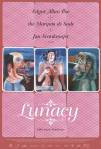
Lunacy/Sileni (2005)

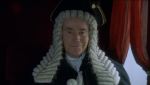
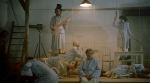
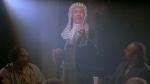
Today’s cinema adventure: Lunacy (Šílení), a darkly comic 2005 horror film by celebrated Czech filmmaker Jan Švankmajer; based on two short stories by Edgar Allan Poe and drawing inspiration from the writing and philosophies of the Marquis de Sade, its an odd, quirky and disturbing foray into the horror genre by a director known for his odd, quirky and disturbing movies, featuring his trademark mixture of macabre puppetry and animation as well as his usual surrealist influences.  Like most of Švankmajer’s work, it initially received little attention outside of Europe (and the few remaining “art house” theaters), but it has since found an audience, alongside the rest of his canon, among the ranks of his loyal international cult following.

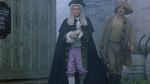
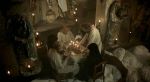
Though it begins, ostensibly, in a present day-setting, the story is quickly drawn anachronistically into the 18th Century, as its protagonist, Jean, is befriended by a wealthy and mysterious marquis (in full period garb) who travels by horse-drawn coach and is attended by a mute servant.  Jean is plagued by recurring nightmares in which two leering goons accost him in his sleep and attempt to forcibly restrain him with a straight jacket; after one such dream causes him to destroy his hotel room in a somnambulant struggle, the marquis comes to his aid by paying for the damages, and then invites the young man to travel with him to his home.  Jean soon discovers, however, that his new benefactor possesses a cruel streak; during his stay he is subjected to cruel pranks- including a bizarre and secretive nocturnal interment- and surreptitiously witnesses a blasphemous ritual in which God and morality are denounced and a young woman in chains is beaten and raped.  Eventually, he accompanies his host to a local asylum, where he is persuaded to remain as a voluntary patient in order to receive treatment for his nighttime disturbances.  His agreement to this arrangement, however, is in reality spurred by the presence there of the girl abused in the black mass, whom he fears to be trapped within the sinister machinations of the marquis and his friend who runs the institution.  Vowing to rescue her and expose the sadistic purposes of her captors, he sets about discovering the hidden truth of the hospital- a place where the inmates and staff are virtually indistinguishable, where chaos and debauchery seem to rampage unchecked, and where a dark secret lies hidden behind the walls, waiting to be set free.

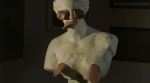
Švankmajer (who provides a spoken introduction to the film in which he plainly states its purpose and emphatically proclaims it not to be “a work of art”) draws the  inspiration for his narrative from Poe’s stories, The System of Doctor Tarr and Professor Fether and The Premature Burial, but the underlying thematic premise is derived from the views espoused by the notorious Marquis de Sade- upon whom the film’s primary antagonist is clearly based.  The argument of both the real and fictional marquis- that man is a product of nature, cruel and carnal by design, and that notions of God and morality are false constructs based in fear and designed to impose control over the weak and foolish- is the central idea which fuels the story, alongside the added intellectual exploration of two opposing methods to governing the insane: absolute control and absolute freedom.  As to the latter, the director states unequivocally in his prologue that the state of the modern world is a combination of the worst aspects of each of these methods, but- apart from this rather glib assessment- his film offers no real support for this theory beyond the extrapolations that can be made from the allegorical elements of the scenario.  Regarding man’s bestiality, however, Švankmajer gives us plenty of meat- literally.  Providing a sort of running commentary to the action are short segments, produced with the filmmaker’s familiar stop-motion techniques, featuring slabs of raw meat animated into performing various activities reminiscent of basic instinctual behavior- such as eating, fighting, and sexual intercourse-  continually reinforcing the idea of humanity as mere senseless flesh driven by primal impulses.  These vignettes, intercut with the main action, also serve to give Lunacy much of its “creep” factor, though as always in Švankmajer’s films, there is good amount of tongue-in-cheek humor that makes us grin even as we cringe.  On a less abstract level, within the narrative proper, the idea of man’s natural urge towards sex and cruelty is illustrated repeatedly in scenes best left for the viewer to discover for himself, with Jean and his enigmatic damsel-in-distress as the only representatives of sanity- as equated to decency, that is.  However, in keeping with the film’s source material, not to mention its creator’s penchant for surrealism, it is never exactly clear that our assumptions are true, and the question of what constitutes sanity- or decency, for that matter- is one which Lunacy leaves unanswered, choosing rather to provide cynical observation on the basic state of humanity.

Švankmajer has built his unique reputation with decades of imaginative filmmaking, blending live action with animation in ways that are at once deceptively simple and devilishly clever.  Influenced by an early career in puppet theatre, he has brought his traditional stagecraft sensibilities into his cinematic language, establishing himself as a genuine auteur with his shorts and feature films that incorporate not only the aforementioned stop-motion techniques, but claymation, a mixture of realistic and stylized scenery as well as puppets and live actors (and sometimes live actors dressed as puppets), and a generally theatrical style possessed of unmistakably ancient roots that stretch back to the Commedia dell’Arte and beyond.  Lunacy, however, like many of his recent works, utilizes a greater proportion of more-or-less straightforward live action footage; indeed, apart from the previously described meat-in-motion sequences, it contains relatively little of Švankmajer’s familiar visual trickery.  This is not to say the movie is short on the director’s usual delight in showmanship; throughout the story are numerous sequences that clearly draw from his love for the stage- the black mass, viewed from the perspective of an unseen audience (Jean peering through a window), is blatantly theatrical, and a tableau vivant of Delacroix’s La Liberté guidant le peuple is later staged by the marquis at the asylum, a nod to the historical de Sade’s direction of plays featuring other inmates when he was at Charenton asylum- as well as to Marat/Sade, the famous avant-garde dramatization of those real-life “productions.”  In addition, the trappings of theatre are scattered throughout the film- costumes, wigs, false facial hair- and the marquis’ entire persona seems to be a sort of performance, as if he is always centerstage in the theatre of his own life.  All of this plays into Švankmajer’s eternal fascination with illusion and the tricks of perception that allow us to be deceived by our own minds, which in turn fits neatly into the Poe-inspired horror scenario, hinging as it does on this very idea; further, the subject matter gives Lunacy‘s theatricality the specific flavor of true Grand Guignol, a style named for the 19th Century Parisian theatre that popularized the staging of horror spectacles, steeped in gore and blasphemy, known for inducing a kind of sexual response to their sensationalistic thrills- which is, of course, highly appropriate in a piece so infused with the spirit of De Sade.

Lunacy is not, of course, a play, and though it borrows much from the theatrical milieu, it also revels in its cinematic nature.  Švankmajer’s understanding of his medium is absolute; he directs with the confidence- even the cockiness- of someone like Hitchcock or Kubrick, delighting in his offbeat style and audaciously presenting his subversive ideas with imagery that is as indelible as it is absurd.  That Lunacy is a self-proclaimed horror film makes little difference in the director’s approach; the choices and tactics he employs are no more horrific than those in any given Švankmajer film, and indeed, he shows considerable restraint here, leaving many things to the imagination that might, with a different director behind the camera, be exploited for their full shock potential.  Providing shock has never been of interest to Švankmajer; rather, he prefers to unsettle us, to disturb the comfort of our psyches by inundating it with the illogical and the impossible, simulating the peculiar flow of a dreamlike consciousness where the contradictory makes perfect sense and the ordinary seems unnatural and menacing.  He creates a hallucinatory landscape in which the demons of our imagination appear before our eyes in all their unexpected familiarity, and because he is so good at doing so, the things he doesn’t show us are all the more potent.

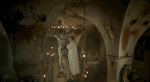
Lunacy, like all of Švankmajer’s films, is ultimately beyond the realm of standard criticism; it exists as a thing unto itself, and to this whimsically macabre visionary’s loyal legion of acolytes, it is one more perfect creation in a body of work that, thankfully, continues to grow.  That said, however, watching his effort at a bona fide horror film (though truthfully, in my view, all of his work could be classed as such) is something of a disappointment.  Given the genre into which he has ventured, one might expect a hitherto unseen level of grotesquery, if not in outright terror and gore, at least in the ferociousness of his approach; but although the film contains several highly effective set pieces (the aforementioned black mass- with its mixture of the arcane, the blasphemous, and the erotic- pushes a lot of buttons for those uncomfortable with such improprieties, and the entire premature burial sequence is a mini-masterpiece of evoking chills with atmospheric story-telling) and it maintains a palpable sense of dread and impending doom throughout, it seems strangely subdued- particularly given its influences from Poe and de Sade, neither of whom could be called masters of restraint. It’s true that the film is meant to be comedic as well, albeit in the darkest sense; but again, this can be said of most of Śvankmajer’s work.  Furthermore, his narrative- despite the anachronisms, non-sequiturs, and other occasionally jarring surrealist ornamentation- is uncharacteristically straightforward, linear, and grounded in a relatively concrete reality (with the exception of the ongoing interpolation of animated meat, that is).  Taken on the whole, Lunacy is less engaging than his Faust, and less disturbing than his Lewis Carroll adaptation, Alice, both of which push the limits of our preconceived boundaries with more enthusiasm and, consequently, linger in our memories far more pervasively.

Comparisons with his other work aside, Švankmajer’s horror film is still an impressively imaginative piece of work, capturing in its unorthodox framework both the delirious psychic instability that makes Poe’s stories feel like a fever dream and the perverse thrill that lies at the heart of de Sade’s nihilistic hedonism.  It’s not terrifying- though parts of it may cause faint hearts to beat faster- and its eventual conclusion is predictable for anyone who even a passing familiarity with the conceits of horror fiction; nevertheless, it succeeds better, both on an intellectual and a deeply primal level, than most of the formulaic, shock-oriented thrillers churned out by the mainstream film industry in its pursuit of teenage dollars.  Of course, its bizarre stylization may prevent many casual audiences from finding it appealing; Švankmajer’s movies are not for every taste, certainly, though in truth, Lunacy may be more accessible than much of his more directly avant-garde work.  As for those with more eclectic tastes, those who are already indoctrinated into the peculiar joys of this Czech master may find, as I did, that Lunacy fails to generate the same deliciously mind-twisting effects as some of his other projects- though doubtless there will be those, with whom it strikes a particular chord, who will quickly adopt it as a new favorite; those adventurous cinema enthusiasts who have yet to see a Švankmajer film, however, are likely to find it a pleasant introduction to a strange and darkly wondrous world unlike anything they have seen before.  It’s as good an introduction as any, and if it leaves you wanting more, you can take comfort in the fact that a five-decade body of work exists, awaiting your discovery.

http://www.imdb.com/title/tt0407236/

Women in Revolt (1971)

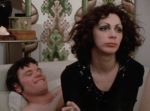
Today’s cinema adventure: Women in Revolt, the 1971 Andy Warhol-produced film satirizing the Women’s Liberation Movement and starring a trio of transgendered “superstars.” Notably, it was the last film to be produced by Warhol on which he actually stood behind the camera, though it was directed by longtime associate Paul Morrissey; it enjoyed more attention and mainstream notoriety than many of the infamous artist’s earlier films, largely on the basis of its controversial approach to the subject matter, drawing the wrath of feminists who felt it was a slap in the face to have their cause savagely lampooned and to be represented onscreen by “female impersonators” instead of biological women.

The plot, such as it is, revolves around three women who become involved in the Women’s Lib movement for their own reasons: Jackie is a militant intellectual schoolteacher who believes men are inferior to women and should be relegated to their naturally subservient place in society; her friend Holly is a model who hates being treated as a sex object, although she herself has a ravenous libido; and Candy is a society heiress who longs to break free of the stiflingly traditional role she is expected by her family to play, wishing instead to build a career for herself as a glamorous movie star. When Jackie and Holly decide to form their own protest group- called Politically Involved Girls, or “P.I.G.” for short- they hit upon the idea of enlisting Candy, hoping to capitalize on her high-profile society position to generate publicity for their cause, and more importantly, to gain access to the financial support of her family and the wealthy circle in which they move. A series of misadventures follows in which each of the three activists are revealed to be more motivated by self-interest than by real passion for their cause. Jackie, despite being a self-proclaimed lesbian, spends the organization’s money on a bodybuilding male hustler and becomes the unwed mother of his baby; Holly succumbs to her penchant for drinking and sex, becoming a derelict living in the street; and Candy abandons her friends, her family, and the movement to realize her dream of stardom.

The scenario for Women in Revolt– it would be inaccurate to call it a script- is not so much a storyline as it is an excuse for extended on-camera improvisation and trashy bad behavior. This, of course, is the real purpose here, far more than any deliberate social or political commentary. Still, it’s easy to see why genuine feminists would find Morrissey’s movie insulting and offensive; their arguments are put into the mouths of enfants terribles whose grotesquely exaggerated behavior and plainly self-absorbed motives render them meaningless and laughable. Given Morrissey’s right-wing political bent, it’s possible, if not probable, that this was at least part of his intention here; but in truth, the whole affair is so patently ridiculous that it is impossible to take seriously. The political satire is merely a vehicle in which the film’s three stars can indulge in their individual excesses, gleefully breaking taboos and acting out with histrionic abandon. Much of the dialogue is devoted to the kind of verbal bitch-slapping that has fueled drag shows for decades, and for the most part, whoever shares the screen with each of the three central characters is merely there to provide a foil- and the occasional straight line- for their onslaught of caustic camp.

Though this formula, admittedly, provides numerous amusing moments throughout the film, it is also the main downfall of Women in Revolt. The pervading atmosphere of uncontrolled, undisciplined expression hardly makes for concise, coherent filmmaking; the improvisational approach works for fleeting moments, but those are islands in a sea of self-indulgent chatter- often spoken simultaneously, in a seeming battle for dominance, rendering much of its content incomprehensible and more than a little grating. This, of course, is inherent in improv, which is why it is most effective when used as a basis for developing more polished material or edited into a cohesive form by a savvy director; it also helps when the performers have been given clear guidance and, ideally, have received some formal training. In the absence of these elements, the end result usually ends up looking and feeling like a free-for-all, reminiscent of rambunctious children play-acting in a schoolyard game of make believe- which can be effective in short doses, but is perhaps not the best way to sustain the length of an entire feature film. It creates, in fact, the sense that we are watching a movie made by amateurs, and such is the case here; the low budget production values, the clumsy lighting, the choppy editing, and the generally insipid nature of most of the dramatic conceits all contribute to this feeling. As a result, instead of being provocative or outrageous, the proceedings quickly become simply tiresome, with a juvenile sensibility that makes the archness of the film’s tone come off more like shallow snarkiness. In addition, despite a considerable amount of gratuitous nudity- mostly male- and sexual content, the handling of these scenes strips them of eroticism; indeed, sex as portrayed here is a repugnant, degrading act, devoid of charm or subtlety, and thoroughly shocking for reasons that have nothing to do with morality or social acceptability. Like everything else in the world as seen by Warhol, Morrissey and company, it’s just another boring convention to be disdained and ridiculed.

These criticisms, valid though they may be, might be immaterial if one considers that film for Warhol- originally, anyway- was just another decorative medium, a way to produce ever-changing pop art images to be projected on a wall at a party, perhaps- a means to provide atmosphere in the background of a real-life “happening.” The rules of good cinema do not apply when a film is more of a statement in itself than a legitimate exploration of the art form. However, by the time of Women in Revolt, the enigmatic Warhol had stepped away from participation in his film productions, handing over the reigns to Morrissey, who had taken things in a more (or, arguably, less) ambitious direction, focusing on a narrative-driven, mainstream approach. It would be a mistake to classify these later Warhol movies as art for art’s sake, as they clearly aspire towards providing a more medium-specific experience; therefore, it seems fair to say that by any reasonable cinematic standards, Women in Revolt is a terrible film. One might argue that the film eschews traditionally accepted style and polish as a rejection of conventional cultural values, but pretensions of artistic purpose are no excuse for sloppy movie-making, and even if one generously classifies Morrissey’s style as cinema verité, it’s hard to think of a less professional, more careless example of cinematic hack-work. What makes this film so appallingly bad is not its nasty attitude or its banality, but the fact that it is, in the end, a poorly executed, badly assembled mess- and despite the fact that Warhol himself operated the camera for several botched scenes (at the insistence of star Jackie Curtis, who refused to perform without his participation), the fault for this lies solely at the feet of its director. Morrissey’s apparent lack of skill in the creation of his product may have been intentional, a deliberate effort to make a statement about the subjectivity of artistic values or to prove the point that arbitrary notions of bad or good are irrelevant to an audience simply seeking to be distracted; but his work here smacks of fraud, the attempts of a would-be artist to discount the importance of techniques he hasn’t the patience or understanding to master. Whereas Warhol’s genius was in simply setting up the camera and letting it capture what it would, the same approach is Morrissey’s crutch. In other words, Women in Revolt seems the work of a lazy director who wants glory without having to work too hard.

Despite this harsh assessment of Morrissey and his work, Women in Revolt is not devoid of value. For better or for worse, in fact, it is probably a more significant film today than it was when it was originally released, due largely to the window it provides into the miliieu of the Warhol factory and- more importantly- the all-too-rare opportunity it gives us to see the work of its three leading players: Jackie Curtis, Candy Darling, and Holly Woodlawn. Each of them were members of Warhol’s famous coterie at the “Factory,” known for their work in previous of his films, and as such were popular- and notorious- fixtures of New York’s avant-garde arts scene. Curtis, unlike his two co-stars, was a female impersonator, who appeared both as a man and a woman in his work, and was successful independently of his projects with Warhol; he was an actor and playwright whose edgy, campy plays were a fixture of New York’s experimental theatre scene, as well as a singer and poet whose work garnered considerable praise and attention from critics of the era. His screen persona- abrasive, outspoken, sarcastic, and sporting a frizzy red wig with glittery make-up- provides many of the best one-liners in Women in Revolt, and whenever he is on the screen he is in absolute command. This is not always to the benefit of the film; many of the shrillest and most confused scenes are the result of Curtis’ aggressive improvisation, in which other performers are drowned out and cut off at every turn in favor of his unscripted outbursts. Nevertheless, it’s a smart performance, giving a glimpse at the potential for brilliance which might have been more fully realized with a little rehearsal and direction. Likewise, Candy Darling, a true transgendered performer, who had worked extensively with Curtis in his plays as well as in previous Warhol outings, reveals the ethereal, double-edged sincerity that allows her, somehow, to rise relatively unscathed above the messy chaos of Women in Revolt; she contrasts Curtis’ brash bullying with her own form of dominance, the cool superiority of a sophisticated and intelligent woman with nothing to prove. She is elegant and truly beautiful, and Women in Revolt is at its best- and most watchable- when she is onscreen, working her magic with the curious blend of earnestness and irony that made her one of the most charismatic of the “superstars.” Rounding out the trio is Woodlawn, also a true transgender, whose fiery Puerto Rican energy bursts from the screen, representing the raw energy of the body (as opposed to that of the mind and spirit, personified by Curtis and Darling, respectively) as she gropes and gyrates her way through the film. Truly sinking her teeth into her role as a nymphomaniac who hates men, she gives a manic, conflicted performance which displays a remarkable gift for comedy and hints- as does the work of her co-stars- at a considerable talent, making us wish all the more for a surer hand behind the camera. The fact that all three of these stars are so obviously gifted is yet another indictment against Morrissey’s infuriating mediocrity as a director; their work continually gives us glimmers of what Women in Revolt might have been. Still, they provide plenty of reasons to sit through the movie- though it requires considerable patience and might be best accomplished in short installments- and even manage to create several moments which could be called classic. Besides these three heavyweights, the film offers brief appearances by other counter-cultural icons of the era, including Penny Arcade and Betty Blue, and Brigid Berlin in a wordless cameo as a decidedly butch bar owner.

The fact that Women in Revolt is an atrocious movie, oddly enough, does not alter the fact that it is a classic, of sorts. Clearly, there are many stalwart supporters of Warhol and his crew that would defend the film staunchly and embrace its many flaws proudly, claiming them as victories in a cultural war and viewing them as medals of honor. There is certainly a weird power to this curiosity of its time, and despite its lack of real ambition it manages to offer up some interesting observations about the power struggle between the sexes- particularly through its reversal of roles in which liberated women treat their men with the same disrespect and contempt they deplore when they are the recipients, and the use of sex as both a bargaining tool and a means of gaining power. It can be argued that the movie was a success in terms of what it set out to accomplish. Warhol neither knew nor cared about the aesthetics of film; he wanted only to present his branded material for the sake of building his cult-of-personality-based empire, and notions of good or bad were of little interest to him. With this in mind, Women in Revolt is exactly what he wanted it to be- a source of controversy and buzz, and another brick in the continually growing monument to his so-called genius. Indeed, given his particular, nose-thumbing stance at conventional society, it is probably preferable that it should be bad; the exaltation of the banal was a major part of what he was all about, after all. Therefore, I find myself in the curious position (which Warhol would have loved) of recommending a movie that I found to be abysmal. I would stress, however, that my endorsement is based not on any sort of respect for the artists behind the scenes, but on my admiration for the ones on the screen. It is beyond tragic that these three were given the treatment they were- exploited by Warhol for their “freak” appeal, they were given just enough cultivation to reveal the brilliance of their underlying talent, then abandoned because the impresario had lost interest. Perhaps the real reason for his fickleness can be surmised by viewing Women in Revolt; it is the talent of Curtis, Darling, and Woodlawn that redeems the experience, and without them it would truly be unwatchable.  Could it be that Warhol feared they might outshine him on their own merits, and take away some of the credit for their own success? It’s a question, sadly, that must be asked, but can never be answered. Darling would pass away of cancer within two years of the film’s release, and Curtis would die of a heroin overdose a decade later; Woodlawn returned to her native Puerto Rico and worked as a busboy until, years later, a resurgence of interest in her former persona allowed her to return to the limelight. Women in Revolt, wretched as it is, is a snapshot of a moment in time, when all three were poised on the brink of success, and maybe, just maybe, could have broken through the barriers of social prejudice to achieve mainstream success. It was not to be, but they paved the way for future generations who continue the struggle for transgender acceptance. That in itself makes this movie worthy of respect- not for the posers behind the camera, but for the real people in front of it.

http://www.imdb.com/title/tt0129631/

The World of Henry Orient (1964)

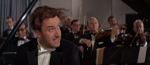
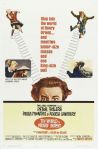
Today’s cinema adventure: The World of Henry Orient, a 1964 comedy directed by George Roy Hill, featuring Peter Sellers as the title character, a concert pianist whose libidinous exploits are complicated by the obsessive adulation of a pair of adolescent schoolgirls.  Based on a novel by Nora Johnson, daughter of Hollywood writer/director Nunnally Johnson (with whom she also co-wrote the screenplay for the film), it places greater emphasis on the coming-of-age story of Orient’s juvenile stalkers than it does on the misadventures of the loutish lothario himself.  It was successful with both audiences and critics, its popularity no doubt bolstered by the presence of its star, who was at the time entering the height of his career, and it was later turned into a Broadway musical, Henry, Sweet Henry, which enjoyed considerably less success.

Set in Manhattan, the film follows the experiences of Val and Marian, two students at an exclusive girls’ school who develop a close friendship; both are outsiders at school, and share an imaginative flair for fantasy and make-believe, which leads to their indulgence in precocious adventures together.  On one such outing, they stumble upon a clandestine rendezvous in Central Park between Orient and his nervous, married, would-be mistress, interrupting their tentative tryst and foiling the pianist’s amorous intentions.  Later, when the girls attend his concert with Marian’s family, they recognize him from their encounter at the park, and Val develops a crush; so the pair begin to follow him, watching his apartment and making a scrapbook about their obsession- as well as a fanciful diary documenting Val’s hypothetical romance with him.  When Val’s jet-setting parents return for a holiday visit, her strict and austere mother finds the secret volume, a discovery which leads to uncomfortable complications not only for the girls, but for the unwilling object of their affections, as well.

Though The World of Henry Orient was a fairly successful film at the time of its release, it has faded somewhat from cultural memory.  Part of the reason for this may be that much of its draw in early 1964 arose from the presence of three up-and-coming names in its credits- Peter Sellers, Angela Lansbury, and director George Roy Hill- each of whose subsequent work would soon eclipse the importance of this quaint little movie.  Another factor, no doubt, was the changing social landscape of the years shortly to follow its debut, in which stories about the wholesome innocence of childhood, no matter how well-made they may have been, seemed somehow to be less relevant and important than those addressing the “larger” issues that were suddenly confronting young people as they came of age during the upheaval of the late sixties.  Ironically, one of the key factors in the film’s initial popularity was likely the fact that, in its good-natured and sweet depiction of teen-agers, it represented something of a backlash against a decade of teen dramas in which modern American youth culture was depicted as a dangerous and depraved environment full of delinquents, drugs, and rock-and-roll; the two young ladies at the center of this film were a refreshing change of pace, and their problems were, in truth, more representative of those faced by the average teen in daily life.  Sandwiched between two eras of rapid cultural evolution, The World of Henry Orient enjoyed its moment in the sun while the world took a moment to catch its breath.

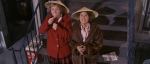
Whatever the reasons for its success or for its relative disappearance, Hill’s sweet-but-sophisticated little movie definitely holds up to contemporary viewings.  It’s worth noting that the title character’s name- a play on the name of renowned celebrity pianist Oscar Levant, whose surname means “Orient” in French and upon whom the character was loosely based- does result in some minor cultural discomfort surrounding Asian stereotypes; in deference to their idol’s unusual moniker, his two young stalkers adopt faux-Japanese code names and indulge in playful rituals which parody Eastern traditions, such as kowtowing to their collection of Henry-themed “relics” and sporting conical straw “coolie” hats as they stake out the pianist’s apartment building.  Aside from this, however, which can be written off as nothing more than playful, non-malicious fancy, the film’s gentle depiction of the transition from childhood into adolescence has a timeless feel, despite its distinctive, now-nostalgic mid-century Manhattan setting; much of this is due to Johnson and Johnson’s screenplay, which manages, through its focus on the universal concerns of young girls (and adults, for that matter) rather than on time-and-place-specific hotbed issues, to avoid any topicality that might have made the story seem dated today.  It also helps that the girls portrayed here are atypical teens, from a social standpoint; Marian comes from a “broken” home, living with her mother and another divorced woman (a situation with overtones which must have been provocative, even in 1964), while Val is the “problem” child of wealthy, distant parents who leave her in the care of hired guardians.  Coupled with the fact that neither girl is among the “in” crowd at school, and are therefore not surrounded by a gang of Hollywood-style adolescents following the latest fads and speaking in the teen-speak jargon of the day, this means that The World of Henry Orient is mercifully free of the kind of mass-media clichés that would make its appeal more ironic than sincere; this is not a picture postcard of idealized nuclear families getting mixed up in occasional kooky hi-jinks, but a story of real, not-so-average people going through genuine life experiences.  This is not to say there is a lack of goofy comedy; that is mainly provided by the over-the-top exploits of the title character, as portrayed by comic chameleon Sellers.  His Henry Orient is a ridiculously shallow, pompous charlatan: affecting the pose of a continental sophisticate as he slips back and forth between a generic, vaguely European accent and a crass Brooklyn-ese; falling over himself in his efforts to lure vulnerable, attached women to worship at the shrine of his ego; indulging in pretentious theatrical antics as he shamelessly fakes his way through an avant-garde piano concerto; and generally revealing himself to be a self-serving buffoon whose real personality is a far cry from the romanticized vision held by his two juvenile followers.  In addition to being funny, of course, this serves to illustrate the contrast between the girls’ rose-colored view of reality and the sometimes sordid truths of the adult world into which they are about to crash.  It’s a revelation that unfolds as the story progresses; as the movie’s focus expands to include the troubled relationship of Val’s parents, we are given more and more evidence of the gap between image and authenticity, and the all-too-frequent failure of adults to live up to the expectations of their roles.

In addition to the aforementioned performance by Sellers- who is, as always, a wonder to watch as he melds psychology and physicality together to completely become his character- there is the work of Angela Lansbury, whose icy turn as Val’s deceitful and hypocritical mother provides another sharp example of the gap between ideal and reality in the adult world, as well as reminding us that, before her success in Broadway’s Mame and her long tenure as television’s Jessica Fletcher re-invented her as a warm and lovable matron, this fine actress was one of the screen’s foremost bitches.  The hollowness of her worldly sophistication and her barely-concealed disinterest in her daughter’s life (until it affects her own image, of course) help to expose the character’s own desperate need for attention and validation, which, though it doesn’t exactly make her sympathetic, certainly paints a clear picture of who she really is, at the core.  Contrasting her unpleasant phoniness are Phyllis Thaxter and Bibi Osterwald, who embody good-natured warmth and unconditional love as Marian’s mother and her live-in, fellow-divorcee companion, making the point that an unorthodox family unit can be far healthier than a traditional one; as well as Tom Bosley, as Val’s father, who foreshadows his later success on Happy Days with his stolid performance as a man finally ready to assume the responsibilities of parenthood, even if it is a little late in the game.  Rounding out the adult cast is the always-delightful Paula Prentiss, as Orient’s skittish would-be lover, who manages to be likable and sympathetic despite the fact that her role is a caricature of upper-middle class shallowness and gullibility; she manages to hold her own opposite Sellers, matching his manic zaniness like a seasoned pro- no small accomplishment, to be sure.  The key performances here, however, are the children’s; Merrie Spaeth (as Marian) and Tippy Walker (as Val) fully live up to the demands placed upon them by their central roles in the proceedings.  Full of youthful giddiness, smart without being precocious, and capable of the honesty required to show us the full emotional journey of these two remarkable young women, they also provide a perfect complement to each other with their distinct and separate personalities- the more grounded Spaeth anchors the duo, while Walker gives us the edgier dynamic of Val.  Neither actress went on to an adult career in cinema- Spaeth became a noted political and public relations consultant, Walker opened an art gallery- but their work in this single film ensured them a secure hold on movie immortality.

As for the director, George Roy Hill does a superb job of juggling the perspectives of the various worlds within The World of Henry Orient.  He captures the irrepressible vivacity of youth with then-edgy techniques such as wildly tilted camera angles and montages utilizing both slow-motion and high-speed photography; he manages some grade-A comedic set pieces around his charismatic star, particularly the extended concert sequence in which the hammy Orient ad-libs his way through a performance at Carnegie Hall while frustrating his conductor and fellow musicians with his ego-maniacal shenanigans; and he uses the Manhattan scenery, lovingly photographed by Boris Kaufman and Arthur J. Ornitz, to full advantage, allowing the change of its character through the seasons to reflect the progression of his two heroines through their rite of passage.  Adding to the bittersweet, nostalgic delight is his confident reliance on the score by Elmer Bernstein, which evokes the carefree ease of childhood, the sweeping majesty of the city, and the emotional longing at the core of the story.

The World of Henry Orient is a difficult movie to criticize; though the themes it tackles are hardly momentous, there is an authentic quality to it that is impossible to dislike, which no doubt arises from the fact that Johnson’s novel was autobiographical, based on her own experiences growing up at a New York girls’ school.  Parenthetically speaking, the fact that she co-wrote the screenplay with her father is very telling, considering the turn of events which brings emotional closure to the story.  The unpretentiousness of the movie has made it one of those certifiable classics that is usually forgotten in discussions of great cinematic art, but is beloved by almost anyone who has seen it in its frequent appearances on the late-night movie broadcasts of the seventies and eighties; there is a comfort in its gentle portrayal of youthful fantasy meeting seedy reality, considerable appeal in the fact that it manages to be sweet without ever becoming cloyingly so, and an additional bonus provided by farcical tour-de-force performance of its star, surely one of the screen’s great masters of comedic acting.  When all is said and done, The World of Henry Orient is a film I can heartily recommend with more confidence than any number of “greater” cinematic achievements; it may not be a masterpiece, but it is one of the most likable little movies I can think of.

http://www.imdb.com/title/tt0058756/
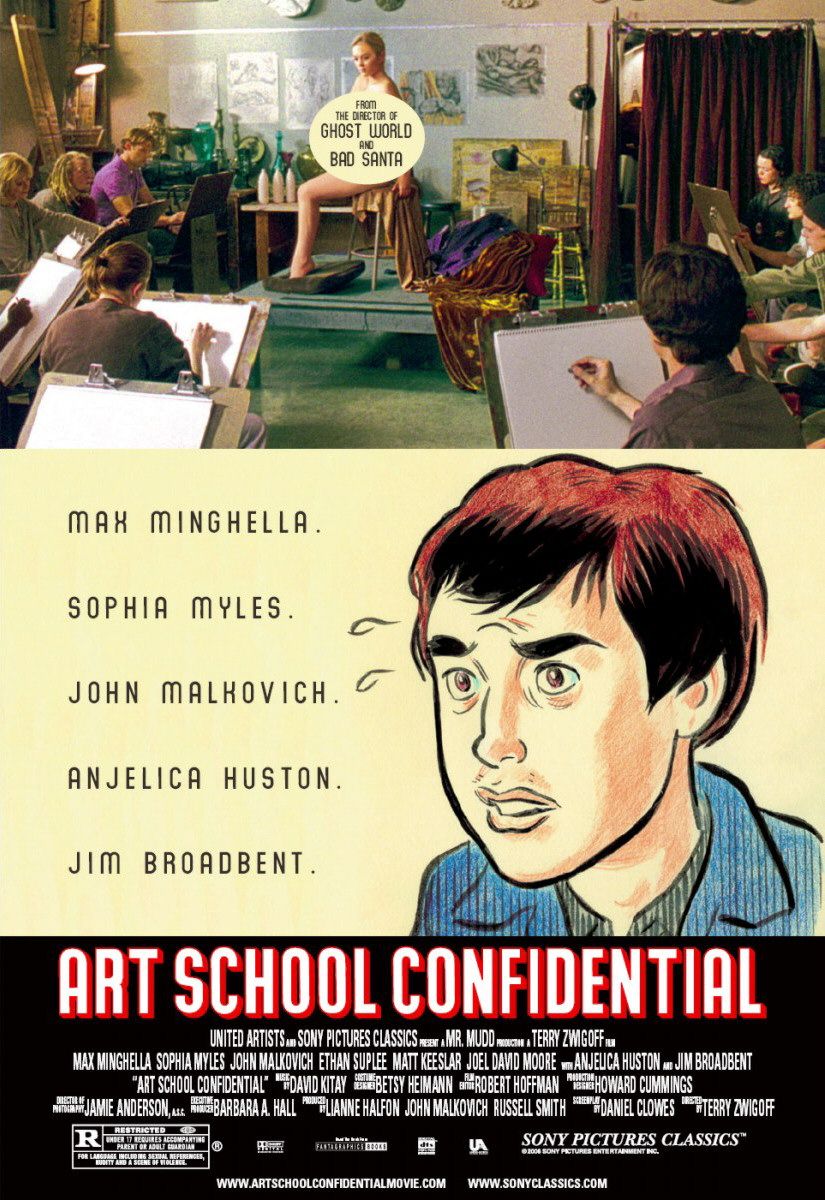
Art School Confidential (2006)


Today’s cinema adventure: Art School Confidential, the 2006 film by Terry Zwigoff based on Daniel Clowes’ underground comic of the same name.  The second collaboration between Zwigoff and Clowes, it follows the efforts of an art college freshman to win the love of his dream girl by becoming a successful artist.  It shares many of the themes of their first joint effort, Ghost World, as well as its bleak world view and cynical take on humanity, and features an impressive array of talent in supporting roles.

The plot follows Jerome, a young man whose interest in art has more to do with his libido than his desire for self-expression.  Believing that success in the art world will allow him a limitless amount of female companionship; he enrolls as an art major in an urban college, where he has high hopes that his talent will quickly be acknowledged.  Instead, he finds himself just one of many frustrated hopefuls in a depressingly grim environment where the only topic more discussed than the uselessness of an art degree is the string of unsolved murders taking place near the campus.  Surrounded by peers who are self-absorbed, pretentious boors, and professors who are self-important, disaffected failures, more interested in their own stalled art careers than in nurturing the abilities of the students under their charge, he gradually realizes that success is more about playing the game than about talent.  To make matters worse, he is completely turned off by the dysfunctional girls in his dating pool, and he begins to despair that his fantasies of being a playboy artist will be crushed by the cold reality of adult life.  Things begin to look up when he meets a beautiful model who shows an interest in him, but after she is swayed by a handsome fellow student- whose work has gained more recognition than his own- his desperation drives him to concoct a deceitful plan which will put him on the fast track to success and win back the attention of his newfound dream girl.

On the surface, Art School Confidential feels like one of those eighties-era coming-of-age comedies directed by John Hughes, in which a geeky teen loser learns that being yourself is more important than being popular and ends up winning the boy or girl of their dreams by the final scene.  That description is not far off, but in this screenplay, penned by Clowes himself to ensure faithfulness to his own misanthropic vision, the formula is turned on its ear.  Jerome doesn’t want to be accepted as he is, he wants to be worshipped; and far from finding empowerment and self-actualization, he learns that being himself brings only further isolation and obscurity, and that if he wants his dreams to come true he will have to find a way to stoop lower than everyone else.  His story is shot through with the kind of social satire that hits uncomfortably close to home, threatening to undermine any preconceived ideas we might have about the underlying goodness of humanity; if there was ever any there, Clowes makes it clear that it has been thoroughly snuffed out by the degraded, ego-driven culture he shows us.  Like our protagonist, we look around desperately for kindred spirits, but the cast of characters offers us little solace; Jerome’s fellow students are a collection of affected misfits and pompous twits, and the adults are more or less an older- and more disillusioned- generation of the same breed.  Virtually every person in the film is motivated by their vanity, and everyone else around them is merely an object to be used in their quest for self-fulfillment.  This is true even of those few characters that seem sympathetic- including Jerome, who turns out to be more of an anti-hero than we surmise.  With such a disheartening perspective on the denizens of the art world- and, by extension, the rest of the human race- it’s hard to find any of the comedy very funny, at least in a laugh-out-loud way.  The film’s humor is dark, dry, and derisive; it is also arch and vaguely judgmental, casting a reproving eye on the professional and personal pursuits of all its characters and concluding that the bulk of human endeavor amounts to a desperate cry for attention.

For his part, director Zwigoff makes every effort to keep things light, at least visually.  He capitalizes on the movie’s teen-angst heritage with nods to the genre’s cliches, such as “getting-it-done” montages and character-based visual gags, and directs his actors with a clear focus on presenting its familiar types.  He obviously relishes the exploration of his quirky characters’ personalities, but he emphasizes the details of the plot enough to keep it moving effectively.  It’s also obvious that he shares Clowes’ ironic sensibilities, and he is careful not to undermine Art School Confidential by softening its snarky edge with sentimentality- although, with the help of his A-list cast of adult actors, he does manage to imply a more mature counter-perspective that includes at least a little mitigation of the seemingly soulless and shallow priorities exhibited by the inhabitants of his film’s inhospitably selfish universe.

For their part, the actors do their best to keep things real, without relying solely on the surface qualities of their stereotypical characters; overall, the cast manages to infuse a level of humanizing depth to the proceedings that keeps the movie from being an unrelentingly pessimistic existential polemic.  Despite their best efforts at honest playing- or perhaps, in many cases, because of it- there are few likable characters in Art School Confidential; the single most pleasant personality is exhibited by Joel Moore, as Jerome’s friend Bardo, whose portrayal of a proudly self-acknowledged failure is refreshingly free of barely-concealed self-promotional subtext- appropriately making this gregarious loser a comfortable island in a sea of  chilly attitudes.  Max Minghella is deceptively appealing as Jerome, until his quest for recognition turns him into a self-pitying cry-baby; and Sophia Myles, likewise, fools us into liking his would-be soulmate, Audrey. The good stuff, however, comes from the heavy-hitting support team of accomplished grown-ups; John Malkovich, Anjelica Huston, Jim Broadbent, and Steve Buscemi all bring their skills to the table as they portray various representatives of the older-but-not-necessarily-wiser set, and the film leaps several notches up in quality when they are on the screen- which, sadly, is never for very long.

Art School Confidential is meant, of course, to be a comedic exposé of the pretentious, stagnated world of academic art, a subject ripe for vigorous satire.  The problem is that the humor seems to come from a rather mean-spirited place; Clowes and Zwigoff take a decidedly uncharitable view of almost every affectation and foible displayed by their characters, and at times their approach feels more like bullying ridicule than good-natured ribbing.  Their critical stance is certainly a valid one, but one can’t help feeling that the harsh perspective is a little too one-sided; after all, it’s easy to point fingers at the hypocrisy and artificiality we see around us, but it is perhaps more interesting to explore what lies underneath that surface.  Coming of age involves an awakening, a realization that the world is full of phonies and disappointments; but it also involves advancing past this stage to a more mature viewpoint, one with which we can discern the more subtle forces at work around us.  Art School Confidential strikes an attitude of smug contempt for its subject which smacks of sophomoric thinking, a pose which is ultimately no different than any of those assumed by the various characters it mercilessly skewers throughout.  It misses its mark not because of the darkness of its tone or its candid observations about the weakness of mankind- many fine films share these qualities, such as the work of director Todd Solondz, whose movies Happiness and Welcome to the Dollhouse are about as pessimistic as you can get but still engage and stimulate us with their depth and their humanity.  Rather, it fails because it lacks a certain maturity; instead of piercing insight, it offers blunt criticism, and in the end it leaves us knowing little and caring less about the inner workings of the world it portrays.  It’s a shame, because Art School Confidential has a lot of potential- both Zwigoff and Clowes are exceptionally talented, and one can’t help but feel that somehow, something was lost in the translation from page to screen.  There are times when the movie almost feels like it’s going to take off, and comedic moments that feel like they are about to make us laugh; but these are short-lived, and by the time we reach its somewhat predictable and not-very-satisfying climax, we have long since lost interest.  Fans of Clowes’ ironic-outsider flavor may find the movie easier to take than the rest of us, but those interested in discovering his work might be better-advised to go to the source rather than starting with this weak adaptation.  Still, the pairing of the author/artist and his filmmaking partner in crime seems a match made in heaven, and together they have managed to craft a very good film – but it’s called Ghost World, and the disappointment of Art School Confidential is probably all the more  bitter because they proved once before that they could get it right.


http://www.imdb.com/title/tt0364955/


The Stunt Man (1980)

Today’s cinema adventure: The Stunt Man, the 1980 feature by director Richard Rush about a runaway fugitive who stumbles into the middle of a film shoot and finds cover working as a stunt man, only to realize that the movie’s megalomaniacal director may be planning to kill him for the sake of filming the ultimate stunt.  A difficult film to place within a genre, it was shot in 1978 and ended up shelved for two years by a studio that didn’t know how to advertise it; when it finally hit the screen it was only given a limited release, and it was largely overlooked by the public.  Nevertheless, it garnered considerable praise from critics and managed to earn several Academy Award nominations, including one for its star- and its main appeal, then and now- Peter O’Toole, whose performance represented something of a comeback in his storied career.

Adapted by Rush and Lawrence B. Marcus from a novel by Paul Brodeur, The Stunt Man follows a young Vietnam War veteran who is running from the law, having committed an unspecified crime after returning from his tour of duty.  With officers in hot pursuit, he runs into the middle of a film shoot, inadvertently disrupting a dangerous automobile stunt in which the driver is accidentally killed.  With a sudden new opening for a replacement and only a few days to finish his ambitious anti-war epic, the movie’s director, Eli Cross, takes the young outlaw under his wing, offering him a safe haven and a new identity- in exchange for completing the aborted stunt himself.  As he prepares for the big moment, learning the tricks of the trade and attempting to bond with the gregarious crew of movie-making gypsies that have taken him into their fold, he begins to suspect the flamboyant and mercurial Cross, who is obsessed with realism, of plotting to orchestrate his death in order to capture it on film.  Things are further complicated when he finds himself in a blossoming romance with the film’s leading lady, heightening his dilemma over whether to flee back into a permanent life on the run or stay and risk his own untimely demise.

If the premise seems a bit gimmicky, it is; The Stunt Man offers a highly improbable premise, riddled with plot holes and unlikely conceits.  This, however, is part of the sense of wicked fun that permeates the movie.  Rush and Marcus never take the pseudo-thriller plot too seriously; although they give an appropriate amount of weight to the psychological conflicts of its hero, they make certain that the overall tone is decidedly comic, flavored with cynical irony and self-satire, and they derive a great deal of nudging humor from the tricks they work on their audience.  Within its far-fetched scenario, The Stunt Man plays with our expectations and our preconceived assumptions in order to keep us off balance, establishing its young protagonist as our access point into its smoke-and-mirrors world and ensuring that we, like him, are constantly betrayed by appearances; this is, after all, a movie about making movies, and in keeping with its subject, nothing is what it seems.  At every turn, we are presented with illusions- many of them clearly established as such- and then find ourselves surprised when the truth behind them is revealed.  The film shrewdly manipulates our willing suspension of disbelief, understanding that we want to buy into its various cons, and exploiting our natural inclination to believe what we see.   Rush spends most of his movie exploring examples of the conflict between truth and illusion, from the oft-repeated assertion that King Kong was only 3′ 6″ to the extended sequence of WWI carnage enacted in front of a throng of horrified spectators at the beach, making for a highly amusing display of magic in which the tricks being performed mirror the tricks being played on us by the magician behind the camera.

Of course, this idea of illusion vs. reality, which fits so perfectly into the metaphoric possibilities of a self-reflexive movie about movies, is nothing new; it has been highlighted in works ranging from Fellini’s 8 1/2 to Ben Stiller’s Tropic Thunder, providing fodder for low comedy to high tragedy and everything in between.  The Stunt Man, however, ties it to another theme, perhaps more immediately relevant to the lives of everyday civilians not lucky enough to be working in the film industry- namely, the difficulty of trust in a culture full of deliberate lies and manipulation.  Our hapless hero, ironically dubbed “Lucky” by his newfound protector (or, perhaps, persecutor), is full of paranoia and mistrust, the result of buying into a much bigger and more insidious con game than any cinematic sleight-of-hand perpetrated by Eli Cross and his crew; he has been cheated by a system that sent him to war on the promise of making him a hero and now treats him as a pariah, and had his hopes for a happy future shattered by faithless friends and lovers.  When the nature of his crime is revealed, we discover it was an act of anger and frustration over the raw deal into which he has been suckered- like so many of his generation.  Is it any wonder, then, that when he is offered a new lease on life by a representative of the dream factory, a man who blatantly and unabashedly manipulates truth and illusion in order to achieve his ends, he is wary of being suckered once again?  This is the central conflict of The Stunt Man; in a world devoted to illusion and deceit, where pretty lies often disguise ugly truths and trust is only a lure by which the foolish are led like lambs to the slaughter, the only hope of self-preservation is to doubt everything and everyone around you.  As Eli Cross puts it, late in the film, “Paranoia is a social disease; it’s got by screwing your fellow man.”  Whether he offers a cure or euthanasia is the primary question of The Stunt Man, and I wouldn’t dream of answering it here.  Suffice to say that the course of treatment has a few twists and turns.

Rush guides his film with bravura flair, capitalizing on his rare opportunity to both celebrate and send up the conventions of movie-making.  Infusing it with a certain tongue-in-cheek aura of self-awareness, he nevertheless dives headlong into the numerous opportunities for old-fashioned movie spectacle, with the added layer of showing us the spectacle behind the spectacle; he gives us a delight akin to seeing a magician reveal his secrets, only to discover the revelation itself is part of the trick.  He also takes advantage of the film-within-a-film milieu to capture a sense of bygone Hollywood glamour in the midst of the nuts-and-bolts candor of the contemporary setting, aided considerably by the extensive use of the historic Coronado del Rey Hotel, which serves as a location for much of the film; and though his film is primarily focused on psychological concerns, he fills it with action, not just within the framework of the “meta-movie” but expanding it outward into the surrounding real environment of the film as well.  The result is a movie that takes its time to get to its point but maintains the feeling of a brisk pace, enhanced by all the inherent details of its film-shoot backdrop, and keeps us engaged in its game of interchanging fact and fiction right up to the final playful moment.

The Stunt Man benefits from Mario Tosi’s cinematography, with its exploration of various qualities of light, both natural and staged; and the rousing score by Dominic Frontiere conjures the circus atmosphere of the movie-making world with a bravado that matches that of its director (the one onscreen, that is), and even includes a haunting vocal tune, “Bits and Pieces,” co-written by veteran songsmith Norman Gimbel and performed by the iconic Dusty Springfield.  As for the cast, a fine ensemble of likeable faces clearly enjoys itself with the material.  The titlular hero is played by Steve Railsback (whose careeer was mostly defined by his portrayal of Charles Manson in the TV film of Helter Skelter), who lets us see the vulnerable little boy inside even as he pulls off the hard-edged toughness he uses as a protective mask, and conveys the impression of a young man walking around in a state of prolonged shell-shock- which, of course, is not far from the truth.  The beautiful Barbara Hershey is highly effective as the leading lady (of both the film and the film within it), marvelously embodying the multi-layered quality of an utterly contemporary woman; she is sensual, independent, confident and full of a zest for her life and her work, but she also reveals the insecure little girl underneath the worldly actress- and, most importantly, she manages to find the balance between candor and mystery that keeps us from really knowing the sincerity of her feelings for “Lucky.”  Alex Rocco is memorable as an exasperated local lawman, as are  Allen Goorwitz, Chuck Bail, Adam Roarke, and Sharon Farrell as various members of the film’s cast and crew; but, without question, The Stunt Man belongs to its star, Peter O’Toole.

As Eli Cross, O’Toole’s famously over-the-top persona finds its perfect match; zooming around in his helicopter, descending from the heavens on his crane, and constantly enfolding his underlings with the enormity of his personality, he gives us the ultimate egotistical film director.  He is vain, dictatorial, demanding, pretentious, manipulative, and arrogant; yet he is also generous, gregarious, compassionate, and clearly more aware than anyone else of his own ridiculousness.  Cross plays himself with gusto, and O’Toole plays Cross with just as much of it; the legendary actor has said he based his performance on David Lean, the famously godlike director who helmed, of course, Lawrence of Arabia.  This may account for the unmistakable air of authenticity that underlies his work here, for despite his fully appropriate chewing of the scenery, every moment of his performance is infused with an absolute honesty and a fully recognizable humanity.  O’Toole’s Eli Cross is exactly the kind of larger-than-life man who is both worshiped and feared by those beneath him- and considering his God-or-the-Devil role in the proceedings of The Stunt Man, it’s a quality that fits to a tee, and makes the entire film work like gangbusters.

The Stunt Man is one of those odd little films that time forgot; a staple in the early days of cable TV, many have seen it- and liked it- and yet it has slipped into relative obscurity, no doubt due to its effervescent qualities that are likely to disguise its deeper matter for audiences who aren’t paying close attention.  For myself, I have noticed that when it comes up in conversation with someone, almost invariably the other person’s eyes light up- “Oh yeah, that’s a great movie!  I haven’t thought about that one in years!”  I’m happy to say that it holds up well, perhaps seeming even better now, though clearly the behind-the-screen technology it shows us is a bit dated in some ways.  The high-spirited camaraderie it depicts among its film-making “family” is timeless, however, and so are the themes it so cagily explores.  After all, today’s world is as full of phonies and liars as ever, and it is perhaps more difficult than ever to let our defenses down, for fear of being taken in and played for a fool- or worse.  The Stunt Man, in its quaint little tale of Machiavellian plotting in an insular world, provides an apt metaphor for the difficulties of overcoming paranoia in our own.

 http://www.imdb.com/title/tt0081568/

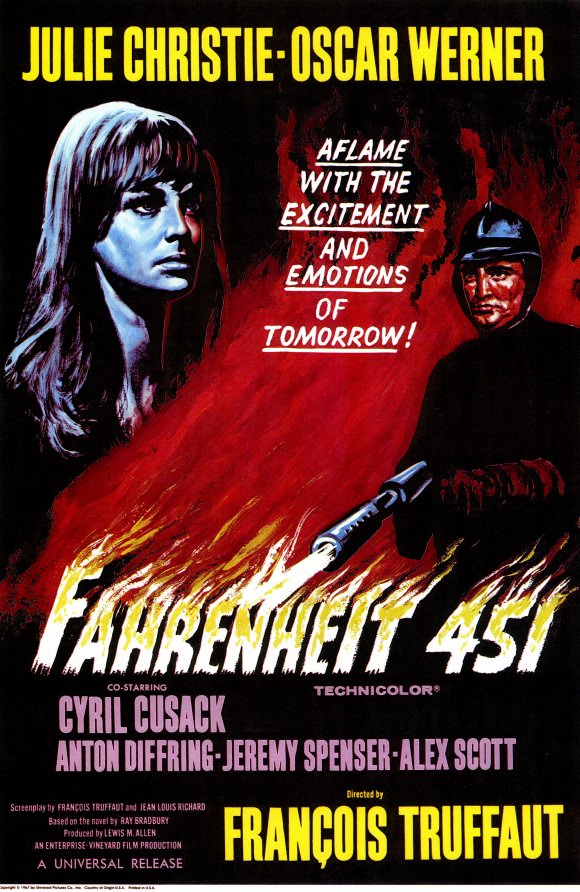
Fahrenheit 451 (1966)

Today’s cinema adventure: Fahrenheit 451, François Truffaut’s 1966 film adaptation of Ray Bradbury’s classic dystopian novel, and the great French director’s first- and only- English-language film.  Set in a non-specified (but not-too-distant) future society, where firemen no longer put out fires but start them- in order to burn books, which have been outlawed- it tells the story of one such officer, Montag, whose curiosity leads him to start reading in secret, resulting in his gradual dissociation from wife, job, and culture.  Though it was misunderstood by the critics and the public upon release, meeting with lukewarm reaction and largely being dismissed as an interesting failure, it has gained in reputation and respect over the years and is now regarded as a minor classic- and certainly as a seminal influence on the development of the sci-fi genre.

The choice of Bradbury’s story as source material for Truffaut was an odd one, considering the director’s previous work.  As one of the founders of the French New Wave movement, he had won much critical and scholarly renown with genre-defying films that broke from traditional ideas of cinematic structure and conventional storytelling, tackling social themes in a peripheral way but focusing more intently on the dynamics of human relationships.  His decision to helm a science fiction story- not only a specific genre but one which he had specifically stated was uninteresting to him, before he read Bradbury’s novel- was surprising in itself, to say nothing of it being a film that required adherence to a specifically structured plot and dealt directly with social and political issues.  Odd choice or not, he felt strongly enough about it to spend several years acquiring financing.  In addition, this would be his first film in English- a language he himself did not speak well- and his first in color.  Clearly, there were a lot of expectations awaiting Fahrenheit 451 when it finally arrived onscreen in November of 1966.

Despite its seeming opposition to Truffaut’s usual milieu, the scenario contains numerous elements, such as self-destructive obsession and the dehumanizing effects of authority, which echo some of the director’s recurring themes.  It’s no surprise, then, that his treatment of Bradbury’s novel brings these features to the forefront; he drives the plot   mainly through his portrayal of the cold and robotic firemen and the protagonist’s slow unraveling through his growing passion for the books he is supposed to destroy.  In addition, the two worlds between which Montag is torn are represented by a woman from each one (both played, in fact, by the same actress, Julie Christie), suggesting the triangular relationships which often figure prominently in Truffaut’s films.  It’s also not surprising that many of the original’s overtly sci-fi trappings have been removed in this version; the technology in use here mostly consists of familiar, contemporary stuff revamped with a futuristic design- indeed, many of the everyday devices shown in the film look specifically antique.  When we do see elements that indicate a more advanced technological world, such as the anti-gravity packs used by the airborne squad hunting Montag near the end, they seem jarringly out-of-place.

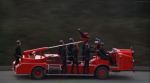
It is this seeming gap between artist and material that likely created much of the critical dissatisfaction that met with Fahrenheit 451 at the time.  Truffaut’s sensibilities as a filmmaker were geared toward capturing the immediate, reflected in a style that seemed- indeed, often was- improvised on the spot, designed to bring attention to the ineffable perfection of the moment that was happening right now.  For him to tackle a story of the future, then, created a conflict between his personal style and the needs of the material, and there were many viewers who felt that the director failed to reconcile these differences.  This, however, seems to fall under the category of judging a film for what it isn’t, rather than for what it is, which, as I believe I have pointed out before, might be missing the point.  After all, Truffaut’s success was built upon his notion that film should not be bound by expectations and convention, so it seems fitting that his contribution to science fiction cinema should be a film that is markedly different in tone and form to the accepted standards previously set for the genre.  The world he depicts is not so much a distant, future community as it is an exaggerated representation of our own- an inherent conceit (indeed, the entire point) of the whole sub-genre of dystopian fiction, and one which Truffaut emphasizes through his visualization of the novel.  Though we are given a few stylized nods to forward-thinking design- the elevated train which provides public transport, the oddly boat-like fire truck- the majority of the setting looks very much like the then-present day surroundings familiar to contemporary audiences.  Most of the buildings have the elegant, mid-century-modern look that was so popular at the time (and indeed, remains so today), as do the clothes and the décor; contrasted with that self-consciously chic style are the obviously old-fashioned homes and trappings of the counter-cultural characters, whose refusal to embrace the modern trend could arguably be seen as a dead giveaway to their subversive tendencies.  The primary means with which Truffaut emphasizes the difference in this social setting to that of our own is by his exaggeration, sometimes satirical and sometimes horrifying, of the more alarming similarities; the unending banalities that mark every interaction (even between husband and wife), the desire for popularity and personal advancement which seems to be the only real concern for most of the inhabitants, and the intrusive presence of the wall-screens through which the unspecified powers-that-be both control and placate the masses.  The latter is particularly prominent, and- along with the telling opening credits, which are read by voice-over rather than seen in printed form, over a montage of TV antennas- underlines the dominant premise of both the book and the film- not the censorship of literature and free thinking by a draconian government, but the erosion of knowledge and wisdom through the superficiality of a popular culture dictated by an ever-shrinking attention span and an ever-growing desire to shut out the unpleasant realities of life.  It is public mandate that has created the disturbing environment of Fahrenheit 451, not the forced domination of a powerful overlord; the citizens of the future are reaping the fruits of their own intellectual and emotional laziness.

Though re-evaluation has led to a much greater appreciation of the film than was present in its initial critical assessment, there are still a few flaws that cannot be completely ignored.  Truffaut was disappointed in the dialogue, which he felt was stilted and pedantic; though he himself had written the screenplay with Jean-Louis Richard, his own lack of proficiency in English limited his ability to create the kind of witty, stimulating exchanges he wished to include- though from a more objective standpoint the marked lack of character in the language of the film creates a strong impression of the puppet-like artificiality of the people that inhabit it.  More unfortunate, really, is the performance of Oskar Werner as Montag; having previously worked with Truffaut in Jules and Jim, the Austrian actor was a last-minute replacement in the role (when Terence Stamp dropped out over fears he would be upstaged by the aforementioned double-casting of Julie Christie), and had substantial disagreement with the director over the way the character should be played.  Truffaut wanted Montag’s humanity to be apparent, Werner felt that he should be stoic and mechanical; the resulting conflict brought an end to the friendship the two men had previously enjoyed, and Werner’s dissatisfaction and refusal to co-operate even led to deliberate sabotage- for example, cutting his hair before filming the final scenes in order to create continuity errors.  His final performance is, as he wanted, detached and largely unemotional- when his passions begin to emerge as a result of his forbidden interests, they seem to surface more as arrogant anger than as deeper awareness- and as a result, it is hard to care about him as more than a vehicle for audience perspective on the story.  As for Ms. Christie, although her twin performances were derided by some critics at the time as being different only in her hairstyle, her work here is highly effective; the similarities between the two women she plays, Montag’s outsider friend and his vapid wife, only serve to enhance the differences that result from their respective interests in the substantial and the trivial.

Truffaut’s vision of Bradbury’s work is realized by a superbly distinctive construction of its physical environment.  The production design by Syd Cain incorporates the contrast between then-contemporary ideas of futuristic styling and a taste for the comfort of familiarity presumably held by the unimaginative residents of this future, unnamed city.  Likewise, Tony Walton’s costume design opposes the gay and cheery hues and smart styles of everyday life against the ominous black fascism of the firemen’s uniforms and the earthy traditional feel of the clothing worn by the “book people.”  The vibrant cinematography, by Nicholas Roeg (whose later work as a director in his own right would sometimes suggest influences from this film), captures it all in a dazzling color palette that reflects the height of mid-sixties fashion.  As for the soundtrack, Bernard Herrmann- the master composer responsible for some of the iconic scores heard in films by Alfred Hitchcock, who was Truffaut’s favorite director- provides a haunting musical accompaniment in his own unmistakable vein, creating an influence, as he always did, that contributes immeasurably to the final overall effect of the movie.

Ultimately, though Fahrenheit 451 has become an acknowledged milestone in the direction of science fiction on screen, and it is now viewed as a little gem of its era, it does fall short in comparison to other works by its auteur director.  Nevertheless, even a weak film by François Truffaut is a work of art, with much to offer and much to appreciate.  It is something of a curiosity in his canon, an out-of-character project undertaken in an alien environment- his limited English made filming in London an isolated and unpleasant experience for him.  It’s worth noting that, despite substantial changes made to his original plot, author Bradbury publicly stated many times that he was pleased with the film, and even that some of the changes (specifically the choice to allow Clarisse, the intellectual schoolteacher who sparks Montag’s curiosity about the books he burns, to survive to the end of the story) were pleasant improvements.  In the final analysis, perhaps, what makes Truffaut’s adaptation work is the thing which drew him to the story in the first place: the director was a lover of books and literature, a fact which is evident in the way he portrays them onscreen.  The weathered and dog-eared volumes seen throughout the film evoke substance and endurance, and the lingering detail in which he depicts their burning emphasizes not so much their destruction as their beauty and their eternal appeal; and the climactic scene in which the exiled literati walk around reciting their memorized books, surrounded by a delicately beautiful snowfall, packs an unexpectedly powerful emotional punch- despite the cold inaccessibility of Werner’s performance as our would-be hero- resulting from this worshipful, loving appreciation of the printed word.  It is a worthy message Truffaut presents here, and one which seems even more urgent as our modern society- in which crucial information is provided in easily digestible factoids by thousands of broadcasted feeds, and bookstores are increasingly difficult to find- grows more and more to resemble the one portrayed here.  That he was successful in translating that message to the screen is made powerfully apparent by the fact that, after watching Fahrenheit 451, I had a sudden and overwhelming urge to go and read a book.

http://www.imdb.com/title/tt0060390/

Death Race 2000 (1975)

Today’s cinema adventure: Death Race 2000, the 1975 fantasy-adventure exploitation film, produced by B-movie king Roger Corman and directed by Paul Bartel, about a gladiatorial motor race taking place in a futuristic America ruled by a totalitarian government. Marked by its clearly low budget and campy sensibilities, it was (of course) lambasted by critics upon release- but has since become a bona fide cult classic, spawning numerous spin-offs in other media, countless imitators, and a big-budget Hollywood remake.

Wanting to capitalize on the publicity surrounding the then-upcoming film Rollerball, Corman found suitable source material in a short story, by sometime colleague Ib Melchior (who has a fascinating history in his own right, which you can read about here), called The Racer. Adapted into a screenplay by Robert Thom, then rewritten by Charles Griffith at the insistence of director Bartel, it visualizes a not-too-distant future in which America has been devastated by economic collapse and is under the control of an Orwellian regime (headed by a smarmy figure known simply as “Mr. President”), possessing the combined authority of church, state and media, and dedicated to a policy of “minority privilege.” Sponsored by the government is a yearly cross-country race in which contestants- paired with “navigators” who are apparently also designated sex partners- not only vie to be first across the finish line, but are awarded points for killing hapless pedestrians. Televised and spun for mass consumption, this ritualistic slaughter is further complicated by the interference of a group of rebels bent on sabotaging the proceedings and kidnapping the star driver, a mythic figure known as Frankenstein, whose survival of previous races has left him half-man/half-machine- or at least, according to his P.R.

Corman had always targeted the youth audience with his trend-savvy drive-in fodder, and by the 1970s had become associated with the counter-culture movement; Death Race 2000 struck just the right blend of anti-establishment sentiment and testosterone-fueled fantasy for his purposes. Using mostly re-bodied Volkswagens to stand-in for the souped-up fantasy roadsters driven by the race contestants, filmed on public roadways without permits, and starring David Carradine for box office insurance, the film was shot for a budget of $300,000 and ended up earning $5 million- critical derision notwithstanding.

The disapproval of 1975 critics was perhaps easy to understand. Death Race 2000 is a prime example of quickie low-budget movie making designed to attract a young and unsophisticated audience by titillating them with gratuitous violence and nudity. However, though that audience of pot-smoking drop-outs (and wannabe drop-outs) may have responded to these elements- which the movie certainly delivered- they also responded to something the establishment critics didn’t seem to notice: wrapped up in its lurid, ridiculous premise and its cheap, exploitational thrills is a core of smart social satire and subversive anarchy that captured the zeitgeist of these disillusioned flower-children; the darkly zany vision of the future presented here was clearly an over-the-top parody of the present-day world they lived in, from which the only real possibility of escape was to destroy the system from within- and this, of course, is exactly the scenario of Death Race 2000. While the movie’s well-intentioned revolutionaries are largely ineffectual in their war against the established order, and its media-hypnotized masses are willing lambs to the slaughter, its darkly wisecracking anti-hero- a trusted tool of the government and the best player in their monstrous game- is the only one who has the power to bring an end to their reign of deceit and oppression. It’s anti-authoritarian wish-fulfillment fantasy at its most unapologetic, and the sentiment that drives it is arguably even stronger today than it was then.

Despite this heavy-sounding sociopolitical subtext, the primary reason for watching Death Race 2000 is the same today as it was 37 years ago: it’s a hoot. Director Bartel brings his brand of dry whackiness to the table here, making the most of the story’s frequently ludicrous conceits with tongue-in-cheek self-parody; we don’t have to take the movie seriously because he reminds us throughout that it doesn’t take itself that way, allowing us to shut down our brains and just enjoy the absurdities onscreen. As for all that gratuitous nudity and violence, it certainly is gratuitous- and gleefully so; the movie revels in its tawdriness, delivering glossy, seventies-flavored sex and gore as often as possible without any attempt to justify it. The bloody parts, in particular, are highlighted with great delight, and they are somehow all the more satisfying for being so clearly fake; indeed, most of the carnage borders on slapstick comedy, and the truly graphic stuff is so fleeting you can miss it if you blink- because if it lasted any longer the bargain-basement trickery being employed would be even more obvious than it is already. It’s just more of the ridiculousness that gives the movie its deliberately mindless appeal; and it probably goes without saying that, by today’s standards, what we see in Death Race 2000 is pretty tame. At any rate, what 1975 critics found objectionable seems today like a pretty good recommendation for the film.

The acting here is more or less what you might expect- which means, actually, that it’s pretty good, all things considered. Each performer brings exactly what is required to their character, and in many cases adds a substantial portion of their own personality to it as well, fleshing out these formulaic ciphers and giving them a life over-and-above their roles in this twisted Wacky Racers-style scenario. Some of the faces are familiar, such as future Love Boat-and-U.S.-Congressional lacky Fred Grandy and former Warhol “superstar” Mary Woronov, the latter in particular being one of the film’s highlights with her surprisingly multi-faceted performance as one of the race’s contestants- although, in truth, Woronov’s presence in such films is always a delight, due to her ability to bring so much of her smart, sexy and sweet self into the mix, so her performance here is not that surprising, after all. For many, the biggest surprise will be the presence of Sylvester Stallone as Frankenstein’s chief rival in the race, a swaggering braggart in a gangster persona who takes everything way too seriously; Stallone, who was doubtless working on the screenplay for Rocky even as he filmed this, shows the charisma and ability that would soon make him a star, even though it’s hard to tell, sometimes, if his effectiveness here is due to his actual work or to the foreshadowing of his future screen persona. As for the movie’s star, David Carradine, he was fresh from his success on TV’s Kung Fu, and he was anxious to shed the image he had gained from it (though Corman had initially wanted anti-establishment icon Peter Fonda for the role); he gives a performance that, in another context, would probably have gained him a lot of critical acclaim, investing his brooding, bitter, bad-ass character with the depth, intelligence and humor necessary to make him not only interesting, but likeable- and, importantly, though perhaps incidentally, creates a persona that adds weight to the underlying elements that give Death Race 2000 its unexpected substance.

As for the film’s technical aspects, it manages to find a fairly coherent visual style despite its low budget, injecting its fruity satirical elements into the design in such a way that the cheapness actually seems to enhance the final effect. The costumes are a blend of cock-eyed futuristic imagining and modern-day tackiness, though its worth noting the striking resemblance between Frankenstein’s intimidating black outfit with the iconic design for Darth Vader, who would first appear on the screen a good two years later. The scenic elements are handled with a similar hybrid approach. The tinselly, cartoonish trappings of the futuristic setting are grafted onto the obviously contemporary surroundings, making its satirical connection to the present more obvious; the garish, cartoonish designs for the cars smacks of adolescent male automotive fantasy, and the fact that these re-purposed vehicles actually seem to perform is impressive in itself- in reality they were usually filmed rolling downhill after being pushed into motion, and the cameras were sped up to make it look like they were moving faster than they really were. The more elaborate effects- such as the single matte painting used to create the future New York skyline- are laughably shoddy, which of course only adds to the overall appeal, as do such obvious earmarks of the grade-Z budget as the undisguised exit door in Frankenstein’s “hotel suite” and the amateurish graphics of the various signage used throughout.

Death Race 2000 was remade a few years back, boosted with big Hollywood money but no doubt targeted at this generation’s version of the same audience. I confess I haven’t seen it; but I must say I find it difficult to believe that an A-list production would have quite the same effect as the original. Watching Corman and Bartel’s film gives the impression that you are somehow participating in an underground revolution, poking fun at “The Man” under his oblivious nose. With real money and studio backing, it seems to me such a film would have a different kind of phoniness to it, one far more insidious and subtle than the cardboard backdrops and obvious stage blood of the original- but that’s a review I haven’t written yet, though perhaps one day I will. In the meantime, I can heartily endorse the low-rent thrills of this cult-classic gem from the past; though the future it foresees is a little behind schedule, it still may come- but if it does, at least we can say we were warned.

http://www.imdb.com/title/tt0072856/\

Cold Comfort Farm (1995)

Today’s cinema adventure: Cold Comfort Farm, the 1995 screen adaptation of Stella Gibbons’ popular 1932 novel parodying the English literary tradition of melodramatic rural fiction.  Directed by Oscar-winning director John Schlesinger (Midnight Cowboy) and produced by BBC television for broadcast in the UK, it was later released theatrically in America, adding the prestige of modest box office success to the critical acclaim it had already received.  The novel from which it was derived poked fun at the conventions used by such authors as D.H. Lawrence and the Bronte sisters, in which life in the English countryside was depicted as a grim and gothic affair, with characters in the grip of long-festering guilt or otherwise self-defeating psychological dysfunctions, usually in connection with some shameful or dishonorable act committed generations before.  The plot of Cold Comfort Farm turns this formula on its ear, as a cheerfully modern young woman comes to live on her relatives’ country estate and sets about applying common sense and psychology to the long-standing status quo that keeps them mired in old-fashioned and unnecessary gloom.

Kate Beckinsale stars as Flora, the heroine, bringing a smart, no-nonsense charm to the character and making us easily believe in her ability to brush aside decades-old stagnation as if it were the cobwebs in a doorway.  Surrounding her as the eccentric Doom-Starkadder clan are a host of veteran British thespians, all clearly relishing the chance to sink their teeth into these deliciously ludicrous roles.  Eileen Atkins is hilariously dour as Aunt Judith, fatalistic, terminally depressed and possessed of a somewhat unhealthy obsession for her libidinous son, Seth; and as the latter, Rufus Sewell strikes the perfect satirical balance to make his vainglorious, womanizing character likable instead of insufferable.  Ian McKellen enjoys an uncharacteristically rough-edged turn as Uncle Amos, an amateur preacher, sporting a ridiculous mash-up of a rural accent as he gleefully spews his fire-and-brimstone sermon from the pulpit.  Sheila Burrell is delightfully domineering as Aunt Ada Doom, the reclusive and tight-fisted matriarch of Cold Comfort Farm, ruling her family with brittle authority as the continually reminds them that she “saw something nasty in the woodshed.”  Rounding out the household are fine performances from Freddie Jones, Miriam Margolyes, and Ivan Kaye, among others; and in non-family roles, there is standout work from Stephen Fry as a pretentiously progressive writer enamored of Flora, and the always-magnificent Joanna Lumley as an impeccable London widow who serves as her friend and mentor.

The screenplay by Malcolm Bradbury captures the goofy sense of fun intended by author Gibbons, sending up the melodramatic conceits of this popular sub-genre of British literature with a smart, optimistic viewpoint and a healthy dose of subtly hilarious wordplay; there are some truly memorable lines (my favorite comes from Amos as he preaches before his quivering congregation: “There’ll be no butter in Hell!”) and the plotting, though ultimately just as unconvincingly tidy as the overwrought romances  being parodied, weaves cleverly enough through its pleasant course that we don’t really mind its unbelievability.  There is also plenty of authentic English scenery- idyllic woodlands and meadows, rustic villages and farmlands, elegantly-appointed estates and salons- to provide eye candy along the way, and director Schlesinger keeps things visually stimulating by keeping his camera moving and using a wide variety of angles and perspectives- as well, of course, as keeping us continually focused on the real meat of the matter, superb actors portraying delightful characters.

Cold Comfort Farm is not a deep movie, nor does it yield a lot of stimulating conversation regarding its themes or its technique, at least not in most circles.  It does, however, yield a lot of fun; it’s smart and literate enough to satisfy those seeking intellectual diversion, yet completely accessible for the viewer with no connection to the English Lit crowd, and it provides plenty of hearty laughs for both kinds of audiences (as well as the rest of us who probably fall somewhere in between).  After all, outrageous behavior is outrageous behavior, whether or not you have read any of Thomas Hardy’s books, and in Cold Comfort Farm, there is no shortage of it.

http://www.imdb.com/title/tt0112701/