The Great Gatsby (2013)

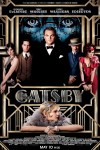
The Great Gatsby 2013 (poster)

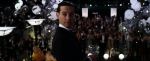
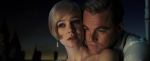
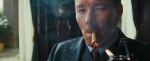
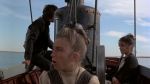
Today’s cinema adventure: The Great Gatsby, director Baz Luhrmann’s appropriately extravagant 2013 screen adaptation of F. Scott Fitzgerald’s iconic “Great American Novel” about an enigmatic millionaire at the center of New York’s Jazz Age social whirl and the intrigues and entanglements which surround him at his Long Island estate.  The fifth film to be based upon the classic book and arguably the most ambitious, it takes special pains to recreate the giddy, opulent atmosphere of the “roaring twenties,” as well as making a direct connection to the contemporary party culture through its interpolation of modern pop music, and striving to translate the story’s introspective style into a strong visual narrative.  Buoyed by the box office appeal of its star, Leonardo DiCaprio, and Luhrmann’s reputation for making wildly eccentric- and hugely successful- films that combine high art with pop culture (Romeo + Juliet, Moulin Rouge), it has met with considerable box office enthusiasm.  Reactions, however, have been dramatically mixed, from critics and the public alike, ranging from enthusiastic praise to vehement antipathy.

The screenplay, by Luhrmann and Craig Pearce, frames Fitzgerald’s plot as a flashback, told by the depressed and alcoholic Nick Carraway- the novel’s narrator- as he receives treatment in a sanitarium.  In the summer of 1922, the young war veteran moves to New York to work in the booming stock market.  He rents a small cottage in an affluent Long Island community, near his cousin, Daisy, and her wealthy husband, Tom Buchanan; a far more intriguing neighbor, however, is the mysterious Jay Gatsby, whose palatial mansion next door to Nick is the site of spectacular parties at which New York’s “glitterati” cavort each weekend, and whose origins are the subject of many wild and conflicting rumors.  As the summer progresses, Nick becomes entwined in the affairs and intrigues of the wealthy social whirl that surrounds him; he is “fixed-up” by Daisy with professional golfer Jordan Baker, he is made an unwilling confidante and accomplice in Tom’s infidelities with working-class housewife Myrtle Wilson, and he eventually receives an invitation to one of Gatsby’s parties.  There, surrounded by the free-spirited excesses of the Jazz Age- flappers, movie stars, musicians, gangsters, politicians, and businessmen, all mingling together in a seemingly endless sea of illegal liquor- he finally meets his infamous neighbor.  Gatsby- who is surprisingly young, handsome, and courteous- is a man possessed of a singular and intangible charisma, to which the idealistic Nick is immediately drawn; the millionaire courts his friendship, taking care to establish his own integrity.  In time, Gatsby reveals that five years previously, as a soldier preparing to depart for the war, he had a brief romance with Nick’s cousin Daisy, and though he promised to return and marry her, he kept himself apart while amassing his fortune; unwilling to wait indefinitely, and presented with a proposal from the rich and handsome Tom, she married, and now her former lover hopes to win her back- with Nick’s help.  Though he has mixed feelings about the morality of the situation, Nick agrees to facilitate a reunion between the pair, and their passion is rekindled- but Gatsby’s noble optimism may not be enough to overturn the jealously guarded status quo of the privileged elite, and the surfacing secrets of his past may shatter the spectacular dream he has so carefully built upon them.

Fitzgerald’s novel, a labor of love for the struggling author whose earlier successes were behind him and who was actively striving to create a lasting and definitive work, was a commercial and critical disappointment when it was published in 1925; it was seen as a shallow and inferior book by a formerly great writer, and by the time Fitzgerald died fifteen years later, it was largely forgotten, except by those who saw it as a quaint and nostalgic period piece, and its creator went to his grave believing himself and his magnum opus to be failures.  In the disillusionment of the post WWII era, however, the book’s theme of naive optimism crushed by cynical reality began to take on a new resonance, and The Great Gatsby rose to prominence as one of the quintessential American novels, eventually being ranked by literary critics and scholars as one of the most important books of all time and becoming standard curriculum in high school English classes the world over.  In the nine decades since its publication, it has become increasingly noted for its timelessness; it possesses a quality of universal relevance, for within the highly specific time and place of its setting it tells a story that touches on experiences of human life that exist in any era.  Consequently, like most great novels, it has repeatedly found its way in front of the camera, and though it’s hard to accurately gauge the relative success of these cinematic incarnations- the original silent version from 1926 is now considered a lost film, and the 1949 remake with Alan Ladd is largely unavailable due to copyright issues- the consensus seems to be that the results have been more or less disappointing.  Anyone familiar with the book itself will find this unsurprising; much of the story’s depth and power comes not from the events of its plot but from the private observations of its narrator, Nick Carraway, through which Fitzgerald’s voice infuses Gatsby’s tragic tale with meaning and significance, as well as providing acute insights on human nature, complex ethical and philosophical ideas, and a fairly sizable portion of social and cultural commentary.  Besides the obvious and uninspired use of voice-over narration, this crucial element of The Great Gatsby has proven virtually impossible to translate to the visual medium of cinema without sacrificing most of its potency- until now.

With Baz Luhrmann behind the camera, this previously insurmountable obstacle becomes instead a means by which to transform a literary masterwork into a breathlessly cinematic experience; rather than taking the expected course of offering a dramatization of the outward events of the plot, thereby rendering extraneous the all-important narration, he has constructed his film as a visualization of Nick’s memories and impressions, thus filtering the story of Gatsby’s idealistic quest through his eyes, and making the movie- like the book- a reflection of his internal reality rather than an objective record of events.  In doing so, the director frees himself from the understated simplicity of the novel- one of its most admired strengths- and allows for a limitless influx of the over-the-top theatricality which has defined his career.  The narration has been restored to its rightful place as the key component to experiencing the story, and Luhrmann employs the tactics of modern filmmaking to bring it into sharp focus, translating literary conceits into clear, striking imagery without regard for maintaining an illusion of realism.  It’s a bold approach, and a canny one, for while the book’s sedate detachment is a springboard for the reader’s imagination into the passion and drama beneath the surface, such a technique is better suited for the page than for the silver screen; by making the kind of florid, outrageous choices for which he is famous, Luhrmann uses aural and visual stimulation to bring about a heightened emotional state in a more directly visceral way.  The end result is the same, but the style which brings it to us is, appropriately enough, purely cinematic.

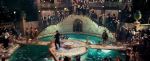
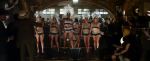
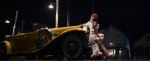
To describe the world Luhrmann conjures for The Great Gatsby in detail would be an overwhelming task, but anyone familiar with his elegantly excessive sensibilities can easily imagine the result of bringing them into a recreation of the Jazz Age, an era of such noisy and self-indulgent flourish that even the most flamboyant exaggeration cannot be said to go too far.  The screen is filled with a maelstrom of period fashion and design, meticulously realized and embellished with all the high-tech magic of a 21st-Century production.  The filmmaker seeks to over-saturate us, not simply in order to magnify our emotional response but to simulate, as much as possible, the giddy energy of the period’s amplified lifestyle, making it clear that every speeding car, frantic dancer, and crowded speakeasy is a pointed and obvious metaphor for the reckless mindset of the age. The camera zooms and twirls through crowds of dancing, reveling party people, piecing together its imagery with a mosaic of rapid cuts and juxtaposed images and making the film’s first two thirds feel like an ongoing bacchanalia; even when the scene changes- to luxurious estates, sumptuous rooms, bustling offices, and (in all their CG-rendered glory) the glittering streets and skylines of New York City- there is a constant sense of urgent movement, providing an appropriate and irresistible feeling of pushing forward to whatever spectacular experience comes next.  In this way, Luhrmann manages to capture the heady, progressive character of the twenties, with all its lax morality and blasé sophistication, in a much more tangible way than most previous films about the period, which often fall prey to a tendency towards the stiff and pretentious- or worse yet, to the quaint and precious- in an attempt to tell the story through imitating the stylistic means of the time itself.  Far from undertaking a recreation of twenties-era filmmaking, he instead pulls out all the stops available in the modern age, not only with the aforementioned computer-enhanced scenery and hi-tech camera fluidity, but by using audaciously contemporary conceptual imagery to bring some of the novel’s more abstract literary conceits (the famous “green light,” the ever-watching eyes of the oculist’s billboard, the utilitarian hellscape of the “City of Ashes”) to life in ways that would be impossible- even unimaginable- in the early days of cinema.  He even goes so far as to make his movie as a 3D blockbuster- and like Martin Scorsese’s Hugo and Ang Lee’s Life of Pi, The Great Gatsby is an example of how this state-of-the-art technology can be elevated from the level of a mere gimmick to an effective artistic embellishment by a true master of the craft.

All this visual opulence has given The Great Gatsby a decidedly dream-like quality, reminding us that what we are watching are the larger-than-life memories of the tale’s narrator, romanticized and heightened by his emotional state; suitably enough, after the parties have ended and the sordid truths have begun to emerge, and the story moves towards its denouement, the golden-hued, luminescent reality of Gatsby’s world takes on the semblance of a nightmare- still the glowing dreamscape, but now tinged with dread, foreboding, and sadness, it is a world in which the shimmering lights taunt us and the fixtures of luxury seem cold and comfortless.  For some, this change in the movie’s thrust, from the fast and furious to the slow and sorrowful, seems to make for an anticlimax in which the promise of the first 90-or-so minutes diffuses into a limping, unsatisfying conclusion; this, of course, is precisely the point of The Great Gatsby– the world it depicts is full of people going nowhere fast, riding a whirlwind of careless abandon towards the assumed certainty of an ever-brighter tomorrow, but we know (as Fitzgerald may have, in some way, foreseen) that their overconfident fantasy will come abruptly crashing down with the stock market just a few short years later.  Gatsby himself is their champion, a uniquely American figure who reinvents himself in the image he wishes to present, believing that wishing can ultimately make it so, and never permits doubt to enter into his thinking or his plans; anything is possible for him, so he thinks, if he wants it badly enough.  It’s a seductive idea, and one which all of us, to some degree, would love to believe in; Gatsby’s failure, then, becomes our own, and Luhrmann’s film does not allow us to deny it within ourselves by distracting us with the continual flash of the previous scenes.  In the end, all of Luhrmann’s razzle-dazzle falls away to reveal a stark and sobering human truth, conveying the purpose of Fitzgerald’s masterpiece by providing a full sensory experience which allows it to hit us not just on an intellectual level, but right where we live.

Though my own response to Luhrmann’s vision of Fitzgerald’s novel may have been highly positive, it should be noted that others have not been quite so appreciative as I.  As mentioned above, reactions to The Great Gatsby have been wildly mixed, unsurprisingly for a film by this particular director.  Baz Luhrmann is one of those filmmakers whose personal style is not only unique and unmistakable, but also aesthetically controversial; as a rule, audiences (and critics) either love or hate his work, with very little middle ground.  With a sensibility that might best be described as low-rent Bohemian glamour, he is unapologetically operatic, deliberately provocative, and audaciously eclectic; he challenges our expectations and preconceptions by imposing contemporary attitudes onto whatever material he happens to be exploring, whether it be the Renaissance poetry of Shakespeare’s Romeo and Juliet or the Parisian post-impressionist fantasia of Moulin Rouge.  His most controversial tactic by far is his prominent use of anachronism in his artistic choices, and Gatsby is no exception.  By far the biggest sore spot for most of the film’s detractors is its use of modern-day pop music- rap, hip-hop, “indie” rock- in the film’s soundtrack, a jarring device which directly opposes the visual (if heightened) authenticity of the 1922 world he has so painstakingly orchestrated.  To be sure, it seems, on first analysis, to be a blatant ploy designed to capture the attention of the youth demographic so coveted by studio executives wishing to maximize their profits; but as the movie progresses, it becomes plain that Luhrmann, who seamlessly interweaves the contemporary material into the genuine period jazz which accompanies the action, has a more pointed artistic agenda here.  The juxtaposition of this familiar “now” sound with the equally familiar (and, for many, dated) sound of the era’s music makes an unmistakable and instantaneous connection between the fast-living partiers which surround Gatsby and the modern-day club culture of which many of the movie’s audiences are presumably a part.  With this over-the-top stroke, Luhrmann succeeds in bringing home the point that, though separated by several generations and countless shifts in cultural interest, the people on the screen are, in essence, the same as the people seated in the theater.  Though it may be difficult for many to overcome their disapproval of Luhrmann’s choice, it is undeniable that it’s an effective tool, and in truth, there is a sense that the strains of Florence + the Machine, Jay-Z, and Beyoncé are a sort of reverse echo from the future, an otherworldly intrusion that we are meant to hear but to which the characters onscreen are oblivious.  Seen this way- and given the fact that Luhrmann has remained diligently faithful to Fitzgerald in both plot and thematic substance, as well as providing a remarkably detailed and authentic recreation of the time and place of the novel’s setting, The Great Gatsby is probably the director’s least anachronistic film.

Without question, the star of this Gatsby is its Australian director; but acknowledgement must be made to his fine cast, charged with putting faces to these iconic characters, who manage to rise admirably to the task- one which is made no less difficult by Luhrmann’s sensibilities, which insist on maintaining Fitzgerald’s already-elevated language in a deliberately heightened style.  Front and center, of course, is Leonardo DiCaprio’s performance in the title role; he is well-suited to play Gatsby, handsome and confident, but with an innate sensitivity that seems almost to be deliberately- and ultimately, unsuccessfully- concealed.  He makes this archetypal American dreamer into a flesh-and-blood individual, whose shining veneer is full of cracks that allow glimpses of the flawed psyche that lies beneath; we get a real sense, from almost his first appearance, that this pretty package contains damaged goods, but his charm and his sincerity- even when he is most obviously putting on a not-very-convincing front and telling the most outrageous untruths- are so engaging that we, like Nick, are naturally drawn in, and we like him despite our ever-growing certainty that he is not what he seems to be.  The more we learn, the more we sympathize with him and long for the success of his grand, romantic undertaking, and though this is partly due to Fitzgerald’s skill in creating the character (and Luhrmann’s skill at translating it into film), DiCaprio deserves full credit for successfully bringing what is clearly a deep understanding of this complex figure to his work here.  In the difficult role of Nick, who is in many ways an outsider to the story, but upon whom so much depends, Tobey Maguire also does stellar work.  Taking clear inspiration from the notion of his character as a stand-in for Fitzgerald himself (a conceit made obvious by the film’s framing device), he gives us a young man with all the manic emotional intensity of a burgeoning alcoholic, indulging in outrageous behavior and introspective intimacy yet always seeming aloof and distant, concealing a surging ocean of depth and feeling behind a faintly bemused, stoic expression.  Thanks to Luhrmann’s stylistic window, we are allowed to see past this placid exterior to the poetic soul which fuels the narrative, and when his pent-up passions finally explode forth, Maguire’s roaring performance elevates Nick to his deserved status as the true hero of the tale, rather than the parenthetical necessity so often presented in previous attempts to dramatize The Great Gatsby.  Joel Edgerton, stuck with the difficult role of Tom Buchanan, is able to bring out the humanity of this elitist, misogynistic racist, though to make such a pointedly hateful man sympathetic is beyond his- or, perhaps, any actor’s- abilities; Elizabeth Debicki fares better as Jordan Baker, presenting the quintessentially chic, sophisticated, and disaffected flapper in a long, lean package that manages to be likable despite the character’s inherent coldness; and Isla Fisher, though her Myrtle Wilson suffers from having a bare minimum of screen time and therefore pales in (the perhaps unfair) comparison to Karen Black’s standout performance of the same role in Jack Clayton’s 1974 film version, shows us both the appealing sparkle and the desperate longing of this tragic girl who is forced, by both the men in her life, to hide her light under a squalid, ashy bushel.  The film’s best performance, though, comes from Carey Mulligan, as Daisy; vilified by so many commentators as a vapid and shallow representative of self-absorbed materialism, the focus of Gatsby’s obsession becomes, thanks to the intelligence of this gifted actress, a real woman, torn apart by the conflicting impulses of her heart and the ingrained conditioning of her social role.  Though Fitzgerald’s portrait of Daisy leaves her inner experience a mystery, Mulligan lets us in, and shows us the pain, the fear, and the heartbreak that goes on as she struggles towards making her choice, and plainly shows us that it is a difficult and heartbreaking choice for her; because of this sensitivity and humanity, we can see why Gatsby should want her so badly- the unspoken depth she reveals validates his obsession, and rescues his character from shallowness, as well- and transforms this much-maligned character from a cruel and thoughtless child into as much a tragic victim of the status quo as her would-be paramour.  It’s a truly luminous performance, yet subtle enough in detail to go unnoticed and unappreciated by many; full recognition is deserved, however, and this remarkable English performer certainly gets it from me.

Ultimately, of course, The Great Gatsby is a movie that is destined to divide; like all revered books, its source novel evokes deeply personal responses in its readers, and it is inherently impossible for an adaptation in any form to satisfy all of them.  Coupled with Luhrmann’s love-it-or-hate-it style of cinema, it is inevitable that many audiences would be left cold- or, just as likely, be actively outraged- by this film’s approach.  It is unlikely that anything I could say would sway those who dislike it, but for viewers with an open mind and a love for outside-the-box filmmaking, this is a movie that deserves a chance; as a fan of the book, I expected to be disappointed, but instead I found Luhrmann’s version not only exceptionally true to Fitzgerald’s original, but loaded with the kind of passion and insight that thrills me and reminds me why I love movies so much.  Is it eclectic and sometimes jarring to accepted sensibilities?  Absolutely, and that’s one of the reasons it worked so well for me.  Most of all, though, it is the work of a bold and consummate artist who was driven- by his own love of the material- to create a lavish and definitive representation of this resonant literary touchstone, and though I can understand why some may take exception to a few of his personal touches, for me it is beyond question that he has succeeded, far beyond reasonable expectation.  Baz Luhrmann has managed, after 87 years, to finally give us a film that conveys why The Great Gatsby is, truly, great.

http://www.imdb.com/title/tt1343092/?ref_=fn_al_tt_1

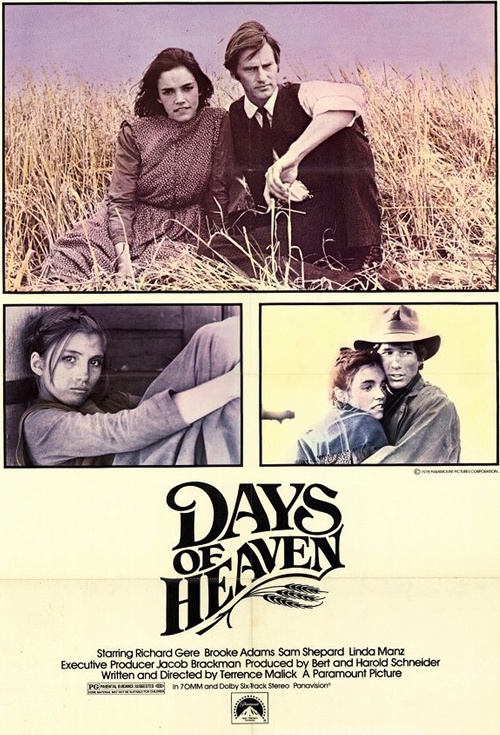
Days of Heaven (1978)

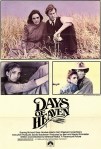
Days of Heaven (poster)

Today’s cinema adventure: Days of Heaven, the 1978 second feature by director Terrence Malick, featuring a young Richard Gere alongside Brooke Adams and actor/playwright Sam Shepard in an elegiac tale of two migrant workers who scheme to con a dying farmer out of his fortune on the early-20th-century Texas panhandle.  Universally lauded for its visual beauty, it was nevertheless snubbed at the time of its release by critics who found it shallow and unengaging; in the years since, however, it has come to be recognized as one of the best films of the seventies, perhaps partly due to a two-decade hiatus taken by its director following its completion, during which time a sense of nostalgic retrospect- coupled with wide exposure on art-house cinema screens, cable TV, and home video- prompted a re-evaluation of its merits.

Set in 1916, Days of Heaven unfolds mostly through its visuals and the overdubbed commentary of Linda, the younger sister of its lead male character.  The movie opens in Chicago, where Bill, a short-tempered steel mill laborer, accidentally kills his foreman in an on-the-job fight.  Fleeing the scene, the young man collects his sister and his girlfriend, Abby, and the trio jumps a train with dozens of other poor laborers seeking opportunities in the wide-open spaces of the American Midwest.  Their journey takes them to the expansive plains of the Texas panhandle, where they find work as harvesters alongside other migrants on a large wheat plantation owned by a shy and sickly young farmer.  To avoid talk among the other workers, the unmarried young couple pose as brother and sister, and for awhile the little makeshift family finds a sort of idyllic peace in their simple existence here, despite the grueling and dangerous work required of them, and despite a growing interest in Abby from the lonely young farmer.  When Bill accidentally overhears a conversation in which a visiting doctor informs the farmer that an unspecified illness leaves him only a few months to live, the ambitious and opportunistic young laborer begins to concoct a scheme by which he and his companions might trick the dying man into leaving them his considerable fortune.  He encourages Abby to accept the farmer’s advances; she does so, reluctantly at first, but gradually warms to him as their relationship progresses.  All goes according to plan- the farmer marries Abby, and moves her into his house along with her supposed siblings- but as time passes and his health remains stable, the delicate balance of this romantic triangle grows ever more precarious.  With Abby’s feelings becoming more and more conflicted, and the suspicions of the farmer’s trusted foreman threatening to expose the plot, Bill’s jealousy and impatience grow, and he begins to contemplate other means of removing their gullible benefactor from the picture.

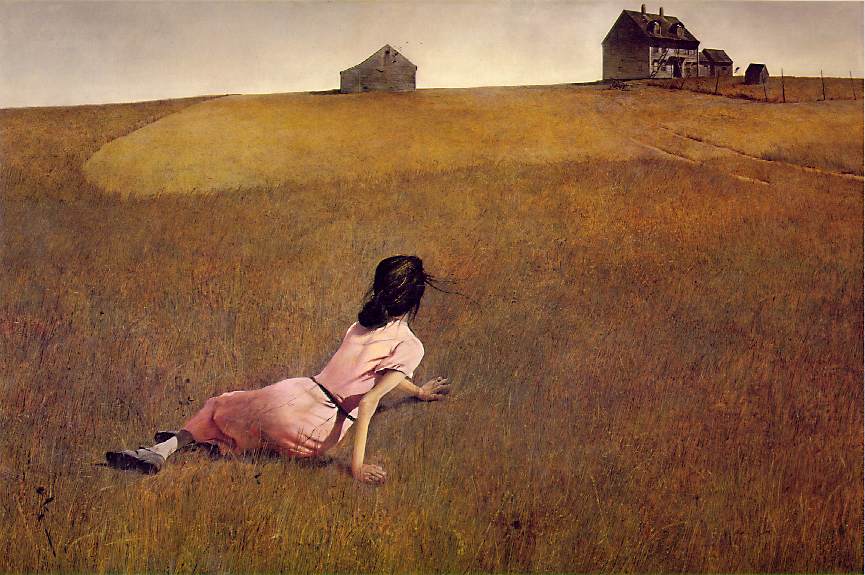
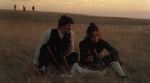
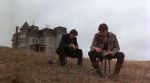
Director Malick, who earned a degree in philosophy before turning to filmmaking, had made an impressive debut with Badlands, a 1973 drama starring Martin Sheen and Sissy Spacek as a young couple on a crime spree; produced independently, it garnered such acclaim at the New York Film Festival that Warner Brothers bought the distribution rights for three times the amount it cost to make.  For his follow-up project, Malick teamed with producer Bert Schneider, who negotiated a deal with Paramount Studios in which he and the director would be given complete artistic control over the project; the studio paid for the film, with Schneider agreeing to cover any amount spent beyond the allotted budget.  Malick, meanwhile, developed his vision for Days of Heaven with acclaimed Spanish-born cinematographer Nestor Almendros, drawing inspiration from paintings by Andrew Wyeth (specifically “Christina’s World”) and Edward Hopper (“The House by the Railroad,” an iconic image upon which the farm house in the film was based) and planning a narrative presented more through imagery than dialogue.   Filming took place in Alberta, Canada, despite the Texas setting, and thanks to Malick’s and Almendros’ wish to shoot mostly during the so-called “magic hours” (the 20-or-so minutes around sunrise and sunset) in order to capitalize on the special quality of light present at these times, it was a painstakingly slow and frustrating process for the actors and crew.  Things were made worse by Malick’s unorthodox shooting schedule, in which he would frequently diverge from the loosely organized daily plan according to his own whims and changing ideas; this caused expensive delays, as did the director’s choice partway through production to jettison his scripted dialogue and allow the actors to craft the story through guided improvisation.  In the end, the project went severely over budget- Schneider had to mortgage his house in order to live up to his deal with the studio- and took so long to complete that key participants (including Almendros) had to leave in order to fulfill other commitments.  To further exacerbate matters, Malick then took two full years to piece together the movie from the miles of footage he had shot; a full year after filming wrapped, he had to call his actors to Los Angeles in order to shoot assorted pick-up shots, famously including close-ups of Sam Shepard taken under a freeway overpass and an underwater take of Richard Gere’s submerging face captured in a large aquarium in Sissy Spacek’s living room.  When Days of Heaven was finally finished and released, the lavish praise it received for its visuals was undermined by the mixed critical reactions to its content, and though it turned a small profit at the box office, it was widely considered a financial failure.

Nevertheless, all the painstaking work undertaken by its director, maddening as his process may have been to his colleagues and his studio, resulted in a film of breathtaking beauty, and though its simple story is seen as if through a prism, detached from the reality of its circumstances and affecting our emotions only obliquely as we take in the wonder of the pretty pageant displayed before us, it nevertheless has a cumulative power that strikes deeply resonant chords within us.  It’s not a deep tale, and its inescapable conclusion is obvious to us even as its premise develops, but that is part of the movie’s haunting charm.  Our intellect is not the target, but rather our senses, and through them that deeper level of understanding where we can appreciate the profound beauty of sadness.  For sadness is the overpowering emotion in Days of Heaven, creeping around the edges of every scene, even those full of joy; it comes from the implicit knowledge that everything is temporary, that the world is in a constant state of change- a theme underlined by the importance of the seasons in the life of the farm, the ominous juxtaposition of industrial age machinery in the pastoral life of its workers, the certainty that the security of regular wages will come to an end with the harvest, and the specter of death that haunts the doomed farmer.  It is exuded in Linda’s narration, filled with wistful nostalgia and philosophical observation rather than direct reminiscence, and it is inherent in the entire situation presented by the film’s central plot- a timeless and oft-repeated saga of the heart being subjugated for worldly gain, of people yearning and struggling for a life better than the one they know, in which brief happiness is attained and lost by all involved.  Days of Heaven, ultimately, is a meditation on the transience of all worldly things, almost biblical in its message; indeed, the title itself is a scriptural reference, and biblical connections are conjured by a number of elements, not the least of which is a plague of locusts that settles on the farm during the film’s climax.  It is not, however, a preachy polemic warning us of the wages of sin, but rather an invitation to embrace life in all its pleasure and its pain, to appreciate the good moments as they come and weather the bad ones with the knowledge that they, too, shall pass; most of all, it is an evocation of things past, a commentary on the repetitive and universal patterns of human behavior, and a chance to mourn our own losses and celebrate our own memories.

Malick’s success at realizing his vision- laborious and, perhaps, badly organized as it was- cannot be denied, nor can credit be denied him for making a film of such unique and delicate beauty; it would be wrong, however, to ignore the tremendous contribution of cinematographer Nestor Almendros on the artistic success of Days of Heaven.  He worked extensively with Malick from the beginning of the process, having been chosen by the director for his earlier efforts (particularly The Wild Child, a 1970 effort by French master François Truffaut, with whom Almendros had a long-standing professional relationship); the two men were much in tune with each other’s sensibilities, and Almendros was impressed by Malick’s knowledge and understanding of cinematography, both technically and aesthetically.  Their collaboration and the loosely-structured, improvisational process they used in creating the all-important look of the film may have led to dissatisfaction and frustration among the rest of the crew (there were claims that the two men “didn’t know what they were doing”), but it resulted in a truly stunning visual experience that still ranks as one of the most gorgeous films ever shot.  Malick’s vision works because of the power of the imagery which Almendros helped him to realize, deliberately drawn from the painters which first inspired the film- not only the aforementioned Wyeth and Hopper, but Johannes Vermeer and other old masters, whose distinctive visual style is referenced throughout in the play of light and shadow- and the techniques of silent filmmaking, with its penchant for the ethereal qualities of natural lighting and its reliance on the importance of wordless storytelling; indeed, these infusions are a perfect fit with the period and setting of Days of Heaven, enhancing its sense of time and place trapped in a bottle, and giving it a magical, shimmering quality that pervades even its earthy and most brutal moments.  The achievement is more remarkable because not only was Almendros, as a foreign national, not allowed to operate the camera himself (due to union regulations), he was also beginning to lose his eyesight at the time, and had to prepare the shots in advance with the cameraman by taking polaroids of the set-ups and studying them through his glasses. It is important to note, in the interest of giving full credit where it is due, that another legendary cinematographer, Haskell Wexler, was brought in to complete the shooting process when Almendros had to leave; the two worked together for a week ahead of time, and Wexler made every effort to duplicate the style that his predecessor had set for the film.  Unfortunately, though over half the footage in the completed movie was shot by Wexler (according to his own letter to critic Roger Ebert), he received credit only for “Additional Photography,” rendering him ineligible to share the Academy Award ultimately received for the cinematography in Days of Heaven.  This oversight resulted in some degree of controversy within the industry, but it has been widely acknowledged by all involved parties that both men played an important role in bringing Malick’s opus to the screen, and the work that they did stands among the best in either of their careers.

Andrew Wyeth's "Christina's World," the painting that primarily inspired Malick to make "Days of Heaven."

Andrew Wyeth’s “Christina’s World,” the painting that primarily inspired Malick to make Days of Heaven

Edward Hopper's "House by the Railroad," another important visual influence on Days of Heaven

Edward Hopper’s “House by the Railroad,” another important visual influence on Days of Heaven

The magic of Days of Heaven is also bolstered immeasurably by Ennio Morricone’s ethereal score, borrowing from Camille Saint-Saëns’ “The Aquarium” (from Carnival of the Animals), which is played over the film’s main tiles, and carrying its mood and motifs into the original music he provides for the narrative.  The remarkably authentic period atmosphere is made possible largely through the costumes designed by Patricia Norris, which she made with old fabric and used clothing items, giving everything a faded look of well-worn realism; also important here are the authentic period vehicles- everything from early automobiles to monolithic farm equipment to a bi-plane carrying a troupe of traveling entertainers- and, most prominently, the farm house, designed and constructed by Jack Fisk, which dominates the landscape of the film, both physically and psychologically, built from plywood and fully dressed with period detail inside and out.  This latter piece was used to film both exterior and interior scenes (a rare occurrence; standard practice, especially at the time, would be to shoot the interiors on a set in a soundstage) and leaves a lingering impression on the memory well after the film has faded to its final close.  It is, in its way, as iconic a structure as the house from Hitchcock’s Psycho (also based, coincidentally, on a painting by Hopper), and gives Days of Heaven a concrete center, a simple, serviceable image rich with multiple layers of symbolic meaning.  Finally, the cast cannot be overlooked.  Though Malick sought to evoke memories of the silent era, there is no bombastic posturing here, no emotional histrionics; instead, his players complement his elegantly simple plot with performances of equal simplicity, avoiding bravura displays and offering instead a low-key naturalism which implies volumes through its very restraint- likely a result of the improvisational nature of Malick’s shooting process.  All four principals give unforgettable performances; Brooke Adams provides a heartbreaking balance of pragmatism and romance as Abby, Linda Manz is hard-shelled but touching as the worldly-wise-before-her-time Linda, Sam Shepard mixes melancholy and earnestness into an appealing package as the unnamed farmer, and Richard Gere uses his almost impossible physical beauty as a powerful tool both to express a genuinely good nature and to mask the darkness brooding inside it in his portrait of the charismatic Bill.  Mention should also go to Robert Wilke, the craggy-faced character actor who manages to touch us deeply in his brief screen time as the farmer’s loyal foreman and surrogate father figure.

Terrence Malick, after Days of Heaven, spent twenty years as a virtual recluse from the movie industry, finally returning in 1998 with The Thin Red Line, a WWII drama which sharply divided critics who found it either a masterpiece or a pretentious sham.  The same response, by and large, has been generated by his subsequent films.  For many, myself included, the jury remains out on whether he is in fact a genius or a charlatan; but regardless of any assessment of his later work, Days of Heaven– especially taken in combination with his earlier Badlands- is more than enough to ensure his status as a true cinematic master.  The way it uses imagery to convey its story, as well as its underlying subtext and the thematic elements which drive it, is a rare and remarkable achievement in utilizing the full power of cinema as a visual medium, and the magnificent beauty of that imagery is still unsurpassed over thirty years later.  Those seeking a passionate romance, with all the typical heart-tugging excesses of standard Hollywood fare, are likely to find it a cold and distant experience, like watching fish behind the glass of an aquarium- a comparison that is, upon reflection, more apt (and less critical) than it might seem.  Malick’s triangulated tale of tragic love is more compassionate for being less sentimental, more deeply moving in its preoccupation with the surface than any number of films that strive to explore the inner experiences of its characters; though it has all the makings of a melodrama, it is a tale without heroes, heroines, or villains, and its characters all contain elements of each, making it impossible to take sides or to judge their actions.  Through the director’s well-considered lens he shows us life, plain and simple, using his art as a means to reveal beauty rather than to manipulate emotion.  As a result, though we may feel somewhat removed from the events and characters, they have the unmistakable ring of truth, and our reactions to them are as honest as they come; for this reason, I count Days of Heaven as one of my personal favorite films, and despite my ambivalent feelings towards its director, consider him one of the greatest filmmakers of his time.  I don’t like to make hyperbolic proclamations like that, so coming from me, you can consider it a pretty strong recommendation.

http://www.imdb.com/title/tt0077405/?ref_=sr_1



John Carter (2012)

John Carter (poster)

Today’s cinema adventure: John Carter, the 2012 sci-fi/action blockbuster based on the first book of Edgar Rice Burroughs’ seminal series of adventures about a former Civil War soldier who is mysteriously transported to Mars (known as “Barsoom” by its inhabitants), where he becomes a hero in the planet’s struggle against domination by an immortal race of super-beings. A lavish production from Disney Studios, it marks the first “live action” feature to be helmed by Andrew Stanton, the acclaimed director responsible for Pixar’s Finding Nemo and WALL-E, although the extensive use of CG technology blurs that definition somewhat; the studio’s certainty that the project was a sure-fire hit is evidenced by the fact that they spent a whopping $250 million dollars to make it. Unfortunately, with such a price tag, the film was required to gross near-record sums in order to simply break even; thanks to a lukewarm critical response and even less enthusiastic audience reception, it instead became one of the most notorious box office flops of all time, leading to recriminations and resignations within the studio and a massive financial loss on the quarterly report. It’s a shame, really, that the movie has now become known as a notorious bomb- an assessment that is not entirely accurate, for overseas returns were substantially better than in the U.S., and home video release ensures that, in the long term at least, it will ultimately recoup its losses and turn a decent profit- because John Carter is not at all a bad film, for what it is, and will likely prove, in time, to gain an appreciative following.

Adapted by Stanton, Mark Andrews, and Michael Chabon from Burroughs’ novel, A Princess of Mars, John Carter concerns a struggle for power between two Martian city-states- Helium, a peace-loving capitol of science, art, and learning, and Zodanga, the “walking city,” a warlike and totalitarian kingdom bent on absolute rule of the planet. The battle has raged for generations, but now, with the aid of a powerful new weapon that has been bestowed upon their leader, the ruthless Seb Than, by a mysterious alien race, the tide is turning in favor of the Zodangans. Meanwhile, on the planet Earth (where it is the late 19th Century), a former Confederate officer named John Carter searches for his fortune in the frontier of the American West; while fleeing an Apache war party, he inadvertently discovers a legendary cave of gold, in which mysterious carvings and glyphs seem to come from an ancient and forgotten civilization- and where an altercation with a mysterious robed figure results in Carter’s sudden and seemingly inexplicable transport to a vast, unfamiliar plain located (as he will later discover) on Mars. After adjusting to the effects of the differing gravity- which, due to his Earth-born bone density, gives him superhuman strength and the ability to leap hundreds of yards in single bound- he soon finds himself captured by a tribe of four-armed, green-skinned humanoids, called Tharks, led by a chieftain named Tars Tarkas. This is only the beginning of his adventure, however, as his fate brings him into the heart of the conflict over the destiny of the Red Planet, in which he must help the Princess of Helium to discover the source of Seb Than’s mysterious new power before she is forced to marry the Zodangan warlord and doom her people to eternal domination.

There’s not much point in offering a more detailed synopsis of John Carter’s convoluted plot than the one above; like the novel from which it is derived, it is a piece of melodramatic pulp fiction in which the story is merely an excuse for the action, romance and imaginative fantasy that keeps an audience coming back for more. Burroughs’ novel was originally published in serialized form of course, in All-Story magazine, beginning in 1912. It was by no means the first episodic science fiction story, but the way it combined elements of other popular genres- sword-and-sorcery adventure, westerns, romance- was a unique and ultimately influential feature that makes A Princess of Mars the direct forerunner of Flash Gordon, Buck Rogers, Star Trek, and Star Wars, to name only an obvious few. This particular sub-genre, known as “planetary romance,” has proven more enduringly successful than science fiction proper (in its strictest sense, that is), and continues to inventively manifest itself through, among other things, the vast wealth of comic book literature (and its related media) that has developed into an increasingly massive force in the entertainment industry. In other words, for anyone out there who is a fan of The Avengers, it all started here. With this in mind, it is only fitting that the saga of Burroughs’ planet-hopping hero should be given, at long last, the kind of lavish, top-shelf Hollywood treatment that has been afforded to so many of its offspring, and though many critics complained of the film’s sprawling, sometimes incoherent storyline and questioned its emphasis on action and spectacle over character and logic, these things are in fact part of the essence of this particular style of fiction; Burroughs was out to thrill his readers with imaginative and impossible scenes of otherworldly escapism, not to stimulate their higher cognitive functions. More accurately, perhaps, he was out to make money by doing it, and the fact that he succeeded- to the point of building an empire that pre-dated Walt Disney, Gene Roddenberry, or George Lucas by decades- is a fact made clear simply by looking up the origin history of Tarzana, California.

The world of a hundred years ago, however, was obviously a different one than we live in today; decades of technological advances- including probes and landing craft on Mars that have yet to discover the existence of mobile cities or multi-limbed green giants- have made us much less naive about the notion of interplanetary adventure, at least this close to home. Part of the commercial failure of John Carter must be ascribed to this; the premise of Burroughs’ story, though always far-fetched, of course, seems particularly dated in the 21st Century, with its swashbuckling warriors and princesses in distress evoking memories of our own antiquated fictional heritage rather than visions of otherworldly experience. Though such elements are present in more contemporary sagas like Star Wars, they are easier to swallow by virtue of a distance in time and place- not to mention a heightened sense of metaphor- which is carefully established from the outset. Not so with John Carter, which takes place in a recognizable part of our own history and asks us to believe in a conceit that feels old-fashioned and far too familiar to be taken seriously.

However, its familiarity is not due to its being derivative or formulaic, in the usual sense; rather, it results from the fact that a century of imitators has made Burroughs’ original seem old hat. Even those who have never read (or even heard of) A Princess of Mars and its sequels will know exactly what to expect in the story of John Carter, because they’ve seen it all before; and though the reason is that this, in fact, is the original blueprint for all those space-adventure-clichés, it makes little practical difference for those who are looking for something new and exciting to occupy two hours’ worth of their attention. This is, in essence, little removed from the cheesy space-opera serials of the ’30s, except by the feature-length format and the gargantuan budget which allows for breathtakingly realistic special effects instead of miniature spacecraft on wires; it is pure escapist nonsense, boy’s adventure at its most rambunctious, designed to stir excitement and elicit fantasies- and, hopefully, to sell the next installment. Except, thanks to the perceived failure of the undertaking, there is not likely to be a next installment.

As I said before, however, John Carter is not a bad movie; though it suffers somewhat from the need to pack too much story into a commercially viable running time, thereby eliminating the opportunity for anything more than perfunctory character development, and lacks the kind of mythological scope that gives such emotional resonance to the Star Wars films, it is nevertheless an obvious labor of love. Corny as it is, it has an infectiously earnest sensibility that makes it hard to dislike- at least, for those approaching it with reasonable expectations. It strikes well the difficult balance in tone that keeps it from becoming too campy- like the painful 1980 adaptation of Flash Gordon, with which it shares numerous parallels- without taking itself too seriously. That’s the key to enjoying John Carter; remembering that it was never intended to be the kind of “important” sci-fi epic that has now become the standard of the genre, with serious undertones of sociopolitical allegory or philosophical subtext, allows us to simply surrender to its lightweight melodrama without faulting it for not being something it was never intended to be. This is not brainy, Asimovian science fiction designed to stimulate the intellect, but pure, testosterone-driven wish-fulfillment at its most adolescent.

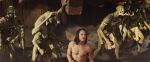
Indeed, there is a lot to enjoy in this unapologetically overblown spectacle, once you accept it as it is. Burroughs’ Martian civilization is given the kind of intricately detailed, fully realized treatment that only big studio money can buy. The cities, with their spacious, retro-futuristic architecture, full of bridges and balustrades, palatial throne rooms, and majestic plazas, are executed with imaginative grandeur; the various alien technology, from great, bird-like airships to pseudo-scientifically-powered cosmic map rooms, as well as all the creatures- besides the Tarks, there are giant fanged apes, massive dinosaurian beasts that serve as mounts, and an oddly lovable amphibian-esque dog that becomes Carter’s loyal pet and protector- are brought to life by state-of-the art screen wizardry in a slick style that combines the iconic illustrative work of artists like Frank Frazetta with a modern-flavored Steampunk sensibility, resulting in a visual design that reimagines the classic Victorian milieu of the original with a firmly contemporary twist. These elements are imposed upon location settings in Utah- where, in fact, the author created his saga over a century ago- which are used to great effect in creating the arid, desolate Martian landscape, with its harsh deserts and monumental geography, making for an utterly convincing otherworldly environment. Of course, it’s no surprise that the film would be visually stunning, given the monumental budget and the participation of Disney’s all-star design and technical staff; as always with such effects-heavy blockbusters, the real test of quality lies in the less showy creative aspects of direction, writing, and acting.

As for the first of these, Andrew Stanton is a proven master of visual storytelling, and he uses his skills here to forge a clear path through the oft-confusing details of the plot, setting up early the crucial points and maintaining a strong through-line as he takes us through the meandering, episodic developments that make up the narrative. He keeps the pace quick with rapid edits and a roving camera, and composes his shots succinctly to convey a maximum of information without lengthy exposition. This is particularly helpful in keeping the audience on track, given the multiple storylines in play here- which brings us to the second foundational element of the film, its screenplay. It has already been mentioned that the novel’s sprawling narrative has been compressed too tightly into the relatively short running time of John Carter; the story might have been better served by being split over two movies, as has become the trend, for better or worse, with other big fantasy epics in recent years. Given the probable demise of this would-be franchise, it’s fortunate that Stanton and his co-writers did not choose that path, but if any one thing could have made John Carter a more satisfying film, it would have been the chance to invest more time in getting to know its characters. Pulpy as the material may be, a more in-depth exploration of the people that inhabit it- both human and non-human- might have gone a long way towards winning the emotional involvement of the audience in its action. Instead, we are presented with short, lightning-quick character sketches that give us the pertinent information about what makes each one tick, and then we’re off and running, knowing everything we need to know about them in order to understand their place- and easily predict their actions- in the story, long before it reaches its climax. As a result, the entire saga often feels as if it were a mere pageant, populated by one-dimensional ciphers who are mainly present to model the costumes and lend scale to the sets; since the story’s heart necessarily lies in its human element, such streamlined writing places a substantial burden on the director and cast to fill in the blanks and provide a greater depth of characterization than is apparent in the dialogue. Stanton, whose previous directorial outings have featured casts of animated characters (each of which are brought to life not only by actors, but a whole team of artists skilled in adding layers of nuance to every movement and expression), may have been at a loss here; his ensemble of performers seem to have been left to their own devices in filling out the inner lives of their roles.

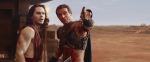
Which leads us to that third crucial pillar of good filmmaking, the acting. The cast of John Carter is, if nothing else, a marvelous-looking bunch; Taylor Kitsch, in the title role, spends most of the film without his shirt, displaying the kind of chiseled body that was presumably much rarer in the 19th Century than it is today- after all, this was a time before the advent of personal trainers and nutritional supplements. Likewise, his co-star, the beautiful Lynn Collins, is costumed in a manner which strategically showcases her considerable physical assets, and most of the other human cast is similarly dressed- or rather, undressed- throughout. Not that there’s anything wrong with that; sex appeal is a big part of what makes these kinds of epic adventures so exciting to their target audience- the young teenager in all of us. In order to elevate these larger-than-life characters above the level of mere pin-ups, however, there must be something under the pretty exterior that will keep us interested, and though both the film’s stars make a noticeable and admirable effort, neither manages to give us much beyond the immediate requirements of any given moment. Their performances are all surface, convincing but never compelling, and though they carry themselves suitably enough for the stature of their roles, there is a decidedly contemporary flavor to their personae; they seem more like a pair of fitness models at a photo shoot than a hardened soldier and an enlightened princess. In the supporting roles, James Purefoy shows some charisma and character as a loyal second-tier hero and would-be sidekick to Carter, but his role is far too brief for him to make more than a fleeting impression; the gifted Ciarán Hinds, as the Princess’ father, is utterly wasted, as is Breaking Bad star Bryan Cranston as a cavalry officer who inadvertently becomes Carter’s companion for the discovery of the cave in which his destiny lies; and the film’s primary villains, Mark Strong and Dominic West, are saddled with two of the least interesting characters in the film- the former disaffected and aloof, the latter merely a mindless brute- and are therefore unable to make either into the kind of formidable antagonist needed in such a swashbuckling tale as this. Perhaps not surprisingly, the most engaging and memorable performances come from the actors lending their voices and movements (through motion capture technology) to the principal Thark characters (Willem Dafoe, Samantha Morton, and Thomas Hayden Church), who provide us with a hero, heroine, and villain, respectively, that we can truly care about. This may be because of the higher caliber of their acting (Dafoe, as Tars Tarkas, reportedly accepted the role because he relished the challenge of giving a performance dressed in pajamas while walking on stilts, and, arguably the film’s most prestigious star, he brings no dishonor to his reputation here), but it is surely not just coincidence that these roles are essentially animated characters- the kind with which director Stanton is clearly more within his comfort zone.

It’s interesting to know that John Carter probably holds the record for the longest development period in cinema history. It was 1931 when Bob Clampett- later to become known for his genius work with Warner Brothers’ Looney Tunes series- approached Edgar Rice Burroughs to purchase the rights to A Princess of Mars and the rest of the Barsoom novels; he planned to make an animated adaptation, knowing that a live action version would be impossible at the time, and he did manage to produce several reels of test footage before the studio (MGM) pulled the plug with fears that stories of an Earthman’s exploits on Mars would be too ridiculous for most American audiences. There were later efforts to produce a screen version throughout the next 80 years, but various creative conflicts and financial concerns sank the project, each time. Finally, when Disney considered the title (for the second time, having intended to produce it in the 1980s as a vehicle for Tom Cruise), Stanton- a fan of the books since childhood- fought hard to get it approved, with himself as the creative force behind it. Based on his previous track record, Disney okayed it- a decision they likely came to regret. By all reports, Stanton’s inexperience with live action production proved an obstacle which may have inflated the film’s already-massive budget, and his rejection of studio ideas about marketing and publicity might very well have been the deciding factor in making John Carter one of the biggest flops in Disney’s long history. There is a theory- which I more or less agree with- that the most significant reason for the movie’s failure was the decision to change the title (already altered from the book’s original name) from John Carter of Mars to John Carter. Stanton said he preferred this because the movie was an “origin story” that told how the character became John Carter of Mars, and studio executives reportedly changed it due to a study which showed that films with the word “Mars” had all suffered some degree of financial failure- including their own Mars Needs Moms. Whatever the reason, and whoever was responsible, it was ultimately this change, coupled with the vague and unexciting marketing campaign that accompanied the movie’s first release, that sealed the doom of Stanton’s lifelong dream project; though earlier generations may have needed no reminders about who John Carter was, in today’s market, where many have never even heard of his creator, Edgar Rice Burroughs, let along the hero himself, it was vital to give audiences more of a clue about what the film was about. Without such a clue, they stayed home and saved their money for the then-upcoming release of The Avengers.

It’s unfortunate that in writing about John Carter, I have to focus so much attention on its supposed financial failure (again, it was not really a flop, just not the mega-hit the studio had hoped for), but sadly, it is a significant part of the public’s perception about the movie, and it must be addressed; as years go by, its box-office receipts will become less and less important to commentators, and perhaps it can be discussed on the basis of quality alone. I hope so. Despite my quibbles about the script and the acting, I enjoyed John Carter, rather more than I had expected. Indeed, I tried very hard not to like it; but by about the halfway point I gave in to its goofy, old-fashioned charms, and by the end I was- dare I say it- glad the movie had been made. It deserved to be made. After a hundred years in which filmmakers have “pillaged” Burroughs’ stories for their own derivative efforts (the reason cited by director Robert Zemeckis when he turned down this project, specifically in reference to George Lucas and Star Wars), it’s fitting that the granddaddy of all those swashbuckling outer space fantasies should at last get the Hollywood treatment that has long avoided it. Fanatical followers of the novels (and they still are legion, even a hundred years later) may wish it had done better justice to the original, and many other audiences may wish it had made more of an effort to contemporize or sophisticate the material, but there are many, too, who will enjoy it just the way it is. Indeed, there are many who already have enjoyed it, myself included, and the seemingly passionate dislike the movie has generated from some (and some who have not even seen it, I might add) makes me once again question the value of judging a piece of art on the basis of personal expectation rather than on its actual merits; if we are too busy complaining about a movie’s not being what we want it to be, how can we enjoy it for what it actually is? Of course, there is also an unavoidable debate about the wisdom of spending enough to feed a small country for a decade on an inflated piece of escapist fluff like this one, but that is a question of ethical economics better left for discussion in another forum; in the long run, the fact that John Carter of Barsoom is at last represented in cinematic form, whether or not he is all he could have been, is a good thing, and though I have yet to discover if the movie proves more rewarding on multiple viewings (which I suspect it will), I am certainly looking forward to doing so.

http://www.imdb.com/title/tt0401729/?licb=0.42602754768506235

Prick Up Your Ears (1987)

Prick Up Your Ears (poster)


Today’s cinema adventure: Prick Up Your Ears, the 1987 feature by director Stephen Frears about the short life and brilliant career of English playwright Joe Orton, whose rise to success in the theatrical scene of mid-sixties London was cut short by his brutal murder at the hands of his long-term partner, Kenneth Halliwell.  Based on the biography of the same name by John Lahr, the film approaches Orton’s life with a macabre sense of humor much like that found in his plays, and features superb performances by Gary Oldman and Alfred Molina (as Orton and Halliwell, respectively); it was greeted by enthusiastic reviews by critics upon its release, though its popular appeal was, naturally, somewhat limited by its subject matter- particularly outside of Britain, where Orton’s name is less familiar.  Nevertheless, it achieved relative box office success due to the wave of interest in British imports during the eighties, and, along with the previous year’s Sid and Nancy, helped to secure Oldman’s place as one of the most promising- and sought-after- young actors of the decade.

The screenplay of Prick Up Your Ears– penned by Alan Bennett, another renowned playwright whose own career dates back to the same era as Orton- is expanded from the book upon which it is based by the inclusion of author Lahr as a character, using his research and writing of the acclaimed biography- particularly through his interviews with Orton’s agent and close friend, Margaret Ramsay- as a means of framing the story.  This device allows for a non-linear exploration of Orton’s life, centered around the notorious murder-suicide which brought it to an end, that reveals key moments of the playwright’s history as it makes a more in-depth examination of his relationship with Halliwell.  In this manner we are given a narrative which chronicles Joe’s life from his working class youth in Leicester, where he pursues an interest in drama despite the intentions of his parents to educate him for a career as an office worker.  He manages to earn a scholarship to the Royal Academy of Dramatic Arts in London, where he meets and becomes involved with Halliwell, an older student attending the school through a small inheritance.  The two take a flat together, and begin an unsuccessful, decade-long attempt to collaborate as writers; Joe also indulges in an almost daily habit of anonymous sexual encounters in public places- mostly men’s restrooms- and writes about them in his diary.  The two are eventually arrested (for defacing library books) and serve short jail terms, during which Joe writes- on his own- a play that he submits to BBC Radio; it is accepted and produced, marking the beginning of his rise to fame- and also of the deterioration of his relationship with the jealous, insecure Halliwell.  As Joe becomes the toast of the London theatrical world, with smash hit plays and an offer to write a screenplay for The Beatles, Ken becomes increasingly morose and frustrated at being kept out of the spotlight, even after the couple spends a lengthy vacation in Morocco; finally, no longer able to face a life lived in the shadow of another’s success, Ken kills Joe as he sleeps, beating him savagely to death with a pall peen hammer, then takes an overdose of pills to follow his lover into death.

As a rule, I generally find film biographies to be somewhat unsatisfying; though, at their best, they can be a showcase for tour-de-force acting, superb direction and magnificent scenic and costume design, at their core they often suffer from an impossible desire to somehow encapsulate a person’s entire life and essence into a two-or-so-hour time frame, or to interpret their motivations and actions in a way that casts them in a particular light.  In truth, of course, even the strictest documentary cannot avoid inserting a subjective viewpoint, but biopics, at their most banal, make a deliberate effort to deify- or vilify, in some cases- their subjects, resorting to the manipulative tactics of melodrama and completely ignoring or altering facts in order to tell a more “satisfying” story.  The most artistically successful examples of this genre are those that use their subject as a means to communicate ideas about universal experience, or simply to entertain us with a little-known story from our past that may, hopefully, encourage us to learn more on our own.   Prick Up Your Ears does both.

Frears’ movie is blessed with the participation of numerous talented individuals with a clear affection for- and familiarity with- Joe Orton and his work, and they have here taken pains to create a picture of this influential and iconoclastic figure that presents his life in a manner that is, if not 100% factually accurate, at least true to his own vision of the world in which he lived.  Much of this is made possible by the use of his diaries as a source of information, both for the original published biography and for the screenplay; through this remarkable document, which has since been published in its own right, we are granted unprecedented access to Orton’s most private thoughts and experiences- most obviously his frequent and adventurous sexual escapades, recorded with particular pride and relish- and allowed to see the author’s own perspective on himself and his life.  Of course, that perspective- dark, cynical and full of deliciously salacious humor- comes as no surprise to those familiar with Orton’s plays, brilliant farces which skewered traditional theatrical forms while undermining and exposing the hypocrisies of social convention and the ugliness hidden behind the all-important facade of so-called “decency.”  Bennett writes the story of Joe and Ken as if it were itself penned by Orton, peppering the dialogue with lines that seem as if they were lifted directly from his writing and presenting the people that surround the two central figures as if they were characters in one of his plays.  This approach makes for a truly Ortonesque experience of Orton himself, but it also has the shrewdly observed added effect of showing how the playwright drew inspiration from the people and circumstances of his real life; seeing the world as Joe himself saw it makes it clear that his particular genius came simply from transcribing what he saw around him into his work.  The farcical absurdities of his real-life experience fed his writing, and the fact that they are here no less believable for their absurdity suggests that very little exaggeration was required to translate them to the stage.

Joe’s perspective is not, however, the only one brought into play in Bennett’s and Frears’ vision of his life.  The film is also, of course, heavily informed by Lahr’s biography, which casts a more detached and empirical eye on the playwright- in particular on his relationship with Halliwell- and allows us to see him in a more humanistic light, perhaps, than that toward which he might have been inclined.  This does not mean, however, that Prick Up Your Ears takes any kind of moral stance on Joe- or Ken, for that matter- in its depiction.  On the contrary, the movie takes pains to portray the pair as they were, without imposing judgment, and allows us to draw our own conclusions; though their end was undeniably tragic, and a good deal of the film can be seen as an examination of the factors that led up to it, there was more to Joe and Ken’s connection than their horrific final destiny, and Frears and Bennett make sure we see as many other facets as possible of their lives together.  Finally, in exploring their relationship, and the changing dynamics created by collaboration, success, fame, and failure, the movie also explores the way these factors are reflected in John Lahr’s marriage, and by extension, suggests certain observations about the nature- and the pitfalls- of mixing creative endeavor with romantic attachment.

Of course, for most people who have even heard of Joe Orton- outside of theatrical and literary circles, of course, and often even there- the lurid and scandalous circumstances of his death are far better-known than his work.  Frears and Bennett make certain that their audience knows, right from the start, that this event is the central focus of the film, a sort of epicenter from which everything else radiates.  The movie opens with a glimpse into the final, terrible moments, followed by the discovery of the bodies and the subsequent invasion of the bloody scene by the authorities.  We are, however, given only a peek, so that for the rest of the movie, we are left to hope for the kind of graphic, gruesome detail we want to see- and we do want to see it, as Joe himself would likely understand better than anyone.  Indeed, it is this gory revelation that the director uses as bait, like a carrot dangling before us as we make the journey through Joe’s life and times, motivating us to stay with the story so that we can get that nasty payoff at the end; and Frears gives it to us, alright, in a harrowingly real depiction of the brutal murder and its aftermath that is likely to affect even the most hardened viewer and leave nightmarish, lingering visions for some time afterwards.  Yet even this dose of cold, hard realism in the midst of the film’s wacky theatricality is in keeping with its dedication to the flavor and spirit of Orton’s work; his writing, for all its juxtaposed sophistication and irrepressible rude-boy naughtiness, carried at its center an acute awareness of the ugliness of human experience, an ignoble convocation of bodily functions- sexual, scatological, and otherwise- which makes ludicrous all attempts to dignify it with pretense or affectation, and is made all the uglier by the mean-spirited cruelty with which we treat each other.  Orton’s brutal death at the hands of his lover- the ultimate bodily function as a result of the ultimate cruelty- serves as a reminder of the nihilistic truth of which he was a champion.

The darkness that underlies all the glib merriment, though, is only a part of the Orton mystique; though he was bent on exposing the inherent nastiness of the human condition, he also derived a great deal of fun from it.  He was a literary rebel, using his wit as a weapon against the stifling social conventions that made him feel like an outsider; he was a master marksman, and his wicked skills gave voice to a new generation that despised the stodginess of their moribund culture as much as he did.  More to the point, though, he had fun doing it; Joe Orton was all about having fun, an obvious fact to which his hedonistic lifestyle plainly attested, and the glee he felt in skewering the pompous and the conventional was almost certainly his main (if not only) reason for doing it.  That glee comes across in his writing, and is readily shared by audiences who see his plays, which are still frequently performed today.  It also comes across in Prick Up Your Ears.

Aside from Bennett’s screenplay, the movie benefits greatly from Frears’ steady, assured direction.  Noted for his skill in handling stories about socially isolated people adapting to new circumstances, a theme which runs through most of his films from My Beautiful Laundrette to The Queen, he shares with Orton an origin in Leicester, a fact which no doubt helped to solidify his understanding of and connection to the material here, and has a long collaborative history with Bennett.  He crafts his film with a perfect balance of the cinematic and the theatrical, creating a blend of gritty realism and heightened style enhanced by flourishes from both media; he also exhibits a showman’s knack for storytelling, managing to form a cohesive and unified narrative which engages our interest and remains easy to follow throughout its non-linear structure.  He is aided by meticulous production design which smartly re-creates the atmosphere of London in the swinging sixties, contrasting it with the mundane and utilitarian environment of working-class Leicester, as well as with various institutional settings and scenes of the seedy sexual underworld that arise within Joe’s checkered story.

Most importantly, though, Frears’ film is blessed with the magnificent performances of its two stars.  Oldman and Molina are electrifying, offering layered, chameleonic portraits of the cheeky, good-natured rude boy and his arch, affected lover that reveal the traits, both positive and negative, in both without sentimentality or comment.  Oldman truly seems to channel his subject, not only bearing a strong physical resemblance to “the most perfectly-developed playwright of his day” but capturing the particular seductive swagger that is evident in photos and the few films that survive of Orton; it’s not mere mimicry, however, for he also infuses the doomed writer with a palpable humanity that allows us to truly involve ourselves with him emotionally, and understand why even those who thought him shocking and indecent found him irresistible and endearing, nonetheless..  The more difficult task, though, is Molina’s; he gives us Halliwell in all his insufferable pomposity, and takes us through his deterioration without varnish, and yet he, too, finds the human element here that makes poor Ken as much a tragic figure as Joe- a man of intelligence, wit, and emotional generosity, clearly affected by psychological issues that might have been more readily understood and addressed in our modern day, but which, at the time, were subject to as much stigma and shame as his homosexuality.  Molina gives a heartbreaking performance, and it is largely thanks to him that Prick Up Your Ears succeeds in capturing the full ironic scope of the Orton-Halliwell saga.  In the third principal role, that of legendary theatrical agent Margaret “Peggy” Ramsay, Vanessa Redgrave is, as always, superb; her glittering charm and sophistication light the screen, but she also gives us a clear view of the character’s opportunistic and manipulative aspects- she, like Joe, is “getting away with it,” but that doesn’t make her any less likeable, in the end.  Redgrave’s presence also adds an important pedigree that links the film directly to the world it portrays; she is, of course, a member of one of Britain’s great acting dynasties, and was deeply immersed in the London theatrical scene during the era in which Orton was active.  This connection is, perhaps, immaterial in terms of practical application to the execution of the film, but it does contribute a sort of authenticity to the proceedings that does seem, to me at least, to have an effect, however intangible, on its sense of validity.  Wallace Shawn (another renowned playwright) uses his familiar nerdy intellectual persona to good effect as biographer Lahr, Frances Barber has a touching turn as Orton’s sister, Leonie, and Janet Dale provides a memorable illustration of classic Ortonesque caricature as Joe and Ken’s doting landlady.  In smaller, cameo-style roles, familiar English character actors such as Julie Walters, Richard Wilson, and Margaret Tyzack bring their considerable talents into the mix, contributing much to the overall perfection of tone and style that makes Prick Up Your Ears such a delightful marriage of film and theater influences.

It’s pretty obvious, by now, that Prick Up Your Ears is a highly recommended cinema adventure, as far as I am concerned.  The fact that I am personally a great admirer of Joe Orton is really not a factor in my enthusiasm for the film, except in the sense that my expectations of any work dealing with him are stringently high, making Frears’ movie all the more impressive to me for its worthiness to the subject matter.  I am confident that this smart, stylish and accessible piece will be an enjoyable experience for almost any mature viewer, whether they are fans of Orton or have never heard of him; even if you have no interest whatsoever in theatrical history, British or otherwise, Prick Up Your Ears offers up a fascinating story that is no less entertaining for being true.  That said, it should be mentioned that it is a film in which homosexuality plays an integral part, and it does include extensive, if not graphic, depictions of gay sexual behavior; if such matter is uncomfortable for you, for whatever reason, then consider yourself warned.  This subject brings up an important point concerning Prick Up Your Ears, and indeed about Orton himself; though the playwright was not overtly involved in any form of struggle for gay rights- his death took place two years before the Stonewall riots in New York, after all- and though the film does not address or take any sort of stance on the issue, the subject is inseparably woven into the fabric of this story.  As gay men living in a society that criminalized and ostracized their kind, Orton and Halliwell lived their lives as disenfranchised outcasts, forced to suppress their true nature in order to avoid persecution and even imprisonment; though it was the older Halliwell who helped Joe to accept and embrace his sexuality, it was the younger man who would go on to live an audaciously open life in the face of societal disapproval, and despite his efforts to bring Ken along, he was unable to overcome the obstacles of shame and insecurity that would eventually result in the tragic conclusion of their love story.  Each man took a different direction in reconciling his sexual identity with cultural expectation, and though this was clearly not the only factor in the murderous frenzy that took their lives, it is beyond question that it played a substantial part.  In this way, though on the surface it seems only a parenthetical circumstance that defines the two central characters, homosexuality- or to be more specific, the rejection of homosexuality by so-called “normal” society- is the issue at the core of Prick Up Your Ears.  Those with a more militant bent might wish that Bennett and Frears had taken a more direct assault on the social injustice that marked the cultural landscape of Orton and Halliwell’s England; but the story, like Joe’s plays- and Joe himself- speaks for itself.  Joe Orton chose not only to be open about who he was, but to flaunt it; he simply was, and the strength of that assertion was sufficient to make him an icon.  Prick Up Your Ears is a celebration of that bold spirit, and it tells Joe’s story in a voice very much like his own; that makes it not only a testament to the lasting mark he made  in his short life, but also a bloody good time.

http://www.imdb.com/title/tt0093776/?licb=0.2046471543502929


The Long, Long Trailer (1954)

The Long, Long Trailer (poster)

Today’s cinema adventure: The Long, Long Trailer, the 1954 big-screen showcase for the talents of America’s then-favorite TV couple, Lucille Ball and Desi Arnaz, directed by Vincente Minnelli and casting the two stars as a pair of newlyweds on a cross-country honeymoon in a super-sized luxury trailer home.  Designed as a vehicle for the tried-and-true antics that fueled the duo’s highly popular comedy series, I Love Lucy, it was considered a risky project by its production studio, MGM, who were skeptical that audiences would pay to see Ball and Arnaz in a movie theater when they could watch the pair, for free, in the comfort of their own living room; Arnaz reportedly made a $25,000 bet with the studio heads that the film would out-gross their highest-earning comedy to date (1950’s Father of the Bride).  Moviegoers responded well to the opportunity to see the couple’s wacky hi-jinks against the expanded backdrop of location-filmed American scenery, turning the film into one of the year’s biggest hits and winning the bet for the confident Arnaz.  Though the movie is ultimately a side note in the success story of these two American entertainment icons, it nevertheless has remained popular among their fans and offers a rare opportunity to see their beloved matrimonial shtick transported out of the studio-bound confines of their classic television show.

Based on a 1951 novel by Clinton Twiss, the screenplay (by Albert Hackett and Frances Goodrich) tailors its plot for the needs of the Ball/Arnaz team’s familiar joint persona.  Framed as a flashback, it tells the story of “Nicky” and “Tacy” (noticeably only a few letters off from “Ricky” and “Lucy”); he is a civil engineer whose job requires his travel to various projects around the country, and she, seeking a way to keep them from being separated during the early days of their marriage, hits upon the idea that they should purchase a travel trailer in which they can set up housekeeping wherever his work takes them.  Though he is skeptical, she convinces him with the notion that a trailer will cost them far less than a house and allow them to save more money for their future.  With their new, enormous, top-of-the-line trailer (plus the new, more powerful car they have had to buy in order to tow it), the couple sets out on their honeymoon- a leisurely road trip across the Sierra Nevadas to Nicky’s next job assignment.  Things start out pleasantly enough, though their trailer park wedding night doesn’t go exactly as planned; but as the trip goes on, the mishaps begin to pile up and take their toll on the relationship.  A rainstorm leads to a night spent stuck in a mudbank, Tacy’s attempts at directing Nicky’s steering results in major damage to her aunt and uncle’s house, and her effort to cook dinner in the moving trailer ends in disaster.  The final straw comes when her growing collections of preserved fruit and souvenir rocks become so heavy that the trailer is dangerously overweight, placing the newlyweds in serious danger as they attempt to drive up a steep and winding mountain road- a trip which, even if they manage to survive, may well mean the end of their marriage.
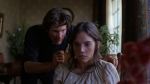
The Long, Long Trailer is hardly the kind of film that warrants an in-depth analysis, though if one wanted to use it as a springboard for discussion about sociological and cultural characteristics of post-war American life, it would likely provide plenty of fodder.  Indeed, watching it today, it seems like a perfect snapshot, glossy and idealized, of the particular mindset of mid-fifties middle class America, personified by a young (well, young-ish) couple on the road to a shining new tomorrow, blessed with a new affluence, possessed of a can-do attitude, and excited about the endless possibilities that wait to be explored right here at home.  Of course, the entire premise of the comedy hinges on the fact that this romanticized fantasy is not quite in tune with reality- the adventure of building a new world on the domestic front is fraught with unforeseen difficulties and offers its own challenges to the character and spirit of those who undertake it.  All of which sounds deeper than it needs to sound, for in The Long, Long Trailer, social commentary is as heavy and unnecessary a burden as Tacy’s rock collection.

What this movie is about, nostalgic retrospect aside, is laughs; the American-Dream-on-wheels premise is entirely geared towards providing a mine of zany situations for the then-reigning royal couple of comedy to exploit.  Though the names are different (barely), the characters are, in essence, the same as their TV roles; Desi is the modestly successful, good-natured-but-hot-tempered immigrant husband (here, inexplicably, not Cuban but Italian), and Lucy is the well-intentioned manipulative housewife whose hair-brained schemes inevitably lead to hilarious complications.  The movie depends entirely on their comfortable chemistry together, their combative-but-affectionate dynamic, and Lucy’s consummate skill as a comedienne.  It is this last element that carries the film, of course; though they made a great team, and although he certainly holds his own during his moments in the spotlight, Desi was always the foil for Lucy’s comedic persona, a relationship upon which their act was utterly dependent.  The biggest laughs in the film come when she unleashes her flair for physical comedy- the classic sequence in which she tries to prepare a meal in the trailer while it is on the road is the movie’s highlight- but these moments work so well because she sets us up for them; she makes Tacy (which is short, by the way, for Anastasia- I know, it’s a stretch, but go with it) as endearing to us as to the hapless Nicky, and thanks to her rubber-faced expressions, we feel like co-conspirators with her, because we can read every thought and plan even as she hatches it herself.  It’s comedy genius, and to over-analyze it is pointless- it works because it works.  Lucy and Desi knew their audience, and they knew what that audience wanted; they weren’t about to take the chance of messing with a successful formula, especially when that formula was at the height of its popularity.  There is even a musical number, though not the kind of elaborate, slapstick-laced showstopper often featured on I Love Lucy, but simply a pleasant little duet performed as an interlude while the stars are driving into Yosemite National Park.  To be sure, the stakes feel a little higher in The Long, Long Trailer than they do on the TV series; there, no matter how big the disaster that results from Lucy’s schemes, we know it will never really threaten the blissful marriage at the center of the show, but here there is at least a more palpable illusion that they could end up apart- though, of course, on an intellectual level, we know that’s not very likely.  After all, this is a comedy, and even if it pokes a little bit of situational fun at the perfect domestic dream of the mid-fifties, it also embraces and reinforces that ideal; you can be sure, by the final frames, Ricky and Lucy… I mean, Nicky and Tacy will be locked once more in a tender and loving embrace.

Although The Long, Long Trailer is mostly an on-the-road installment of the Lucy-and-Desi Show, this is not its only appeal.  There are a few interesting cameos from other familiar personalities of the era; Marjorie Main of Ma and Pa Kettle fame makes an appearance, as does an uncredited Howard McNear (better known as “Floyd the Barber”) and a prominently-billed Keenan Wynn (who has less than 30 seconds of screen-time- and no scripted lines- as a traffic cop).  Vincente Minnelli, one of Hollywood’s seasoned veterans at turning out crowd-pleasers, wisely keeps the main focus on his stars, but frames them in a gorgeous visual environment; fans of mid-century roadside Americana will adore this film, which sometimes looks like a travelogue produced by the U.S. Tourism Bureau and sometimes a montage of picture-postcards, interlaced with stylish tableaux of glamorous settings that look like vintage magazine ads, brought to life.  Minnelli (and his stars) were smart enough to utilize the advantages of the big screen, giving audiences a scope they couldn’t get from I Love Lucy, so there is an extensive use of breathtaking location footage, most notably in the aforementioned Yosemite scenes, but also in the hair-raising climax when the couple drives their trailer up the mountain (Mt. Whitney, to be exact).  The realism of this latter sequence aids considerably in its effectiveness, and captures the universal anxiety shared by anyone who has ever attempted to navigate one of the winding, narrow roads that lace the mountainous regions of America- or, for that, matter, the world.  The road trip experience, naturally, must include a good deal of focus on the vehicles used, especially the title “character” (for it is, truly, a character in the plot), which is a beautiful, canary yellow, 36-foot 1953 “New Moon.”  Those who care about such things will doubtless be delighted by the extensive depiction of this remarkable piece of mid-century design, in all its improbable luxury, as they will also be by the car which tows it, an equally beautiful 1953 Mercury Monterey convertible.  Of course, the costumes also add to the movie’s nostalgic appeal, with both Lucy’s and Desi’s outfits representing the epitome of mid-fifties fashion- not high–fashion, mind you, but modest, popular, middle-class clothes that conjure images from the countless grainy home movies taken by couples and families during the era.  In essence, The Long, Long Trailer is a love letter to its time, a nostalgic walk down memory lane for those old enough to remember it first-hand and a wide-open window through which younger viewers can catch a glimpse of an America before affordable plane travel and utilitarian super-highways made the delights of the road trip into a thing of the past.

It’s somewhat tempting, today, to watch The Long, Long Trailer with a sense of irony.  The feeling of gee-whiz wonder and self-discovery that permeated the cultural psyche of the fifties has long since fallen under the wheels of progress, transformed by the turbulent decade which followed into a quaint and kitschy joke; it’s almost impossible to believe in the naïveté we see displayed here, and the knowledge that Lucy and Desi, like so many of the “perfect” couples of the Eisenhower era, would later end their real-life marriage in an acrimonious divorce casts a somewhat cynical pall over the proceedings, and makes the inevitable happy ending seem like just another carefully packaged lie- which, of course, it was.  The whole of the movie is sentimentalized dream-factory nonsense, but that’s not a negative criticism in this case; it was never meant to be anything else, and it’s easy to forget, from a modern perspective, that the audiences of the day were no more fooled by the pretty-picture images of society presented by their popular entertainment than we are by those we are fed today.  Indeed, much of Lucy and Desi’s appeal for their many fans came because they (or at least, their characters) were a couple whose efforts to fit into a cultural ideal never seemed to go quite as planned; at the end of every misadventure, no matter what affectations they may have tried on or pie-in-the-sky dream they may have chased, what was left was simply them as they were, imperfect perhaps, but together- and that was all that mattered.  Though they themselves were icons of their era, forever associated with the now-archaic ideals and attitudes it held dear, their message transcended it; they were champions of love and companionship, acting out the universal experience of living together despite difficulties and differences- not an easy task in any era- and making us laugh at our own relationships by reflecting them back to us in exaggerated form.  To put it more simply, The Long, Long Trailer might seem like a movie we can watch with an aloof detachment, making arch commentary or snarky observations based in our modern-day sophistication- but it’s not.  It doesn’t take long to forget our superior stance and get caught up in the somehow endearing ridiculousness of Nicky and Tacy’s great experiment, and we end up laughing exactly as we were intended to laugh by the film’s creators- not with the hip, contemporary irony we may have expected.  Don’t mistake me here; I’m not saying that The Long, Long Trailer is anyone’s idea of great cinema, and I’m fairly certain that nobody involved in it thought of it that way, either.  It is, however, a fine example of slick Hollywood entertainment, designed to exploit the popularity of its stars and the mood of the time, and the fact that it still works as more than a mere curiosity piece is a testament to the considerable talent behind it.  Lucy and Desi made their true mark in television; their pioneering work there changed the medium forever, in countless ways, and their big screen projects were really little more than a footnote in their legend.  Even so, The Long, Long Trailer is a charming and worthwhile way to spend 90 minutes, and even the most jaded viewers are likely to be won over by it.  Of course, you might not be able to keep from wondering exactly when Fred and Ethel are going to show up, or when Nicky is going to break out the conga drums, but even if those things never materialize, you won’t miss them- at least not too much.

http://www.imdb.com/title/tt0047191/

An American Werewolf in London (1981)

An American Werewolf in London (poster)

Today’s cinema adventure: An American Werewolf in London, the 1981 comedy-horror film by John Landis, about a young American who survives an attack by a mysterious assailant while backpacking through England, only to find that he has become cursed to transform into a monster by the light of the full moon.  A quirky mix of madcap humor and gruesome horror, it was a fairly respectable hit upon its release, despite mixed reviews, and has since become something of a cult classic.  It was particularly notable for its then-groundbreaking make-up effects, which garnered their creator, Rick Baker, the first-ever Academy Award in the new category created to honor such work.

The movie opens on the moors of Northern England, where two young American friends, David and Jack, are on the first leg of a European hiking tour.  Arriving at nightfall in a remote village, they decide to stop off at the town pub in order to get some rest and sustenance.  The locals view them with suspicion, and when Jack asks about a strange 5-pointed star carved into the wall, they become downright hostile; the two young men decide to leave, and though they are warned to stick to the roads they soon become lost on the moor.  Things get much worse when they realize they are being stalked by a mysterious animal; when they try to run, it abruptly attacks them, savagely killing Jack and mauling David before the villagers arrive and shoot the beast dead as the young traveler loses consciousness.  He wakes up some days later, in a London hospital, where he has been sent by the locals to recover from his injuries.  The physician, Dr. Hirsch, and the attending nurse, the lovely Alex, are kind and sympathetic, but their young patient is troubled by the villagers’ official report that he and Jack were attacked by an escaped lunatic and not a ferocious animal.  Though the police put little stock in his traumatized memories, Dr. Hirsch decides to do a little further investigation on his own; meanwhile, David strikes up a relationship with Nurse Alex, moving in with her upon his release from the hospital.  Their romance is blissfully therapeutic, despite the young man’s troubling, violent nightmares; but harder to ignore are the visits from the increasingly decomposed ghost of his unfortunate friend Jack, who claims that they were actually attacked by a werewolf, and that David is now a werewolf himself.  Worse yet, Jack and all the other victims of the monster’s bloodthirsty rage are doomed to wander the earth until their killer’s bloodline has been severed- meaning that David, as the last surviving carrier of the curse, must die before the next full moon can transform him into a ravenous beast and lead to more senseless slaughter.  Though David is skeptical of the warnings, Hirsch is sufficiently convinced by a visit to the moors that his former patient may be a danger to himself and others, and he joins forces with Alex in an attempt to protect the young man from the darkness- whether supernatural or psychological- that threatens to take control of his destiny.

As written by Landis, who was inspired over a decade earlier when he witnessed a group of Central Europeans performing a ritual to prevent a deceased fellow villager rising from his grave, this grim and familiar tale is laced with the kind of hip, contemporary humor that marked the youth-oriented films of the period; arch, ironic, tongue-in-cheek, and self-referential, the comedy is a major ingredient in the mix, but Landis stops short of letting it undermine the gravity of his horror story.  It seems an odd juxtaposition, and many critics were at a loss to reconcile the seeming opposition of the movie’s two aspects; nevertheless, the apparent cross purposes complement each other in a way that makes for a unique and highly entertaining ride.  In addition, the two cultural sensibilities reflected in the film’s title are brought into the equation through the film’s overall style; the flip jocularity of the American mindset is superimposed against a background of traditional English influences that resembles a blend of Hammer horror and the Carry On series, with a slight dash of Monty Python thrown in for good measure.  The resulting subtextual implication in which the youthful, callow naïveté of the distinctly American personality is thrust into the Old World subtlety of European experience, suggests a story that is ultimately, perhaps, about the dangers of being overconfident in a world that is deeper and more complex than we know.

That’s not to propose that Landis’ purpose here involves any kind of socio-political statement; the “babe in the woods” undercurrent, extrapolations about cultural identity aside, serves mainly as a foundation for the uneasy sense of foreboding that pervades the film from its opening frames, when the hazy atmosphere of the isolated moors seems pregnant with ominous possibility and fills us with the dread of something unknown, lurking just beyond the hills or, perhaps, hiding in plain sight.  Confronted from the start with this landscape that is at once familiar and alien, we immediately bond with the two fresh-faced adventurers who, a few moments later, arrive on the scene- in a truck full of sheep, like proverbial lambs to the slaughter (to reinforce this idea, the pub through which they will soon begin their descent into horror is called “The Slaughtered Lamb”).  We are charmed by their banter, comfortable in their camaraderie, and touched by their friendship; we share their bemused outsiders’ perspective because we, too, are outsiders here, a commonality that helps us identify with them, but because they are so endearing, we also genuinely like them.  It is this factor, cannily accomplished by Landis in his script, that makes us cringe at a deeper level when they become victims of the inevitable carnage; and with this foundation laid, as the film follows the subsequent adventures of David, despite the cheeky comic tone maintained throughout, we can never quite escape or ignore the soul-sickening undercurrent of sadness which pursues us to the end.

Landis is able to pull off this delicate balance largely because he seems unconcerned with pre-conceived limitations of genre; as the director of the wildly popular Animal House and The Blues Brothers, he was the undisputed master of the kind of irreverent and iconoclastic humor that is on display in American Werewolf, and he confidently delivers the same lampooning style in his approach.  There is a definite anti-establishment flavor here that is cut from the same cloth as those earlier films, manifested in a continual opposition between stodgy decorum and free-spirited permissiveness.  The guarded discretion of the villagers regarding their town’s dark secret, the by-the-book attitude of the bumbling policemen assigned to de-brief David, and the stiff-upper-lip dispassion of Dr. Hirsch and even Nurse Alex as they become more deeply involved with their patient; all these are contrasted with the repeated disregard for rules of behavior displayed by the young Americans.  Jack and David challenge local custom with their questions in the pub, and later on, David flies against procedural form with passionate protests regarding the truth about his attacker on the moors, and he skirts propriety by crossing professional boundaries to initiate a relationship with his nurse; it is a similar lack of concern for the rules that allows Landis to blur the lines between comedy and horror with such disarming audacity.  In a way, it is as if he is attacking repressive authority on multiple fronts; not only does he sideswipe convention and cliche with satirical absurdity, and disturb order and decorum with gruesome violence, he also flaunts conservative standards of decency with a high level of sexual frankness and pointedly gratuitous nudity.

An American Werewolf in London uses all these ingredients, ultimately, in the service of providing entertaining thrills for the youth audience at which it was targeted.  The hip, comedic tone and the willful exploitation of sex and violence create an appealingly loose, edgy atmosphere, but it is the narrative itself that keeps us hooked, and Landis the director handles it skillfully.  The leisurely opening sequence is a small masterpiece in itself, and could stand on its own as a fine short film; the jocularity of the protagonists is slowly overtaken by the undercurrent of menace in a textbook example of building tension through visual storytelling.  As the tale progresses, we are subjected to alternating moments of hilarity and terror, often spiking one with the other, keeping us off balance at a visceral level while Landis fills the screen with artfully arranged variety of culturally telling details, from the recurring ironic presence of a Mickey Mouse figurine to the ludicrous porno send-up being shown at the cinema where David has his final meeting with Jack.  Along the way he continues to build on our emotional connection to David (as well as to Alex and, to a lesser extent, Dr. Hirsch, who become his allies) and offers up numerous stylish set pieces- a handful of nightmare sequences, a zany romp at the London Zoo, a gripping predator-and-prey chase in a “tube” terminal, an erotically-charged love scene between David and Alex in the shower- until he reaches the climax, an over-the-top blow-out of carnage and confusion in Piccadilly Circus that plays like a deadly slapstick farce.  Up until this point, his recipe works; the excesses of the finale somehow push the limits of plausibility to the breaking point, and the callousness with which he treats the deaths of all these innocent bystanders feels a little too mean-spirited to be excused under the license of black comedy.  The final tragic confrontation which closes the film, a forgone conclusion since the very first frame, is also, undeniably, a bit of a letdown, and the promising potential for emotional payoff remains unrealized; it’s as if Landis, who has expertly managed to pad out what is essentially a familiar and simple scenario with clever distractions, has reached the bottom of his bag of tricks and decided to end his movie by hurriedly delivering the expected ending with as little fuss as possible.  Despite this anticlimax, however, Landis’ has invested enough into his main characters, on a deeper level than the snarky disaffection of the movie’s surface, to leave us in a state of satisfied melancholy as the end credits roll, and though we may have wished for an worthier ending for his clever mash-up, it must be admitted that his effort to present an oft-told tale in a fresh and surprising package has been, on the whole, a success.

A good deal of that success deserves to be credited to the charm of Landis’ leading players; in particular, of course, the considerable appeal of his star, David Naughton, whose earlier career as a pitchman for Dr. Pepper had made him a familiar face for most audiences, contributes significantly.  Attractive, affable, sincere, and possessed of a devilishly sly but somehow wholesome quality that makes him both sexy and endearing, his personality is well-suited to the demands of both the lightweight and dramatic aspects of American Werewolf, and watching him here makes us regret that, for whatever reason, he failed to become the rising star that his talent seemed to promise.  Matching him well is the beautiful Jenny Agutter, another familiar face (Logan’s Run¸ Equus) who never quite achieved full stardom, at least in the U.S., as Alex; she carries the same, sweet-but-sexy aura as her leading man, with an added layer of maturity and intelligence that makes her far more interesting than the standard damsel-in-distress usually found in monster movies.  John Woodvine is witty and refreshingly likable in his role as the benevolent older authority figure, Dr. Hirsch, and the assortment of recognizable English actors that constitute the cadre at the “Slaughtered Lamb” do a fine job of infusing life and dimension into the stock “superstitious villagers” characters that they represent.  The standout performance, though, comes from Griffin Dunne, as the doomed Jack; his lovably nebbish, self-deprecating nerd persona provides a perfect complement to Naughton’s all-American boy, and the chemistry they share is tangible- a factor that helps to add resonance to later developments when the deceased Jack returns to haunt his best friend.  Dunne manages, in those scenes, to bring the likable humanity of his character to the forefront despite the progressively hideous make-up he wears, undercutting the body horror of his walking-dead image with wit, pathos, and personality.

On the subject of the make-up, the aforementioned Rick Baker- whose prolific work in this field has always helped to redefine and push the limits of the craft- leads the pack in terms of kudos for Landis’ technical crew.  Not only do his remarkably detailed and gruesome prosthetic creations make for an utterly convincing conversion of Dunne into a grisly walking corpse, his work with Naughton’s transformation sequence, in which the handsome actor becomes the fearsome title creature, is a ground-breaking display of wizardry; a far cry from the old stop-motion effects used to morph Lon Chaney, Jr. in the classic Universal Wolf Man and its sequels, it is a truly hair-raising (literally and figuratively) pre-CG spectacle that reminds us all that movie magic did not begin with the computer age.  Also noteworthy is the cinematography by Robert Paynter, capturing the character and mood of the numerous English locations, from the desolate moors to the garish lights of Piccadilly, with a richness that gives weight to the proceedings; again, it’s a reminder of a now-bygone time, before the distinctive visual quality created by photography on actual film was supplanted by the high-definition digital imaging that dominates cinema today.  Finally, Landis gives his film a soundtrack that is comprised partly of effectively unsettling original scoring by veteran composer Elmer Bernstein, and partly of a rather tongue-in-cheek selection of various popular recordings linked together by the subject of the moon, with several varied renditions of the standard, “Blue Moon,” Creedence Clearwater Revival’s “Bad Moon Rising,” and Van Morrison’s “Moondance,” each figuring prominently in highly memorable sequences.

An American Werewolf in London is another one of those films that figured prominently in my own younger years; I have fond memories of seeing it, multiple times, on the big screen, and there was a time when I could quote virtually every line of dialogue.  In the ensuing years I assumed that my youthful enthusiasm, coupled with a fondness for monster movies and all things English, had probably paid a large part in my enjoyment of a film which, really, was little more than pulp cinema.  Upon my recent viewing, I was pleasantly surprised to discover that, in fact, Landis’ odd little film holds up extremely well, and, in fact, boasts many nuances- some of which are explored above- that I had not previously recognized.  It’s really a tight, stylish, and yes, classy movie; though it deliberately strives for the lurid, sensational atmosphere of both Hollywood exploitation cinema and British “penny dreadfuls,” and it offers up a considerable amount of nudity, sex and violence (the gory, nightmarish kind so gleefully proffered by the blood-spattered horror films produced in England throughout the ‘60s and ‘70s), it nevertheless maintains an elegant, restrained sensibility, suggesting far more than it shows and allowing the audience’s imagination to fill in a lot of the blanks.  Landis, for all his excess, does himself credit in his handling of the werewolf and its reign of terror, giving us only brief glimpses of the beast itself and using cinematic artistry- sound, camera perspective, editing- to build the suspense and fear; of course, we would feel cheated if he didn’t also deliver some good old blood-and-guts, and he gives us just enough of those to make us happy (if that’s the right word), but its also to his credit that we walk away feeling as if we’ve seen much more of a bloodbath than we actually have.  In the end, though, American Werewolf is most truly memorable for its unique hybrid personality, which lets us laugh, cringe, and cry a good deal more than we might expect.  It’s a smart, sexy, and surprisingly affecting film that has aged well, which is more than can be said for many of the more lauded-at-the-time works from the period.  Though it may not, at the time, have been as highly esteemed as Landis’ previous hits (mentioned above), and though, for many, his most important and lasting creation will always remain his video for Michael Jackson’s “Thriller,” An American Werewolf in London  may well, in truth, be his best work as a filmmaker; at the least, it’s a definite crowd-pleaser, guaranteed to evoke a grin and a grimace from even the most hardcore horror buff.

http://www.imdb.com/title/tt0082010/

Les Miserables (2012)

Les Miserables (poster)

Today’s cinema adventure: Les Misérables, the 2012 film adaptation of the hit stage musical by Alain Boublil and Claude-Michel Schönberg, based in turn on the classic 1862 Victor Hugo novel of the same name.  Affectionately referred to as “Les Miz” by many of its legion of fans, the show had one of the longest runs in both London and Broadway history, as well as hundreds of international and touring productions, and continues to be a major draw in theaters around the world to this day; needless to say, the blockbuster film version, in development (off-and-on) for nearly 25 years, had a sizable built-in audience awaiting its debut on Christmas Day.  Directed by Tom Hooper, who was at the helm of 2010’s Oscar-winner, The King’s Speech, and produced with heavy involvement from the show’s original creators, including producer Cameron Mackintosh, it has opened to mostly positive reviews, already scored multiple nominations and wins among the various year-end film awards, and been greeted -if the crowded audience I saw it with was any clear indication- with wildly enthusiastic response from the public.

Adapted for the screen by William Nicholson, the floridly romantic score by Boublil and Schönberg (with English lyrics translated by Herbert Kretzmer) makes it to the screen remarkably intact, a rarity in Hollywood transpositions of stage musicals, with very few passages removed and a minimum of strategic re-ordering; consequently, as with the original production, almost the entire story is told through singing, with only a smattering of spoken dialogue.  The epic tale begins, as does the novel, in 1815 France, a country that has reverted to despotic monarchy only a few short years after its bloody revolution deposed the reigning aristocracy.  We are introduced to two men: Jean Valjean, a hardened convict who is being paroled after spending 19 years on a chain gang for stealing a loaf of bread to feed his starving family; and Javert, the strict and stalwart policeman who oversees their labor.  Upon Valjean’s release, his status as a paroled felon prevents him from finding work or shelter, and the cruelty and humiliation he suffers reinforce his hatred and mistrust of humanity, until an act of kindness by an elderly bishop inspires him to transform his life and dedicate himself to God.  He knows he cannot live under the draconian terms of his parole, however, and so he tears up his papers, vowing to begin a new life.  The story then shifts 8 years into the future, when Valjean has established himself under a new identity as a successful factory owner and is now the mayor of Montreuil-sur-Mer, a small seaport city.  One of his workers, a young woman named Fantine, is dismissed by the foreman when it is discovered that she is an unwed mother; with no job, she is unable to send support for her child- a little girl named Cosette who is in the care of a tavern-keeper and his wife in a nearby town- and she soon discovers her only avenue is to join the ranks of the town’s prostitutes.  Meanwhile, Valjean is made uneasy by the arrival of the town’s new police inspector- none other than Javert himself, whose suspicions are aroused by the mayor’s familiar appearance.  When Fantine, now gravely ill, is arrested in an altercation with an abusive “customer,” Valjean intervenes, and promises his dying former employee that he will take care of the child she leaves behind; but when he learns that another man has been mistaken for him and arrested in his name, he knows he cannot secure his own freedom at the expense of an innocent soul.  He reveals his identity to the court, then evades Javert in order to rescue little Cosette from her cruel guardians and flee with her to Paris, where he disappears into yet another life- this time as a loving and protective father.  Another 9 years go by; Valjean and the now-grown Cosette live in comfortable but secluded anonymity, and Javert now patrols the streets of Paris, where poverty and social injustice have bred a new generation of revolutionaries- a band of students under the leadership of the charismatic Enjolras.  One of their number, Marius, becomes smitten with Cosette when they see each other in the street; but their budding romance is interrupted by fate, as her former foster parents, the scheming Thénardiers (now also living in Paris, with their real daughter, Eponine), have recognized Valjean, prompting the longtime fugitive to plan an escape to England with his beloved ward.  On the eve of their departure, the student rebellion begins, throwing Paris into turmoil and bringing the destinies of the characters together for a climactic confrontation that will determine all of their fates forever.

In the original stage version of the musical, numerous liberties were taken with Hugo’s original novel, in the interest of simplifying the complex narrative and restructuring it for the needs of theatrical presentation; even so, through clever staging and production design, the epic sweep of the original was captured and maintained in a way that helped to redefine and reassert the musical theater art form for a new generation.  In re-expanding the story from the confines of the stage to the endless possibilities of the cinematic format, screenwriter Nicholson and director Hooper have returned to the source material for inspiration in filling in the background details, which successfully fleshes out the saga with the epic stature it deserves, but they have faithfully maintained the plot structure of Boublil and Schönberg’s version.  Part of this may be because of the involvement of Mackintosh, whose insistence on keeping the integrity of the show has been a factor throughout its history, and also because any significant changes would doubtless awaken the wrath of the musical’s sizable army of devoted followers, thereby alienating the lion’s share of their target audience.  Whatever the reason behind it, the decision to present the musical largely as written has resulted, perhaps ironically, in a brave and groundbreaking piece of filmmaking; since the decline of the film musical as a viable box office draw in the late 1960s, and particularly since the undeniably brilliant screen version of Cabaret directed by Bob Fosse in 1972, Hollywood has had a fear of allowing the conceits of the genre to be manifested onscreen.  To put it simply, the idea of characters breaking out into song and dance in order to express themselves fell from fashion with the rise of a jaded generation raised on contemporary realism; the “hokiness” of musicals was rejected by an audience that associated it with the values of their parents’ era, and filmmakers have since been reluctant to put them on the big screen without justifying the song-and-dance elements by the use of some stylized approach- usually separating them from the narrative by treating them as fantasy or by presenting them as staged performances within the world of the film.  There have been few movie musicals over the course of the last two or three decades, and with few exceptions they have largely been lackluster efforts which have failed to score with either critics or audiences.  In recent years, however, the popularity of the Broadway musical has undergone a sort of revival in the popular imagination, and the comparative success of such stage-to-film transitions as Hairspray and Sweeney Todd: The Demon Barber of Fleet Street has given tentative indication that audience acceptance for such fare is growing in movie houses, as well.  With Les Misérables, Hollywood takes the bold step of returning to the traditional approach, at last permitting the musical score to be performed, without qualification or apology, as the primary medium through which the story is told.  Unlike Hairspray, with its kitshy camp sensibilty, or Sweeney Todd, with its dark, cartoonish stylization, Les Misérables is grounded in a gritty period realism, and yet its characters express not only their inner monologues through song, they converse, confront and comfort each other through it as well.  In today’s cinema, such a basic, play-as-written approach to such material seems a novel concept, and it is precisely for this reason that it breaks free of its theatrical roots and comes to life as pure cinema.

To be sure, it takes a little adjusting for audiences unused to the genre, and even for those familiar with it.  The spectacular opening sequence, in which scores of rough-edged prisoners drag the enormous wrecked hull of a sunken ship while they sing of the cruelty and hopelessness of their existence, thrusts us immediately into the film’s operatic milieu, without fanfare or warning; it’s a jarring, alien experience, at first, but the utter conviction with which it is performed and presented soon carry us into acceptance, and by the time the story comes to its final fruition 150-odd minutes later the cumulative power of the score rewards us with an emotional catharsis rarely achieved by standard, non-musical methods.  That is, it rewards those who are able to surrender to it; there are undeniably viewers who simply don’t like musicals, and no amount of discussion about the aesthetics or traditions of the genre is likely to persuade them to open their minds to Les Misérables.  Make no mistake, this is a hardcore musical, and anyone who has trouble suspending their disbelief in a world where thieves, prostitutes and soldiers sing in unison would be well-advised to steer clear.  At the risk of seeming confrontational, I might also say they would be well-advised not to try and spoil it for the rest of us.

Of course, there are also those who, as die-hard fans of the musical, will be coming into the theater with their own high standards and expectations about the piece; “Les Miz” aficionados generally have their favorite recordings of the show, with every vocal and instrumental nuance memorized by heart, or perhaps envision a “dream cast” in which their favorite performers from the various productions might somehow be united into one perfect rendition if the show.  These viewers are likely to be disappointed in what they see (and hear) here, as, indeed, they would be bound to be with any version of the piece short of the one they have in their imagination.  In fact, it’s probably fair to say that anyone who is a stickler for “legit” singing will probably have difficulty accepting the vocal performances in Les Misérables; though its cast is composed primarily of actors who are trained and experienced singers, the film’s highly unusual approach to capturing their vocals has yielded a different sound than might be anticipated.  In order to focus on the immediacy and spontaneity of the scenes- particularly since virtually the entire film is sung- the decision was made to forego the usual technique of pre-recording all the songs and lip-syncing to a playback on the set during filming.  Instead, the actors sang everything live on camera, with a piano providing accompaniment through concealed earpieces and the full orchestral underscore being added in post-production.  The result of this approach is a raw, improvisational quality- decidedly different from the meticulously phrased, measured delivery found on most musical theater recordings- that gives the songs an unpredictable, electric vitality; it is not the first time such a tactic has been employed, but it is certainly the most extensive use of it to date, and though it may not satisfy the ears of purists, it creates a hitherto unseen level of honesty in the performances, with each actor given the opportunity to fully express emotional reality in the moment without being hindered by a forced layer of artificiality.  This is not to say that the vocals are in any way inadequate- on the contrary, the cast of Les Misérables is more than capable of the meeting the demands of the material- but rather that they do not adhere to expectations; there is understatement where there is usually bombast and vice versa, and tempos are stretched or tightened according to interpretive need (all dictated, incidentally, by the actors themselves), giving the familiar score a freshness and an urgency that would have been impossible had the performers merely attempted to recreate the sound of those who have gone before.

To execute these performances, Hooper has assembled an ensemble of prestigious actors that, though they may not constitute a typical “Les Miz dream cast,” certainly lay claim to their iconic roles and bring them to life with a clear and infectious relish.  Heading this gallery of versatile “A-listers” is Hugh Jackman as Valjean, finally given the chance to bring to the screen the skills that made him a star on the musical stage before his days as an action-adventure star.  Those who know him only as Wolverine may well be surprised by his magnificent performance here; his renditions of Valjean’s signature songs display his prodigious musical talent and his clear, soaring tenor voice while bringing a depth and emotional immediacy that make them completely his own, and he charts this archetypal character’s journey from hardened thug to selfless benefactor with a brave and powerful range, finding surprising nuances of strength and vulnerability that continually remind us of his humanity.  As Javert, Russell Crowe is perhaps less noticeably effective, due to his stoic, seemingly emotionless presence as this ultimate champion of the letter of the law; his singing is metered and free of all but the sparsest of ornamentation, and he avoids playing into potentially passionate moments with the rigorous restraint of an ascetic.  For some, this approach to the character may seem like a missed opportunity, but in fact it is a remarkably honest interpretation, faithful to Hugo’s original portrayal, of a character whose life is devoted to a code which permits no room for personal choice; Javert does his duty, nothing more, and Crowe is to be commended for resisting the temptation to add showy flourishes.  Anne Hathaway, as the tragic Fantine, delivers the film’s standout performance, a heartbreaking portrait of a young woman driven to desperation by the cruel oppression of her time, and her stunning performance of the musical’s best-known song, “I Dreamed a Dream,” is destined to go down in cinema history as one of those great, unforgettable scenes that shows up in montages paying tribute to classic moments from the movies.  As the Thénardiers, Sacha Baron Cohen and Helena Bonham Carter provide double-edged comic relief in roles that could probably be described as the “Sacha Baron Cohen and Helena Bonham Carter” characters- which may sound like a bit of a dig, but in fact it is a testament to their skill at portraying these kinds of audaciously unpleasant types.  They seem absolutely right as this pair of opportunistic reprobates, and it is hard to imagine anyone else playing them.  As Marius, the immensely gifted Eddie Redmayne truly shines, taking this crucial character and making him a likable, genuine young man with a passionate soul, and not just another handsome romantic juvenile; his own belief in his “love at first sight” is so sincere, we are swept up in it easily- and not just because we accept the convention as a necessary part of the story-, and later in the film, his rendition of “Empty Chairs at Empty Tables, a mournful elegy to his fallen companions and an expression of his own post-traumatic-shock demons, is riveting and heart-rendingly real.  As Cosette, Amanda Seyfried is likewise believably dimensional, rising above the level of mere ingénue, and though her character gives her less chance to stand out, she invests it with so much charm and life that it seems she has a much bigger role than she really does.  Samantha Barks, one of the two principal cast members to have previously played their role onstage, gives a sweet and sad performance as Eponine, capturing the simultaneous joy and despair of her own signature number, “On My Own,” without the affectation that its heart-tugging mixture of despair and joy might inspire in a lesser performer.  Broadway actor Aaron Tveit makes a compelling Enjolras, brandishing a powerfully eloquent singing voice and a piercing intensity that perfectly embodies the enigmatic young revolutionary and makes him utterly convincing as a figure that might inspire other young men to follow him to their deaths; young Daniel Huttlestone (the other “Les Miz” stage veteran) easily wins our affections as the scrappy Gavroche, giving us just enough of the “precocious urchin” persona to make him familiar without adding the sentimentality that would turn him into a cliche; similarly, Isabelle Allen plays the young Cosette without cloying cuteness, delivering her song, “Castle on a Cloud,” with endearing honesty and refreshing simplicity.  Indeed, every member of the cast, from the cadre of student rebels to the gaggle of gossipy factory women, does stellar work and provides a memorable contribution to the whole, making Les Misérables feel like a true ensemble effort. Lastly, in a fitting touch that adds a certain intangible resonance to the proceedings, Colm Wilkinson, the Irish folk-singer-turned-actor who became an international star when he originated the role of Valjean in both the London and Broadway productions, makes a cameo appearance, giving an all-too-brief, transcendent performance as the Bishop of Digne, whose act of kindness sets Valjean on the path to redemption.  It’s also worth a mention that many of the film’s extras and “chorus” members are also alumni of stage productions of the show, including original Eponine Frances Ruffelle, who plays a fairly sizable role as a prostitute.  Their involvement is a testament to the powerful spell of the show, which engenders a lasting bond and loyalty among those who have participated in it and consider themselves all to be part of a family- a family which has every reason to be proud of its newest members, who have joined their ranks through this film.

With such a collection of fine performances on display, it is only right that the film should deliver an equally impressive production to showcase them; thanks to the efforts of Tom Hooper and his creative staff, it does better than that.  Les Misérables goes beyond the perfunctory spectacle provided by its painstaking recreation of 19th Century France and endeavors to re-invent the classic film musical in terms of contemporary cinematic approach.  Hooper does not rely on traditional methods of capturing the show for the screen, but utilizes the language of modern filmmaking to bring the experience into the 21st Century, complete with CG enhancements, rapid editing, and extensive use of steadi-cam photography.  To be sure, there are times when the constant visual motion of the film threatens to overwhelm, and one can’t help but feel that certain moments- particularly in the numerous “arias,” mostly shot in tight close-up to capture the intimacy of the experience- might have been better served with the occasional use of a wider angle lens; certainly, in some of the bigger musical sequences, for example the musical montage, “One Day More,” a more expansive perspective feels needed in order to give full reign to the magnitude of the forces in play.  There is a trade-off to be made here, though; after all, film is an entirely different medium than theater, and it is fitting that a movie should provide an experience impossible to receive from a stage performance.  There is little point to constructing a motion picture that endeavors only to recreate what has already been seen on stage, beyond preserving it for archival purposes, though this is precisely the approach that has been taken with many stage-to-screen transfers; the best cinematic transpositions of theatrical pieces come when a director re-imagines the material without attempting to make the camera lens a mere substitute for a proscenium arch.  Hooper has made his epic with this clearly in mind, and his eye for exploring the visual possibilities of the art form, from the repeated use of overhead perspective to the vastness of the crowded streets of Paris to the closer-than-close revelation of every subtle shift of expression in the performers’ faces.  In particular, he exploits the advantage of realism in the depiction of the crushing conditions of 19th Century poverty, an important factor of the story that can, on stage, only be suggested (or worse, glossed over), as well the contrasting Empire-era opulence of the salons and gardens of the wealthy. Set against the impressive splendor of the production design by Eve Stewart, clothed in the sumptuous authenticity of Paco Delgado’s costumes, and captured with the larger-than-life digital graininess of Danny Cohen’s pseudo-cinema-verité photography, Les Misérables meets and exceeds any reasonable standard for visual style, and- from a technical standpoint, at least, regardless of how picky audiences may respond to the interpretation of the content- provides a total movie-going experience worthy of its beloved source material.

Once again, it seems, I am in the position of having to make full disclosure of the fact that I am, in fact, a fan.  Though I have personally had an ambivalent relationship with the musical theater genre (as opposed to outright film musicals, of which I am an unrepentant enthusiast), Les Misérables is a piece which captured me from the very first time I heard it, and I have seen several stage productions over the years (including the original Broadway run);though its pop-opera format might seem, for some, to cheapen the translucent sincerity of Hugo’s masterful novel, its message of humanism and social awareness shines through in a way that never fails to leave me deeply moved and inspired.  Though this long-awaited film version is not, nor could it ever have been, a perfect rendition, and though I will admit to finding myself overly critical of details and choices throughout as I watched it (on opening day, of course), in the final analysis I have only praise to give it.  The deciding factor for me lies in the simple fact that, at the end, not only was I personally affected by the emotional upheaval to which it carried me- despite my every-lyric-by-heart familiarity with the show- but my companion, a skeptical died-in-the-wool disparager of musicals, was also moved to a prodigious outpouring of tears, as was, indeed, every member of the packed audience.  Make no mistake about it, Les Misérables is a tear-jerker of the highest order, and the enormity of its scope only serves to intensify its effectiveness as such.  If such fare is normally unappealing to you, or if you are one of those aforementioned musical non-lovers, you might want to skip this one, no matter how many awards it may end up getting.  You might want to, but my advice is: don’t.  Go and see it.  Give it a chance.  Like my companion, you may find yourself unexpectedly opened up and transported to a new level of appreciation for the possibilities of the genre.  It’s not a guarantee, but Les Misérables has the power to affect such a softening of the heart, and this movie largely succeeds in capturing the qualities that give it that power.  Those qualities, ultimately, rest in the soul of the story, and not in its spectacle; Les Misérables is not about revolution, nor romance, nor social injustice, nor even the desire for a better life- an oft-repeated theme within its narrative, and one from which it admittedly derives a great deal of its humanistic appeal.  It’s about the redemption which comes from the simple Christian ethic of self-sacrifice, of caring more for another than for oneself; this principal is embodied in the story of Jean Valjean, which remains the central focus throughout the interwoven subplots and ultimately yields the final epiphany towards which the entire saga builds.  When it comes, the catharsis which results from our sharing of it is powerful and cleansing, and no matter what quibbles you may or may not have about this or that detail of the film’s interpretation of the musical, they seem inconsequential in the face of that experience.  In that sense, Les Misérables completely succeeds in its purpose, and at the end of the day (if you’ll pardon the expression) you can’t expect more than that.

http://www.imdb.com/title/tt1707386/

Hitchcock (2012)

Hitchcock (poster)

Today’s cinema adventure: Hitchcock, the 2012 film exploring the relationship between legendary film director Alfred Hitchcock and his wife (and most trusted collaborator) Alma Reville during the process of creating his most famous film- the 1960 horror classic, Psycho.  Directed by Sacha Gervasi, and featuring tour-de-force performances by acclaimed Oscar-winners Anthony Hopkins and Helen Mirren, it was a project long in development and eagerly anticipated, stirring high interest and expectations among film literati over its portrayal of a true cinema icon at work.

Based on Stephen Rebello’s non-fiction book, Alfred Hitchcock and the Making of “Psycho,” a meticulously researched classic long considered a cornerstone in the literature of film studies, the movie’s screenplay, by John J. McLaughlin, takes a less documentary style than its source material, opting instead for a sort of mature Hollywood romance which focuses primarily on the complex dynamics between Hitchcock and his wife.  It opens in 1959 with the premiere of the director’s North by Northwest, a glamorous, wildly popular comic thriller which marked a triumphant return to familiar form after the box office disappointment of darker experiments like The Wrong Man and Vertigo; back at the top of the game, but unsettled by suggestions that he should now, at 60, settle back on his laurels and quit while he’s ahead (and by reviews which unfavorably compare the comfortable safety of his latest hit with the edgy freshness of his earlier work), Hitchcock begins to search for a new project unlike any he had done before.  Rejecting sure-fire hits and the solicitations of his wife to adapt her friend Whitfield Cook’s newest book into a film, he sets his sights instead on a sordid little novel by Robert Bloch, a gruesome tale of madness and murder inspired by the real-life case of 1940s serial killer Ed Gein.  Determined to make a film totally unlike anything he’s done before, he undertakes the project, even mortgaging his house for provide his own financing when his studio will not pay for the production.  Though initially skeptical, his beloved Alma throws herself into the project at his side, as always, providing her uncredited expertise in every aspect of the film- as she has done throughout their 30-plus years of marriage.  The pressures of working on such a risky endeavor, however, begin to take their toll, as Hitchcock’s personal obsessions begin to overwhelm him- his fixation on his icy, unattainable leading ladies in particular- and his overbearing demeanor pushes Alma to the limit of her patience, driving her to seek solace in the task of helping Cook- who may or may not have romantic designs on her, as well- to adapt his novel into a screenplay.  As jealousy on both sides threatens to drive a wedge between the Hitchcocks, both personally and professionally, the making of Psycho suffers from delays, personality conflicts, studio interference, and pressure from the censorship board, making the prospect of failure uncomfortably tangible.  Facing both financial ruin and the loss of his considerable reputation, Hitchcock must overcome his dysfunctional tendencies and restore the good faith of his most indispensable collaborator in order to salvage the film and avert disaster.  More importantly, however, he must suppress his massive ego and humble himself in order to repair the damage it has caused in his marriage and win back the only woman who has ever really mattered in his life.

Rebello’s book was written in 1990, and the exhaustive research the author undertook included access to Hitchcock’s personal notes and every available archival resource, as well as interviews with almost every individual who had worked on Psycho that was still living at the time, including stars Anthony Perkins and Janet Leigh.  The wealth of information he compiled resulted in an intricately detailed portrait of Hitchcock’s creative process, and inevitably yielded considerable insight into the personal factors that informed the director’s work at this particular time in his career.  The book is a scholarly work, albeit an entertaining one as well, which is intended to document the making of a seminal film which would go on to have far-reaching influence on the future of the movie industry and, indeed, on the art of cinema itself; the details and observations of the Hitchcocks’ relationship, while fascinating, are primarily important to show how essential Alma was to her husband’s work and how integral the couple’s teamwork was to the ultimate success of the movie.  McLaughlin’s screenplay reverses this emphasis, shifting the primary focus to the domestic life of this legendary power couple and using the making of Psycho as a means to reflect the personal issues threatening their relationship.  The reason for this may seem obvious; building an engaging story around the nuts-and-bolts construction of a film- or any work of art, for that matter- might easily result in a dry and unemotional narrative, intellectually stimulating, perhaps, but lacking the kind of human connection necessary to appeal to a typical movie-going audience.  Even so, in the process of transforming the documentary book into a fictional narrative, Hitchcock crosses over into the territory of Hollywood fantasy, offering up a sanitized and streamlined version of real-life events in its effort to make its two leading figures into an unlikely pair of romantic protagonists.  This is not necessarily a bad thing; though McLaughlin glosses up the facts with fancy and compresses complicated situations into neat little packages, he gets the gist of it right, and though purists may squirm over some of the more overtly sentimentalized indulgences or take exception to some of the artistic license that simplifies painstaking creative decisions into 30-second vignettes, these conceits serve the larger purpose of revealing the great director’s human side- an aspect he kept closely guarded behind his iconic public persona- and the true extent of his wife’s involvement and influence in his work.

Whether or not you prefer a subtler, more realistic approach to your bio-drama, if you are a fan of Hitchcock in general, or of Psycho in particular, you are sure to find a good deal of enjoyment in the film’s playful exploration of these almost mythic cultural touchstones.  Hitchcock adopts the drily comedic tone so readily associated with the Master of Suspense, particularly in connection to his classic television anthology series- a program that was current during the making of Psycho and which had transformed the already famous director into an instantly recognizable celebrity figure and a household name.  Indeed, the movie even frames its story with segments reminiscent of the ones that bookended every episode of Alfred Hitchcock Presents, in which the rotund host would provide wry commentary on the story being showcased; this conceit also serves to set up another device concocted by McLaughlin, in which Hitchcock engages in an ongoing fantasy dialogue with the aforementioned murderer, Ed Gein- a suitably macabre touch for a movie about an artist whose name is virtuously synonymous with the word.  Hitchcock maintains a close connection to the sensibilities of its central figure, using wit, intelligence, and a heavy dose of irony to tell its story and making sly observations about human nature as it entertains us with the surface details which are ostensibly its focus; and like any real Hitchcock film, it features the “McGuffin.”  For those that don’t know, of course, this is the term coined by the Master to describe a key plot device upon which the characters place great significance, providing an impetus for the story and seeming, on the surface, to be of the utmost importance, but which is, in fact, ultimately irrelevant to the real purpose of the movie.  In Psycho, for example, it takes the form of the $40,000 stolen by the movie’s ill-fated heroine; in Hitchcock, however, the McGuffin is Psycho itself.  It is the making of the movie that is the supposed center of the the plot, but in reality, it merely provides a lens through which is revealed the characters’ psychological and emotional traits, and serves as a catalyst for their personal transformations- the true subject at hand.

Entertaining as it may be, one can’t help feeling that there are a great many missed opportunities in Hitchcock.  To begin with, though the film’s overall ambiance bears a strong connection to Hitchcock’s ouvre, director Gervasi makes only a perfunctory attempt to emulate his visual style.  One longs for the kind of crazy tilted angles, overhead perspectives, stylized dream sequences, and other such dramatic elements that helped Hitch become one of the most influential and distinctive directors in cinema history.  Although I’m not one to criticize a movie for what it isn’t, it seems as if more of an effort could have been made to shape the film in homage to its subject; after all, the deliberate inclusion of the framing device sets us up for a Hitchcockian experience, and by the end of the movie, we are still waiting for it.  In addition, in its attempt to generate suspense (since history tells us that the Hitchcocks were more than successful in their efforts to turn Psycho into a game-changing hit), McLaughlin and Gervasi seem to be implying that Hitchcock himself is in danger of slipping into madness and indulging in a little murder and mayhem of his own- a patently ridiculous notion made even more pointless by the simple fact that no such occurance ever took place.  Their movie might have been better served by taking the time used up by this unnecessary digression to explore other interesting relationships, such as Hitchcock’s collaboration with composer Bernard Herrmann (who is only represented in a single scene depicting the now-famous disagreement over the use of music in Psycho’s notorious shower scene) or the couple’s relationship with daughter Pat, who appeared in a small role in Psycho (and several other of her father’s films) but who is never even mentioned here.

Nevertheless, there is much to enjoy in this reverent portrayal of Hollywood royalty, not the least of which is its sumptuous recreation of mid-century life through its costumes and decor, and its all-too-few-and-too-brief recreations of the filming of Psycho.  When all is said and done, however, what makes Hitchcock a treat to watch, for either the dedicated Hitch-o-phile or the uninitiated novice, are the stunning performances of its two leading players.  As Hitchcock, the great Anthony Hopkins reminds us once more that he is one of the best actors in the business, capturing every nuance of the familiar voice and demeanor with uncanny accuracy; though he is buried beneath layers of makeup, prosthetics, and body padding- all of which physically transform the star into a remarkable facsimile of the iconic director- he conveys a deep and multidimensional portrait of this troubled genius, giving us an impressive display of his ability to capture the inner truth of a character and not just a highly skilled piece of mimicry.  Superb as he is, however, it is co-star Helen Mirren who truly dazzles us, shining through with yet another marvelous portrayal.  As Alma Reville, she is sharp, grounded, warm, strong, loving, and confident, a consummate artist and a woman who needs no validation from the Hollywood circus which surrounds her- as long as she has the acknowledgment of her husband, whom she makes clear from her very first moments onscreen is the object of her undying love.  Simultaneously simple and complex, direct and reserved, ebullient and stoic, and- above all-  radiant, she is the undisputed center of attention in her every scene, and when she delivers the inevitable climactic speech in response to her husband’s paranoia-fueled confrontation, the credibility and good will she has earned throughout turns it into the emotional highlight of the film and keeps us from minding that it is, in essence, a predictably formulaic device to move the story into its final chapter.  She and Hopkins are an utter delight together, captivating us with the sheer effortlessness of two seasoned veterans still very much at the height of their powers, and they constitute far and away the most powerful reason to see this movie.

The rest of the cast also performs admirably, with the lovely Scarlett Johansson, as Janet Leigh, standing out as she negotiates the difficult task of providing the director with his latest “Hitchcock blond” with grace, charm, and genuine sweetness.  Toni Collette is memorable as Hitchcock’s trusted and invaluable personal assistant, Peggy Robertson; James D’Arcy captures the twitchy, nervous persona of troubled boy-next-door actor Anthony Perkins; Kurtwood Smith is appropriately severe and amusingly officious as powerful censorship chieftain Geoffery Shurlock; and Ralph Macchio makes a quirky surprise cameo as screenwriter Joseph Stefano, who wins the job of penning Psycho by revealing the issues that he discusses with his own psychotherapist.

I am, as some of you may have guessed, a passionate fan of Alfred Hitchcock and his work.  Like most others who share my enthusiasm for him, I have been eagerly anticipating the release of this film, though I confess to having felt some trepidation when it was announced that the title was shortened from Alfred Hitchcock and the Making of “Psycho” to simply Hitchcock.  That change says it all; it reveals the shift in focus that turned the project from a dramatization of a historical event into a biopic trying to convey the man’s entire persona in less than two hours- though in truth, a better choice in title might have been The Hitchcocks.  For me, film biographies work best when they approach their subject within a slice-of-life setting, revealing aspects of their character through the examination of a specific, limited episode- Frost/Nixon comes to mind, or last year’s My Week With Marilyn, a film which bears a good deal of similarity to this one.  Hitchcock does take this more narrow approach, to an extent, but within its finite framework it tackles the ambitious agenda of encapsulating the director’s complicated personality- with all its obsessions, foibles, and dysfunctions- into a definitive portrait, a sort of Cliff’s Notes dossier that sums up, explains, and resolves the myriad questions and observations about this enigmatic man and shapes them all with a particular point of view.  It offers us a conflict and a resolution and gives us the obligatory happy ending, and while these things are not altogether untrue- Mr. and Mrs. Hitchcock did indeed remain a deeply devoted couple until his death in 1980, and he did publicly acknowledge her contribution to his work on many occasions- the way they are presented here seems far too pat, too simplistic to be completely believed.  It’s not that anything in the movie is a lie, exactly, but the need to turn their story into a plot with a beginning, middle, and ending somehow makes it feel like one.  Was I disappointed in Hitchcock?  The answer, obviously, is yes.  I do not, however, think it is a bad film; on the contrary, it is exceptionally well-made and phenomenally well-acted, an intelligent and entertaining piece that is more than worthy of its subject.  I recommend it to almost any audience- a knowledge of Hitchcock himself or even of Psycho is not necessary to enjoy the movie’s many pleasures- and I am confident that the upcoming awards season will be ripe with many well-deserved accolades for its stars.  My only caveat is this: Hitchcock is a film about the making of a masterpiece, but it is not a masterpiece itself.   Understand this going in, and you will undoubtedly have a good time- though if you’re anything like me, you may find yourself watching Psycho (for the 217th-or-so time) at home later that evening.

http://www.imdb.com/title/tt0975645/

Life of Pi (2012)

Life of Pi (poster)

Today’s cinema adventure: Life of Pi, the 2012 film adaptation of Yann Martel’s popular novel of the same name, relating the tale of a boy who, stranded by shipwreck in the middle of the Pacific, must survive alone in a lifeboat with a ferocious Bengal tiger.  In development for several years, it was assigned to a number of directors before finally being offered to acclaimed filmmaker Ang Lee; under his guidance, the challenging material was shaped into a 3D blockbuster, utilizing extensive CG effects to realize the logistically daunting circumstances of its plot.  Long anticipated by fans of the book, many of whom undoubtedly regarded it unlikely that an adequate film could be made from the delicate source material, it has thus far been greeted with overwhelmingly positive response by both critics and audiences, who have marveled at its visual beauty and technical wizardry, as well as expressing admiration for its handling of the novel’s important metaphysical themes.

Adapted more or less faithfully from Martel’s original by screenwriter David Magee, the film begins in Canada, with an interview between an unnamed writer and the possible subject for his new book- Piscine “Pi” Patel, a teacher from India who, as a teenager, survived the sinking of a trans-Pacific freighter and spent nearly a year adrift in a lifeboat before reaching safety on the shores of Mexico.  Pi proceeds to tell his tale, first detailing his childhood in Pondicherry, India, as the younger son of a zookeeper and his wife.  Exposed at an early age to not only his native Hindu religion, but also Christianity and Islam, he becomes devout in all three- though his family, particularly his father, tries to encourage him to take a more practical, scientific approach to life.  Eventually, as Pi approaches adulthood, the family decides to start a new life in America; father arranges passage on a freighter, upon which they can also transport the zoo animals.  Halfway through the journey, however, Pi awakens in the middle of the night to discover the ship is sinking; forced into a lifeboat by the frantic crew, he soon finds himself the only human survivor, stranded thousands of miles from land- but not quite alone.  Under the canopy of the lifeboat lurks an enormous tiger, the last remaining member of his father’s menagerie.  In order to survive his ordeal at sea, Pi must establish a precarious relationship with the huge carnivore, simultaneously his only companion and his greatest threat, while also learning to procure the fresh water and food they will both need in order to survive.  The experiences and adventures they share form a strange bond between boy and beast, and Pi’s journey becomes a rite of passage in which he must come to terms with his place in the universe and define his relationship with the absolute.

Life of Pi is one of those movies that is exceptionally difficult to write about in any meaningful way; even a description of the plot is impossible to accomplish without either giving away key story elements or making the whole thing sound like an implausibly far-fetched boy’s adventure yarn.  The film’s advertising campaign makes it clear, however, that it is a movie meant to inspire a sense of wonder, so it’s no spoiler to reveal that director Lee approaches the novel’s scenario with an eye towards capturing the mystical experience of it; and rightly so: like Hemingway’s The Old Man and the Sea, from which it clearly bears a direct lineage, Martel’s novel is as much a metaphor as a narrative, offering a portrait of inner transformation through its description of outward events.  It is precisely this quality that makes the notion of transposing it to film so questionable, since translating the esoteric into a visual milieu can be problematic, to put it mildly, particularly when the outward circumstances of the story are not only limited by its setting but also extraordinarily difficult to capture on film by conventional means- the 1957 film version of Hemingway’s tale, well-acted as it may have been by Spencer Tracy, is proof enough of that.  Fortunately, Life of Pi benefits immeasurably from the technological advances in filmmaking that have allowed the convincing depiction of almost anything imaginable; even more importantly, it benefits from the supervision of a truly gifted film artist who understands the importance of using all these high-tech enhancements to serve his material, rather than the other way around.

Ang Lee is an exceptional filmmaker, one who has proven time and again his particular gift for approaching Western subject matter with the perspective of his Asian background.  With films like The Ice Storm and Brokeback Mountain, he has explored distinctively American subjects and settings with the cool and sensitive eye of a shrewd outsider, distilling humanity at its essence from the conflict between the cultural and personal mores of his characters; with Life of Pi, he is given the opportunity to merge these differing viewpoints in a story which draws from the elements of both.  In Martel’s novel- and fortunately, in Magee’s screenplay- the literal, narrative-based traditions of the West are blended with the symbolic, inscrutable mysticism of the East, creating a story which satisfies the needs of both; it is simultaneously a tall tale and an object for meditation, an invitation to participate in both a rousing adventure and a spiritual journey, and a celebration of both the outward and inward beauties of the universe.  With a keen understanding of this material, Lee once more coaxes the innermost revelations from his meticulously crafted arrangement of surface details, resulting in a remarkable film that combines his characteristic observational lyricism with the kind of shimmering magic that elevated his Crouching Tiger, Hidden Dragon from a straightforward martial arts genre picture to an unforgettable cinematic experience.

Unlike Crouching Tiger, however, Life of Pi is not exactly a fantasy picture; but Lee shoots it as if it were, giving even its most mundane settings a feeling of being larger than life.  He gives us a world where everything seems to shine with an inner glow, possessed of a deeper nature just beneath its surface, and in all his settings- the streets of Pondicherry with their fusion of European and Indian influence, the lush wonderland of the zoo, the cavernous, animal-filled cargo hold of the freighter, the exotic jungle of the mysterious floating island Pi discovers late in the film, and of course the alternately idyllic-and-punishing timelessness of existence in the isolated void of the ocean- everything we see has the a priori familiarity of an archetype, a deeply-embedded subconscious memory of a place we’ve never been.  This is accomplished by the surreal visual atmosphere the director achieves with the help of his artistic and technical team (particularly through the golden-hued palette captured by cinematographer Claudio Miranda and the hauntingly ethereal score by Mychael Danna), but also by a sublime artistic sense that allows him to put all the pieces together with just the right balance of dream-like ephemera and visceral tangibility.

It needs also to be observed that Ang Lee chose to make Life of Pi as a 3D movie, and though I’m not a fan of the current trend towards putting almost everything into this unnecessarily costly and often gratuitous format, his film demonstrates- like Martin Scorsese’s Hugo– what can be done with it in the hands of a truly gifted filmmaker.  Lee uses the extra depth to enhance and expand our experiences in the world of his film, particularly in regard to suggesting the overlay of different perspectives and realities that is of such great importance to the thematic core of the story.  Indeed, though Life of Pi can most certainly be enjoyed and appreciated in the conventional format, I might even venture to say that, at least in terms of artistic relevance to the material, it is the greatest use to date of three-dimensional technology; if at all possible, its a film that definitely warrants the extra effort and expense of an outing to your nearest 3D-equipped multiplex.

Besides the 3D effects, as mentioned before, there are many other technical aids that contribute to Life of Pi; it is safe to say the film would be impossible without them, for though most of the story’s circumstances could likely be provided by standard, pre-digital-age camera trickery, there is at least one crucial element that could probably never be realized without the help of the advanced computer wizardry on display here.  I refer, of course, to the tiger- who has a name I will not reveal here, since I am loath to spoil even the smallest of the movie’s many delights.  The relationship between Pi and this formidable creature is the crux of the entire film; through it comes the majority of the boy’s revelatory experience, his attempts to establish a connection to the awesome and terrifying power of the universe and come to terms with his own true nature.  The beast must seem as fully alive, perhaps even more so, as his human co-star, and it is a testament to the artistry of Lee and his CG technicians that this condition is met beyond any reasonable expectation. Remarkably, the tiger’s presence is almost entirely created digitally- the only live footage comes when he is swimming, and it is virtually impossible to tell the difference.  Pi’s feline companion exudes a palpable reality and a distinct personality, making him arguably the most impressive of the film’s triumphs.

The tiger’s utterly convincing presence is by no means the only triumph of Life of Pi, though, and while the beast is a display of special effects at their most dazzling level, it never overwhelms or upstages the rest of the film.  Rather, the tiger plays its role alongside the flesh-and-blood human cast members so seamlessly that the film’s advertising tag line, “Believe the Unbelievable,” seems entirely apt.  As for the humans, they form a superb ensemble of players, embodying their roles so perfectly as not to call attention to themselves as actors at all.  As so frequently happens in a film of this magnitude, the performers are so much a part of the cohesive whole that they tend to go unnoticed, but nevertheless they deserve praise for their fine work.  In particular, Bollywood actress Tabu and Anil Hussain make an impression as Pi’s mother and father, respectively, as does the lovely Shravanthi Sainath as a girl with whom the young hero enjoys a brief romance before he begins his fateful journey.  As the adult Pi, Irrfan Khan (another Bollywood stalwart) is serene and approachable, yet perhaps, somehow haunted- he makes us want to hear the tale of the journey that shaped him into this enigmatic figure.  As the writer to whom he tells it, Rafe Spall is appropriately likable (suitably enough for a character whose role is to stand in for the audience), but also offers a faint aura of desperation, suggesting that underlying his practical interest in Pi’s narrative as inspiration for his work is the deeper need of a spiritual seeker.  As an interesting side note, Spall was cast only after actor Tobey Maguire had already completed filming his own performance in the role; Lee decided Maguire was too recognizable and his presence would call undue attention to what was essentially, though important, a minor role, and reshot all of his scenes with Spall instead.  Interestingly, iconic French star Gérard Depardieu makes an appearance in another small- but ultimately significant- role as a chef aboard the freighter, making one wonder if his scenes might have been reshot for the film’s French release.

Clearly, though, the most crucial performance must come from the young actor playing 16-year old Pi, whose experiences- both exterior and interior- provide the main body of the film.  Making his screen debut in the role, first-time actor Suraj Sharma rises admirably to the occasion.  Chosen by Lee out of 3000 candidates, he actually attended the audition as an escort to his younger brother, but the director was taken by his appearance and asked him to try for the part; though he went through several rounds of readings, he was eventually chosen to star in the film, but before filming began he underwent extensive training- not only in acting, but in yoga and meditation practices as well as ocean survival.  The resulting performance is as magnificent a film debut as any young actor could hope to deliver, requiring Sharma to portray a profound range of emotional and psychological transformations, and he does so with utter conviction- and charisma on top of that.  He takes us every step of the way through Pi’s journey, without faltering for a moment.  It is a superb piece of film acting, and proves that this young man fully deserves a long and active future in front of the cameras, should he choose to continue on that path.

Though I haven’t said it yet, in so many words, it should be obvious be now that I think Life of Pi is a pretty great movie.  I should accompany that endorsement with the disclaimer that I am a huge fan of the book and also of Ang Lee; but even considering any personal bias, I feel pretty confident in my assessment of the film as one of the best films of 2012.  No doubt there are those who might be skeptical, particularly those unfamiliar with the original book who might suspect it of bring some sort of gooey boy-and-his-tiger adventure.  Rest assured, it is not.  Life of Pi is the story of man’s quest to form a relationship to the mysteries of existence, to reconcile the delicate balance between life and death, and to find within himself the strength and determination to keep going in the face of the uncertain and unknowable.  Like its protagonist, it draws influences from the three religious traditions mentioned above, as well as from a healthy dose of existentialism; it uses its story to explore not only themes of personal development, but of the nature of perception and reality itself.  Some viewers may feel that Pi’s tale is too preposterous to be believable, and to be sure, it strains plausibility increasingly as it progresses; to that, I can only say that this is in itself a part of the film’s unusual power, and that in the end, the story’s very unlikeliness is in fact a key factor to its purpose. Ultimately, Life of Pi asks a great many questions about existence, questions that each of us must face in our own lives, but it doesn’t answer any of them; instead, it challenges us to find our own answers, leaving us puzzled and pondering, stimulated and shaken- but most of all, amazed and- just maybe- a little bit more enlightened.

Before offering a whole-hearted recommendation for Life of Pi, I must also caution that, in spite of the presence of zoo animals and its adventurous overtones, this is not a typical “family” movie; not only does it deal with the sophisticated, “heavy” themes discussed above, it also contains much that could be very upsetting to young children- indeed, even to most adults.  Lee does not shy away from showing us the universe in its most chaotic, destructive, and unmerciful aspect, and though the movie contains a considerable amount of humor and counters its more terrifying content by also capturing the world in its most blissful and sublime beauty, his purpose is not to offer a comforting, sentimentalized vision of a reality in which, despite the scary parts, everything will always turn out alright.  That said, there is nothing inappropriate for young people in Life of Pi, and with guidance and participation from parents, it is probably a much finer choice for family viewing than the majority of safe and formulaic pabulum churned out around the holiday season; I would recommend it heartily above such “tweener” crowd-pleasers as the latest Twilight installment.  As for the rest of the film-going public, I can think of no qualification to offer with my encouragement to see this movie; it is one of those rare examples of mainstream moviemaking that successfully achieves the status of great art, and I have little doubt it will become a classic.  Thus far, Life of Pi has performed respectably at the box office, though it has been predictably overshadowed in a season that also offers impressive revisitations of James Bond and Abe Lincoln in addition, of course, to Twilight’s doe-eyed teenage vampires; let’s hope that it manages to hold its own long enough to ensure an opportunity for all fans of great cinema to experience it in its full glory on the big screen.  If you miss that chance, though, it will still be worth your while to pick it up as soon as it becomes available for home release- and buy, don’t rent.  This one’s a keeper.

http://www.imdb.com/title/tt0454876/

Cinderella (1950)

Today’s cinema adventure: Cinderella, Walt Disney’s 1950 animated adaptation of the classic folk tale immortalized by 17th-Century author Charles Perrault, a simple tale about a young orphaned girl, forced to work as a menial servant by her vain stepmother and stepsisters, who is granted a wish to attend a royal ball where her sweet nature and her beauty win her the heart of a handsome prince.  The first fully animated feature produced by the Disney Studio after World War II, it was something of a gamble, an expensive undertaking which would have likely resulted in bankruptcy had it failed to attract an audience; it did not fail, however, instead becoming an overwhelming success which provided the financial base for the expansion of the Disney company during the 1950s, paving the way not only for more features, but for the establishment of their television division and the beginnings of their theme park empire.  It remains one of their most enduring titles, commonly ranking near the top on lists of the greatest animated films of all time and continuing to enchant viewers of all ages as it inspires new generations of would-be princesses to believe in their dreams.

The basic plot of Cinderella dates back to ancient times, and can be found in folklore from a wide range of cultures and eras.  One version even found its way into Shakespeare’s King Lear, albeit with a tragic twist, through the story of the mythic Princess Cordelia, who not only marries her dream prince but defeats her cruel and ambitious sisters with his army; another dark variation on the tale can be found in the stories of the Brothers Grimm, who included such details as the stepsisters cutting off portions of their feet and their being blinded by attacking birds.  The most familiar version today, however, arises from Perrault’s story, which added the iconic elements now indelibly associated with it, including the fairy godmother and the magic pumpkin coach; Disney’s artistic team used this as their source, eliminating some of the darker aspects and placing a heavy emphasis on the peripheral adventures of the heroine’s animal allies, which are played for child-pleasing comic effect.  Indeed, the main events of the plot comprise relatively little screen time, and the story is largely told through the behind-the-scenes perspective of the mice, whose machinations are largely responsible for Cinderella’s eventual triumph.  The film opens with a narrated prologue in which the tale’s background is set; Cinderella is the daughter of a widowed aristocrat who takes a second wife with two daughters of her own, hoping to provide his child with a motherly influence, but upon his premature demise this new stepmother becomes a domineering tyrant, forcing Cinderella to live the life of a servant while doting on her own vain and mean-spirited girls.  Despite her lowly existence, Cinderella grows into a lovely and sweet-natured young woman, befriending the animals of the household, including the mice and birds, and treating them all with kindness- even her stepmother’s spoiled and vindictive cat, appropriately named Lucifer.  One day, an proclamation arrives from the palace that all eligible young ladies in the kingdom are invited to a royal ball in honor of the Prince, whom the King hopes will choose a bride from among them; Cinderella hopes to attend along with her stepsisters, but their scheming and jealous mother burdens the girl with extra chores in order to prevent her having the time to prepare a suitable dress.  Her loyal animal friends manage to make a lovely gown from the cast-off scraps of the stepsisters’ wardrobes, but when the elated Cinderella rushes to join her family as they prepare to depart, the two selfish girls accuse her of theft, and rip the borrowed items from her dress, leaving her in tatters as they head off to the palace.  Her tears of despair quickly disappear, however, when a kindly old woman materializes, proclaiming that she is Cinderella’s fairy godmother; she promptly transforms a pumpkin into an elegant coach and the girl’s torn dress into a sumptuous gown, and sends her off to the ball- admonishing her, however, that she must return before midnight, when the spell will be broken and all her magical accoutrements will return to their original, non-enchanted form.  At the palace, the young Prince is bored and unimpressed by the procession of bachelorettes vying for his hand- that is, until the late arrival of a mysterious beauty, to whom he is immediately drawn.  They waltz together and wander the palace grounds- until the clock begins to strike midnight, when she hastily flees, leaving behind no clue to her identity except a single glass slipper, lost on the palace steps in her hurry to escape before the final chime can break the spell and reveal her lowly state.  Determined to find the mystery girl who has won his son’s heart, the King declares that the slipper will be tried on the foot of every maiden in the kingdom until a match is found, but Cinderella’s destiny may still be jeopardized by the efforts of her malicious stepmother, who is bent on seizing this last chance to secure a royal marriage for one of her own unpleasant children.  With time running out, it will be up to the heroine’s animal friends to come to the rescue and ensure that her “happily ever after” dreams will at last come true.

As with all of Disney’s early productions, the screenwriting and directing duties on Cinderella were handled by multiple individuals, working in concert under the tight supervision of Walt himself and in close collaboration with the chief animators.  It is a testament to the strength of Disney’s vision that these films emerged as cohesive works of art, blending the styles and influences of their various contributors together into a unified whole.  At the time of Cinderella, the studio had spent several years languishing under the budgetary constraints of wartime, when their output had been limited to the obligatory shorts- still popular, but eclipsed by the success of Warner Brothers’ edgier Looney Toons and Merrie Melodies cartoons- and omnibus features which packaged several of them together or mixed short animated segments with live action footage.  Though the great features of the pre-war era had earned them much acclaim and a formidable reputation, only the first of them- Snow White and the Seven Dwarfs–  had been a bona fide hit, and full-length animation was too risky to warrant the considerable expense required for its production during the wartime economy; even so, the studio had honed its skills during these lean years, particularly in its recognition of the importance of music as a means to generate interest- and additional income- for their films.  Disney’s return to the field of feature-length animation was therefore bolstered by a deliberate effort to create songs which could not only add to the movie’s appeal, but which could become an asset in their own right, and Walt enlisted three established popular songwriters- Mack David, Jerry Livingston, and Al Hoffman- to compose tunes which could also be marketed on their own through the studio’s music division (the song rights for the previous films had been sold to other music publishers).  Even with this hedging of its bets, Disney was taking a major risk with Cinderella, releasing a family-oriented fairy tale into a market dominated by the grittier, world-weary cynicism and social commentary that had grown prevalent in post-war American films; but, whether by instinct, luck, or savvy foresight, Walt’s return to the medium which made him famous came at precisely the right time, heralding a revival of optimism and a growing taste for glossy fantasy that would mark the new and prosperous decade.

Watching Cinderella today, it’s remarkable to see the seeds of Eisenhower-era sensibility so clearly visible in its framework.  The “American Dream” is here encapsulated by the movie’s story of success earned by hard work and a positive attitude, and its focus on the feminine perspective emphasizes the role of women in that objectified way of life- namely, to strive for fulfillment through the ultimate life accomplishment of marriage to a successful man.  Cinderella, after all, is trained from the outset to be a devoted wife, with a deep attachment to her father and years of experience tending to every household chore; and her fitness as a mother is plainly seen in her nurturing relationship with her animal friends- particularly the two foremost mice, Jaq and Gus, who are more or less characterized as children in animal form.  Of course, the importance of beauty is also stressed, most strongly in the significance of Cinderella’s ball attire, with both the simple-but-charming dress constructed by the animals and the sumptuously dazzling gown into which it is magically transformed being afforded considerable weight in the film’s plotline.  Throughout the movie, even in the animal subplots, traditional gender roles are subtly reinforced, and the principal male characters- the human ones, anyway- are firmly established as the natural beneficiaries of masculine privilege, a status heightened by their identification as royalty in the hierarchy of the story.  On top of all these social foreshadowings, the visual design of the film is replete with precursors to 1950s fashion, from the rich color palette, to the lines of the clothing, to the predominance of old-fashioned Euro-elegance in the settings and decor.  As a final touch, the lush and dreamy music, at once catchy and soothing, fits directly into the mold of the popular songs that would dominate the sound of the coming decade- until the advent of Elvis and his rock-and-rolling ilk, that is.  In short, Cinderella, in the clarity of hindsight, looks very much like a blueprint for life in the ’50s, and one which may have had more influence on the shape of that decade than its creators had ever envisioned.

Aside from these signposts of its place in the timeline of cultural history, Cinderella also offers a look at the state of its art form at the time.  Despite Warner’s’ dominance in the realm of popular cartoons, Disney was still the undisputed master of the genre; nobody else could do the things they were doing, and their drive to continually advance the art was still strong, perhaps even more so after years of being held back by the war.  Even so, the creative juices flowing through Cinderella seem flavored less by the hunger of young visionaries than by the confidence of mature artists; there is an obvious delight in their work here, a feeling of seasoned professionalism taking enjoyment in showing off a hard-earned mastery.  There is also a softening in tone, a gentleness which marks a shift from the more heightened drama of such films as Pinocchio and Bambi to an easier-going sensibility more in keeping with the middle-of-the-road values the studio would come to represent over the coming decades.  This is not to say that Cinderella is devoid of drama or suspense; on the contrary, it takes full advantage of its creators’ cinematic skills in order to increase the tension in a story which is, to be quite frank, lacking in the type of high-stakes conflict found in the studio’s earlier classics- extreme perspectives, rapid editing, heavy use of light and shadow, and all the other tricks of the trade with which these animated filmmakers not only enhanced their storytelling, but which were imitated by live-action directors and thereby bore significant influence on the future development of cinema in general.  Even so, it is undeniable that Cinderella is more calculated, for want of a better word, in the sense that it makes a deliberate effort to evoke reactions to its narrative, rather than allowing its form to be a direct expression of the needs of the story itself.  This is, perhaps, an intangible distinction, and one which arises more from the nature of the story being told than a change in the attitudes of the artists, but it is a noticeable factor in the ongoing development of the Disney animation machine, and one which would later result in what many critics would characterize as a decline in the immediacy and relevance of their work.

None of those later criticisms apply, however, to Cinderella; it’s a fresh and heartfelt piece of entertainment, and whatever subliminal social agenda might be read into it by progressive modern thinkers, it transcends such retro-fitted concerns with its imaginative approach to a timeless story.  Sweet without being sugar-coated, funny without undermining its deeper themes, and stylish without being shallow, it is a fine representative of Disney at its magical best.  It goes without saying that the animation is stunningly executed; in their quest to infuse the film with a high level of reality, the animators turned once more to their technique of utilizing live action footage as a guide, filming a heavy percentage of the movie with real costumed actors and models in order to give themselves a reference from which to capture the illusion of real movement and expression.  This was not accomplished through rotoscoping- the actual frame-by-frame tracing of live footage- but by free-hand drawing to recreate the filmed sequences, a painstaking process, but one which affords a considerable amount of leeway for artistic interpretation.  In this way, the Disney artists seamlessly blend the realistic style of their human characters with the more overtly cartoonish animals, bridging the two worlds with the intermediate characterization of such comic figures as the King and the Stepsisters.  It’s a fully realized world, enhanced further by the magnificent work of the background artists and the conceptual designers.  I am not one to belittle the advances in technology which have given us the remarkable computer-generated wonders seen in today’s movie houses, but when confronted with the sheer beauty of a film like Cinderella, made all the more dazzling by the intangible influence of the direct human touch, it is difficult not to lament the all-but-lost art of hand-drawn animation.

The visual artistry here, as usual with a Disney production of this nature, is in the service of a story that, for all its simplicity and kid-friendly humor, strikes deep chords in the hands of these gifted artists.  Though contemporary audiences may quibble about the story’s pre-feminist underpinnings, Cinderella‘s message is not simply a reinforcement of the traditional belief that a woman’s place is in the home with a man to take care of her; rather, the emphasis is placed on the theme of believing in yourself and having faith in your dreams.  Likewise, though outward appearance is clearly a factor in the fantasy being portrayed- Cinderella must be lovely, after all, and the Prince must be handsome, just as the stepsisters cannot be anything but homely- it is not these surface qualities that are central to the plot; it is Cinderella’s kindness and good nature that make her deserving not only of our sympathies, but of the fierce loyalty of her animal friends and the help of her fairy godmother, and it is the selfishness and jealous vanity of her two stepsisters that make them truly ugly.  Disney knew what he was doing, too; Walt himself made cuts to the screenplay in order to remove episodes that implied less attractive qualities in his heroine, and great care was taken to ensure that her happy ending hinged not on her pretty face, but on the positive effects of her inner beauty.  Finally, the brightness of the slick romantic fantasy is countered by the palpably dismal atmosphere surrounding Cinderella’s family life; despite the extensive humor provided by the mice and the comic exaggeration of the stepsisters’ unpleasant personalities, the film makes clear the grim reality of its heroine’s existence, making the best of a miserable situation in which she is treated, essentially, as a slave and a prisoner, and victimized by the severe psychological abuse of her menacing stepmother- whose cold and calculated cruelty is no less horrific for the certainty that she will, in the end, fail to prevent her ward from finding happiness.

As previously observed, Cinderella is the result of extensive collaboration, and there is little point in reciting a list of names here; the names of the directors, writers, supervising animators and designers, all of whom deserve praise for their work, can easily be found on any number of other websites.  A few individuals, however, deserve to be singled out for their particularly notable contributions.  Perhaps most significant of these is Mary Blair, credited as “color stylist,” whose concept art featured a distinct array of primary hues but went beyond the creation of a color palette to infuse the entire film with her own subtly whimsical-but-elegant visual style; her work on this and subsequent Disney projects- including the creation of Disneyland- helped to define and influence the familiar “look” of much of the studio’s output throughout the next two decades.  Also important is the voice work done by a talented cast of Disney stalwarts, particularly Ilene Woods (as Cinderella)- who landed the role after friends recorded her singing voice and sent the tape to Disney without her knowing, and who ended up also modeling the character in the live action reference footage, a duty she would later repeat for other Disney heroines- and Eleanor Audley (as the Stepmother), whose chillingly austere vocal talents would be used again in another iconic villain role- the evil Maleficent in Sleeping Beauty– and in Disneyland’s “Haunted Mansion” attraction.  Lastly, the aforementioned trio of songsmiths provide one of Disney’s most memorable and popular scores, which includes at least two songs that would become signature tunes for the studio (“A Dream is a Wish Your Heart Makes” and the Oscar-nominated nonsense tune, “Bibbidi-Bobbidi-Boo”), and which yielded a number of successful recordings by popular singers of the era.

I must confess that though I am, perhaps obviously, an unrepentant fan of Disney movies (at least, of their canon of classic animated features), Cinderella has never been a particular favorite of mine.  Perhaps it is that my own taste runs towards the darker, more dramatic flavor of the studios original array of classics, or that the “princess” theme doesn’t have a strong appeal for me.  Even so, I am quick to acknowledge the superb artistry behind it; every frame is rich with the kind of imaginative detail that infuses the movie with a life of its own and separates a Disney film from the pedestrian efforts of lesser producers.  It contains many of the studio’s most beloved and iconic sequences, such as the architectural construction of Cinderella’s would-be party dress by the determined crew of mice and birds, the architectural construction of the fairy godmother’s magical creation of the coach and gown, the lovely scene in which a scrubbing Cinderella sings harmonies with herself while reflected in floating soap bubbles, and the ethereal beauty of her rendezvous with Prince Charming (who is, incidentally, never referred to by that name- nor any other, for that matter).  The character animation is superb, bringing to life one of Disney’s most disturbing villains in the Stepmother- a completely human monster who is more terrifying than many of the supernatural antagonists created for the studio’s other films- as well as the delightfully engaging mice, Jaq and Gus, and their nemesis, Lucifer the cat, whose ongoing conflict provides much of the film’s real action as well as its comedy.  Lucifer, in particular, is a marvelous creation, with an instantly recognizable feline personality and just the right balance of menace and silliness to make him both a tangible threat and a buffoonish foil for the antics of his rodent quarries.  All in all, there is a lot to love about Cinderella, a radiant and charming piece of filmmaking with its heart in the right place, no matter what accusations may be leveled by modern-day social critics; even if, in the end, I can’t say it places as highly on my personal “best of animation” list as it does on so many others, I still recommend it heartily, without reservation, as a fine example of Disney artistry in its prime.  In the end, or course, my opinion- or that of any other critic- is irrelevant; Cinderella is a classic, destined to remain with us for a long time to come.  After all, it has appealed to generations of children- and quite a few grown-ups- as strongly as it did upon its first release, over a half-century ago, and all those little princesses certainly couldn’t be wrong.

http://www.imdb.com/title/tt0042332/?licb=0.9790095793792765