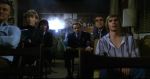
A Mighty Wind (2003)


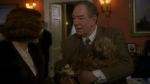
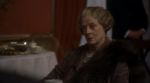
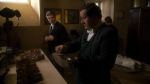
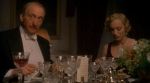
Today’s cinema adventure: A Mighty Wind, the 2003 “mockumentary” feature by master-of-the-genre Christopher Guest, following the efforts to reunite several legendary folk-music acts for an impromptu concert paying tribute to their recently deceased producer.  With several characters developed from an earlier appearance on Saturday Night Live and songs penned mostly by the principal cast (along with Annette O’Toole, wife of frequent Guest collaborator Michael McKean, and C.J. Vanston, the film’s music director- who also appears), it received mostly positive response from critics and moderate success with the public, though it failed to achieve the popularity of Guest’s previous effort, Best In Show– possibly because of its focus on a less universal interest (folk singers are not as much of a draw as fanatical dog owner, apparently) and its more serio-comic tone.  Nevertheless, it has achieved a substantial cult following, alongside Guest-and-company’s other films, and together with these has exerted a visible influence in the creation of a whole new pseudo-documentary style for popular entertainment- particularly on television where successful shows such as Modern Family can be clearly seen as an outgrowth of this genre.

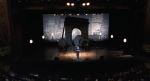
The script for A Mighty Wind, as with all Guest’s movies in this style, was generated through improvisation by its stellar cast, which is comprised almost entirely of veterans from the director’s stock company of players.  When pioneering folk-music impresario and producer Irving Steinbloom passes away, his three children- spearheaded by the fastidious and über-cautious Jonathan- organize a televised memorial concert to be performed at New York’s famous Town Hall; featured will be three of their father’s most famous and beloved acts, two of which have been long-disbanded.  The New Main Street Singers are the latest incarnation of a “supergroup” which once dominated the folk scene, now touring the County Fair circuit and headed by husband-and-wife team Terry and Laurie Bohner, with a sizable lineup which includes the minimal participation of only one original founding member; The Folkmen, an acoustic trio comprised of the relatively good-natured Mark Shubb, Alan Barrows, and Jerry Palter, are enthusiastic about the challenge of returning to the stage to and pleased to be performing together after decades apart; the most eagerly anticipated reunion, however, is that of Mitch and Mickey, a ballad-crooning duo whose starry-eyed connection fueled a successful career in which they captured the idealistic imagination of a generation of fans- and which collapsed along with their romance, leaving Mitch a burnt-out, drug-addled  has-been and Mickey the discontented middle-aged housewife of a medical catheter salesman.  As the date of the concert approaches, the various participants offer a behind-the-music look at their personal and professional lives, revealing both the expected clichés of the musical genre and a few not-so-typical surprises- including adult film careers, bizarre cult affiliations, and gender-identity issues- along the way; but the most pressing concern is whether or not Mitch and Mickey can overcome their long-unresolved passions and resentments to recapture the former magic of their collaboration- and indeed, whether they will make it to the stage at all.

The first and foremost objective of A Mighty Wind, of course, is to amuse; beginning with his involvement in Rob Reiner’s This Is Spinal Tap– the grand-daddy of all “mockumentaries,” and a classic that maintains an enormous fan following to this day- Guest has mined comedy gold by sending up the foibles of odd little social niches- small-town community theater in Waiting for Guffman, competition dog breeders in Best in Show– with shrewdly observational explorations of their rarified worlds.  A Mighty Wind is cut from the same cloth as his earlier efforts, and it mercilessly attacks its target with just as much relish.  The folk music movement of the early sixties was marked not only by the militant political activism of Phil Ochs or the oblique poetry of Bob Dylan, but by the squeaky-clean warblings of such groups as The Kingston Trio and The New Christy Minstrels; in its portraits of the three fictional acts upon which it focuses, A Mighty Wind draws inspiration from all these sources for its parody, but it takes particular glee in its depiction of the extremely white-bread, middle-class sensibility that marks the genre.  These are not the visionary firebrands we might expect from a group of folkies dating back to the pre-hippie days, though there are traces of Dylan and his ilk to be found in the character of Mitch; rather, they are an assortment of more-or-less middle-of-the-road types who seem oblivious not only to the gap between their personalities and the music they perform, but to any of the irony that can be derived from it.  Aside from the New Main Street Singers, who deliberately present an almost sickeningly wholesome image in spite of their bizarre habits and shady histories, these people are more or less exactly what they appear to be, unsophisticated and bland.  They are unquestionably talented- in order for the premise to work, they have to be talented- but their music comes more, perhaps, from imitation than imagination, the pleasant-but-hollow product of a privileged generation trying to emulate the hard-won brilliance of musical pioneers who came before them.  A great deal of the movie’s comic genius can possibly be better experienced listening to the soundtrack album, since the keen musical parodies crafted by the cast beg for our full attention in order to be properly appreciated; even so, in true “mockumentary” fashion, a lot of mileage is gained through “archive footage” of the groups performing in their heyday, along with wickedly satirical photographic depictions of various events, costumes and album covers from the era, most of which evoke memories of real-life personalities and their work.

A Mighty Wind, however, does not depend solely on the easy laughs derived from poking fun of bygone trends in music and pop culture; it also finds a wealth of humor in the well-developed, fully-drawn characters created by its superb collection of comedic performers.  With each outing, Guest’s growing gang of cohorts, comedy legends all, managed even greater dimension in the creation of their characters, making whichever group of off-kilter average folk they happen to be skewering seem more and more fully realized and authentic.  By this time around, the troupe had reached the point of tipping the scales beyond simply lampooning their subjects, resulting in a genuine emotional connection that sometimes brings the story- almost- into the realm of serious character drama.  To be sure, the satirical edge is never absent, but there are moments when heartfelt sentiment emerges with enough strength to transcend the comedic style and unexpectedly strike a more resonant chord.  For the most part, this is reserved for the segments of the film that revolve around Mitch and Mickey, who seem to embody the lost spirit of the sixties, a feeling of youth and unlimited possibility that was soon to be buried and replaced by the worldly cynicism born of disappointment and failure; in the tentative efforts of this broken duo to bridge the gulf between past and present, A Mighty Wind expresses a yearning for lost idealism that cannot help but affect us at a deeper level than the snarky humor that otherwise dominates it.

Whether or not this is a negative criticism depends upon your point of view.  For many fans of Guest’s trademark formula, the crossover into pathos may be too much, an attempt to take the characters as seriously as they take themselves- and, of course, the key connecting theme of all these films, and the source of most of their comedy, is the fact that its characters take themselves far too seriously, investing their storm-in-a-teacup concerns with world-shaking significance and underscoring their own foolishness at every step.  For me, however, the underlying factor which makes these comedies funny- as opposed to hip and snarky- is the humanity with which Guest and his players treat their buffoonish creations.  In their efforts to puff themselves up, these champions of mediocrity enact our own desire to make a mark in the world, to rise above the mundane and often unfulfilling drudgery of an unremarkable life.  By laughing at them, we can laugh at our own occasional pomposity; but because they are also, in the end, so recognizably human in the insecurities and uncertainties that inevitably show through their facades, we can forgive them their self-aggrandizement and, by extension, forgive ourselves for ours, as well.  A Mighty Wind takes this equation one step further; by giving us an assortment of throwbacks to an earlier era, one at once more naive and more promising than our jaded present day, it sets up a sort of reflection on our entire cultural identity, with all its irony-laced sophistication, and its collective longing to believe in itself again- even if it’s just for a moment.

I don’t want to make it sound, however, like A Mighty Wind is one of those feel-good comedies that wins our attention with laughs and then degenerates into pseudo-heartfelt preciousness.  Guest and his compatriots ensure that they never even come close to that boundary, simply by virtue of their entirely honest approach to the characters.  There are no scenes of forced emotional climax; the epiphanies take place between the lines, without comment, and become part of the landscape on which further developments are built.  Nor does the film present some false fable of life-changing redemption, comic or otherwise.  The final scenes make it clear that whatever may have happened during the adventure of the concert, these people will continue to lead a life on the fringes, still seeking- though perhaps with renewed vigor- to grab another moment in the sun by whatever means necessary, no matter how ridiculous; and we love them all the more for their determination to go on trying, even though we may giggle at the absurdity of their attempts or feel a bit embarrassed for them over the indignities to which they stoop in their quest.  Still, whereas in previous outings we only shake our heads and dismiss these further shenanigans with bemusement, in A Mighty Wind, thanks to the genuinely sympathetic insight we have gained into at least some of these loony losers, there is a pang of wistful regret added to the mix that creates a distinctive sense of melancholy.  It’s not a bad thing, in my view, for even if the movie lacks the outright hilarity of Guffman or Best in Show, it stays with us in a way those previous gems do not, and the stronger emotional connection it makes leaves us feeling all the more satisfied.

Whether or not you respond to the way Guest’s film strives for more legitimacy through its forays into tenderness, it is undeniable that the work of the ensemble has here reached a new level of brilliance.  Each character, no matter how small, is invested with a sense of complete life, contributing indispensably to the overall picture presented by the film.  The front lines are manned by the performers taking on the personae of the musicians.  Michael McKean, Harry Shearer and Guest himself are The Folksmen, giving the workmanlike trio an unrelenting aura of positivity that may occasionally be strained but is never forced, making them a sort of flip side to their trio of heavy metal rockers in Spinal Tap; foremost amongst the New Main Street Singers are John Michael Higgins and Jane Lynch as the headlining Bohners, who give the pair a comically unsettling aura of sexual ambiguity and deep dysfunction under their slick-and-shiny patina of professional cuteness, with Parker Posey adding her own touch as a former-delinquent-turned-group-member who exudes the vacuous zealotry of a brainwashed teenage cultist; and giving the film its heart- while still providing mordant commentary through their keenly-observed  performances- are the incomparable Eugene Levy and Catherine O’Hara, as Mitch and Mickey, respectively.  These latter two take their improv-built characters to a depth and fullness that rivals those in any conventional screenplay, layering them with a kind of subtext and dimension that makes us forget these are not real people on the screen. Levy brilliantly exudes the aura of the intense, visionary and antisocial poet, seething with all the charisma that entails, until he opens his mouth to reveal his true nature as an inarticulate, fatuous burnout whose emotional and social maturity seems to have ceased developing circa 1965.  It is O’Hara, though, who steals the show with her remarkable portrayal of Mickey, the sensible and pragmatic housewife who finds the dreams of her youth- and her passions for the love of her life- are reawakened by the chance to relive her gone-but-not-forgotten glory days.  She alone, of all these misfits, defies ridicule; she is foolish, yes, and caught up in an illusion as much as any of the others, but she is also eminently likable in her blend of down-to-earth simplicity and mature sophistication, and we find ourselves hoping alongside her that the promise of her past can at last come triumphantly to fruition.  It’s a forgone conclusion that it won’t, at least not in any lasting way, but O’Hara’s complete and sincere commitment to the role allows us to fool ourselves just as willingly as Mickey does, and her inevitable disillusionment is ultimately perhaps more heartbreaking for us than it is for her.  It’s a transcendent piece of acting, by any standards, and together with her old SCTV cohort Levy, she makes A Mighty Wind as poignant a portrait of unrequited longing as any “legitimate” Hollywood romance.

Other fine performances come from stalwarts such as Bob Balaban (as the anal-retentive Jonathan Steinbloom, who along with Michael Hitchcock as a Town Hall event coordinator provides the movie’s biggest laugh-out-loud moment), Fred Willard (as a leering and embarrassingly tacky  sitcom-has-been-turned-agent), Ed Begley, Jr. (as a public television executive of Jewish/Scandinavian descent), and the scene-stealing Jennifer Coolidge (sporting a ridiculously unplaceable accent as possibly the stupidest P.R. agent in history).  Making the cast’s contribution even more impressive, of course, is the fact that those impersonating the musicians not only wrote the movie’s musical selections, but also played and sang them, in some cases teaching themselves the necessary instruments.  The result, as noted above, is a collection of songs that are not only wickedly hilarious but are as infectious and memorable as the ones they so cleverly mock; indeed, Mitch and Mickey’s signature hit (which plays a key role in the story) is so authentic that it stands on its own, without irony, and received a nomination for Best Song at the Academy Awards; and the film’s title tune (with its brilliant lyric, “A mighty wind is blowin’ […] it’s blowin’ peace and freedom, it’s blowin’ you and me”) was actually awarded a Grammy for Best Song Composed for a Movie.

In this prodigious display of talent, its easy to overlook the contributions of the film’s director.  Guest- in addition to his subtly hilarious turn as the vaguely dim-witted, Garfunkel-haired, fuddy-duddiest third of The Folksmen-  humbly provides his skills as a guiding hand; much of his genius rests in his willingness to turn his collaborators loose in front of the camera and let them work their magic, but his ability to piece together a finished result cannot be underestimated.  He shapes a coherent, intelligent, touching and hilarious narrative out of what must have been hundreds of hours of footage, and A Mighty Wind is a testament to his patience and dedication as much as his sense of humor and his talent- both behind and in front of the camera.

As with all of Guest’s films, appreciation for A Mighty Wind is dependent on a number of factors.  A taste for satire is required, as is a fondness for dry humor and an enjoyment for both “high” and “low” comedy; it certainly helps to have at least a passing knowledge of whichever insular world on which he has chosen to turn his focus.  Those without exposure to the history or conventions of folk music may find little amusement in A Mighty Wind, just as those who have never seen a small town theatre production may not “get” Waiting for Guffman.  For those “in the know,” both films are funny; but whereas Guffman (and Best in Show, for that matter) has a tendency towards an almost mean-spirited ruthlessness in its approach, this time around, the Guest Gang seems to have mellowed; not that they have lost their edge, but perhaps they have softened it.  There is a fondness for the people of A Mighty Wind that seeps into us as we watch, bonding us to them in a way we could never achieve with, say, Corky St. Clair of Guffman; these characters become a part of us, and seem as real to us- perhaps more so, in fact- as the true-life musicians that inspired them.  Furthermore, because the film’s humor- and its pathos- is based more in its characters than on its subject matter, A Mighty Wind might just be, despite the relative obscurity of the milieu in which it dwells, the most accessible of these movies.  At any rate, it certainly touches on a more universal nerve than any of the others, and does so in a way that is both touching and faintly unsettling, like a wistful reminder of a mark we once made for ourselves as a culture- and a remonstration for having fallen so far short of it.

http://www.imdb.com/title/tt0310281/


Bringing Up Baby (1938)

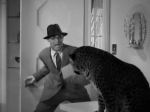
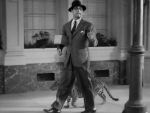
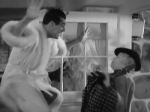
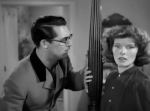
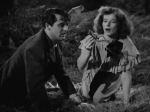
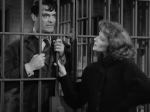
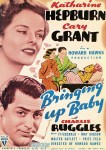
Today’s cinema adventure: Bringing Up Baby, the 1938 classic by director Howard Hawks, teaming Katharine Hepburn and Cary Grant as a pair of misfits who become entangled with each other in a complicated adventure involving (among other things) a tame leopard, a rambunctious terrier, a priceless dinosaur bone, several cases of mistaken identity, and a million dollars.  Despite good reviews and popularity with audiences in more sophisticated urban markets, it was a major box office flop upon its first release, leading to both its director and its female star being released from their contracts with RKO Pictures, the studio that produced it- indeed, Hepburn, who had headlined a string of financially disappointing movies, was labeled “box office poison” following this failure, and had to return to the Broadway stage in order to restore her reputation and her clout.  Nevertheless, a generation later, the film was rediscovered through the new medium of television, and has subsequently taken its place as one of the greats, a definitive example of the “screwball comedy” sub-genre, one of the finest vehicles to feature either of its iconic stars, and an influential piece of filmmaking that has inspired countless imitations and homages over the years.

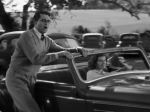
The plot, based on a short story by Hagar Wilde (who also co-authored the screenplay with Dudley Nichols), focuses on one David Huxley, a paleontologist who, on the eve of his wedding to no-nonsense colleague, Miss Swallow, is sent to secure a million dollar donation to the Manhattan museum for which they both work.   It seems an open-and-shut deal- all that is required is a meeting with the donor’s attorney, upon whose approval the money will be bestowed; but David’s appointments with the lawyer are repeatedly interrupted by Susan Vance, a dizzy young society woman who seems to turn up everywhere he goes- and whose precocious antics involve him in enough confusion and mishap to blow his chances at obtaining the money.  As it happens, though, Susan turns out to be the niece of the museum’s would-be benefactor- a wealthy widow named Mrs. Random- and she promises David (with whom she has become smitten) she will persuade her aunt to donate to the museum anyway.  She enlists his help, against his will and his better judgment, to accompany him to her aunt’s country estate in order to deliver a pet leopard (named Baby) that has been sent as a gift from her big-game-hunter-brother; once they arrive, more confusion erupts, starting with Susan’s false introduction of David as a mentally unstable friend of her brother’s, and complications continue to arise- including the theft of David’s precious brontosaurus clavicle by Mrs. Random’s dog, a mix-up between Baby and an escaped (and mean-tempered) leopard from a traveling circus, and the interference of a crotchety local constable.  Through it all, David struggles to resolve the situation and make it back to the city in time for his wedding, but it becomes clear that Susan is doing everything she can to delay him and keep him by her side.

A description of the plot, in print, seems ridiculously far-fetched and convoluted; that, however, is what gives Bringing Up Baby its zany appeal on film.  The entire movie is a whirlwind of unlikely circumstances and coincidental relationships, bound together by a premise that is as flimsy as one of the diaphanous costumes that Hepburn sports onscreen.  This is the nature of the screwball comedy; we take for granted that the scenario will be ridiculous, and as long as it yields the kind of laughs we expect, we don’t mind suspending our disbelief in the absurdity of its situations.  As scenarios go, that of Bringing Up Baby is more ridiculous than most- in fact it borders on the surreal, but we accept it without batting an eye, because it also delivers more laughs than almost any other film of its era- or any other, for that matter.  It certainly helps that director Hawks drives the proceedings at a breakneck pace, scarcely giving us time to think about the credibility gaps or even to register the fast-and-furious jokes until they have already passed us by.

Much of the hilarity, however, arises from the chemistry of the two stars, perfectly matched and clearly relishing their roles; their comic banter arises so effortlessly as to belie the artificiality of the dialogue- indeed, the two performers ad-libbed some of the film’s best jokes- and they so completely inhabit their roles as to make us easily forget the many other personas they adopted on the screen over their long individual careers.  Grant in particular made a breakthrough here; his previous career had been mostly comprised of more-or-less dramatic (and none-too-weighty) leading man roles, and though he had previously appeared in The Awful Truth– another screwball classic in which he demonstrated his particular flair for comedy- nothing had prepared audiences for his work here.  Playing gleefully against type, the impossibly handsome Grant pulls off the role of the timid, nervous and befuddled bookworm without ever letting us doubt his awkward ineptitude; at the same time, he rattles off his barbed dialogue with the timing and wit of a master, making it clear that he is up to the challenge of sharing the screen with the formidable Hepburn.

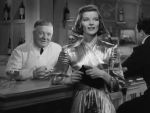
As for The Great Kate, it’s hard to see her performance here and understand why she should be deemed a liability by studio executives; her sharp, patrician bearing is brilliantly undercut with a little-girlish softness that makes her instantly lovable no matter how maddeningly daffy she gets.  Careening from haughty and indignant to doe-eyed and tender and back again through all stops in between, her portrayal of Susan drives the film and gives it a heart; and even when her behavior is at its most inane, her glittering intelligence always shines through, giving this upper-crust oddball an edge that leaves no doubt of her absolute control over the entire madcap situation.  She never overwhelms her co-star, however; the two make a magnificent team, one that is immediately recognizable as perfect for each other (a conceit on which, of course, the entire movie depends), and the obvious real-life affection between them translates into an onscreen chemistry that has rarely been matched and makes this pairing one of the most iconic co-starring turns in cinematic memory.

Perfect as they may seem in their roles, both of the stars initially had trouble with the project.  Grant feared being unable to project the necessary intellectual quality of a career scientist, and was only able to relax into the the character when director Hawks told him to base his performance on the persona of silent screen comedian Harold Lloyd; Hepburn was stymied by the over-the-top zaniness of Susan, and struggled with finding the right approach until Hawks asked veteran character actor Walter Catlett, who was playing a minor role, to coach her in the art of playing outrageous comedy- he taught her the effectiveness of underplaying and naturalistic delivery (as opposed to the more deliberately comedic style she was attempting), and she was so grateful for the help that she insisted his part- the town constable with whom she tangles in the film’s climactic scene- be expanded to give her a chance to work with him more extensively.  Their initial reticence allayed, both the film’s stars settled into the rhythm of their characters and created the sparkling joint accomplishment that makes Bringing Up Baby so delightful to this day.  Their enjoyment of each other is clear to see, and infectious; they had so much fun working together on this film that shooting went over schedule (and over budget) due to their difficulty in completing their scenes without laughing.  Though doubtless this was a thorn in the side of RKO executives who were already anxious over the project, the fun translates to the screen.

Apart from the obvious joys of Hepburn and Grant’s interplay and their attractiveness both individually and as a couple, there is a more subtle aspect to their dynamic that lends a unique flavor to the goofball romance at the center of Bringing Up Baby.  Grant, though decidedly masculine in his energy and personality, plays the passive, pursued role in this relationship, while Hepburn is clearly the active aggressor.  It seems a minor twist, but by reversing the traditional gender roles of courtship in such a way, Baby sets itself apart from most of the romantic comedies that came before it.  It would be wrong to credit the film for being the first work of fiction to do this- after all, Shakespeare wrote several plays in which this inversion was explored- but Hollywood has always been known for reinforcing stereotypes, and by swapping these accepted standards of masculine and feminine behavior Bringing Up Baby became a milestone in the depiction of gender identity on the big screen.

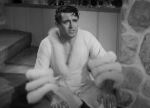
This in itself is enough to have given the movie a special significance for GLBT audiences; but there is another point of interest here for cinema historians which also gives the movie its “gay appeal.”  In one memorable scene, Cary Grant, dressed in a frilly and feminine house robe (having had his clothes stolen by Hepburn whilst showering), is forced to meet the returning aunt- a formidable dowager- at her own front door.  The understandably flustered woman, confused by the presence of a strange man in her house, presses him impatiently with questions, and most adamantly (for some reason, though it seems the least alarming aspect of the situation) she wants to know why he is wearing those clothes; the badgered Grant, already pushed to the limit of his patience by Hepburn’s continued hijacking of his formerly sedate life, leaps in the air and shouts, “Because I just went gay, all of a sudden!”  This line, ad-libbed by Grant on the set, may be the very first instance in mainstream fiction that the word “gay” was used to denote homosexuality, though within the underground gay community it had been used as a code word since at least the 1920s.  It may not have been intentional (though frankly, it’s unlikely that a group of Hollywood sophisticates such as these would be unaware of the double meaning- particularly Grant, whose famous long-term relationship with “roommate” Randolph Scott is still the subject of much debate among his many fans), but whether it was or it wasn’t, this bold double-entendre provides one of the biggest laughs in the film, and is yet another reason why Bringing Up Baby has been accorded landmark status.

Historical footnotes aside, there are plenty of reasons to watch this little gem of late-Depression escapism today.  Not only are Hepburn and Grant a rare treat to watch, they are supported by a fine cast of character players that bring to life the assortment of other lunatics surrounding the film’s dotty protagonists.  In addition to the aforementioned Walter Catlett, whose comically cagey turn as the rural lawman provides Hepburn with a magnificent foil late in the film, there’s Charlie Ruggles (as a mild-mannered and easily flustered hunter who turns up as a guest to Mrs. Random’s estate), Barry Fitzgerald (as a heavy-drinking Irish gardener, a bit of now-inappropriate ethnic profiling that nevertheless seems innocent of malice and manages to still be funny today), perennial screen waiter Fritz Feld (here cast as a smugly pompous psychiatrist whose path keeps crossing with Hepburn’s, adding to the already-convoluted tangle of misunderstandings), and the redoubtable May Robson (as the somewhat battle-axish Mrs. Random).

More vital than any of these notables, however, are the non-human members of the supporting cast, and they too deserve mention.  Nissa, the leopard, a veteran of numerous B-movie jungle adventures, plays the dual role of both Baby and the dangerous circus escapee; the other four-legged star, in the role of the mischievous bone-thief, George, was Skippy, a terrier whose fame as “Asta” in the popular Thin Man movies made him nearly as big a draw as the human headliners, and his appearance here is highly memorable, exhibiting the exuberant canine personality that made him a natural and ensured his place as one of the immortal screen animals.

On top of the performances, Bringing Up Baby offers a fine look at late-thirties fashion and design through its sets (a sumptuous blend of Art Deco and neo-classical influences alongside the elegantly rustic charms of the Random estate, overseen by the legendary Art Director, Van Nest Polglase) and its costumes (most particularly the various range of outfits worn by Hepburn, with which designer Howard Greer manages to add some sly satirical commentary on the frivolity of fashion into the movie’s comedic recipe).  In addition, tech aficionados may find some interest in the early special effects- quite sophisticated for the time- with which the actors are sometimes made to appear with the leopard in close proximity (especially Grant, who wouldn’t go near the creature- though the fearless Hepburn directly interacted with it and can even be seen petting it in a few scenes); in several of the split screen sequences, a moving center line was required, creating a complex challenge for the technicians of the day.  They rose to it admirably; the seams are virtually invisible to all but the most attentive observers.

Bringing Up Baby, it may be clear by now, is a seminal movie for me; I have fond memories of watching it on TV with my parents, all of us laughing out loud together, and through the years I have seen it countless times- I can practically recite the dialogue along with the actors, and yet a viewing will still have me giggling uncontrollably throughout, as well as discovering nuances and subtleties that I had never noticed before.  No doubt there are many others out there with a similar relationship to this film; it was, after all, one of the first movies selected for preservation by the Library of Congress, and it has been consistently named on lists of the 100 best or funniest movies of all time.  For most, it is the movie that comes immediately to mind when the term “screwball comedy” is mentioned, and for good reason- it’s about as screwball a comedy as you can get without veering into the realm of the Looney Tunes.  For those who have yet to discover its sublime wackiness, I will give away no more than I already have; and for those who feel their modern tastes are too sophisticated for a 75-year-old comedy to provide much amusement, I can only challenge anyone to sit through Bringing Up Baby without cracking at least a smile.  After all, it has been called more than once a movie ahead of its time- which may, better than anything, explain why a film that temporarily sank the careers of both its director and its leading lady (though not, tellingly, that of the resilient Cary Grant) went on to become one of their most enduring and beloved creations.

http://m.imdb.com/title/tt0029947/

Gosford Park (2001)

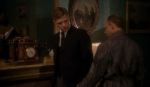
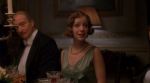
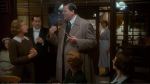
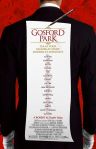
Today’s cinema adventure: Gosford Park, the 2001 period mystery-comedy directed by Robert Altman and featuring an all-star ensemble cast in a screenplay by future Downton Abbey writer Julian Fellowes.  Set on an English country estate in the early 1930s, it uses the familiar premise of an Agatha-Christie-style whodunnit as a pretense to explore the complex social structure and interrelationships among the wealthy landed gentry and the servant class that runs their households, exposing the busy undercurrent of secrets and scandals that flows beneath the genteel and proper surface of upper class British society.  One of Altman’s most successful films, it was popular at the box office as well as with most critics, and it received a number of awards and nominations, including an Oscar for Fellowes’ screenplay, Best Film at the BAFTAs and Best Ensemble Cast (the rough equivalent of Best Picture) from the SAG Awards.

The film takes its title from the name of the estate on which it is set, owned by Sir William McCordle, where a number of guests gather for a weekend hunting party.  Most are relatives or family associates- Lady McCordle’s sisters and their husbands, daughter Isobel’s suitor, a dowager cousin- but among their midst are also a few strangers, including a Hollywood producer named Weissman and noted film star Ivor Novello.  This elite crowd, however, constitutes a minority of the population here in Gosford Park; the household is crowded with an army of servants, bustling around the clock to serve their masters, and their number is increased by the influx of personal valets and maids who attend the estate’s guests.  As the weekend progresses, rigorous adherence to decorum and tradition dominates the outward appearance of this gathering and its festivities, despite the myriad personal agendas, hidden relationships, false pretenses, secret histories, private resentments, and unseen tragedies that exist behind the scenes.  These underlying dramas are unexpectedly brought to the surface when a murder takes place, prompting the intrusion of the local police inspector whose investigation lays bare many of the dirty little secrets on both sides of the class divide- as well as some which cross that inflexible boundary.  The solution to the mystery, masked beneath layers of assumption, convention, and privilege, may be a simple crime of passion or a calculated act motivated by financial gain- or it may ultimately hinge on the conflict between an unjust social system and the most basic impulses of humanity.

Director Altman was known for his explorations of different subcultures (the military in M*A*S*H, the country music community in Nashville, the Hollywood film industry in The Player), using an interwoven tapestry of characters and events to offer social observation and commentary through the prism of these microcosmic settings; by the time of Gosford Park, his reputation was such that he had no trouble securing the impressive collection of collaborators necessary to bring to life this meticulous recreation of Edwardian country life between the wars.  Screenwriter Fellowes, an actor who had (at the time) never previously authored a screenplay, was approached by the director due to his extensive knowledge of the complex workings of the domestic management of the era and the culture of the serving class upon which it all depended; he wrote a script, and served as the film’s technical advisor as well, allowing him to rewrite and hone portions of his work on the set.  As with most of Altman’s films, some of the dialogue was also improvised during filming, particularly in the scenes involving a large group of actors, lending an authenticity to the sound of the conversations and contributing to the overall feel that we, the audience, are eavesdropping upon the characters’ private lives; even so, under Fellowes’ guidance, the entire, sprawling saga is united with a cohesive singularity of purpose and consistency of style, providing the master director a solid structure upon which to build his own vision.

Altman’s signature format, in which a focused perspective is imposed upon an almost documentary approach to the narrative, at first might seem a bit ill-suited to a costume piece like Gosford Park; we are conditioned by experience to expect a more theatrical presentation in films such as this.  However, the Altman treatment works brilliantly here, particularly given the director’s purpose; like all of his films, Gosford Park is less concerned with plot (though the story is intricately woven and ultimately, very compelling) than it is with its characters and its observations of human behavior.  Like a fly on the wall, we are privy to the public and private interactions of the denizens of this estate and their guests, but these exchanges seem part of a bigger landscape, as if they were individual trees or a babbling brook in a painting of a countryside; in other words, the concerns of the characters are details which contribute to the more significant whole, a complete portrait of a way of life.  The details of a nobleman’s financial schemes or backstairs dalliances are granted no more importance than the polishing of the silver for dinner service; indeed, the mundane details of this rarefied lifestyle are far more interesting to Altman than the various worldly concerns of the characters, and, thanks to his careful choices in focus, he makes them so for us, too.

In keeping with his detached observational technique, the director similarly places emphasis on the intricacies of his characters’ behavior and personalities.  Each individual is seen in relation to the others, illuminating their social roles and the subtleties of the relationships between the various subdivisions, even within the two primary groups.  Money, status, seniority, tradition, convention- all these and more play a part in determining the “pecking order,” and the rules of this rigid structure far outweigh any considerations based on emotion or concern for humanity; there is no tolerance for those who forget or disguise their rightful place in the order of things, and the public display of passion, particularly when it crosses the sacred class boundaries by which the entire cultural system is governed, is a greater transgression of decency and decorum than a discreetly-executed murder.  It is this obsession with maintaining appearances, of keeping all the warts and wrinkles of being human out of sight at all cost, that ultimately emerges as the over-reaching theme of Gosford Park; it is also seen, by microcosmic implication, as the mechanism for the looming downfall of this ponderous, antiquated way of life- for in the deeply buried untidiness of past scandal lies the seed of the consequence which rises from the well-hidden, forgotten depths to strike a blow against the entrenched injustice of the entire system.  In this way, despite its almost reverent depiction of an ultra-conservative world in which even the most downtrodden are contemptuous of change, Gosford Park manages to echo the anti-establishment sentiment usually associated with Altman’s work.

Such socio-political conclusions are left, however, to be drawn (or not) by the viewer; Altman adopts an objective eye, almost like a field researcher doing an anthropological study.  He records the events of the weekend with a slowly moving camera, lingering here or there to pick up an interesting detail or reveal a fact which might not be apparent to the passing eye, and trusting Fellowes’ words to carry the narrative, along with any thematic elements that may be present.  Of course, it falls to the cast to bring life to the script and give the director the behaviors with which to fill his lens; and the collection of superb actors on display in Gosford Park does so magnificently, capturing every subtle nuance of their roles and deftly providing an ocean of subtext without ever disturbing the naturalistic atmosphere that is Altman’s milieu.  Most of these players are experienced in theatre, which serves them well as Altman allows his focus to move freely amongst the characters the way the eye travels around the stage at a live performance; as they conduct their conversations, steal their glances at each other, clear the table, pour the sherry, and all the other living activities on display at a dinner party, the audience may or may not be watching- they must be “on” at all times, regardless.  They speak realistically, often overlapping dialogue and talking simultaneously, as Altman shrewdly hovers just long enough to permit us to hear the crucial bits; and in the smaller scenes, depicting the private moments spent alone or in pairs, though the emphasis is often on what is seen and what is left unsaid rather than what is spoken, the vital information is communicated, nevertheless, through the minutest of gestures and expressions.  It’s an impressive collection of performances, one of the finest examples of true ensemble screen acting in recent memory.

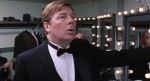
This incomparable cast includes a mix of actors, from the legendary to the unknown, all of whom deliver exemplary performances; a few stand out, deserving special nods, not so much because they are superior but because their roles give them the chance to shine individually. Most noticeable, perhaps, is the always delicious Maggie Smith as a snobbish and acid-tongued dowager countess (foreshadowing her Emmy-winning role in Fellowes’ wildly successful Downton Abbey series a decade later); Helen Mirren exudes the anonymous perfectionism and the crisp, selfless honor of a lifetime in service, and late in the film releases an unforgettable flood of repressed humanity that drives home everything Gosford Park is about; Michael Gambon, as the misanthropic lord of the manor, and Kristin Scott-Thomas, as his icy and discontented wife, personify the insulated ennui of the inconceivably wealthy-and-powerful upper class; Stephen Fry has a remarkable turn as the police inspector, turning the familiar stock character of this genre on its ear by being dull and sycophantic instead of brilliant and unflappable; Emily Watson gives us a portrait of youth and good nature being bent by servitude towards frustration, bitterness and cynicism, putting a human face on the socially-sanctioned exploitation of the serving class; and relative newcomer Kelly Macdonald is charming and likable as the deceptively naive young ladies’ maid who provides our window of access into the austere and intimidating world of the film.  Also lending the weight of their presence are such thespian luminaries as Alan Bates, Derek Jacobi, Eileen Atkins, and Charles Dance; a newer generation asserts itself through the work of Clive Owen and Jeremy Northam, and representing the American contingent are the stalwart Bob Balaban and the handsome Ryan Phillippe, as the film producer and his valet, respectively, present for the purpose of researching an upcoming movie project and concealing a number of secrets in their own right.

The three-way combination of director, screenwriter, and cast is supported by a top-notch assembly of technical and visual elements; filmed on location at several authentic English country houses and a painstakingly constructed soundstage set at Shepperton Studios, the atmosphere of Gosford Park is so completely realized that we are wholly transported to this bygone place and time.  The sumptuous production design executed under the supervision of the director’s son, Stephen Altman, and the dazzling array of costumes, designed by Jenny Beavan, all captured by the rich cinematography of Andrew Dunn- these contributions help to make the movie a total immersion in the period it portrays.  Completing the effect is the wistfully nostalgic score by Patrick Doyle, evoking the sadness of a dying age, and rounded out by the inclusion of several songs by the real-life Ivor Novello, performed exquisitely by actor Northam, both on camera and off.

With the popularity of the aforementioned Downton Abbey, many will no doubt be drawn to this previous work by its author; it should be noted that, though the intricacies of English country life are depicted with the same painstaking accuracy as in Gosford Park, the tone here is much different than in the hit series.  Altman’s style and purpose are far removed from the tone of fond admiration which pervades Downton, and his characters are less likely to incur our affections and loyalties than those to be found on Lord Grantham’s estate.  As with all of the director’s work, Gosford Park is not for every taste- the cool detachment, the oddly stylized naturalism, the oblique and almost passive-aggressive social criticism, the ironic and oh-so-dry humor, and- perhaps most of all- the constantly roving focus that makes it difficult to anchor one’s emotional perspective in the story; these are all common obstacles for many viewers who dislike Robert Altman films, and they are certainly present here.  Conversely, fans of the director’s work may be turned off by the movie’s cloistered atmosphere, a far cry from the more free-wheeling, overtly colorful setting of his usual, decidedly American subjects.  Nevertheless, Gosford Park is one of Altman’s most accessible pictures, appealing to a wide range of audiences that might not otherwise be appreciative of his sometimes obtuse approach.  In some ways his most atypical project, and in others a quintessentially Altman creation, it cannot be termed his masterpiece, by any means, but it must be ranked highly in his canon as one of his most successful films in terms of overall accomplishment of its intended goals.  Taken independently from Altman’s other work, it certainly stands as a prime example of what can happen when style, content, and execution come together so coherently that the end result is as polished and nearly perfect as a film can be.  For my part, Gosford Park is the kind of movie that makes me remember why I love movies; even if it’s not your cup of tea (to use an apt expression), it’s worth a look just to see what happens when genuine cinematic teamwork makes all the pieces fit as neatly as a good butler’s tuxedo.

http://www.imdb.com/title/tt0280707/

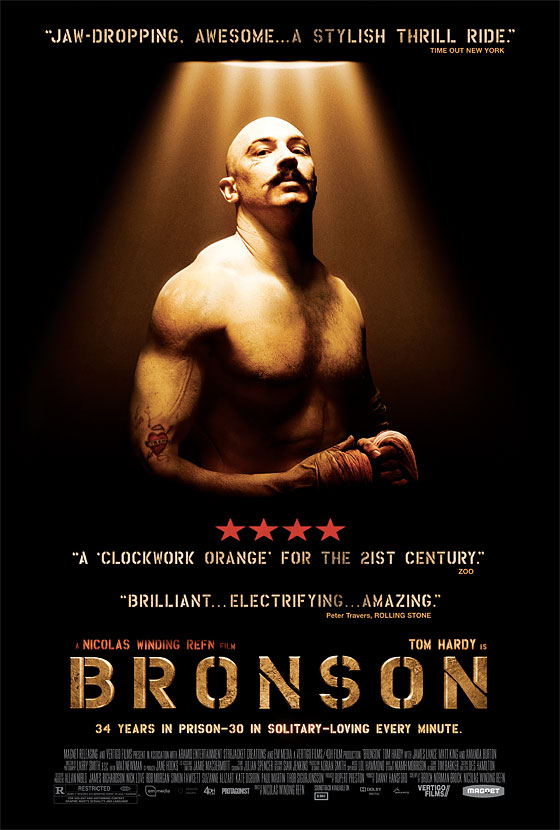
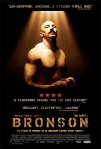
Bronson (2008)

Today’s cinema adventure: Bronson, the 2008 biopic about England’s most notorious prison inmate, Michael Peterson (who changed his name to Charles Bronson during his brief career as a boxer), whose reputation for violence and trouble-making has led to his having spent the majority of his adult life behind bars- and most of that in solitary confinement.  Directed by Nicholas Winding Refn and starring Tom Hardy in the title role, the film takes Peterson’s real-life story and presents it in a highly stylized, theatrical manner, focusing on fictionalized vignettes and incorporating some real-life footage to depict some of the most infamous incidents from his long history.  Rather than a straightforward biography, the movie is more a meditation on the enigmatic nature that causes such antisocial behavior, ultimately leaving its subject’s motivations a mystery and offering no concrete explanation for the impulse towards violence.

Bronson frames its story with a narrative conceit in which Peterson presents his own story, to an unseen but appreciative audience, on a bare stage; in various stages of theatrical make-up, and with a considerable amount of flourish, he gleefully relates his life story, beginning with his childhood as the son of typical middle-class parents in the London suburb of Luton.  Intercutting portrayals of real events with his “performance” in the theater, the film proceeds to relate the general outline of his life.  We see his early marriage to a co-worker who witnesses his first crime (the theft of money from a cash drawer in their shop), his subsequent arrest and incarceration for the armed robbery of a post office, and the continual extension of his 7-year sentence due to his repeated assaults on his guards and fellow inmates.  When frequent transfers to different facilities throughout the penal system fail to curb his violent tendencies, he is declared insane and moved to a mental institution, where despite heavy sedation he nevertheless attempts to murder another patient.  Further transfers lead to further incidents, so he is declared sane and set free.  His return to the outside world is short-lived, however.  After a short career as a fighter in the illegal sport of bare-knuckle boxing (for which, at the suggestion of his promoter, he adopts his new name), a jewelry store robbery lands him back in prison after only 69 days, where he promptly resumes his  escalating cycle of violence, despite showing an interest- and some talent- in art, leading to an ongoing campaign of riots, beatings, and  hostage-taking that continues not only up to the making of the film, but to this day.

The challenge for a filmmaker trying to tell this story is to find a way to avoid making it seem repetitive; Peterson’s life is one brutal fight after another, almost all of which happen in prison cells.  In the screenplay for Bronson, co-written by director Refn with Brock Norman Brock, an elegant solution is found with the bold and decidedly stylized narrative device in which the film’s subject presents his own vision of his life in the “theater of the mind.”  Besides providing a unique means of breaking up the action and offering pithy commentary, this technique creates an almost Brechtian detachment in which, constantly alienated from the story by the obvious artificiality of this conceit, we are encouraged to examine Peterson’s tale with our intellect instead of our emotions; yet, at the same time, by allowing the darkly charismatic criminal to speak for himself, Refn and Brock also make it possible for us to make a connection with him that would be impossible in a more standard approach to his tale.  He is permitted to be polished and eloquent in the spotlight of his fantasy, a stark contrast to the brutish, inarticulate beast we see in the scenes of his real life, and the self-satisfied irony of his performance persona confronts us with a defiantly mocking challenge to our attempts to find reason or logic behind his ferocious nature.  In short, the interstitial theatrics convert the proceedings from a straightforward- if stylish- biographical drama to a somewhat surreal cinematic exploration of the violent mind and its disquieting opposition to the standards of civilized normalcy we take for granted.

Despite this artistic spin, Bronson still struggles with the issue of redundancy; the film’s more concrete depiction of events returns, by necessity, to scenes of its anti-hero beating his handlers to a pulp, making it feel like something of a one-note symphony.  Director Refn, however, a Danish-born wunderkind whose later film, Drive, has firmly established him as an auteur on the rise, manages to find a number of creative stylistic tweaks which prevents the movie from seeming like it is stuck in a loop.  Even when we are not within the clearly marked boundaries of the theatrical framing device, Refn maintains a dreamlike sensibility that keeps us unsure of where we stand in the continuum of reality and illusion; he creates a visually arresting and mentally stimulating atmosphere through his use of bold primary colors, odd lenses and camera angles, and an absurdist perspective in his approach to the mundane aspects of the institutionalized settings.  He varies the environment as much as possible, choosing a number of distinctively different backdrops for Peterson’s myriad brawls and acts of terror (particularly memorable is the re-purposed ballroom that serves as a Fellini-esque purgatory for the scenes in the mental institution) and utilizing a surprisingly diverse assortment of jail cells and common rooms- which has the added effect of underscoring just how many times responsibility for “England’s most violent prisoner” is passed from one facility to another.  Most importantly- and more to Refn’s purpose- the ever-changing backdrops and the hallucinatory sense of heightened reality yield a disorientation that keeps us from anchoring ourselves as we experience Peterson’s journey and, ultimately, reminds us that everything we see here is filtered through the skewed perspective of his mind.

In the center, standing in for the larger-than-life figure himself, is Tom Hardy, making a substantial breakthrough in a career which has since led him to participation in blockbusters such as Inception and The Dark Knight Rises.  Given his powerful, commanding performance, it’s no surprise that he has become one of the industry’s most promising stars; his vision of Peterson- with whom he met in person before filming began- is an impressive creation, full of raw, animalistic power (his massive, rock-solid physique contributes greatly in this department) and yet with the spark of considerable native intelligence that makes it impossible to explain away his brutal tendencies as the product of ignorance.  This is a man who knows exactly what he is doing- his violence is a conscious choice, even a calling, and Hardy makes it clear how much pride he takes in it.  What makes his portrayal most effective, perhaps, and in precise tune with Refn’s approach, is the humor he brings to it; ironic, dark and unsettling humor, but effective in helping us into the mind of this flamboyant character.  We may not understand what we find there, but in Hardy’s performance at least, we are captivated by it.  The rest of the performances- small roles, for the most part, reflecting the peripheral nature of others in Peterson’s personal universe- are effective as well, though no one gets much opportunity to shine, save for Matt King as the convict’s fey and seedy former-prison-acquaintance-turned-boxing-promoter and Juliet Oldfield as the young call girl with whom he has a dalliance during his brief taste of freedom.  It’s not meant to be an ensemble piece, however; Bronson is, for all intents and purposes, a one-man show for Hardy, who certainly proves himself up to the challenge.

With such a strong performance to recommend it, showcased in a stylish and visually exciting vehicle by its exceptionally talented director, Bronson succeeds in providing an engaging look at its notorious subject, albeit a highly fictionalized one- numerous facts are significantly altered and others are omitted or made up entirely to suit the purpose of Refn’s vision, which is more along the lines of an expressionist horror film.  The director casts his real-life subject as a sort of monster, though the story is seen from his point of view; Peterson is depicted as a force of chaos, a willful representative of the uncontrollable nature that lurks behind our civilized veneer, and much in the way that Godzilla represented the nuclear demons that lurked in the post-war Japanese zeitgeist, so does this destructive beast stem from our own uneasiness about the wild, untamed impulses surging beneath the surface of our blandly dehumanized society.  Though we struggle to understand the deeper motivations for Peterson’s deranged behavior, he himself offers the simple explanation that he wants to be famous; and in a world where fame and celebrity are the only way to rise above the dull existence of the common throng, it is discomfortingly reasonable to assume that this may, in fact, be the truth.  If he is a monster, he is a monster we have created, and the irony which permeates Hardy’s performance and the film itself aptly underlines this.

Thought-provoking and compelling though this thematic perspective may be, Bronson never really shakes us up in the way other films with a similar take on society have done.  Refn crafts his movie carefully, giving it a distinctive flavor of its own while evoking the memory of such iconic works as Kubrick’s A Clockwork Orange and Lindsay Anderson’s If…, but despite- or perhaps because of- the clear calculation of his vision, in the end the film feels more like an exercise in style than an expression of truth.  Still, that style has considerable appeal, and Bronson, while it may not be gripping, is never boring to watch.  This in itself would earn the film a recommendation, but when Hardy’s deeply committed tour-de-force performance is added into the mix, it’s an irresistible combination.  It may not be a great film, but it offers an exciting early glimpse at the prodigious talent of its two driving forces; both Refn and Hardy are still relatively new in the game, but they seem poised on the brink of long and significant careers, and based on the potential they reveal here, it’s easy to see why.

It should be mentioned that Bronson features a considerable amount of full-frontal nudity, all of it provided by Tom Hardy, thanks to the title character’s penchant for stripping down and covering his body with “war paint” before a brawl.  Depending on your viewpoint regarding such content- and your feelings about Mr. Hardy- this could provide further incentive to schedule a viewing, ASAP.

http://www.imdb.com/title/tt1172570/

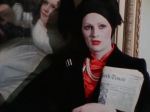
Women in Revolt (1971)

Today’s cinema adventure: Women in Revolt, the 1971 Andy Warhol-produced film satirizing the Women’s Liberation Movement and starring a trio of transgendered “superstars.” Notably, it was the last film to be produced by Warhol on which he actually stood behind the camera, though it was directed by longtime associate Paul Morrissey; it enjoyed more attention and mainstream notoriety than many of the infamous artist’s earlier films, largely on the basis of its controversial approach to the subject matter, drawing the wrath of feminists who felt it was a slap in the face to have their cause savagely lampooned and to be represented onscreen by “female impersonators” instead of biological women.

The plot, such as it is, revolves around three women who become involved in the Women’s Lib movement for their own reasons: Jackie is a militant intellectual schoolteacher who believes men are inferior to women and should be relegated to their naturally subservient place in society; her friend Holly is a model who hates being treated as a sex object, although she herself has a ravenous libido; and Candy is a society heiress who longs to break free of the stiflingly traditional role she is expected by her family to play, wishing instead to build a career for herself as a glamorous movie star. When Jackie and Holly decide to form their own protest group- called Politically Involved Girls, or “P.I.G.” for short- they hit upon the idea of enlisting Candy, hoping to capitalize on her high-profile society position to generate publicity for their cause, and more importantly, to gain access to the financial support of her family and the wealthy circle in which they move. A series of misadventures follows in which each of the three activists are revealed to be more motivated by self-interest than by real passion for their cause. Jackie, despite being a self-proclaimed lesbian, spends the organization’s money on a bodybuilding male hustler and becomes the unwed mother of his baby; Holly succumbs to her penchant for drinking and sex, becoming a derelict living in the street; and Candy abandons her friends, her family, and the movement to realize her dream of stardom.

The scenario for Women in Revolt– it would be inaccurate to call it a script- is not so much a storyline as it is an excuse for extended on-camera improvisation and trashy bad behavior. This, of course, is the real purpose here, far more than any deliberate social or political commentary. Still, it’s easy to see why genuine feminists would find Morrissey’s movie insulting and offensive; their arguments are put into the mouths of enfants terribles whose grotesquely exaggerated behavior and plainly self-absorbed motives render them meaningless and laughable. Given Morrissey’s right-wing political bent, it’s possible, if not probable, that this was at least part of his intention here; but in truth, the whole affair is so patently ridiculous that it is impossible to take seriously. The political satire is merely a vehicle in which the film’s three stars can indulge in their individual excesses, gleefully breaking taboos and acting out with histrionic abandon. Much of the dialogue is devoted to the kind of verbal bitch-slapping that has fueled drag shows for decades, and for the most part, whoever shares the screen with each of the three central characters is merely there to provide a foil- and the occasional straight line- for their onslaught of caustic camp.

Though this formula, admittedly, provides numerous amusing moments throughout the film, it is also the main downfall of Women in Revolt. The pervading atmosphere of uncontrolled, undisciplined expression hardly makes for concise, coherent filmmaking; the improvisational approach works for fleeting moments, but those are islands in a sea of self-indulgent chatter- often spoken simultaneously, in a seeming battle for dominance, rendering much of its content incomprehensible and more than a little grating. This, of course, is inherent in improv, which is why it is most effective when used as a basis for developing more polished material or edited into a cohesive form by a savvy director; it also helps when the performers have been given clear guidance and, ideally, have received some formal training. In the absence of these elements, the end result usually ends up looking and feeling like a free-for-all, reminiscent of rambunctious children play-acting in a schoolyard game of make believe- which can be effective in short doses, but is perhaps not the best way to sustain the length of an entire feature film. It creates, in fact, the sense that we are watching a movie made by amateurs, and such is the case here; the low budget production values, the clumsy lighting, the choppy editing, and the generally insipid nature of most of the dramatic conceits all contribute to this feeling. As a result, instead of being provocative or outrageous, the proceedings quickly become simply tiresome, with a juvenile sensibility that makes the archness of the film’s tone come off more like shallow snarkiness. In addition, despite a considerable amount of gratuitous nudity- mostly male- and sexual content, the handling of these scenes strips them of eroticism; indeed, sex as portrayed here is a repugnant, degrading act, devoid of charm or subtlety, and thoroughly shocking for reasons that have nothing to do with morality or social acceptability. Like everything else in the world as seen by Warhol, Morrissey and company, it’s just another boring convention to be disdained and ridiculed.

These criticisms, valid though they may be, might be immaterial if one considers that film for Warhol- originally, anyway- was just another decorative medium, a way to produce ever-changing pop art images to be projected on a wall at a party, perhaps- a means to provide atmosphere in the background of a real-life “happening.” The rules of good cinema do not apply when a film is more of a statement in itself than a legitimate exploration of the art form. However, by the time of Women in Revolt, the enigmatic Warhol had stepped away from participation in his film productions, handing over the reigns to Morrissey, who had taken things in a more (or, arguably, less) ambitious direction, focusing on a narrative-driven, mainstream approach. It would be a mistake to classify these later Warhol movies as art for art’s sake, as they clearly aspire towards providing a more medium-specific experience; therefore, it seems fair to say that by any reasonable cinematic standards, Women in Revolt is a terrible film. One might argue that the film eschews traditionally accepted style and polish as a rejection of conventional cultural values, but pretensions of artistic purpose are no excuse for sloppy movie-making, and even if one generously classifies Morrissey’s style as cinema verité, it’s hard to think of a less professional, more careless example of cinematic hack-work. What makes this film so appallingly bad is not its nasty attitude or its banality, but the fact that it is, in the end, a poorly executed, badly assembled mess- and despite the fact that Warhol himself operated the camera for several botched scenes (at the insistence of star Jackie Curtis, who refused to perform without his participation), the fault for this lies solely at the feet of its director. Morrissey’s apparent lack of skill in the creation of his product may have been intentional, a deliberate effort to make a statement about the subjectivity of artistic values or to prove the point that arbitrary notions of bad or good are irrelevant to an audience simply seeking to be distracted; but his work here smacks of fraud, the attempts of a would-be artist to discount the importance of techniques he hasn’t the patience or understanding to master. Whereas Warhol’s genius was in simply setting up the camera and letting it capture what it would, the same approach is Morrissey’s crutch. In other words, Women in Revolt seems the work of a lazy director who wants glory without having to work too hard.

Despite this harsh assessment of Morrissey and his work, Women in Revolt is not devoid of value. For better or for worse, in fact, it is probably a more significant film today than it was when it was originally released, due largely to the window it provides into the miliieu of the Warhol factory and- more importantly- the all-too-rare opportunity it gives us to see the work of its three leading players: Jackie Curtis, Candy Darling, and Holly Woodlawn. Each of them were members of Warhol’s famous coterie at the “Factory,” known for their work in previous of his films, and as such were popular- and notorious- fixtures of New York’s avant-garde arts scene. Curtis, unlike his two co-stars, was a female impersonator, who appeared both as a man and a woman in his work, and was successful independently of his projects with Warhol; he was an actor and playwright whose edgy, campy plays were a fixture of New York’s experimental theatre scene, as well as a singer and poet whose work garnered considerable praise and attention from critics of the era. His screen persona- abrasive, outspoken, sarcastic, and sporting a frizzy red wig with glittery make-up- provides many of the best one-liners in Women in Revolt, and whenever he is on the screen he is in absolute command. This is not always to the benefit of the film; many of the shrillest and most confused scenes are the result of Curtis’ aggressive improvisation, in which other performers are drowned out and cut off at every turn in favor of his unscripted outbursts. Nevertheless, it’s a smart performance, giving a glimpse at the potential for brilliance which might have been more fully realized with a little rehearsal and direction. Likewise, Candy Darling, a true transgendered performer, who had worked extensively with Curtis in his plays as well as in previous Warhol outings, reveals the ethereal, double-edged sincerity that allows her, somehow, to rise relatively unscathed above the messy chaos of Women in Revolt; she contrasts Curtis’ brash bullying with her own form of dominance, the cool superiority of a sophisticated and intelligent woman with nothing to prove. She is elegant and truly beautiful, and Women in Revolt is at its best- and most watchable- when she is onscreen, working her magic with the curious blend of earnestness and irony that made her one of the most charismatic of the “superstars.” Rounding out the trio is Woodlawn, also a true transgender, whose fiery Puerto Rican energy bursts from the screen, representing the raw energy of the body (as opposed to that of the mind and spirit, personified by Curtis and Darling, respectively) as she gropes and gyrates her way through the film. Truly sinking her teeth into her role as a nymphomaniac who hates men, she gives a manic, conflicted performance which displays a remarkable gift for comedy and hints- as does the work of her co-stars- at a considerable talent, making us wish all the more for a surer hand behind the camera. The fact that all three of these stars are so obviously gifted is yet another indictment against Morrissey’s infuriating mediocrity as a director; their work continually gives us glimmers of what Women in Revolt might have been. Still, they provide plenty of reasons to sit through the movie- though it requires considerable patience and might be best accomplished in short installments- and even manage to create several moments which could be called classic. Besides these three heavyweights, the film offers brief appearances by other counter-cultural icons of the era, including Penny Arcade and Betty Blue, and Brigid Berlin in a wordless cameo as a decidedly butch bar owner.

The fact that Women in Revolt is an atrocious movie, oddly enough, does not alter the fact that it is a classic, of sorts. Clearly, there are many stalwart supporters of Warhol and his crew that would defend the film staunchly and embrace its many flaws proudly, claiming them as victories in a cultural war and viewing them as medals of honor. There is certainly a weird power to this curiosity of its time, and despite its lack of real ambition it manages to offer up some interesting observations about the power struggle between the sexes- particularly through its reversal of roles in which liberated women treat their men with the same disrespect and contempt they deplore when they are the recipients, and the use of sex as both a bargaining tool and a means of gaining power. It can be argued that the movie was a success in terms of what it set out to accomplish. Warhol neither knew nor cared about the aesthetics of film; he wanted only to present his branded material for the sake of building his cult-of-personality-based empire, and notions of good or bad were of little interest to him. With this in mind, Women in Revolt is exactly what he wanted it to be- a source of controversy and buzz, and another brick in the continually growing monument to his so-called genius. Indeed, given his particular, nose-thumbing stance at conventional society, it is probably preferable that it should be bad; the exaltation of the banal was a major part of what he was all about, after all. Therefore, I find myself in the curious position (which Warhol would have loved) of recommending a movie that I found to be abysmal. I would stress, however, that my endorsement is based not on any sort of respect for the artists behind the scenes, but on my admiration for the ones on the screen. It is beyond tragic that these three were given the treatment they were- exploited by Warhol for their “freak” appeal, they were given just enough cultivation to reveal the brilliance of their underlying talent, then abandoned because the impresario had lost interest. Perhaps the real reason for his fickleness can be surmised by viewing Women in Revolt; it is the talent of Curtis, Darling, and Woodlawn that redeems the experience, and without them it would truly be unwatchable.  Could it be that Warhol feared they might outshine him on their own merits, and take away some of the credit for their own success? It’s a question, sadly, that must be asked, but can never be answered. Darling would pass away of cancer within two years of the film’s release, and Curtis would die of a heroin overdose a decade later; Woodlawn returned to her native Puerto Rico and worked as a busboy until, years later, a resurgence of interest in her former persona allowed her to return to the limelight. Women in Revolt, wretched as it is, is a snapshot of a moment in time, when all three were poised on the brink of success, and maybe, just maybe, could have broken through the barriers of social prejudice to achieve mainstream success. It was not to be, but they paved the way for future generations who continue the struggle for transgender acceptance. That in itself makes this movie worthy of respect- not for the posers behind the camera, but for the real people in front of it.

http://www.imdb.com/title/tt0129631/

BearCity (2010)

Today’s cinema adventure: BearCity, a 2010 romantic comedy about a young man whose secret attraction for big, hairy, masculine men leads him into the insular gay subculture of “bears.” Directed by Douglas Langway, and co-written by Langway and Lawrence Ferber, it attempts to graft the familiar Hollywood-style romance formula onto an exploration of the tight-knit bear community, exposing and poking fun at stereotypes along the way, in order to both appeal to a largely underrepresented sector of the population and to present a sort of primer for those unfamiliar with this rarified scene. Though it has met with a somewhat mixed response from critics and some members of the gay community, it has been sufficiently popular and successful to warrant a sequel, BearCity 2: The Proposal, which is currently being screened at GLBT film festivals across the U.S. and Canada.

Taking its inspiration from the popular TV and movie series, Sex and the City, Langway’s fluffy tale of love and lust in New York centers on Tyler, a 21-year-old “twink” (for those unfamiliar with the term, look it up on Urban Dictionary or ask a gay friend) and aspiring actor who is open and comfortable about his sexuality- but less so about his preferred taste in men. Drawn to older, bigger, hairier guys who don’t fit the “typical” gay mold of attractiveness, he keeps his proclivities a secret from his roommate and his friends; when a potential online hookup lures him to a nightclub for bears, he falls in with a group of hirsute friends who welcome him with open arms, and he begins the process of “coming out of the second closet.” He finds new roommates, gets a job at a bear-friendly coffee bar, and develops a new crush- on Roger, a handsome older “daddy” type who is one of the best-known and popular members of the bear community. The attraction seems to be mutual, but Roger’s sensitivity to the customs and expectations of the micro-culture that surrounds the pair repeatedly thwarts Tyler’s attempts to make a connection. Meanwhile, Tyler’s other new comrades face a variety of issues in their own love lives: his new roommates, Fred and Brent, struggle with the question of remaining monogamous or opening up their relationship to add some spice; and another couple, Michael and Carlos, are pushed apart by Michael’s decision to have weight-reduction surgery. In the midst of all the complications, romantic and otherwise, the whole gang gears up for “BearCity,” a big weekend party which brings the whole community together to celebrate in their own bearish way.

Like most ensemble “rom-coms,” BearCity has a plot tailor-made for the inclusion of one episodic misadventure after another, with which to gently spoof- and reinforce- the familiar foibles and pitfalls inherent in the quest for love. Normally, such a film’s agenda is limited to pleasing its audience with a lot of laughter, a few tears, and, usually, a couple of big “awww” moments leading up to a satisfying conclusion in which love conquers all; this would also be true of BearCity, except clearly, given the community on which it focuses, there is an additional goal. By setting the action amidst gay culture- and a subdivision of gay culture, at that- the film hopes to bridge social gaps and reveal the basic truth that the affairs of the heart, though they may take different forms on the outside, are the same for everyone, regardless of race, creed, culture, or sexuality. It’s not the first film to carry this message, not even the first to deal with that curious subspecies known as “bears;” but what is refreshing about it is that it eschews pretensions of a political or moral agenda and simply concentrates on telling its characters’ stories, devoid of higher messages. Equality is assumed, not defended, and sexual tastes- while they may be subject to lampooning- are accepted without moral judgment. As a result, the movie gets to turn its full attention to the universal concerns which its characters, like everyone else, must address in their various attempts to find- and keep- love.

Even so, BearCity also seems to be very aware that it serves as a sort of travelogue to the uninitiated viewer for whom the world of gay bears is completely unfamiliar; as a result, it takes pains to include a broad view of the community’s peculiarities- including its sexual adventurousness and promiscuity, heavy focus on alcohol and drugs, and a pervading shallowness that seems, more and more, to characterize the popular image of gay life in general. This tapestry of cultural detail provides more than just a backdrop for the proceedings, as the guys’ stories hinge on some of these issues- particularly the ones surrounding sexual mores- and their outcomes are dependent on a coming-to-terms with the particular obstacles they present. In addition, the behavioral observations to be found here have the unfortunate potential for perpetuating stereotypes- though not necessarily the old-fashioned, limp-wristed kind- which continue to create social prejudice against the gay community; despite the fact that the characters, for the most part, are explored to a much deeper level, the surface characteristics they display- however honestly- could be seen as clichéd variations on the familiar theme of “wacky gay neighbor” mannerism. Once again, however, the film is ultimately unconcerned with such factors- the opinions of outsiders are of little consequence to these bears, and in fact one of the film’s most significant themes- one which could even be called an underlying tenet of “bear philosophy,” perhaps- is the importance of being comfortable in who and what you are, without regard to the expectations and standards of others. In BearCity, the only way to find happiness is to be yourself, not who you think you are supposed to be; if that’s not a universal message, I don’t know what is.

Unfortunately, though BearCity succeeds in presenting an authentic portrait of the social atmosphere and lifestyle that characterizes its subjects, it is somewhat less successful in its attempt to craft a smart and compelling romantic comedy. The central love story between Tyler and Roger is sweet enough, if that’s the right word, on the surface; but the pair seem mismatched in a way that goes beyond the obvious differences in age, bearing, and outlook. We want to see them united by the end, but that has more to do with the conditioned response of wishing for a happy ending than it does with any sense that these two are made for each other; their attraction seems little more than just that, an impulse based on surface qualities rather than an instinctive bond between kindred spirits. As for the comedy element, much of the overt humor comes in the form of dialogue which seems far too calculated, as if Langway and Ferber were determined to insert all the standard jokes related to each subject matter they touch upon; the “clever” banter is laced with variations on standard one-liners known universally throughout the gay community, and even if they are less familiar to a straight audience, they still feel forced and deliberate, and as a result, much of the comedy falls flat. Perhaps the intention was to cultivate a further sense of universality, by showing a group of gay guys making the same jokes every other group of gay guys makes, but it has the effect of undermining the freshness which otherwise permeates the film.

BearCity works far better when it leaves behind the larger social scene and brings us into the intimate reality of its characters. In the one-on-one scenes we are given a much more honest and engaging look at the real lives of gay men, and this is where the movie’s more substantial charm becomes apparent. In the subplots surrounding Tyler and Roger’s tentative courtship, we find people who are actively dealing with the real, down-to-earth complications of building a lasting relationship, not the airy fantasy of a first crush. Fred and Brent’s grappling over the question of staying monogamous rings much truer than the moon-eyed wooing of the central couple in an empty bowling alley, and the emotional rift that threatens to rip apart the tender love between Michael and Carlos seems far more important than concerns over what Tyler should wear to BearCity in order to get Roger’s attention. Furthermore, because it grows honestly from the characters and their situations, the comedy that comes in these scenes is much more believable- and therefore funnier- than the predictable humor in the rest of the film. In particular, the comedy of errors that arises when Fred and Brent attempt a three-way play session in the shower is a comic highlight, underscoring the fact that BearCity is at its best when it embraces the opportunity to be different than the mainstream formula comedies it tries to emulate.

The actors, for the most part, are likable and believable enough, although at times the stilted quality of some of their dialogue trips up each and every one of them. Joe Conti is sincere and competent as Tyler, making him a suitable protagonist, albeit less interesting than some of his co-stars. Likewise Gerald McCullouch, as Roger, manages to convey an underlying integrity that keeps him sympathetic and allows us to see his appeal, despite the less savory aspects of his character. Both players are attractive, particularly McCullouch- who, it should be said possesses only marginal qualities that could be described as “bearish,” prompting suspicions that the film’s creators were hedging their bets in trying to appeal to a broader audience. In keeping with the fact that the supporting roles are by far more interesting than the star-crossed lovers in the spotlight, Brian Keane and Stephen Guarino (Fred and Brent) and Gregory Gunter and James Martino (Michael and Carlos) provide much more solid performances, investing their characters with a wider range and deeper authenticity, and generally making us wish they all had more screen time. Alex Di Dio is infectiously charming as Simon, Tyler’s spritely former roommate who later becomes involved as a confidante and advisor in the efforts to win Roger’s affections, and Sebastian LaCause has a nice turn as a Spanish party-bear who threatens to come between the film’s would-be lovers.

As for Langway’s efforts as a director, his work can be described as serviceable, at best. For the most part, he adheres to the familiar conventions of lightweight formula comedy, with little in the way of showy camerawork or flashy editing and not much stylization beyond the occasional obligatory montage. Not that anything more is required here, and truthfully a more self-consciously arty approach would most likely make BearCity insufferably pretentious. Nevertheless, at times the movie has a vaguely amateurish feel, as if Langway (both as director and screenwriter) were trying too hard to fit every ingredient into the soup pot. In addition, the elements which border on stereotypical would perhaps have seemed less so with a more delicate, thoughtful approach behind the camera, though it’s hard to level a criticism over something that might have been. In the same vein, it’s difficult to criticize his soundtrack choices, although one might have wished for a bit more imagination and variety in the selection than what we are given- a bland collection of disco-lite club music which may capture the feel of the community but seems disconnected from the action on the screen.  Nevertheless, insofar as he gives us a genuine and clearly affectionate depiction of the world he showcases in his film, Langway’s work is, more-or-less, successful.

BearCity is a movie that carries a social importance heavier than its actual content; by showcasing the life of a culture rarely represented on screen (unless as a source of humor, as in John Waters’ A Dirty Shame), it represents a bold effort to cross the boundaries of social convention and promote true understanding and equality, even though such an issue is outside the scope of its plot. Perhaps even more significant is its revelation of prejudices and social gaps that exist within the gay community itself; the bear movement has largely developed as a reaction against the ostracization of men who fall outside the accepted standards of male beauty celebrated by the “mainstream” of gay society, and the movie makes it clear that there is still a lack of understanding and acceptance between these two factions of the culture. This factor, too, is beyond BearCity’s intentional purpose, except at an observational level, though it does play a role in the plot insofar as it provides the inner conflict that initially catapults its protagonist into a strange new world and provides the motivation for Roger’s reluctance to become involved with someone from outside the community. With so much riding on its shoulders, it is admirable that BearCity does not fall into the trap of taking itself too seriously and playing into its own importance; it would be even more admirable if it were a better film. Still, in its best moments it offers surprising depth and disarming honesty, and acquaints us with memorable characters who remain with us after the credits roll; and even in its worst moments, it is harmless and likable, a charming bit of wish-fulfillment fantasy that satisfies the universal need to believe in the power of true love, no matter what your preferences are with regard to gender- or body hair.

http://www.imdb.com/title/tt1426320/

The World of Henry Orient (1964)

Today’s cinema adventure: The World of Henry Orient, a 1964 comedy directed by George Roy Hill, featuring Peter Sellers as the title character, a concert pianist whose libidinous exploits are complicated by the obsessive adulation of a pair of adolescent schoolgirls.  Based on a novel by Nora Johnson, daughter of Hollywood writer/director Nunnally Johnson (with whom she also co-wrote the screenplay for the film), it places greater emphasis on the coming-of-age story of Orient’s juvenile stalkers than it does on the misadventures of the loutish lothario himself.  It was successful with both audiences and critics, its popularity no doubt bolstered by the presence of its star, who was at the time entering the height of his career, and it was later turned into a Broadway musical, Henry, Sweet Henry, which enjoyed considerably less success.

Set in Manhattan, the film follows the experiences of Val and Marian, two students at an exclusive girls’ school who develop a close friendship; both are outsiders at school, and share an imaginative flair for fantasy and make-believe, which leads to their indulgence in precocious adventures together.  On one such outing, they stumble upon a clandestine rendezvous in Central Park between Orient and his nervous, married, would-be mistress, interrupting their tentative tryst and foiling the pianist’s amorous intentions.  Later, when the girls attend his concert with Marian’s family, they recognize him from their encounter at the park, and Val develops a crush; so the pair begin to follow him, watching his apartment and making a scrapbook about their obsession- as well as a fanciful diary documenting Val’s hypothetical romance with him.  When Val’s jet-setting parents return for a holiday visit, her strict and austere mother finds the secret volume, a discovery which leads to uncomfortable complications not only for the girls, but for the unwilling object of their affections, as well.

Though The World of Henry Orient was a fairly successful film at the time of its release, it has faded somewhat from cultural memory.  Part of the reason for this may be that much of its draw in early 1964 arose from the presence of three up-and-coming names in its credits- Peter Sellers, Angela Lansbury, and director George Roy Hill- each of whose subsequent work would soon eclipse the importance of this quaint little movie.  Another factor, no doubt, was the changing social landscape of the years shortly to follow its debut, in which stories about the wholesome innocence of childhood, no matter how well-made they may have been, seemed somehow to be less relevant and important than those addressing the “larger” issues that were suddenly confronting young people as they came of age during the upheaval of the late sixties.  Ironically, one of the key factors in the film’s initial popularity was likely the fact that, in its good-natured and sweet depiction of teen-agers, it represented something of a backlash against a decade of teen dramas in which modern American youth culture was depicted as a dangerous and depraved environment full of delinquents, drugs, and rock-and-roll; the two young ladies at the center of this film were a refreshing change of pace, and their problems were, in truth, more representative of those faced by the average teen in daily life.  Sandwiched between two eras of rapid cultural evolution, The World of Henry Orient enjoyed its moment in the sun while the world took a moment to catch its breath.

Whatever the reasons for its success or for its relative disappearance, Hill’s sweet-but-sophisticated little movie definitely holds up to contemporary viewings.  It’s worth noting that the title character’s name- a play on the name of renowned celebrity pianist Oscar Levant, whose surname means “Orient” in French and upon whom the character was loosely based- does result in some minor cultural discomfort surrounding Asian stereotypes; in deference to their idol’s unusual moniker, his two young stalkers adopt faux-Japanese code names and indulge in playful rituals which parody Eastern traditions, such as kowtowing to their collection of Henry-themed “relics” and sporting conical straw “coolie” hats as they stake out the pianist’s apartment building.  Aside from this, however, which can be written off as nothing more than playful, non-malicious fancy, the film’s gentle depiction of the transition from childhood into adolescence has a timeless feel, despite its distinctive, now-nostalgic mid-century Manhattan setting; much of this is due to Johnson and Johnson’s screenplay, which manages, through its focus on the universal concerns of young girls (and adults, for that matter) rather than on time-and-place-specific hotbed issues, to avoid any topicality that might have made the story seem dated today.  It also helps that the girls portrayed here are atypical teens, from a social standpoint; Marian comes from a “broken” home, living with her mother and another divorced woman (a situation with overtones which must have been provocative, even in 1964), while Val is the “problem” child of wealthy, distant parents who leave her in the care of hired guardians.  Coupled with the fact that neither girl is among the “in” crowd at school, and are therefore not surrounded by a gang of Hollywood-style adolescents following the latest fads and speaking in the teen-speak jargon of the day, this means that The World of Henry Orient is mercifully free of the kind of mass-media clichés that would make its appeal more ironic than sincere; this is not a picture postcard of idealized nuclear families getting mixed up in occasional kooky hi-jinks, but a story of real, not-so-average people going through genuine life experiences.  This is not to say there is a lack of goofy comedy; that is mainly provided by the over-the-top exploits of the title character, as portrayed by comic chameleon Sellers.  His Henry Orient is a ridiculously shallow, pompous charlatan: affecting the pose of a continental sophisticate as he slips back and forth between a generic, vaguely European accent and a crass Brooklyn-ese; falling over himself in his efforts to lure vulnerable, attached women to worship at the shrine of his ego; indulging in pretentious theatrical antics as he shamelessly fakes his way through an avant-garde piano concerto; and generally revealing himself to be a self-serving buffoon whose real personality is a far cry from the romanticized vision held by his two juvenile followers.  In addition to being funny, of course, this serves to illustrate the contrast between the girls’ rose-colored view of reality and the sometimes sordid truths of the adult world into which they are about to crash.  It’s a revelation that unfolds as the story progresses; as the movie’s focus expands to include the troubled relationship of Val’s parents, we are given more and more evidence of the gap between image and authenticity, and the all-too-frequent failure of adults to live up to the expectations of their roles.

In addition to the aforementioned performance by Sellers- who is, as always, a wonder to watch as he melds psychology and physicality together to completely become his character- there is the work of Angela Lansbury, whose icy turn as Val’s deceitful and hypocritical mother provides another sharp example of the gap between ideal and reality in the adult world, as well as reminding us that, before her success in Broadway’s Mame and her long tenure as television’s Jessica Fletcher re-invented her as a warm and lovable matron, this fine actress was one of the screen’s foremost bitches.  The hollowness of her worldly sophistication and her barely-concealed disinterest in her daughter’s life (until it affects her own image, of course) help to expose the character’s own desperate need for attention and validation, which, though it doesn’t exactly make her sympathetic, certainly paints a clear picture of who she really is, at the core.  Contrasting her unpleasant phoniness are Phyllis Thaxter and Bibi Osterwald, who embody good-natured warmth and unconditional love as Marian’s mother and her live-in, fellow-divorcee companion, making the point that an unorthodox family unit can be far healthier than a traditional one; as well as Tom Bosley, as Val’s father, who foreshadows his later success on Happy Days with his stolid performance as a man finally ready to assume the responsibilities of parenthood, even if it is a little late in the game.  Rounding out the adult cast is the always-delightful Paula Prentiss, as Orient’s skittish would-be lover, who manages to be likable and sympathetic despite the fact that her role is a caricature of upper-middle class shallowness and gullibility; she manages to hold her own opposite Sellers, matching his manic zaniness like a seasoned pro- no small accomplishment, to be sure.  The key performances here, however, are the children’s; Merrie Spaeth (as Marian) and Tippy Walker (as Val) fully live up to the demands placed upon them by their central roles in the proceedings.  Full of youthful giddiness, smart without being precocious, and capable of the honesty required to show us the full emotional journey of these two remarkable young women, they also provide a perfect complement to each other with their distinct and separate personalities- the more grounded Spaeth anchors the duo, while Walker gives us the edgier dynamic of Val.  Neither actress went on to an adult career in cinema- Spaeth became a noted political and public relations consultant, Walker opened an art gallery- but their work in this single film ensured them a secure hold on movie immortality.

As for the director, George Roy Hill does a superb job of juggling the perspectives of the various worlds within The World of Henry Orient.  He captures the irrepressible vivacity of youth with then-edgy techniques such as wildly tilted camera angles and montages utilizing both slow-motion and high-speed photography; he manages some grade-A comedic set pieces around his charismatic star, particularly the extended concert sequence in which the hammy Orient ad-libs his way through a performance at Carnegie Hall while frustrating his conductor and fellow musicians with his ego-maniacal shenanigans; and he uses the Manhattan scenery, lovingly photographed by Boris Kaufman and Arthur J. Ornitz, to full advantage, allowing the change of its character through the seasons to reflect the progression of his two heroines through their rite of passage.  Adding to the bittersweet, nostalgic delight is his confident reliance on the score by Elmer Bernstein, which evokes the carefree ease of childhood, the sweeping majesty of the city, and the emotional longing at the core of the story.

The World of Henry Orient is a difficult movie to criticize; though the themes it tackles are hardly momentous, there is an authentic quality to it that is impossible to dislike, which no doubt arises from the fact that Johnson’s novel was autobiographical, based on her own experiences growing up at a New York girls’ school.  Parenthetically speaking, the fact that she co-wrote the screenplay with her father is very telling, considering the turn of events which brings emotional closure to the story.  The unpretentiousness of the movie has made it one of those certifiable classics that is usually forgotten in discussions of great cinematic art, but is beloved by almost anyone who has seen it in its frequent appearances on the late-night movie broadcasts of the seventies and eighties; there is a comfort in its gentle portrayal of youthful fantasy meeting seedy reality, considerable appeal in the fact that it manages to be sweet without ever becoming cloyingly so, and an additional bonus provided by farcical tour-de-force performance of its star, surely one of the screen’s great masters of comedic acting.  When all is said and done, The World of Henry Orient is a film I can heartily recommend with more confidence than any number of “greater” cinematic achievements; it may not be a masterpiece, but it is one of the most likable little movies I can think of.

http://www.imdb.com/title/tt0058756/

Art School Confidential (2006)


Today’s cinema adventure: Art School Confidential, the 2006 film by Terry Zwigoff based on Daniel Clowes’ underground comic of the same name.  The second collaboration between Zwigoff and Clowes, it follows the efforts of an art college freshman to win the love of his dream girl by becoming a successful artist.  It shares many of the themes of their first joint effort, Ghost World, as well as its bleak world view and cynical take on humanity, and features an impressive array of talent in supporting roles.

The plot follows Jerome, a young man whose interest in art has more to do with his libido than his desire for self-expression.  Believing that success in the art world will allow him a limitless amount of female companionship; he enrolls as an art major in an urban college, where he has high hopes that his talent will quickly be acknowledged.  Instead, he finds himself just one of many frustrated hopefuls in a depressingly grim environment where the only topic more discussed than the uselessness of an art degree is the string of unsolved murders taking place near the campus.  Surrounded by peers who are self-absorbed, pretentious boors, and professors who are self-important, disaffected failures, more interested in their own stalled art careers than in nurturing the abilities of the students under their charge, he gradually realizes that success is more about playing the game than about talent.  To make matters worse, he is completely turned off by the dysfunctional girls in his dating pool, and he begins to despair that his fantasies of being a playboy artist will be crushed by the cold reality of adult life.  Things begin to look up when he meets a beautiful model who shows an interest in him, but after she is swayed by a handsome fellow student- whose work has gained more recognition than his own- his desperation drives him to concoct a deceitful plan which will put him on the fast track to success and win back the attention of his newfound dream girl.

On the surface, Art School Confidential feels like one of those eighties-era coming-of-age comedies directed by John Hughes, in which a geeky teen loser learns that being yourself is more important than being popular and ends up winning the boy or girl of their dreams by the final scene.  That description is not far off, but in this screenplay, penned by Clowes himself to ensure faithfulness to his own misanthropic vision, the formula is turned on its ear.  Jerome doesn’t want to be accepted as he is, he wants to be worshipped; and far from finding empowerment and self-actualization, he learns that being himself brings only further isolation and obscurity, and that if he wants his dreams to come true he will have to find a way to stoop lower than everyone else.  His story is shot through with the kind of social satire that hits uncomfortably close to home, threatening to undermine any preconceived ideas we might have about the underlying goodness of humanity; if there was ever any there, Clowes makes it clear that it has been thoroughly snuffed out by the degraded, ego-driven culture he shows us.  Like our protagonist, we look around desperately for kindred spirits, but the cast of characters offers us little solace; Jerome’s fellow students are a collection of affected misfits and pompous twits, and the adults are more or less an older- and more disillusioned- generation of the same breed.  Virtually every person in the film is motivated by their vanity, and everyone else around them is merely an object to be used in their quest for self-fulfillment.  This is true even of those few characters that seem sympathetic- including Jerome, who turns out to be more of an anti-hero than we surmise.  With such a disheartening perspective on the denizens of the art world- and, by extension, the rest of the human race- it’s hard to find any of the comedy very funny, at least in a laugh-out-loud way.  The film’s humor is dark, dry, and derisive; it is also arch and vaguely judgmental, casting a reproving eye on the professional and personal pursuits of all its characters and concluding that the bulk of human endeavor amounts to a desperate cry for attention.

For his part, director Zwigoff makes every effort to keep things light, at least visually.  He capitalizes on the movie’s teen-angst heritage with nods to the genre’s cliches, such as “getting-it-done” montages and character-based visual gags, and directs his actors with a clear focus on presenting its familiar types.  He obviously relishes the exploration of his quirky characters’ personalities, but he emphasizes the details of the plot enough to keep it moving effectively.  It’s also obvious that he shares Clowes’ ironic sensibilities, and he is careful not to undermine Art School Confidential by softening its snarky edge with sentimentality- although, with the help of his A-list cast of adult actors, he does manage to imply a more mature counter-perspective that includes at least a little mitigation of the seemingly soulless and shallow priorities exhibited by the inhabitants of his film’s inhospitably selfish universe.

For their part, the actors do their best to keep things real, without relying solely on the surface qualities of their stereotypical characters; overall, the cast manages to infuse a level of humanizing depth to the proceedings that keeps the movie from being an unrelentingly pessimistic existential polemic.  Despite their best efforts at honest playing- or perhaps, in many cases, because of it- there are few likable characters in Art School Confidential; the single most pleasant personality is exhibited by Joel Moore, as Jerome’s friend Bardo, whose portrayal of a proudly self-acknowledged failure is refreshingly free of barely-concealed self-promotional subtext- appropriately making this gregarious loser a comfortable island in a sea of  chilly attitudes.  Max Minghella is deceptively appealing as Jerome, until his quest for recognition turns him into a self-pitying cry-baby; and Sophia Myles, likewise, fools us into liking his would-be soulmate, Audrey. The good stuff, however, comes from the heavy-hitting support team of accomplished grown-ups; John Malkovich, Anjelica Huston, Jim Broadbent, and Steve Buscemi all bring their skills to the table as they portray various representatives of the older-but-not-necessarily-wiser set, and the film leaps several notches up in quality when they are on the screen- which, sadly, is never for very long.

Art School Confidential is meant, of course, to be a comedic exposé of the pretentious, stagnated world of academic art, a subject ripe for vigorous satire.  The problem is that the humor seems to come from a rather mean-spirited place; Clowes and Zwigoff take a decidedly uncharitable view of almost every affectation and foible displayed by their characters, and at times their approach feels more like bullying ridicule than good-natured ribbing.  Their critical stance is certainly a valid one, but one can’t help feeling that the harsh perspective is a little too one-sided; after all, it’s easy to point fingers at the hypocrisy and artificiality we see around us, but it is perhaps more interesting to explore what lies underneath that surface.  Coming of age involves an awakening, a realization that the world is full of phonies and disappointments; but it also involves advancing past this stage to a more mature viewpoint, one with which we can discern the more subtle forces at work around us.  Art School Confidential strikes an attitude of smug contempt for its subject which smacks of sophomoric thinking, a pose which is ultimately no different than any of those assumed by the various characters it mercilessly skewers throughout.  It misses its mark not because of the darkness of its tone or its candid observations about the weakness of mankind- many fine films share these qualities, such as the work of director Todd Solondz, whose movies Happiness and Welcome to the Dollhouse are about as pessimistic as you can get but still engage and stimulate us with their depth and their humanity.  Rather, it fails because it lacks a certain maturity; instead of piercing insight, it offers blunt criticism, and in the end it leaves us knowing little and caring less about the inner workings of the world it portrays.  It’s a shame, because Art School Confidential has a lot of potential- both Zwigoff and Clowes are exceptionally talented, and one can’t help but feel that somehow, something was lost in the translation from page to screen.  There are times when the movie almost feels like it’s going to take off, and comedic moments that feel like they are about to make us laugh; but these are short-lived, and by the time we reach its somewhat predictable and not-very-satisfying climax, we have long since lost interest.  Fans of Clowes’ ironic-outsider flavor may find the movie easier to take than the rest of us, but those interested in discovering his work might be better-advised to go to the source rather than starting with this weak adaptation.  Still, the pairing of the author/artist and his filmmaking partner in crime seems a match made in heaven, and together they have managed to craft a very good film – but it’s called Ghost World, and the disappointment of Art School Confidential is probably all the more  bitter because they proved once before that they could get it right.


http://www.imdb.com/title/tt0364955/


The Stunt Man (1980)

Today’s cinema adventure: The Stunt Man, the 1980 feature by director Richard Rush about a runaway fugitive who stumbles into the middle of a film shoot and finds cover working as a stunt man, only to realize that the movie’s megalomaniacal director may be planning to kill him for the sake of filming the ultimate stunt.  A difficult film to place within a genre, it was shot in 1978 and ended up shelved for two years by a studio that didn’t know how to advertise it; when it finally hit the screen it was only given a limited release, and it was largely overlooked by the public.  Nevertheless, it garnered considerable praise from critics and managed to earn several Academy Award nominations, including one for its star- and its main appeal, then and now- Peter O’Toole, whose performance represented something of a comeback in his storied career.

Adapted by Rush and Lawrence B. Marcus from a novel by Paul Brodeur, The Stunt Man follows a young Vietnam War veteran who is running from the law, having committed an unspecified crime after returning from his tour of duty.  With officers in hot pursuit, he runs into the middle of a film shoot, inadvertently disrupting a dangerous automobile stunt in which the driver is accidentally killed.  With a sudden new opening for a replacement and only a few days to finish his ambitious anti-war epic, the movie’s director, Eli Cross, takes the young outlaw under his wing, offering him a safe haven and a new identity- in exchange for completing the aborted stunt himself.  As he prepares for the big moment, learning the tricks of the trade and attempting to bond with the gregarious crew of movie-making gypsies that have taken him into their fold, he begins to suspect the flamboyant and mercurial Cross, who is obsessed with realism, of plotting to orchestrate his death in order to capture it on film.  Things are further complicated when he finds himself in a blossoming romance with the film’s leading lady, heightening his dilemma over whether to flee back into a permanent life on the run or stay and risk his own untimely demise.

If the premise seems a bit gimmicky, it is; The Stunt Man offers a highly improbable premise, riddled with plot holes and unlikely conceits.  This, however, is part of the sense of wicked fun that permeates the movie.  Rush and Marcus never take the pseudo-thriller plot too seriously; although they give an appropriate amount of weight to the psychological conflicts of its hero, they make certain that the overall tone is decidedly comic, flavored with cynical irony and self-satire, and they derive a great deal of nudging humor from the tricks they work on their audience.  Within its far-fetched scenario, The Stunt Man plays with our expectations and our preconceived assumptions in order to keep us off balance, establishing its young protagonist as our access point into its smoke-and-mirrors world and ensuring that we, like him, are constantly betrayed by appearances; this is, after all, a movie about making movies, and in keeping with its subject, nothing is what it seems.  At every turn, we are presented with illusions- many of them clearly established as such- and then find ourselves surprised when the truth behind them is revealed.  The film shrewdly manipulates our willing suspension of disbelief, understanding that we want to buy into its various cons, and exploiting our natural inclination to believe what we see.   Rush spends most of his movie exploring examples of the conflict between truth and illusion, from the oft-repeated assertion that King Kong was only 3′ 6″ to the extended sequence of WWI carnage enacted in front of a throng of horrified spectators at the beach, making for a highly amusing display of magic in which the tricks being performed mirror the tricks being played on us by the magician behind the camera.

Of course, this idea of illusion vs. reality, which fits so perfectly into the metaphoric possibilities of a self-reflexive movie about movies, is nothing new; it has been highlighted in works ranging from Fellini’s 8 1/2 to Ben Stiller’s Tropic Thunder, providing fodder for low comedy to high tragedy and everything in between.  The Stunt Man, however, ties it to another theme, perhaps more immediately relevant to the lives of everyday civilians not lucky enough to be working in the film industry- namely, the difficulty of trust in a culture full of deliberate lies and manipulation.  Our hapless hero, ironically dubbed “Lucky” by his newfound protector (or, perhaps, persecutor), is full of paranoia and mistrust, the result of buying into a much bigger and more insidious con game than any cinematic sleight-of-hand perpetrated by Eli Cross and his crew; he has been cheated by a system that sent him to war on the promise of making him a hero and now treats him as a pariah, and had his hopes for a happy future shattered by faithless friends and lovers.  When the nature of his crime is revealed, we discover it was an act of anger and frustration over the raw deal into which he has been suckered- like so many of his generation.  Is it any wonder, then, that when he is offered a new lease on life by a representative of the dream factory, a man who blatantly and unabashedly manipulates truth and illusion in order to achieve his ends, he is wary of being suckered once again?  This is the central conflict of The Stunt Man; in a world devoted to illusion and deceit, where pretty lies often disguise ugly truths and trust is only a lure by which the foolish are led like lambs to the slaughter, the only hope of self-preservation is to doubt everything and everyone around you.  As Eli Cross puts it, late in the film, “Paranoia is a social disease; it’s got by screwing your fellow man.”  Whether he offers a cure or euthanasia is the primary question of The Stunt Man, and I wouldn’t dream of answering it here.  Suffice to say that the course of treatment has a few twists and turns.

Rush guides his film with bravura flair, capitalizing on his rare opportunity to both celebrate and send up the conventions of movie-making.  Infusing it with a certain tongue-in-cheek aura of self-awareness, he nevertheless dives headlong into the numerous opportunities for old-fashioned movie spectacle, with the added layer of showing us the spectacle behind the spectacle; he gives us a delight akin to seeing a magician reveal his secrets, only to discover the revelation itself is part of the trick.  He also takes advantage of the film-within-a-film milieu to capture a sense of bygone Hollywood glamour in the midst of the nuts-and-bolts candor of the contemporary setting, aided considerably by the extensive use of the historic Coronado del Rey Hotel, which serves as a location for much of the film; and though his film is primarily focused on psychological concerns, he fills it with action, not just within the framework of the “meta-movie” but expanding it outward into the surrounding real environment of the film as well.  The result is a movie that takes its time to get to its point but maintains the feeling of a brisk pace, enhanced by all the inherent details of its film-shoot backdrop, and keeps us engaged in its game of interchanging fact and fiction right up to the final playful moment.

The Stunt Man benefits from Mario Tosi’s cinematography, with its exploration of various qualities of light, both natural and staged; and the rousing score by Dominic Frontiere conjures the circus atmosphere of the movie-making world with a bravado that matches that of its director (the one onscreen, that is), and even includes a haunting vocal tune, “Bits and Pieces,” co-written by veteran songsmith Norman Gimbel and performed by the iconic Dusty Springfield.  As for the cast, a fine ensemble of likeable faces clearly enjoys itself with the material.  The titlular hero is played by Steve Railsback (whose careeer was mostly defined by his portrayal of Charles Manson in the TV film of Helter Skelter), who lets us see the vulnerable little boy inside even as he pulls off the hard-edged toughness he uses as a protective mask, and conveys the impression of a young man walking around in a state of prolonged shell-shock- which, of course, is not far from the truth.  The beautiful Barbara Hershey is highly effective as the leading lady (of both the film and the film within it), marvelously embodying the multi-layered quality of an utterly contemporary woman; she is sensual, independent, confident and full of a zest for her life and her work, but she also reveals the insecure little girl underneath the worldly actress- and, most importantly, she manages to find the balance between candor and mystery that keeps us from really knowing the sincerity of her feelings for “Lucky.”  Alex Rocco is memorable as an exasperated local lawman, as are  Allen Goorwitz, Chuck Bail, Adam Roarke, and Sharon Farrell as various members of the film’s cast and crew; but, without question, The Stunt Man belongs to its star, Peter O’Toole.

As Eli Cross, O’Toole’s famously over-the-top persona finds its perfect match; zooming around in his helicopter, descending from the heavens on his crane, and constantly enfolding his underlings with the enormity of his personality, he gives us the ultimate egotistical film director.  He is vain, dictatorial, demanding, pretentious, manipulative, and arrogant; yet he is also generous, gregarious, compassionate, and clearly more aware than anyone else of his own ridiculousness.  Cross plays himself with gusto, and O’Toole plays Cross with just as much of it; the legendary actor has said he based his performance on David Lean, the famously godlike director who helmed, of course, Lawrence of Arabia.  This may account for the unmistakable air of authenticity that underlies his work here, for despite his fully appropriate chewing of the scenery, every moment of his performance is infused with an absolute honesty and a fully recognizable humanity.  O’Toole’s Eli Cross is exactly the kind of larger-than-life man who is both worshiped and feared by those beneath him- and considering his God-or-the-Devil role in the proceedings of The Stunt Man, it’s a quality that fits to a tee, and makes the entire film work like gangbusters.

The Stunt Man is one of those odd little films that time forgot; a staple in the early days of cable TV, many have seen it- and liked it- and yet it has slipped into relative obscurity, no doubt due to its effervescent qualities that are likely to disguise its deeper matter for audiences who aren’t paying close attention.  For myself, I have noticed that when it comes up in conversation with someone, almost invariably the other person’s eyes light up- “Oh yeah, that’s a great movie!  I haven’t thought about that one in years!”  I’m happy to say that it holds up well, perhaps seeming even better now, though clearly the behind-the-screen technology it shows us is a bit dated in some ways.  The high-spirited camaraderie it depicts among its film-making “family” is timeless, however, and so are the themes it so cagily explores.  After all, today’s world is as full of phonies and liars as ever, and it is perhaps more difficult than ever to let our defenses down, for fear of being taken in and played for a fool- or worse.  The Stunt Man, in its quaint little tale of Machiavellian plotting in an insular world, provides an apt metaphor for the difficulties of overcoming paranoia in our own.

 http://www.imdb.com/title/tt0081568/

The Life Aquatic with Steve Zissou (2004)

Today’s cinema adventure: The Life Aquatic with Steve Zissou, Wes Anderson’s 2004 feature about a legendary oceanographer and his misadventurous quest for the giant “jaguar shark” that ate his partner.  Featuring a full array of Anderson’s trademark elements- and a cast which includes several members of his usual company of actors- it met with a mixed and bewildered response from critics, which probably played a large part in its failure at the box office, but received praise for the performance of its star, Bill Murray, and managed to earn a number of award nominations despite the lukewarm reception.  Though Anderson’s former writing partner, Owen Wilson, appears in a major role, this film marked the director’s first screenplay collaboration with fellow indie-filmmaker Noah Baumbach, a pairing which would later continue with the much more successful animated feature, Fantastic Mr. Fox.

Drawing its obvious inspiration from the real-life career of famed marine adventurer and inventor Jacques Cousteau, the plot concerns itself with the personal and professional tribulations of the title character as he embarks upon a mission to exact revenge on the possibly non-existent fish that killed his long-time colleague.  His long career, once marked by the popularity and success of the documentary films he produced of his exploits, has fallen into decline, while his personal life is in similar disarray with the onset of a mid-life crisis and the collapse of his marriage.  When his expedition is joined by a young man who is possibly his son, rivalries are sparked among the crew and Zissou finds himself struggling with his own fear of emotional connection, as things become increasingly complicated by the presence of a pregnant reporter, an incursion of marauding pirates, and the interference of a rival oceanographer.  As Team Zissou journeys the seas in search of their elusive quarry, their leader must work out his personal issues as he scrambles to prevent the failure of the mission, which may be his last chance to save his faltering reputation.  True to Anderson’s form, the insular scenario provides a metaphoric framework for the emotional and psychological landscape of his characters, and as they negotiate the conflicts and obstacles of the plot, they are really working to resolve their own dysfunctional relationships with the world and themselves; and, as always, he draws on collective pop cultural memory to provide a distinctively quirky backdrop for his deadpan psychodrama.

In this case, that backdrop is designed to specifically evoke the juvenile imagination of the late-mid-century generation he represents, a world resembling a sort of mash-up between The Undersea World of Jacques Cousteau and Jonny Quest; Zissou and his crew are not merely sea-going scientists and filmmakers, they serve as a sort of merry band of adventurers, facing intrigue and danger as they catalogue specimens, navigate unprotected waters, and weather the fickle opinions of the scientific community, film critics and their financial backers.  The sea life they encounter on their voyage is as fanciful and implausible as the names of the exotic places to which they travel, emphasizing even more the deliberate ridiculousness of the premise, and giving the whole film the air of a made-up adventure game played in the back yard after a Saturday morning cartoon marathon.  This pre-adolescent sensibility serves Anderson’s purpose in a two-fold way, suggesting thematic ideas that figure prominently in his tale.  It allows him to offer up a tongue-in-cheek exploration of the gap between the brave promise of the nuclear age and its failure to reach fruition in the reality of modern adult life.  Team Zissou’s adventurous voyage is a far cry from the optimistic visions portrayed in the treasured boyhood TV fantasies from which he has derived his inspiration; their highly-trained dolphin scouts are uncooperative and useless, they are saddled by their backers with a “bond company stooge,” and their space-age gadgetry has become broken-down equipment.  Though it’s a running source of humor throughout the movie, this pageant of ironic de-mystification carries a decided tone of sadness and disillusionment that undercuts the comical posturing and lends an unexpected poignancy to the proceedings; and appropriately so, for it informs the other major theme of the movie. The Life Aquatic is a film about boys who won’t- or can’t- grow up, a phenomenon which seems to center on issues of fatherhood; Zissou’s ambivalent feelings towards his own father figure are merely hinted at, but his failure to resolve them are evident in his self-indulgent life of adventure, in which he continually pursues the elusive, whether it be a mythic sea monster or an unattainable woman, while he proudly and flagrantly disregards authority- but simultaneously seeks approval from the establishment it represents.  His stunted emotional development is challenged by the arrival of another man-child, seeking his own validation from a father he never knew- a role Zissou is ill-prepared and unsuited for, but finds himself longing to fill.  Through their shared journey on and under the sea- with all its richly symbolic implications- they undergo a shared rite of passage to manhood, and in their belated transition to maturity they find the potential to transform their world of compromised hope and sold-out ideals back into the enlightened future promised by the bright dreams of the past.  Meanwhile, of course, the film’s few women wait, not always patiently, while the boys play at their adventure, hoping that the consequences of the game are not too dire, serving as mothers or lovers, or more accurately, both.

In presenting his male-centric delayed-coming-of-age tale, director Anderson utilizes all his now-familiar tricks of the trade: his meticulously tidy shot composition, his primary color palette (with an emphasis, this time, on yellow and blue), his visual influences drawn from a retro-hip nostalgic sensibility, his unapologetic use of obvious symbolism drawn from his own personal mythology, and, of course, his heavy use of vintage pop and folk music- here given a new twist by the inclusion of several Brazilian acoustic renditions of classic David Bowie tunes, most of them performed live onscreen by cast member Seu Jorge, adding to the film’s oddball blend of the exotic and the familiar.  Another Anderson trademark, his affinity for montage and whimsical graphic illustration for setting up key points, is here given a particularly spectacular expression through the use of a life-sized cross-section set to represent Zissou’s boat (named the Belafonte in yet another nod to Cousteau, whose own ship was famously called Calypso); this enormous visual aid allows the director to indulge his obsession for the methodical establishment of his characters’ world and the arrangement of their thematic place in the story.  For those scenes which take place off the boat, he chooses a variety of Mediterranean locations (beautifully captured by cinematographer Robert Yeoman) that evoke the flavor of the classic French and Italian cinema that has helped to shape his personal filmic style, but which also create a visual impression of old-time glamour and sophistication that- in many cases- has grown weathered and gone to seed.

Anderson’s ensemble, for the most part, is made up of the actors he had in mind when he and Baumbach wrote the screenplay, a fortunate- and uncommon- occurrence which bears testimony to the director’s popularity with his cast and crew.  Most important, of course, is the central presence of the aforementioned Murray, whose dry demeanor embodies and defines the movie’s overall tone; always a surprisingly rich and subtle player, he uses his familiar screen persona to portray Zissou as a man who is good-natured, well-intentioned, and generous of spirit- but also infuriatingly self-absorbed and remote.  These qualities are not static, however, and much of the joy that can be derived from The Life Aquatic comes from watching this perennially underappreciated actor navigate the complex changes undergone by the title character, embracing the demands of the moment with the refreshing gung-ho gusto that has always made him so likable, no matter how smarmy or pompous his role may require him to be.  It’s a good thing for the movie that he has the ability to remain endearing, for Steve Zissou could easily have come across as a fatuous, manipulative phony; thanks to Murray’s self-deprecatingly buffoonish personality, we can see the charisma that underlies the character’s less pleasant qualities and believe that he is a man who inspires the loyalty and admiration of his misfit crew.

As for the unlikely assortment of oddballs that comprise that crew- as well as the sundry other characters that populate The Life Aquatic– they are brought to varying degrees of life by a mix of familiar and not-so-familiar faces.  The most prominent is Wilson, who portrays the young newcomer who may or may not be Zissou’s son; with his earnest, gee-whiz manner and his genteel southern drawl, he provides both a contrast and a foil for the more flamboyant Murray, and suggests a child-like naïveté that reinforces the movie’s boyish-fantasy theme- though at times he comes off as too good to be true, or worse, seems simple-minded rather than simple.  Anjelica Huston and Cate Blanchett, as Zissou’s estranged wife and the ambivalent journalist, respectively, are effective in their roles but are ultimately a bit wasted in the long run; Jeff Goldblum brings his usual oily eccentricity to the role of Zissou’s shamelessly self-congratulatory rival, Michael Gambon offers well-mannered class as a mask for the hidden shadiness of Zissou’s producer, and Bud Cort (of Harold and Maude, a film that clearly ranks high in the Wes Anderson pantheon of influences) gives a disarmingly human turn as the “bond company stooge.”  As for Zissou’s crew members and interns, most of them are established as distinct “types” to flesh out the background, but unfortunately most of them remain there throughout the film without making much of an individual impression; the exceptions are the previously-mentioned Jorge, whose musical interludes are a frequent (and welcome) distraction, and Willem Dafoe, who plays Klaus, the German first mate whose petulant jealousy is aroused by the favoritism his beloved captain bestows on interloper Wilson.  His emotionalism stands out from the rest of the crew, who seem nonplused and disaffected by even the most dramatic developments, but occasionally the performance feels a bit gimmicky, as if the actor were essaying a role in a comedy sketch instead of a major character in a serious feature film.  This, in fact, sums up the most problematic element of The Life Aquatic; like all of Anderson’s work, many of the film’s situational conceits are pointedly absurd, and much of the dialogue is self-consciously glib, underplayed with a heightened detachment that gives the whole piece a somewhat artificial feel.  Most of the time, it’s a technique that works, but there are times in the film when it gives the impression we are being put-on, creating a disingenuous air that threatens to undermine the sincerity of Anderson’s ultimate message.  However, it is not the fault of Dafoe, or any of the other talented players, all of whom deliver on-the-money performances that are true to the style, that it sometimes feels like we are watching an elaborate and extended skit; rather, it is a sense that Anderson, in this particular outing, may have laid it on just a little too thick.

That said, however, I should be quick to point out that The Life Aquatic with Steve Zissou, though it may not be his best work, is a definitively Wes Anderson project, and as such, is full of more than enough delights to compensate for the occasional stylistic miscalculation.  Indeed, it has become apparent over his relatively short career that this young filmmaker is a true auteur, a visionary director with an distinct and powerful style which can, perhaps, be easily imitated or parodied but never quite duplicated; his growing body of work exhibits a rare wealth of imagination, coupled with a desire to explore his own foibles onscreen- foibles he happens to share with most of his generation, and that find a unique form of expression through his cinematic voice.  Coming at the mid-point of his career so far, and on the heels of his much-lauded The Royal Tennenbaums, The Life Aquatic with Steve Zissou perhaps represents a crystallization of his milieu, a vehicle with which he defined his personal style in the most assertive form to date.  If it sometimes seems a little too much, maybe that’s appropriate; after all, Anderson’s films are not meant to be realism- they portray a world of archetypal dream mythology, re-invented with a hipster-ish vocabulary, perhaps, but no less profound for the twist.  No matter that it sometimes feels like play-acting; indeed, in a film about boys who would rather go adventuring than grow up, that might even be the point.

http://www.imdb.com/title/tt0362270/