The Revenant (2015)


leo-xlarge

Today’s Cinema Adventure originally appeared in

The Pride L.A.

With a title like “The Revenant,” one might expect the newest work by Alejandro G. Iñárritu to be a horror movie.  Indeed, though its name is meant only as a metaphoric reference to the central character’s experience, many viewers may find themselves horrified by much of its content and imagery.  This is not a criticism; rather, it’s a warning to viewers who might otherwise be unprepared for the level of intensity attempted- and achieved- by Iñárritu as he tells this story of determination and survival within the terrifying beauty of the natural world.

The screenplay, by Iñárritu and Mark L. Smith, is based “in part” on a novel by Michael Punke, which was itself based on the real-life story of Hugh Glass.  An experienced frontiersman, he was part of an 1823 fur trading expedition in the northern reaches of the Louisiana Purchase; abandoned and left for dead by his comrades after sustaining severe injuries on the trail, he managed to crawl 200 miles to the nearest settlement- despite his grave condition, the harsh weather, and the danger from hostile Arikara war parties in the region.  The real Glass became something of a legend, to be sure; through the combined dramatic embellishments of Parke’s novel and the movie’s script, that legend is transformed into a classical revenge tragedy exploring the contrast between the savagery and nobility of man.

To go into any more detail about the plot would be difficult, not so much for fear of giving away the twists and turns of the story as for the sake of preserving the revelatory power of the film’s key moments.  Iñárritu uses a fluid camera to immerse his audience, creating an effect which is less like watching a series of events take place than it is like being in the midst of them as they arise and recede.  It’s disorienting and overwhelming; the vast scope of the wilderness setting, the camera’s restless focus, the hyper-reality of the natural light and the meticulously crafted soundscape- all these combine to form an atmosphere pregnant with surprises, both wondrous and terrible.  When those surprises come, the film commands a visceral response that rises beyond mere involvement in its narrative and connects you with that primal corner of your psyche that still sends prickles up your spine whenever you hear an animal howling in the darkness of night.  Iñárritu, far from rehearsing yet another big-screen tale that could easily have been lifted from a samurai epic or “spaghetti” western, seeks to provide his audience with a concrete experience of unthinkable occurrences.

It may have been the director’s audacious vision to bring such remarkable things to the screen, but an expert team was necessary to realize it.  The film’s roving camerawork, though carefully plotted by Iñárritu, was executed by cinematographer Emmanuel Lubezki, who also managed to give every shot a surreal and luminous beauty that haunts the memory long after the film is over.  Accompanying the stunning visuals is the ethereal score, composed by Ryuichi Sakamoto (in collaboration with Alva Noto and Bryce Dessner), which contributes its own sense of stark detachment and otherworldly grace to the action.  In front of the lens, Leonardo DiCaprio gives a raw performance, possibly his best to date, as Glass; he communicates a profound range of humanity with a minimal amount of dialogue, in spite (or perhaps because) of the sheer physical ordeal of filming the role.  No less effective is Tom Hardy as the darker half of the story’s human conflict, creating an unforgettable portrait of a man who has become hardened into the personification of self-serving indifference.

“The Revenant” certainly feels unprecedented, but it does not completely escape its very “Hollywood” roots.  It retains many of the familiar tropes found throughout decades of frontier adventure movies, and it yields to the temptation of rewriting history in order to provide the kind of satisfying climactic showdown expected in such fare.  Nevertheless, Iñárritu, who is Mexican, brings an outsider’s perspective to this inherently American milieu and transcends its form to offer something beyond expectation.  Even as he charts the inexorable force of will that drives the drama, he confronts us with the breathtaking enormity of Nature and thereby forces us to contemplate our own irrelevance in the face of its awesome power.  He took well-documented pains to do so- going over budget and behind schedule in order to shoot his film in sequence with natural light, under grueling and dangerous conditions which sometimes endangered his cast and crew- but the payoff is visible in every extraordinary frame.  “The Revenant” shows us a kind of cold, profound beauty that is rarely seen in a mainstream American film, and that is a precious reward for those who have the stamina to endure it.


The Witch: A New England Folk Tale (2015)

WITCH

Today’s Cinema Adventure originally appeared in

The Pride L.A.


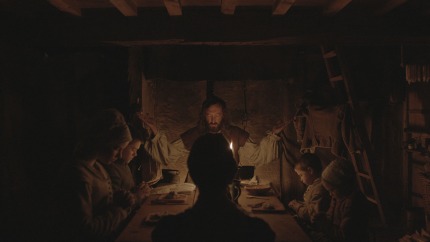
The Witch, from first-time filmmaker Robert Eggers, is a horror movie which asks us to suspend our modern-day disbelief in order to accept that witchcraft, black magic, and Satanic possession are as much a part of the real world as its family of 17th Century protagonists considers them to be.  Subtitled “A New England Folk Tale,” and based on the lore of a region and era in which widespread hysteria over such matters infamously culminated in the Salem witch trials, it informs us that much of its dialogue is taken directly from official transcripts of first-hand accounts from the period.  It strives to convince us of its authenticity, seeming to insist that our ability to accept the literal truth of what it shows us is crucial to our understanding of the story.

Set in New England of the early 1600s, it follows a family of settlers who have been cast out of their Puritan community for their preaching their own strictly conservative beliefs.  They establish a farm on the edge of the wilderness, where father William rules the family with a firm but loving hand; he daily performs the hard work required to maintain their home with the help of his eldest, daughter Thomasin, and her brother, Caleb; mother Kate tends to her newest baby, while the young twins, Mercy and Jonas, spend their days playing with the goats in the stable.  For a time, they seem to thrive, living an austere but tranquil life.  Their fortunes take a turn, however, when baby Samuel, while under the watch of Thomasin, suddenly disappears from their midst.  Though William insists the infant was taken by a wolf, it soon becomes apparent that another sinister presence from the woods is responsible, and as its mysterious grip tightens around the isolated family they find themselves terrorized by events that challenge not only their deeply-held faith in God, but their faith in each other, as well.

In the hands of many directors, this plot would undoubtedly be the framework for a host of lurid thrills and cheap shocks.  Indeed, throughout The Witch, horror buffs may find themselves repeatedly expecting the requisite “surprise” pop-up frights, and waiting for the slow build to explode into a progression of ever-grislier mutilation and carnage.

Eggers, however, has a different experience in mind; through both his screenplay and his meticulous staging of the film, he avoids sensationalism and focuses instead on maintaining and reinforcing the kind of realism more reminiscent of a subtle period drama than an over-the-top fright flick.  Not only are the costumes and the settings simple and historically accurate, the language of the dialogue is written and spoken with the ring of period authenticity.  The cinematography (elegantly executed by Jarin Blaschke) uses mostly natural and available light to remain firmly rooted in the real world while still using plenty of shadow to evoke the implied darkness lurking in the heart of the story, and Eggers artfully frames his shots to create painterly images that are nevertheless tangibly naturalistic.

Perhaps most critically, the actors are uniformly superb, a true ensemble cast.  Each member of the family is portrayed with the kind of absolute honesty that reveals complex and unexpected layers of humanity; even the youngest children are remarkably believable, a fact which enhances the overall effect of the film’s horror immeasurably.  All deserve equal credit.  .

It is the film’s well-crafted realism, though, that may prove its fatal flaw, for some audiences.  Everything about it, from its title to its haunting score (composed by Mark Korven), tells you that it is a horror film, but- on the surface at least- it doesn’t play like one.  The pace is slow, and the implied menace is rarely shown.  Even the title character herself barely appears onscreen, though we are emphatically expected to believe in her.

The brilliance of Eggers’ movie, of course, is that it never really does expect us to do that.  The movie hinges on the certainty that we will question the reality of this family’s experience and analyze it on a deeper level.  This is no cautionary tale about danger in the literal woods; rather, it’s a warning about what happens when we isolate ourselves within our beliefs- at odds with our communities, our loved ones, and our own true nature.  The interpersonal drama of the little family we are shown gives us plenty of clues about the real evil that is tearing them apart, and it comes from within, not from without.  It is this sly and subversive subtext running through its center that makes The Witch stand apart within its genre.  It may not terrify, but it provokes, and that is what will linger in your memory.

Well, that, and a certain black goat…

Sing Street (2016)

SingStreet

Today’s Cinema Adventure originally appeared in

The Pride L.A.


Movie musicals are a rarity these days.  Every so often a Broadway blockbuster will find its way to the big screen, but an original musical, with a new script and songs, comes along about as often as a light traffic day on the 405.  The last one of any significance came nearly a decade ago in the form of Once, a bittersweet, tuneful romance from Irish writer-director John Carney that went on to be adapted into a Broadway show in its own right.  Now Carney has returned to the genre with a new effort, the semi-autobiographical Sing Street.

Set in Dublin of the mid-eighties, it focuses on Connor (Ferdia Walsh-Peelo), a teenager whose middle-class family has fallen on hard times.  No longer able to afford his private education, they send him to a public boys’ school where discipline is strict, teachers are indifferent, and bullies rule the schoolyard.  It’s a bleak environment, but he finds a ray of light in the form of  Ruphina (Lucy Boynton), an aloof girl who frequently stands on a stoop across the street.  To impress her, he tells her he is in a rock band; her interest is piqued, and Connor starts recruiting schoolmates to make the lie a reality.  What starts as an attempt to get a girlfriend soon develops into a journey of self-discovery- and, just maybe, a way out of the dead-end life for which he seems destined.

Sing Street, on the surface, seems like an implausible mix.  Carney, evoking the gritty social realism that British cinema has been mastering since the “kitchen sink” dramas of the early sixties, places his story in an economically depressed urban landscape and populates it with characters who have more or less given up hope of anything better, yet he uses this grim setting as the backdrop for an escapist flight of rock-and-roll fancy which seems straight out of the Hollywood dream factory.  It shouldn’t work- but it does.

It’s just this odd juxtaposition of moods, in fact, that gives his film its magic.  Carney tempers the desperation with humor and grounds the giddiness with melancholy.  He treats his characters with compassion- even when they serve as antagonists to our hero- and never allows the fantasy to lose its connection to the underlying reality.  As for the romance (deftly played by the two young co-stars), instead of adolescent wish-fulfillment we are reminded, to paraphrase a line from the film, that to be in love is to be happy and sad at the same time.  It’s this delicate balance of “happy/sad” that permeates Sing Street, and serves as the lynch pin that helps it maintain its own delicate balance, right up to the sublimely satisfying ending.

The cast -mostly comprised of unknowns- brings an infectious energy to the mix, performing with the kind of authenticity that makes you forget they are acting.  Although the charismatic Walsh-Peelo definitely deserves singular praise for largely carrying the movie, he is equally matched by the lovely Boyle, and all of their young co-stars perform at the same level.  Special mention should also go to Jack Reynor as Brendan, Connor’s older brother and unlikely mentor; he gives a heartbreakingly endearing performance which, in many ways, provides the emotional center of the movie.

Finally, there’s the music.  Composed by Carney (with Gary Clarke and Adam Levine), a series of period-flavored songs brilliantly charts each new development in the fictional band’s style (as they progress though various phases of eighties pop), as well as Connor’s growing maturity.  They work as integral parts of the story, but they also stand on their own merits- catchy, heartfelt, and imaginative, they make the band’s onscreen success all the more believable.  These original tunes are the heart and soul of Sing Street, but a number of familiar eighties hits are sprinkled throughout as well, just for good measure.

It’s worth noting that the generation which lived through the era depicted will find that Carney’s film strikes a particularly resonant chord.  The clothes, the hairstyles, the videos- all are skillfully and lovingly recreated here, and it gives the movie a decidedly nostalgic flavor.  That doesn’t mean it won’t also feel fresh enough for younger audiences.  Ultimately, what makes Sing Street so appealing is that, at its core, it’s about the promise of the future- no matter how hopeless the present may seem.  That’s certainly a message that has a place in the world today, and it might just make even the most cynical of movie-goers walk out of the theater with a little more lightness in their step.

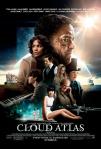
Cloud Atlas (2012)

Cloud Atlas (poster)

Today’s cinema adventure: Cloud Atlas, the epic 2012 adaptation of David Mitchell’s multi-narrative novel exploring the connections between individuals and their actions across time and space, written and directed by Lana and Andy Wachowski in collaboration with longtime associate Tom Tykwer, and featuring an ensemble cast of stars in multiple roles.  Produced in Germany with funding from an assortment of production companies and government agencies, it was one of the most expensive independent films ever made (with a budget of $100 million); the difficulty in securing the necessary finances led to stalls in development and production, with the project being declared “dead” at several points, but the enthusiasm and determination of the cast and crew- particularly the dedication of its biggest star, Tom Hanks- helped provide the impetus to drive the project to fruition.  After a premiere at the Toronto Film Festival met with a ten-minute standing ovation, it was released to widely mixed reviews and disappointing box office receipts, ending up in the unusual position of being placed on lists of both the ten-best and ten-worst movies of the year; nevertheless, its creators have maintained their pride and belief in the work as a labor of love and a true expression of cinematic art.

The screenplay, written in close consultation with original novelist Mitchell, follows six interwoven stories, each set in different eras, in which common elements bind seemingly unrelated characters and developments together through the course of an overall narrative.  In 1849, Adam Ewing, a young lawyer on an ocean voyage to conduct a transaction for his father-in-law’s slave-trading business, keeps a journal of his experiences on the ship, detailing his battle against a mysterious disease which worsens despite the efforts of the ship’s doctor, as well as his unexpected friendship with a runaway slave who has stowed away in his cabin; in 1936, Robert Frobisher, a gifted young musician, writes letters to his lover Rufus Sixsmith from the estate of an aging composer, where he works as an amanuensis, transcribing his employer’s musical creations as he strives to compose his own masterpiece; in 1973, Luisa Rey, a young reporter, has a chance encounter with the now-elderly Sixsmith, leading to her dangerous pursuit of a story exposing corruption and fraud in the development of a new nuclear power plant; in 2012, Timothy Cavenaugh, an aging, down-on-his-luck London publisher, has a surprise bestseller on his hands when its author becomes front page news by murdering a disapproving critic- but when the writer’s thuggish family comes after a cut of the profits, he is duped by his own resentful brother into hiding out in a rest home, where a draconian staff holds him against his will until he joins with a band of other disgruntled residents to plan a daring escape; in 2144, Sonmi-451, a genetically-engineered “fabricant” created for life as a server in a Seoul restaurant, is freed from her slavish existence by a handsome and mysterious young stranger who wishes to recruit her into a rebellion against the oppressive, consumer-driven government, and after he reveals to her the dark secrets of the regime and its treatment of her kind, she agrees to speak out in an underground broadcast which will expose the truth and spread a message of love and equality for all people; and finally, in 2321, a century after a catastrophic event in which most of Earth’s population either perished or fled to colonies in outer space, a primitive tribesman named Zachry lives with intrusive visions of a ghoulish figure he refers to as “Old Georgie,” and when his village is visited by a “prescient” (a group of culturally-and-technically advanced remnants from the old society) who seeks their aid in reaching a deserted outpost from before “the fall,” he must decide whether to offer her his assistance or to abide by the prompting of his otherworldly counselor, who advises him to mistrust and betray her.  As these six different tales unfold, it becomes clear that the events of the past send ripples through time to shape the events of the future, and that each person is intertwined with every other who ever lived or will live in an ongoing destiny shaped by individual choices and actions, no matter how small or insignificant they may seem.

If all that seems confusing when encapsulated into a bare-bones one-paragraph synopsis, it is no less perplexing as it plays out in leisurely detail during a nearly-three-hour running time on the screen.  This is, however one of the strengths of Cloud Atlas; as the various plotlines slowly move around each other in a carefully orchestrated progression of intercut scenes, they offer a challenge that intrigues the viewer despite the seeming incoherence of the juxtaposed scenarios, rather like the experience of piecing together a puzzle without being able to see the picture it will eventually form.  It is difficult to become emotionally engaged in the characters or their adventures, at least at first, simply because for a good third of the film it is virtually impossible to tell what is going on or where it is all leading; but the intellectual challenge of piecing it all together from the plethora of tantalizing clues with which it baits us is sufficiently irresistible to hold our attention until, as the parallels and common elements become apparent, we find ourselves invested in the proceedings, almost without having noticed it happening.  The rhyme and reason of these initially dissevered narratives becomes clearer as the threads that bind them into one are revealed, and by the time we see the underlying premise at work- the interconnectedness of all human life and experience as revealed through the gradual passage of time- we are ready to let go of our academic need to understand precisely how it fits together and simply sit back to watch as they resolve into their respective conclusions, simultaneously converging into an emotional climax which unites them into the single story which, of course, they have been all along.

At least, this is the design of the Wachowsi/Tykwer team behind the film; however, in order for it to work according to that plan, the viewer must be willing and able to buy into the conceits upon which their movie is built.  This is asking a lot of modern mainstream audiences, who generally expect their movies to be grounded in concrete, tangible realism and follow a logical, linear storyline; and though there is a built-in appeal for fantasy and sci-fi fans, Cloud Atlas mixes in elements of other genres that may only serve to put off those who are hoping for a more straightforward piece of escapist adventure.  In addition, its philosophical leanings, serving not merely as underpinnings to the overall piece but as the very core of its purpose, are impossible to disregard for those whose taste runs towards more concrete matter.  In the end, though the film packs plenty of action, drama, and even comedy into its panoramic tale, these things take a backseat to its larger agenda of presenting an epic meditation on the unseen forces that drive our collective journey through history; there is a decidedly literary feel here- indeed, references and homages abound to authors from Melville to Ray Bradbury, and many of the situations and settings evoke memories of their best-known works- and though the directors have not slacked in their efforts to create a cinematic experience, Cloud Atlas achieves its ends largely through a cerebral process more akin to reading a book than to the visceral response associated with film.  This is an observation, not necessarily a criticism; nevertheless, audiences seeking thrills and excitement may find themselves less entertained than frustrated.

For those who relish the challenge of it, however, the scrambled-picture format of Cloud Atlas makes for an engaging exercise; deciphering the internal logic that transforms this mosaic of seeming non-sequiturs into a cohesive whole requires a close attention to detail and provides insurance against a flagging of interest before things become clear enough to capture our sympathies as well as our intellectual curiosity.  Tykwer and the Wachowskis have done a deft job of building their game of connect-the-dots, providing no shortage of clues- presented with varying degrees of subtlety- that keep us assured that something is going on here, even if we can’t tell what it is.  This, of course, binds us with the characters, most of whom also become gradually aware of these as-of-yet unexplained points of intersection, and by the time we have begun to see the layered pattern of connectivity within these conjoined tales, we are able to surrender to the momentum and let the movie carry us towards the emotional nexus of its finale.  Indeed, it is the structural mystery itself that gives the film its appeal; taken on their own, the various episodes would be far too weak to build an entire movie around- with the possible exception of the dystopian saga of Sonmi-451.  Tied together by the undercurrents of causality that are the filmmakers’ true focus, however, each segment assumes a higher level of integrity than is bestowed by its individual premise or plot developments, and Cloud Atlas ultimately becomes a whole that is greater than the sum of its parts.

Besides the ambitious structural conceit, there are other aspects of the movie that may prove problematic for some viewers.  Part of the thematic core is reinforced by the choice of using the same company of actors in all the stories, playing different roles; the cast was told by their directors to think of themselves as playing a “genetic strain” rather than individual characters, and the result is a suggestion of spiritual continuity and progression throughout a series of lives- though the idea of reincarnation is not directly referenced in any other way, nor is the story dependent on a belief in that concept.  This multiplicity of casting, of course, gives the film’s stars a rare opportunity to show the range of their talents and yields the fun of seeing them in a wide variety of personas throughout- some of them across lines of age, gender, and ethnicity.   This latter element has been the source of some controversy, with objections being raised to the use, specifically, of white actors in “yellowface” to portray Asian characters.  This decision was made purely to maintain a crucial thematic concept, and indeed, Asian and black actors are also cast in white roles for the same reason; nevertheless, audiences sensitive to these kind of racial issues may find this uncomfortable.

Questions of perceived racism aside, this somewhat theatrical tactic, achieved with an extensive use of make-up and prosthetic effects in order to create vastly differing appearances for each of the characters’ various incarnations, may prove somewhat distracting- even jarring- to audiences not quite able to accept seeing these familiar faces passed off as anything other than their recognizable selves.  Some of the more obviously exaggerated permutations- Hanks as a Cockney gangster, for instance, or Hugo Weaving as a sadistic female nurse- are deployed for intentional comedic effect, but the inescapable cartoonishness of the disguises, in other cases, may elicit inappropriate chuckling.  To be sure, the use of actors in multiple roles is nothing new; it is part of a grand cinematic tradition most famously represented by the likes of Alec Guinness and Peter Sellers.  Again, though, contemporary audiences are unused to seeing it, and the sight of Hanks with enormous prosthetic buck teeth or Susan Sarandon as a heavily-tattooed tribal crone might demand too great a test of the willing suspension of disbelief for a good number of viewers.

The biggest obstacle that Cloud Atlas faces, though, in winning the hearts and minds of its audience, comes not from its unorthodox structural form or its casting, but from the very essence of its premise.  In positing a continuous thread of influence that runs through the course of human history, the film presents a thought-provoking- and relatively uncontroversial- idea that most reasonable viewers will have no problem accepting; but Tykwer and the Wachovskis, along with original author Mitchell, layer in the additional suggestion of an underlying consciousness of this phenomenon that manifests itself in an awareness within the characters themselves.  While it is not a stretch to portray individuals who feel a certain sense of destiny, Cloud Atlas goes further than this, making it clear that these moments of a priori recognition are the result of a force- whether supernatural, spiritual, or scientific- which exists beyond conscious perception.  To fully accept Cloud Atlas, the viewer must be open to embracing a certain “New Age” sensibility (for want of a better term) that encompasses notions of collective consciousness, the continuity of souls, and the workings of karma; though there is no overt discussion of these things by name- characters express their own beliefs and speculations in more-or-less generic, non-denominational terms- they are directly implied and, indeed, required as a condition of the film’s entire premise.  It is this factor that may most sharply determine whether a viewer can enjoy Cloud Atlas or not, and it’s a point that is not dependent on any affect the film may adopt.  There is no persuasion to be accomplished here; you either believe in this stuff or you don’t, and if you don’t, the payoff at the end of this ambitious epic will likely leave you cold.

That said, even for skeptical or cynical cinema enthusiasts, there is much to admire in Cloud Atlas.  The directors- who split the segments between themselves, with Tykwer handling the 1936, 1973, and 2012 stories and the Wachovski siblings helming those set in 1849, 2144, and 2321- have delivered a polished and cohesive whole while not only working separately but within styles appropriate for the different tones and settings of each of the six episodes; from period drama to seventies action to contemporary comic caper to futuristic action-adventure, they hit the right chords in their approach.  They deftly cut between the various threads in such a way as to emphasize the crucial parallels and reinforce their central conceit, as well as using the cross-cutting as a technique to build suspense and quicken the pace.  Most importantly, perhaps, they infuse their movie with the kind of epic visuals that linger in the memory- not just in the sci-fi segments, where dazzling design and effects create a distinctive and original vision of the future while evoking classics like Blade Runner and 2001: A Space Odyssey, but in the less fantastical sequences as well.  Artful composition and imaginative camerawork are expertly employed throughout, allowing, after all, for that direct, visceral effect of a purely cinematic experience, and thereby creating a cumulative emotional response while the necessary intellectual constructs develop through the dialogue.  It is this mastery of filmmaking technique that gives Cloud Atlas its most universal appeal; even those with the most vehement rejection of its concept and message can appreciate the artistry that has been employed by its makers in their passion to bring it to the screen.

That same passion manifests itself in the work of the cast, an oddly-mixed yet complementary ensemble that includes no less than four Oscar-winners and an assortment of acclaimed up-and-comers.  The aforementioned Hanks heads the group, playing a “genetic strain” that makes perhaps the most profound journey- from avaricious killer to selfless hero- during the course of his six incarnations; of these roles, the most “Hanks-like” is that of a sympathetic nuclear physicist in the 1973 sequence, in which he gives voice to perhaps the most eloquent expression of the film’s central theme, but it is in his against-type turn as a visionary post-apocalyptic tribesman that he truly shines- though for some viewers, accepting the usually warm and civilized everyman actor in this gruff and primitive persona may be too much of a stretch.  Halle Berry is also prominently placed as Hanks’ feminine counterpart, of sorts, serving as muse and catalyst for the development of others as she continually works towards her own fulfillment; her best work comes in her showcase role as journalist Luisa Rey- though she has an undeniably intriguing presence as the white, Jewish-refugee wife of the aged composer in the 1936 story.  Jim Broadbent is, as always, spot-on in his multiple appearances, the quintessential character actor clearly relishing the opportunity to show off his range; though his star spot comes in arguably the weakest of the scenarios- the cutely comedic adventure of the rascally publisher and his escape from the old folks’ home- his honest and likable performance is more than enough to make it engaging and endow it with the weight necessary to make it suitable as a companion to the other, more serious tales.  Hugo Weaving is perhaps a bit wasted in his series of roles, for the most part representing the darkest side of humanity throughout the film, and therefore denied the opportunity to show the kind of variety displayed by his co-stars; but he is, nevertheless, a welcome participant, particularly in his delightfully droll drag appearance as the elder-abusing head nurse who terrorizes Broadbent.  Ben Whishaw and James D’Arcy are moving and believable as the doomed young musician and his future-nuclear-physicist lover, making their tragic love story as inspirational, resonant, and universal as it deserves to be.  The former is particularly heartbreaking, playing against sentimentality to embody the roguish dilettante and making this pivotal character all the more sympathetic for it; and the latter- the only cast member to play the same character in two separate segments- also stands out in his other featured role as the interrogator struggling to maintain his neutrality as he questions captured rebel Sonmi-451. Jim Sturgess, who plays a central role in both the 1849 shipboard drama and the tale of Sonmi, is appealingly sensitive- and handsome- as each; and Hugh Grant is virtually unrecognizable in most of his appearances here, but highly effective in all of them, reminding us that this former matinee-idol- a last-minute addition to the cast- has always been a formidable actor, as well. With less screen time than some of the others, the aforementioned Sarandon lends her venerable respectability to a handful of supporting parts, mostly representing the dignity and wisdom of the feminine aspect, and David Gyasi scores with the earnest nobility he brings to Autua, the runaway slave.  The performance that provides the heart and soul of Cloud Atlas, though, comes from Doona Bae as reluctant rebel Sonmi-451; with quiet, unassuming intelligence and a sense of wonder that mixes with a deep sadness in her core, she gives us a believable and touching transcendence from slave to saint, filling the center of the film’s most ambitious segment and making it into the most touching and memorable of the lot.

Aside from the direction and the performances, there are numerous other impressive contributions to Cloud Atlas; the costume and makeup design are outstanding, the cinematography luminous, the scenic elements- which include both magnificent natural locations and sumptuously realized interiors- rich and detailed, and the special effects stunning.  If there were a single element to be singled out, however, it would unquestionably be the remarkable score.  Composed by co-director Tykwer himself in collaboration with Reinhold Heil and Johnny Klimek (a long-standing team responsible for the music in most of Tykwer’s previous films, as well), it is a genuine masterpiece of movie music.  Emerging within the narrative itself as the “Cloud Atlas Suite” written by young Frobisher, it weaves the same dominant themes and motifs throughout the six stories in styles which complement the mood and setting of each; alternately haunting, sad, stirring, triumphant, eloquent, and simple, it registers both subliminally and overtly as the true backbone of the film’s emotional and conceptual raison d’être, and though it could easily have been pushed just a few notches up to become maudlin, manipulative, and bathetic, instead it strikes just the right balance of flourish and restraint every step of the way.  A textbook example of the proper use of scoring in the cinema, it is strong enough that it could likely tell the story without need for dialogue, and deserves to stand among the best works of other film-scoring giants from Erich Wolfgang Korngold to John Williams.

Ultimately, Cloud Atlas is one of those movies that defy criticism.  Technically superb as it may be, and whole-heartedly committed and enthusiastic as all its participants were in its making, it inevitably elicits a polarized response.  Cinema, like all art forms, is at its essence a conceptualized expression- whether of an idea, an emotion, or some mixture of both; the reaction of the observer, when all is said and done, is dependent upon how that observer feels about what has been expressed.  There are those who will simply not respond sympathetically to the message of Cloud Atlas, and there are others who will find it deeply profound and inspirational.  Much like the perennial Christmas classic, Frank Capra’s It’s A Wonderful Life, its a matter of personal taste; one could probably split the world neatly into two types of people: those who like it and those who don’t.  Of course, there will always be an overlapping group of those who can’t quite make up their mind, for whatever reason; for my own part, that’s where I found myself fitting in, at least initially.  As days went by, however, I kept thinking about this unusual, challenging film, and remembering moments that I had almost overlooked in the lengthy sweep of it; the more I thought, the more I admired it, and I am now eager for a second viewing, and perhaps more, in order to catch hold of the myriad threads of detail with which its tapestry is woven.  I suspect that multiple viewings are probably necessary to gain a full appreciation for Cloud Atlas, and I must say that I am now more than willing to test that theory.  As much as I have come to appreciate it, however, I have my doubts that this Wachowsi/Tykwer opus will ever approach the top of my list of favorites.  Though I confess my personal beliefs are very much in sync with the ones presented here, there is something about seeing them presented as a concrete truth that somehow diminishes them; perhaps it is because, by nature of the very act of creating a story to encapsulate them, a degree of necessary artifice exists which evokes a suggestion of insincerity.  To its credit, Cloud Atlas skillfully avoids being precious, preachy, or cloying, despite many moments which could easily go this way, and it is clear from beginning to end that its makers are adamant in the beliefs their film espouses; indeed, it’s hard to imagine a movie that feels more genuine in its dedication to a purpose.  Even so, there are many viewers- myself included- who simply prefer to be allowed to draw their own conclusions about such deeply personal matters, and while Cloud Atlas never makes a defining pronouncement about the nature of existence itself nor declares any principle as an ultimate truth, it certainly leaves no doubt which way you should look for these things.  Perhaps it’s less a movie than a devotional meditation, in the end; though it can be a beautiful experience for seekers and believers, everybody else is going to have a hard time seeing the point.

http://www.imdb.com/title/tt1371111/?ref_=sr_1

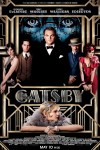
The Great Gatsby (2013)

The Great Gatsby 2013 (poster)

Today’s cinema adventure: The Great Gatsby, director Baz Luhrmann’s appropriately extravagant 2013 screen adaptation of F. Scott Fitzgerald’s iconic “Great American Novel” about an enigmatic millionaire at the center of New York’s Jazz Age social whirl and the intrigues and entanglements which surround him at his Long Island estate.  The fifth film to be based upon the classic book and arguably the most ambitious, it takes special pains to recreate the giddy, opulent atmosphere of the “roaring twenties,” as well as making a direct connection to the contemporary party culture through its interpolation of modern pop music, and striving to translate the story’s introspective style into a strong visual narrative.  Buoyed by the box office appeal of its star, Leonardo DiCaprio, and Luhrmann’s reputation for making wildly eccentric- and hugely successful- films that combine high art with pop culture (Romeo + Juliet, Moulin Rouge), it has met with considerable box office enthusiasm.  Reactions, however, have been dramatically mixed, from critics and the public alike, ranging from enthusiastic praise to vehement antipathy.

The screenplay, by Luhrmann and Craig Pearce, frames Fitzgerald’s plot as a flashback, told by the depressed and alcoholic Nick Carraway- the novel’s narrator- as he receives treatment in a sanitarium.  In the summer of 1922, the young war veteran moves to New York to work in the booming stock market.  He rents a small cottage in an affluent Long Island community, near his cousin, Daisy, and her wealthy husband, Tom Buchanan; a far more intriguing neighbor, however, is the mysterious Jay Gatsby, whose palatial mansion next door to Nick is the site of spectacular parties at which New York’s “glitterati” cavort each weekend, and whose origins are the subject of many wild and conflicting rumors.  As the summer progresses, Nick becomes entwined in the affairs and intrigues of the wealthy social whirl that surrounds him; he is “fixed-up” by Daisy with professional golfer Jordan Baker, he is made an unwilling confidante and accomplice in Tom’s infidelities with working-class housewife Myrtle Wilson, and he eventually receives an invitation to one of Gatsby’s parties.  There, surrounded by the free-spirited excesses of the Jazz Age- flappers, movie stars, musicians, gangsters, politicians, and businessmen, all mingling together in a seemingly endless sea of illegal liquor- he finally meets his infamous neighbor.  Gatsby- who is surprisingly young, handsome, and courteous- is a man possessed of a singular and intangible charisma, to which the idealistic Nick is immediately drawn; the millionaire courts his friendship, taking care to establish his own integrity.  In time, Gatsby reveals that five years previously, as a soldier preparing to depart for the war, he had a brief romance with Nick’s cousin Daisy, and though he promised to return and marry her, he kept himself apart while amassing his fortune; unwilling to wait indefinitely, and presented with a proposal from the rich and handsome Tom, she married, and now her former lover hopes to win her back- with Nick’s help.  Though he has mixed feelings about the morality of the situation, Nick agrees to facilitate a reunion between the pair, and their passion is rekindled- but Gatsby’s noble optimism may not be enough to overturn the jealously guarded status quo of the privileged elite, and the surfacing secrets of his past may shatter the spectacular dream he has so carefully built upon them.

Fitzgerald’s novel, a labor of love for the struggling author whose earlier successes were behind him and who was actively striving to create a lasting and definitive work, was a commercial and critical disappointment when it was published in 1925; it was seen as a shallow and inferior book by a formerly great writer, and by the time Fitzgerald died fifteen years later, it was largely forgotten, except by those who saw it as a quaint and nostalgic period piece, and its creator went to his grave believing himself and his magnum opus to be failures.  In the disillusionment of the post WWII era, however, the book’s theme of naive optimism crushed by cynical reality began to take on a new resonance, and The Great Gatsby rose to prominence as one of the quintessential American novels, eventually being ranked by literary critics and scholars as one of the most important books of all time and becoming standard curriculum in high school English classes the world over.  In the nine decades since its publication, it has become increasingly noted for its timelessness; it possesses a quality of universal relevance, for within the highly specific time and place of its setting it tells a story that touches on experiences of human life that exist in any era.  Consequently, like most great novels, it has repeatedly found its way in front of the camera, and though it’s hard to accurately gauge the relative success of these cinematic incarnations- the original silent version from 1926 is now considered a lost film, and the 1949 remake with Alan Ladd is largely unavailable due to copyright issues- the consensus seems to be that the results have been more or less disappointing.  Anyone familiar with the book itself will find this unsurprising; much of the story’s depth and power comes not from the events of its plot but from the private observations of its narrator, Nick Carraway, through which Fitzgerald’s voice infuses Gatsby’s tragic tale with meaning and significance, as well as providing acute insights on human nature, complex ethical and philosophical ideas, and a fairly sizable portion of social and cultural commentary.  Besides the obvious and uninspired use of voice-over narration, this crucial element of The Great Gatsby has proven virtually impossible to translate to the visual medium of cinema without sacrificing most of its potency- until now.

With Baz Luhrmann behind the camera, this previously insurmountable obstacle becomes instead a means by which to transform a literary masterwork into a breathlessly cinematic experience; rather than taking the expected course of offering a dramatization of the outward events of the plot, thereby rendering extraneous the all-important narration, he has constructed his film as a visualization of Nick’s memories and impressions, thus filtering the story of Gatsby’s idealistic quest through his eyes, and making the movie- like the book- a reflection of his internal reality rather than an objective record of events.  In doing so, the director frees himself from the understated simplicity of the novel- one of its most admired strengths- and allows for a limitless influx of the over-the-top theatricality which has defined his career.  The narration has been restored to its rightful place as the key component to experiencing the story, and Luhrmann employs the tactics of modern filmmaking to bring it into sharp focus, translating literary conceits into clear, striking imagery without regard for maintaining an illusion of realism.  It’s a bold approach, and a canny one, for while the book’s sedate detachment is a springboard for the reader’s imagination into the passion and drama beneath the surface, such a technique is better suited for the page than for the silver screen; by making the kind of florid, outrageous choices for which he is famous, Luhrmann uses aural and visual stimulation to bring about a heightened emotional state in a more directly visceral way.  The end result is the same, but the style which brings it to us is, appropriately enough, purely cinematic.

To describe the world Luhrmann conjures for The Great Gatsby in detail would be an overwhelming task, but anyone familiar with his elegantly excessive sensibilities can easily imagine the result of bringing them into a recreation of the Jazz Age, an era of such noisy and self-indulgent flourish that even the most flamboyant exaggeration cannot be said to go too far.  The screen is filled with a maelstrom of period fashion and design, meticulously realized and embellished with all the high-tech magic of a 21st-Century production.  The filmmaker seeks to over-saturate us, not simply in order to magnify our emotional response but to simulate, as much as possible, the giddy energy of the period’s amplified lifestyle, making it clear that every speeding car, frantic dancer, and crowded speakeasy is a pointed and obvious metaphor for the reckless mindset of the age. The camera zooms and twirls through crowds of dancing, reveling party people, piecing together its imagery with a mosaic of rapid cuts and juxtaposed images and making the film’s first two thirds feel like an ongoing bacchanalia; even when the scene changes- to luxurious estates, sumptuous rooms, bustling offices, and (in all their CG-rendered glory) the glittering streets and skylines of New York City- there is a constant sense of urgent movement, providing an appropriate and irresistible feeling of pushing forward to whatever spectacular experience comes next.  In this way, Luhrmann manages to capture the heady, progressive character of the twenties, with all its lax morality and blasé sophistication, in a much more tangible way than most previous films about the period, which often fall prey to a tendency towards the stiff and pretentious- or worse yet, to the quaint and precious- in an attempt to tell the story through imitating the stylistic means of the time itself.  Far from undertaking a recreation of twenties-era filmmaking, he instead pulls out all the stops available in the modern age, not only with the aforementioned computer-enhanced scenery and hi-tech camera fluidity, but by using audaciously contemporary conceptual imagery to bring some of the novel’s more abstract literary conceits (the famous “green light,” the ever-watching eyes of the oculist’s billboard, the utilitarian hellscape of the “City of Ashes”) to life in ways that would be impossible- even unimaginable- in the early days of cinema.  He even goes so far as to make his movie as a 3D blockbuster- and like Martin Scorsese’s Hugo and Ang Lee’s Life of Pi, The Great Gatsby is an example of how this state-of-the-art technology can be elevated from the level of a mere gimmick to an effective artistic embellishment by a true master of the craft.

All this visual opulence has given The Great Gatsby a decidedly dream-like quality, reminding us that what we are watching are the larger-than-life memories of the tale’s narrator, romanticized and heightened by his emotional state; suitably enough, after the parties have ended and the sordid truths have begun to emerge, and the story moves towards its denouement, the golden-hued, luminescent reality of Gatsby’s world takes on the semblance of a nightmare- still the glowing dreamscape, but now tinged with dread, foreboding, and sadness, it is a world in which the shimmering lights taunt us and the fixtures of luxury seem cold and comfortless.  For some, this change in the movie’s thrust, from the fast and furious to the slow and sorrowful, seems to make for an anticlimax in which the promise of the first 90-or-so minutes diffuses into a limping, unsatisfying conclusion; this, of course, is precisely the point of The Great Gatsby– the world it depicts is full of people going nowhere fast, riding a whirlwind of careless abandon towards the assumed certainty of an ever-brighter tomorrow, but we know (as Fitzgerald may have, in some way, foreseen) that their overconfident fantasy will come abruptly crashing down with the stock market just a few short years later.  Gatsby himself is their champion, a uniquely American figure who reinvents himself in the image he wishes to present, believing that wishing can ultimately make it so, and never permits doubt to enter into his thinking or his plans; anything is possible for him, so he thinks, if he wants it badly enough.  It’s a seductive idea, and one which all of us, to some degree, would love to believe in; Gatsby’s failure, then, becomes our own, and Luhrmann’s film does not allow us to deny it within ourselves by distracting us with the continual flash of the previous scenes.  In the end, all of Luhrmann’s razzle-dazzle falls away to reveal a stark and sobering human truth, conveying the purpose of Fitzgerald’s masterpiece by providing a full sensory experience which allows it to hit us not just on an intellectual level, but right where we live.

Though my own response to Luhrmann’s vision of Fitzgerald’s novel may have been highly positive, it should be noted that others have not been quite so appreciative as I.  As mentioned above, reactions to The Great Gatsby have been wildly mixed, unsurprisingly for a film by this particular director.  Baz Luhrmann is one of those filmmakers whose personal style is not only unique and unmistakable, but also aesthetically controversial; as a rule, audiences (and critics) either love or hate his work, with very little middle ground.  With a sensibility that might best be described as low-rent Bohemian glamour, he is unapologetically operatic, deliberately provocative, and audaciously eclectic; he challenges our expectations and preconceptions by imposing contemporary attitudes onto whatever material he happens to be exploring, whether it be the Renaissance poetry of Shakespeare’s Romeo and Juliet or the Parisian post-impressionist fantasia of Moulin Rouge.  His most controversial tactic by far is his prominent use of anachronism in his artistic choices, and Gatsby is no exception.  By far the biggest sore spot for most of the film’s detractors is its use of modern-day pop music- rap, hip-hop, “indie” rock- in the film’s soundtrack, a jarring device which directly opposes the visual (if heightened) authenticity of the 1922 world he has so painstakingly orchestrated.  To be sure, it seems, on first analysis, to be a blatant ploy designed to capture the attention of the youth demographic so coveted by studio executives wishing to maximize their profits; but as the movie progresses, it becomes plain that Luhrmann, who seamlessly interweaves the contemporary material into the genuine period jazz which accompanies the action, has a more pointed artistic agenda here.  The juxtaposition of this familiar “now” sound with the equally familiar (and, for many, dated) sound of the era’s music makes an unmistakable and instantaneous connection between the fast-living partiers which surround Gatsby and the modern-day club culture of which many of the movie’s audiences are presumably a part.  With this over-the-top stroke, Luhrmann succeeds in bringing home the point that, though separated by several generations and countless shifts in cultural interest, the people on the screen are, in essence, the same as the people seated in the theater.  Though it may be difficult for many to overcome their disapproval of Luhrmann’s choice, it is undeniable that it’s an effective tool, and in truth, there is a sense that the strains of Florence + the Machine, Jay-Z, and Beyoncé are a sort of reverse echo from the future, an otherworldly intrusion that we are meant to hear but to which the characters onscreen are oblivious.  Seen this way- and given the fact that Luhrmann has remained diligently faithful to Fitzgerald in both plot and thematic substance, as well as providing a remarkably detailed and authentic recreation of the time and place of the novel’s setting, The Great Gatsby is probably the director’s least anachronistic film.

Without question, the star of this Gatsby is its Australian director; but acknowledgement must be made to his fine cast, charged with putting faces to these iconic characters, who manage to rise admirably to the task- one which is made no less difficult by Luhrmann’s sensibilities, which insist on maintaining Fitzgerald’s already-elevated language in a deliberately heightened style.  Front and center, of course, is Leonardo DiCaprio’s performance in the title role; he is well-suited to play Gatsby, handsome and confident, but with an innate sensitivity that seems almost to be deliberately- and ultimately, unsuccessfully- concealed.  He makes this archetypal American dreamer into a flesh-and-blood individual, whose shining veneer is full of cracks that allow glimpses of the flawed psyche that lies beneath; we get a real sense, from almost his first appearance, that this pretty package contains damaged goods, but his charm and his sincerity- even when he is most obviously putting on a not-very-convincing front and telling the most outrageous untruths- are so engaging that we, like Nick, are naturally drawn in, and we like him despite our ever-growing certainty that he is not what he seems to be.  The more we learn, the more we sympathize with him and long for the success of his grand, romantic undertaking, and though this is partly due to Fitzgerald’s skill in creating the character (and Luhrmann’s skill at translating it into film), DiCaprio deserves full credit for successfully bringing what is clearly a deep understanding of this complex figure to his work here.  In the difficult role of Nick, who is in many ways an outsider to the story, but upon whom so much depends, Tobey Maguire also does stellar work.  Taking clear inspiration from the notion of his character as a stand-in for Fitzgerald himself (a conceit made obvious by the film’s framing device), he gives us a young man with all the manic emotional intensity of a burgeoning alcoholic, indulging in outrageous behavior and introspective intimacy yet always seeming aloof and distant, concealing a surging ocean of depth and feeling behind a faintly bemused, stoic expression.  Thanks to Luhrmann’s stylistic window, we are allowed to see past this placid exterior to the poetic soul which fuels the narrative, and when his pent-up passions finally explode forth, Maguire’s roaring performance elevates Nick to his deserved status as the true hero of the tale, rather than the parenthetical necessity so often presented in previous attempts to dramatize The Great Gatsby.  Joel Edgerton, stuck with the difficult role of Tom Buchanan, is able to bring out the humanity of this elitist, misogynistic racist, though to make such a pointedly hateful man sympathetic is beyond his- or, perhaps, any actor’s- abilities; Elizabeth Debicki fares better as Jordan Baker, presenting the quintessentially chic, sophisticated, and disaffected flapper in a long, lean package that manages to be likable despite the character’s inherent coldness; and Isla Fisher, though her Myrtle Wilson suffers from having a bare minimum of screen time and therefore pales in (the perhaps unfair) comparison to Karen Black’s standout performance of the same role in Jack Clayton’s 1974 film version, shows us both the appealing sparkle and the desperate longing of this tragic girl who is forced, by both the men in her life, to hide her light under a squalid, ashy bushel.  The film’s best performance, though, comes from Carey Mulligan, as Daisy; vilified by so many commentators as a vapid and shallow representative of self-absorbed materialism, the focus of Gatsby’s obsession becomes, thanks to the intelligence of this gifted actress, a real woman, torn apart by the conflicting impulses of her heart and the ingrained conditioning of her social role.  Though Fitzgerald’s portrait of Daisy leaves her inner experience a mystery, Mulligan lets us in, and shows us the pain, the fear, and the heartbreak that goes on as she struggles towards making her choice, and plainly shows us that it is a difficult and heartbreaking choice for her; because of this sensitivity and humanity, we can see why Gatsby should want her so badly- the unspoken depth she reveals validates his obsession, and rescues his character from shallowness, as well- and transforms this much-maligned character from a cruel and thoughtless child into as much a tragic victim of the status quo as her would-be paramour.  It’s a truly luminous performance, yet subtle enough in detail to go unnoticed and unappreciated by many; full recognition is deserved, however, and this remarkable English performer certainly gets it from me.

Ultimately, of course, The Great Gatsby is a movie that is destined to divide; like all revered books, its source novel evokes deeply personal responses in its readers, and it is inherently impossible for an adaptation in any form to satisfy all of them.  Coupled with Luhrmann’s love-it-or-hate-it style of cinema, it is inevitable that many audiences would be left cold- or, just as likely, be actively outraged- by this film’s approach.  It is unlikely that anything I could say would sway those who dislike it, but for viewers with an open mind and a love for outside-the-box filmmaking, this is a movie that deserves a chance; as a fan of the book, I expected to be disappointed, but instead I found Luhrmann’s version not only exceptionally true to Fitzgerald’s original, but loaded with the kind of passion and insight that thrills me and reminds me why I love movies so much.  Is it eclectic and sometimes jarring to accepted sensibilities?  Absolutely, and that’s one of the reasons it worked so well for me.  Most of all, though, it is the work of a bold and consummate artist who was driven- by his own love of the material- to create a lavish and definitive representation of this resonant literary touchstone, and though I can understand why some may take exception to a few of his personal touches, for me it is beyond question that he has succeeded, far beyond reasonable expectation.  Baz Luhrmann has managed, after 87 years, to finally give us a film that conveys why The Great Gatsby is, truly, great.

http://www.imdb.com/title/tt1343092/?ref_=fn_al_tt_1

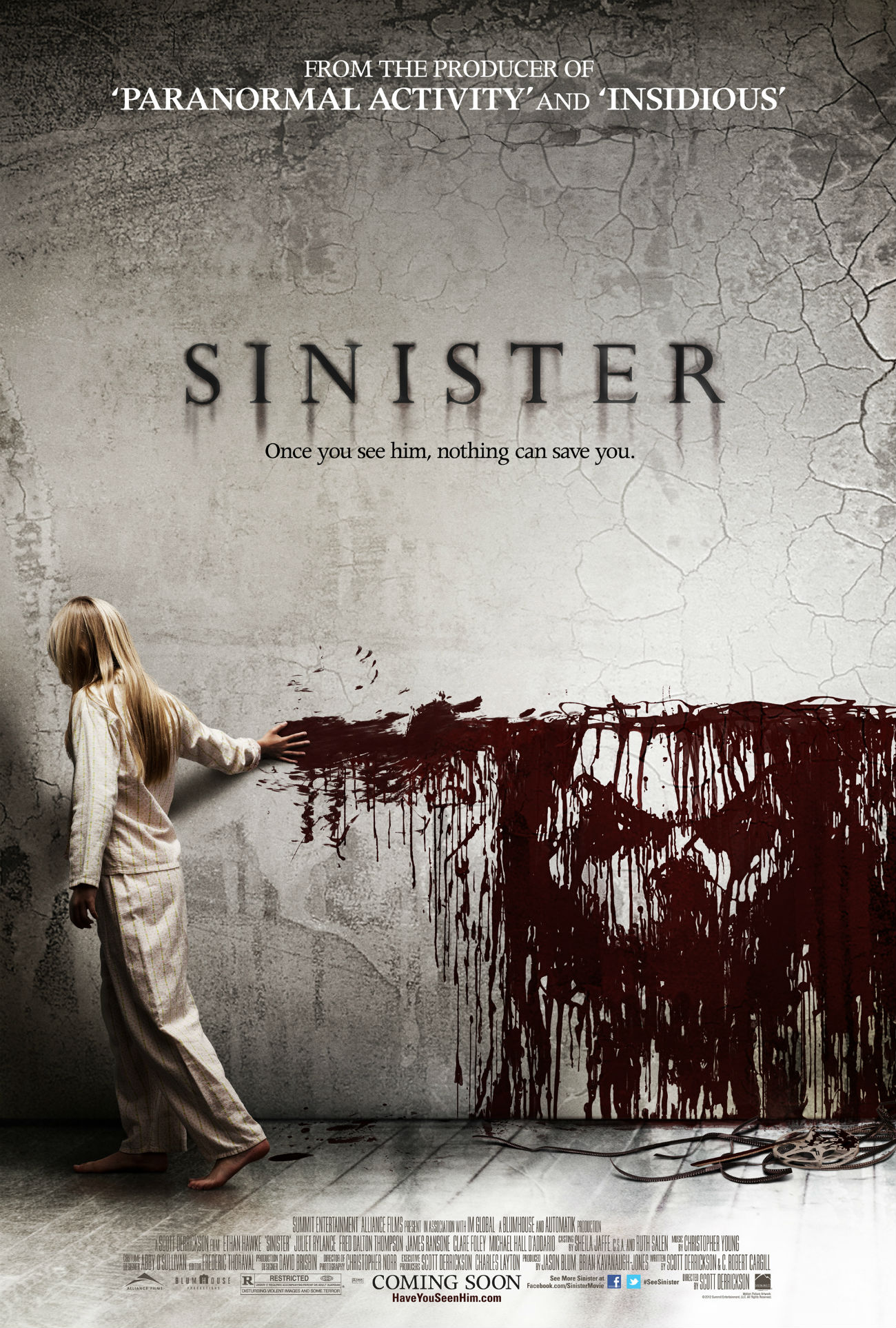
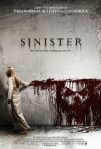
Sinister (2012)

Sinister (poster)

Today’s cinema adventure: Sinister, the 2012 horror feature by director Scott Derrickson, about a true-crime writer whose research into the unsolved murder of an entire family uncovers links to a decades-long series of similar killings and connections to an ancient malevolent force.  Combining a standard cinematic narrative with elements of the now-prevalent “found footage” format employed by the horror genre, it relies heavily on mood and atmosphere, eschewing overt violence and gore for the terrors of a stimulated imagination and the deliberate build of suspense through tried-and-true methods of filmic storytelling.  Benefitting from intelligent writing and a strong and experienced cast headed by Ethan Hawke, it received mostly positive response from critics and was even named by some as the best horror film of the year.

Inspired by a nightmare in which he discovered a home movie documenting the hanging death of an entire family, Derrickson built a screenplay, co-written with C. Robert Cargill, in which this situation serves as the premise for a tale of real-life obsession and supernatural evil.  It begins as crime author Ellison Oswalt, moves with his family into a house located in a small rural town where a family has been brutally murdered the year before- except for a young daughter, who disappeared without a trace.  Hoping to recapture the success of his first bestseller after a string of subsequent failures, Ellison plans to research the sensational case up close; unbeknownst to his wife and children, he has gone so far as to purchase the very house in which the killings took place.  While exploring the attic, he discovers a box containing an old projector and several reels of Super 8 home movies; obviously curious, he takes them into the office he has set up in a spare bedroom and begins to watch.  When he begins with the most recently-dated film, he finds- to  his horror- that it shows the murder of the house’s former occupants, although any shots of the murderer have been edited out; even more disturbingly, the remaining films, dated over the course of six decades, contain a visual record of other, similar murders- each one the ritualized slaughter of an entire family by different, equally horrifying methods- and in each one, upon close inspection, can be found a glimpse of an ominous, dark-eyed figure watching the gruesome proceedings.  Though at first he considers bringing the films to the police, Ellison’s ambition to regain his fame and fortune wins out; he decides to pursue the investigation by himself, hoping to solve the case on his own and use it as the basis for his triumphant return to the bestseller lists.  With the help of a star-struck deputy sheriff and a local expert on the occult, he begins to piece together a pattern linking the various filmed murders, but the mystery only deepens- as does his obsession with it, leading him to heavy drinking and driving a wedge of alienation between himself and his family, who have begun to be affected by the sinister aura of the house.  It soon becomes apparent that Ellison’s ego-driven quest for answers has uncovered an ancient and diabolical secret, and that he may unwittingly be placing himself and his loved ones at risk by continuing to pursue the truth.

Derrickson’s efforts to create a truly frightening film went beyond the development of the screenplay itself, and involved a heavy focus on the creation of the central villain, whose wordless presence gives Sinister the bulk of its creepy power.  After abandoning his original conception of an evil “Willy Wonka” figure, luring children into his murderous trap, and transforming the character into an legendary Sumerian spirit rather than a demonic entity (to avoid rooting the film in a specific religious setting), he researched over half a million online images and drew inspiration from the visual style of “black metal” music- which is extensively used in the soundtrack- in order to achieve the look and persona of “Bughuul,” fondly known as “Mr. Boogie” by the children who fall under his spell.  The filmmaker’s instinct to get it right was a wise one- many otherwise effective horror films have been sunk by the presence of an unconvincing or laughable monster, but Sinister succeeds in dispensing chills largely because of the primal fear effortlessly elicited by its elegantly simple, utterly terrifying boogeyman. Made all the more disturbing by his ephemeral presence on the fringes of consciousness and reality, he appears only fleetingly onscreen, yet he leaves haunting, indelible images in the mind and makes us search for another look at him even as we dread the prospect of it.  Though the plot of the movie is driven, like so many other films in the genre, by characters making mind-numbingly stupid choices (why do horror characters never reach for a light-switch when they enter a darkened room?) and implausibilities that stretch the willing suspension of disbelief dangerously close to its limit, we forgive these clichés of the formula because of the palpable aura of inevitable doom conjured by our brief encounters with this otherworldly phantom.  From the first moment we see him, we know where things are going, and we are drawn into the journey towards that horrific culmination with the same illogical, obsessive fascination as the characters onscreen.

Not that Sinister is devoid of strengths besides the portrayal of its Sumerian specter; although the perfunctory and predictable pitfalls of the genre- cheap and sudden shocks, the usual reliance on creepshow staples such as evil children and menacing animals, the aforementioned brainless behavior of the potential victims- are undeniably present here, Derrickson and Cargill have infused their screenplay with enough intelligence to bring a sort of sense to these elements.  Their clever use of modern technology to facilitate the story not only allows for the visceral immediacy of the supposed “actual footage” upon which the premise hangs, but also for streamlining the narrative; the pursuit of information requires no more than a few keystrokes on a laptop, eliminating the need for lengthy expository scenes at the local library.  In addition, the rooting of the story in a tech-savvy modern world helps to heighten the contrast with the antiquated force of evil within it, and- more importantly, perhaps- serves to compound the isolation of our protagonist, whose vulnerability increases the as he retreats deeper into his self-created solitary confinement.  In addition, Sinister re-imagines the stock characters of the genre to a sufficient degree that they almost seem original.  The town sheriff is not a pompous buffoon, but a smart and authoritative figure with refreshing candor and obvious wisdom, and our confidence in Ellison is undermined almost from the outset, simply through the hostility and lack of respect he bestows upon this man; likewise, the deputy who later assists in Ellison’s research, though he seems, at first, to be the slack-jawed yokel we’ve seen so many times before, soon proves to be a sharp and savvy investigator, who might be a valuable ally if the ostensible hero were not blinded by his own sense of intellectual superiority; finally, Ellison’s wife and children, though ultimately relegated to the position of a plot condition, are not the clichéd ciphers so often seen in these roles- the kids, though troubled (understandably and believably so), are possessed of genuine and endearing personalities, and his wife (played by the lovely and substantial Juliet Rylance) is strong, supportive- within reason- and eloquent enough to deliver the film’s keystone monologue about her husband losing sight of his life’s true purpose in the pursuit of fortune and glory.

It is this last point that underscores what truly elevates Sinister above the level of schlock horror and gives it the weight and substance that allows it to be more than just a spooky campfire story.  In Ellison’s self-destructive determination to recapture his worldly success, he abandons his role as protector and companion to his family; indeed, he effectively separates himself from the rest of mankind, devaluing all outside influence and presuming to stand alone against a powerful evil which he has yet to fully comprehend.  Cut off from the source of his humanity, and with his stubborn ego undermined by self-doubt and self-loathing, he can only watch, powerless, as the forces he has unleashed proceed to overwhelm him and infiltrate the world around him.  It is this portrait of a man haunted from within, driven by his ambition but paralyzed by his fear of failure, that gives Derrickson’s movie its real power; the story of Bughuul and his ancient evil becomes a metaphor for the soul-consuming effect of displacing one’s humanity in favor of the blind pursuit of material success, and Ellison’s spiraling downfall is as much an indictment of the so-called “American Dream” as Willy Loman’s delusional road to suicide in Death of a Salesman over a half-century ago.  Of course, this is not to say that Sinister has social commentary as its ultimate purpose; the film is aimed squarely at scaring the bejeezus out if its audience, and it succeeds wickedly.   Nevertheless, while it is relatively easy to shake off the chills it brings by exploiting our fear of things that go bump in the night, this deeper level allows those chills to sink to the bone, leaving us unsettled and uncertain long after the final, gruesome images have faded from the screen.  It is also the presence of this underlying theme that allows the film to seem fresh and original even as it evokes and pays homage to the genre classics which influenced its director- most obviously The Shining, a movie with which Sinister bears many similarities in story, subject, and mood.

Derrickson’s slick direction goes a long way towards making the whole thing work.  He heavily utilizes his soundtrack, both musical and ambient, to create near-unbearable tension; the big visual scares come as surprises, emerging from the periphery of our gaze or rising from the shadows of the background; his use of authentic Super 8 film to recreate the ghostly snuff films which lure both protagonist and audience into the story lends a grainy realism that makes these sequences all the more disturbing, and his choice to cut away from these at their most gruesome moments, or show us the gore out-of-focus, in a reflection or in the background, forces our imagination to complete the picture with images more horrific and unthinkable than anything he could have put on film.  The director’s cleverness behind the camera, however, would be for naught without a strong performance from his star, and Ethan Hawke- an oft-overlooked but genuinely fine actor, particularly adept at playing likable losers on a downward spiral- delivers just that; in Hawke’s capable hands, Ellison avoids coming off as just another cocksure golden boy paving the road to his own deserved comeuppance and instead becomes a sympathetic Everyman, flawed but inherently decent, well-intentioned despite his over-confidence, and ultimately more devoted to his family’s welfare than his own success.  Though we see from the beginning that he is an unreliable figure in which to place our trust, we are drawn to identify with him nevertheless, largely due to Hawke’s honesty, which lets us inside the conflicted and desperate mind which drives him; he takes us along for the ride, bouncing between determination and fatalism, buoying himself with self-assured good cheer even as morbid self-doubt eats away at his core, and never letting us forget that Sinister, for all the arcane circumstances at its surface, is really about a man’s struggle with demons on the inside.

This review may seem like a rave, and in a way, it is.   I must admit that, for the most part, contemporary horror movies do very little for me; I find them gimmicky, shallow, and unimaginative, relying on gross-out tactics and cheap scares to make an impact without challenging the intellect.  They debase human behavior, fetishize violence and cruelty, and reinforce a simplistic morality even as they present a nihilistic view of a hostile and malicious universe.  Of course, these criticisms of the genre are not unique to its most recent expressions- far more horror movies have been lowbrow schlock than have been cinematic gems, no matter what the era- and there are certainly exceptions.  Sinister is one of those, a movie in which the shocks resonate to a deeper level and strike at fundamental issues in our collective psyche; it taunts us not just with primal fear of horrors hiding in the dark, but with the more sophisticated terrors of living in the real world- of failure, of inadequacy, of getting it all wrong, and perhaps worst of all, of playing in a rigged game where even your most determined effort only serves to ensure your ultimate defeat.  Sinister is not, in the end, a film of the caliber of such cinema greats as Rosemary’s Baby or The Exorcist, which weave philosophical contemplation about the true nature of evil seamlessly into their narratives, nor does it approach the subversive genius of Golden Age classics like King Kong or Bride of Frankenstein, in which the hypocrisy, greed, and intolerance of so-called normalcy are used to cast the “monsters” as more worthy of sympathy than those they terrorize; like those and other films of the genre, it invites us to think and to feel as it thrills us, but it falls short of true brilliance by never quite breaking free of standard formula, no matter how expertly it adapts the tropes to its own ambitious needs.  Nevertheless, it succeeds in chilling us to the bone without expecting us to shut off our higher functions in exchange for the thrill, and it manages to breathe new life into its clichés without being too clever for its own good (see my review of The Cabin in the Woods).  Sinister may not be a great movie, but it is, in my estimation, a good horror movie- and coming from me, that is high praise indeed.

http://www.imdb.com/title/tt1922777/?ref_=fn_al_tt_1

Argo (2012)

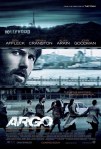
Argo (poster)

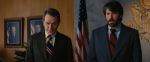
Today’s cinema adventure: Argo, the winner of the 2012 Academy Award for Best Picture, directed (and starring) Ben Affleck and offering a fictionalized chronicle of the real-life rescue of six American refugees from Tehran during the 1979-1980 Iranian hostage crisis.  With a screenplay by Chris Terrio (who also won an Oscar for his work) and a talented ensemble cast that includes veteran actors Alan Arkin and John Goodman, as well as acclaimed Breaking Bad star Bryan Cranston, it was an instant critical and financial success upon its release, revitalizing Affleck’s career and garnering much praise for its intelligent, character-driven approach to the story- though it has also received criticism for its use of embellishments and fabrications to increase the drama of its narrative, as well as for its selective arrangement of facts to maximize its pro-American sentiments.

Based on Tony Mendez’ personal memoir, The Master of Disguise, and Joshuah Bearman’s magazine account of the mission, “Escape from Tehran,” Argo begins with the 1979 storming of Tehran’s U.S. embassy by militants following the Iranian revolution which supplanted the American-backed Shah with radical Islamic cleric Ayatollah Khomeni as leader of the nation.  The embassy staff have barely enough time to shred their confidential papers before they are taken hostage by the angry throng, who seek to exchange them to the U.S. for the return of the former Shah, so that he can be tried and executed by the new revolutionary government.  Unbeknown to the militants, however, six Americans have managed to escape through a side door, and have found refuge in the Canadian embassy; as the world’s attention turns to the tense diplomatic standoff over the captive diplomats, the C.I.A. tries to develop a plan for the safe extraction of these secret fugitives before the Iranian militants can discover their existence.  Called in to consult, “exfiltration” expert Tony Mendez hatches an unlikely plot by which the six can be safely flown out of the country under the very noses of the Iranian government; posing as a Canadian film producer, he will enter Iran under the pretext of scouting exotic locations for a new science fiction epic, then- with the aid of falsified passports provided by the Canadian government- the six refugees can depart with him, posing as his film crew.  With the help of a Hollywood contact- Oscar-winning makeup designer John Chambers- Mendez enlists a famous producer to help set up a production company for his phony epic, thereby establishing a convincing cover story through the Hollywood publicity machine, and with all the pieces in place, sets out for Tehran to enact his outrageous plan.  Before he can succeed, though, he must first convince the six terrified diplomats to cooperate with the scheme and turn them into a believable facsimile of a movie crew; to further complicate matters, the ever-changing political tides at home threaten to undermine C.I.A. support for the mission, and the Iranians- who are painstakingly restoring the shredded embassy records- are on the verge of discovering that there are six Americans still unaccounted for and at large somewhere within the city.  With time running out and no other option besides eventual capture and probable execution, there is no choice but to follow through with their desperate ruse and hope that their luck holds out.

In crafting a screenplay from these true-life events, Terrio has created, in essence, a caper film; the story is molded in the classic form of an adventure in which a diverse team of mismatched characters must work together to execute an elaborate scheme, wherein intricate planning and precise timing- and a healthy dose of good luck- are required to achieve success.   The premise is not far removed from such films as The Sting or Ocean’s 11, except that instead of a heist the players are attempting an escape.  Since the outcome is a matter of relatively well-known history, the challenge is to generate suspense as the action unfolds; in order to achieve this, the writer wisely chose to focus much of his attention on the personalities of the people involved, heightening the suspense with a personal dynamic that places much of the interest in seeing how these various characters manage to rise to the challenges they face.  This allows for a strong sense of ensemble among the actors and a layered tapestry of nuanced performances, bringing the plot to life with a richness that evokes the character-driven political dramas of the era in which Argo takes place.

The other tactic by which the movie creates suspense, while it is standard practice in the dramatization of true events, could be considered a bit of a cheat; Terrio has fabricated a number of circumstances within the narrative that did not occur in real life.  The six American escapees were never in imminent danger of detection by the Iranian militants, nor was there any suspicion or investigation of the Canadian embassy while they were lodged there; the C.I.A. never withdrew support for the rescue mission, and the Carter administration approved the plan well before the eleventh-hour climax portrayed in the film; and when the time came for the clandestine travelers to make their escape, they walked easily onto the plane and flew out of the country without so much as a second glance by the security at the airport.  Using artistic license is certainly an accepted method- even an expected one- for creating a more eventful and exciting film narrative, and it serves well in Argo, though historical purists may quibble; more questionable are the deliberate omissions and slanted characterizations that diminish the real-life role played by the Canadians in the operation, cast the British and other governments in an unsympathetic light, and depict the Iranians in a manner which reinforces an already problematic cultural bias.  Nevertheless, setting aside questions of fairness or historical accuracy in what is, after all, a movie “based on” a true story (as opposed to a recreation of actual events), Terrio’s screenplay is a superb piece of Hollywood myth-making, building a gripping and compelling story out of its concern for character instead of the intricacies of the plot, and doing it with a great deal of intelligence and- both surprisingly and refreshingly- a great deal of humor.

As for Affleck’s direction of the piece, he picks up the obvious connection of Argo to seventies cinema and uses it as the basis for his mise-en-scène; though modern day technical trickery has been used to achieve certain ends (such as the transformation of the Istanbul filming locations into the city of Tehran and the dilapidated state of the iconic “Hollywood” sign- another historical inaccuracy, since the landmark was actually restored a full year before the events depicted in Argo), the visual milieu of his movie is constructed with a deliberate eye towards capturing the time and place in which it takes place.  There are no ostentatious displays of effects wizardry, no high-def action sequences designed to dazzle and distract; Argo is made to look and feel like a product of seventies sensibility, with influences drawn from such films as All the President’s Men and an authentically grainy look to Rodrigo Prieto’s cinematography- achieved by shooting on film, cutting the images down by half, then blowing them up 200%.  Affleck heavily utilizes authentic archival footage from the real historical events, both within the film (as TV newscasts) and as a guide for recreating the environment; the costumes (by Jacqueline West) are superbly realized recreations of late-seventies fashion, executed with authenticity rather than caricature (though in some instances- such as the scene in which a bogus cast, decked out in a ludicrous, disco-influenced wardrobe of campy science fiction designs, assembles for a read-through of the fictional film- the line between caricature and authenticity is non-existent); and all the trappings of the film’s environment- the architecture of the carefully chosen locations, the sensibility of the décor, even the artistic style of the various corporate logos and advertising which are almost omnipresent in the background- contribute tremendously towards transporting us back to this not-too-distant time in our cultural history.

Affleck’s work in coordinating all these technical asepects is impressive enough in itself, but his handling of Argo is also polished from the perspective of cinematic storytelling.  He keeps the movie moving at a pace which is tight but never hurried, superbly utilizing cross-edited footage to move different elements of the story simultaneously; he captures the claustrophobic experience of the American refugees with tight close-ups and jerky hand-held shots, he suggests the bustle of governmental bureaucracy with scenes of offices in constant motion and characters endlessly walking down long corridors (bristling with purpose, of course), and he evokes the loneliness of his protagonist’s chosen career with artfully composed scenes of his isolation in the midst of crowds, sumptuous rooms, and exotic locations.  It’s a strong, workmanlike effort, undoubtedly the young director’s best work to date, and though it is not exactly visionary or groundbreaking in nature, it is exactly fit to the material he is presenting; his omission as a nominee for the Best Director Oscar is certainly an oddity, particularly considering that he won the honor at many of the other awards ceremonies and that his film eventually took the Best Picture prize- though such a seeming paradox is not unheard of, as Oscar trivia buffs will quickly point out.  Honors and awards aside, Argo is a career-changing work for Affleck, and will doubtless provide the momentum for future projects which will (hopefully) stretch his artistic boundaries even further.

The cast, a crack ensemble of skilled professionals ranging from old hands to promising newcomers, does an excellent job across the board; there is a singleness of vision in the performances that allows each individual player to shine without any one of them seeming to stand out above the others.  The most screen time, of course, belongs to Affleck, and though his self-casting as the half-latino Mendez has generated some raised eyebrows from those who feel a more culturally appropriate choice would have been better, he makes for a likable hero, a man whose personal issues provide the impetus to redeem himself through his professional duties.  Bryan Cranston is memorable as Mendez’ superior, fleshing out what amounts to a stock character with rich personality, and Victor Garber is the picture of genteel compassion as Ken Taylor, the Canadian ambassador who harbors the fugitive Americans and- historically, at any rate, if not within the context of Argo­– was the primary engineer of the plan to get them to safety.  As the harried refugees, a sextet of actors- Tate Donovan, Clea Duvall, Scoot McNairy, Rory Cochrane, Christopher Denham, and Kerry Bishé- creates distinctive portraits of each one despite a shortage of screen time, with McNairy given the most prominent of these roles as a skeptical holdout to the plan who ends up playing a crucial part in its success.  A number of familiar faces also turn up in smaller parts, but the film’s biggest stars, in the two most colorful roles, are the great Alan Arkin and John Goodman, as the two Hollywood players who make Mendez’ subterfuge possible.  In a movie that casts the movie industry itself in a heroic role, it is only fitting that its representatives should be larger than life, and both of these fine actors fit the bill.  Goodman is characteristically robust and colorful as makeup designer John Chambers, but Arkin is particularly effective as fictional producer Lester Seigel (in real life the producer of the bogus movie was impersonated by an associate of Chambers’ named Robert Sidell), letting us see the pull of a deeper purpose in his choice to become involved with the mission.

Argo is a movie that is hard to fault, in terms of execution.  It features top-notch work all around and tells a story which is important to American cultural identity and has clear implications within the current political situation (in regards to the still-strained relationship with Iran).  It addresses, by implication, the consequences of former American policies in the Middle East, and it offers a chance to cheer for heroic deeds that transcend the ever-shifting needs of politics.  For my own part, I can admire the work done here by Affleck and company, but I can’t help but wish it had been done without the omissions and exaggerations that create a false impression of the roles of various participants in the saga- both national and individual.  Drama, traditionally, has always played fast and loose with facts in the interest of telling a good story, but this particular story may be a bit too close to home for such tactics to be entirely appropriate, and as a result, no matter how effective Argo is as entertainment, it smacks, vaguely, of propaganda.  Though it is an exemplary piece of intelligent popular filmmaking,  Affleck’s movie panders more than a little to its audience in the way that it manages to avoid taking either a liberal or conservative stance on its subject, adopting populist attitudes and embracing clichéd assumptions, and presenting America in a way that allows us to recognize its flaws while still feeling good about it.  As a result, it narrowly misses the mark of true greatness and instead settles firmly on the ground of romanticized dream factory escapism.  Not that there’s anything wrong with that; far too few big film projects achieve that ideal with as much success and integrity as Argo.  Clearly, given its tally of major industry awards, it’s a movie that strikes all the right chords, and even if it does so by means of manipulation, that is, after all, what filmmakers do.  Nevertheless, of the six (out of nine) nominees for the Best Picture Oscar of 2012 that I have thus far seen, Argo would have been my last choice for the winner.  It’s a very good movie, solid, polished, and safe; but if you expect to be blown away- as the accumulated hype may by now have led you to- you are likely to wonder what all the fuss was about.

http://www.imdb.com/title/tt1024648/?ref_=sr_1

Beasts of the Southern Wild (2012)

Beasts of the Southern Wild (poster)


Today’s cinema adventure: Beasts of the Southern Wild, the 2012 first feature from director Benh Zeitlin, a movie which rose from acclaim in the festival circuit to become hailed as one of the best films of the year.  The story of a little girl and her father who face the destruction of their way of life as rising sea levels threaten to submerge their Louisiana fishing community, it not only took top awards at the Sundance, Los Angeles, and Cannes film festivals (among many others), it also surprised many industry insiders by earning nominations for several Academy Awards- including Best Picture, Best Actress (for Quvenzhané Wallis, at 9 years old the youngest person nominated to date for this award), and Best Director, with newcomer Zeitlin edging out several favored contenders to gain his slot in the latter category.

Adapted by Zeitlin and Lucy Alibar from the latter’s one-act play, Juicy and Delicious, the film unfolds through the perspective of Hushpuppy, a 5-year-old black girl who is part of an isolated community on the Isle de Charles Doucet, known to its residents as “the Bathtub,” an island in the mouth of the Mississippi River delta at the southernmost edge of Louisiana.  Following a generations-long tradition, the people of the Bathtub eke out their simple existence by harvesting the riches of the sea; they are separated from the wider world by geography- and the levee which protects the population of the north from the fluctuations of the tides and the weather- but they are fiercely proud of their heritage and their independence, despite the precarious nature of their existence at the mercy of the ever-rising sea levels.  Little Hushpuppy- though she lives by herself in a separate house- is under the care of Wink, her short-tempered but loving father; she is also, like all the children of the community, under the watchful eye of Miss Bathsheba, the island’s schoolteacher, who tells them how the melting ice caps will cause the ocean to eventually submerge the Bathtub.  Her lessons also include stories about their prehistoric ancestors and the fierce wild beasts- the aurochs- which preyed upon them.  These things have a deep impact upon Hushpuppy’s inner life- she imagines the great aurochs slowly being released from their frozen sleep by the melting ice, and slowly making their way towards the Bathtub.  She also maintains an imaginary relationship with her long-absent mother, as well as making drawings which she intends to be found by “scientists of the future.”  As for Wink, his health is clearly deteriorating; he disappears for days, eventually returning in a hospital gown, and he sometimes collapses into a near-catatonic state, but he refuses to acknowledge this weakness to his daughter.  An approaching storm soon supersedes all other concerns, and though some islanders opt to abandon their homes for higher ground, many stubbornly refuse to leave.  Wink and Hushpuppy weather the violent storm, but when it subsides, the Bathtub is flooded underneath several feet of water.  The two form a camp with fellow survivors to wait for the flood to recede, but their hardships are only beginning; the salt water lingers, slowly killing the land beneath it, until Wink develops a desperate plan to solve the problem by sabotaging the levee.  The resulting consequences could lead to the islanders’ forced evacuation from the land they love, as well as the separation of father and daughter.  As the aurochs grow nearer in Hushpuppy’s imagination, she resolves to undertake a journey which might help her to flee the troubles which have enveloped her world- or to find the answers and the strength she needs to face them.

Zeitlin’s movie is a remarkably unique accomplishment, to be sure.  He takes us into a world most of us have never seen or even known about, revealing its conditions with a documentarian’s style while using it as the basis for a multi-layered metaphor infused with humor, drama, and fantasy, one that addresses human concerns from the most basic and primal to the most pressing and contemporary.  With a restless, hyper-mobile camera, mostly utilized for extreme close-ups and wide establishing shots, he pieces together a clear, compelling narrative that grabs us from the beginning and keeps us riveted throughout.  He tells his story through impressions, a whirlwind of fleeting images that somehow conveys all the pertinent information we need to follow the plot and connect with the emotional reality of its people, while also suggesting the perspective of its tiny lead character on the constantly-fluctuating reality that surrounds her.  This is all the more remarkable in light of the fact that he never looked at any of the raw footage from the shooting process until it was time to edit the film into completed form.  Any of these feats alone would be enough to mark Zeitlin as a gifted young director; taken all together, they herald him as a prodigy.

All of his prowess behind the camera would be for naught, however, if not for the casting of young Wallis in the film’s central role.  At 6, she possesses more screen charisma than that shown by any number of established starlets in their entire careers, and the sheer power of her diminutive presence is enough to make Beasts of the Southern Wild an unforgettable film.  It’s one of the most impressive film debuts in recent memory, and certainly one of the strongest juvenile performances in cinematic history; Zeitlin builds his movie around it, and it never comes up short.  Of course, considering the young lady’s age- and the certain fact that film is a director’s medium- it is possible that Wallis’ formidable performance may be at least partly the result of careful editing, pieced together by Zeitlin himself to achieve maximum effect; even if this were the case, however, the little girl’s presence, personality, and raw honesty are undeniably on display, and these qualities cannot be faked even by the most gifted film technician.  She is well-deserving of all the kudos she has received.  She is ably supported by Dwight Henry, as her father; a non-professional, like the rest of the film’s cast, he is a New Orleans’ bakery owner whose life experience as a survivor of two real-life hurricanes- Betsy in his childhood, and Katrina as an adult- helps to infuse his performance with an innate understanding of the precariousness of his character’s situation, and he is equally capable of capturing the volatile psychological chemistry that makes Wink both charismatic and intimidating.  The rest of the cast is as authentic a collection of local faces and personalities as ever seen in a fictional film, underscoring the documentary feel and helping to transport us completely into the unfamiliar world it depicts.

There are any number of reasons why Beasts of the Southern Wild is an excellent and exciting piece of filmmaking, the aforementioned performances and direction among the foremost.  For many viewers, it will doubtless be considered great; for me, however, despite its many strengths, it falls just short of that mark.  For all its imagination, its blend of harsh social realism and youthful fantasy is held together by a plot that is ultimately as typically “Hollywood” as any mainstream studio family picture you might think of.  Zeitlin and Alibar’s screenplay undertakes from the very beginning to tug at our heartstrings in a manner which would seem insultingly blatant if not for the film’s edgy style, and despite the seemingly detached empiricism of the director’s approach, Beasts of the Southern Wild has a calculated feel in the way it manipulates our sympathies throughout.  We never really get the chance to make up our own minds about how we feel towards Hushpuppy, Wink, or the Bathtub itself and its way of life; we are guided to our conclusions by Zeitlin’s steamroller approach to the story.  Of course, it is a work of fiction, so there are no aesthetic or ethical reasons why the writing and direction should not be designed to elicit a desired response from the viewer; and it’s not as if the movie lacks any sincerity- on the contrary, it’s clear throughout that it is a work of deeply heartfelt passion.  Nevertheless, there is a heavy-handed quality to the narrative that ultimately leaves us feeling less satisfied than wheedled into submission.

This is not to say that Zeitlin’s film is a failure, by any means; Beasts of the Southern Wild is a refreshing example of the kind of cinematic magic that can be created outside of the numbers-driven system of mainstream movie-making, and it leaves an indelible impression upon any viewer.  Audiences whose tastes run towards sentimentality will undoubtedly find it an exceptionally rich experience, and even those who prefer a less “precious” approach will be moved by it, if not overwhelmed.  It may not be the masterpiece that some have hailed it to be, but it’s still an impressive work of art by a promising young director.  To be truthful, Quvenzhané Wallis alone provides a good enough reason to see it; but beyond her remarkable performance, there is also a thought-provoking and resonant meditation on the nature of human existence in the universe, both as individuals and as a whole, which contemplates everything from parental bonds to global warming and manages to leave us with a thrilling sense of hope and possibility despite a story which dwells in desperation and dysfunction.  It’s a rare film that can pull off a trick like that, and even if some of the trickery might be a little obvious, it’s still an accomplishment that deserves to be lauded.

http://www.imdb.com/title/tt2125435/?ref_=sr_1


Django Unchained (2012)

Django Unchained (poster)


Today’s cinema adventure: Django Unchained, Quentin Tarantino’s 2012 epic revenge-fantasy western, a movie that generated (and continues to generate) much controversy over its handling of the still-raw issue of slavery in the American past.  The tale of a freed slave who joins forces with a white bounty hunter to rescue his still-captive wife from a Mississippi plantation, it’s a characteristically violent entry to the Tarantino canon, paying homage to the exploitation films of old and using a mashed-up blend of genres to address complex social issues in a way that flies in the face of contemporary ideas about political correctness.  Unsurprisingly, it has drawn both passionate praise and passionate objection, primarily focused on its depiction of racism and its over-the-top violence.

Tarantino’s screenplay, like most of his others, brings together explicit influences from numerous pieces of cinematic history, most notably the spaghetti westerns and “blaxploitation ” films of the ’60s and ’70s- with a liberal sprinkling of the prime-time television shows from the same era.  Most specifically, he takes inspiration (and the theme song) from a particular 1966 spaghetti western called Django, directed by Sergio Corbucci, a bloody tale of revenge which was considered at the time to be the most violent western ever made.  Though its plot has no resemblance to Tarantino’s story, nor does it involve issues of racism or slavery, the spirit of this original film is nevertheless a tangible part of Django Unchained– a title which also references Hercules Unchained, another Italian epic about a mythic hero who breaks the bonds of slavery to rescue the woman he loves.  Alongside these pulpy pop-culture sources, though, Tarantino draws from the Nordic legend of Brünhilde and Siegfried, adding a deeper mythic connection to the story and rooting its true thematic purpose to an archetypal level that transcends the racial subject matter on its surface.  Set in 1858, the film opens as a pair of slave traders march their chained captives- barefoot- through the Texas desert at night.  They are intercepted by a horse-drawn wagon driven by a courtly German, a traveling dentist named Dr. King Schultz, who has traced a particular slave to them.  After questioning the man he seeks, whose name is Django, Schultz offers to buy him, but the traders, uncomfortable with the German’s attitude and wary of the manner of his approach, refuse to sell; they order Schultz to leave and threaten to shoot him if he does not comply, at which point their visitor draws his gun and fires, killing one trader and trapping the other under the body of his fallen horse.  He gives the wounded survivor money for Django, takes the keys to unchain his purchase, and leaves the rest of the chain gang to free itself and deal with their former captor as they see fit.  Schultz, as he informs Django, is a bounty hunter, who tracks wanted criminals and kills them for the reward money; he is very good at his job, and he has sought out his new companion because the men he is now tracking were former foremen at a plantation upon which Django was once a slave, and he needs someone who can positively identify them.  He tells Django- whom he treats as an equal- that in exchange for helping find the wanted men, he will receive his freedom and a share of the reward.  As the two men travel in search of the fugitives,  Django reveals that he and his wife had both been slaves on his former plantation, but after they had tried to run away together, their owner had them sold to separate buyers as punishment; he plans to use his share of the bounty to pay for her freedom, but Schultz fears that a black man, legally free or not, will be at high risk if he returns to the heart of the slave empire alone.  The German makes a proposition- if Django (who clearly has a knack for the work) will partner with him as a bounty hunter for the winter, the two will find and liberate his wife together.  Django agrees, and the pair begins a series of adventures that will culminate in a deadly confrontation with one of the most notoriously cruel slave owners in the country.

Tarantino makes movies that are a critic’s dream, in the sense that they are- for better or for worse- an unapologetic expression of love for the medium of cinema in all its forms. He borrows elements from all genres, disregarding accepted notions of worthiness or quality, and puts them together in an eclectic mishmash of style that is distinctly his own.  He is as much an auteur as Kubrick, as great a showman as DeMille, and as much a master of exploitation as Russ Meyer, and, without discrimination between these differing aspects of the medium, he blends them into one audacious approach that invites comparison to another great maverick filmmaker, Orson Welles.  It may be premature to place him in such company, but his impact on the art form has been substantial and significant, legitimizing styles and forms from outside the mainstream that were previously dismissed as irrelevant or inferior, confronting difficult or taboo subject matter in a way which challenges and provokes his audiences, and breaking the established rules and conventions of cinematic storytelling even as he uses them like a master.  In short, his movies elicit strong reactions and give us a lot to think, talk, and argue about.  Django Unchained, with its pulp-fiction storyline constructed squarely around the inherently divisive subject of racism, is unquestionably his most provocative effort to date- and that’s saying a lot.

So much has already been written and said about Tarantino and his work; I’ve discussed him in my earlier review of Death Proof (a vastly inferior movie to Django Unchained) and I don’t feel it necessary to repeat myself here.  A description and analysis of his signature style is available in a vast number of other places.  In discussing Django Unchained, it is far more relevant to address the elephant in the room; by making a movie about slavery in which a black hero avenges himself on the white people who have perpetrated unspeakable cruelty upon him and his kind, the filmmaker throws aside any semblance of a protective veil and confronts his audience squarely with the difficult issue of race- or, perhaps more accurately, of attitudes towards race, both within the setting of the film and in contemporary society.  Here is a white filmmaker, using a traditionally white milieu (the Western, with all its mythic reverberations in the ethical and psychological landscape of American culture) to tell a story about white guilt and black revenge; this in itself invites debate about everything from Tarantino’s suitability to address the topic to his motivations and methods of doing so, as well as invoking questions of social responsibility in the approach he has chosen to take.  The film has been accused of racism against both blacks and whites, criticized for its perceived advocation of violence, and even described as an incitement to race war; it has been lambasted for both exaggerating and trivializing the horrors of slavery and for making this abhorrent institution the basis for a piece of slick pop culture escapism.  It has also been acclaimed for daring to address the subject of America’s heritage of slavery without equivocation, apology, politics, or preaching.  In other words, like all great art, it serves as a mirror; the interpretations and reactions of its audience are reflections of their own viewpoints.  Like an ink blot, it shows us the content of our own psyche.

This is not to say that Tarantino has put nothing of himself into the film; obviously, it is an extremely personal statement for him, one which expresses his own character and personality and clearly- in my interpretation- reflects his utter disdain for the entire concept of racism.  Django Unchained assumes at its core the inherent wrongness of racist thinking.  Without exception, those who embrace the idea of slavery are depicted as monsters, and though racism is the central condition of the movie’s world, it is ultimately a symptom of the overall inhumanity that pervades the social order.  Though it is a film which deals with race, the conflict here is not between black and white, but between ignorance and enlightenment.  Furthermore, it reflects a populist sensibility in its suggested equation of the proponents of slavery to the economic elite, who maintain their wealth and power by means of a legally-sanctioned hierarchy of enforced dominance; this is underlined by the fact that one of the film’s most loathsome villains is in fact a black man, completely indoctrinated into a system that dehumanizes himself and the rest of his race by the personal status he holds within it.  Conversely, the white Schultz, despite his mercenary profession, is clearly a fierce opponent of racial inequality and injustice (he refers to slavery as “malarkey” at one point), risking his own life and livelihood to strike a blow for freedom whenever the opportunity arises; and despite the title character’s assertion that his new vocation is appealing because he gets to “kill white people” and be paid for it, his true purpose is to seek justice for himself and the woman he loves.  Django and Schultz are champions of the oppressed and downtrodden, and neither their compassion nor their wrath are conditional upon race.  The story here is classic western fare, really; a wronged man seeking frontier justice against those who have done him harm, except instead of the archetypal white cowboy he is a freed black slave.  Though some may find this new twist to the old formula to be somehow disrespectful or inappropriate, the real shame, in my view, is that it took until 2012 for a mainstream Hollywood film to attempt it.  It’s a natural fit, and the inescapable sociological questions that it conjures, however difficult or painful they may be to those who would avoid them, are long overdue for confrontation.

Django Unchained is not, however, the first mainstream Hollywood film to address the issue of racism in a controversially irreverent manner; it’s not even the first western to do so.  In 1974, Mel Brooks similarly outraged and shocked the movie-going public with Blazing Saddles, a raucous and raunchy lowbrow farce that attacked the issue head-on, openly mocking racial stereotypes and exposing the inherent racism of Hollywood’s traditional myth of the Great American West.  Brooks’ film created controversy with its deliberately excessive use of “the ‘N’ word” (which I will not use in this forum, to avoid opening myself up to the same kind of controversy), intended to detoxify it through over-exposure and to turn it against itself by using it as an instrument of comedy.  It’s ironic that Tarantino’s film, 38 years later, has fallen under criticism for breaking the exact same taboo, using the epithet so much that it becomes a mere banality.  Ironic, but not surprising, considering that Mark Twain’s The Adventures of Huckleberry Finn, written well over a century ago, still falls regularly under criticism for the same reason despite its anti-racist message.  Django Unchained is not Huckleberry Finn, nor is it Blazing Saddles, for that matter, though these works form an artistic heritage from which it is definitely descended.  Like them, it addresses a serious social issue- perhaps, ultimately, the most serious one affecting American culture- with a considerable amount of humor.  To be sure, it’s a grim sort of humor, to say the least; but it is irresistible, and the way he connects it with horrific imagery is one of the most significant devices he uses to give Django Unchained its unique power.  Nevertheless (though some have suggested it), Tarantino’s film is not a comedy- not even a dark one.  Like all of his work, it defies exact classification; though it follows the formula of a melodrama, it’s infused with elements of so many other genres, and marked by such a ferocious and unrelenting pattern of escalating tension and ultra-violent release, that the most accurate description is probably just to call it a Tarantino film and leave it at that.

Like the other movies that fit into that exclusive category, Django Unchained is not for every taste; those sensitive viewers who are easily disturbed by profanity and excessive violence- including violence towards animals- will likely be out of their depth here, and those for whom the issue of race relations is an uncomfortable topic are almost certain to find themselves offended.  For the rest of us, however, it’s a film that offers a wealth of cinematic riches.  Gorgeous cinematography by Robert Richardson evokes the visual qualities of Tarantino’s beloved filmic influences while asserting its own distinct flavor; imaginative, detailed costume design by Sharen Davis adds its own subtle commentary and playfully- but meticulously- incorporates iconic inspirations that help to establish the purposefully derivative pop-culture tone; the eclectic, carefully chosen mix of musical selections, which includes everything from segments of scoring lifted out of other films to ’70s pop standards to modern rap, continues Tarantino’s tradition of deliberate anachronism on his soundtracks, a technique which helps contemporary audiences to connect to the material and provides its own kind of commentary through the associations it creates; and, of course, there are the performances.

Tarantino’s writing, like Woody Allen’s, requires his actors to convincingly speak in his own voice, another hallmark of his canon; his dialogue, laced with intricate wordplay and possessed of his own distinctive syntax and structure, at once creates vivid individual characterizations and unifies his work with a singular verbal style, and challenges his actors to strike a perfect balance of stylization and reality.  The cast of Django Unchained meets this challenge triumphantly, with solid and unforgettable performances from all.  Jamie Foxx makes a perfect western hero, a seamless blend of Clint Eastwood and Isaac Hayes that bridges the gap between genres and helps the film to successfully accomplish the same feat; Leonardo DiCaprio is well-cast against type as the dissipated and off-handedly sadistic slave master into whose empire the heroes must venture to achieve their quest; and Kerry Washington, playing the object of that quest with quiet dignity, shines in her relatively silent presence amidst all the bombastic rhetoric spewed around her.  There are a number of familiar faces in smaller roles, ranging from TV icon Don Johnson (complete with white jacket) in a featured turn to screen veteran Bruce Dern in an unbilled cameo; even Franco Nero, the original “Django” from the aforementioned 1966 classic, turns up to participate in the most blatant of the film’s many in-jokes.  All these players contribute to Tarantino’s vision, both with their talented work and by virtue of the associations they bring with them.

The standouts, though, are the mesmerizing performances of Tarantino stalwarts Christoph Waltz and Samuel L. Jackson.  As Schultz, the former glitters with wit and intelligence without once letting us lose sight of his serious subtext; he gives us a man of scrupulous honor, grim determination, and unparalleled capability, as charming as he is deadly and as noble as he is practical.  He makes his character a ray of dazzling light in a very dark world, and brings the ethics of contemporary reason into the film’s primitive setting like an inexorable wave of progress bent on sweeping away the stubborn ignorance of the past.  In direct opposition to this paladin-like force of justice is Jackson, as the “old retainer” of DiCaprio’s household; a re-invention of the well-worn “Uncle Tom” figure, he fumes with what one of my friends called “misdirected rage,” diverting his considerable intelligence and power towards the protection of his master’s world- in which he enjoys his own high status- at the expense of his own people.  Wily, cantankerous, and proud, he is the true villain of the piece, having gone beyond mere acquiescence to an oppressive and inhumane system to become a ferocious guardian of it; in his complete lack of compassion, and in his unrepentant commitment to upholding the brutal status quo, he becomes arguably more reprehensible than the master he adores, and Jackson- though he finds the human truth of this twisted soul and plays it with utter conviction- makes no attempt to sugarcoat or shy away from the ugliness of this character.  It’s a delicious performance, perhaps the finest of the actor’s career, and its lack of sentiment drives home the movie’s indictment of compromise in the face of racial inequality by peeling off the benign mask of a stereotype and revealing the tragic betrayal of humanity that it represents.

The true star of Django Unchained, however, is Quentin Tarantino himself, and I’m not referring to his signature cameo appearance late in the film; no matter how big the names in his cast, it is his own name above the title which provides the biggest draw, making him part of an elite club of filmmakers whose reputation and celebrity in itself is enough to ensure substantial box office sales.  He has earned this status by his ability to make films that provide visceral, audience-pleasing thrills while still stimulating the intellect and stretching the boundaries of the art form.  Django Unchained is no exception; he keeps us riveted with a story which compels us at an almost primal level, confronts us with situations which force us to think about difficult issues, and dazzles us with his technical and aesthetic mastery of the medium.  He provokes us by finding visual poetry in horrific violence, creates profoundly resonant imagery with the elegant simplicity of his composition, and combines lowbrow content with highbrow concept to manipulate our emotions and bring us to a catharsis that satisfies on every level at once.  Perhaps most important (and ultimately, perhaps, most controversial); he invites us to laugh at things which would normally disturb us, helping us to distance ourselves from the issues at hand and simultaneously letting us share in his own perspective on the absurdity of human behavior; like his penchant for building tension through dialogue and his heightened, over-the-top stylistic choices, his use of macabre and ironic humor as a tool for audience alienation betrays an unmistakably theatrical sensibility, yet thanks to his gift for the medium of film, what he creates with these elements is pure cinema.

I could, of course, go on and on about Django Unchained, dissecting its details, tracing its themes, identifying its influences, and analyzing its effect; as I said, we love to write about Tarantino films.  In the end, it’s up to individual viewers to determine the merits of his latest piece of “dangerous art” for themselves.  As I mentioned above, it’s a movie that gives us back what we bring into it; Tarantino himself has discussed, in interviews, his love for “subtextual criticism,” the discussion and analysis of facets of a film that were not, in fact, intended by its creator, but which are present, nonetheless, by virtue of their having been perceived by the viewer.  It’s no surprise, therefore, that he builds his work in a way that encourages these kind of individualized reactions, and it’s highly likely he would acknowledge the validity of any point of view towards Django Unchained, no matter how far it veers from his own intentions in making it.  For myself, I’ve expressed my take on the issues at hand, and I’ve probably made my admiration for the movie itself pretty clear.  If I were to make comparative value judgments, I would probably place it pretty high on my list of Tarantino’s films, slightly above the youthful bravado of Pulp Fiction, about equal with the devilish boldness of Inglorious Basterds, and slightly below my personal favorite, the sublimely elegant two-part (so far) Kill Bill saga; but such distinctions are unimportant, really, when one considers his entire body of work as a series of variations on his recurring themes.  One arrangement of the melody may please you more than another, but it’s a pretty good tune all the way through, regardless.  For those who would avoid Django Unchained out of objections to any of its content or its handling thereof, there is probably nothing I can say to change your mind; but in addressing at least one of these concerns- the idea that Tarantino’s ultra-violent fantasy of revenge is itself a call to violence- I think it is important to remember that film, like all art, presents a metaphor for reality.  Though Django exacts a high payment in blood from his oppressors, and the filmmaker takes great pleasure in making us enjoy his lethal victories and cheer him on as the body count gets higher and higher, he- and the scourge of his vengeance- are not meant to be emulated in a literal sense, but rather to be seen as a symbolic cleansing of antiquated, ethnocentric fallacies, once and for all, from our culture.  We must be as ruthless and unforgiving in our quest to eradicate racism in our thinking as Django and Schultz are to eliminate the racists who stand against them.  That’s what the ink blot shows me, anyway.  You may see something different; but whatever it is, it’s a pretty sure bet that you will never forget it.  Django Unchained is that kind of movie; it stamps itself on your mind immediately, and refuses to fade away.  For that reason alone, there’s no arguing that, whether you love it or hate it, it’s destined to be a classic.

http://www.imdb.com/title/tt1853728/?ref_=sr_1


The Cabin in the Woods (2012)

The Cabin in the Woods (poster)

Today’s cinema adventure: The Cabin in the Woods, the genre-twisting feature, from the team of Joss Whedon and Drew Goddard, that satirizes horror movie conventions within a larger science fiction framework as it tells the tale of five college-age friends who are secretly manipulated by a mysterious high-tech agency during a weekend getaway at a mountain lake.  Filmed in 2009, it was held from release by the bankruptcy of its studio, MGM, which could not afford the cost of marketing and publicity; eventually picked up by Lionsgate Films, it finally hit screens in early 2012, when the long anticipation by Whedon’s many fans turned it into a major box office success.  Lauded by many critics for its clever restructuring and skewering of the “slasher movie” genre, it managed to find its way onto several best-of-2012 lists in addition to becoming one of the year’s biggest financial hits.

The movie begins with the back-and-forth intercutting between scenes of a large-scale government tech lab where final preparations are under way for an elaborate and unspecified project, and a group of five young people getting ready for a trip to a secluded mountain cabin.  The kids- Dana (the sweet and comparatively wholesome “good girl”), Jules (the bleached-blonde sexpot), Curt (Jules’ jock boyfriend), Holden (Curt’s studious friend, brought along as a blind date for Dana), and Marty (the pot-smoking nerd)- set out in an  RV, and, though they have an unsettling encounter with the attendant at a run-down gas station on the road to the cabin, they remain in high spirits, looking forward to a weekend of good times.  Meanwhile, it becomes clear they are being remotely monitored by the technicians in the mysterious lab, who seem to have complete control over their environment.  Upon arrival at their destination, the five friends discover that the cabin- recently purchased by a cousin of Curt’s- is an odd and disconcerting place, adorned with gruesome art, fearsome stuffed animals, and see-through mirrors, and they eventually stumble upon a trap door which leads to a secret basement full of odd and arcane relics.  Among these objects they find a diary, written by the daughter of the cabin’s original owners; as Dana reads it aloud, it reveals a horrific tale of torture, disfigurement, and murder, practiced by the family in the service of their twisted puritanical beliefs, and includes a strange Latin invocation- which she also reads aloud, unwittingly calling the long-deceased clan back from the dead.  Perhaps even more sinister is the fact that all of these events seem to be under the orchestration of the observing lab technicians, who watch with satisfied interest as the murderous zombies slink towards the unsuspecting young people in the cabin.  Needless to say, the weekend getaway is soon to become a terrifying fight for survival, in which the would-be victims will discover that their perilous situation has larger implications more dire than any of them could suspect.

The screenplay for The Cabin in the Woods was co-written by Whedon and Goddard, who worked together on Whedon’s cult-classic TV series, Buffy the Vampire Slayer; though it took them only three days to write, it is undeniably clever.  It’s difficult to discuss it in much detail without giving away too many of its secrets, but it is safe to describe it as a mash-up of Friday the Thirteenth and Night of the Living Dead as conceived by H.P. Lovecraft. This in itself is creative enough, but it’s also apparent that the pair have a definite agenda here, in which they use a sort of meta-drama- self-consciously utilizing all the stock characters and conceits of the slasher film scenario- to explore the deeper psychological origins of the horror genre, linking it both to its ancient roots in the superstitions and religions of ancient cultural memory and to its modern role as a fetishized outlet for the primordial and antisocial urges that still lie at its core.  The story of the five not-so-innocent kids is enfolded into a larger plot that allegorizes the makers of such formulaic horror vehicles themselves, using an elaborate metaphor to satirize their motivations and criticize the growing trend towards “torture porn” within the genre.  The concept is ingenious, audacious and inspired; the writers have constructed a puzzle box of a movie, in which several layers of plot fit neatly inside each other, with each addressing larger and more significant themes, ultimately providing both homage to and an indictment of a genre which celebrates the bloodlust lurking in the core of human nature.  At the same time, they endeavor to create a movie which works simultaneously as a high-concept art piece and a wildly entertaining example of schlock cinema.  With the first goal, they come respectably close; with the second, however, they are much further from the mark.

On a conceptual level, The Cabin in the Woods works well; the underlying conceit, though veiled, is apparent from the beginning, allowing us to appreciate the way it informs the narrative as it gradually emerges to our full understanding.  It’s a good choice, because on the surface level, what we are given is far too ordinary to hold our interest for long.  The movie-in-a-movie storyline, with its hapless young victims being stalked and slaughtered one by one, is so familiar and predictable as to be completely devoid of shock; it’s deliberately derivative, of course, but the unimaginative, by-rote handling of the formula is no less dull for its intentions.  To make matters worse, the dialogue, loaded with obligatory comic banter and snarky “fanboy” in-jokes, is stale and stilted, with a decidedly sophomoric reliance on cliché and self-indulgence; the characters, though an effort is made to give them more personality and depth than the typical stock figures in such fare, still behave like one-dimensional stereotypes, and despite the fact that we are clearly told that their actions are being manipulated by their white-collar puppeteers, again, it makes little difference to our level of emotional investment in them- or rather, our lack of it.  It’s true that. as the movie expands from the killer zombie hillbilly scenario, they (the survivors anyway) are seen to have a little more on the ball than they’ve managed to show so far, but by the time this larger plot has taken over, so much screen time has been squandered on the regurgitation of shallow horror convention that it’s hard to care.  Even though it happens too late in the game, the development of the framing plot, in which we discover the real horrors of the cabin in the woods, is far more original and engaging, though it, too, suffers from the malady of unconvincing dialogue; the film’s final quarter is so much more interesting that it heightens our disappointment over everything that has gone before.  Still, when the movie finally reaches its endgame, fully revealing its devilishly clever dual purpose as a satirical exploration of form and a cynical commentary on human nature, it succeeds in winning us over with its sheer audacity, leaving us with a sort of grudging delight and making us wish that Whedon and Goddard had spent more than three days writing their screenplay.

The movie built on that script is certainly made well enough; directed by Goddard, with Whedon serving as producer (presumably too involved with his myriad other creative endeavors to get behind the camera on this one), it succeeds in emulating the stylistic sensibilities of the teen scream genre it draws from, using time-honored techniques of visual vocabulary to tell its story (with a good bit of sly humor) and expanding to a slicker, more contemporary mode as the focus shifts loose from the constraints of genre formula. There is nothing truly mind-blowing here, in terms of visual style or innovation, just smart utilization of the established tricks of the trade, but Goddard has clearly done his homework, and he pulls it off in a workmanlike fashion. More overtly impressive, from the standpoint of cinematic creativity, is the work of the movie’s designers and technicians, who give us a number of delicious visual treats, particularly in the climactic scenes involving an everything-but-the-kitchen sink catalogue of movie monsters ranging from the familiar (murderous clowns, werewolves, sadistic hell-spawn) to the not-so-familiar (a killer unicorn, a lamprey-faced ballerina, and a decidedly grotesque merman). These sequences were accomplished by an impressive assemblage of the finest effects artists and technicians in the industry, requiring the rental of extra facilities to accommodate the sheer number of workers, and shooting at the huge aerospace building of the British Columbia Institute of Technology, since the available studio space was inadequate for the necessary scale. The unprecedented effort was worth it- this section is by far the most fun and memorable few minutes in the movie, generating more actual laughs and thrills than the entire pick-em-off-one-by-one saga that takes up the first three-quarters of screen time.

The film’s other production values are solid, as well; the cinematography by Peter Deming, the musical score by David Julyan, the production design by Martin Whist – all these are several cuts above the level of the low-budget exploitation thrillers upon which The Cabin in the Woods depends for inspiration, which is not necessarily a good thing. A little amateurish roughness around the edges might have gone a long way towards bestowing Goddard’s film with more of the authentic grindhouse flavor it sorely needs.  The higher quality is appreciated, however, when it comes to the performances, since bad acting is rarely a plus, and since the film requires a bit more nuance from its players than the typical horror entry.  Though it’s notable that two of the cast members are Chris Hemsworth (as Curt) and Richard Jenkins (who shot their roles here before making it big as Thor and earning an Oscar nomination for The Visitor, respectively), the true stars are Kristen Connolly and Fran Kranz, as Dana and Marty, who are both charming enough, and more importantly project the intelligence and spunk needed to make them into a convincing hero and heroine.  Jenkins and Bradley Whitford are goofily likeable as the pair of elder-generation nerds who serve as team leaders for the mysterious behind-the-scenes project, and Hemsworth, Anna Hutchison, and Jesse Williams, as the remainder of the youthful adventurers, succeed in making their characters more than the mere ciphers they might have been.  Sigourney Weaver, who seems to have made a supplemental career for herself playing self-referential cameos in this kind of satirical sci-fi fare, makes a surprise appearance near the end, but disclosing the nature of her role would be too much of a spoiler; suffice to say that her presence onscreen is welcome and her performance is amusing without being over-the-top.

I suppose I should confess that I have never been particularly fond of the “slasher movie” sub-genre, though most of my generation, which grew up with them, seems to consider them essential touchstones of pop culture experience.  I always thought they were predictable and dull, and rarely frightening; consequently, I am perhaps not the best person to judge the effectiveness of The Cabin in the Woods, either as a legitimate entry or as a parody.  Many viewers have responded much more positively than I to Whedon and Goddard’s Lovecraftian mind-bender, but even I can say that it’s worth a look.  Even though, ultimately, I found it as predictable and unengaging as the films it sends up, it contains many aspects that impressed me, and yes, even entertained me.  For one thing, it has a lot more “heart” than most of these cold-blooded slaughter-fests, reminding us that alongside those savage instincts in our unconscious there are also nobler ones; though, in the end, the film’s “message,” if you can call it that, is cynical and even nihilistic, it leaves you with a more or less positive view of mankind- in the individual, if not in the collective.  It’s also a very smart movie, with canny observations about human behavior on the personal, social, and cultural level, and it weaves these into its formulaic plot in a way that illuminates the stock situations and conventions, revealing the deeper implications of the well-worn narrative structure and helping us to see it as more than mere repetitive drivel.  Finally, I can truly embrace its creators’ avowed purpose of decrying the level to which the horror genre has sunk in our modern era; most horror movies today are mindless spatter films, capitalizing on flavor-of-the-week trends and using sensationalistic formats to earn a quick buck and nothing more.  At best, they are meaningless, and at worst, they are thought pollution, celebrating cruelty and violence for their own sake and reinforcing some very ugly behavioral tendencies in an audience that is typically of a very impressionable age.  The Cabin in the Woods attempts to address this state of affairs by offering an alternative which both satisfies the need for a good scare and stimulates the intellect, as many (though certainly, admittedly, not all) of the so-called “old school” horror films tried to do.  It’s very clever, alright; unfortunately, in the end, it’s too clever for its own good.  Those who are likely to clue into the brainier aspects of the film will probably not respond to the horror, and those who are in it for the cheap thrills will undoubtedly be disinterested in any higher purpose.  Of course, there is a convergent group of viewers- most of them, probably, already fans of Whedon’s nerdy-cool fictional universe- who will find both levels of The Cabin in the Woods right up their alley, and they are the ones for whom this movie is made.  You might not be one of them, but it’s still worth watching; even if it doesn’t quite work (and even if it doesn’t look like it, at first glance), it’s refreshingly intelligent filmmaking.  There’s precious little enough of that out there, so get it where you can.

http://www.imdb.com/title/tt1259521/?ref_=sr_1
WARNING: If you haven’t seen the movie, you should know that looking at the pictures below might be a mistake.  I try not to provide spoilers, but some of these images might give things away that you don’t want to know ahead of time, and once you see something, you can’t unsee it, so view at your own risk.